Matthew 26:51
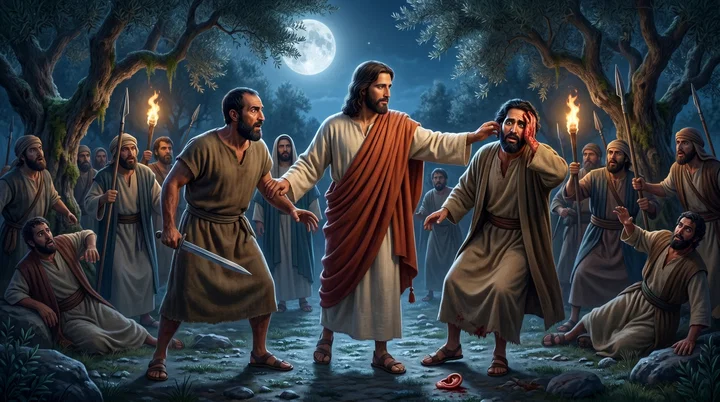
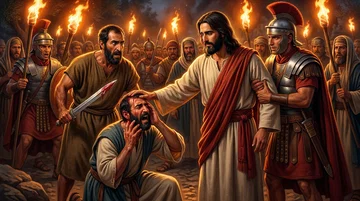
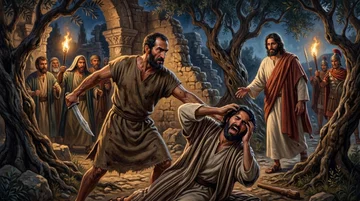
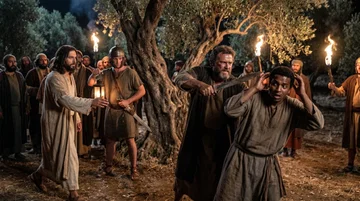
And, behold, one of them which were with Jesus stretched out his hand, and drew his sword, and struck a servant of the high priest’s, and smote off his ear.
Translations
American King James Version, King James Version
And, behold, one of them which were with Jesus stretched out his hand, and drew his sword, and struck a servant of the high priest’s, and smote off his ear.
And behold, one of them which were with Jesus stretched out his hand, and drew his sword, and stroke a servant of the high priest’s, and smote off his ear.
And behold, one of them, who were with Jesus, stretched out his hand, and drew his sword, and struck a servant of the high priest, and smote off his ear.
Revised Version, American Standard Version
And behold, one of them that were with Jesus stretched out his hand, and drew his sword, and smote the servant of the high priest, and struck off his ear.
And lo, one of those with Jesus, having stretched forth the hand, drew his sword, and having struck the servant of the chief priest, he took off his ear.
And behold, one of those with Jesus stretched out his hand and drew his sword, and smiting the bondman of the high priest took off his ear.
And lo! one of those with Jesus, stretching forth his hand, grasped his sword, and smiting the servant of the High-priest, cut off his ear.
Berean Standard Bible, Majority Standard Bible
At this, one of Jesus’ companions drew his sword and struck the servant of the high priest, cutting off his ear.
Behold, one of those who were with Jesus stretched out his hand and drew his sword, and struck the servant of the high priest, and cut off his ear.
And one of those who were with Jesus put out his hand, and took out his sword and gave the servant of the high priest a blow, cutting off his ear.
And behold, one of them which were with Iesus, stretched out his hand, and drewe his sworde, and strooke a seruaunt of the high Priest, and smote off his eare.
Douay-Rheims (Challoner revision)
And behold one of them that were with Jesus, stretching forth his hand, drew out his sword: and striking the servant of the high priest, cut off his ear.
Pictures
Cross-references
- John 18:10-11
Then Simon Peter having a sword drew it, and smote the high priest’s servant, and cut off his right ear. The servant’s name was Malchus.
John identifies Peter and Malchus and records Jesus’ command to sheath the sword and accept the Father’s cup.
- Luke 22:50-51
And one of them smote the servant of the high priest, and cut off his right ear.
Jesus heals the servant’s ear after the sword blow.
- John 18:36
Jesus answered, My kingdom is not of this world: if my kingdom were of this world, then would my servants fight, that I should not be delivered to the Jews: but now is my kingdom not from hence.
Jesus says his kingdom is not worldly, so his servants do not fight for it.
- Mark 14:47
And one of them that stood by drew a sword, and smote a servant of the high priest, and cut off his ear.
Both recount a bystander striking the high priest’s servant during Jesus’ arrest.
- Matthew 26:56
But all this was done, that the scriptures of the prophets might be fulfilled. Then all the disciples forsook him, and fled.
The disciples flee when Jesus is arrested and does not defend Himself.
- John 18:6
As soon then as he had said unto them, I am he, they went backward, and fell to the ground.
Jesus’ words caused his captors to fall to the ground.
- Matthew 26:69-75
Now Peter sat without in the palace: and a damsel came unto him, saying, Thou also wast with Jesus of Galilee.
Peter denies Jesus later that same night after acting with the sword.
- John 18:11
Then said Jesus unto Peter, Put up thy sword into the sheath: the cup which my Father hath given me, shall I not drink it?
Jesus accepts the cup of suffering given by his Father.
- Matthew 5:39
But I say unto you, That ye resist not evil: but whosoever shall smite thee on thy right cheek, turn to him the other also.
same nonviolent teaching as rebuke
- 1 Peter 2:21-23
For even hereunto were ye called: because Christ also suffered for us, leaving us an example, that ye should follow his steps:
Christ’s nonretaliation is an example of patient suffering for believers.
- John 18:15
And Simon Peter followed Jesus, and so did another disciple: that disciple was known unto the high priest, and went in with Jesus into the palace of the high priest.
John stays close to Jesus after Peter’s rash act.
- Luke 22:33
And he said unto him, Lord, I am ready to go with thee, both into prison, and to death.
Peter declares himself ready to face prison and death with Jesus.
- Mark 14:43-45
And immediately, while he yet spake, cometh Judas, one of the twelve, and with him a great multitude with swords and staves, from the chief priests and the scribes and the elders.
Listed as a parallel account of the betrayal and arrest.
- Mark 14:48-50
And Jesus answered and said unto them, Are ye come out, as against a thief, with swords and with staves to take me?
Jesus says his arrest fulfills Scripture, and the disciples flee.
- Luke 22:38
And they said, Lord, behold, here are two swords. And he said unto them, It is enough.
The two swords set up Jesus’ rebuke when one was used against the servant.
- Revelation 13:10
He that leadeth into captivity shall go into captivity: he that killeth with the sword must be killed with the sword. Here is the patience and the faith of the saints.
Sword-killing is punished by the sword.
- Romans 12:17-19
Recompense to no man evil for evil. Provide things honest in the sight of all men.
same nonviolent teaching as rebuke
- 1 Samuel 26:9-11
And David said to Abishai, Destroy him not: for who can stretch forth his hand against the LORD’s anointed, and be guiltless?
David refuses to strike Saul, as Jesus’ companion strikes the high priest’s servant.
- Matthew 26:58
But Peter followed him afar off unto the high priest’s palace, and went in, and sat with the servants, to see the end.
Peter follows Jesus at a distance after the sword episode.
- Luke 9:55-56
But he turned, and rebuked them, and said, Ye know not what manner of spirit ye are of.
Both rebuke disciples for using violence.
Commentary
Each commentary is drawn from primary sources: the writings of Ellen G. White and Adventist pioneers and periodicals. Each commentary is separate. Its own words are not a quotation; follow the references to read the source passages.
Ellen G. White
18 sources
On the night of his arrest in Gethsemane, Peter in vehement anger and rashness drew his sword when cords were brought to bind Jesus, and struck a servant of the high priest and cut off his ear.5RED 24.2–3Ms 42, 1897, par. 23–27ST Dec 9, 1897ST Jun 6, 1878 Jesus freed his own hands from the soldiers holding him, touched the wounded ear and instantly made it whole.5RED 24.2–3ST Sep 23, 1886DA 696.3 He rebuked Peter and told him to put the sword away, for those who take the sword will perish by the sword.Ms 42, 1897, par. 23–27ST Dec 9, 1897ST Sep 23, 1886DA 696.3 He was not helpless, for he could have asked his Father for more than twelve legions of angels to rescue him and his disciples, but he refused to use force to escape arrest.5RED 24.2–3Ms 42, 1897, par. 23–27ST Dec 9, 1897 He willingly submitted and accepted suffering to drink the cup the Father had given him, so that the Scriptures must be fulfilled.5RED 24.2–3Ms 42, 1897, par. 23–27ST Sep 23, 1886
Arrest in Gethsemane
Matthew 26:51 belongs to Passover night in the garden of Gethsemane, reached in company with His disciples after the Passover supper, when the broad full Passover moon shone from a cloudless sky and the city of pilgrims' tents was hushed into silence.DA 685.1ST Nov 30, 1882Ms 95, 1897, par. 10–12 After that supper neither food nor drink was given Him, and at midnight He was seized by force in Gethsemane, beginning the chain of trials that leads to condemnation and crucifixion.ST Nov 30, 1882Ms 95, 1897, par. 10–12 Just before the seizure He agonized in the garden in conflict with satanic agencies striving to divorce Him from God, and He would not yield.Ms 95, 1897, par. 10–12
As they approached the garden the disciples marked a change, never before seeing Him so utterly sad and silent, with a strange sadness deepening as He proceeded, His form swaying as if about to fall, every step taken with labored effort and groaning aloud as under a terrible burden, so that twice His companions supported Him or He would have fallen to the earth.DA 685.3 After earnestly conversing with and instructing His disciples He became strangely silent near Gethsemane, a place He had often visited for meditation and prayer but never with a heart so full of sorrow.DA 685.2 Throughout His life on earth He had walked in the light of God's presence, but now He seemed shut out from God's sustaining presence, numbered with transgressors bearing the guilt of fallen humanity with the iniquity of all laid upon Him who knew no sin.DA 685.2 Sin appeared dreadful to Him, and the weight of guilt tempted Him to fear being shut out forever from His Father's love, and feeling the terribleness of God's wrath against transgression His soul was exceeding sorrowful even unto death.DA 685.2 The conflict was so terrible that great drops of blood came from the pores of His skin, moistening the sods of Gethsemane, after His long agony there.Ms 107, 1893, par. 2Ms 95, 1897, par. 10–12
He was betrayed by Judas, one of His professed disciples, with expressions of love, with a kiss, to a band of men and soldiers with staves and spears, who laid violent hands on Him to bind His precious hands that had ever been employed in doing good.ST Jun 6, 1878Ms 107, 1893, par. 2Ms 95, 1897, par. 10–12 He was then taken to Annas, then to Caiaphas, and then to Pilate.Ms 95, 1897, par. 10–12 The one who drew the sword was Peter, one of those with Jesus, acting in vehement anger and rashness when cords were brought to bind Jesus.5RED 24.2–3ST Jun 6, 1878 The disciples had seen the armed, strong men fall prostrate and helpless and thought Jesus would not allow Himself to be taken, since the same power could keep the mob helpless until He and His companions escaped, and they were disappointed and indignant to see Him submit to binding.5RED 24.2–3ST Jun 6, 1878
In that anger, as Jesus was surrounded by His enemies, Peter stretched out his hand, drew his sword, and struck a servant of the high priest, smiting off his ear.5RED 24.2–3Ms 42, 1897, par. 23–27ST Dec 9, 1897ST Sep 23, 1886DA 696.3 Jesus freed His own hands though firmly held by soldiers, touched the wounded ear, and instantly made it whole.5RED 24.2–3ST Sep 23, 1886DA 696.3ST May 20, 18893SP 104.2–3 The arrest was a severe trial and difficulty for His followers in which Peter was not the only one who failed to stand firm.Ms 29, 1909, par. 10–11DA 394.2–3 Their hope gave way to despair as Jesus allowed Himself to be led away, and all His disciples forsook Him and fled, yet He had prepared and strengthened His true followers for the ordeal surrounding His betrayal and crucifixion.EW 137.1DA 394.2–3Ms 95, 1897, par. 10–12
Refusing Sword, Accepting Scripture
Jesus at once rebuked the stroke and commanded Peter to put the sword away.ST Dec 9, 1897ST Sep 23, 1886DA 696.3ST May 20, 1889EW 137.1 The same rebuke met Peter's drawing of the sword and cutting off the ear during the arrest, forbidding resistance and requiring submission to arrest and to the suffering the Father had given.5RED 24.2–3Ms 42, 1897, par. 23–27
The rebuke teaches that resorting to the sword brings death by the sword, that those who take the sword will perish by the sword.Ms 42, 1897, par. 23–27ST Dec 9, 1897DA 696.3 He was not helpless, for He could have prayed to and asked His Father for rescue.Ms 42, 1897, par. 23–27ST Dec 9, 1897ST Sep 23, 1886DA 696.3ST May 20, 1889 More than twelve legions of angels were at His call to rescue Him and His disciples, yet He did not use force to escape arrest.ST Dec 9, 1897ST Sep 23, 1886DA 696.3ST May 20, 1889EW 137.1 That power was deliberately left unused, though prayer alone could have summoned it.5RED 24.2–3Ms 42, 1897, par. 23–27
He willingly submitted to arrest and accepted suffering so that the Scriptures must be fulfilled.5RED 24.2–3ST Sep 23, 1886DA 696.3ST May 20, 1889EW 137.1 He must drink the cup the Father had given Him, and therefore allowed Himself to be taken and led away.5RED 24.2–3Ms 42, 1897, par. 23–27ST Sep 23, 1886DA 696.3ST May 20, 1889 The companion drawing a sword when Jesus was arrested stands recalled as an image of Christ again being delivered into the hands of Caiaphas and Pilate.GC 198.2
Sources
Pioneers and periodicals
48 sources
In Gethsemane on the night of His betrayal and arrest, Peter drew his sword in rash anger and struck Malchus, a servant of the high priest, cutting off his ear.ST Feb 7, 1900ST Jan 25, 1899RH May 9, 1865ST Mar 18, 1897ST Feb 27, 1901 Jesus at once stopped the resistance, commanded Peter to put the sword back into its sheath, and healed the wounded enemy by miracle.ST Feb 7, 1900ST Jun 11, 1912RH May 9, 1865ST Mar 18, 1897 His rebuke that all who take the sword shall perish with the sword is an everlasting prohibition against His followers ever using violence or going to war, even to defend an innocent person, persecuted brethren, or Christ Himself.RH May 9, 1865RH Dec 16, 1862ST Mar 18, 1897ST Jan 16, 1901ST Oct 21, 1897 His servants were not to fight to establish, advance or defend His kingdom, for His kingdom is not of this world and is advanced only by spiritual weapons and not by force.ST Oct 21, 1897ST Sep 13, 1905RH Mar 26, 1914ST Sep 3, 1894 He could have called for more than twelve legions of angels but refused all carnal weapons, willingly accepting the Father's cup so the Scriptures might be fulfilled.ST Sep 23, 1886ST Oct 21, 1897ST Jun 11, 1912ST Jul 4, 1899ST Feb 27, 1901
Arrest Setting and Details
The arrest took place in Gethsemane at night after the Passover supper, when Jesus was betrayed by Judas, one of the twelve, and seized by a great multitude, mob and officers with swords and staves and lanterns from the chief priests and elders.ST Oct 21, 1897RH Oct 24, 1854ST Jan 8, 1902ST Mar 8, 1899 He was taken at midnight by force into the chain of trials that led to condemnation and crucifixion the next day, giving His life for sinful people on a day made memorable by betrayal, agony and trial.ST Nov 30, 1882ST Oct 21, 1897RH Feb 13, 1872 While abandoned to His enemies He was denied by another disciple and forsaken by all, yet met suffering without an unkind word or reproach.RH Oct 24, 1854
The one of those with Jesus who stretched out his hand and drew the sword was Peter, His companion and disciple.ST Feb 7, 1900ST Jan 25, 1899RH May 9, 1865RH Dec 16, 1862ST Sep 13, 1905 He used the sword to defend Jesus by striking the high priest's servant and cutting off his ear.ST Jan 25, 1899RH May 9, 1865RH Dec 16, 1862ST Sep 13, 1905ST Mar 18, 1897 Jesus then stopped the resistance, told him to put away the sword, and healed the wound.ST Feb 7, 1900RH May 9, 1865RH Dec 16, 1862
The man struck was Malchus, a servant of the high priest, and the parallel account identifies the wound as his right ear.ST Feb 27, 1901ST Jan 10, 1911ST Dec 30, 1889ST Aug 8, 1906 Peter grasped his sword and struck the man nearest him, the foremost servant, meaning to give a mortal blow.ST Jan 10, 1911ST Dec 30, 1889 The stroke just missed his head and glanced to cut off his ear so that it hung down upon his shoulder.ST Mar 18, 1897ST Jan 10, 1911
The disciples had seen the strong men fall prostrate and helpless and thought Jesus would not suffer Himself to be taken, since the same power could hold the mob helpless until He and His companions passed beyond reach.ST Jun 6, 1878 When the murderous band laid violent hands on Jesus to bind His precious hands that had ever been employed in doing good, they were disappointed and indignant.ST Jun 6, 1878 In that moment Peter in vehement anger rashly struck foremost, acting impulsively from the mistaken belief that he must do something by force.ST Sep 23, 1886ST May 20, 1889ST Jun 6, 1878ST Feb 27, 1901
Jesus' Rebuke and Power
Jesus at once stopped the resistance and ordered the sword put back into its place and sheathed again.ST Dec 9, 1897ST Feb 7, 1900ST Jun 11, 1912ST Sep 16, 1897 The command came the moment the ear was cut off, rebuking the use of the sword in the very hands of the mob that was leading Him to the tribunal where He would be condemned to death.ST Dec 9, 1897ST Feb 7, 1900ST Jan 16, 1901 Taken with the following verses, the order meant He rejected fighting in His own defense and would have no part in forceful methods.ST Jun 11, 1912ST Sep 16, 1897ST Jan 16, 1901
He warned that all who take the sword shall perish with the sword, that resorting to the sword brings death by the sword.ST Dec 9, 1897ST Oct 21, 1897ST Jun 11, 1912RH Dec 16, 1862 The saying reaches beyond private revenge to violence on a public occasion, and stands as an everlasting rule for disciples in all future generations never to use the sword.ST Jul 4, 1899RH Dec 16, 1862 His followers therefore must not answer violence with violence.ST Oct 21, 1897ST Jul 4, 1899ST May 26, 1898
He declared He could pray to His Father and presently receive more than twelve legions of angels.ST Dec 9, 1897ST Sep 23, 1886ST Oct 21, 1897ST Jun 11, 1912ST Jul 4, 1899 He did not ask for them, did not use force to escape arrest, and refused an army of men, human law, human power, and carnal weapons for His own protection and for furthering His cause.ST Dec 9, 1897ST Oct 21, 1897ST Jun 11, 1912 He had an invincible army at His command but would use no force, and those sent to carry on His work need no human guard because all power in heaven and earth is given to Him and He is with them always even to the end.ST Oct 21, 1897ST Jul 4, 1899ST Dec 20, 1905
He touched the severed ear and healed the wounded enemy at once by miracle.ST Sep 23, 1886ST May 20, 1889ST Feb 7, 1900RH May 9, 1865ST Mar 18, 1897 The healing proved He came to save life and not to take it, and the injury itself was healed as part of the rebuke.RH May 9, 1865ST Mar 18, 1897ST Dec 16, 1886 He would not allow even a drop of blood to be shed in support of His kingdom, which is spiritual and not to be advanced by force.ST Feb 7, 1900ST Mar 18, 1897ST Dec 16, 1886
He willingly accepted the cup the Father had given Him and allowed Himself to be taken so that the Scriptures might be fulfilled.ST Sep 23, 1886ST May 20, 1889ST Feb 27, 1901ST Feb 27, 1901 He could have called more than twelve legions of angels, but He drank the cup given by His Father instead of resisting by arms.ST Sep 23, 1886ST May 20, 1889ST Feb 27, 1901 His response was submission rather than armed resistance, showing restraint and silence as strength and heroism, acting from the conviction that force was not required.ST Sep 23, 1886ST May 20, 1889ST Feb 27, 1901
Nonviolence and the Sword
The rebuke that followed the drawing of the sword and the cutting off of the high priest's servant's ear when Jesus was arrested by a band of men and officers from the chief priests is plain and cannot be mistaken.RH Dec 16, 1862ST Jan 16, 1901 It is a positive prohibition against any follower of Christ ever going to war or ever using the sword.RH Dec 16, 1862ST Jan 16, 1901 It forbids not only private revenge but violence on a public occasion, and it stands as an everlasting rebuke to all disciples in all future generations never to use the sword.RH Dec 16, 1862ST Jan 16, 1901 The two swords had been permitted just before the arrest because that was enough to give occasion to use one in defense of the Master, so that the rebuke would be more impressive and be remembered afterward, since before it had been declared that Jesus should not suffer at the hands of the chief priests and readiness had been professed to defend Him and go with Him to prison and to death.RH Dec 16, 1862
His followers must not use violence even to defend an innocent person, for Jesus ordered the sword put away and healed the injury.RH May 9, 1865ST Mar 18, 1897 They cannot fight in defense of themselves or even of persecuted brethren, and they are not to defend themselves or Christ's cause by force or temporal power, but to live in humble submission under wrong and suffer patiently when doing well, following Christ who reviled not and threatened not but committed Himself to God who judges righteously, trusting God alone as rock, fortress and deliverer while looking for the new heavens and new earth wherein dwells righteousness.ST Mar 18, 1897ST Oct 21, 1897 This holds even when He was innocent and suffering the worst kind of religious persecution with every indignity, insult and outrage, for He did not resist and He forbade His followers to fight in His defense, since the disciple is not greater than his Lord.ST Mar 18, 1897 His power is sufficient, so His followers should trust God rather than use coercion, for Peter's sword is not the means by which God's people are to be protected.ST Oct 21, 1897ST Jan 20, 1909
Christ's followers are not called to destroy lives with weapons, but to save them by pointing them to Christ.ST Jan 25, 1899 They must not answer violence with violence, for those who take the sword will perish by the sword.ST May 26, 1898 The Christian stands on higher ground than the soldier whose sole object is to kill and destroy, with more powerful weapons than sword and spear of the arm of flesh, to gain moral victories and develop character in harmony with the life and example of Jesus, building life on righteousness and not carving it out with the sword.
Zeal for God does not justify violence or oppression, for Christ censured the bloody act and healed the hurt it caused.ST Mar 19, 1896 He gives no authority for loving fighting and war and no warrant for defending truth, purity, honor, manhood, or anything more precious than life by killing. He did not teach war and bloodshed.
Kingdom, Church and State
His servants were not to fight to establish, advance or defend His kingdom, for His kingdom is not of this world but spiritual, and was not to be made part of earthly states and empires or advanced by force.ST Oct 21, 1897ST Mar 19, 1896ST Sep 16, 1897ST Dec 16, 1886 When He was arrested in Gethsemane by a great multitude with swords and staves from the chief priests and elders, knowing His life would be sacrificed on the cross the next day, one who was with Him drew his sword and struck a servant of the high priest and cut off his ear, at the critical point when if ever He needed protection.ST Oct 21, 1897ST Mar 19, 1896 Jesus rebuked the use of the sword and commanded it put away, for all who take the sword shall perish with the sword, and He refused military force even in His own defense.ST Oct 21, 1897ST Mar 19, 1896ST Sep 16, 1897 He had at His command more than twelve legions of angels that the Father would presently give on prayer, but He did not even ask for them, refusing an army of men, human law, human power and carnal weapons for His own protection and for furthering His cause.ST Oct 21, 1897ST Dec 20, 1905 His disciples sent to carry on His work need no human guard because all power in heaven and earth is given to Him and He is with them alway even unto the end.ST Oct 21, 1897 Driven by zeal to defend Christ's kingdom, Peter used the sword to defend Jesus and wounded the high priest's servant, but Jesus showed His followers must not use force to defend or advance His spiritual kingdom, would not allow even a drop of blood to be shed in its support, and healed the wounded man by a miracle.ST Sep 13, 1905ST Dec 16, 1886
Christ's church does not use physical force to advance its work, for its weapons are spiritual, not earthly.RH Mar 26, 1914ST Sep 3, 1894ST Feb 20, 1893 Its power is the persuasive influence of God's word and Spirit on the heart, accepting only willing service arising from a heart touched by God's love and trusting the gospel, and Christ does not accept obedience imposed by force.ST Sep 3, 1894 Christ's gospel is not advanced by force, and ministers may reprove, exhort and contend spiritually, but they must not use civil power to compel observance of any religious institution.RH Mar 26, 1914ST Feb 20, 1893
Nor must His followers resist civil authority with force, but entrust themselves to God rather than use force against rulers even when condemned for political reasons, as Jesus stopped the resistance despite having power to defend Himself.ST Aug 13, 1896 He would have no part in the politics or forceful methods of civil government, so those who share His heavenly citizenship leave the politics of the world alone.ST Sep 16, 1897 He had an invincible army at His command but would use no force, made no attempt to reform the Roman government or to overrule its action by any political methods, but demonstrated the Spirit of the Gospel.ST Dec 20, 1905 He sent His apostles into all parts of that corrupt kingdom only to preach the Gospel and do other good work to bring individuals to Christ, with no authority and no attempt to reform the government or take any part in its affairs.ST Dec 20, 1905
Just before the arrest Jesus permitted the disciples to take two swords because that was enough to give Peter occasion to use one in defense of his Master, so the rebuke would be more impressive and be remembered afterward.RH Dec 16, 1862 Peter had before declared that Jesus should not suffer at the hands of the chief priests and that he was ready to defend Him and go with Him to prison and to death.RH Dec 16, 1862 When Jesus was arrested by a band of men and officers from the chief priests, Peter drew a sword and cut off the high priest's servant's ear, and Jesus rebuked him to put up the sword because all who take the sword shall perish by the sword.RH Dec 16, 1862 That rebuke was not only against private revenge but against violence on a public occasion, and it is an everlasting rebuke to all disciples in all future generations never to use the sword.RH Dec 16, 1862
Discipleship and Character Lessons
Peter's stroke expressed ardent, impetuous love for his Master and willingness to give his life for Him and to face death, and he was well-meaning and sincere in it.ST Mar 18, 1897RH Jul 13, 1911ST Dec 30, 1889 Yet it was physical bravery and outward zeal, acting in reliance on human strength and self rather than on moral principle and trust in the Lord.ST Dec 30, 1889ST Aug 8, 1906RH Jul 13, 1911 His willingness to fight could make him feel ready to face death, but it did not prove he could remain faithful when circumstances turned against him and offered no praise or glory.RH Jul 13, 1911
At that time he did not know the spirit of the gospel, was not yet converted, and had not accepted Christ's admonitions wholeheartedly, and his impulsive violence was not God's way.ST Mar 18, 1897ST Dec 30, 1889ST Aug 8, 1906 His fighting in the garden is rash zeal for which Christ has no use, able to fight with the sword but quite unable to suffer shame for His sake.RH Jul 6, 1869ST May 1, 1901 That outward display of zeal was a mistake and could not take the place of giving himself wholly to God.ST May 1, 1901
To advance or defend God's cause by carnal means denies His divinity and cheapens God.ST Jan 24, 1900 Peter's brandishing of the sword was forceful self-assertion that revealed the aggression of the human heart, not the advancing life of one made new, and it was not true courage, as his later denial exposed his cowardice.ST Jan 24, 1900RH Feb 5, 1914 When Jesus stopped him and his will was crossed, Peter quickly failed the test of discipleship and afterward followed at a distance.ST Jan 10, 1911ST Jan 18, 1916 Seeing that Jesus would do nothing to defend Himself, Peter with the other disciples was seized with fear and forsook Him and fled, showing that discipleship is tested not only by willingness to face death but by meeting everyday frustrations without losing spiritual steadiness.ST Jan 10, 1911ST Jan 18, 1916RH Jul 13, 1911
Christ's servants need an experience beyond Peter's earlier, untried zeal, marked by patience, self-sacrifice, and willingness to suffer rather than defend the cause through violence or flee when conflict grows fierce. The Christian calling shown here is to follow Christ's steps by suffering unjustly patiently without complaining and without resistance.ST Mar 18, 1897 Though abandoned to His enemies, Jesus met His suffering without an unkind word or reproach, showing patient endurance rather than seeking to destroy opposers.RH Oct 24, 1854ST Mar 18, 1897 Christians are therefore not to defend themselves or Christ's cause by force or temporal power, but to live in humble submission under wrong, suffering patiently when they do well, following Christ who reviled not and threatened not but committed Himself to God who judges righteously, trusting God alone as rock, fortress, and deliverer while looking for the new heavens and new earth wherein dwells righteousness.ST Mar 18, 1897ST Oct 21, 1897
The time of betrayal and apprehension included a Judas among the chosen twelve, the disciples who were with Him forsaking Him and fleeing, and Peter afterward denying with cursing and swearing that he knew Him.RH Sep 2, 1873 Trials, offenses, and apostasies come even among Christ's closest followers, so they should be expected and should not discourage believers as though some strange thing had happened to them.RH Sep 2, 1873
Prophecy and Scriptural Links
The drawing of the sword at the arrest belongs to the rejection and suffering that fulfills the prediction that the Messiah would be despised and rejected and be a man of sorrows.RH Nov 18, 1862 The apprehension stands with the betrayal, agony and trial on the day leading to the crucifixion, a day more memorable than any other in His history because on it He gave His life for sinful people.RH Feb 13, 1872 It stands in the short step between Christ mocked and Christ rejected, alongside the hollow homage of Hail, Master and the smiting and buffeting of open outrage, showing how easily and quickly lip-confession passes into life-denial.RH Dec 29, 1863
His being taken was permitted as part of God's eternal purpose in the conflict between good and evil, yet the disciples were unprepared and resisted in their hearts an experience included in the Father's plan. The surrounding events include His proceedings before the Sanhedrin and Pilate, which were illegal and irregular, though no record kept by His enemies would call them illegal or irregular, because religious prosecutors and persecutors never condemn their own work in their own records, and the true history of religious persecution is recorded only in heaven.ST Jan 28, 1903 In warning against trusting human strength, the use of the sword at the arrest with Jesus' rejection of armed defense and reliance on His Father's power shows that God's work is not to be advanced by force.ST Jul 1, 1908 Christ's power is sufficient, so His followers must not rely on force or coercion to defend Him, and Peter's sword is not the means by which God's people are to be protected.ST Jul 1, 1908ST Jan 20, 1909
Sources