Luke 22:50
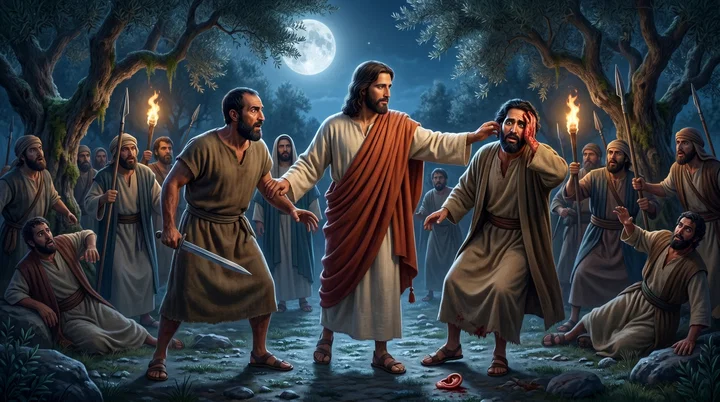
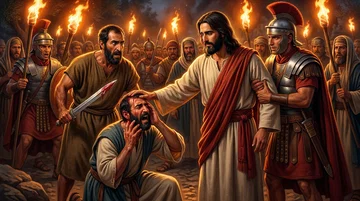
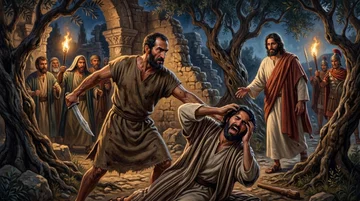
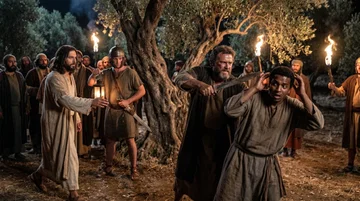
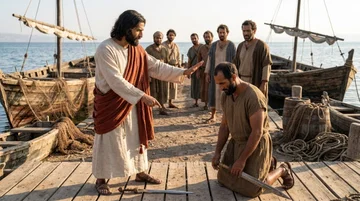
And one of them smote the servant of the high priest, and cut off his right ear.
Translations
American King James Version, King James Version, KJV Cambridge Paragraph Bible, Webster Bible
And one of them smote the servant of the high priest, and cut off his right ear.
Revised Version, American Standard Version
And a certain one of them smote the servant of the high priest, and struck off his right ear.
And a certain one of them smote the servant of the chief priest, and took off his right ear,
And a certain one from among them smote the bondman of the high priest and took off his right ear.
And a certain one from among them smote, the High-priest’s, servant, and took off his right ear.
Berean Standard Bible, Majority Standard Bible
And one of them struck the servant of the high priest, cutting off his right ear.
A certain one of them struck the servant of the high priest, and cut off his right ear.
And one of them gave a blow to the servant of the high priest, cutting off his right ear.
And one of them smote a seruant of the hie Priest, and strooke off his right eare.
Douay-Rheims (Challoner revision)
And one of them struck the servant of the high priest, and cut off his right ear.
Pictures
Cross-references
- Matthew 26:51-52
And, behold, one of them which were with Jesus stretched out his hand, and drew his sword, and struck a servant of the high priest’s, and smote off his ear.
Jesus tells Peter to put away his sword and warns that those who take the sword will perish by it.
- John 18:10-11
Then Simon Peter having a sword drew it, and smote the high priest’s servant, and cut off his right ear. The servant’s name was Malchus.
John names Peter and Malchus and records Jesus’ command to sheath the sword and accept the Father’s cup.
- Mark 14:47
And one of them that stood by drew a sword, and smote a servant of the high priest, and cut off his ear.
A disciple strikes the high priest’s servant during Jesus’ arrest.
- John 18:6
As soon then as he had said unto them, I am he, they went backward, and fell to the ground.
The arresting crowd fell before Jesus’ disciple struck the high priest’s servant.
- John 18:36
Jesus answered, My kingdom is not of this world: if my kingdom were of this world, then would my servants fight, that I should not be delivered to the Jews: but now is my kingdom not from hence.
Jesus’ kingdom is not defended or advanced by physical fighting.
- John 18:11
Then said Jesus unto Peter, Put up thy sword into the sheath: the cup which my Father hath given me, shall I not drink it?
Jesus commands Peter to sheath his sword and accepts the cup given by the Father.
- Matthew 26:53
Thinkest thou that I can not now pray to my Father, and he shall presently give me more than twelve legions of angels?
Jesus could call angelic power but did not use it to escape suffering.
- Matthew 26:51
And, behold, one of them which were with Jesus stretched out his hand, and drew his sword, and struck a servant of the high priest’s, and smote off his ear.
A disciple strikes the high priest’s servant and cuts off his ear.
- Mark 14:43-45
And immediately, while he yet spake, cometh Judas, one of the twelve, and with him a great multitude with swords and staves, from the chief priests and the scribes and the elders.
Parallel account of Jesus being betrayed and arrested.
- Luke 22:36-37
Then said he unto them, But now, he that hath a purse, let him take it, and likewise his scrip: and he that hath no sword, let him sell his garment, and buy one.
The sword instruction and being reckoned among transgressors frame the incident.
- Luke 22:39-46
And he came out, and went, as he was wont, to the mount of Olives; and his disciples also followed him.
The account of Jesus’ prayer in Gethsemane precedes his betrayal and arrest.
- John 18:8
Jesus answered, I have told you that I am he: if therefore ye seek me, let these go their way:
Jesus shields disciples while Peter fights
- Matthew 26:54
But how then shall the scriptures be fulfilled, that thus it must be?
Jesus refused defense and yielded so Scripture would be fulfilled.
- Mark 14:49
I was daily with you in the temple teaching, and ye took me not: but the scriptures must be fulfilled.
Jesus says the Scriptures must be fulfilled as he is arrested.
- Luke 22:33
And he said unto him, Lord, I am ready to go with thee, both into prison, and to death.
Peter declared his readiness to suffer and die for Jesus.
- John 18:15
And Simon Peter followed Jesus, and so did another disciple: that disciple was known unto the high priest, and went in with Jesus into the palace of the high priest.
John’s close identification with Jesus contrasts with Peter’s response after the arrest.
Commentary
Each commentary is drawn from primary sources: the writings of Ellen G. White and Adventist pioneers and periodicals. Each commentary is separate. Its own words are not a quotation; follow the references to read the source passages.
Ellen G. White
11 sources
Peter rashly struck the high priest's servant with his sword and cut off his right ear in anger and hasty zeal as armed men seized and bound Jesus after His agony in Gethsemane and Judas's betrayal.5RED 24.2–3ST Sep 23, 1886ST Jun 6, 1878DA 696.3ST May 20, 1889 The stroke came in vehement anger at the moment violent hands were laid upon Jesus to take Him.5RED 24.2–3ST Sep 23, 1886ST Jun 6, 1878DA 696.3ST May 20, 1889
The disciples had just seen the strong armed band fall prostrate backward to the ground before His divine power and lie helpless there.ST Jun 6, 1878EW 137.1 They thought He would not suffer Himself to be taken, for the same power that prostrated the mob could keep them helpless until He and His companions passed beyond reach, and they began to hope He would deliver Himself.ST Jun 6, 1878EW 137.1 They were disappointed and indignant when cords were brought to bind the hands of Him whom they loved, those precious hands that had ever been employed in doing good.ST Jun 6, 1878 As those violent hands were laid on Jesus to bind Him, Peter struck.ST Jun 6, 1878EW 137.1
Jesus at once healed the wounded ear, even while Roman soldiers held Him, showing mercy to one among the arresting party.5RED 24.2–3ST Sep 23, 1886DA 696.3ST May 20, 1889ST Aug 21, 1879 That healing, together with the prostrating of those who came to take Him, proved He had power to deliver Himself from the murderous mob if He chose, and gave even His enemies clear evidence of His divine power.3SP 105.1ST Aug 21, 1879 Jesus rejected Peter's attempted armed defense, telling him to put away his sword and rebuking its use, and suffered Himself to be taken because the Scriptures must be fulfilled thus.5RED 24.2–3ST May 20, 1889EW 137.1 He declared He could pray to His Father for more than twelve legions of angels.EW 137.1
That declaration filled the watching angels with hope that they might surround their Commander and disperse the mob, until His adding that the Scriptures must be fulfilled thus brought them sadness.EW 137.1 The disciples knew He had power to free Himself, yet were offended that He suffered this humiliation to Himself and to them instead of freeing Himself, and blamed Him for not doing so.3SP 105.1EW 137.1 Mortified and terror-stricken by His course, and sunk into despair and bitter disappointment as He let His enemies lead Him away, they forsook Him and fled as He had forewarned in the upper chamber.3SP 105.1EW 137.1
The stroke belongs to His great trial of betrayal, agony in Gethsemane, condemnation in the judgment hall, humiliation, mocking by the multitude that had hailed Him as king, and death.4RED 102.2–103.1Ms 107, 1893, par. 2 He foresaw this trying ordeal and knew who among His followers were unbelieving and weak in faith and undecided in character.4RED 102.2–103.1 He had brought on the earlier crisis of many turning from Him while He was still present to comfort and strengthen His chosen twelve and prepare their minds for what was to follow.4RED 102.2–103.1 So when professed lovers of the Master turned from Him in His trouble, and faint-hearted ones sank beneath fear and disappointment at the hissing and reviling and the cry of Crucify Him, the faithful would not be overwhelmed with surprise in that hour of horror and ruined hopes, would not hang their faith on the inconstant favor and opinions of others, and would not be carried away by the example of apostasy.4RED 102.2–103.1
Peter's ardent, quick, hasty zeal in raising the sword was not conversion, for the same zeal soon gave way to denying the Lord with cursing and swearing, proving the heart still unconverted.Lt 12, 1861, par. 12–14 True conversion came only after Jesus looked upon Peter in sadness and grief, which broke his heart so that he repented and was made ready to strengthen his brethren.Lt 12, 1861, par. 12–14 Hasty quick temper brings trouble and destroys peace and happiness, and must be overcome by the sanctifying influence of truth that makes a man patient.Lt 12, 1861, par. 12–14 That victory requires holding the mouth shut when hot passion rises, and persevering in prayer and lifelong untiring effort until it is gained.Lt 12, 1861, par. 12–14
Sources
Pioneers and periodicals
29 sources
After praying on the Mount of Olives where He often resorted, Jesus was seized at midnight when Judas came with soldiers and officers from the priests and elders bearing lanterns and swords and staves, and one of those with Him asked about smiting with the sword and then struck the high priest's servant Malchus and cut off his right ear.ST Nov 5, 1894ST Nov 5, 1894ST Feb 27, 1901ST Jun 11, 1896ST Jan 10, 1911 Peter struck rashly in anger with one of the swords the disciples carried, meaning a mortal blow but only severing the ear so that it hung by the flesh, when violent hands were laid on Jesus to bind Him.ST Sep 23, 1886ST Jun 6, 1878ST Nov 5, 1894ST Feb 27, 1901ST Jan 10, 1911 Jesus at once halted further resistance, commanded Peter to put up the sword into its sheath, touched the severed ear and healed it amid the arrest while submitting to drink the cup the Father had given Him.ST Feb 7, 1900ST Nov 5, 1894ST Jun 11, 1896 Even under anguish and injustice He turned His power to a wounded enemy in compassion, rectifying His follower's blunder by His last miracle before death and proving He came to save life and not take it.ST Sep 23, 1886ST Feb 7, 1900ST Nov 14, 1906ST Mar 18, 1897ST Feb 27, 1901 His refusal of defense by force teaches that His spiritual kingdom is not of this world and is never set up or sustained by fighting, so His command to put up the sword has never been revoked and forbids Christians to advance the Gospel or meet persecution with carnal weapons.ST Mar 18, 1897ST Feb 27, 1901ST Dec 16, 1886
Arrest Setting and Action
After going to the Mount of Olives with His disciples and praying there, Jesus was met at the midnight place where He often resorted by Judas coming with a multitude, a band of soldiers and officers from the chief priests, Pharisees, elders and captains of the temple, carrying lanterns and torches and swords and staves, who betrayed Him with a kiss.ST Nov 5, 1894ST Jun 11, 1896ST Jan 10, 1911 The cutting off of the ear belongs to that seizure of Jesus.ST Nov 5, 1894ST Nov 19, 1894 It marks the moment He was seized, after which He was taken first to one place, then to Annas and Caiaphas and others, then sent onward toward Pilate, condemnation and the cross.ST Jan 10, 1911ST Nov 19, 1894
When those around Jesus saw what would follow they asked, Lord, shall we smite with the sword, and one of them struck the servant of the high priest and cut off his right ear.ST Nov 5, 1894ST Jun 11, 1896ST Nov 5, 1894 The one who struck was Simon Peter, and the servant was identified as Malchus.ST Feb 27, 1901ST Jun 11, 1896ST Nov 5, 1894 Peter used one of the swords Jesus had permitted the disciples to carry, without understanding His teaching about the sword, just as they did not understand His death, burial and resurrection until they passed through the experience.ST Dec 10, 1894
Peter struck rashly in vehement anger as violent hands were laid on Jesus to bind Him and cords were brought to bind the precious hands that had done good.ST Sep 23, 1886ST Jun 6, 1878ST May 20, 1889ST Aug 21, 1879 The disciples had seen strong men prostrated helplessly and thought Jesus would not suffer Himself to be taken, and were disappointed and indignant when He allowed Himself to be bound.ST Jun 6, 1878 Peter meant a mortal blow at the man nearest him but the sword glanced and cut off the ear and left it hanging on his shoulder.ST Jan 10, 1911
Jesus at once halted further resistance, rebuked Peter for using the sword, and commanded him to put up the sword into its sheath.ST May 20, 1889ST Nov 5, 1894ST Jun 11, 1896ST Nov 5, 1894ST Jan 10, 1911 He touched the severed ear and healed it, taking time amid the arrest to do so, while Malchus turned astonished eyes on Peter but said nothing.ST Feb 7, 1900ST Jun 11, 1896ST Jan 10, 1911 He then confronted the chief priests, captains and elders for coming with swords and staves as against a robber, submitted to drink the cup the Father had given Him so Scripture would be fulfilled, and declared that all who take the sword shall perish with the sword and that He could beseech His Father for more than twelve legions of angels.ST May 20, 1889ST Nov 5, 1894ST Jun 11, 1896
Christ's Mercy and Kingdom
Even while about to suffer Himself, under anguish and dread and severe injustice, Jesus turned His power toward another's need with compassion, kindness and mercy to a wounded enemy among the arresting party, touching the wound and making it whole at once, even amid the arrest.ST Sep 23, 1886ST Nov 14, 1906ST Mar 18, 1897ST Jan 31, 1906 This showed self-restraint and love focused on others rather than Himself, proving He came to save life, not to take it.ST Mar 18, 1897ST Jan 31, 1906 The healing was His last miracle before death, done for one who was seeking His life, taking time to touch and heal him with calm care for those in need.ST Feb 27, 1901ST May 20, 1897
It rectified His follower's rash blunder in cutting off the right ear of the high priest's servant, repairing Peter's mistake.ST Feb 7, 1900ST Nov 14, 1906 In this God is liberal with His ministry of healing, willing even sometimes to help over the results of rash blunders and heal the consequences of gross carelessness.ST Nov 14, 1906
The act gave even His enemies clear evidence of divine power and mercy, later recalled as such.ST Aug 21, 1879ST Jan 17, 1911 While seeming overpowered at His apprehension, He caused armed adversaries to go backward and fall to the ground and with a touch healed the severed ear of Malchus, so that no low or weak passage about Him stands alone but is immediately seconded by another that is high and miraculous.RH Feb 20, 1900 It demonstrates He is the same personal Savior who walked and talked with people on earth and now exalted, the same yesterday and today and forever.ST Nov 18, 1886ST Dec 21, 1915
Peter's rash blow cutting off the ear would have brought the disciples into the same danger of arrest as Christ.ST Nov 18, 1886 Christ never used His power and majesty for Himself, but used it to undo Peter's act and keep His little band safe.ST Nov 18, 1886 Even under anguish and dread His first thought was for them, proving His self-sacrificing solicitude as the shepherd who lays down life for the sheep.ST Nov 18, 1886
Jesus refused defense by force, would not permit the shedding of a single drop of blood in support of His kingdom, and healed by miracle the wound Peter inflicted.ST Dec 16, 1886 His kingdom is a glorious spiritual kingdom, not of this world, never to be set up or sustained by servants fighting, by soldiers and bayonets, by the military power of government, by might or power, or by carnal weapons to establish peace.ST Dec 16, 1886ST Sep 20, 1910 The disciple's rash use of a carnal weapon in defense of the Gospel and its ministry does not justify the sword in God's work, for the Gospel is not to be defended or advanced by violence.ST Feb 27, 1901ST Dec 10, 1894 His command to put up the sword into its sheath has never been revoked, forbids taking up carnal weapons to fight and kill, and calls instead to endure unjust suffering and religious persecution without violent resistance.ST Mar 18, 1897ST Feb 27, 1901 Wickedness must not be met by might or power, but the fortresses of sin in the heart are to be overcome with spiritual weapons mighty through God, since silence and nonresistance have a power more heroic than tumult or violence.ST Feb 27, 1901ST Sep 20, 1910
Peter acted with physical courage and bravery but rashly, impetuously, hastily and cruelly in vehement anger, striking because he thought he had to act for the cause.ST Aug 21, 1879ST Aug 8, 1906ST Feb 27, 1901ST Aug 8, 1906 He relied on physical courage rather than accepting Christ's instruction, warnings and way, acting for a cause rather than from pure love for people.ST Dec 30, 1889RH Nov 5, 1901 His violent response was not God's way, created prejudice and wounds that Christ had to follow and heal and that may leave lasting scars.ST Aug 8, 1906RH Nov 5, 1901 His action reflected an earlier experience of zeal when he was not yet converted, but after conversion he was willing to suffer for his Lord even to death and felt unworthy to suffer as Jesus had.
Sources