Luke 23:2
And they began to accuse him, saying, We found this fellow perverting the nation, and forbidding to give tribute to Cæsar, saying that he himself is Christ a King.
Translations
And they began to accuse him, saying, We found this fellow perverting the nation, and forbidding to give tribute to Caesar, saying that he himself is Christ a King.
And they began to accuse him, saying, We found this fellow perverting the nation, and forbidding to give tribute to Cæsar, saying that he himself is Christ a King.
And they began to accuse him, saying, We found this fellow perverting the nation, and forbidding to give tribute to Cesar, saying that he himself is Christ a King.
And they began to accuse him, saying, We found this man perverting the nation, and forbidding to give tribute to Cesar, saying, that he himself is Christ a king.
And they began to accuse him, saying, We found this man perverting our nation, and forbidding to give tribute to Caesar, and saying that he himself is Christ a king.
And they began to accuse him, saying, We found this man perverting our nation, and forbidding to give tribute to Cæsar, and saying that he himself is Christ a king.
and began to accuse him, saying, 'This one we found perverting the nation, and forbidding to give tribute to Caesar, saying himself to be Christ a king.'
And they began to accuse him, saying, We have found this [ man] perverting our nation, and forbidding to give tribute to Caesar, saying that he himself is Christ, a king.
And they began to accuse him, saying—This one, found we, perverting our nation, and forbidding to give, tribute unto Caesar,—and affirming himself to be, an anointed king.
And they began to accuse Him, saying, “ We found this man subverting our nation, forbidding payment of taxes to Caesar, and proclaiming Himself to be Christ, a King.”
And they began to accuse Him, saying, “ We found this man subverting the nation, forbidding payment of taxes to Caesar, and proclaiming Himself to be Christ, a King.”
They began to accuse him, saying, “ We found this man perverting the nation, forbidding paying taxes to Caesar, and saying that he himself is Christ, a king.”
And they made statements against him, saying, This man has to our knowledge been teaching our nation to do wrong, and not to make payment of taxes to Caesar, even saying that he himself is Christ, a king.
And they began to accuse him, saying, We haue found this man peruerting the nation, and forbidding to pay tribute to Cesar, saying, That he is Christ a King.
Douay-Rheims (Challoner revision)
And they began to accuse him, saying: We have found this man perverting our nation, and forbidding to give tribute to Caesar, and saying that he is Christ the king.
Pictures
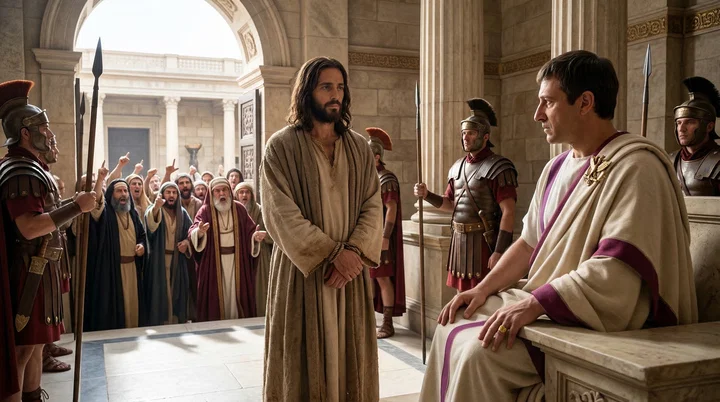
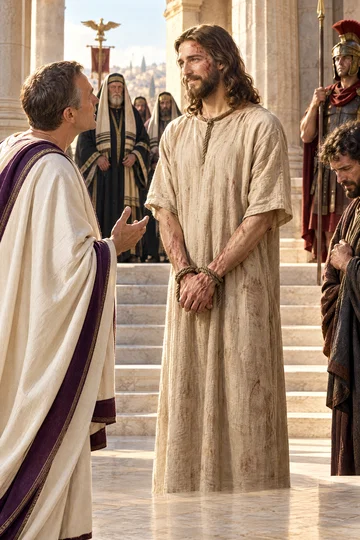
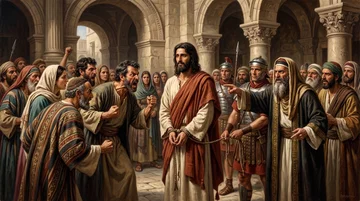
Cross-references
- John 18:33-37
Then Pilate entered into the judgment hall again, and called Jesus, and said unto him, Art thou the King of the Jews?
Jesus explains his kingship and otherworldly kingdom to Pilate.
- John 19:12
And from thenceforth Pilate sought to release him: but the Jews cried out, saying, If thou let this man go, thou art not Cæsar’s friend: whosoever maketh himself a king speaketh against Cæsar.
Jesus’ kingship is used to pressure Pilate with an accusation of disloyalty to Caesar.
- Luke 20:22-25
Is it lawful for us to give tribute unto Cæsar, or no?
Jesus answered whether tribute should be paid to Caesar.
- Matthew 22:17-21
Tell us therefore, What thinkest thou? Is it lawful to give tribute unto Caesar, or not?
Jesus answered a trap about paying tribute to Caesar.
- Matthew 27:11
And Jesus stood before the governor: and the governor asked him, saying, Art thou the King of the Jews? And Jesus said unto him, Thou sayest.
Pilate asks Jesus whether he is King of the Jews.
- Mark 15:1-20
And straightway in the morning the chief priests held a consultation with the elders and scribes and the whole council, and bound Jesus, and carried him away, and delivered him to Pilate.
A parallel account of the accusations and events before the crucifixion.
- Mark 12:14-17
And when they were come, they say unto him, Master, we know that thou art true, and carest for no man: for thou regardest not the person of men, but teachest the way of God in truth: Is it lawful to give tribute to Cæsar, or not?
Jesus taught that Caesar’s due should be rendered to Caesar.
- Psalms 2:1-2
Why do the heathen rage, and the people imagine a vain thing?
Rulers oppose the Lord’s anointed, echoing the accusations against Jesus as king.
- Matthew 27:2
And when they had bound him, they led him away, and delivered him to Pontius Pilate the governor.
Jesus is brought before Pilate for trial.
- John 11:47-48
Then gathered the chief priests and the Pharisees a council, and said, What do we? for this man doeth many miracles.
The leaders fear Roman intervention and plot against Jesus.
- Luke 23:38
And a superscription also was written over him in letters of Greek, and Latin, and Hebrew, THIS IS THE KING OF THE JEWS.
same accusation fixed to the cross
- Luke 23:13-25
And Pilate, when he had called together the chief priests and the rulers and the people,
Pilate yields to the rulers’ demand against Jesus.
- Mark 15:3-4
And the chief priests accused him of many things: but he answered nothing.
Records the accusers bringing charges against Jesus.
- Luke 23:6-7
When Pilate heard of Galilee, he asked whether the man were a Galilæan.
Pilate sends Galilean Jesus to Herod
- Mark 15:13
And they cried out again, Crucify him.
The crowd rejects Jesus and cries for his crucifixion.
- Matthew 27:22-23
Pilate saith unto them, What shall I do then with Jesus which is called Christ? They all say unto him, Let him be crucified.
The crowd demands that Jesus be crucified.
- Matthew 27:24
When Pilate saw that he could prevail nothing, but that rather a tumult was made, he took water, and washed his hands before the multitude, saying, I am innocent of the blood of this just person: see ye to it.
Pilate washes his hands to escape responsibility for Jesus’ trial.
- Matthew 27:19
When he was set down on the judgment seat, his wife sent unto him, saying, Have thou nothing to do with that just man: for I have suffered many things this day in a dream because of him.
Pilate’s wife warns him after suffering because of a dream about Jesus.
- John 19:20
This title then read many of the Jews: for the place where Jesus was crucified was nigh to the city: and it was written in Hebrew, and Greek, and Latin.
same public notice written in three languages
Commentary
Each commentary is drawn from primary sources: the writings of Ellen G. White and Adventist pioneers and periodicals. Each commentary is separate. Its own words are not a quotation; follow the references to read the source passages.
Ellen G. White
22 sources
Luke 23:2 belongs to Jesus' Roman trial, where He stands bound as a prisoner before Pilate's judgment seat after the Sanhedrin has condemned Him and brought Him to the governor to have the sentence confirmed and carried out.Ms 112, 1897, par. 1–6DA 722.5DA 723.1–724.1 It records three accusations against Him, that He stirred up the nation, that He forbade giving tribute to Caesar, and that He claimed to be Christ a King.COS 137.2–138.4DA 722.5DA 725.3–6 The charges frame Him as a political criminal against Rome, a disturber of the peace and leader of rebellion whose alleged treason against the Roman government is made the crime for which He is executed.3SP 113.25RED 33.2ST Aug 1, 1878 The political charges are false, for He had always been obedient to the reigning power, had taught to render to Caesar what is Caesar's, had paid tribute Himself, and had taught His disciples to do so.COS 137.2–138.4ST Jul 4, 18783SP 129.3–130.1 The priests press sedition and hide their real religious ground of blasphemy because Pilate would dismiss a religious dispute, using the political charge to alarm him and secure condemnation by the Romans.DA 725.3–6ST Jul 4, 18783SP 129.3–130.1 Yet as Roman magistrate Pilate is convinced there is no substantiated evidence of guilt, does not believe the witnesses, and finds no fault in Him.Ms 112, 1897, par. 1–6COS 137.2–138.4Ms 95, 1897, par. 3–4
Trial Before Pilate
Luke 23:2 belongs to Jesus' Roman trial before He was taken to Calvary, where He stands bound as a prisoner before Pilate's judgment seat after the Sanhedrin has condemned Him and brought Him to the governor to have the sentence confirmed, legally condemned, and carried out.Ms 112, 1897, par. 1–6DA 722.5DA 723.1–724.1Ms 107, 1893, par. 2 The whole Jewish multitude brings Him there, with a gathering crowd and spectators surrounding Him on every side while the judge looks on Him with suspicion and severity, and the Jewish officials who seek His execution will not enter the judgment hall for fear of ceremonial defilement before Passover.Ms 112, 1897, par. 1–6DA 723.1–724.1 Their testimony against Him contradicts itself and is valueless, without substantiated evidence of guilt.Ms 112, 1897, par. 1–6Ms 107, 1893, par. 2 The verse records three accusations: that He perverted or stirred up the nation and the people, that He forbade giving tribute to Caesar, and that He said He Himself is Christ, a King of the Jews.COS 137.2–138.4DA 722.5DA 725.3–65RED 49.2–50.1
The accusations frame Him as a political criminal against Rome and Caesar — a disturber of the peace, a leader of rebellion and sedition who turned the nation and the people against Rome — and present treason against the Roman government as the alleged crime for which He was executed.3SP 113.25RED 33.2ST Aug 1, 18785RED 92.2ST Jun 28, 1877 The charge that He had set Himself up against Caesar and claimed to be a king portrays Him as seeking a rival kingdom and subverting Roman authority.ST Jul 4, 1878DA 538.1–2ST Jun 28, 18772SP 367.3–368.1 The charges are pressed by the whole Jewish multitude with the priests and rulers, including Annas and Caiaphas and the Pharisees.Ms 112, 1897, par. 1–65RED 33.2ST Jun 28, 1877 They are brought while the members of the Sanhedrin council are being called together, as Jesus is questioned to provoke Him to make some statement they could use to His disadvantage, continuing their earlier efforts to turn Roman authority against Him by portraying Him as seeking a rival kingdom and subverting Roman authority although His works were acts of mercy and His teachings were pure.5RED 33.2DA 538.1–2ST Jun 28, 18772SP 367.3–368.1
The trial is the setting in which the crowd that had hailed Him as king turns against Him to condemn Him.Ms 112, 1897, par. 1–64RED 102.2–103.1 That fickleness does not surprise the disciples because He had prepared them for the rejection and humiliation He would face.4RED 102.2–103.1
False Charges to Condemn
The political charges were false, for He had always been obedient to the reigning power and had plainly approved paying what was due.COS 137.2–138.4ST Jul 4, 18783SP 129.3–130.15RED 49.2–50.1 When trapped over tribute He had answered by teaching to render unto Caesar the things which are Caesar's, He had paid tribute Himself, and He had taught His disciples to do so, so the claim that He forbade tribute to Caesar was a pretext and not a true account of His teaching, conduct, works of mercy, and pure teachings.ST Jul 4, 18783SP 129.3–130.15RED 49.2–50.1DA 538.1–22SP 367.3–368.1 His works were acts of mercy and His teachings were pure, contradicting the effort to portray Him as seeking a rival kingdom and subverting Roman authority.ST Jul 4, 1878DA 538.1–22SP 367.3–368.1
The accusers knew the charges were false yet pressed them from hypocrisy and deep plotting and cunning artifice to get rid of Him, willing to perjure themselves and speak falsehoods.Ms 112, 1897, par. 1–6Ms 95, 1897, par. 3–4DA 725.3–6 They acted from envy under Satan's inspiration with murderous determination to destroy life rather than save it.Ms 112, 1897, par. 1–6Ms 95, 1897, par. 3–4 They even added that the world was gone after Him and that all men would believe in Him if He were permitted to live.Ms 95, 1897, par. 3–4
The priests hid their real religious ground of blasphemy, including that He made Himself equal with God, because Pilate would dismiss it as religious bigotry and priestly jealousy or as a religious dispute.Ms 112, 1897, par. 1–6ST Jul 4, 18783SP 129.3–130.15RED 49.2–50.1 Instead they charged sedition to alarm Pilate and excite his fear, since charges of religious offense would not secure his condemnation.ST Jul 4, 18783SP 129.3–130.15RED 49.2–50.1 The political charge of disturbing the peace and leading rebellion was meant to secure condemnation by the Roman authorities, while the companion charge of blasphemy was meant to secure condemnation among the Jews, and by one or the other they meant to effect His condemnation.DA 725.3–63SP 113.25RED 33.2 That strategy was pursued by Annas and Caiaphas while the members of the Sanhedrin council were being called together, as they questioned Jesus to provoke some statement they could use to His disadvantage.5RED 33.2
To gain their end the accusers took a deceptive position, trying to make it appear that the Jews admitted Caesar's supremacy and professing to be his most devoted subjects, while they were in fact the greatest opponents of Roman power who hated his rule and supremacy, having no conscience and no pure principles.Ms 95, 1897, par. 3–4 The charge was so wholly at variance with His appearance that it contradicted His conduct.Ms 95, 1897, par. 3–4ST Jul 4, 1878
The charges were without substantiated evidence of guilt, and Pilate as Roman magistrate was convinced of this.Ms 112, 1897, par. 1–6COS 137.2–138.4Ms 95, 1897, par. 3–4 He did not believe their words and was not persuaded by the witnesses, but found no fault in Him and pronounced Him innocent.Ms 112, 1897, par. 1–6COS 137.2–138.4Ms 95, 1897, par. 3–4DA 727.5–728.1 Yet the rulers presented the charges to make Him appear politically seditious and used the charge of perverting the people to demand His death.Ms 112, 1897, par. 1–6DA 727.5–728.14SP 121.2–122.2 They forced the Roman governor to carry out their will against Him, even threatening Him with the vengeance of Roman law if he released Him.RH Nov 11, 1915
Treason against the Roman government was the alleged crime for which He was executed.ST Aug 1, 18785RED 92.2 Persons put to death for this offense were taken down by common Roman soldiers and consigned to a burial ground reserved exclusively for that class of criminals who had suffered the extreme penalty of the law.ST Aug 1, 18785RED 92.2 His standing before Roman authority when Jewish priests and rulers opposed Him shows that faith in God can remain steadfast when opposed by powerful human authorities.RH Nov 11, 1915
Sources
Pioneers and periodicals
24 sources
Before Pilate the Jewish leaders opened their case by accusing Jesus of stirring up the people, forbidding payment of taxes to Caesar, and claiming to be Christ a king, making his identity and kingship appear a threat to Roman rule.ST Nov 12, 1894ST Oct 26, 1882 The tax charge was false, for he had himself paid tribute and had taught that what belonged to Caesar should be given to Caesar.ST Nov 12, 1894ST Oct 26, 1882ST May 25, 1904 The whole accusation was lying testimony without evidence of crime, brought by priests, scribes and rulers determined to destroy an innocent man who stood in their way.ST Nov 12, 1894ST Sep 30, 1886ST Oct 27, 1898 Because a religious offense would not secure condemnation, they framed it as sedition and treason to alarm Pilate and compel a Roman death sentence without examination.ST Jul 4, 1878ST Oct 26, 1882ST Mar 13, 1901 The kingship charge caught Pilate's attention, yet Jesus disclaimed any earthly throne or rival kingdom to Caesar, for his kingdom was not of this world and was not advanced by force, as shown by the absence of armed resistance by his followers, though he still affirmed that he was King whose purpose was fulfilled through his death.ST May 25, 1904ST Jun 18, 1912
False Charges Before Pilate
Luke 23:2 records the opening accusation brought against Jesus before Pilate, that he was perverting or stirring up the nation, forbidding payment of tribute to Caesar, and claiming to be Christ a king, framing his identity and kingship as a threat to Roman rule.ST Nov 12, 1894ST Oct 26, 1882ST May 25, 1904ST Jun 18, 1912ST Nov 12, 1894 The charge about kingship was the one that drew Pilate's attention, yet the whole accusation about opposing tribute was false witness.ST Nov 12, 1894ST Nov 12, 1894 The charge about opposing tribute falsely represented his teaching, since he had paid tribute himself and taught that Caesar should receive what was due him.ST Jul 4, 1878ST Oct 26, 1882ST May 25, 1904ST Oct 26, 1882 His answer about giving to Caesar what belongs to Caesar affirmed that duty to pay tribute.ST Jul 4, 1878ST Oct 26, 1882
The charges were false witness and lying testimony with no evidence of crime.ST Nov 12, 1894ST Sep 30, 1886ST Oct 27, 1898 They were part of a desperate and deliberate plot by the priests, scribes and rulers to destroy an innocent man who stood in their way.ST Sep 30, 1886ST Oct 27, 1898 Pilate was not deceived by them but recognized the plot and became sure such a plot existed.ST Sep 30, 1886 Because a charge of religious offense would not secure condemnation, the leaders framed the accusation as sedition and high treason to alarm Pilate.ST Jul 4, 1878ST Oct 26, 1882ST Mar 13, 1901 They presented these accusations of high treason to obtain Roman authority for a death sentence, wanting him to accept their claims without examination.ST Jul 4, 1878ST Oct 26, 1882ST Mar 13, 1901
Although they also condemned Jesus for blasphemy, the political charge of being an enemy of the Roman state was used to justify crucifixion.ST Oct 1, 1896ST Oct 28, 1875 The leaders charged that he had set himself up against Caesar and misleadingly claimed to be king of Israel, and these charges were presented as reasons for his sentence to death by crucifixion.ST Jul 4, 1878ST Oct 28, 1875 The same charge against Caesar was later used to threaten Pilate with the vengeance of Roman law if he released him, even though Pilate as Roman magistrate had pronounced Jesus innocent.ST Jul 4, 1878 Jesus had to be brought to Pilate because as governor of Judea his sentence was necessary before execution, since the power of life and death was vested in the Roman governor.RH Feb 11, 1862
The procedure follows Roman law and custom exactly, and this minute agreement of the account with known customs, institutions and political facts confirms its truthfulness.RH Feb 11, 1862 After rejecting him as their king, the Jews delivered him to the Romans hoping to save their city from Roman destruction, presenting his claim to be king as rebellion against Caesar.ST Nov 8, 1883 Pilate's examination found no crime, a finding in which Herod concurred when Pilate attempted to escape responsibility by turning him over to Herod who found him worthy of no punishment, though both declarations of innocence were overborne.ST Jul 4, 1878ST Oct 27, 1898
Christ's Non-Earthly Kingship
Of the accusations of stirring up the nation, opposing tribute to Caesar, and claiming to be a king, it was the claim to kingship that drew Pilate's attention.ST May 25, 1904ST Jun 18, 1912 Jesus disclaimed temporal authority and any seeking of Caesar's throne, declaring that His kingdom was not of this world.ST May 25, 1904ST Jun 18, 1912 That kingdom was distinct from worldly rule and was not maintained by force or fighting.ST May 25, 1904ST Jun 18, 1912 The lack of armed resistance by His followers showed that He was not leading an earthly political or military revolt.ST May 25, 1904ST Jun 18, 1912 He did affirm that He was King, but not in the worldly sense His accusers alleged, and the purpose of His kingdom was fulfilled through His death rather than armed resistance.ST May 25, 1904
His enemies had earlier likewise represented Him as turning the people against Rome, seeking to subvert Roman authority and establish a rival kingdom.ST Jun 28, 1877ST Nov 8, 1883 In this trial they presented His claim to be king as rebellion against Caesar and a threat to Roman rule, alongside the accusation that He opposed paying tribute.ST Jun 28, 1877ST Nov 8, 1883
Wider Witness and Application
Luke 23:2 stands in a chapter that recounts the trials of Jesus, followed by his crucifixion and triumph over death.ST Oct 4, 1910 It belongs to the final scene of his life, when he stood before Pilate and Herod and endured mockery, cruelty, and ultimately crucifixion as suffering at the hands of the world.RH Jun 10, 1862
His being brought before great Rome in the person of Pontius Pilate was an effort to save Pilate.ST Oct 27, 1898 The malignant priests and scribes brought him clamoring for his death over unproved charges with no evidence of crime, yet his dignified bearing, unlike the criminals Pilate knew, showed trust in a higher power.ST Oct 27, 1898 Pilate attempted to escape responsibility by turning him over to Herod, who found him worthy of no punishment, and the Jews in further malignity chose Barabbas while Jesus offered no retaliation.ST Oct 27, 1898 Their repeated outbursts against law and justice in the face of declarations of innocence by both Pilate and Herod, and against pity at the sight of the scourged, beaten, bruised, bleeding and unresentful man, convinced Pilate that before him stood one more than man and appealed to him to do right whatever the consequences, yet fear of the Jews left him undecided.ST Oct 27, 1898
His condemnation by Pilate as a traitor and his apparent criminal death did not disprove his divine mission or Messiahship, since his life and works agreed with the prophecies of Scripture.ST Sep 23, 1889 Treason against the Roman government was the alleged crime for which he was executed.ST Aug 1, 1878 Persons put to death for this offense were taken down by common soldiers and consigned to a burial ground reserved exclusively for that class of criminals who had suffered the extreme penalty of the law.ST Aug 1, 1878 In this way his faithful preaching of a gospel intended for people's good was treated by civil authorities as treason or sedition.ST Jun 7, 1899
The verse exposes religious persecution carried on by watching, spying, false accusation of perverting the nation, and prosecution under civil law before the courts to have the victim condemned to death.RH Aug 8, 1907 The Jews refused to count Christ a good man and instead accused him of deceiving the people and subverting the nation, calling him a Samaritan with a devil and worthy of death.ST Jul 4, 1911 The same false charge was brought by the Papacy in its war against the saints through the 1,260 years, when it refused to count God's people as Christians or good men and called them heretics, Jews, infidels, apostates, deceivers, subverters and traitors against civil power, counted them worthy of death, and turned them over to papal governments to be tortured and executed by cruel and inhuman methods, putting over fifty million to death.ST Jul 4, 1911
The account shows Jewish priests and rulers forcing the Roman governor to carry out their will against Jesus.RH Nov 11, 1915 His experience shows that faith in God can remain steadfast when opposed by powerful human authorities.RH Nov 11, 1915
Sources