Luke 23:3
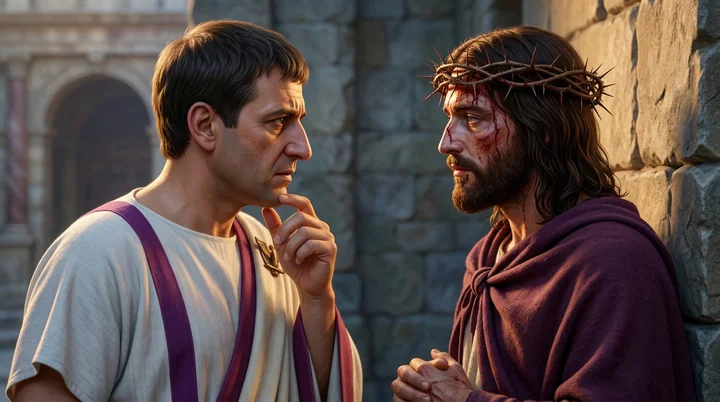
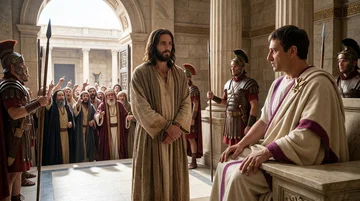
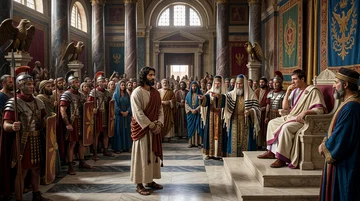
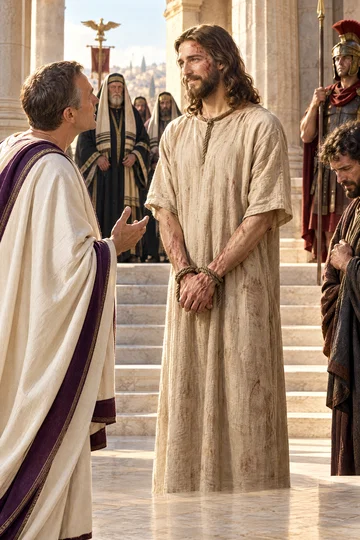
And Pilate asked him, saying, Art thou the King of the Jews? And he answered him and said, Thou sayest it.
Translations
And Pilate asked him, saying, Are you the King of the Jews? And he answered him and said, You say it.
King James Version, KJV Cambridge Paragraph Bible, Webster Bible
And Pilate asked him, saying, Art thou the King of the Jews? And he answered him and said, Thou sayest it.
Revised Version, American Standard Version
And Pilate asked him, saying, Art thou the King of the Jews? And he answered him and said, Thou sayest.
And Pilate questioned him, saying, 'Thou art the king of the Jews?' and he answering him, said, 'Thou dost say [it].'
And Pilate demanded of him saying, Art thou the king of the Jews? And he answering him said, Thou sayest.
And, Pilate, questioned him, saying—Art, thou, the king of the Jews? And, he, answering him, said—Thou, sayest.
Berean Standard Bible, Majority Standard Bible
So Pilate asked Him, “ Are You the King of the Jews?”“ You have said so,” Jesus replied.
Pilate asked him, “ Are you the King of the Jews?”He answered him, “ So you say.”
And Pilate said to him, Are you the King of the Jews? And he said in answer, You say so.
And Pilate asked him, saying, Art thou the King of the Iewes? And hee answered him, and sayd, Thou sayest it.
Douay-Rheims (Challoner revision)
And Pilate asked him, saying: Art thou the king of the Jews? But he answering, said: Thou sayest it.
Pictures
Cross-references
- John 18:33-37
Then Pilate entered into the judgment hall again, and called Jesus, and said unto him, Art thou the King of the Jews?
Pilate questions Jesus about his kingship, and Jesus explains his kingdom and witness to truth.
- Matthew 27:11
And Jesus stood before the governor: and the governor asked him, saying, Art thou the King of the Jews? And Jesus said unto him, Thou sayest.
Pilate asks Jesus whether he is King of the Jews, and Jesus gives the same reply.
- Mark 15:2
And Pilate asked him, Art thou the King of the Jews? And he answering said unto him, Thou sayest it.
Pilate asks whether Jesus is King of the Jews, and Jesus gives the same reply.
- John 19:1-16
Then Pilate therefore took Jesus, and scourged him.
Continues Pilate’s examination and sentencing of Jesus.
- Mark 15:4-5
And Pilate asked him again, saying, Answerest thou nothing? behold how many things they witness against thee.
Pilate appeals to Jesus amid accusations, but Jesus gives no further answer.
- Matthew 27:2
And when they had bound him, they led him away, and delivered him to Pontius Pilate the governor.
Parallel account of Jesus before Pilate.
- Psalms 2:6-7
Yet have I set my king upon my holy hill of Zion.
The psalm’s appointed King and Son connects with Pilate’s question about Jesus as King of the Jews.
- Luke 23:14-15
Said unto them, Ye have brought this man unto me, as one that perverteth the people: and, behold, I, having examined him before you, have found no fault in this man touching those things whereof ye accuse him:
Pilate and Herod find no crime in Jesus
- Luke 22:69-70
Hereafter shall the Son of man sit on the right hand of the power of God.
Jesus answers questions about his identity before Pilate questions him.
- Zechariah 9:9
Rejoice greatly, O daughter of Zion; shout, O daughter of Jerusalem: behold, thy King cometh unto thee: he is just, and having salvation; lowly, and riding upon an ass, and upon a colt the foal of an ass.
Jesus is presented as the King, forcing a choice about his kingship.
- Matthew 27:19
When he was set down on the judgment seat, his wife sent unto him, saying, Have thou nothing to do with that just man: for I have suffered many things this day in a dream because of him.
wife's dream warning gives Pilate last chance
- Matthew 27:24
When Pilate saw that he could prevail nothing, but that rather a tumult was made, he took water, and washed his hands before the multitude, saying, I am innocent of the blood of this just person: see ye to it.
washing hands shows refusal to stand with Jesus
- Luke 23:21
But they cried, saying, Crucify him, crucify him.
The crowd demands Christ’s crucifixion during his trial.
- Luke 19:38
Saying, Blessed be the King that cometh in the name of the Lord: peace in heaven, and glory in the highest.
Jesus is hailed as king, then questioned and reviled.
Commentary
Each commentary is drawn from primary sources: the writings of Ellen G. White and Adventist pioneers and periodicals. Each commentary is separate. Its own words are not a quotation; follow the references to read the source passages.
Ellen G. White
10 sources
The questioning belongs to the examination before Pilate in the judgment hall, after the Jewish leaders brought Jesus to the Roman governor for legal condemnation to carry out the Sanhedrin's sentence and obtain a death sentence, before He was led to Calvary for crucifixion, at a point when Pilate had not yet received a substantiated charge against Him.DA 723.1–724.1DA 722.5Ms 107, 1893, par. 2 He stood bound as a prisoner before the judgment seat while spectators gathered and the charges that He claimed to be King of the Jews, forbade tribute to Caesar, and made Himself equal with God were read, with Pilate looking on with suspicion and severity.Ms 112, 1897, par. 1–6 He stood pale, bruised and faint from loss of sleep and food and from being hurried from place to place with insult and violence, yet noble in bearing with lighted and shining countenance.5RED 50.2–51.1DA 725.3–6
Pilate was not deceived by the charge of sedition and the framing of Jesus as a political threat to Roman rule, but was confident a deep plot had been laid to destroy an innocent man who stood in the way of the Jewish dignitaries.5RED 50.2–51.1DA 725.3–6 When Pilate asked if He was the King of the Jews, Jesus answered affirming that He is.Ms 112, 1897, par. 1–63SP 130.2–131.25RED 50.2–51.1DA 725.3–6ST Jul 4, 1878 Caiaphas standing at the threshold with priests, scribes and rulers seized the answer as an admission of crime and a virtual acknowledgment that He sought to establish a rival earthly throne in Judah in opposition to Caesar, and with noisy denunciation importuned Pilate for sentence of death, but the exchange does not itself establish that charge, for His kingship did not mean plotting a political revolt or seeking earthly honors.3SP 130.2–131.25RED 50.2–51.1ST Jul 4, 1878 Pilate did not believe Jesus had plotted against the government, saw that the accusation concealed a plan to destroy an innocent man, saw no seditious marks in Him and had no confidence in the priests, became convinced that no evidence of guilt could be substantiated, and declared he found no fault in Him even though the priests and rulers had declared He spoke blasphemy.Ms 112, 1897, par. 1–65RED 50.2–51.1DA 725.3–6
His calm, noble bearing and answer stirred conviction in Pilate and led him to question Him further, so after the uproar Pilate urged Him to answer the many charges but He answered nothing to Pilate's marveling, and hoping to gain truth away from the crowd Pilate took Him alone into his house and respectfully asked again if He was King of the Jews.5RED 50.2–51.1ST Jul 4, 1878 Jesus did not answer the renewed question directly but asked whether Pilate spoke of himself or from what others told him, to give awakened conviction in Pilate opportunity and to learn whether the question came from the Jews' accusations or from desire to receive light from Christ.5RED 50.2–51.1 The verse shows Jesus in His most trying ordeal, betrayed and condemned in the judgment hall, humiliated and scorned as One doomed to the cross, while the multitude who had hailed Him as king hissed at and reviled Him, the cruel jeering crowd cried for His crucifixion, and those who had professed to love Him turned from Him in His trouble.4RED 102.2–103.1 It was a great trial, an hour of horror, the crowning trial and final test, bringing great grief and the terrible ruin of fondest hopes to His faithful followers, yet He knew it beforehand and prepared His chosen so they would not be overwhelmed with surprise and would not hang their faith on the inconstant favor of the world.4RED 102.2–103.1 The verse also belongs to the account of Jesus on the cross, when the Jewish priests and rulers pressed the Roman governor to carry out their will.RH Nov 11, 1915
Sources
Pioneers and periodicals
13 sources
When the chief priests and rulers brought Jesus to Pontius Pilate in the morning for the Roman sentence they required, Pilate asked if he was the King of the Jews on the charge that he claimed to be Christ a king against Caesar, and Jesus answered Thou sayest it in affirmation of the title in Pilate's own sense.ST Nov 12, 1894ST Oct 26, 1882ST Nov 12, 1894ST Sep 30, 1886ST Mar 13, 1901 His kingship claimed no earthly throne in Judah and meant no political revolt, sedition, or seeking of earthly honors.ST Jul 4, 1878ST Sep 30, 1886 Pilate's examination found no fault and no evidence of sedition, and Christ's calm and noble bearing under accusation stirred conviction in him, yet after declaring him innocent he evaded his duty to release and protect him.ST Nov 12, 1894ST Sep 30, 1886ST Mar 13, 1901 In that exchange the Jews rejected Christ as their king and seized him as a rebel against Caesar to deliver him to the Romans to be put to death.ST Nov 8, 1883 The trial carried the gospel in perfection to Rome, for Christ's dignified trust in a higher power and unresentful silence under malignity and scourging convinced Pilate he stood before One more than man and called him to do right whatever the cost, and God gave him a last warning through the dream of his wife Claudia Procula to have nothing to do with that righteous Man, which he refused when fear of the Jews led him to deliver Jesus to the mob and wash his hands to ease his conscience.ST Oct 27, 1898
Trial Setting and Exchange
Luke 23:3 belongs to the last suffering before the crucifixion, when Jesus stood before Pontius Pilate, the Roman governor of Judea.RH Feb 11, 1862RH Jun 10, 1862 Roman governors held the power of life and death, and his sentence was required before Jesus could be executed.RH Feb 11, 1862 At that time the Jewish priests and rulers were pressing the Roman governor to carry out their will.RH Nov 11, 1915
The question was put in morning proceedings after Jesus had already been condemned by the chief priests and elders the previous night.ST Oct 26, 1882 Those proceedings were held in the morning to appear to comply with the rule that judicial proceedings be by day.ST Oct 26, 1882 Yet pronouncing the death sentence on the same day the trial began violated the rule for capital cases.ST Oct 26, 1882
Pilate's question, Art thou the King of the Jews, followed the accusation that Jesus claimed to be Christ, a king, and opposed Caesar.ST Nov 12, 1894ST Mar 13, 1901 To that question Jesus answered, Thou sayest it, affirming the title in the form and sense of Pilate's own words.ST Jul 4, 1878ST Nov 12, 1894ST Nov 12, 1894ST Mar 13, 1901 His answer acknowledged the title of King.ST Sep 30, 1886
Caiaphas and the priests treated that answer as an admission that he was seeking to establish an earthly throne in Judah against Caesar.ST Jul 4, 1878ST Sep 30, 1886 His kingship, however, meant no plotting of political revolt, no sedition, and no seeking of earthly honors.ST Jul 4, 1878 Pilate recognized no evidence that Jesus was seditious.ST Sep 30, 1886
Pilate's examination found no fault in him.ST Nov 12, 1894 The calm, noble bearing of Jesus and his answer stirred conviction in Pilate and led him to question Jesus further.ST Jul 4, 1878 Pilate declared him innocent, yet afterward evaded his duty to release and protect him.ST Mar 13, 1901
Teaching Doctrine and Appeal
The verse shows the Jews rejecting Christ as their king, denying his right to call himself their king, and seizing him as a rebel against Caesar to deliver him to the Romans to be put to death.ST Nov 8, 1883 That rejection was the decision forced upon the nation when he presented himself as their king by entering Jerusalem seated upon the ass.ST Nov 8, 1883 They chose to reject and deliver him in order to save their city from being destroyed by the Romans, but God punished that crime by employing the Romans to destroy their city and their nation.ST Nov 8, 1883
The verse belongs with the Saviour resting in the grave on the seventh day, when the women also rested, one day before the first day of the week and resurrection day.RH Sep 4, 1856 His rest was on the same day the Father rested, namely the seventh day, so there is only one unit of rest and no separate rest of the Saviour to conjoin with the rest of the Maker as a reason for transferring rest from the seventh to the first day of the week.RH Sep 4, 1856
The verse presents the gospel in glorious perfection to great Rome in the person of Pontius Pilate as an effort to save him.ST Oct 27, 1898 The questioning finds no evidence of crime in him, and his dignified bearing, unlike the criminals Pilate knew, his trust in a higher power, and his unresentful and unresisting silence under unproved charges, malignity, scourging and insult convince Pilate that before him stands One more than man and appeal to him to do right whatever the consequences, yet fear of the Jews leaves him undecided.ST Oct 27, 1898 God then makes one more effort through Pilate's wife Claudia Procula by a dream-vision of Christ warning to have nothing to do with that righteous Man, giving Pilate his last chance.ST Oct 27, 1898 He refuses it by delivering Jesus to the mob and washing his hands in water to escape responsibility and ease conscience rather than identifying with the suffering Innocent One.ST Oct 27, 1898
The scene inspires worship as part of Christ's ministry, in which he stands before Pilate, as he also stood before Herod, and goes on to die in agony on the cross without complaint.RH Mar 9, 1905
Sources