Luke 23:49
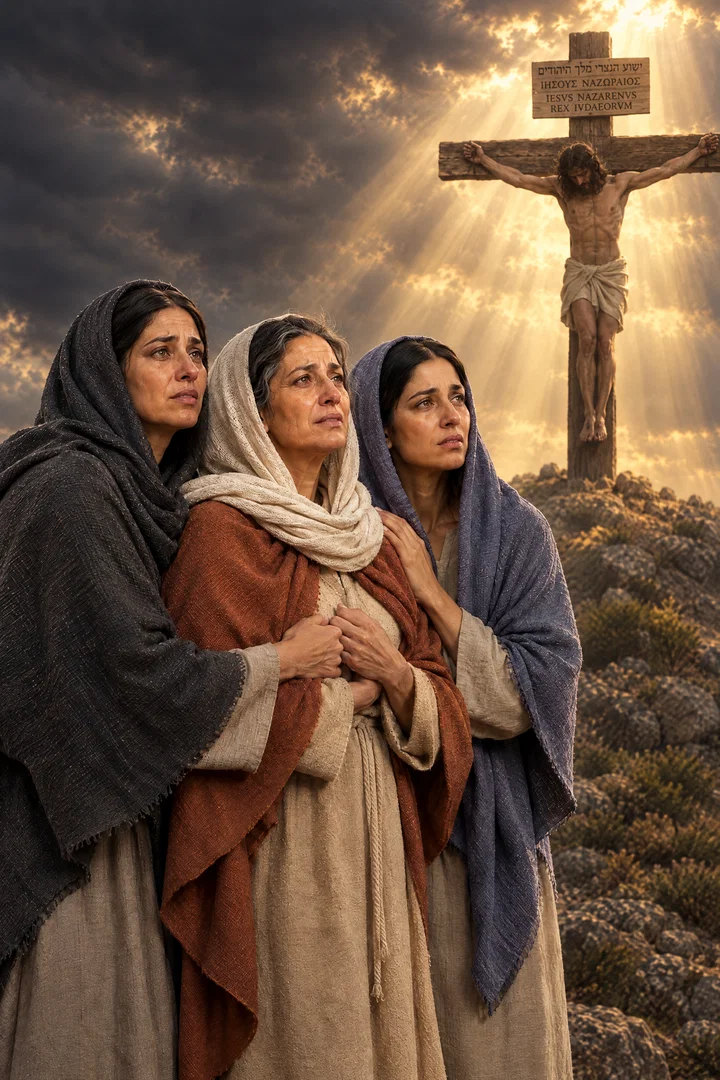
And all his acquaintance, and the women that followed him from Galilee, stood afar off, beholding these things.
Translations
American King James Version, King James Version, KJV Cambridge Paragraph Bible
And all his acquaintance, and the women that followed him from Galilee, stood afar off, beholding these things.
And all his acquaintance, and the women that followed him from Galilee, stood afar off beholding these things.
Revised Version, American Standard Version
And all his acquaintance, and the women that followed with him from Galilee, stood afar off, seeing these things.
and all his acquaintances stood afar off, and women who did follow him from Galilee, beholding these things.
And all those who knew him stood afar off, the women also who had followed him from Galilee, beholding these things.
But all they who were acquainted with him, were standing afar off, women also who had followed with him from Galilee,—beholding these things.
Berean Standard Bible, Majority Standard Bible
But all those who knew Jesus, including the women who had followed Him from Galilee, stood at a distance watching these things.
All his acquaintances and the women who followed with him from Galilee stood at a distance, watching these things.
And all his friends and the women who came with him from Galilee, were waiting at a distance, watching these things.
And all his acquaintance stood a farre off, and the women that followed him from Galile, beholding these things.
Douay-Rheims (Challoner revision)
And all his acquaintance, and the women that had followed him from Galilee, stood afar off, beholding these things.
Pictures
Cross-references
- Luke 24:1
Now upon the first day of the week, very early in the morning, they came unto the sepulchre, bringing the spices which they had prepared, and certain others with them.
The women who stood afar off came to the tomb early on the first day after the Sabbath.
- Luke 23:55-56
And the women also, which came with him from Galilee, followed after, and beheld the sepulchre, and how his body was laid.
The women saw where Jesus was laid, prepared spices, and rested on the Sabbath.
- Matthew 27:55
And many women were there beholding afar off, which followed Jesus from Galilee, ministering unto him:
Women who followed Jesus from Galilee watched his death from a distance.
- Mark 15:40-41
There were also women looking on afar off: among whom was Mary Magdalene, and Mary the mother of James the less and of Joses, and Salome;
Women who followed Jesus watched his crucifixion from a distance.
- John 19:25
Now there stood by the cross of Jesus his mother, and his mother’s sister, Mary the wife of Cleophas, and Mary Magdalene.
Jesus’ mother and other women stood by the cross.
- Psalms 38:11
My lovers and my friends stand aloof from my sore; and my kinsmen stand afar off.
It foretells that Jesus’ friends would stand at a distance.
- Luke 24:6
He is not here, but is risen: remember how he spake unto you when he was yet in Galilee,
tomb found empty, risen as foretold
- Mark 16:1
And when the sabbath was past, Mary Magdalene, and Mary the mother of James, and Salome, had bought sweet spices, that they might come and anoint him.
The women come to the tomb after the Sabbath.
Commentary
Each commentary is drawn from primary sources: the writings of Ellen G. White and Adventist pioneers and periodicals. Each commentary is separate. Its own words are not a quotation; follow the references to read the source passages.
Ellen G. White
1 source
The followers of Jesus, including the women who had come with him from Galilee, remained to watch what was done to him, standing at a distance from the cross.ST Aug 22, 1878 They beheld his suffering and death as eyewitnesses, though removed from the immediate scene.ST Aug 22, 1878 Their presence links the crucifixion to what follows, for they are the same women who afterward acted in love toward his dead body.ST Aug 22, 1878
Having witnessed these things, those women prepared spices and ointments to anoint him.ST Aug 22, 1878 They then came to his tomb early on the first day of the week, bringing what they had prepared.ST Aug 22, 1878 Thus the distant beholding at his death passes directly into their faithful coming to his burial place at dawn.ST Aug 22, 1878
Sources
Pioneers and periodicals
16 sources
All his acquaintance and the women that followed him from Galilee stood at a distance watching the events of his crucifixion and death.ST Sep 3, 1902 The verse belongs to the crucifixion record in which preparation day was the day before the Sabbath and the first day of the week was the day after the Sabbath, establishing Saturday as the Sabbath.ST Sep 23, 1913ST May 11, 1904 The women who watched saw where his body was laid and followed it to the tomb on preparation day, which was Friday, then bought and prepared spices and ointments, rested the Sabbath day according to the commandment, and came early the first day of the week to anoint him.ST Sep 3, 1902 Their actions show that his most intimate earthly associates gave the seventh-day Sabbath the same careful regard he gave it, deferring the work though they felt free to do it on the first day, which proves the Sabbath immediately before the first day is the seventh day and that it remained a perpetual institution kept after his death.ST Sep 3, 1902 His death upon the cross ended the whole typical system that had pointed forward to that death and sealed the new covenant by his blood, fulfilling the prophecy that his friends would stand afar off.ST Sep 23, 1913ST Oct 21, 1930
Witnesses at the Crucifixion
All his acquaintance and the women that had followed him from Galilee stood at a distance watching the events of his crucifixion and death.ST Sep 3, 1902 They were among those who witnessed what happened before the women saw where his body was laid and returned to prepare spices and ointments and rest on the Sabbath.ST Sep 3, 1902 His friends stood at a distance while he was crucified, fulfilling the prophecy that his friends would stand afar off.ST Oct 21, 1930
They were weeping friends who had hoped for much from him and mourned his fate.ST Apr 8, 1903 His killing was the saddest tragedy in human history, when the Man of Galilee was put to death by a bloodthirsty, hardened mob. The detailed Gospel account of his trial and execution is consistent with the customs and circumstances of the time.RH Feb 11, 1862
The place of crucifixion was outside Jerusalem, near a gate, and visible from afar, which explains standing afar off and beholding.ST Feb 18, 1913 The reference to beholding him dying in agony connects with the crucifixion watched from a distance by his acquaintances and the women from Galilee.RH Mar 9, 1905 The women who watched from a distance later came nearer.ST Jul 8, 1913
As one of his acquaintance who had beheld these things, Joseph of Arimathea afterward came with the weeping women followers who had stood afar off beholding the crucifixion to Pilate's Pretorium on stairs still stained with his blood.RH Jul 16, 1861 There he threw himself at Pilate's feet weeping and begged on his knees for permission to bury Jesus of Nazareth.RH Jul 16, 1861 Pilate granted it and ordered soldiers under Manlius to superintend the interment lest it be profaned.RH Jul 16, 1861 The crucifixion thus witnessed by his acquaintances and followers occurred in A.D. 31, not A.D. 32, and his resurrection and ascension occurred in that same year, following a public ministry of nearer three years and six months than three years and three months.ST Sep 22, 1909
Sabbath Identity and Observance
Luke 23:49 belongs to the account of the crucifixion and death by which the new covenant was sealed by blood on Friday afternoon, before the first day of the week.ST Sep 23, 1913ST May 11, 1904 In the immediate context of Luke 23:54 to 24:1, preparation day was the day before the Sabbath and the first day of the week was the day after the Sabbath, establishing Saturday as the Sabbath.ST May 11, 1904 The women who followed from Galilee watched him laid in the tomb on preparation day, which was Friday, and after seeing the burial they started for home, stopped in the city on the way and bought sweet spices intending to come and anoint him at a future time. With the accounts of the crucifixion and resurrection in the four Gospels, this shows that the Sabbath according to the commandment is the day just before the first day of the week, fixing the identity of the seventh day at the death of Christ.ST Jun 3, 1908 There the seventh day and the first day of the week stand in immediate chronological connection, so their identities have continued in unbroken succession from the cross.ST Jun 3, 1908ST Feb 1, 1905
The count of the days of the week has not been lost since that time, and the change from the Julian to the Gregorian calendar does not change the day of the week because calendars give the day of the month and year, not the day of the week.ST Jun 3, 1908 The acquaintances and the women who had followed from Galilee watched the events from a distance, and the women then saw where his body was laid and followed it to the tomb on preparation day, which was Friday.ST Sep 3, 1902 They returned to prepare spices and ointments and rested on the Sabbath. They rested the Sabbath day according to the commandment, and came to the sepulcher early the first day of the week expecting to anoint the body, but the stone was rolled away and he had risen.
Their actions after the Sabbath show that they observed the seventh-day Sabbath.ST Sep 3, 1902 His most intimate earthly associates gave the seventh-day Sabbath the same careful regard he gave it, deferring the work of preparing and anointing his body because of the Sabbath though they felt free to do it on the first day.ST Sep 3, 1902RH Aug 1, 1912 This identifies the Sabbath immediately before the first day of the week as the seventh day and proves that it remained a perpetual institution kept after his death.RH Aug 1, 1912 Though part of the account of the day after the Sabbath, the verse does not establish that the first day was sacred.ST Nov 11, 1889
Prophecy and Doctrinal Bearings
His friends standing at a distance while he was crucified fulfilled the prophecy that his friends would stand afar off.ST Oct 21, 1930 His death upon the cross ended the whole typical system that had pointed forward to that death as the beginning of its antitype. That sealing of the new covenant by his blood took place on Friday afternoon, before the first day of the week.ST Sep 23, 1913 What followed was that Joseph of Arimathea went in unto Pilate and begged the body of Jesus and with the assistance of Nicodemus buried it in his own new tomb. The acquaintances and the women who had followed him from Galilee are identified as witnesses who watched the events from a distance, but it is not said that they went to Paradise after his death.ST Nov 4, 1880
Sources