Luke 23:55
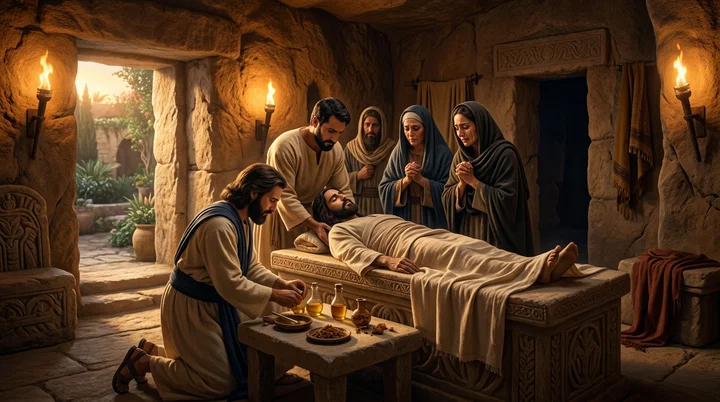
And the women also, which came with him from Galilee, followed after, and beheld the sepulchre, and how his body was laid.
Translations
And the women also, which came with him from Galilee, followed after, and beheld the sepulcher, and how his body was laid.
King James Version, KJV Cambridge Paragraph Bible
And the women also, which came with him from Galilee, followed after, and beheld the sepulchre, and how his body was laid.
And the women also, who came with him from Galilee, followed after, and beheld the sepulcher, and how his body was laid.
And the women, which had come with him out of Galilee, followed after, and beheld the tomb, and how his body was laid.
And the women, who had come with him out of Galilee, followed after, and beheld the tomb, and how his body was laid.
and the women also who have come with him out of Galilee having followed after, beheld the tomb, and how his body was placed,
And women, who had come along with him out of Galilee, having followed, saw the sepulchre and how his body was placed.
And the women, they who had come out of Galilee with him, following after, observed the tomb, and how his body was laid.
Berean Standard Bible, Majority Standard Bible
The women who had come with Jesus from Galilee followed, and they saw the tomb and how His body was placed.
The women who had come with him out of Galilee followed after, and saw the tomb and how his body was laid.
And the women who had come with him from Galilee went after him and saw the place and how his body had been put to rest;
And the women also that followed after, which came with him from Galile, behelde the sepulchre, and how his body was layd.
Douay-Rheims (Challoner revision)
And the women that were come with him from Galilee, following after, saw the sepulchre, and how his body was laid.
Pictures
Cross-references 20 of 28
- Luke 24:1
Now upon the first day of the week, very early in the morning, they came unto the sepulchre, bringing the spices which they had prepared, and certain others with them.
The women return to the tomb on the first day of the week after the Sabbath.
- Mark 16:1-2
And when the sabbath was past, Mary Magdalene, and Mary the mother of James, and Salome, had bought sweet spices, that they might come and anoint him.
Both accounts place the women’s visit to Jesus’ tomb after the Sabbath, on the first day of the week.
- Matthew 28:1
In the end of the sabbath, as it began to dawn toward the first day of the week, came Mary Magdalene and the other Mary to see the sepulchre.
Women come to the tomb after the Sabbath, at the dawn of the first day.
- John 20:1
The first day of the week cometh Mary Magdalene early, when it was yet dark, unto the sepulchre, and seeth the stone taken away from the sepulchre.
Mary visits the tomb early on the first day of the week and finds it empty.
- Mark 15:42-47
And now when the even was come, because it was the preparation, that is, the day before the sabbath,
Describes Jesus’ burial and the women observing where he was laid.
- John 19:31
The Jews therefore, because it was the preparation, that the bodies should not remain upon the cross on the sabbath day, ( for that sabbath day was an high day,) besought Pilate that their legs might be broken, and that they might be taken away.
Identifies the preparation day and the Sabbath following Jesus’ death.
- Matthew 27:61
And there was Mary Magdalene, and the other Mary, sitting over against the sepulchre.
The women watch the tomb where Jesus was laid.
- John 19:38-42
And after this Joseph of Arimathaea, being a disciple of Jesus, but secretly for fear of the Jews, besought Pilate that he might take away the body of Jesus: and Pilate gave him leave. He came therefore, and took the body of Jesus.
Joseph and Nicodemus prepare and lay Jesus’ body in the tomb.
- Mark 15:47
And Mary Magdalene and Mary the mother of Joses beheld where he was laid.
The women observe where Jesus is laid.
- Matthew 27:66
So they went, and made the sepulchre sure, sealing the stone, and setting a watch.
The tomb is sealed and guarded after Jesus’ burial.
- John 19:30
When Jesus therefore had received the vinegar, he said, It is finished: and he bowed his head, and gave up the ghost.
Jesus’ finished work of redemption precedes his Sabbath rest.
- Luke 24:6
He is not here, but is risen: remember how he spake unto you when he was yet in Galilee,
The burial account is followed by the announcement that Christ is risen.
- 1 Corinthians 15:4
And that he was buried, and that he rose again the third day according to the scriptures:
Christ was buried and rose again on the third day.
- Matthew 27:60
And laid it in his own new tomb, which he had hewn out in the rock: and he rolled a great stone to the door of the sepulchre, and departed.
Describes Joseph laying Jesus’ body in the tomb, which the women saw.
- Mark 16:2
And very early in the morning the first day of the week, they came unto the sepulchre at the rising of the sun.
Both place the women at the tomb early on the first day of the week.
- Luke 8:2-3
And certain women, which had been healed of evil spirits and infirmities, Mary called Magdalene, out of whom went seven devils,
Women who accompanied Jesus ministered to him from their means.
- Exodus 20:8-11
Remember the sabbath day, to keep it holy.
The burial was hurried so the disciples could keep the Sabbath commandment.
- Matthew 27:55
And many women were there beholding afar off, which followed Jesus from Galilee, ministering unto him:
Women who followed Jesus from Galilee watched at his crucifixion and burial.
- Mark 15:40
There were also women looking on afar off: among whom was Mary Magdalene, and Mary the mother of James the less and of Joses, and Salome;
Identifies the Galilean women who followed to the tomb.
- Luke 24:10
It was Mary Magdalene, and Joanna, and Mary the mother of James, and other women that were with them, which told these things unto the apostles.
Identifies the women who reported what they found.
Commentary
Each commentary is drawn from primary sources: the writings of Ellen G. White and Adventist pioneers and periodicals. Each commentary is separate. Its own words are not a quotation; follow the references to read the source passages.
Ellen G. White
10 sources
The women were those who had come with Jesus from Galilee, and they followed Joseph and Nicodemus and the burial party to the tomb and carefully observed where and how His body was laid and what was done with it.Ms 111, 1897, par. 63–643SP 176.1ST Aug 22, 1878EW 148.35RED 95.2 They included Mary Magdalene and the other Marys, the two Marys, and at this time they stayed with John.3SP 174.33SP 186.3–187.1ST Aug 1, 1878 Although their faith in Him as the promised Messiah had perished with Him, they cared deeply about His body.3SP 174.3
They came to see that everything possible had been done for His lifeless body.5RED 95.2ST Aug 1, 1878DA 773.5 They watched the bruised and lacerated body bathed and cleansed from blood, wrapped in linen with the spices, laid in Joseph's new stone tomb near Calvary wherein man had never lain, with mangled limbs straightened and bruised hands folded upon the pulseless breast.ST Aug 1, 1878 They remained until He was placed in the tomb and saw the heavy stone rolled across and set against the entrance, leaving Him at rest.EW 148.35RED 95.2SG1 64.1ST Aug 1, 1878
They stayed near the tomb after the men had placed Him there and lingered in grief and sorrow about the sacred resting place while the evening shades gathered, shedding tears over Him whom they loved.3SP 176.15RED 95.2ST Aug 1, 1878DA 773.5 They were last at the cross and last at the tomb, among the last to leave.3SP 176.15RED 95.2ST Aug 1, 1878DA 773.5 They observed carefully so they could return to anoint Him with spices and ointment after the Sabbath.Ms 111, 1897, par. 63–64ST Aug 22, 1878 His burial was hurried because the Sabbath was near so His disciples could keep the Sabbath according to the commandment, while the Passover was being observed as the Lamb it foreshadowed lay slain in the tomb.3SP 186.3–187.1
The tomb was also watched by angels, who awaited the command to release Him from death.EW 148.3
Sources
Pioneers and periodicals
90 sources
The women who had come with Jesus from Galilee followed Joseph's burial party to the tomb and carefully watched where and how his body was laid so they could return to anoint him.RH Jan 1851RH Dec 24, 1861STST Mar 16, 1882 This was done on the preparation day, Friday, as the Sabbath drew on toward sunset, with the burial finished before sundown leaving no time to complete the anointing.ST Apr 21, 1914ST May 24, 1883ST Oct 7, 1930 They then rested on the Sabbath according to the commandment and came very early on the first day of the week, showing the Sabbath is the day immediately before the first day and distinct from it.ST Jul 11, 1916ST Aug 22, 1916ST Nov 11, 1930ST Sep 2, 1889RH Apr 12, 1860 Their rest after his death proves the Sabbath and its commandment were not ended, changed, or nailed to the cross, but remained binding as the fourth commandment kept in knowing obedience.RH Aug 15, 1854ST Dec 8, 1898ST Sep 13, 1899ST Sep 20, 1883 That Sabbath is the seventh day, Saturday, blessed and hallowed at creation in Exodus 20:8-11, not Sunday the first or resurrection day, and Jesus himself rested in the tomb on that Sabbath from his finished work of redemption as he had rested after creation.RH Dec 24, 1861STST Sep 16, 1880ST
Burial Witnesses and Setting
The women who had come with Jesus from Galilee followed Joseph of Arimathea and his burial party to the tomb and beheld the sepulchre and how his body was laid there.RH Jan 1851RH Dec 24, 1861STST Sep 16, 1880ST Apr 29, 1913 This following and seeing belongs to the burial-day account before their rest on the Sabbath according to the commandment and their coming on the first day of the week.RH Jan 1851RH Dec 24, 1861ST Jul 11, 1916 They watched carefully where and how he was laid so they could return after the Sabbath to complete anointing and embalming him with spices and ointments.ST Mar 16, 1882ST Aug 13, 1874RH May 16, 1854RH Nov 12, 1872 They prepared those spices and ointments to embalm him, rested on the Sabbath according to the commandment, and went to the tomb after the Sabbath on the first day to do that work.ST Aug 13, 1874RH Mar 31, 1874
Those present with Joseph and Nicodemus included Mary Magdalene, Mary the mother of James the Less and of Joses, and the other Galilean women who came with Jesus.ST Aug 1, 1878ST Oct 7, 1930ST Mar 12, 1894 The bruised and lacerated body was bathed and cleansed from blood, wrapped in linen with the spices, with mangled limbs straightened and bruised hands folded upon the pulseless breast.ST Aug 1, 1878ST Feb 1, 1899 It was laid in Joseph's new rock-cut tomb near Calvary a short distance away wherein man had never lain, and a heavy stone was rolled against the entrance leaving the Son of God at rest.ST Aug 1, 1878ST Feb 1, 1899ST Nov 15, 1910ST Mar 12, 1894 They were last at the cross and last at the tomb, lingering about the sacred resting place while the evening shades gathered and shedding tears of sorrow over Him whom they loved.ST Aug 1, 1878ST Feb 1, 1899
This happened on the preparation day, the sixth day commonly called Friday, as the Sabbath drew on toward sunset.ST Apr 21, 1914ST May 24, 1883ST Nov 27, 1884ST Sep 12, 1900 The burial was completed before sundown, with still time before the closing of the sixth day to go and prepare spices and ointments for anointing but with only moments left that did not permit performing that rite without trespassing on the sacred hours.ST Apr 21, 1914ST Nov 27, 1884 Those who hold the Friday Nisan 15 Passover holy convocation view teach that no servile work might be done except preparing food to eat, so that Friday Passover sabbath could still be called the preparation before the weekly Sabbath.ST Oct 7, 1930RH Feb 5, 1914 The preparation day on which this happened had nothing to do with the Passover preparation in the view of the weight of testimony, which was already made before Jesus ate the Passover, but was the day before the weekly seventh-day Sabbath.ST Oct 7, 1930
After seeing the burial they returned and prepared spices and ointments on Friday, a detail reconciled with Mark's account of spices bought after the Sabbath, then rested.ST Nov 11, 1930RH Apr 12, 1860 Those who distinguish two Sabbaths that week teach they prepared between the high ceremonial Sabbath and the weekly Sabbath.RH Apr 12, 1860 Because they had seen where the body was placed, they could recognize the tomb was empty when they returned, giving them direct evidence of the resurrection.ST Jun 8, 1904 Christ himself was laid in Joseph's new tomb and was seen there by the women from Galilee, proving He remained in the grave until He rose from the dead.ST Jan 9, 1893 While in the grave He did nothing and knew nothing, for there is no work, device, knowledge, wisdom, consciousness, intelligence, love, hatred, or envy in death, which shows all the dead remain unconscious in the grave until resurrection.ST Jan 9, 1893
Sabbath Day Identified
The visit to the tomb falls between the preparation day and the first day of the week, for the women saw where the body was laid, then rested on the Sabbath according to the commandment, then came very early on the first day of the week to the sepulchre.ST Jul 11, 1916ST Aug 22, 1916ST Sep 2, 1889ST Feb 10, 1898ST Dec 8, 1898 The preparation ended as the Sabbath drew on, the Sabbath fully passed before the dawning of the first day, and Christ rose on the day following the commanded Sabbath.ST Sep 2, 1889ST Feb 10, 1898ST Dec 8, 1898ST Feb 7, 1911 The Sabbath according to the commandment is therefore the day immediately before the first day and distinct from it, while the first day is simply named as the first day of the week.ST Jul 11, 1916ST Aug 22, 1916ST Dec 8, 1898 That Sabbath is the Sabbath of the Decalogue, the seventh day God commanded to be remembered and kept holy and sanctified and blessed.ST Sep 2, 1889ST Feb 10, 1898ST Dec 8, 1898
That Sabbath according to the commandment is the seventh day of the week, Saturday, the day God commanded, blessed, hallowed and sanctified at creation in Exodus 20:8-11, not Sunday the first day or resurrection day.RH Dec 24, 1861STST Sep 16, 1880ST May 24, 1883ST Oct 22, 1902 The burial-day account places the Sabbath rest after the preparation day and before the first day of the week, so the next day after the preparation was the seventh day and the day after that was the first day.RH Dec 24, 1861ST Sep 16, 1880ST May 24, 1883ST Sep 2, 1889 The women waited until the first day of the week to complete preparation of the body, identifying the Sabbath they observed as the seventh day.STST Feb 10, 1898ST Feb 7, 1911 The seventh day does not coincide with the resurrection day, so keeping the resurrection day or first day of the week is not keeping the Sabbath according to the commandment, and rest for God and resurrection cannot both be commemorated by observance of one day each week.ST Dec 8, 1898
The sequence proves which day was the seventh day at the death of Christ and that the true seventh day was still known at the crucifixion, the same day on which God rested from the work of creation.RH Feb 26, 1867RH Jul 21, 1853 That Sabbath lies between the crucifixion day now called Good Friday and the resurrection Sunday now called Easter exactly the same now as when Christ lay in the tomb, proving no time has been lost and the weekly cycle is unchanged.RH Feb 26, 1867ST Sep 29, 1914 Jews in all parts of the world keep exactly the same record with no confusion among nations whether keeping Old Style or New Style, and later calendar changes did not alter the sequence of weekdays.ST Sep 29, 1914ST May 25, 1915 Since the true reckoning of days has not been lost since that time the seventh day can still be known, Sunday is the first day, and resting on the Sabbath according to the commandment means resting on the same Saturday on which those women rested.RH Feb 26, 1867ST Sep 29, 1914
The account supports that the biblical day begins in the evening, for the women saw where the body was laid before the Sabbath and then rested on the Sabbath whose sacred hours drew on at sunset, rather than a day beginning at midnight.ST Jul 26, 1905 Luke's calling the seventh day the Sabbath only names an already established day and does not by that designation alone make it a permanent rule, just as temporary purification rites were not made binding by observance.RH Feb 21, 1854 Those who held the opposite understanding taught that the seventh day was already the Sabbath and permanently established, so that Luke names it as the Sabbath but does not make it so.RH Feb 21, 1854
Sabbath Binding After Cross
The devoted followers rested on the Sabbath according to the commandment even after Jesus had died, and their observance proves the Sabbath and its commandment had not ended, been changed, abolished, or nailed to the cross with the typical system at his death.RH Aug 15, 1854ST Sep 13, 1899RH Apr 25, 1854RH May 31, 1864 The women who had come with Jesus from Galilee had followed Joseph to the tomb and observed where and how his body was laid, and then, between the burial and the first day of the week, they rested on the Sabbath according to the fourth commandment, showing the commandment still required Sabbath rest after the crucifixion.ST Sep 13, 1899RH Apr 25, 1854RH May 31, 1864RH May 5, 1863 Their Sabbath-keeping immediately after the cross is striking testimony that the fourth commandment remained in force and had not been changed to the first day.ST Sep 13, 1899RH Apr 25, 1854RH May 5, 1863
Their rest was knowing obedience taught and practiced by Jesus, not ignorance, superstition, or fear, for Jesus had taught them by his life to keep the Sabbath holy and they knew of no change.RH Aug 15, 1854RH Sep 2, 1851RH Apr 25, 1854RH Oct 31, 1854ST Sep 15, 1887 They had not been taught that the Sabbath was changed or abolished, and after his death they resumed work on the first day of the week, delaying their burial preparations and restraining grief until after the Sabbath.RH Apr 25, 1854RH Oct 31, 1854ST Sep 15, 1887 Their rest was obedience to the command to cease from labor.RH Sep 2, 1851
The commandment they kept is the Sabbath of the Decalogue, the seventh day of the week God commanded to be remembered and kept holy, on which he rested and which he blessed, hallowed, and sanctified.ST Dec 8, 1898ST Sep 20, 1883ST Aug 27, 1885 It is the Sabbath of the New Testament identical with the Sabbath of the Old Testament, the Hebrew, Greek, and English words for Sabbath having all one meaning, in the same weekly order preserved from creation and Sinai.ST Sep 20, 1883ST Aug 27, 1885ST May 20, 1897 That seventh day of the commandment was the seventh day of creation sanctified and given in Eden, coming down without break or change through patriarch, priest, prophet, and king, honored by Jesus in life and death and kept by his followers before and after his death at the very time some suppose another day was to be observed.ST Sep 20, 1883ST May 20, 1897ST Sep 22, 1909 It fully passed before the dawning of the first day of the week, Christ arising on the day following the commanded Sabbath, the day succeeding it being known with certainty to be the first day of the week.ST Dec 8, 1898ST Aug 27, 1885ST Sep 22, 1909
Their example is a positive gospel commandment for Sabbath-keeping, as binding as if it said they rested the first day according to the commandment, which Sunday keepers would claim as law and sufficient proof for Sunday observance.ST Oct 26, 1904ST Jul 24, 1893 With Christ's example it stands as a rebuke to knowingly profaning the Sabbath, calling Christians to build upon the observance of Christ, the prophets, and the apostles by having the law in the heart and keeping the commandments.ST Oct 26, 1904ST Jul 24, 1893RH Oct 21, 1873 If the first Sabbath after the Lord's death was to be observed, every succeeding Sabbath demands the same recognition, and the cross in no way abrogates, changes, limits, or modifies the command to remember the Sabbath day to keep it holy.ST Sep 22, 1909
They kept the Sabbath after the new covenant had been sealed by his blood, returning and preparing spices and ointments and resting the Sabbath day according to the commandment before coming to the sepulchre on the first day of the week.ST Jan 22, 1885ST Oct 15, 1902 This proves the authority of the fourth commandment was expressly recognized after the crucifixion, that the New Testament is not silent on the Sabbath, and that the weekly Sabbath survived the passing away of the typical system at the cross when only the typical or shadowy sabbaths were abolished and blotted out.ST Jan 22, 1885ST Oct 15, 1902
The Sabbath command is a perpetual covenant applying throughout human existence in mortal and immortal life, still existing and binding in the gospel dispensation, spoken of in a familiar way by the evangelists who wrote afterward as an existing institution that did not need to be given over a second time in the New Testament.RH Apr 21, 1851RH May 2, 1854RH Jan 24, 1907RH May 26, 1853 The apostles were not fully instructed in the truth until Pentecost and therefore could not have kept a new first-day Sabbath before then, and the claim that the burial ended the Sabbath's connection and restored an original first-day Sabbath is not supported by Scripture.RH Dec 16, 1858ST Nov 12, 1885
No change of the Sabbath from Saturday to Sunday had taken place by the burial in the tomb, for the seventh-day Sabbath according to the commandment was still unchanged.ST Dec 8, 1898ST Jul 8, 1930 The Sabbath according to the commandment is not Sunday the first day of the week, so keeping Sunday or the resurrection day is not keeping the Sabbath according to the commandment, and rest for God and resurrection cannot both be commemorated by observance of one day each week.ST Dec 8, 1898 The Sabbath had not disappeared from the record or been replaced in the week.ST Mar 4, 1889 Their ceasing from labor did not require performing the sacrifices associated with the Sabbath, since the Sabbath command existed before those sacrifices and they were not part of it.RH Sep 2, 1851
Christ's Rest in Tomb
Jesus was laid in the tomb as the seventh-day Sabbath began after finishing His work of re-creation by death for sinners.STST May 13, 1908 He rested there on the Sabbath from redemption as He had rested after creation, and the seventh day thereby became a memorial of redemption as it was of creation, with Himself as Redeemer because Creator.STRH Aug 13, 1857ST May 13, 1908ST Dec 19, 1900 The plan of redemption had been carried out and His redeeming work declared finished when the disciples saw how His body was laid in Joseph's new tomb.STST May 13, 1908
In this God, Christ, angels and disciples were in harmony in keeping the Sabbath.STST May 13, 1908 There was grief among those who loved Him on earth but joy in heaven, because Satan's fate was sealed, a restored creation was secured beyond doubt, and the salvation of a redeemed race was eternally secured.STST May 13, 1908 God and angels saw this, and these events were ever after to be indelibly linked with Sabbath observance.STST May 13, 1908
He calmly slept in the grave on the Sabbath, keeping it in death as in life.ST Oct 10, 1906ST Jul 1, 1908 By resting in death on the Sabbath He honored the Sabbath hallowed by the Creator, the only weekly Sabbath recognized in the Bible.ST Oct 10, 1906ST Jul 1, 1908 After His work on earth was finished He rested in the tomb on the seventh day, as He had rested after creation, and the Sabbath was made by God's resting.RH Aug 13, 1857ST Dec 19, 1900
That Sabbath was His last day as earthly Prophet before rising on the first day as Priest-King to begin new work for mankind.RH Aug 13, 1857ST Dec 19, 1900ST Sep 22, 1909 He finished His work on the sixth day, rested in the tomb on the Sabbath, then resumed activity and began work on the first day.ST Dec 19, 1900ST Sep 22, 1909ST The first day, when He rose and stood in the gates of triumph as the Mighty Creator glorified into the Mighty Redeemer, was a day of great activity and not of rest.RH Aug 13, 1857ST Dec 19, 1900ST His death baptized the old Sabbath, and the Sabbath of creation was thereby re-sanctified and hallowed as the Sabbath of redemption, so that the day which sings of creation rising from chaos and the day which sings of Christ rising from death meet and mingle in union declaring the God of nature and the God of grace to be one God and His Sabbath one.RH Aug 13, 1857
The very same Jesus laid in the tomb could not be held by the grave because He was the Son of God.RH Dec 5, 1865 He rose and went to heaven in a cloud.RH Dec 5, 1865 His body lay in the tomb during one seventh day more than eighteen hundred years ago, which does not mean those who keep the seventh day now have a dead Saviour.RH Mar 21, 1865
Crucifixion Date and Prophecy
Christ died on the sixth day of the week, commonly called Friday, not on Wednesday the fourth day, and was buried on the preparation day before the weekly Sabbath.ST Oct 7, 1930ST Apr 21, 1914ST Oct 7, 1930RH Nov 15, 1906 The women who had come with him from Galilee, including Mary Magdalene, Mary the mother of James the Less and of Joses, and the others with them, followed and beheld the sepulchre and how his body was laid.ST Oct 7, 1930RH Feb 12, 1914RH Nov 15, 1906 That preparation day had nothing to do with the Passover preparation, which was already made before Jesus ate the Passover, but was the day before the weekly seventh-day Sabbath, with burial on Friday afternoon as the Sabbath drew on and resurrection early Sunday the third day after crucifixion without remaining in the tomb three full days.ST Oct 7, 1930RH Feb 12, 1914RH Nov 15, 1906
He was crucified later on Friday and laid in the tomb, rested in the tomb on the Sabbath, and arose in the middle of the third day on the first day of the week.RH Feb 12, 1914ST Jul 25, 1911 The three days and three nights mean parts of three days in a general way, the Bible counting parts of days as whole days, not seventy-two hours literally in the earth.ST Apr 21, 1914RH Feb 12, 1914ST Jul 25, 1911 In this reckoning he let himself be taken into custody by earthly powers on Thursday and remained under their power until Sunday morning.ST Apr 21, 1914
That Sabbath was also a high day because it coincided with the Passover Sabbath on Nisan 15 or, if the weekly Sabbath fell on Nisan 16, because the wave sheaf was offered that day. The crucifixion was on Friday the fifteenth of Nisan, the first day of the seven-day feast of Passover, which was an holy convocation Passover sabbath on which no servile work might be done except that which every man must eat, and since preparing necessary articles of food was permitted that Friday Passover sabbath could still be called the preparation before the weekly Sabbath.RH Feb 5, 1914RH Jun 24, 1873 The preparation also involved getting ready to eat the Passover lamb, which points to the crucifixion occurring before the paschal meal and not on the fifteenth day after the meal had already been eaten, with the weekly Sabbath and the yearly Passover Sabbath coinciding to make that Sabbath a high day.RH Jun 24, 1873 He lay in the tomb on the Sabbath following the crucifixion, identified as the sixteenth of Abib when the wave sheaf was presented, and the sixteenth was the seventh-day Sabbath and the first day in the count of fifty to Pentecost, so counting those days places Pentecost that year on the seventh-day Sabbath.RH Feb 12, 1914ST Mar 11, 1886
He died before the Sabbath and was raised the day after it, fulfilling the prediction that he would rise on the third day and the sign of Jonah in full harmony with Matthew 12:40.ST Jul 25, 1911RH Sep 16, 1902 The first-day account reports what the women did at the tomb after the Sabbath, not a command or example establishing the first day as sacred.ST Nov 11, 1889 The work of embalming his body was deferred because the Sabbath prevented it, to be done on the next convenient day, Sunday, which shows the Sabbath was observed on Saturday, not Sunday.ST Jan 31, 1911
Faithful Example Applied
The women who followed to the tomb were holy, devout disciples and Christians, including the mother of Jesus who had kept his sayings in her heart.ST Apr 21, 1914 Their watching where and how the body was laid was faithful devotion, love and constancy that continued after his death.RH Feb 14, 1856RH Dec 8, 1859 That devotion brought them back at dawn with spices and ointment, even when told the visit would be useless, so that they were among the first to come to the tomb on the resurrection morning and the first to see him after his death.RH Feb 14, 1856RH Dec 8, 1859 They had noted the sepulchre on Friday afternoon, then had time before sunset to prepare spices and ointments but not to perform the anointing without trespassing on the sacred hours that drew on.ST Apr 29, 1913ST Apr 21, 1914RH Nov 12, 1872
Though anointing his body was at hand and might have seemed a highly commendable Sabbath service, they left that last act of love undone rather than violate holy law.ST Apr 29, 1913ST Apr 21, 1914ST May 6, 1913 Their consciences, made tender in the school of Christ, would not permit even anointing the body of the Lord of glory on his holy day, and they rested void of offense according to the commandment.ST Apr 29, 1913ST Apr 21, 1914ST Sep 24, 1902 Their waiting until the first day of the week to do that work, a delay of about thirty-six hours until very early on the first day, shows their observance and their regard for the seventh day and their restraint even of grief.ST Apr 29, 1913RH Nov 12, 1872 In this the followers who became founders of the Christian church continued Christ's practice by sacredly observing the seventh day.ST Sep 24, 1902ST May 6, 1913
Keeping the Sabbath according to the commandment means so holy a life and conception of rest that no earthly consideration, however dear, finds place in it, so that not even care for their divine Lord could be performed until the setting sun brought another day.ST Sep 22, 1909ST Sep 22, 1909 The Sabbath they kept after the crucifixion was the same seventh day Jesus and they had kept before his death, the seventh day of the commandment and of creation sanctified in Eden and kept without break by patriarch, priest, prophet and king, coming to them by the death of the Son of God as a new-covenant blessing.ST Sep 22, 1909ST Sep 22, 1909 If the first Sabbath after the Lord's death was to be observed, every succeeding Sabbath demands the same recognition, for the cross in no way abrogates, changes, limits or modifies the command to remember the Sabbath day to keep it holy.ST Sep 22, 1909 Their presence also honors women and shows that women's participation in worship is not forbidden.
Their observation established the setting of his burial before the day of his resurrection, placing him in the tomb during the seventh day before his resurrection on the first day of the week.ST Aug 8, 1900 Their Sabbath observance stood in contrast to the chief priests and elders, who used the Sabbath hours to ask Pilate for a guard and to secure and seal the tomb. In the chronology the burial they witnessed came three days before the first-day events, after his death had sealed the new covenant.ST Sep 23, 1913
Sources