Mark 14:47
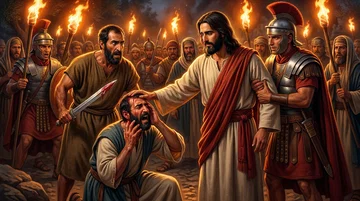
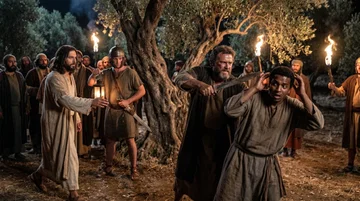
And one of them that stood by drew a sword, and smote a servant of the high priest, and cut off his ear.
Translations
American King James Version, King James Version, KJV Cambridge Paragraph Bible, Webster Bible
And one of them that stood by drew a sword, and smote a servant of the high priest, and cut off his ear.
Revised Version, American Standard Version
But a certain one of them that stood by drew his sword, and smote the servant of the high priest, and struck off his ear.
and a certain one of those standing by, having drawn the sword, struck the servant of the chief priest, and took off his ear.
But a certain one of those who stood by, having drawn his sword, struck the bondman of the high priest, and took off his ear.
[A certain] one of the by-standers, drawing a sword, smote the servant of the High priest, and took off his, ear.
Berean Standard Bible, Majority Standard Bible
And one of the bystanders drew his sword and struck the servant of the high priest, cutting off his ear.
But a certain one of those who stood by drew his sword and struck the servant of the high priest, and cut off his ear.
But a certain one of those who were near took out his sword, and gave the servant of the high priest a blow, cutting off his ear.
And one of them that stoode by, drewe out a sword, and smote a seruant of the hie Priest, and cut off his eare.
Douay-Rheims (Challoner revision)
An one of them that stood by, drawing a sword, struck a servant of the chief priest, and cut off his ear.
Pictures


Cross-references
- Matthew 26:51-52
And, behold, one of them which were with Jesus stretched out his hand, and drew his sword, and struck a servant of the high priest’s, and smote off his ear.
Jesus rebukes the disciple who strikes the high priest’s servant with a sword.
- John 18:10-11
Then Simon Peter having a sword drew it, and smote the high priest’s servant, and cut off his right ear. The servant’s name was Malchus.
Names Peter and Malchus and records Jesus telling Peter to sheath his sword.
- Luke 22:50-51
And one of them smote the servant of the high priest, and cut off his right ear.
Jesus heals the servant’s ear after the sword strike.
- Matthew 26:51
And, behold, one of them which were with Jesus stretched out his hand, and drew his sword, and struck a servant of the high priest’s, and smote off his ear.
Peter strikes the high priest’s servant during Jesus’ arrest.
- Luke 22:50
And one of them smote the servant of the high priest, and cut off his right ear.
Both recount the servant’s wounded ear during Jesus’ arrest.
- John 18:11
Then said Jesus unto Peter, Put up thy sword into the sheath: the cup which my Father hath given me, shall I not drink it?
Jesus accepts the cup the Father gave.
- Matthew 26:53-54
Thinkest thou that I can not now pray to my Father, and he shall presently give me more than twelve legions of angels?
Jesus could summon angels but allowed events to fulfil Scripture.
- John 18:36
Jesus answered, My kingdom is not of this world: if my kingdom were of this world, then would my servants fight, that I should not be delivered to the Jews: but now is my kingdom not from hence.
Jesus says his kingdom is not advanced by fighting.
Commentary
Each commentary is drawn from primary sources: the writings of Ellen G. White and Adventist pioneers and periodicals. Each commentary is separate. Its own words are not a quotation; follow the references to read the source passages.
Ellen G. White
6 sources
The verse belongs to the slow journey in company with the disciples to the garden of Gethsemane on Passover night, when the broad full Passover moon shone from a cloudless sky and the city of pilgrims' tents lay hushed in silence.DA 685.1 It belongs to Jesus coming to Gethsemane on the night of His last agony with a heart full of sorrow.DA 685.2 It belongs to the arrest of Jesus in the Garden of Gethsemane after His long agony there, when Judas, one of His professed disciples, betrayed Him and a band of men and soldiers with staves and spears arrested Him.Ms 107, 1893, par. 2 It belongs to the betrayal and arrest that came before His agony and crucifixion, trials for which He had prepared His faithful disciples so that the betrayal and hostility toward Him would not take them wholly by surprise.4RED 102.2–103.1
As Jesus was being seized, Peter in vehement anger rashly drew his sword and cut off the ear of the high priest's servant.ST Jun 6, 1878ST Sep 23, 1886 The disciples had just seen divine power prostrate the mob, so they were disappointed and indignant to see cords brought to bind hands that had always been employed in doing good, and Peter's stroke was human resistance to Christ's willing surrender.ST Sep 23, 1886 Jesus answered the stroke by freeing His own bound hands to touch the wounded ear and instantly make it whole, then rebuked Peter to put up the sword because all who take the sword perish by the sword, affirming that He could pray to His Father for more than twelve legions of angels, yet must let the Scriptures be fulfilled and drink the cup His Father had given Him.ST Sep 23, 1886
The verse stands where Jesus enters suffering after a life walked in the light of God's presence, now seeming shut out from God's sustaining presence as He is numbered with transgressors and bears the guilt of fallen humanity.DA 685.2 It means the iniquity of all was laid on Him who knew no sin, and sin appeared dreadful to Him.DA 685.2 The weight of guilt tempted Him to fear being shut out forever from His Father's love, and feeling the terrible wrath of God against transgression, His soul was exceeding sorrowful even unto death.DA 685.2
Sources
Pioneers and periodicals
10 sources
Mark 14:47 belongs to the arrest in Gethsemane, when Jesus was seized and apprehended by an armed crowd and mob brought by Judas.ST Feb 7, 1900ST Jan 8, 1902ST Mar 11, 1886 The one who stood by and drew the sword was Peter, acting rashly and impetuously in vehement anger and mistaken zeal because he felt he had to do something to defend his Master.ST Jun 6, 1878ST Feb 7, 1900ST Apr 23, 1902ST Jun 11, 1896ST Feb 27, 1901 This act belonged to his earlier, less-tested experience, before he learned in later experience the patient willingness to suffer for Christ. The one struck was a servant of the high priest, identified in the parallel accounts as Malchus, whose ear was cut off.ST Feb 7, 1900ST Jun 11, 1896
The stroke shows a rapid movement from hollow homage to open violence.RH Dec 29, 1863 It came as the disciples, having just seen divine power prostrate the mob, were disappointed and indignant to see cords brought to bind the hands that had always been employed in doing good.ST Sep 23, 1886 Jesus answered by releasing His own bound hands to touch the wounded ear and instantly make it whole.ST Sep 23, 1886 He rebuked Peter to put up the sword because all who take the sword perish with the sword, and He willingly allowed Himself to be taken in order to drink the cup His Father had given Him and let the Scriptures be fulfilled, though He could have prayed to His Father for more than twelve legions of angels.ST Sep 23, 1886ST Feb 7, 1900ST Apr 23, 1902ST Jun 11, 1896 He healed the wound and accepted the suffering given to Him by the Father.ST Feb 7, 1900ST Apr 23, 1902ST Jun 11, 1896
Peter's attempt to defend Jesus by force showed his failure to understand Jesus' spirit and the principles of His kingdom.ST Mar 14, 1906 A spiritual cause is not defended by a carnal weapon, and Christ's cause is not advanced by carnal weapons and carnal means.ST Mar 14, 1906ST Apr 23, 1902 The contrast teaches faithful service: submission, silence, and non-resistance can be powerful action and heroism unlike noisy violence.ST Feb 27, 1901 More than impetuous zealous defense is required — patient, self-sacrificing endurance and willingness to suffer for Christ.ST Feb 27, 1901
In Mark the verse stands at the close of chapters 8 to 14, after the very heart of His ministry and among the wonderful works of the wonderful Man, requiring time in reading and time to meditate afterward. Gethsemane itself is a place of watchfulness, betrayal, and suffering that leads to the cross.ST Jan 8, 1902 After Jesus was taken He was mistreated and crucified that same day in the afternoon.ST Mar 11, 1886
Sources