Mark 15:16
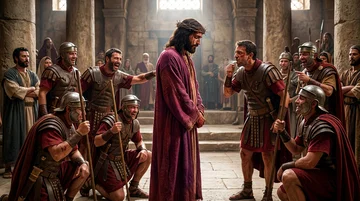
And the soldiers led him away into the hall, called Prætorium; and they call together the whole band.
Translations
And the soldiers led him away into the hall, called Praetorium; and they call together the whole band.
And the soldiers led him away into the hall, called Prætorium; and they call together the whole band.
And the soldiers led him away into the hall, called Pretorium; and they call together the whole band.
And the soldiers led him away into the hall, called Pretorium; and they call together the whole band;
And the soldiers led him away within the court, which is the Praetorium; and they call together the whole band.
And the soldiers led him away within the court, which is the Prætorium; and they call together the whole band.
And the soldiers led him away into the hall, which is Praetorium, and call together the whole band,
And the soldiers led him away into the court which is [ called the] praetorium, and they call together the whole band.
And, the soldiers, led him away, inside the court, which is a judgment-hall,—and called together the whole band;
Berean Standard Bible, Majority Standard Bible
Then the soldiers led Jesus away into the palace ( that is, the Praetorium) and called the whole company together.
The soldiers led him away within the court, which is the Praetorium; and they called together the whole cohort.
And the men of the army took him away into the square in front of the building which is the Praetorium, and they got together all the band.
Then the souldiers led him away into the hall, which is the common hall, and called together the whole band,
Douay-Rheims (Challoner revision)
And the soldiers led him away into the court of the palace, and they called together the whole band:
Pictures
Cross-references
- Matthew 27:27-31
Then the soldiers of the governor took Jesus into the common hall, and gathered unto him the whole band of soldiers.
The soldiers gather, dress Jesus as king, and mock and abuse him.
- John 19:1-3
Then Pilate therefore took Jesus, and scourged him.
Jesus is scourged, crowned with thorns, robed in purple, and mocked by the soldiers.
- John 18:28
Then led they Jesus from Caiaphas unto the hall of judgment: and it was early; and they themselves went not into the judgment hall, lest they should be defiled; but that they might eat the passover.
Jesus is led to the judgment hall before Pilate.
- Mark 15:20-24
And when they had mocked him, they took off the purple from him, and put his own clothes on him, and led him out to crucify him.
Continues Jesus’ journey to Calvary and describes his crucifixion and the soldiers dividing his garments.
- Luke 23:11
And Herod with his men of war set him at nought, and mocked him, and arrayed him in a gorgeous robe, and sent him again to Pilate.
Herod and his soldiers mock Jesus and dress him in a robe.
- John 19:17-18
And he bearing his cross went forth into a place called the place of a skull, which is called in the Hebrew Golgotha:
Jesus is led away carrying the cross and crucified between two others.
- Mark 15:1
And straightway in the morning the chief priests held a consultation with the elders and scribes and the whole council, and bound Jesus, and carried him away, and delivered him to Pilate.
same Pilate trial narrative
- Matthew 27:2
And when they had bound him, they led him away, and delivered him to Pontius Pilate the governor.
Jesus is bound and delivered to Pilate before his condemnation.
- Isaiah 53:5
But he was wounded for our transgressions, he was bruised for our iniquities: the chastisement of our peace was upon him; and with his stripes we are healed.
Jesus’ wounds and scourging bear sins and bring healing.
- Matthew 27:29
And when they had platted a crown of thorns, they put it upon his head, and a reed in his right hand: and they bowed the knee before him, and mocked him, saying, Hail, King of the Jews!
Both describe soldiers mocking Jesus with a reed and a crown of thorns.
- Matthew 27:31-38
And after that they had mocked him, they took the robe off from him, and put his own raiment on him, and led him away to crucify him.
Describes Jesus being led away to be crucified with two criminals.
- Luke 23:13-24
And Pilate, when he had called together the chief priests and the rulers and the people,
Both recount Jesus’ hearing before Pilate and the demand for his crucifixion.
- Luke 23:26
And as they led him away, they laid hold upon one Simon, a Cyrenian, coming out of the country, and on him they laid the cross, that he might bear it after Jesus.
Describes Simon carrying Jesus’ cross after the soldiers take him away.
Commentary
Each commentary is drawn from primary sources: the writings of Ellen G. White and Adventist pioneers and periodicals. Each commentary is separate. Its own words are not a quotation; follow the references to read the source passages.
Ellen G. White
17 sources
The hall called Praetorium is Pilate's judgment hall as Roman governor, where Jesus is led away as a bound prisoner and given into the soldiers' custody while the whole band is called together around Him.Lt 115, 1903, par. 13–14DA 723.1–724.1SG1 50.13SP 138.1–2EW 138.1 This leading away comes after the order to scourge Him and before He is set beside Barabbas and hurried toward Calvary to be crucified amid shouts and jeers.DA 722.55RED 63.13SP 143.1–2 There the gathered soldiers make His claim to kingship a cruel spectacle, clothing Him in a worn purple robe, crowning Him with thorns, putting a reed in His hand for a scepter, hailing Him as King of the Jews with mock worship, spitting on Him and striking Him with the reed until blood runs down His face.Lt 115, 1903, par. 13–14SG1 50.1DA 734.1–5 Already scourged and wounded, He bears it all with calm meekness and patience, refusing to complain or to use His power to escape His Father's will, while Satan works through the hall to destroy sympathy and provoke Him to fail.DA 734.1–53SP 138.1–2EW 138.1 His suffering at the hands of wicked men was necessary to carry out the plan of salvation and pay humanity's ransom, and His patient abasement pledges His exaltation and anointing as the great high priest.DA 734.1–5EW 138.3Lt 1a, 1861, par. 2–5
Praetorium Setting and Sequence
The hall called Praetorium is Pilate's judgment hall as Roman governor, the governor's headquarters and hall.DA 723.1–724.13SP 138.1–2EW 138.13SP 143.1–2Lt 1a, 1861, par. 2–5 Into it Jesus was led away as a bound prisoner and delivered into the soldiers' hands and custody, while the whole band or company of soldiers was called together around Him with the guard about Him.Lt 115, 1903, par. 13–14DA 723.1–724.1SG1 50.13SP 138.1–2Ms 3, 1898, par. 20–21 The hall was fast filling with spectators, while just outside the entrance stood the judges of the Sanhedrim, priests, rulers, elders, and the mob, who would not enter the Roman hall because under their ceremonial law it would defile them and prevent them from taking part in the feast of the Passover.DA 723.1–724.1
The leading into the Praetorium comes after Pilate's decision and order to have Jesus scourged and before He is presented to the crowd beside Barabbas.DA 722.55RED 63.13SP 143.1–2 It belongs to His being led from Pilate's court toward Calvary to be crucified, hurried amid shouts and jeers.DA 722.55RED 63.1COS 155.1 After Herod's suggestion, the gathered soldiers cruelly scourged and abused Him with mock royal treatment that turned His claim to kingship into a spectacle.SG1 50.1DA 734.1–55RED 58.1–23SP 138.1–23SP 148.1
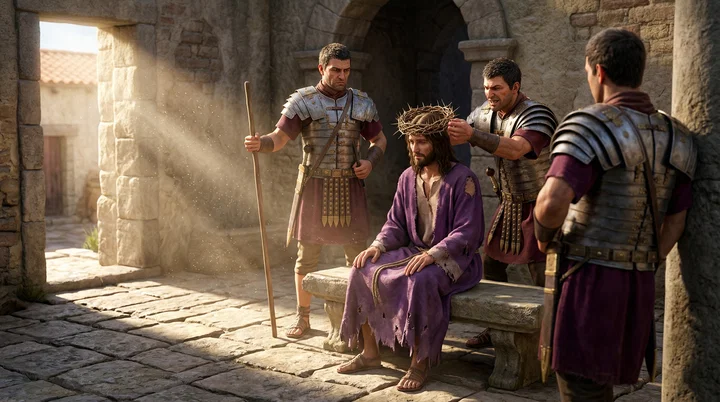
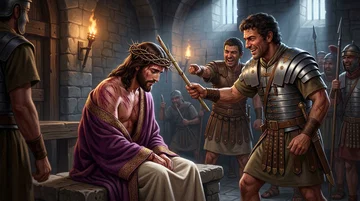
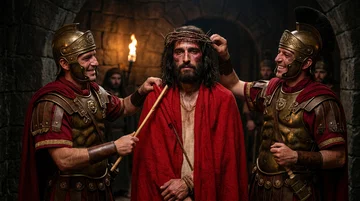
They dressed Him in a purple, tattered and worn robe, crowned Him with thorns, and placed a reed in His hand as a scepter.Lt 115, 1903, par. 13–14SG1 50.1DA 734.1–55RED 58.1–23SP 138.1–2 They hailed Him as King of the Jews and bowed in mock worship.Lt 115, 1903, par. 13–14SG1 50.15RED 58.1–23SP 138.1–23SP 148.1 They spit on Him and struck Him with the reed, driving the thorns into His head, brow, and temples so that blood ran down His face and beard.Lt 115, 1903, par. 13–14SG1 50.1DA 734.1–55RED 58.1–23SP 138.1–2
Meaning, Sacrifice and Response
Already scourged and wounded, Jesus is led into the Praetorium where the whole company gathers to mock and abuse Him, and His calm endurance under their cruelty shows meekness and patience.DA 734.1–53SP 138.1–2 He bears insults and violence without retaliation and without using His power to escape or to depart from His Father's will.DA 734.1–53SP 138.1–2 By that refusal He preserves Himself as the perfect offering for humanity's redemption.DA 734.1–5 The mock royal treatment turns His claim to kingship into a cruel spectacle, with a crown of thorns pressed upon His head, a worn purple robe upon Him, a reed placed in His hand, bowing in mock worship, and blows with the reed driving the thorns into His head.3SP 138.1–2
The judgment hall lies under Satan's influence working to destroy human sympathy.EW 138.1 There chief priests and elders join in insulting and abusing Jesus, while Satan seeks to provoke Him to complain or to use divine power to escape so that the plan of salvation will fail.EW 138.1 As Jesus suffers wearing the crown of thorns, the angels lay aside their crowns.EW 138.1
His suffering at the hands of wicked men was necessary to carry out the plan of salvation and to pay the ransom for humanity.DA 734.1–5EW 138.3Lt 1a, 1861, par. 2–5 It reveals the cost of what He gave up for humanity as He is mocked and insulted and then led away weak and fainting to die.Lt 1a, 1861, par. 2–5 His suffering and abasement also pledge His exaltation and His anointing as the great high priest.DA 734.1–5
In the Praetorium His dignity and patient endurance stand in contrast with Barabbas's hardened criminality.3SP 143.1–2 He is displayed beside Barabbas and scourged as the worst of criminals, while the murderous Barabbas is chosen in place of the beloved Teacher.5RED 63.1ST Jul 7, 1898 The cross prepared for Barabbas is placed upon His bruised, bleeding shoulders, two thieves are taken to be put to death with Him, and He is then lifted up on the cross to die as a malefactor.COS 155.1ST Jul 7, 1898
The crowd that had hailed Him as king turns against Him and cries for His death, showing the fickleness of popular support.4RED 102.2–103.1 His own nation clamors for His blood though they had thought He would take His place on David's throne.ST Jul 7, 1898 He had prepared His faithful disciples for this trial so that the crowd's hostility and the departure of former followers would not take them by surprise or shake their faith.4RED 102.2–103.1
The disciples watch the One in whom their hopes of eternal life are centered descend into the depths of humiliation into the hands of wicked men.ST Jul 7, 1898Lt 1a, 1861, par. 2–5Ms 3, 1898, par. 20–21 They see their beloved Teacher treated as a criminal, dressed in purple, mocked, struck with a reed, crowned with thorns, and led away weak and fainting to die.Lt 1a, 1861, par. 2–5Ms 3, 1898, par. 20–21 This taking away of the Bridegroom gives them cause to mourn and fast, trying their faith and causing their hope and courage to fail.ST Jul 7, 1898Ms 3, 1898, par. 20–21
Sources
Pioneers and periodicals
19 sources
After Pilate gave sentence, the soldiers led Jesus away into the governor's headquarters and called the whole band together around Him to make sport of Him as a pretended king before leading Him out to be crucified.RH Nov 5, 1872RH Dec 9, 1858RH Feb 11, 1862ST Apr 4, 1906 Pilate was convinced He was innocent and proposed to chastise and release Him, but he gave way to the priests, rulers and people crying for Barabbas to be released and for Jesus to be crucified.ST Mar 13, 1901RH Dec 9, 1858 They had Him stripped and scourged till His body was all one wound, then clothed Him in a purple or scarlet robe, crowned Him with thorns, put a reed in His hand for a scepter, and bowed before Him hailing Him King of the Jews while they spit upon Him and smote Him on the cheek and head.ST Dec 17, 1912RH Dec 9, 1858ST Oct 7, 1886RH May 27, 1873ST Jul 14, 1881 He bore it all meekly without anger though He could have delivered Himself, enduring it to redeem the ruined race, and His lowliness in that mock coronation reveals His true kingship while giving the clearest discovery of the exceeding sinfulness of sin.ST Jul 7, 1898RH Nov 5, 1872ST Dec 17, 1912RH May 27, 1873RH Jun 10, 1862 His faithfulness under scorn is the pattern for His followers, and the soldiers' cruel honor that covers His wounds with purple and crowns Him with thorns becomes a picture of how earthly power professes to honor Christ while humiliating, wounding and degrading Him.ST May 21, 1912ST Jan 24, 1906ST Feb 22, 1910RH Jun 20, 1871
Context and Cruel Mockery
The soldiers led Jesus away into the Praetorium, the Roman governor's headquarters, and there after Pilate's sentence they called together around Him the whole band, cohort, or company.RH Feb 11, 1862ST Apr 4, 1906ST Feb 22, 1910ST Feb 16, 1882 The verse belongs to the last scene of Jesus' life on earth in His trial before Pilate and crucifixion, part of the history of Jesus and Pilate in Mark 15:1-20, which is the same history told in Luke 23:13-24.ST Mar 13, 1901RH Jun 10, 1862ST Feb 16, 1882 Pilate, though convinced of Jesus' innocence, declared with Herod that he found no fault in Him worthy of death and proposed to chastise and release Him, but gave way to the demands of priests, rulers, and people who cried away with Jesus, release Barabbas the insurrectionist and murderer, and crucify Jesus, and at last gave sentence that what they asked should be done.ST Mar 13, 1901RH Dec 9, 1858
Pilate ordered Jesus scourged as a preparatory step to execution, having Him scourged in the presence of the multitude in the vain hope of stirring pity so the people would decide punishment was enough.RH Dec 9, 1858ST Oct 7, 1886 Jesus stood stripped to the waist, pale, with long cruel stripes from which blood flowed freely, His face stained with blood and bearing marks of exhaustion and pain, His sacred body all one wound.RH Dec 9, 1858ST Oct 7, 1886RH May 27, 1873 Even in that condition His noble character stood out in marked contrast when He was placed side by side with Barabbas the robber chief, whose every feature proclaimed a debased and hardened desperado, yet the murderous Barabbas was chosen in place of the beloved Teacher.ST Jul 7, 1898ST Oct 7, 1886 The verse begins the soldiers' renewed, wanton mockery in derision of Him as one who aspired or pretended to be a king, before they led Him out to be crucified.RH Nov 5, 1872RH Dec 9, 1858ST Apr 4, 1906ST Jul 14, 1881
They stripped Him and put on Him an old robe of royal color, purple or scarlet, placed a plaited crown of thorns on His head, put a fragile reed in His right hand for a scepter, bowed the knee before Him hailing Him as King of the Jews, spit upon Him, smote Him on the cheek and on the head with the reed, cruelly forcing the thorns to pierce Him on every side, covered with purple the wounds their own hands inflicted, and later inscribed magnificent titles over the cross on which they fixed Him to perish in ignominy and pain.ST Dec 17, 1912RH Dec 9, 1858ST Jul 14, 1881ST May 21, 1912 Exhausted, torn by the scourge, and disfigured with blood from His temples, He was then brought out before the people in hope of pity, but the cry for crucifixion continued until Pilate, threatened with loss of Caesar's friendship and fearing the suspicious and jealous Tiberius Caesar, resisted conscience for worldly interest and ordered the execution to proceed.RH Dec 9, 1858 Such derision was the customary practice toward criminals before and during execution at that time, and the calling together of the whole band to make sport of Christ as a mock king was in imitation of the yearly festival of Saturn, at which the soldiers appointed a mock king, placed royal robes upon him, let him direct the wildest carousals of his subjects for a certain number of days, and then put him to the sword.RH Feb 11, 1862ST Jun 8, 1904 Mock imitations of that riotous Saturnalia celebration were a favorite amusement of the soldiers with condemned culprits handed over to the executioners as objects of sport and with others who had incurred their displeasure.RH Feb 11, 1862ST Jun 8, 1904 The detail is brought in accidentally by slight and distant allusion, flowing naturally and undesignedly out of the progress of the narrative with nothing forced, fetched, or out of place, and it maintains exact consistency with the testimony of other authors and with the manners and institutions of that period; such minute accuracy in subordinate circumstances proves the truth of the Gospel history, since an inventor would not hazard so many points of comparison for detection.RH Feb 11, 1862
Theological Meaning and Application
Jesus in the Praetorium meekly bears the soldiers' treatment without anger or resentment, though He could have delivered Himself, enduring it for the sake of humanity's salvation.RH Nov 5, 1872 Fainting and crushed beneath the load of sin, with His sacred body all one wound, He suffers to redeem the ruined race.RH May 27, 1873
His suffering is part of a mock coronation in Pilate's hall, where the soldiers clothe Him in a scarlet robe, give Him a reed as a scepter, kneel in mock honor, strike Him and jeer at Him.ST Dec 17, 1912 That coronation is marked by suffering rather than worldly triumph, yet His lowliness reveals His kingship and royal lineage.ST Dec 17, 1912 He whom they thought would take His place on David's throne is scourged as the worst of criminals and lifted up on the cross to die as a malefactor, while the murderous Barabbas is chosen in place of the beloved Teacher.ST Jul 7, 1898
What He did and suffered there gives the clearest discovery of the dreadful evil and exceeding sinfulness of sin.RH May 27, 1873 The last scene of His life on earth before Pilate, with its cruelty, mockery and abuse before the crucifixion, shows the cruelty and folly of sin and the character of the world's master.RH Jun 10, 1862
The account shows Him descending into the depths of humiliation as He approached the cross, in the hands of wicked men while His disciples watched Him in whom their hopes of eternal life were centered, with His own nation clamoring for His blood and the whole band called together against Him.ST Jul 7, 1898 He is mocked with a plaited crown of thorns for His sacred brow, clad in a purple robe, bowed before in scorn, and struck with the reed placed in His hand.ST Jul 7, 1898 These details show His extreme humiliation and poverty: He gives up everything and is ultimately stripped of His clothing before being nailed to the cross, as they strip off His garments, dress Him in a scarlet robe, mock Him, and later divide His clothes and cast lots for His vesture.RH Oct 25, 1870
His treatment presents Him as the pattern of faithfulness amid mockery and suffering, set in contrast to professed followers when they avoid the cross because of the scorn faced by those who live by Christian principles.RH Jun 20, 1871 This taking away of the Bridegroom gives the disciples cause to mourn and fast, trying their faith and causing their hope and courage to fail.ST Jul 7, 1898
The soldiers' show of honor hides cruelty, as they bow, hail Him, give Him a reed as a scepter, and crown Him with thorns.ST May 21, 1912 It becomes a picture of how earthly and temporal power treats Christ and Christianity when it professes allegiance and claims to honor while actually humiliating, wounding, degrading and harming.ST May 21, 1912ST Jan 24, 1906 Bowing before Him in ridicule, striking Him, putting a fragile reed in His hand, crowning Him with thorns, covering His wounds with purple, and leading Him to the cross disguises cruelty as honor and conceals contempt under apparent honor.ST Feb 22, 1910
The verse's setting thus becomes a picture of Christianity's danger when earthly power joins itself to the church, offering it authority and honors while corrupting and persecuting it.ST Feb 22, 1910 Those who thrust temporal sovereignty upon Christianity repeat the prototypes' treatment of her Author, bowing the knee and spitting, crying Hail while smiting on the cheek, putting a fragile reed in the hand for a scepter, crowning with thorns, covering with purple the wounds their own hands inflicted, and inscribing magnificent titles over the cross on which they fixed Him to perish in ignominy and pain.ST Apr 3, 1928 Alliance with civil power corrupts her far more than opposition crushes her.ST Apr 3, 1928
Sources