Luke 23:11
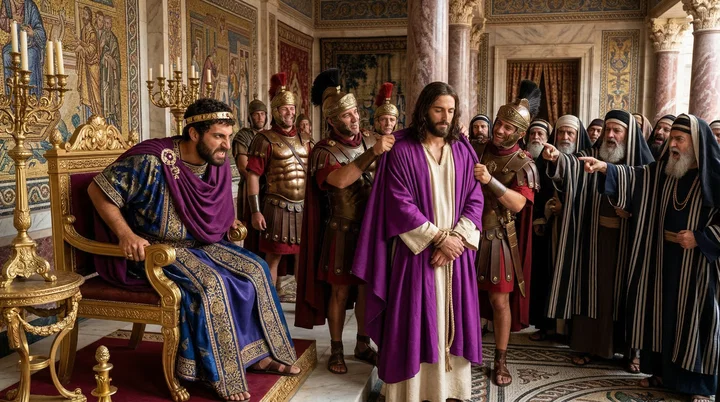
And Herod with his men of war set him at nought, and mocked him, and arrayed him in a gorgeous robe, and sent him again to Pilate.
Translations
And Herod with his men of war set him at nothing, and mocked him, and arrayed him in a gorgeous robe, and sent him again to Pilate.
King James Version, KJV Cambridge Paragraph Bible
And Herod with his men of war set him at nought, and mocked him, and arrayed him in a gorgeous robe, and sent him again to Pilate.
And Herod with his troops set him at naught, and mocked him, and arrayed him in a gorgeous robe, and sent him again to Pilate.
Revised Version, American Standard Version
And Herod with his soldiers set him at nought, and mocked him, and arraying him in gorgeous apparel sent him back to Pilate.
and Herod with his soldiers having set him at nought, and having mocked, having put around him gorgeous apparel, did send him back to Pilate,
And Herod with his troops having set him at nought and mocked him, having put a splendid robe upon him, sent him back to Pilate.
And Herod with his soldiery, having set him at nought, and mocked him, threw about him a gorgeous robe, and sent him back unto Pilate.
Berean Standard Bible, Majority Standard Bible
And even Herod and his soldiers ridiculed and mocked Him. Dressing Him in a fine robe, they sent Him back to Pilate.
Herod with his soldiers humiliated him and mocked him. Dressing him in luxurious clothing, they sent him back to Pilate.
And Herod, with the men of his army, put shame on him and made sport of him, and dressing him in shining robes, he sent him back to Pilate.
And Herod with his men of warre, despised him, and mocked him, and arayed him in white, and sent him againe to Pilate.
Douay-Rheims (Challoner revision)
And Herod with his army set him at nought, and mocked him, putting on him a white garment, and sent him back to Pilate.
Pictures
Cross-references 20 of 30
- Matthew 27:27-31
Then the soldiers of the governor took Jesus into the common hall, and gathered unto him the whole band of soldiers.
Jesus is dressed in a robe and mocked as king before his crucifixion.
- John 19:1-3
Then Pilate therefore took Jesus, and scourged him.
Describes Jesus being dressed and mocked as king.
- Mark 15:16-20
And the soldiers led him away into the hall, called Prætorium; and they call together the whole band.
Soldiers mock Jesus, dress him in a robe, and lead him away.
- Acts 4:27
For of a truth against thy holy child Jesus, whom thou hast anointed, both Herod, and Pontius Pilate, with the Gentiles, and the people of Israel, were gathered together,
Herod and Pilate are named among those gathered against Jesus.
- John 18:33-38
Then Pilate entered into the judgment hall again, and called Jesus, and said unto him, Art thou the King of the Jews?
Pilate questions Jesus about his kingship and truth, then finds no fault in him.
- Mark 6:17-29
For Herod himself had sent forth and laid hold upon John, and bound him in prison for Herodias’ sake, his brother Philip’s wife: for he had married her.
Herod’s imprisonment and execution of John explain his later treatment of Jesus.
- Luke 23:33
And when they were come to the place, which is called Calvary, there they crucified him, and the malefactors, one on the right hand, and the other on the left.
The Herod-Pilate journey leads to Jesus’ crucifixion at Calvary.
- Matthew 14:3
For Herod had laid hold on John, and bound him, and put him in prison for Herodias’ sake, his brother Philip’s wife.
Herod had imprisoned John for reproving his unlawful marriage.
- Matthew 27:19
When he was set down on the judgment seat, his wife sent unto him, saying, Have thou nothing to do with that just man: for I have suffered many things this day in a dream because of him.
Pilate’s wife warns that Jesus is just, but her warning is overborne.
- Luke 9:7-9
Now Herod the tetrarch heard of all that was done by him: and he was perplexed, because that it was said of some, that John was risen from the dead;
Herod wonders whether Jesus is John risen from the dead.
- Matthew 27:2
And when they had bound him, they led him away, and delivered him to Pontius Pilate the governor.
Both recount Jesus’ trial before the Roman authorities.
- John 19:16-17
Then delivered he him therefore unto them to be crucified. And they took Jesus, and led him away.
Jesus is condemned and led away to be crucified, bearing His cross.
- John 19:22
Pilate answered, What I have written I have written.
Pilate’s written declaration follows the proceedings involving Herod.
- Isaiah 53:7
He was oppressed, and he was afflicted, yet he opened not his mouth: he is brought as a lamb to the slaughter, and as a sheep before her shearers is dumb, so he openeth not his mouth.
Jesus remains silent in submissive suffering before his hostile judge.
- Matthew 27:42
He saved others; himself he cannot save. If he be the King of Israel, let him now come down from the cross, and we will believe him.
same Jesus mocked on cross as before Herod
- Matthew 26:67-68
Then did they spit in his face, and buffeted him; and others smote him with the palms of their hands,
Describes earlier insults and mockery of Jesus.
- Matthew 27:28
And they stripped him, and put on him a scarlet robe.
Both describe Christ being clothed in a robe while mocked.
- John 19:7-8
The Jews answered him, We have a law, and by our law he ought to die, because he made himself the Son of God.
Jesus’ claim to be the Son of God increased Pilate’s fear during the trial.
- Luke 23:1-2
And the whole multitude of them arose, and led him unto Pilate.
The accusers bring Jesus to Pilate and charge him with opposing Caesar.
- Luke 23:5
And they were the more fierce, saying, He stirreth up the people, teaching throughout all Jewry, beginning from Galilee to this place.
The accusation that Jesus stirred up the people from Galilee helps explain Pilate’s decision to send Him to Herod.
Commentary
Each commentary is drawn from primary sources: the writings of Ellen G. White and Adventist pioneers and periodicals. Each commentary is separate. Its own words are not a quotation; follow the references to read the source passages.
Ellen G. White
27 sources
Pilate sends Jesus to Herod the ruler of Galilee to shift responsibility for the trial, one transfer in a night-long succession from ruler to ruler before condemnation and crucifixion.COS 141.2–3ST Nov 30, 1882Ms 95, 1897, par. 10–12 Herod with his soldiers treats him with contempt, mocking him and arraying him in a gorgeous white royal robe to turn his claim to be king into humiliation, then sends him back to Pilate, and the two rulers become friends that day.COS 145.2–3Ms 112, 1897, par. 13–17ST Jan 24, 1900 Herod knows malice and envy have led the Jews to condemn an innocent man, yet demands a miracle to satisfy curiosity, while Jesus answers nothing and will not use divine power to please wicked men or spare himself suffering.COS 145.2–3Ms 112, 1897, par. 13–17ST Nov 2, 1882SG1 55.1–23SP 135.2 His dignified silence and godlike endurance astonish Herod and convict his heart, so that though he finds nothing to condemn he dares not decide and sends Jesus back to Pilate rather than accept responsibility.SG1 55.1–2DA 731.1–55RED 59.2 Those who mocked his royal claim will see their deeds again in the judgment, in stark contrast to the glory of the same prisoner who rises from the tomb and now intercedes in heaven for those who refused him.ST Jan 24, 1900GC 643.1–24SP 481.2–482.2
Trial Before Herod
Pilate sent Jesus to Herod, the ruler of Galilee, to shift responsibility for the trial, when Jesus was already faint from hunger, lack of sleep, and cruel treatment.COS 141.2–3 This sending was one stage in repeated transfers among earthly rulers and tribunals before condemnation and crucifixion.ST Nov 30, 1882 It belonged to a night-long succession from Annas to Caiaphas to Pilate to Herod and back to Pilate, from insult to renewed insult and from mockery to mockery, including being twice tortured by the scourge.Ms 95, 1897, par. 10–12
Jesus was brought before Herod in the midst of a pressing mob crying different charges against Him.5RED 55.2 Herod ordered the crowd to be silent and had Jesus unbound so He could be questioned.3SP 135.25RED 55.2ST Nov 2, 1882 The Jewish priests and rulers pressed the Roman governor to carry out their will against Him, encouraged the insults and cruelty, and stirred the soldiers to ridicule Christ.ST Jan 24, 1900RH Nov 11, 1915 That cruelty was stirred by Satan.Ms 112, 1897, par. 13–17
Herod, like Pilate, knew from acquaintance with the character of the Jews that malice and envy had led them to condemn an innocent man.3SP 135.25RED 55.2ST Nov 2, 1882 His angry accusation that Jesus was an impostor was false in light of Jesus' mighty works, which His accusers knew.COS 145.2–3 He demanded a miracle to satisfy curiosity and to secure Jesus' release.ST Nov 2, 1882 He looked with curiosity mixed with pity on a pale, sad face marked with deep wisdom and purity yet showing extreme weariness and suffering.5RED 55.2ST Jun 3, 1889
Herod's hardness had grown after he ignored the teaching of John the Baptist and ordered John killed to please Herodias.COS 144.2–3 To set at nought means to treat with contempt: Herod with his men of war mocked Jesus, arrayed Him in a gorgeous, splendid, royal robe to humiliate His claim to be king, and sent Him back to Pilate.COS 145.2–3Ms 112, 1897, par. 13–17ST Jan 24, 1900SG1 55.1–2DA 731.1–5 The robe is elsewhere specified as white, and was a sign of mockery, not honor.DA 731.1–5EW 142.1–2 Herod and Pilate became friends that day though they had previously been enemies.Ms 112, 1897, par. 13–17
The fuller account of the mockery staged a false act of worship that turned kingship into a joke, with a mock throne and scepter and further abuse by the crowd.3SP 138.1–2 They plaited the crown of thorns for His sacred brow, clad Him in the purple robe, bowed before Him in mockery, and struck Him with the reed they had placed in His hand.ST Jul 7, 1898 He stood there with His form already lacerated by the cruel scourge.DA 780.3 While some bowed before Jesus in mockery, others who came forward for the same purpose saw a look so like a king and turned back ashamed of their own audacity.5RED 59.2
Christ's Silent Endurance
Having taken human nature, Jesus would not work a miracle to gratify wicked men nor to spare Himself suffering and humiliation, and He would not answer Herod's questions nor put forth divine power for His own benefit or protection.ST Nov 2, 1882SG1 55.1–2DA 731.1–5EW 142.1–2 He endured contempt and insult without reproach, with divine patience, dignified composure and unparalleled passive serenity, and His submission to what men did to Him was humanity's only hope.Ms 112, 1897, par. 13–17DA 731.1–55RED 59.2ST Jun 3, 1889 Through the disgraceful farce of a trial He failed not, spoke no word but what tended to glorify God, and uttered not one syllable more than was essential.Ms 112, 1897, par. 13–17ST Nov 2, 1882
His noble, godlike appearance astonished Herod, and His silence spoke conviction to Herod's heart such as no words could have done.SG1 55.1–25RED 59.2EW 142.1–2 Herod's perception that Jesus was no common man convicted him, and he was moved with sudden fear and perplexity as he looked upon the prisoner's pure, pale face, questioning whether He might be a heavenly being or a god come down to earth.5RED 59.2ST Jun 3, 1889COS 145.4–5 While some bowed before Jesus in mockery, others who came forward for the same purpose looked into the sufferer's face, saw there a look so like a king, and turned back ashamed of their own audacity.5RED 59.2 He bore this humiliation in silence and remained unmoved despite Herod's anger and threats.COS 145.4–5COS 144.2–3
Herod found nothing in Jesus to condemn, yet mocked Him and heaped every insult upon Him.SG1 55.1–2DA 731.1–5EW 142.1–2 Hardened and ill at ease, he feared to condemn Him and dared not ratify the condemnation of the Jews, so rather than accept responsibility he sent Jesus back to Pilate.SG1 55.1–2DA 731.1–55RED 59.2ST Jun 3, 1889COS 145.4–5
Judgment and Faithful Witness
Those who joined in the insults and cruelty encouraged by the Jewish priests stirring the soldiers to ridicule will one day see their own words and actions as in a mirror, when it will be too late to undo them.ST Jan 24, 1900 Their mocking of the royal claim by the splendid robe and sending back to Pilate stands in stark contrast to the glory and authority later displayed, and in the judgment scene that treatment is replayed so that Herod sees the guilt of his part in the events leading to death.GC 643.1–24SP 481.2–482.2 The unresisting prisoner with form already lacerated by the cruel scourge is the same one afterward seen in the judgment hall and the same glorified being who came forth from Joseph's new tomb when heaven's decree loosed Him, whom no mountains piled over the sepulcher could have kept from rising.DA 780.3 Though condemned and mocked before Herod and Pilate, He is now in heaven interceding for those who refused Him, and His death will bring judgment on the world.Lt 31, 1898, par. 36
The robe put on in insult was a sign of mockery, not honor, and that humiliation gives an example for accepting shame rather than denying faith.GC 108.4–109.1 This was recalled by Huss when he was dressed in a priestly, white robe during his own degradation before being sent onward.GC 108.4–109.1GC88 108.3–109.1
The trial and humiliation before crucifixion was foreknown as betrayal, condemnation, and public scorn that would test the disciples, whose earlier experience of followers turning away prepared them not to be surprised nor to base faith on the crowd's changing opinions.4RED 102.2–103.1 His experience shows faithfulness to God standing against human power used to support evil, when Jewish priests and rulers pressed the Roman governor to carry out their will against Him.RH Nov 11, 1915 As He approached the cross He entered depths of humiliation in which the disciples saw Him in whom their hopes of eternal life were centered in the hands of wicked men, with His own nation clamoring for His blood, mocked with plaited crown of thorns for His sacred brow, purple robe, bowing in mockery, and striking with the reed placed in His hand.ST Jul 7, 1898 Seen by those who thought He was to take His place on David's throne, this shaming with scourging as the worst of criminals, choosing of the murderous Barabbas in place of their beloved Teacher, and lifting up on the cross to die as a malefactor gave cause to mourn and fast, tried their faith, and caused hope and courage to fail.ST Jul 7, 1898
Sources
Pioneers and periodicals
43 sources
Herod Antipas, the ruler of Galilee who had murdered John the Baptist, received Jesus when Pilate sent him as a Galilean, and with his soldiers treated him with contempt, mocked him, dressed him in a splendid royal robe in scorn of his kingship, and sent him back to Pilate to leave the decision to him.RH Nov 12, 1861ST Oct 28, 1913RH Jul 16, 1861RH Feb 11, 1862ST Jan 17, 1911 To set him at nought was to reject and despise him, and the gorgeous robe was an old purple garment put on to mock his claim to be King, a mockery continued in the crowning with thorns.ST Jan 13, 1898RH Jun 10, 1862 Jesus would not work a miracle to gratify curiosity or spare himself, but stood silent with unparalleled serenity and patient endurance without anger or revenge, and his silence convicted Herod and made him fear he was more than a common man.ST Nov 2, 1882ST Jun 3, 1889RH Jun 15, 1911 Herod, like Pilate, found him worthy of no punishment and dared not ratify his condemnation, yet the two rulers became friends in joining to reject an innocent man, and Pilate yielded his authority to the mob and sent him to be crucified.RH Nov 11, 1915ST Oct 27, 1898ST Mar 28, 1906RH Dec 3, 1857 His being despised and mocked fulfills Psalm 22:6, and belongs to his great sacrifice for a lost race on the way to Calvary, in which he submitted silently as a lamb though his rights extended over the universe, leaving his followers to bear insult after him rather than contend for their own rights.RH Jun 24, 1858ST Aug 21, 1907RH Jul 15, 1875
Trial Setting and Wording
The Herod of this verse is Herod Antipas, the ruler of Galilee, the same ruler who had murdered John the Baptist.RH Nov 12, 1861ST Jan 17, 1911ST Feb 7, 1911 Pilate sent Jesus to him because Jesus was a Galilean under his jurisdiction, and Herod then returned him to Pilate, leaving the decision of his fate to Pilate.RH Jul 16, 1861ST Jan 17, 1911 Herod was a weak and wicked ruler whom Jesus' enemies sought to use against him, and although he would have preferred to put Jesus to death, he feared that doing so might lessen his standing with Caesar.RH Jul 16, 1861
The verse belongs to Jesus' repeated transfer among earthly rulers and tribunals before condemnation and crucifixion, involving Herod as well as Pilate and the Jewish high priest, with execution carried out by the Romans.ST Nov 30, 1882ST Mar 15, 1877 Jesus was brought before Herod amid accusations, and Herod had him unbound so he could question him.ST Jun 3, 1889ST Nov 2, 1882 He looked with curiosity and pity on his pale, sad, weary, suffering face marked with wisdom and purity.ST Jun 3, 1889 The taking of Jesus to Herod is distinctive to Luke's account, not recorded by the other evangelists, and its circumstantial details fit the customs and events of the period.RH Feb 11, 1862ST Apr 28, 1909
Herod with his soldiers treated Jesus with contempt, mocked him, dressed him in a splendid robe, and sent him back to Pilate, showing the humiliation Jesus endured at the hands of those in power.ST Oct 28, 1913RH Feb 11, 1862ST Feb 7, 1911RH Dec 9, 1858ST Mar 13, 1901 Herod then sent Jesus back to Pilate without condemning him, and this return without condemnation was part of that humiliation and cruelty during the trial.ST Mar 28, 1906RH Dec 9, 1858 The unmerited torture and mockery were suffered despite innocence being declared.ST Mar 13, 1901 "Set at nought" means they rejected and despised him.
The gorgeous robe was a splendid, royal, old purple robe put on in scorn, mocking Jesus' claim to be a King.ST Jan 13, 1898RH Jun 10, 1862 That mockery was continued in the crowning with thorns before the crucifixion.ST Jan 13, 1898 Making light of sin in this way is a way of scorning the suffering of the Son of God, and the scene displays the cruelty and folly of sin.RH Jun 10, 1862 After a night with no rest Jesus was hurried travel-stained, weary, footsore, bruised and lacerated from one proud ruler to another amid a shouting crowd.ST Oct 31, 1916 In that going to Herod and returning he was buffeted, smitten with palms, spit in the face, sneered at about the shame of his birth, scourged, and demanded to perform a miracle, though he had committed no fault.ST Oct 31, 1916ST Jun 18, 1912
Christ's Bearing Under Contempt
Jesus would not work mighty deeds merely to display power or to gratify a king.ST Nov 2, 1882 Herod demanded a miracle from him to satisfy curiosity and to secure a ground for releasing him.ST Nov 2, 1882 Having taken human nature, he would not work a miracle to please wicked men or to spare himself suffering and humiliation.ST Nov 2, 1882 His refusal to answer was followed by Herod's mockery and contempt, and Herod sent him back to Pilate.ST Nov 2, 1882
He stood silently before Herod, submitting passively to every indignity with unparalleled serenity.ST Nov 2, 1882ST Jun 3, 1889 He endured contempt and mocking by Herod and his soldiers in complete silence without a word of complaint.ST Nov 2, 1882ST Jun 3, 1889RH Jun 15, 1911 That silence convicted Herod and made him fear that Jesus was not a common man but perhaps a god come down to earth.ST Jun 3, 1889 Herod could not understand such endurance but wondered at it as Pilate marveled at it.ST Nov 2, 1882RH Jun 15, 1911
He patiently endured the contempt and mockery as they abused him in Herod's hall.RH May 26, 1868 He remained composed and cheerful while Herod and his soldiers treated him with contempt, mocked him, dressed him in a splendid robe, and sent him back to Pilate.RH Aug 25, 1859 When ridiculed and abused in the presence of Herod and Pilate he showed no anger and sought no revenge. He did not retaliate but prayed for his persecutors, remaining unresentful and unresisting under indignity and insult.
Innocent Declared Yet Condemned
Herod had Jesus unbound so that he could question him, and looked with curiosity and pity on his pale, sad, weary, suffering face marked with wisdom and purity.ST Jun 3, 1889ST Nov 2, 1882 Like Pilate, Herod knew that malice and envy had led the Jews to condemn an innocent man.ST Jun 3, 1889ST Nov 2, 1882 Jesus submitted passively to every indignity with unparalleled serenity and answered only with silence, and that silence convicted Herod and made him fear Jesus was not a common man but perhaps a god come down to earth.ST Jun 3, 1889 Troubled and ill at ease, Herod dared not ratify the condemnation of the Jews and sent Jesus back to Pilate.ST Jun 3, 1889
Herod with his soldiers treated Jesus with contempt and mocked him by dressing him in a splendid robe, then sent him back to Pilate without condemning him, finding him worthy of no punishment.ST Oct 27, 1898ST Mar 28, 1906ST Mar 13, 1901 In this Herod joined Pilate in declaring Jesus innocent under law and justice, so that the torture and mockery were unmerited suffering by one declared innocent.ST Oct 27, 1898ST Mar 13, 1901 Pilate found no evidence of crime, Christ's dignified bearing was unlike that of common criminals, the Jews clamored for death on unproved charges and chose Barabbas without retaliation from Jesus, and repeated efforts to release the innocent man were met with fresh malignity.ST Oct 27, 1898 Herod's verdict stands as part of God's presentation of the gospel in glorious perfection to Rome in Pilate, to convince him that before him stood one more than man and to appeal to him to do right whatever the consequences, though he still feared the Jews.ST Oct 27, 1898
Prejudice and the pressure of the crowd turned Pilate away from the truth, so that although he had declared Jesus innocent he sent him to be crucified as a criminal.ST Aug 20, 1896 The cruel temper and overbearing cruelty and ridicule at Herod's bar joined the fury of the Jews and the determination of the Jewish rulers and the popular clamor, with his wife's warnings overborne, and overcame Pilate's weaker resolve.ST Oct 12, 1876 Pilate had power to defend Jesus from the injustice of the mob and the envy of the priests and intended to do so, but he yielded his authority to the mob and Jesus was crucified.ST Oct 12, 1876 He could have stopped the ridicule and allowed Jesus to be heard in his defense, but did not.ST Oct 12, 1876
Pilate and Herod became friends in one day and joined in rejecting Jesus, though they could not say what he was guilty of.RH Oct 20, 1859 The Jewish priests and rulers pressed the Roman governor to carry out their will against him.RH Nov 11, 1915 His experience shows faithfulness to God standing against human power used to support evil, and Herod's treatment of him is an example of unjust authority.RH Nov 11, 1915RH Dec 3, 1857
Prophecy Sacrifice and Triumph
Herod with his men setting Christ at nought and mocking him fulfills Psalm 22:6, in which Christ is a reproach of men and despised of the people.RH Jun 24, 1858 Herod and Pilate acted together under pagan Rome, the fourth head of the Satan-controlled beast system of government that succeeded Grecia in dealing with God's people in B.C. 161.ST Jun 27, 1911 Satan knew the man child was to be born and stirred up pagan Rome under Herod and Pilate to do his will and destroy Jesus, the hope of the race, but the attempt failed.ST Jun 27, 1911
The cruel mocking in Herod's court was one step of sacrifice in Jesus' earthly life for a lost and sinful race. It belongs with his temptation in the wilderness, prayers during long cold nights, and giving of life in teaching and healing. It belongs with his agony of Gethsemane, trials before Annas and Caiaphas, scourging and crowning with thorns, and unjust condemnation at last. It belongs with his journey from the Roman praetorium to the cross and his crucifixion and death as King of the Jews in the great all-comprehending divine sacrifice for fallen man.
The contempt, mockery, and humiliation in Herod's hall were part of the insults and cruelty Jesus endured while giving his life for a sinful and ruined world.ST Aug 21, 1907ST Jul 14, 1881RH Mar 12, 1872 Herod and his soldiers treated him with contempt and mocked him and dressed him in a splendid robe before sending him back to Pilate on the way toward Calvary.ST Aug 21, 1907ST Jul 14, 1881 That suffering was accepted for helpless people, including those who would not believe in him as Saviour, and his humiliation and suffering in Herod's hall were endured for sinners.ST Aug 21, 1907RH Mar 12, 1872
The verse shows the depths of humiliation Christ entered as he approached the cross, when the disciples saw him in whom their hopes of eternal life were centered in the hands of wicked men with his own nation clamoring for his blood.ST Jul 7, 1898 Mocked by Herod and his soldiers, clad in purple, crowned with thorns, bowed to in mockery, and struck with the reed, he was scourged as the worst of criminals.ST Jul 7, 1898 Set aside for the murderous Barabbas and lifted on the cross as a malefactor, the shaming gave cause to mourn and fast, tried their faith, and caused their hope and courage to fail.ST Jul 7, 1898 Though Jesus was mocked and put to death, truth lives on despite the apparent triumph of injustice.RH Aug 12, 1873
Warning and Example for Believers
The contempt poured out in Herod's judgment hall sets the measure for believers, for the insults and slander they suffer are lesser by comparison.RH Mar 15, 1860 Though his rights extended over the whole universe and it was in his power to maintain them, he did not stand up for them when misused but submitted silently as a lamb led to the slaughter.RH Jul 15, 1875 His followers, when misused and run over, must follow that same example rather than contend for their own rights, bearing the cross after him.RH Jul 15, 1875
The Jewish priests encouraged the insults and cruelty, stirring the soldiers to ridicule him.ST Jan 24, 1900 Those who took part in that ridicule will one day see their words and actions as in a mirror, but then it will be too late to undo them.ST Jan 24, 1900 Herod himself stands as an example of a sinner who is sorry yet continues in sin, whose sorrow is not the brokenness that comes from repentance.RH Sep 22, 1863
The abuse was cruel treatment of God's beloved Son by his murderers, endured in complete silence without a word of complaint, an endurance at which Herod wondered as Pilate marveled.RH Jun 15, 1911 Yet God the Father loved even those men and afterward sent them blessing through the risen Jesus to turn them from their wrongdoing.RH Jun 15, 1911 The scene displays the cruelty and folly of sin, and to make light of sin is to scorn the suffering of the Son of God.RH Jun 10, 1862 His appearance before Herod's court belongs to his example of going among people of every rank and circumstance and doing what he could for them, and his humility before Pilate stands contrasted with the Pope.ST Jul 9, 1894RH Dec 28, 1911
Sources