Matthew 27:29
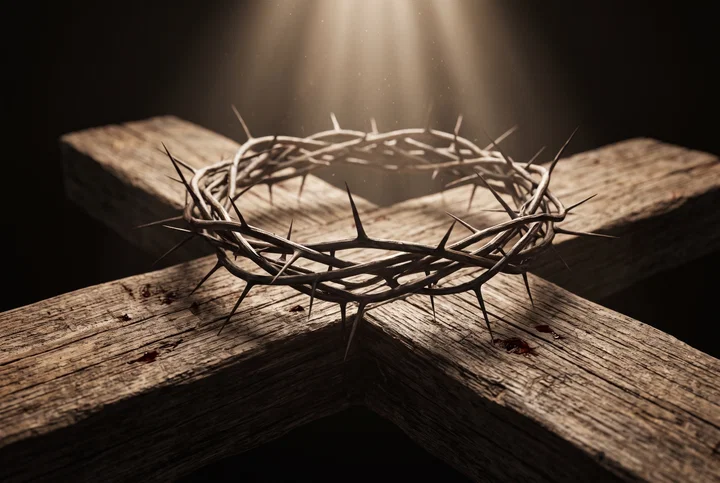
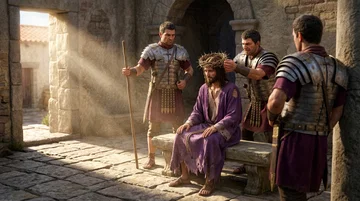
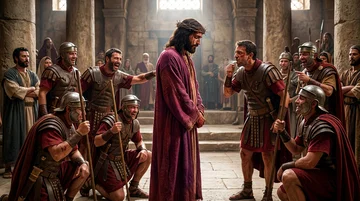
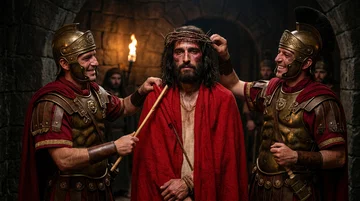
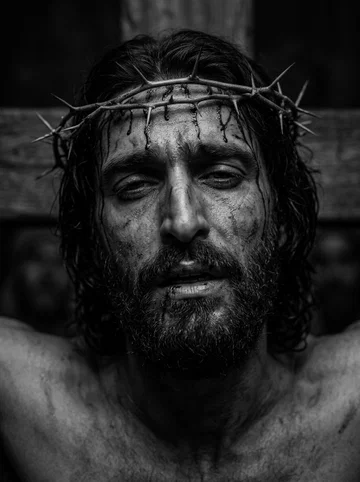
And when they had platted a crown of thorns, they put it upon his head, and a reed in his right hand: and they bowed the knee before him, and mocked him, saying, Hail, King of the Jews!
Translations
And when they had platted a crown of thorns, they put it on his head, and a reed in his right hand: and they bowed the knee before him, and mocked him, saying, Hail, King of the Jews!
King James Version, KJV Cambridge Paragraph Bible
And when they had platted a crown of thorns, they put it upon his head, and a reed in his right hand: and they bowed the knee before him, and mocked him, saying, Hail, King of the Jews!
And when they had platted a crown of thorns, they put it upon his head, and a reed in his right hand: and they bowed the knee before him, and mocked him, saying, Hail, King of the Jews?
And they plaited a crown of thorns and put it upon his head, and a reed in his right hand; and they kneeled down before him, and mocked him, saying, Hail, King of the Jews!
And they platted a crown of thorns and put it upon his head, and a reed in his right hand; and they kneeled down before him, and mocked him, saying, Hail, King of the Jews!
and having plaited him a crown out of thorns they put [it] on his head, and a reed in his right hand, and having kneeled before him, they were mocking him, saying, 'Hail, the king of the Jews.'
and having woven a crown out of thorns, they put it on his head, and a reed in his right hand; and, bowing the knee before him, they mocked him, saying, Hail, King of the Jews!
and, plaiting a crown out of thorns, they put it upon his head, and a reed in his right hand,—and, kneeling before him, began to mock him, saying—Joy to thee, King of the Jews!
And they twisted together a crown of thorns and set it on His head. They put a staff in His right hand and knelt down before Him to mock Him, saying, “ Hail, King of the Jews!”
And they twisted together a crown of thorns and set it on His head. They put a staff in His right hand, knelt down before Him, and mocked Him, saying, “ Hail, King of the Jews!”
They braided a crown of thorns and put it on his head, and a reed in his right hand; and they kneeled down before him and mocked him, saying, “ Hail, King of the Jews!”
And they made a crown of thorns and put it on his head, and put a rod in his right hand, and they went down on their knees before him, and made sport of him, saying, Long life to the King of the Jews.
And platted a crowne of thornes, and put it vpon his head, and a reede in his right hand, and bowed their knees before him, and mocked him, saying, God saue thee King of the Iewes,
Douay-Rheims (Challoner revision)
And platting a crown of thorns, they put it upon his head, and a reed in his right hand. And bowing the knee before him, they mocked him, saying: Hail, king of the Jews.
Pictures
Cross-references 20 of 51
- John 19:2-3
And the soldiers platted a crown of thorns, and put it on his head, and they put on him a purple robe,
The soldiers crown Jesus with thorns and mock him as king.
- Mark 15:17-19
And they clothed him with purple, and platted a crown of thorns, and put it about his head,
Describes the soldiers’ crown of thorns, mock homage, and blows.
- Isaiah 53:5
But he was wounded for our transgressions, he was bruised for our iniquities: the chastisement of our peace was upon him; and with his stripes we are healed.
prophesied wounding and bruising fulfilled here
- Genesis 3:18
Thorns also and thistles shall it bring forth to thee; and thou shalt eat the herb of the field;
The ground’s curse produces thorns, which Christ wears.
- Isaiah 53:3
He is despised and rejected of men; a man of sorrows, and acquainted with grief: and we hid as it were our faces from him; he was despised, and we esteemed him not.
The thorn-crowned Christ is mocked and despised, the Man of Sorrows.
- Luke 23:11
And Herod with his men of war set him at nought, and mocked him, and arrayed him in a gorgeous robe, and sent him again to Pilate.
Herod and his soldiers mocked Jesus and dressed him in a robe.
- Matthew 27:42
He saved others; himself he cannot save. If he be the King of Israel, let him now come down from the cross, and we will believe him.
The rulers mocked Jesus at the cross, recalling the earlier mockery.
- 1 Peter 5:4
And when the chief Shepherd shall appear, ye shall receive a crown of glory that fadeth not away.
Christ’s crown of thorns contrasts with the unfading crown of glory to come.
- Isaiah 53:7
He was oppressed, and he was afflicted, yet he opened not his mouth: he is brought as a lamb to the slaughter, and as a sheep before her shearers is dumb, so he openeth not his mouth.
Jesus endures mockery in silence like the meek Lamb.
- Matthew 26:67
Then did they spit in his face, and buffeted him; and others smote him with the palms of their hands,
Both describe Jesus being struck, spat upon, and mocked.
- Psalms 22:16
For dogs have compassed me: the assembly of the wicked have inclosed me: they pierced my hands and my feet.
Its pierced hands and feet recall Jesus’ suffering.
- Matthew 27:35
And they crucified him, and parted his garments, casting lots: that it might be fulfilled which was spoken by the prophet, They parted my garments among them, and upon my vesture did they cast lots.
The crucifixion joins Jesus’ nail-pierced hands and feet with his thorn-crowned brow.
- John 18:36
Jesus answered, My kingdom is not of this world: if my kingdom were of this world, then would my servants fight, that I should not be delivered to the Jews: but now is my kingdom not from hence.
Christ’s kingdom is contrasted with earthly rule and splendor.
- Philippians 2:8
And being found in fashion as a man, he humbled himself, and became obedient unto death, even the death of the cross.
Christ humbled himself, enduring shame and suffering unto death.
- John 19:17
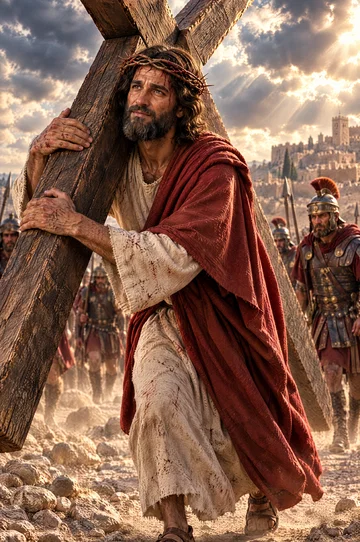
And he bearing his cross went forth into a place called the place of a skull, which is called in the Hebrew Golgotha:
Jesus was crowned with thorns before bearing the cross to Calvary.
- Galatians 3:13
Christ hath redeemed us from the curse of the law, being made a curse for us: for it is written, Cursed is every one that hangeth on a tree:
Christ bears the curse to redeem humanity.
- Revelation 19:12
His eyes were as a flame of fire, and on his head were many crowns; and he had a name written, that no man knew, but he himself.
contrasts thorns with diadem of glory
- Revelation 2:10
Fear none of those things which thou shalt suffer: behold, the devil shall cast some of you into prison, that ye may be tried; and ye shall have tribulation ten days: be thou faithful unto death, and I will give thee a crown of life.
Christ’s crown of thorns contrasts with the crown promised to the faithful.
- Matthew 21:9
And the multitudes that went before, and that followed, cried, saying, Hosanna to the Son of David: Blessed is he that cometh in the name of the Lord; Hosanna in the highest.
The crowd welcomed Jesus as king before mocking him.
- Hebrews 12:3
For consider him that endured such contradiction of sinners against himself, lest ye be wearied and faint in your minds.
Jesus endured sinners’ hostility, including their mockery and abuse.
Commentary
Each commentary is drawn from primary sources: the writings of Ellen G. White and Adventist pioneers and periodicals. Each commentary is separate. Its own words are not a quotation; follow the references to read the source passages.
Ellen G. White
61 sources
The verse pictures a mock coronation in the judgment hall before the crucifixion, where a platted crown of thorns was set on his head, a reed was placed in his right hand for a scepter, and his tormentors bowed the knee and hailed him as King of the Jews in pretended honor and derision.Ms 29, 1909, par. 185RED 58.1–2SG1 50.1 The mockery went further in putting an old purple robe on him, striking him on the head with the reed so the thorns pierced his temples and blood ran down his face and beard, with smiting and spitting by hardened soldiers and a stirred-up multitude.SG1 50.13SP 138.1–21T 240.2 He bore it all with patient dignity and meekness without murmur or retaliation, restraining the divine power by which he could have called angels, paralyzed his smiters and freed himself, because using that power to escape would have frustrated the plan of salvation.3SP 143.1–2ST Jul 11, 1878SG1 49.1 He suffered thus as the just for the unjust with the sins of the whole world upon him, joined to the garden agony, scourging and cross, to redeem sinners by his blood, bear guilt as the Sin-bearer and open the way of salvation.Ms 29, 1909, par. 18STSE 41.2–42.1CET 106.3–107.2 The same head once crowned with thorns will be crowned with a diadem of glory, and those who mocked his royal claim will see him in kingly majesty as King of kings and Lord of lords at his second coming, in complete contrast to his first coming in lowliness as a prisoner.EW 250.2–251.1ST Mar 26, 1894RH May 5, 1903ST Nov 21, 1906ST Apr 19, 1905 His thorn-crowned suffering rebukes pride, vanity and love of display and calls his followers to humility, self-denial, patience under affliction and joyful bearing of shame for him, that they may share his sufferings now and receive crowns of immortal glory at his coronation.3T 379.2STSE 58.18MR 241.2–242.3RH May 5, 1903SG4 179.1
Mock Coronation Described
The platted crown of thorns was put upon his head, a reed was placed in his right hand as a mock scepter, and his tormentors bowed the knee before him and hailed him as King of the Jews in pretended honor and derision.Ms 29, 1909, par. 185RED 58.1–2SG1 50.13SP 138.1–21T 240.2 The crown was made of sharp thorns, and the reed was an old reed held as though he sat enthroned.5RED 58.1–23SP 138.1–2ST Jul 11, 1878 The bowing and saluting as king was done with jeers, insults, and cruel mockery.SG1 50.11T 240.2ST Jul 11, 1878
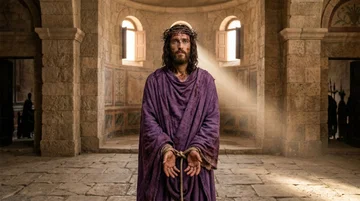
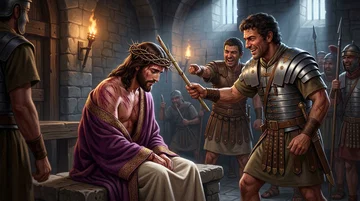
An old purple kingly robe, a purple robe, was put upon him for the mock coronation.SG1 50.1COS 149.7–150.1EW 138.3 Then they took the reed from his hand and struck him on the head with it, driving the thorns into his temples so that blood trickled down his face, brow and beard.SG1 50.11T 240.2ST Jul 11, 1878COS 149.7–150.1EW 138.3 The abuse included smiting and spitting upon him, with blows that made blood run down his face and flow from his brow.3SP 138.1–21T 240.2ST Jul 11, 1878COS 149.7–150.1
The scene belongs to the judgment hall and to the road from Pilate's hall to Calvary where he was led to be crucified before the crucifixion, amid shouts, jeers, wailing, and a hooting, cruel, jeering rabble.DA 722.54RED 102.2–103.13SP 148.1MH 509.1 It followed a night of prayer and came after scourging, when bloodied and exhausted he wore the crown of thorns in his humiliation.3SP 143.1–2STBk 105.2MH 509.1 He had been seized at midnight in Gethsemane and hurried from tribunal to tribunal, arraigned twice before the priests, twice before the Sanhedrim, twice before Pilate and once before Herod, then mocked, scourged, condemned and led out bearing the cross.4RED 102.2–103.1
The mocking was done by hardened soldiers and by a clamoring multitude clamoring for his blood, stirred up by Herod, the priests, chief priests, elders and rulers.SG1 50.13SP 138.1–24RED 102.2–103.13SP 148.1 The ridicule of the religious leaders spread through the people, until the very multitude that had hailed him as king hissed, reviled and cried against him.4RED 102.2–103.13SP 148.1 Satan and his angels were busy in the judgment hall to destroy human feeling and sympathy, making the atmosphere heavy and polluted.EW 138.1 The scene took place in heaven's sight and revealed how Satan's influence could turn people into liars and murderers.ST Mar 26, 1894EW 138.1
Patient Redemptive Suffering
Though bloodied and exhausted from scourging, he bore the crowning insult with patient dignity, meekness and steadfast faithfulness to his Father's will, without murmur, complaint or retaliation, as a meek lamb opening not its mouth.3SP 143.1–2ST Jul 11, 1878ST Jul 11, 1878Lt 8, 1854, par. 10–11 He neither sought applause nor feared threats, and his heroism in finishing his life-work included humbling himself still lower to bear insult, reproach, accusation and shameful abuse in the very world he had made and still sustained.ST May 30, 19118MR 241.2–242.3Lt 8, 1854, par. 10–11 His condescension and infinite love were displayed in enduring this humiliation before death, remaining the innocent sufferer who must suffer all to make a way of escape.8MR 241.2–242.3ST Jul 11, 1878Lt 8, 1854, par. 10–11
He restrained his divine power when he could have called for a legion of angels, displayed his divine majesty, sealed the lips of scoffers, paralyzed the smiting hand and freed himself from the multitude.ST Jul 11, 1878Lt 8, 1854, par. 10–1112MR 394.3–395.1 Heaven witnessed the scene, for angels laid aside their glittering crowns in sorrow, unwilling to wear crowns while their Commander suffered, and legions waited sorrowfully hoping to be permitted to prevent his shameful death.STSE 41.2–42.1SG1 49.1EW 138.1 The mockery was inspired to destroy human feeling and sympathy, making the atmosphere heavy and polluted, to the marvel and mystery of angels who beheld his restraint.EW 138.112MR 394.3–395.1
The insults were meant to provoke him to complain or to wrench himself free by divine power, which would have frustrated the plan of salvation and caused redemption to fail.5RED 58.1–2SG1 49.1EW 138.1 His refusal to fail under the test preserved his perfect humanity and kept him the unblemished, blameless offering and Lamb of God, for one failure would have made the offering imperfect.5RED 58.1–2ST Jul 11, 1878COS 149.7–150.1 His suffering at the hands of wicked men, with the reed striking his head and driving thorns into his temples until he bled, was the necessary test and ransom-paying endurance to carry out the plan.5RED 58.1–2COS 149.7–150.1EW 138.3
He suffered as the just for the unjust with the burden of the sins of the whole world upon him, joined with sweating great drops of blood in the garden, scourging and the cross, to redeem sinners to God by his precious blood and open the way for salvation.Ms 29, 1909, par. 18CET 106.3–107.2EW 40.3STBk 105.2ST2 46.2 The glorious Redeemer left the realms of glory for this dark and lonely world to give his precious life and die for human sin, enduring through to bowing his head and dying to rescue fallen man from utter ruin.STSE 41.2–42.1EW 40.3ST2 46.2 His pierced head, striped flesh, nailed hands, spiked feet, bodily agony and anguish at the hiding of his Father's face declare that for each person he consented to bear guilt, become sin and the sin-bearer, endure divine justice, spoil death and open Paradise, moved by eternal redeeming love.EW 40.3STBk 105.2ST2 46.2
His humiliation was endured because of human sin, including pride, vanity, love of pleasure and display, to save people from these sins and call them to reject them.3T 379.2STSE 58.1 The mocking cruelty came because men hated his reproof and sinless character and were determined to remove him even though Pilate declared him without fault, and it belongs to his unbroken humiliation from leaving his kingly crown to become a babe and a man of sorrows.12MR 394.3–395.1Ms 75, 1910, par. 19–21 The greatest guilt belonged not to comparatively ignorant Pilate, Herod and soldiers, who did not know he was the Sent of God and lacked the abundant light and Old Testament knowledge given to the nation, but to those in the highest places who betrayed their sacred trust.12MR 394.3–395.1Ms 75, 1910, par. 19–21
Future Glory Foretold
Those who platted the crown of thorns, put the reed in His hand as a mock scepter, bowed the knee and hailed Him as King of the Jews will see Him again in kingly majesty and glory as King of kings and Lord of lords at the second resurrection and at the second coming, and will recognize Him as the One they crucified and derided.EW 250.2–251.1ST Mar 26, 1894SG1 214.1–215.1GC88 643.1–4 The men who struck Him with the reed, smote and spit upon Him, derided His claim to be the Son of God and jeered His royal title will then face the truth of His identity with terror and remorse.EW 250.2–251.1SG1 214.1–215.1GC 643.1–2GC88 643.1–4 With impious hands they put the purple robe upon His form, the thorny crown upon His sacred brow and the mimic scepter in His unresisting hand, bowing before the Prince of life in blasphemous mockery, and when He is beheld in His glory those very men are speechless before His piercing gaze.GC 643.1–2GC88 643.1–4 They behold the marks with terror and remorse, turn to flee from the overpowering glory of His presence, and yet see Him sitting on the right hand of power as He declared.GC 643.1–2
The same head once crowned with thorns will be crowned with a diadem of glory on His coronation day.RH May 5, 1903ST Nov 21, 1906 In place of the crown of thorns He will wear a crown of glory, a crown within a crown, and in place of the old purple robe a garment of whitest white such as no fuller on earth can white.ST Nov 21, 1906ST Apr 19, 1905 Upon His vesture and on His thigh will be written the true title, King of kings and Lord of lords.ST Apr 19, 1905 He will be escorted by ten thousand times ten thousand and thousands of thousands of angels and surrounded by the army of the redeemed, each marked as covered by His righteousness.RH May 5, 1903
The mock coronation shows His first coming in lowliness, obscurity, suffering and humiliation, as a prisoner surrounded by a rabble, poor and mocked as King of the Jews.ST Apr 19, 1905 At His second coming all will be changed, for He will come not as a prisoner but as heaven's King in His own glory and His Father's glory and the glory of the holy angels.ST Apr 19, 1905 His humiliation at death stands in contrast to the glory and triumph of His second coming, when humiliation gives way to royal majesty.ST Apr 19, 1905Ms 39, 1898, par. 21–22
Scriptural and Historical Connections
The jeers, taunts, revilings, derision, mocking and spitting in the judgment hall and on the way to Calvary fulfilled what Abraham's offering of Isaac foreshadowed of the gospel of salvation and revealed the unutterable self-denial of the infinite God.STSE 41.2–42.1 Unlike Isaac, Jesus was not spared at the last moment but was given to humiliation to rescue fallen man from utter ruin.STSE 41.2–42.1 Legions of angels waited sorrowfully hoping they would be permitted to prevent His shameful death and bear the message that He need not die, but they were not permitted, so He endured through to bowing His head and dying on the cross.STSE 41.2–42.1
As He stood wearing the crown of thorns after being scourged, bloodied and exhausted yet bearing abuse with patient dignity, His noble character contrasted with the hardened wickedness of Barabbas the robber beside Him.3SP 143.1–25RED 63.1 The crowd that now rejected and condemned Him, hissing and crying for crucifixion, contrasted with the earlier welcome He had received as king.DA 394.2–3 His condemnation and mockery as King of the Jews, with thorn crown on His head and reed in His hand in pretended honor, thus set His humiliation against both the criminal beside Him and the fickle favor of the multitude.3SP 143.1–25RED 63.1DA 394.2–3
The disciples were to see their hoped-for King treated as a criminal doomed to the cross, stretched on the cross at Calvary as a malefactor dying as a criminal, then taken down and laid in Joseph's new tomb.Ms 80, 1886, par. 3–5ST Jul 7, 1898Ms 3, 1898, par. 20–21 That sight killed their hope that He would deliver Israel and reign on David's throne, bringing affliction, agony, anguish and grief that tested their faith, hope and courage, so that the testimony that He had risen seemed too much to believe.Ms 80, 1886, par. 3–5ST Jul 7, 1898Ms 3, 1898, par. 20–21 He foresaw this most trying ordeal of betrayal, agony in Gethsemane, humiliation, scorn and crucifixion with full knowledge of unbelieving and weak faith among His followers.4RED 102.2–103.1 He therefore deliberately brought on a testing crisis beforehand while still present to comfort, strengthen and prepare His faithful few, so that when the scorn came they would not be overwhelmed with surprise, sink beneath fear and disappointment and grief over the ruin of their fondest hopes, hang their faith upon the inconstant favor and opinions of others, or be carried away by the apostasy of faint-hearted professed followers in that hour of horror.4RED 102.2–103.1
The shameful treatment and crucifixion are recalled in the apostles' proclamation of Him as the risen Saviour whom no obstacle could keep in the tomb.RH Feb 9, 1911 The very Roman soldiers who had plaited the crown of thorns in the judgment hall later saw the mocked prisoner glorified when He came forth risen from the tomb.DA 780.3 His betrayal by Judas frames the mockery, for Judas acknowledged that he had handed Him over yet felt no deep grief that he had delivered the Son of God to be mocked as a false king, scourged and crucified.5T 637.1 Later Huss, at his degradation, likened the paper mitre placed on his head to Christ's crown of thorns and accepted his own crown of shame for Jesus' sake, recalling that Jesus bore shame for him.GC 108.4–109.1
Call to Humble Discipleship
The derision on the way to crucifixion — thorns driven into the temples by the reed until blood flowed from the brow — shows what was endured for humanity and puts all self-denial asked of followers into perspective.1T 240.2Lt 1a, 1861, par. 2–5SG2 251.3–252.2 Beside that sacrifice all human self-denial is put in the shade, proving the narrow, self-denying way is not too strait, and remembering it should awaken gratitude and move to sacrifice rather than indifference which shows loss of a sense of the cost of salvation.Lt 1a, 1861, par. 2–5SG2 251.3–252.21T 155.1–2 He suffered as the just for the unjust with the burden of the sins of the whole world upon him, joined with sweating great drops of blood in the garden, that by precious blood sinners might be redeemed to God, and this rebukes those who treat it as a great thing to help the cause and will not dispose of this world's goods to save perishing souls.Lt 1a, 1861, par. 2–5ExVEGW 30.2–31.1 His wearing the thorny crown while bearing the cross and drinking the bitter cup stands in contrast to ease and self-glorification and calls for undivided affections, entire consecration, separation from the world and from dead heartless professors, serving God wholeheartedly with time and means and bearing the cross by which souls were redeemed with blood rather than living for self-glory.1T 240.2Lt 1a, 1861, par. 2–54T 83.1
The thorn-crowned head rebukes pride, vanity, love of pleasure, display and self-sufficiency and calls for humility and cleansing of the heart.3T 379.2STSE 58.1SG2 286.2–287.1 The holy, self-denying Master wore suffering and shame, was wounded for transgressions and bruised for iniquities, and through His wounds there is healing and peace.SG4 179.1ST Apr 1, 18801T 135.2–136.1 Because He who gave His life to redeem sinners was so decorated with suffering and shame as a man of sorrows acquainted with grief, His professed followers washed by His blood must not decorate poor mortal bodies with needless ribbons, laces, bonnets, collars, costly clothing and showy fashion.SG4 179.1ST Apr 1, 18801T 135.2–136.1 Spending for prideful adornment while He wore thorns proves pride in the heart, for outward appearance is an index to the heart that must be cleansed, and following Him calls for humility rather than pride.SG4 179.1ST Apr 1, 1880SG2 286.2–287.1 His sorrow and anguish were borne to save from these sins, in exhausting work, self-denial and long nights of prayer to bless the needy and help resist temptation.3T 379.2STSE 58.1
He is the example for overcoming passion, impatience, complaint and murmuring, enduring all slight and indignity and opening not His mouth though He could have asked the Father for a legion of angels.Lt 8, 1854, par. 10–1121MR 366.1 As the innocent Sufferer spit upon, crowned with thorns and stretched on Calvary's cross to die an ignominious death for sins, it behooved Him to suffer all this to make a way of escape for lost man.Lt 8, 1854, par. 10–1121MR 366.1 Therefore those He died for must be perfectly subdued by grace, must not complain or murmur over any sacrifice even when suffering for their own sins, but deny self, die to self and crave the suffering part.Lt 8, 1854, par. 10–1121MR 366.1 Thinking of His meek and lovely endurance nailed to the cross for sins should humble and break the heart to shame and humiliation in the dust and turn from sin, especially one continuing in a course condemned of God in the face of warnings instead of thinking well of himself.21MR 379.3–4Lt 51, 1886, par. 4–10 The thorn-crowning belongs to unbroken humiliation all the way through, leaving the kingly crown to become a babe and a Man of sorrows amid mocking and cruelty because men hated His reproof and sinless character and were determined to get Him out of the way even though Pilate declared Him without fault, and it sets a depth of humility no believer can go beyond, teaching that partakers of His divine nature must be willing partakers of His sufferings in hard places.Ms 75, 1910, par. 19–21
His bearing that shameful mockery for each person individually gives followers reason to joyfully bear their own crown of shame for Him.8MR 241.2–242.3GC88 108.3–109.1 His endurance displays condescension and infinite love, neither seeking applause nor fearing the world's threats.8MR 241.2–242.3 Together with His conflict in the wilderness of temptation, His life of self-sacrificing love, His soul agony in Gethsemane and His agony upon the cross, it teaches self-sacrifice, patience under affliction, solemn consecration to God and fitting preparation for holy work, requiring one called to minister souls and enlighten them with divine truth to put whole energies into it and make every other consideration secondary.Ms 75, 1910, par. 19–21GW92 360.3 The same head once crowned with thorns will be crowned with a diadem of glory on coronation day, and His faithful ones without spot or wrinkle will receive crowns of immortal glory and shine in the glory of the Father and the Son, surrounded by the army of the redeemed each marked as covered by His righteousness.RH May 5, 1903ST Dec 29, 1887
Sources
Pioneers and periodicals
123 sources
The soldiers staged a mock coronation, pressing a platted crown of thorns on his head, placing a reed in his hand for a scepter, bowing the knee and hailing him as King of the Jews, then spitting on him, striking him with the reed and driving the thorns into his brow until blood ran down his face.ST Dec 10, 1894ST Sep 23, 1889ST Nov 16, 1882ST Oct 31, 1916ST Dec 17, 1912 He bore it all with meekness, patience and calm dignity, without anger, retaliation or display of divine power.ST Jul 11, 1878RH Jun 12, 1856ST Jul 18, 1878 The thorns were the curse laid on the ground for Adam's sin, and in wearing them when made a curse for men he bore the curse on the earth as well as on humanity to redeem both and reclaim the lost dominion.ST Mar 19, 1885ST Mar 19, 1885ST Mar 30, 1888 His shame and wounding belonged to his atoning suffering, showing the depth of his love in coming from the highest throne to save fallen humanity by bearing its sin and sorrows.RH Feb 1, 1870RH Nov 18, 1862RH Feb 13, 1872ST Jul 18, 1878 Though mocked as King he is truly King, and the same head once crowned with thorns will at his coming wear a crown of glory as King of kings and Lord of lords.RH Sep 25, 1913ST May 31, 1899ST Sep 23, 1889RH Dec 12, 1865ST His thorn-crowned path is the pattern for his followers, who share scorn and suffering with him now before they share glory, the cross coming before the crown.RH Dec 12, 1865RH Apr 14, 1859RH Feb 8, 1870
The Mock Coronation Enacted
The soldiers staged a deliberate mock coronation, platting thorns into a crown and setting it on his head, placing a reed in his right hand as a false scepter, clothing him in a scarlet or purple robe of royal color, bending the knee before him, and hailing him in derision as King of the Jews.ST Dec 10, 1894ST Dec 17, 1912ST Oct 7, 1886RH Dec 9, 1858ST Jul 14, 1881 The crown and reed with the kneeling and jeering salute turned royal honor into insult, making a cruel imitation of kingship out of his claim to be King.ST Dec 10, 1894ST Sep 23, 1889ST Dec 17, 1912ST Oct 7, 1886RH Dec 9, 1858 Even amid blood and suffering his noble character remained evident, and his meek endurance made his true kingship and royal lineage plain.ST Sep 23, 1889ST Dec 17, 1912ST Oct 7, 1886
The mockery was not a single act but repeated and cruel, with soldiers in procession passing before him in the hall, each kneeling and saluting him as king in rising excitement.ST Jul 11, 1878ST Nov 16, 1882ST Mar 29, 1899 They spat on him after the example set against him, tore his brow and hair with the thorns, and took the reed scepter from his hand to strike him repeatedly on the head and cheek.ST Jul 11, 1878ST Nov 16, 1882ST Oct 31, 1916RH Jun 9, 1868RH Aug 14, 1866 The blows drove the thorns into his temples, leaving cruel marks in his flesh and making blood run down his face and beard.ST Jul 11, 1878ST Oct 31, 1916RH Jun 9, 1868RH Aug 14, 1866ST Mar 29, 1899
He bore all of it with dignity, meekness, patience, moral courage and calm self-possession, without any wrathful answer from his lips, without malice, murmur, retaliation, or display of divine power.ST Jul 11, 1878ST Jul 11, 1878RH Jun 12, 1856ST Jul 18, 1878ST Mar 11, 1908 Though he had power to call angels and manifest his divine majesty to stop them, he remained steadfast and faithful to his Father's will.ST Jul 11, 1878ST Jul 11, 1878RH Oct 17, 1854 By refusing to deliver himself his perfect humanity as the Lamb of God was preserved, for one failure under that test would have made the offering imperfect and caused redemption to fail.ST Jul 11, 1878 His meek endurance under cold scorn thus became both atonement and example for those facing hardship.RH Jun 12, 1856ST Jul 18, 1878RH Oct 17, 1854
The scene belongs in the judgment hall after scourging, when he had been declared to have no fault and handed to the Roman soldiers, and it led onward to crucifixion.ST Mar 13, 1901ST Jul 14, 1881ST Jan 17, 1911ST Nov 9, 1882RH Jul 7, 1910 Pilate ordered him scourged though convinced of his innocence, then had him brought out thus arrayed, exhausted and torn and disfigured with blood trickling from his temples, hoping the sight of suffering and helplessness would move the people to pity and to consent to his release as no dangerous king or insurgent.ST Jul 14, 1881ST Nov 9, 1882 Such derision with crown, reed, bended knee and mock hail was the customary treatment given to condemned criminals before and during execution, agreeing with Roman manners and institutions, and it is also reckoned in the manner of the soldiers' Saturnalia mock-king revelry, involving Herod's custody before he was sent back to Pilate.RH Feb 11, 1862ST Jul 14, 1881ST Jan 17, 1911
Thorns Bearing Earth's Curse
The thorns platted for his head were the curse pronounced on the ground because of Adam's sin, when the ground was told to bring forth thorns and thistles.ST Mar 19, 1885ST Mar 19, 1885ST Mar 30, 1888ST Mar 24, 1909RH Jun 12, 1856 They recalled the doom laid on the groaning earth, so that the cursed earth itself was set forth in the crown, and his burial afterward in that earth meant the cursed earth receives blessing instead of the curse.ST Mar 19, 1885ST Mar 19, 1885ST Mar 30, 1888RH Jun 12, 1856RH Jul 23, 1857 The robe and reed put with the crown served as a false royal robe and scepter and objects of cruel laughter, mocking his rightful kingship while he meekly endured the world's cold treatment.RH Jun 12, 1856
When he was made a curse for men on the tree he wore those thorns as a crown, taking the earth's curse upon himself as well as the curse on humanity through his suffering and death.ST Mar 19, 1885ST Mar 19, 1885ST Mar 30, 1888ST Mar 24, 1909ST Jun 23, 1881 Thorns came into the world because of human sin, and he was crowned with them when he was offered for sin, bearing the curse of death and the curse represented by the thorns together.ST Mar 30, 1888ST Jun 23, 1881ST May 8, 1884 By bearing both curses he gained the right to redeem both the earth and humanity, to reclaim the dominion Satan had usurped, and to take the sins of humanity upon himself on the cross for humanity's sake.ST Mar 19, 1885ST Mar 19, 1885ST Mar 30, 1888ST Mar 24, 1909
The thorn-crown proves the earth itself is the purchased possession that needs redemption, and wherever there is any curse there is Christ bearing it, and he bears it only on the cross, so the whole creation which now groans under the curse is to be redeemed through the cross.ST Jun 23, 1881ST Feb 1, 1899 By bearing this crown he sanctified the earth, and his wearing the thorns cancels that doom, so that at the end of the world the created world will be made new and a fairer world revealed because sin and bloodshed have filled the present world.RH Jul 23, 1857RH Oct 2, 1900 Pain and death and thorns and thistles now show Satan's triumph under that curse, which will not continue forever, for his crown signifies not only that the curse will be crushed underfoot, but that it will be obliterated forever.ST Jun 23, 1881ST Jun 11, 1902
The thorns signify sin's consequences and pain, which Christ accepted so that people may receive the consequences and benefits of his life and wear a crown of immortal glory.ST Jun 9, 1914RH Oct 16, 1860ST Sep 29, 1898 Sin caused his lashings, the crown of thorns, the nails, the spear, the vinegar and gall, and his agonizing death, for he bore sins in his body on the tree and suffered to put sin away.ST Feb 25, 1889 The thorns were his, while the crown of glory is for those who receive the blessing and inheritance purchased through his death.RH Oct 16, 1860 Yet the crown and purple robe that mocked his right to be king also became part of his triumph, helping vindicate God's justice before people and angels in the judgment.ST May 8, 1884
Suffering Borne for Humanity
The mocking with thorns belongs to his atoning suffering as the despised and rejected Messiah, bearing guilt not his own and human sin and sorrows, wounded for transgressions and giving his life on the cross to save fallen and rebellious humanity.RH Feb 1, 1870RH Nov 18, 1862RH Feb 13, 1872ST Jan 27, 1904ST Nov 14, 1906 Condemned to an ignominious death, he was led out of the city carrying his cross and died at Golgotha as the Lamb slain from the foundation of the world, so that sinful mortal people might have life, and the thorns on his head remain the sign of the suffering he endured that humanity might live.ST Jan 27, 1904ST Nov 14, 1906ST Oct 8, 1896 That day of crucifixion, when he gave his life for sinful people and bore the curse, was more significant than any other day in his history.RH Feb 13, 1872
His willingness to submit to shame, scourging, and thorn-crowning shows the depth of his love, grace, and pity.RH Feb 1, 1870RH Feb 13, 1872ST Jul 18, 1878 He bore the piercing crown in wondrous love for the guilty soul, bearing its sorrows for its sake, meekly bearing scorn and shameful jest and cruel word without any wrathful answer, calling the guilty soul to accept his grace with tearful eyes and grateful heart lest when he comes in glorious might the soul hear the dreadful word Depart.ST Jul 18, 1878 He bore shame and pitiless mocking with the crown upon his brow for thee, the sinful soul, coming down from the highest throne to earth's profoundest depths of sin in divine love, with cruel scourge and nail-pierced hands and feet and pierced heart, so that sin's degraded slave need no longer remain in fearful bondage of soul and mind unto despair, but may have cleansing for sin in his blood, healing for the heart, and freedom from the load of sin and guilt.RH Jan 19, 1905 Love came down from the glory and peace of the mountain top to foes hating him, to the waiting scourge and the twining crown, to the shame of being lifted up on the cross and drinking the bitter cup to the dregs, with face unveiled and shining, to set the seal on God's great love and to reveal God to men, and the crown and the cross together were borne for humanity as an act of grace and love for each person.RH Dec 25, 1913ST Dec 23, 1913
Every person's individual sin helped cause that suffering just as much as any other's, and every time a person sins it is as if he himself does again what the Romans did and puts the crown on the Master's brow.RH Jan 27, 1916 One who loves Christ and fully realizes that his own sin caused the Lord such suffering will begin to hate sin and determine to stop sinning, and will be prepared to share in looking on the pierced One and mourning over him.RH Jan 27, 1916 The thorns sinking deep into his holy head and drawing blood, with his groans and agony, prove his kind and sympathizing deep love, and seeing that suffering with his scourged back, pierced hands and feet, closing eyes in death, and opened side awakens conscience, wounds pride, moves the heart to bitter tears of repentance, and reveals a fountain bursting from the smitten rock of ages, a flood and wide deep river of salvation and sea of mercy from his open side containing heavenly riches, the key to Paradise and all treasures of God's storehouse, the depth of the riches of love of both the Father and the Son, living water that quenches thirst forever as a well springing up into everlasting life.RH Sep 5, 1865 The unconverted carnal heart is wholly hostile and gives him no crown of glory, only thorns, gives him no true submission to his kingship, only a reed of mockery, and takes up no cross for him but nails him to the cross, crucifying the Lord of glory afresh by every willful sin.RH Nov 12, 1861 Sin caused his lashings, the crown, the nails, the spear, the vinegar and gall, and his agonizing death, for he bore sins in his body on the tree and suffered to put sin away.ST Feb 25, 1889 He bore that heavy load with spear and nail wounds, bruised face, bloody agony of Gethsemane, and thorn crown to cleanse sin by bleeding and dying, and he holds it before the sinner as a tender pitying plea to be reconciled to God, which calls for deep contrition and surrender rather than refusal; yet denied help, betrayal, sin, hatred, and refusal to heed him continue to wound him, as though humanity still holds him on the cross.RH Mar 8, 1906ST Jan 7, 1897
His suffering gives a still clearer discovery of the dreadful evil and exceeding sinfulness of sin than the fall of angels into devils, the driving of Adam from Paradise with loss of God's favor and image and the bringing of death and woe into the world, or God's sweeping off a whole world in the flood in just displeasure against sin, for at Pilate's bar his sacred body was all one wound from scourging and mocking, then followed to Calvary and stretched on the tree fainting and crushed beneath the load of human sin, even crying out in forsakenness, to redeem the ruined race.RH May 27, 1873 That cruelty displays the madness and folly of sin.RH Jun 10, 1862 His humiliation as mocked and crowned was part of his suffering and death as the sacrifice for sin, through which he bore the law's penalty and God's justice was upheld while sinners could be justified.ST Feb 25, 1889ST Dec 6, 1883 His suffering and crucifixion were the bruising of his heel, for Satan could inflict pain and anguish on him but could not corrupt his purity, and as he endured sinners' hostility Satan's head was being bruised, marking Satan's defeat. That last act on Calvary amid jeers of throats that had once praised, done with relentless fury through the fiend turning Judea's heart against her Lord, sealed the doom of evil and its king, and forever showed what cherished thoughts of self produce when held in the heart of one endowed with glory, beauty, and wisdom and familiar with the love and peace of heaven, revealing a cherub transformed into a malignant fiend warring ever against his God, and inspiring dread of evil and loathing and fear of transgressing the perfect law of love even by a thought, placing an eternal safeguard against further experiment.ST Mar 11, 1903
The apparent defeat was victory, for nobleness lies in valiant suffering for others rather than in slothfully making others suffer, the chief of men stands at the front facing the peril that frightens all others back and that would devour them if not vanquished, and every noble crown on earth is and forever will be a crown of thorns.ST Sep 8, 1881 The thorn crown marks a victory that reveals the true standard, for the way of God is most triumphant in suffering and most lovely when his hands and feet are pierced.RH Oct 13, 1868 The thorn crown with the cross and scourge is overcome in his victory through the resurrection, for his suffering leads to glorious victory, not to an earthly throne.ST Jul 7, 1914 His being crowned and crucified did not mean that divine power had failed, for the cross was driven not merely by wood, hammer, and nails, but by human hatred and sin, and his love held him there.RH Sep 7, 1916 Seized by a murderous throng and led to Calvary's hill, mocked and scourged and crowned with thorns in anguish no mortal can tell, he freely gave his life for his people as the Good Shepherd, and even there God the Ruler was present with him, bringing victory through the lightened tomb and resurrection and his promise to be with his people always.RH May 10, 1906 Thorn-crowned and mocked in Pilate's judgment hall, he is still the same King who is triumph-crowned in God's courts, and his suffering and temptations belong to his work of overcoming sin for all humanity, in every trial the victorious and helpful leader and pilot.ST Mar 21, 1906
Mocked King and Coming King
Though hailed in derision as King of the Jews, he was truly King even while wearing the thorns, and the mocking itself made his kingship known.RH Sep 25, 1913ST May 31, 1899ST Sep 23, 1889ST Dec 17, 1912RH Oct 13, 1874 The reed put in his hand as a false scepter, the scarlet robe, the bent knees and jeering salute turned royal honor into insult, yet his meek endurance under blows and taunts displayed his royal lineage and glory in lowliness rather than in worldly triumph.ST Sep 23, 1889ST Dec 17, 1912RH Jan 2, 1900RH Oct 13, 1874 His enemies meant the ridicule to show his kingdom had failed, but even dying under that scorn his promise of coming into his kingdom could be believed.RH Sep 25, 1913 The innocent, crucified King wore the thorny crown as he suffered and died, more glorious in humility than any earthly pomp.ST Sep 23, 1889ST Dec 17, 1912RH Oct 13, 1874
The same sacred head once pierced and torn by thorns will at his second coming wear a diadem of glory, even a crown within a crown.RH Dec 12, 1865STRH Dec 23, 1858ST Dec 15, 1898RH Oct 24, 1854 The crown of shame is contrasted with a golden crown, a crown of everlasting glory, worn when he comes as conquering King seated on the great white cloud to bring deliverance to his saints and recompense to proud oppressors.RH Dec 12, 1865STRH Dec 23, 1858ST Dec 15, 1898 Then he will appear as King of kings and Lord of lords with royal majesty, in white garments and with angelic escort and countless hosts acclaiming him worthy Lord of all.ST Mar 26, 1894RH Dec 23, 1858 Those who mocked and rejected him amid lies and murder will see him in that glory, while the tempted, tried and torture-torn who follow him need not expect an easier road than he marked out.ST Mar 26, 1894RH Dec 12, 1865
His acceptance of the mock symbols expressed contempt for earthly rule rather than willingness to claim an earthly crown or exercise earthly power.RH Jan 2, 1900 He wore the world's hostile crown and received a hostile welcome, bringing no royal pomp at his first coming but grief, shame, rejection and death as the injured King.ST Dec 16, 1897ST Feb 15, 1905RH Jul 28, 1874 That thorn crown was the only crown of human design he ever wore, showing his rejection of worldly political power and alliance with politics.RH Jan 2, 1900ST Feb 15, 1905 If he came again teaching the same principles, the world would treat him just the same and would not endure him as an earthly ruler.ST Dec 16, 1897
That crowning with thorns belongs to the past time of Calvary when he was made gory, mocked and led away, and not to today, for he is now crowned with glory, even with everlasting glory.STST Dec 15, 1898 He was not then seen in royal beauty but amid ridicule and suffering; he will be seen in beauty when he comes again, triumph-crowned in God's courts though once thorn-crowned in Pilate's judgment hall.ST Dec 8, 1914ST Mar 21, 1906 The thorn-crowned prisoner is the same Jesus who was crucified, rose, and will descend from the skies, the returning Prince whose reign is near, whom his followers will recognize without fear.ST Mar 21, 1906 His suffering and temptation belonged to his work of overcoming sin for all humanity as the victorious and helpful leader, even when his own had forsaken him and his people wept at the cross and lamented beside the closed grave.ST Mar 21, 1906ST His pain is contrasted with the starry crown that will rest on the believer's brow.RH Jun 4, 1908
Prophecy History and Proof
The mock crowning belongs to the account of the Messiah despised and rejected, mocked and humiliated in his suffering, persecuted and scourged before his death as a just teacher, and presented as the world's crowning figure, Saviour and perfect example whose coming was foretold.RH Nov 18, 1862ST Oct 7, 1875 Wounded and bruised in trial before the cross, it literally fulfills Isaiah 53:5 as one of at least twenty-four Old Testament prophecies about his betrayal, trial, death and burial, spoken by different prophets between about 1000 and 500 B.C. and all literally fulfilled within twenty-four hours on crucifixion day, making that day a wonderful climax and decisive crisis in the divine plan for earth.ST Oct 21, 1930 The derision with crown of thorns, reed, bended knee and mock Hail, King of the Jews was the customary treatment given to criminals at that time before execution and during it.RH Feb 11, 1862 Its agreement with Roman manners and institutions shows the Gospel history minute, consistent and accurate in subordinate details, and the crowning with thorns with the details of his suffering belongs to the literal events of his first advent fulfilled in the plain sense of the words, not spiritually.RH Feb 11, 1862RH Apr 25, 1854
He was crucified at the last Passover he attended in A.D. 31, closing a three-and-one-half-year public ministry begun at thirty years of age six months before his first Passover.ST Dec 23, 1897 That places his birth six months before Passover in autumn, about September in the month Tisri, the season of fruitage, and not on December 25.ST Dec 23, 1897 The crucifixion took place in the spring of A.D. 31, not A.D. 32, when evil came upon him in arrest and crucifixion; the common chronology is practically correct in placing his anointing in A.D. 26 or 27 but wrong in placing his crucifixion and resurrection in A.D. 32, which would make him thirty-six years old at death, with Stephen's death occurring in A.D. 34.ST May 8, 1879ST Nov 2, 1915 He was crucified as the great sacrifice for human sin in fulfillment of the Messiah being cut off in the middle of the seventieth week, and by his death he brought the sacrificial system to an end.
The account belongs to his first advent and earthly life, to his trial and crucifixion. The rough crown left his temple pale and bleeding with dark stains on his head, remained on him through his death on the cross, and was taken from his head when his body was taken down to be washed and prepared for burial.ST Aug 1, 1878 The Gospel's simple account of the crown of thorns placed on his head does not describe drops or streams of blood following it and should not be enlarged by dramatic invention.ST Jan 9, 1901
Pattern for Disciples' Suffering
The thorn-crowned head is the pattern for all who belong to his kingdom, who must share suffering with him rather than expect an easier road through this vale of woe than the Son of God marked out.RH Dec 12, 1865RH Apr 14, 1859RH Jan 17, 1865 To wear his name is to expect scorn and shame for his sake, to walk where thorns pierce, to bear his cross in self-denial, and to refuse dallying in paths of roses where he suffered or seeking a crown of glory where he wore thorns.RH Feb 8, 1870ST Nov 21, 1911RH Jan 17, 1865 Beside his thorn-crowned head a crown of roses is shameful, for discipleship itself is willingness to suffer with Christ amid pain and mockery.RH Apr 14, 1859RH Feb 8, 1870ST Jan 29, 1880 They are therefore to bear the warning message bravely to every place despite scorn, uncomplaining though grown hoary with care, treading the same gloomy valley of bitter pain and scorn in his footsteps.RH Dec 12, 1865ST Nov 21, 1911
Faith values these painful humiliations above earthly treasure because they will give way to an enduring crown of glory.RH Feb 8, 1870ST Jan 29, 1880 Each thorn will become a ray of glory and each pang of anguish will become joy, when patience and firm endurance have carried the sufferer to the eternal gate and thorns become flowers.RH Feb 8, 1870ST Jan 29, 1880RH May 28, 1857 The order is fixed: the crown of thorns before the crown of glory, the cross before the crown, present hardship faithfully endured before sharing his kingdom.RH Jun 4, 1908RH Jul 28, 1904ST Sep 11, 1907 The starry crown to rest on the believer's brow, bright and immortal, is joined to willingness to endure with pierced brow even when hope and joy seem broken, in the promise of sharing his glory and throne when he comes to claim his own.RH Jun 4, 1908RH Jul 28, 1904
That example subdues pride and casts out discontent, exposing how slight ordinary grievances are beside his humiliation and mockery.ST Apr 17, 1879ST Apr 17, 1879 His followers are to seek his mind, enduring mistreatment without speaking in self-defense, bearing hardship without complaint, and showing meek endurance under scorn.ST Apr 17, 1879RH Oct 17, 1854 Even amid suffering greater than any believer has yet been called to bear, he prayed with a heart of love for his tormentors, and believers are to let that same love and spirit fill their hearts in the home and toward their families, acting under every circumstance as he would act, even in the face of rebuff, great provocation, persecution, and labor to win loved ones.RH Aug 3, 1916 His love and endurance under mocking and nailing to the cross are the ground for asking his forgiveness and help to forgive others, for speaking kindly, for following closely on the path he traveled to Calvary, and for serving in mission under rebuff rather than slighting his grace or counting life's trials too hard.RH Jul 21, 1904RH Apr 9, 1914
Remembrance of the thorns on his brow awakens love and makes personal pain seem small by comparison, comforting the afflicted and steadying the weary toward heaven.RH Feb 16, 1905ST May 14, 1894ST Nov 25, 1886 Life's painful burdens and duties are to be endured like a crown of thorns, hardship borne before reward, deep sorrow carried rather than cast off.ST Dec 10, 1894RH Sep 16, 1902 That suffering keeps the sufferer close to God, teaches patience under burdens and labor's wounds, and shows that victory comes only through strife.ST Nov 25, 1886RH May 28, 1857
Warning and Moral Appeal
To force temporal sovereignty upon Christianity is to repeat the mock homage done to Christ, offering outward honor that wounds while it pretends to crown. ST Jan 23, 1907ST Jan 24, 1906ST Nov 13, 1893ST May 21, 1912 The reed put in his hand was a fragile scepter, the thorns on his head a crown for honor, the kneeling and hailing a show of enthronement, yet beneath purple covering and magnificent title were spitting, striking on cheek and head, and fixing to shame and painful death. ST Jan 23, 1907ST Jan 24, 1906ST May 21, 1912ST Feb 22, 1910 Such alliance with political power professes to exalt her while it humiliates, corrupts and crucifies her, doing her more harm than open opposition. ST Jan 24, 1906ST Nov 13, 1893ST May 21, 1912ST Feb 22, 1910
The blood drawn by thorns, with the wounds of nails and spear, condemns religious intolerance and should have taught the world religious liberty. RH Dec 31, 1908 The thorn crown stands in contrast to the pope's triple diadem, and true religion refuses civil rule in meekness rather than grasping it. RH Dec 31, 1908ST Jun 15, 1904
The thorn-crowning answers human pride, for the King of glory endured shame and nakedness while men exalt themselves. ST Dec 29, 1887RH May 21, 1857RH Aug 7, 1900 His sacred head wounded by thorns, with his side pierced by the spear, exposes a life spent for money, fine pictures, pleasant books, soft carpets, easy couches and delicate dishes, showing that pampering the body is not life's supreme object but a snare to the soul. ST Dec 4, 1884 There is no room for both his cross and the crowns of pleasure, so destiny here and hereafter hangs on whether the will for pleasure or for pain is yielded to the will of God, and lovers of enjoyment prove lovers of pleasure rather than lovers of God. ST Dec 4, 1884 His plainness rebukes showy adornment, for the only ornament on his head was thorns and his coat was plain and seamless, calling his professed followers to humility instead of needless ornaments, costly clothing, extravagance in dress, living for ease, and obedience only when convenient. ST Apr 1, 1880RH Aug 7, 1900RH Jun 23, 1863 Following him therefore means wholehearted service, self-denial, and willingness to lose property, reputation and life for faith. ST Apr 1, 1880RH Aug 7, 1900RH Jun 23, 1863
Those who platted the crown and struck him with the reed will face him on the great day of his return, when the mocked sufferer is seen in glory as King of kings and Lord of lords. ST Mar 26, 1894RH May 20, 1858 The scene was enacted in heaven's sight, revealing Satan's frenzied power over hearts that turned men into liars and murderers as the betrayed victim was hurried from tribunal to tribunal, seized at midnight as a murderer, dragged from palace to judgment hall, arraigned twice before priests, twice before the Sanhedrim, twice before Pilate and once before Herod, then mocked, scourged, condemned and led to crucifixion amid wailing and jeering. ST Mar 26, 1894ST Nov 30, 1882 That relentless persecution of the Harmless One amid throats that had once praised sealed the doom of evil and its king, showing what cherished self produces in one endowed with glory, beauty and wisdom and familiar with heaven's love and peace, a cherub turned malignant fiend warring against God. ST Mar 11, 1903 Beholding it inspires dread of evil and loathing and fear of transgressing the perfect law of love even by thought, placing an eternal safeguard against further experiment with transgression. ST Mar 11, 1903
The crown also pictures principle suffering under policies devised against it, liberty bleeding under tyranny, public judgment that is cruel, and the suffering the liquor traffic lays upon homes. ST Jun 17, 1903 It marks love joined with pain, for beneath the thorns his love remains visible, his wounded hands and feet and bloodied wreath in place of jewels belonging to his work of seeking the erring and bringing the lost to safety. ST Jan 30, 1907ST Nov 11, 1880 The royal Prince was kind to the poor while the proud made thorns his diadem, and the thorn tree itself is portrayed as kind to him amid shame. ST Nov 1, 1877RH Aug 3, 1869ST Jul 8, 1897 So the thorns picture the hardship and cross of God's poor in every age, yet in God's kingdom the cross is crowned and thorns become pearls and flowers. ST Nov 1, 1877RH Aug 3, 1869
Sources