Mark 15:19
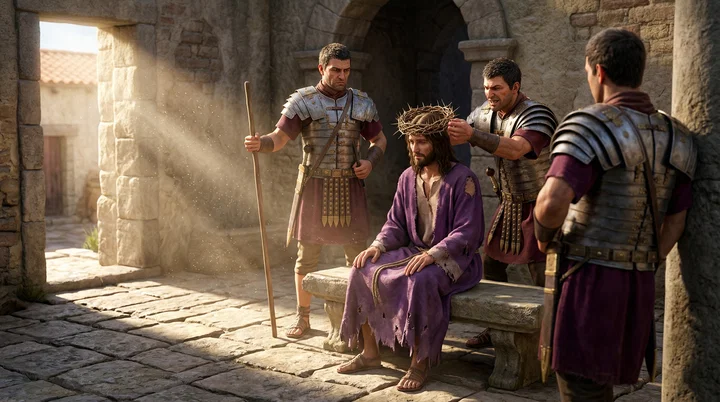
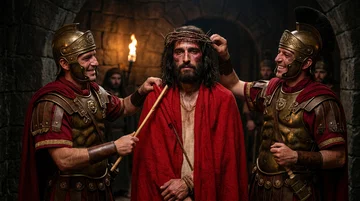
And they smote him on the head with a reed, and did spit upon him, and bowing their knees worshipped him.
Translations
And they smote him on the head with a reed, and did spit on him, and bowing their knees worshipped him.
King James Version, KJV Cambridge Paragraph Bible
And they smote him on the head with a reed, and did spit upon him, and bowing their knees worshipped him.
And they struck him on the head with a reed, and spit upon him, and bowing their knees, worshiped him.
And they smote his head with a reed, and did spit upon him, and bowing their knees worshipped him.
And they smote his head with a reed, and spat upon him, and bowing their knees worshipped him.
And they were smiting him on the head with a reed, and were spitting on him, and having bent the knee, were bowing to him,
And they struck his head with a reed, and spat on him, and, bending the knee, did him homage.
and were striking him on the head with a reed, and were spitting at him,—and, bowing their knees, were doing him homage.
Berean Standard Bible, Majority Standard Bible
They kept striking His head with a staff and spitting on Him. And they knelt down and bowed before Him.
They struck his head with a reed and spat on him, and bowing their knees, did homage to him.
And they gave him blows on the head with a stick and put shame on him and, going down on their knees, gave him worship.
And they smote him on the head with a reede, and spat vpon him, and bowed the knees, and did him reuerence.
Douay-Rheims (Challoner revision)
And they struck his head with a reed: and they did spit on him. And bowing their knees, they adored him.
Pictures
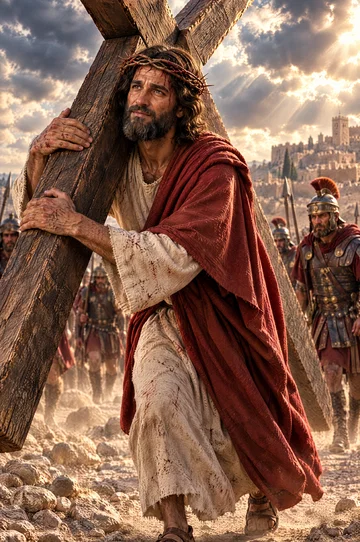
Cross-references
- Matthew 27:29-30
And when they had platted a crown of thorns, they put it upon his head, and a reed in his right hand: and they bowed the knee before him, and mocked him, saying, Hail, King of the Jews!
The soldiers mock Jesus as king, spit on him, and strike him with a reed.
- John 19:2-3
And the soldiers platted a crown of thorns, and put it on his head, and they put on him a purple robe,
Jesus is crowned with thorns, mocked, and struck by the soldiers.
- Isaiah 53:7
He was oppressed, and he was afflicted, yet he opened not his mouth: he is brought as a lamb to the slaughter, and as a sheep before her shearers is dumb, so he openeth not his mouth.
Both portray Christ’s patient silence and submission amid suffering.
- Luke 23:11
And Herod with his men of war set him at nought, and mocked him, and arrayed him in a gorgeous robe, and sent him again to Pilate.
Herod and his soldiers mocked Jesus and clothed him in a robe.
- Isaiah 53:5
But he was wounded for our transgressions, he was bruised for our iniquities: the chastisement of our peace was upon him; and with his stripes we are healed.
His wounds and scourging were for human sin and healing.
- 1 Peter 2:23
Who, when he was reviled, reviled not again; when he suffered, he threatened not; but committed himself to him that judgeth righteously:
Jesus endured insults without retaliating.
- Psalms 22:16-18
For dogs have compassed me: the assembly of the wicked have inclosed me: they pierced my hands and my feet.
Jesus’ suffering and the division of his garments fulfill David’s prophecy.
- Luke 23:13-24
And Pilate, when he had called together the chief priests and the rulers and the people,
parallel account of same trial
- Mark 15:24
And when they had crucified him, they parted his garments, casting lots upon them, what every man should take.
The crucifixion follows the soldiers’ humiliation of Jesus.
Commentary
Each commentary is drawn from primary sources: the writings of Ellen G. White and Adventist pioneers and periodicals. Each commentary is separate. Its own words are not a quotation; follow the references to read the source passages.
Ellen G. White
19 sources
In Pilate's judgment hall after He had been scourged and wounded, the soldiers clothed Jesus in purple, crowned Him with thorns, put a reed in His hand for a scepter, spat upon Him and bowed in mock worship as King, then seized the reed and struck the crown into His brow until blood ran down His face.Lt 115, 1903, par. 13–145RED 58.1–2SG1 50.1DA 734.1–55RED 63.1 Through it all He remained serene and dignified, submitting with meekness and patience and no retaliation, though He could have called the heavenly host to His aid.ST Jun 3, 18895RED 58.1–2DA 734.1–5 Satan led the cruelty and ridicule in hope of provoking Him to complain, retaliate, or free Himself by miracle, and so break the plan of salvation.DA 734.1–5EW 138.1COS 149.7–150.1 His unbroken endurance kept Him a perfect offering, for one stain or failure would have made redemption impossible, and His abasement and wounded temples are the pledge of His exaltation and anointing as great high priest.Lt 115, 1903, par. 13–145RED 58.1–2DA 734.1–53SP 138.1–2COS 149.7–150.1 Seeing Him thus humiliated, scourged, crowned with thorns, mocked with reed and robe, rejected for Barabbas and led to die as a malefactor, tried the faith of His disciples and made their hope and courage fail.ST Jul 7, 1898Ms 3, 1898, par. 20–21
Setting and Mockery
The scene is the judgment hall of Pilate the Roman governor, where Christ stands bound as a prisoner with the guard of soldiers about Him while the hall fast fills with spectators and just outside the entrance stand the judges of the Sanhedrin, priests, rulers, elders, and the mob.DA 723.1–724.1 This follows the council of the Sanhedrin condemning Jesus and coming to Pilate to have the sentence confirmed and executed, while the Jewish officials refuse to enter the Roman hall lest ceremonial defilement keep them from the feast of the Passover.DA 723.1–724.1 Their murderous hatred has already defiled their hearts, and they do not see that Christ is the real Passover Lamb and that by rejecting Him the great feast has for them lost its significance.DA 723.1–724.1
It follows Pilate having Jesus scourged, leaving Him faint with weariness and covered with wounds, stripped and crowned with thorns and bleeding from cruel stripes.DA 734.1–53SP 143.1–2 He is then led by the soldiers into the Praetorium where the whole band gathers, and He is displayed beside Barabbas, whose hardened appearance contrasts with His noble character.DA 734.1–55RED 63.1 He endures the abuse with patience, gentleness, and dignity.DA 734.1–53SP 143.1–2
There the soldiers clothe Him in purple and put a platted crown of thorns upon Him and place a reed in His hand as a mock scepter.5RED 58.1–2SG1 50.1DA 734.1–5 They salute Him with Hail, King of the Jews, spit upon Him, and mock Him with bowing knees in false worship as a king.Lt 115, 1903, par. 13–145RED 58.1–2SG1 50.1DA 734.1–53SP 148.1 Then wicked hands snatch the reed and strike the crown upon His brow and temples, forcing the thorns in so that blood trickles down His face and beard.Lt 115, 1903, par. 13–145RED 58.1–2SG1 50.1DA 734.1–53SP 138.1–2 The physical cruelty is joined with ridicule of His claim to be the Son of God and with mocking of His lowly birth and humble life.DA 734.1–53SP 148.1
The mockery belongs also to the account of Jesus being mocked on the way from Pilate's judgment hall to Calvary, when the jeers are interrupted upon encountering the body of Judas, and the sight makes the mockery lessen.DA 722.5 It belongs to the account of Jesus being hurried to Calvary, where the cross prepared for Barabbas is placed on His bruised and bleeding shoulders while two thieves are also being taken to die with Him.COS 155.1
Endurance and Redemption
Amid the blows of the reed, the spitting, and the kneeling in false worship, He remained serene and dignified, bearing the marks of violence without losing His composure.ST Jun 3, 1889DA 734.1–53SP 143.1–2 He submitted with perfect calmness and no murmur to the coarsest insult, enduring with meekness, patience and gentleness rather than retaliating or using divine power to escape.5RED 58.1–2DA 734.1–53SP 138.1–23SP 143.1–2 Though He could have summoned the heavenly host to His aid or driven the mob away by His divine majesty, He departed in nothing from His Father's will, sustained by Godlike fortitude in human nature.5RED 58.1–2DA 734.1–53SP 138.1–2 That meekness and patience under cruelty which degraded His torturers below humanity into Satan's likeness exalted Him above humanity and proved His kinship to God.DA 734.1–5
Satan himself led the abuse, hoping that insult and violence would provoke Him to complain, to retaliate, or to perform a miracle to release Himself.DA 734.1–5EW 138.1COS 149.7–150.1 His aim was to break the plan of salvation by drawing out such a response.DA 734.1–5EW 138.1COS 149.7–150.1 For one stain or one failure to endure would have made the Lamb of God an imperfect offering, and would have made redemption a failure and impossible.DA 734.1–5COS 149.7–150.1 It is His meekness and patience that upheld the perfect offering required for humanity's redemption.DA 734.1–53SP 138.1–2COS 149.7–150.1
His humiliation and suffering were part of the violence He endured to carry out the plan of salvation for those He came to save.Lt 115, 1903, par. 13–14DA 734.1–5EW 138.3 His abasement is the pledge of His exaltation.DA 734.1–5 The drops of blood from His wounded temples, where the thorns were driven in, are the pledge of His anointing with the oil of gladness as great high priest.Lt 115, 1903, par. 13–14DA 734.1–5
Trial for Disciples
The condemnation and mockery He endured belong to the trial awaiting His disciples.4RED 102.2–103.1 They had already seen the fickleness of the crowds, and they were prepared beforehand for their Master to be reviled.4RED 102.2–103.1 They were therefore not overwhelmed with surprise when the jeering crowd scorned Him.4RED 102.2–103.1
They were to see Him whom they hoped would reign on David's throne brought into the depths of humiliation on the way to the cross.ST Jul 7, 1898Ms 3, 1898, par. 20–21 He was in the hands of wicked men, clad in the purple robe, with a reed placed in His hand as a mock scepter, bowed before in mock worship and then struck with that reed.ST Jul 7, 1898Ms 3, 1898, par. 20–21 Around that outrage were the clamoring for His blood, the crown of thorns, the scourging, the choosing of Barabbas in His place, and His lifting up to die as a malefactor.ST Jul 7, 1898 Witnessing it tried their faith and made their hope and courage fail.ST Jul 7, 1898Ms 3, 1898, par. 20–21 Once the Bridegroom was taken away from them, they had cause to mourn and fast.ST Jul 7, 1898Ms 3, 1898, par. 20–21
He was struck on the head with a reed as part of the mockery and abuse before His crucifixion, and the reed drove the crown of thorns into His temples so that blood flowed from His brow.Lt 1a, 1861, par. 2–5 His suffering shows what He gave up for humanity.Lt 1a, 1861, par. 2–5 Beside it, any sacrifice His followers are called to face seems small by comparison.Lt 1a, 1861, par. 2–5
Sources
Pioneers and periodicals
29 sources
Roman soldiers in Pilate's judgment hall mocked Jesus as a pretended king after dressing Him in purple and crowning Him with thorns, putting a reed in His hand for a scepter, hailing Him, kneeling in feigned worship, spitting on Him and striking Him on the head to drive the thorns in.RH Nov 5, 1872ST Oct 31, 1916ST Sep 23, 1889RH Dec 9, 1858ST Aug 17, 1904 This came after Pilate had found no fault worthy of death in Him yet ordered Him scourged to excite pity and win His release, only to surrender to the demand to free Barabbas and crucify Jesus.ST Jun 3, 1889ST Mar 13, 1901RH Dec 9, 1858ST Oct 7, 1886ST Apr 4, 1906 The Son of God bore these blows and insults meekly without anger though He could have freed Himself, suffering to redeem the ruined race.RH Nov 5, 1872ST Jan 27, 1904ST Oct 31, 1916 Even in that humiliation His serene endurance revealed true royal dignity and kingship through suffering, turning the thorn crown into a sign of coronation.ST Jun 3, 1889ST Sep 23, 1889ST Dec 17, 1912 The false homage with a fragile reed scepter stands as a pattern of how earthly power corrupts when it claims to honor Christ while wounding Him, showing outward honor can conceal contempt.ST Jan 23, 1907ST Jan 24, 1906ST Feb 22, 1910
Trial Setting and Details
The verse belongs to the account of Jesus' trial before Pilate, telling the same history as Luke 23:13-24, Matthew 27:11-31, and John 18:28 to 19:16.ST Jun 3, 1889ST Mar 13, 1901 Pilate examined Jesus before the chief priests, rulers and people, found no fault worthy of death in Him, and sought to chastise and release Him.ST Mar 13, 1901 He was met with the demand to release Barabbas the insurrectionist and murderer and to crucify Jesus, and at last gave sentence that what the loud voices demanded should be done.ST Mar 13, 1901 Amid the indignities inflicted on Him He bore marks of violence yet remained serene and dignified.ST Jun 3, 1889
The mockery followed Pilate's ordering Jesus to be scourged as a preparatory step to execution though he had no doubt of His innocence.RH Dec 9, 1858ST Aug 17, 1904 It was done in the presence of the multitude in the vain hope of exciting pity so they would deem it sufficient punishment and consent to His release.RH Dec 9, 1858ST Oct 7, 1886 The scourging was with the Roman whip of many lashes set with sharp bits of iron that cruelly lacerated skin and flesh.ST Aug 17, 1904 He stood stripped to the waist, revealing long cruel stripes from which blood flowed freely, His face stained with blood and marked by exhaustion and pain.RH Dec 9, 1858ST Oct 7, 1886 He was placed beside Barabbas, whose every feature proclaimed a debased and hardened desperado, in marked contrast to His noble character.ST Oct 7, 1886 Pilate's voluntary scourging and permission of further abuse by soldiers and rabble until they tired of mocking Him was a ruse that accentuated his cowardice before the multitude.ST Apr 4, 1906ST Aug 17, 1904
The abuse was sport for the whole band of Roman soldiers, renewing wanton mockery of Jesus as one who aspired to be a king.RH Dec 9, 1858ST Aug 17, 1904 After clothing Him in purple, crowning Him with thorns, and hailing Him as King of the Jews, they struck Him and spat on Him.ST Aug 17, 1904RH Jun 20, 1871 Thus arrayed, exhausted and torn and disfigured with blood trickling from His temples over His face, the governor brought Him out before the people hoping they might yet be moved with pity.RH Dec 9, 1858 They smote Him on the head with a reed, spat upon Him, and bowing their knees worshipped Him with cruel sarcasm in the final scene of His life on earth.RH Nov 5, 1872ST Oct 31, 1916RH Jul 7, 1910 The bent knees and blows were acts of contempt in feigned and false worship of Him as king.ST Sep 23, 1889RH Dec 12, 1865ST Dec 17, 1912 A reed had been placed in His hand, in His right hand, for a scepter, and after bowing the knee saying Hail, the reed was taken to strike His head, cruelly forcing the crown of thorns to pierce it on every side.RH Dec 9, 1858ST Jul 14, 1881
Such derision was customary in connection with executions in that period.RH Feb 11, 1862 The soldiers modeled Christ's treatment as a mock king on their yearly festival of Saturn, in which soldiers put royal robes on an appointed man, let him direct wild carousing for a certain number of days, and then put him to the sword.ST Jun 8, 1904 Imitating that riotous Saturnalia king with condemned criminals handed over to executioners as objects of sport was a favorite amusement, inflicted on Christ as a condemned man who had incurred their displeasure.ST Jun 8, 1904 Jesus shed blood in the Pretorium when struck and abused by the soldiers, leaving His blood on the stairs there where it still remained after the crucifixion.RH Jul 16, 1861 The city of Jerusalem recalls Christ mocked there before His crucifixion, as it brings to mind where He lived and died.RH Dec 25, 1856 The verse is part of the cruel mockery before the crucifixion, a scene so vivid that a reader can almost imagine witnessing it.ST Feb 16, 1882 It is reflected in Central American Good Friday reenactments in which men dressed as Roman soldiers buffet, deride, and spit on a man representing Jesus during His crucifixion.RH Jul 7, 1910
Humiliation Borne for Redemption
The Son of God endured mockery and rough blows as part of the humiliation He bore before the crucifixion.ST Jan 27, 1904ST Oct 31, 1916 He was struck on the head with a reed, spat upon, and knelt to in mock worship, His sacred body made all one wound, as part of what He did and suffered to redeem the ruined race.RH Nov 5, 1872ST Oct 31, 1916RH May 27, 1873 He meekly endured this treatment without anger or resentment, though He could have freed Himself, because He suffered for humanity's salvation.RH Nov 5, 1872
Amid the indignities He bore marks of violence yet remained serene and dignified.ST Jun 3, 1889 The bent knees and blows were acts of contempt in false worship of Him as king, while His meek endurance amid insults and blows revealed His royal dignity and glory.ST Jun 3, 1889ST Sep 23, 1889 That endurance revealed His kingship through suffering and lowliness, so that the crown of thorns became a sign of His coronation.ST Dec 17, 1912
This suffering gives a still clearer discovery of the dreadful evil of sin and the exceeding sinfulness of sin than the fall of angels into devils, the driving of Adam from Paradise with loss of the favor and image of God and the bringing of death and all woe into the world, or God's just displeasure against sin in sweeping off a whole world at one stroke.RH May 27, 1873 In the final scene of His life on earth He was struck, spat upon, and treated with cruel sarcasm, and His suffering in that scene reveals the cruelty and madness of sin.RH Jun 10, 1862
His mocked crown of thorns was endured for humanity, and it contrasts with the golden crown He will wear when He returns as a conquering King to deliver His saints and repay the proud oppressors.RH Dec 12, 1865 He was in the depths of humiliation as He approached the cross in the hands of wicked men, clad in the purple robe with a reed placed in His hand by His persecutors, who bowed before Him in mock worship and then struck Him with that reed.ST Jul 7, 1898 Witnessing this outrage, with the clamoring for His blood, the crown of thorns, the scourging, the choosing of Barabbas in His place, and His lifting up on the cross to die as a malefactor, was to try the disciples' faith and make their hope and courage fail, giving them cause to mourn and fast once the Bridegroom was taken away from them.ST Jul 7, 1898
His suffering and humiliation in purple robe and crown of thorns set the pattern against which His professed followers' willingness to bear reproach for Christian principles is measured.RH Jun 20, 1871
Warning Against Earthly Power
The reed struck against the head is a false and fragile scepter, and the bowing of knees with crying of Hail is false honor that is contempt rather than honor.ST Jan 23, 1907ST Jan 24, 1906ST May 21, 1912ST Apr 3, 1928 Pretended worship is joined to spitting and to smiting on the head and cheek, to crowning with thorns, to covering with purple the wounds inflicted by the same hands, and to inscribing magnificent titles over the cross on which He is fixed to perish in ignominy and pain.ST Jan 23, 1907ST Jan 24, 1906ST May 21, 1912ST Apr 3, 1928 The reed placed in the hand for a scepter is the sign of that mock kingship.ST Jan 23, 1907ST Jan 24, 1906ST May 21, 1912ST Apr 3, 1928
The same treatment becomes the pattern of Christianity corrupted by alliance with earthly power.ST Jan 23, 1907ST Jan 24, 1906ST Feb 22, 1910ST Apr 3, 1928 Temporal powers and earthly rulers that claim to honor Christianity treat it as Christ was treated, professing to honor His cause while wounding and humiliating it.ST Jan 23, 1907ST Jan 24, 1906ST Apr 3, 1928 When political power takes control of the church, outward honors and titles conceal contempt and harm, just as mock homage concealed cruelty toward Christ.ST Jan 23, 1907ST Feb 22, 1910ST Apr 3, 1928
To try to make Christ a temporal ruler of this world is to repeat that mockery, and to thrust temporal sovereignty upon the Christian religion is to treat her as her Author was treated.ST Nov 13, 1893ST Feb 22, 1910ST Apr 3, 1928 Outward acts of honor cannot make such a worldly kingdom His, since fragile temporal power used in place of genuine spiritual authority humiliates and wounds.ST Nov 13, 1893ST Apr 3, 1928 She is in far greater danger of being corrupted by the alliance of power than of being crushed by its opposition.ST Apr 3, 1928
Sources