Mark 15:38
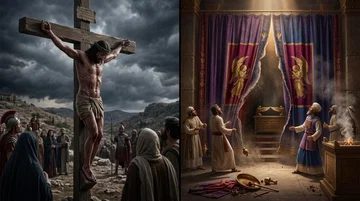
And the veil of the temple was rent in twain from the top to the bottom.
Translations
American King James Version, American Standard Version, Darby Translation
And the veil of the temple was rent in two from the top to the bottom.
King James Version, Revised Version
And the veil of the temple was rent in twain from the top to the bottom.
And the vail of the temple was rent in twain from the top to the bottom.
And the vail of the temple was rent in two, from the top to the bottom.
and the veil of the sanctuary was rent in two, from top to bottom,
And, the veil of the Temple, was rent into two, from top to bottom.
Berean Standard Bible, Majority Standard Bible
And the veil of the temple was torn in two from top to bottom.
The veil of the temple was torn in two from the top to the bottom.
And the curtain of the Temple was parted in two from end to end.
And the vaile of the Temple was rent in twaine, from the toppe to the bottome.
Douay-Rheims (Challoner revision)
And the veil of the temple was rent in two, from the top to the bottom.
Pictures
Cross-references 20 of 21
- Matthew 27:51
And, behold, the veil of the temple was rent in twain from the top to the bottom; and the earth did quake, and the rocks rent;
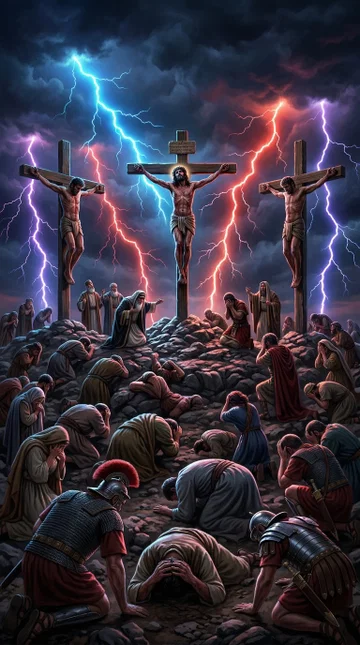
Records the temple veil tearing at Jesus’ death.
- Luke 23:45
And the sun was darkened, and the veil of the temple was rent in the midst.
Also records the temple veil tearing at Jesus’ death.
- Hebrews 10:19-20
Having therefore, brethren, boldness to enter into the holiest by the blood of Jesus,
Christ’s death tears the veil and opens a new way into God’s presence.
- Hebrews 10:1-10
For the law having a shadow of good things to come, and not the very image of the things, can never with those sacrifices which they offered year by year continually make the comers thereunto perfect.
Christ’s offering replaces the repeated sacrifices of the temple.
- Hebrews 9:8
The Holy Ghost this signifying, that the way into the holiest of all was not yet made manifest, while as the first tabernacle was yet standing:
The way into the heavenly sanctuary was opened when the first tabernacle’s service ended.
- John 19:30
When Jesus therefore had received the vinegar, he said, It is finished: and he bowed his head, and gave up the ghost.
Jesus’ death and declaration that his work was finished accompany the veil’s tearing.
- Hebrews 9:12
Neither by the blood of goats and calves, but by his own blood he entered in once into the holy place, having obtained eternal redemption for us.
Describes Christ entering the holy place by his own blood.
- Hebrews 8:1-2
Now of the things which we have spoken this is the sum: We have such an high priest, who is set on the right hand of the throne of the Majesty in the heavens;
After the veil is rent, Christ ministers in the true heavenly tabernacle.
- Hebrews 9:24
For Christ is not entered into the holy places made with hands, which are the figures of the true; but into heaven itself, now to appear in the presence of God for us:
The torn temple veil gives way to access to God through Christ in the true heavenly sanctuary.
- Leviticus 16:2
And the LORD said unto Moses, Speak unto Aaron thy brother, that he come not at all times into the holy place within the vail before the mercy seat, which is upon the ark; that he die not: for I will appear in the cloud upon the mercy seat.
The veil restricted access to the inner sanctuary to the high priest at the appointed time.
- Hebrews 9:3
And after the second veil, the tabernacle which is called the Holiest of all;
Names the second veil that was rent in the temple.
- Exodus 26:33
And thou shalt hang up the vail under the taches, that thou mayest bring in thither within the vail the ark of the testimony: and the vail shall divide unto you between the holy place and the most holy.
The veil separated the holy place from the most holy place.
- Hebrews 10:19
Having therefore, brethren, boldness to enter into the holiest by the blood of Jesus,
Christ’s sacrifice opens access to the holy places.
- Leviticus 16:15
Then shall he kill the goat of the sin offering, that is for the people, and bring his blood within the vail, and do with that blood as he did with the blood of the bullock, and sprinkle it upon the mercy seat, and before the mercy seat:
The high priest entered the holy of holies once a year.
- Hebrews 6:19
Which hope we have as an anchor of the soul, both sure and stedfast, and which entereth into that within the veil;
Both texts refer to the temple veil, using the same Greek word.
- Exodus 26:30
And thou shalt rear up the tabernacle according to the fashion thereof which was shewed thee in the mount.
tabernacle as copy whose veil was rent
- Hebrews 9:7
But into the second went the high priest alone once every year, not without blood, which he offered for himself, and for the errors of the people:
The yearly entry of the high priest contrasts with the veil being torn.
- Leviticus 16:34
And this shall be an everlasting statute unto you, to make an atonement for the children of Israel for all their sins once a year. And he did as the LORD commanded Moses.
The high priest entered the holy of holies once a year.
- Exodus 40:3
And thou shalt put therein the ark of the testimony, and cover the ark with the vail.
Compared to identify the veil over the ark.
- Exodus 30:10
And Aaron shall make an atonement upon the horns of it once in a year with the blood of the sin offering of atonements: once in the year shall he make atonement upon it throughout your generations: it is most holy unto the LORD.
The yearly atonement rite involved the sanctuary.
Commentary
Each commentary is drawn from primary sources: the writings of Ellen G. White and Adventist pioneers and periodicals. Each commentary is separate. Its own words are not a quotation; follow the references to read the source passages.
Ellen G. White
27 sources
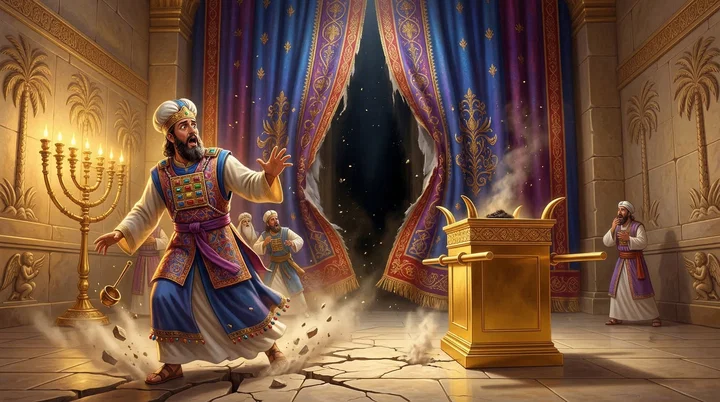
At the moment Jesus died, the heavy curtain separating the holy place from the most holy place was torn in two from top to bottom by divine power.5RED 86.26RED 8.3Ms 91, 1897, par. 6 Its rending declared that the whole system of animal sacrifices had ended forever, because it had pointed to Christ and was fulfilled in His one infinite sacrifice as the Lamb of God for the sins of the world.2SP 122.2–123.2DA 774.1LC1 81.2–82.1 It showed that the One who had dwelt in the man-made temple had departed, so that the earthly most holy place was no longer recognized as sacred and God would no longer accept its sacrifices.Ms 91, 1897, par. 6DA 774.1ST Oct 7, 1886 By His blood paying the claims of God's holy law, a new and living way was opened to the fallen race, making reconciliation with God, eternal life, and the final end of sin possible.ST Jun 10, 1889ST Jun 10, 1889ST Dec 8, 1898 The barrier between Jews and Gentiles was thus broken down, for salvation for both depends on believing in Him as the only offering for sin.EW 174.1SG1 102.1
The Veil Torn Open
At the very moment Jesus died, as He cried that His work was finished and breathed His last, the inner temple veil was torn in two from top to bottom by divine power, by unseen hands, by a divine hand and not by any human agent.5RED 86.2Ms 91, 1897, par. 6ST Oct 7, 1886SG1 60.1ST Dec 8, 1898 The tearing took place at His death and remained, for there was not time to replace the curtain or fully repair it.6RED 8.3ST Aug 8, 1878ST Nov 8, 1883
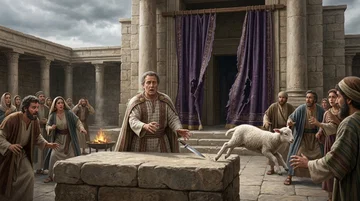
The veil was a costly, large curtain of purple and gold, of great length and breadth, strong and heavy, a strong rich drapery renewed yearly.Ms 91, 1897, par. 6ST Oct 7, 1886ST Dec 8, 1898 It separated the holy place from the most holy place, which human feet had sacredly entered only once a year, guarded from all but the high priest's yearly entrance.5RED 86.2ST Oct 7, 1886COS 164.1–165.112MR 417.1–418.1 Its rending laid open the most holy place and exposed its sacred mysteries and the mysteries of the Most Holy Place to common gaze and to curious eyes, after God had before wonderfully protected His temple.6RED 8.3ST Aug 8, 1878ST Nov 8, 1883ST Oct 7, 1886
Priests were ministering in the temple before the veil and before the altar when the earth trembled beneath them, and people in the temple witnessed the rending.6RED 8.3Ms 91, 1897, par. 6ST Oct 7, 1886 The ministering priests looked on the torn curtain, and the uncovering brought gloomy forebodings and shuddering dread.6RED 8.3ST Aug 8, 1878ST Nov 8, 18833SP 186.3–187.1 The most holy place thus lay open, its sacred mysteries exposed to common and curious gaze.ST Aug 8, 1878ST Oct 7, 18863SP 186.3–187.1
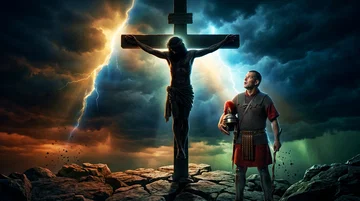
The rending belongs with the supernatural signs accompanying Jesus' death — earthquake, darkness over the land, split and rending rocks — by which nature testified and sympathized that the Son of God, its Author, had died.ST Jun 10, 1889ST Feb 15, 1883SG1 60.1ST Aug 28, 1879 The earth shook, rocks split, darkness covered the land, and the mysterious darkness over the earth passed away at His death as He cried, It is finished.ST Feb 15, 1883SG1 63.15RED 93.2–3SG1 60.1 These events troubled His enemies and made His murderers tremble, filling executioners and spectators with terror.ST Jun 10, 1889ST Feb 15, 1883SG1 63.1ST Aug 28, 1879
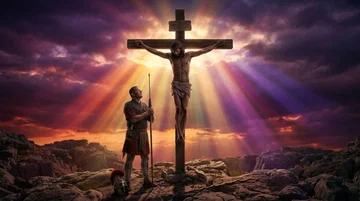
Its setting is the crucifixion, where Jesus as the patient Sufferer shed His life-blood from every wound in consequence of sin.ST Jun 10, 1889 Silent before mocking priests, elders and mob, He answered no taunt even while nailed to the cross, breathing pardoning love for His murderers, suffering the penalty of man's transgression of the Father's law.ST Jun 10, 1889
What the Rending Means
The tearing declares that the whole ceremonial system of sacrificial offerings ended forever at the cross.2SP 122.2–123.2DA 774.1LC1 81.2–82.11RED 81.2–82.1ST Dec 8, 1898 Its sacrifices, services, offerings, ordinances and ritual had pointed forward to Christ, and their meaning met its fulfillment in His one final, infinite sacrifice as the Lamb of God for the sins of the world.2SP 122.2–123.2DA 774.1LC1 81.2–82.11RED 81.2–82.112MR 417.1–418.1 Animal offerings and services were therefore no longer needed and no longer had value.DA 774.1LC1 81.2–82.1COS 164.1–165.1
It declares that the One who had dwelt in the temple made with hands had departed and would never again grace it with His presence.Ms 91, 1897, par. 6ST Dec 8, 1898 The earthly most holy place, once guarded as God's sacred audience chamber, was no longer recognized by the Lord as sacred.DA 774.1COS 164.1–165.112MR 417.1–418.1 The place laid open to view was no longer His sacred audience chamber.DA 774.112MR 417.1–418.1
God's presence would no longer overshadow the earthly mercy-seat.5RED 86.2ST Oct 7, 1886 The light of His glory would no longer flash forth upon the precious stones in the high priest's breastplate, nor would the cloud of His disapproval shadow them.5RED 86.2ST Oct 7, 1886 The high priest's robes no longer had meaning as a sign that he represented the great High Priest.DA 709.3–4
The rending declares that God would no longer accept the priests' temple sacrifices and ordinances.EW 174.1SG1 102.1 By rejecting Christ, the reality to which their types and shadows pointed, the Jewish people were separated from God.EW 174.1DA 709.3–4 Israel was thereby declared to be separated from God.DA 709.3–4
It shows that the division and barrier between Jews and Gentiles was broken down.EW 174.1SG1 102.1 Jesus offered Himself for both Jew and Gentile.EW 174.1SG1 102.1 Salvation for either depends on believing in Him as the only offering for sin and the Saviour of the world.EW 174.1SG1 102.1
Its rending signified to the heavenly universe and to a world corrupted by sin that a new and living way had been opened to the fallen race.ST Dec 8, 1898 By ransoming His people with His own blood and paying the just claims of God's holy law, Christ completed the work He came to do.ST Jun 10, 1889ST Jun 10, 1889 He thereby carried the plan of redemption forward and made reconciliation with God and eternal life possible.ST Jun 10, 1889 Through that work an end is finally to be made of sin and Satan and his host to be vanquished.ST Jun 10, 1889
How the Sign Struck
The laying open of the sacred mysteries of the most holy place brought the ministering priests before the altar gloomy forebodings and a shuddering dread of coming calamity, for they looked on the torn veil as a sign of coming calamity.6RED 8.3ST Aug 8, 1878ST Nov 8, 18833SP 186.3–187.1ST Apr 22, 1913 There had not been time to replace the veil or fully repair it, so it remained torn before their eyes.6RED 8.3ST Apr 22, 1913 The rent veil convicted many of the officiating priests of the true character of Jesus, proving that their searching of the prophecies had not been in vain.6RED 8.3ST Aug 8, 1878ST Nov 8, 18833SP 186.3–187.1ST Apr 22, 1913 After He was raised from the dead they acknowledged Him as the Son of God, and many were changed in religious understanding and came to faith.6RED 8.3Ms 91, 1897, par. 6ST Nov 8, 18833SP 186.3–187.1ST Apr 22, 1913
With earthquake, darkness over the land, and split and rending rocks, the rending proclaimed that the Son of God had died, as nature testified and sympathized that its Author had died.ST Jun 10, 1889ST Feb 15, 1883SG1 63.1ST Aug 28, 1879ST Dec 21, 1888 These signs filled the executioners and spectators with terror and added to their terror at the sight.ST Jun 10, 1889ST Feb 15, 1883ST Aug 28, 1879ST Dec 21, 1888 They troubled His enemies and made His murderers tremble.SG1 63.1EW 148.1 They helped silence the mocking of the priests and elders, and led some among the executioners and spectators to wonder whether Jesus was innocent and truly the Son of God.ST Jun 10, 1889ST Aug 28, 1879ST Dec 21, 1888 For the disciples, by contrast, the same death amid earthquake, split rocks, darkness, and His cry that His work was finished seemed to end their last hope, and their hopes of His reigning as a temporal prince died with Him.SG1 60.1EW 148.1 The event belongs to the fulfilled prophecies that confirmed Jesus as the Messiah and the world's Redeemer.3SP 186.3–187.1
Sources
Pioneers and periodicals
55 sources
The inner curtain between the holy place and the most holy place was torn in two from top to bottom by the hand of God at the very moment Christ died at the time of the evening sacrifice.ST Jul 25, 1878ST Sep 9, 1930RH Jul 20, 1876ST Mar 20, 1901ST Jun 20, 1911 With that tearing the earthly typical services and priesthood were finished forever, for type had met antitype in the once-for-all sacrifice of Jesus Christ as the true Lamb.RH Aug 17, 1916RH Jan 20, 1853ST Dec 3, 1902RH Oct 25, 1906ST Mar 26, 1912 God's presence departed from the house made with hands, leaving its most holy place exposed to common gaze and no longer sacred as the center of worship.ST Jul 25, 1878ST Oct 7, 1886ST Nov 5, 1912ST Jun 19, 1907ST Oct 5, 1904 In its place the way was opened into the true tabernacle in heaven, where Christ ministers His own blood as High Priest forever after the order of Melchizedek.RH Aug 17, 1916RH Jan 20, 1853RH Mar 1, 1870ST Mar 17, 1898ST Jun 19, 1907 The barrier is thus removed so that all may approach God through Jesus by a new and living way, proving the law honorable and unabolished while its ceremonial shadows have passed away.ST Jun 15, 1904ST Oct 31, 1900RH Nov 10, 1863ST Apr 15, 1897
Veil Described and Torn
The veil torn was the inner second curtain, standing between the first apartment or holy place and the second apartment or most holy place.ST Sep 9, 1930RH Jul 20, 1876RH Jul 20, 1876 The word for veil is katapetasma, the same word used by Matthew and Luke for the tearing and used three times in Hebrews, a word able to designate both the outer hanging at the sanctuary entrance and the inner veil.RH Jul 20, 1876 By contrast, those who held that an unmodified veil in Hebrews means the first veil at the sanctuary entrance left which veil Mark describes unspecified.RH Oct 5, 1916
It was a strong, rich, heavy curtain of most costly purple and gold material, of great length and breadth, renewed each year, separating the holy from the most holy place which was entered ordinarily only by the high priest once a year with incense.ST Jul 25, 1878ST Oct 7, 1886ST Dec 8, 1898ST Mar 20, 1901 It was torn in two from the top to the bottom by God's hand, by a divine, unseen, invisible, or angelic hand, not by human hands, as though a massive curtain had been miraculously ripped.ST Jul 25, 1878ST Aug 8, 1878ST Nov 8, 1883ST Oct 7, 1886ST Dec 8, 1898 The rending came with a great noise, before witnesses in the temple, and it could not be fully replaced or repaired.ST Dec 8, 1898ST Nov 5, 1912
The tearing happened at the very moment Christ died, when He cried out that His work was finished and breathed His last.ST Oct 7, 1886ST Dec 8, 1898 It happened at the time of the evening sacrifice while priests were ministering in the temple before the veil.ST Oct 7, 1886ST Mar 20, 1901 It was after the ninth hour when darkness had ended, at the Passover time described as between the two evenings.ST Jun 20, 1911
Death and Surrounding Signs
The rending belongs to the death of Jesus, led in procession outside the city to the skull-like hill bearing His own cross until exhaustion required a strong countryman to be pressed into service.ST Apr 8, 1903 There He was nailed to the cross and died amid wonders and convulsions in heaven and earth, after which wealthy friends begged His body from the governor, wrapped it in linen with a hundred pounds of aloes, myrrh and aromatics, laid it in a sealed rock-hewn tomb, and left it only for Him to come forth as Conqueror over sin and death.ST Apr 8, 1903 The tearing occurred amid earthquake, darkness, and rent rocks, with midday darkness among the signs surrounding His death.ST Jun 10, 1889ST Feb 15, 1883ST Aug 28, 1879ST Dec 21, 1888ST Apr 11, 1911 Nature in sympathy with its Creator was affected at the crucifixion and testified that the Son of God had died, filling with awe those who witnessed it.ST Jun 10, 1889ST Feb 15, 1883ST Aug 28, 1879ST Dec 21, 1888ST Apr 11, 1911
The day darkened like a winter twilight and loud clamors of unheard agony came from Golgotha.RH Jul 16, 1861 Dark clouds lowered over the pinnacle of the temple, and large ruptures settled over Jerusalem and covered it as with a veil.RH Jul 16, 1861 The crowd was struck with terror and remorse, and the signs declared that either the Author of nature was suffering or the universe was falling apart.RH Jul 16, 1861 The temple, though once valid, tore its veil at the death of the Lamb of God, and the crucifixion is placed amid extraordinary signs while recalling that Jesus had foretold His resurrection.RH Jul 16, 1861RH Dec 12, 1912
The rending is a historical detail accompanying the crucifixion that could have been contradicted if false, yet no ancient writer is said to have contradicted it.RH Feb 11, 1862 When Jesus died the veil was torn from top to bottom so that ordinary people could see what had previously been visible only to the high priests.ST Jan 31, 1911 The tearing of the veil is placed side by side with the tearing of the Lord's mother's heart.ST Jan 31, 1911 The tear was miraculous, as though a hand had ripped the massive curtain, and it signaled the decisive moment when the Messiah was cut off.ST Jan 24, 1911 At that moment the lamb about to be sacrificed escaped unharmed.ST Jan 24, 1911
Earthly Sanctuary Ended
At Christ's death the special services, typical services, carnal ordinances, continual service, and earthly priesthood and ministry were finished, closed, and rendered null and void forever.RH Aug 17, 1916RH Jan 20, 1853RH Mar 1, 1870ST Mar 17, 1898ST Mar 20, 1901 The veil separating its two apartments was torn, making them one common room and bringing the special services performed in them to an end.RH Aug 17, 1916RH Jan 20, 1853RH Mar 1, 1870ST Mar 17, 1898ST Mar 20, 1901 The tearing happened at the time of the evening sacrifice while priests were ministering in the temple, and because it was from top to bottom it was not done by human hands.RH Aug 17, 1916RH Jan 20, 1853RH Mar 1, 1870ST Mar 17, 1898ST Mar 20, 1901 Christ, who fulfilled the meaning of temple, sacrifice, priesthood, and service, had been offered on the cross and was about to ascend to begin His ministry in the heavenly sanctuary.RH Aug 17, 1916RH Jan 20, 1853RH Mar 1, 1870ST Mar 17, 1898ST Sep 20, 1910
Both apartments were abandoned by the symbol of God's presence because their work was finished.RH Aug 17, 1916ST Mar 17, 1898 Type met antitype: the tabernacle in the wilderness and later the temple as copy of things in heaven reached their heavenly reality and eternal substance, the shadow reached its substance.ST Dec 3, 1902RH Aug 18, 1863ST Sep 2, 1913ST Dec 3, 1902 By taking flesh and offering Himself for man, Jesus took away the typical continual service, which had degenerated into mere ceremonialism, and revealed the eternal reality in its place.ST Dec 3, 1902ST Dec 3, 1902 By virtue of His death and resurrection He became minister of the true tabernacle which the Lord pitched and not man, and this change from typical ministry to ministry in the holy place of the heavenly sanctuary was part of God's purpose of salvation to be understood so His people could cooperate intelligently.ST Dec 3, 1902ST Dec 3, 1902 The long-observed sanctuary types met their fulfillment in Christ, animal offerings were no longer serviceable after Christ's offering for the world, and Christ's blood was henceforth to be ministered in the heavenly sanctuary where the world was to look for salvation and pardon.ST Nov 5, 1912RH Aug 18, 1863ST Sep 2, 1913
The symbolic sacrificing of animals was replaced by the actual, greater, once-for-all sacrifice of the life of Jesus Christ, the true Lamb and great antitypical Sacrifice and ransom for the world.RH Oct 25, 1906ST Mar 26, 1912RH Aug 8, 1871ST Sep 2, 1913 His sacrifice was complete, and sacrifice and offering were effectual no longer.RH Oct 25, 1906ST Mar 26, 1912RH Aug 8, 1871ST Sep 2, 1913 The tearing exposed the most holy place and its sacred mysteries to common gaze and curious eyes after God had before wonderfully protected His temple.ST Jul 25, 1878ST Oct 7, 1886ST Dec 8, 1898ST Jun 19, 1907 The veil had been a strong, rich, heavy curtain of most costly purple and gold material, of great length and breadth, renewed each year, separating the holy from the most holy place which human feet had sacredly entered only once a year.ST Jul 25, 1878ST Oct 7, 1886ST Dec 8, 1898
Its rending by God's hand, by a divine, unseen, invisible hand before witnesses in the temple, repudiated the earthly sanctuary as no longer sacred and ended it as the center of worship.ST Jul 25, 1878ST Oct 7, 1886ST Dec 8, 1898ST Jun 19, 1907 God's presence would no longer overshadow the earthly mercy seat, nor would the light of His glory flash forth upon nor the cloud of His disapproval shadow the precious stones in the breastplate of the high priest.ST Jul 25, 1878ST Oct 7, 1886 He who had dwelt in the house made with hands went forth never again to grace it with His presence, and all sacrificial offerings terminated in the one great offering of the Son of God.ST Jul 25, 1878ST Oct 7, 1886ST Dec 8, 1898ST Jun 19, 1907 God departed from the temple and no longer recognized the most holy place as His dwelling; the temple had been holy only because of His indwelling presence, and when He departed the holy thing became common.ST Nov 5, 1912ST Oct 5, 1904
From then on its services were empty, dead ritualism and display with the substance gone and only the shadow remaining, for the Jews had rejected Christ and the glory had departed.ST Nov 5, 1912ST Oct 5, 1904 He now calls it not My house or My temple but your house, left desolate, proving that a righteous character is of more consequence and far more enduring than the most stately temple and that the thing cherished as holiest is profane unless Christ is in it.ST Oct 5, 1904 Angel hands threw open the apartment where the symbol of His government was set, marking that Jehovah finished with Israel and abandoned His sovereignty and theocracy over that nation after they slew the Lord of glory.RH Feb 23, 1911 This fulfilled the word that their house was left desolate, as voices said, Arise, let us go hence.RH Feb 23, 1911ST Oct 5, 1904
The old Jewish age and the new age then overlapped for nearly forty years, the building remaining until the Romans destroyed Jerusalem and the temple in A.D. 70 and its sacrifices disappeared.ST Nov 5, 1912RH May 14, 1901ST Nov 28, 1892 When the veil was torn the true sacrifice had been offered and the earlier sacrifices were shown to be only types of it, marking the beginning of the closing period of the Jewish age and the passing of the old dispensation and its sanctuary services.ST Nov 5, 1912RH May 14, 1901ST Nov 28, 1892
Heavenly Sanctuary Opened
The tearing of the veil at the death of Jesus shows that the services of the earthly sanctuary were finished and that the way into the true heavenly sanctuary was opened.RH Jan 20, 1853RH Mar 1, 1870ST Dec 3, 1902 The typical sanctuary of the first covenant, the tabernacle in the wilderness and afterward the temple as a copy of things in heaven, ended and gave place to the true tabernacle which the Lord pitched and not man.RH Jan 20, 1853RH Mar 1, 1870ST Dec 3, 1902 Type met antitype when the true sacrifice was offered, for by taking flesh and offering Himself for man Jesus took away the typical continual service, which had degenerated into mere ceremonialism, and revealed the eternal reality in its place.RH Mar 1, 1870ST Dec 3, 1902 By virtue of His death and resurrection He became the minister of the true tabernacle, and this is the mystery of godliness.ST Dec 3, 1902
The rending repudiated the earthly sanctuary as no longer sacred and ended it as the center of worship.ST Jun 19, 1907RH Aug 18, 1863ST Jun 10, 1880 The center of God's worship transferred to the heavenly courts, where Christ ministers His own blood on behalf of sinners.ST Jun 19, 1907RH Aug 18, 1863ST Jun 10, 1880 His blood shed at Calvary was henceforth to be ministered in the heavenly sanctuary, where the world was to look for salvation and pardon, since animal offerings were no longer serviceable after His offering for the world.ST Jun 19, 1907RH Aug 18, 1863ST Jun 10, 1880
His offering of His blood signaled the transfer of the priesthood from Levi to Judah, as the Son of God became High Priest forever in the order of Melchizedek.RH Aug 17, 1916ST Mar 17, 1898RH Dec 25, 1860 The two apartments were made one common room and abandoned by the symbol of God's presence because their work was finished, bringing the special services performed in them to an end.RH Aug 17, 1916ST Mar 17, 1898 The typical temple service ended and the priesthood passed from the Aaronic order to the Melchizedek order, with Christ as the everlasting High Priest of His people, so that the Levitical priesthood ceased and the Melchisedec priesthood began.RH Aug 17, 1916ST Mar 17, 1898RH Dec 25, 1860 The question of who was intercessor while Christ lay in the grave is unprofitable curiosity that does not affect the sanctuary subject.RH Dec 25, 1860
Christ fulfilled the meaning of temple, sacrifice, priesthood, and service, and the torn veil shows that He had been offered on the cross and was about to ascend and begin His ministry in the heavenly sanctuary.ST Sep 20, 1910ST Dec 5, 1892 After He ascended that ministry began, and this marked the end of the old dispensation, with the services of the earthly sanctuary ended forever.ST Sep 20, 1910ST Dec 5, 1892 The change from the earthly sanctuary's typical service to ministry in the holy place of the heavenly sanctuary was part of God's purpose of salvation, and His people needed to understand it so they could cooperate intelligently with that purpose.ST May 1, 1907 The sanctuary was dedicated throughout when Christ began that work, including both the holy and the most holy places, and His ministry looked forward to its culmination at the end when the Christian's hope would be consummated.ST May 1, 1907
That heavenly sanctuary and its teaching is a key to understanding the Scriptures that reveals God's holiness, majesty, mercy, and nearness as Father and Friend.ST Jun 19, 1907 The end of the earthly sanctuary's typological service at the crucifixion in A.D. 31 means that sanctuary cleansing placed by prophecy after the crucifixion applies to the heavenly sanctuary, where Christ's closing work as High Priest takes place.ST Mar 3, 1890
Law, Sacrifice, and Salvation
At the tearing of the veil Jesus hangs as the patient Sufferer shedding His life-blood from every wound in consequence of sin, silent before mocking priests and elders and the mob controlled by Satan, answering no taunt even while nailed to the cross and breathing pardoning love for His murderers.ST Jun 10, 1889 In that suffering He bears the penalty of man's transgression of the Father's law, ransoming His people with His own blood and paying the just claims of God's holy law, through which an end is finally to be made of sin and Satan and his host to be vanquished.ST Jun 10, 1889 His death for our sins magnifies the law and makes it honorable and vindicates its claims, proving the law was not abolished as having outlived its usefulness, for then His death on behalf of those living afterward would not have been necessary.ST Jun 15, 1904 That death was necessary because sin is transgression of the law, the law is so firmly established that not one jot or tittle could be repealed, the penalty of sin is death and all have sinned so all must die or some acceptable substitute must die in their stead, which Jesus did.ST Jun 15, 1904 All who accept Him by faith therefore acknowledge the just claims of the law upon them.ST Jun 15, 1904
The ceremonial system which pointed to Christ's atoning and cleansing work no longer has continuing purpose because that work was completed, and the torn veil signifies the end of the need for those ceremonies. His completed work also included keeping the moral law on humanity's behalf and making divine power available through the risen and ascended Christ and the Spirit for keeping God's law, not releasing people from obligation to that eternal law. The rending does not mean salvation itself changed, for Christ saved from the beginning and the spirit of the law of love never ceased.RH Oct 25, 1906 It means the particular way men gave evidence of that law's control in their lives changed with Jesus' life and death, since even under the old dispensation animal offerings were not essential to salvation but only what they stood for.RH Oct 25, 1906 The symbolic sacrificing of animals was thus replaced by the actual sacrifice of the life of Jesus Christ, greater than all other sacrifices and the reality of which they were only the type and forecast.RH Oct 25, 1906
The torn veil and the ended ceremonial shadows did not abolish the Sabbath, for the disciples rested on the Sabbath after His death according to the commandment.RH Sep 2, 1851 That commandment's requirement was rest from labor, not the temple sacrifices performed on that day.RH Sep 2, 1851 His death completed the work He came to do and carried the plan of redemption forward in glorious triumph of eternal righteousness, making reconciliation with God and eternal life possible.ST Jun 10, 1889
Access Opened and Applied
The curtain between the sanctuary and the holy of holies stood for separation, and its tearing abolished the separation between Jews and Gentiles and opened to all people the access once reserved to the high priest, so that through Jesus Christ the one great Mediator all may approach the throne of grace.RH Nov 10, 1863 The barrier between God and His people was removed, for the veil had taught that Jesus is the way to God, and through His blood all may enter the heavenly sanctuary, the work of God is no longer hidden from Christians, and every class of people is united in Christ.ST Apr 15, 1897 The rending signalized the passing from shadow into sunshine, when the whole system of shadows growing out of sin passed away, and the veil of sin separating man and God was rent asunder on Calvary while the blood that takes away sin flows, so that by faith those emancipated from sin may now enter into the holiest by the blood of Jesus through the veil, that is His flesh.ST Oct 31, 1900 The tearing marked the change from the former sanctuary arrangement to a new and living way through Jesus' flesh, opened to the fallen race and signified to the heavenly universe and to a world corrupted by sin, with the temple veil separating people from the mercy seat torn.ST Dec 8, 1898RH Jun 21, 1864
The signs added terror and awe to executioners, spectators, and witnesses, helped silence the mocking of priests and elders, and awakened wondering whether Jesus was innocent and truly the Son of God.ST Jun 10, 1889ST Aug 28, 1879ST Dec 21, 1888ST Apr 11, 1911 Priests ministering in the temple saw the sacred mysteries laid open to curious eyes after God had wonderfully protected His temple, and were filled with dread of coming calamity.ST Aug 8, 1878ST Nov 8, 1883ST Oct 7, 1886 Many were convicted that Jesus was the Son of God and after His resurrection acknowledged Him as such.ST Aug 8, 1878ST Nov 8, 1883ST Apr 22, 1913
The Jews had counted their magnificent temple with its porticos, ceremonies, and ordinances whose meaning they had forgotten as the greatest thing in the world, valuing tradition and display above Christ even though One greater than the temple was present.ST Oct 5, 1904 By rejecting Him their service became dead, proving that a righteous character is of more consequence and far more enduring than the most stately temple, and that the thing cherished as holiest is profane unless Christ is in it.ST Oct 5, 1904 The rending marks the moment of Jesus' death within the prophetic midst of the week, with the crucifixion and the Sabbath that followed placed in that prophecy.ST Jan 31, 1911
Sources