Hebrews 9:3
And after the second veil, the tabernacle which is called the Holiest of all;
Translations
American King James Version, King James Version
And after the second veil, the tabernacle which is called the Holiest of all;
And after the second vail, the tabernacle which is called the holiest of all;
And after the second vail, the tabernacle which is called the Holiest of all;
Revised Version, American Standard Version
And after the second veil, the tabernacle which is called the Holy of holies;
and after the second vail a tabernacle that is called 'Holy of holies,'
but after the second veil a tabernacle which is called Holy of holies,
But, after the second veil, a tent, that which is called Most Holy:
Berean Standard Bible, Majority Standard Bible
Behind the second curtain was a room called the Most Holy Place,
After the second veil was the tabernacle which is called the Holy of Holies,
And inside the second veil was the place which is named the Holy of holies;
And after the seconde vaile was the Tabernacle, which is called the Holiest of all,
Douay-Rheims (Challoner revision)
And after the second veil, the tabernacle, which is called the holy of holies:
Pictures
Cross-references 20 of 73
- Hebrews 8:1-2
Now of the things which we have spoken this is the sum: We have such an high priest, who is set on the right hand of the throne of the Majesty in the heavens;
Christ ministers as High Priest in the true heavenly sanctuary.
- Hebrews 9:23-24
It was therefore necessary that the patterns of things in the heavens should be purified with these; but the heavenly things themselves with better sacrifices than these.
Earthly holy places figure the heavenly sanctuary where Christ appears before God for us.
- Leviticus 16:2
And the LORD said unto Moses, Speak unto Aaron thy brother, that he come not at all times into the holy place within the vail before the mercy seat, which is upon the ark; that he die not: for I will appear in the cloud upon the mercy seat.
Explains the inner sanctuary and the high priest’s restricted entry into God’s presence.
- Exodus 25:10-22
And they shall make an ark of shittim wood: two cubits and a half shall be the length thereof, and a cubit and a half the breadth thereof, and a cubit and a half the height thereof.
Describes the ark and its place in the most holy room.
- Exodus 26:33-34
And thou shalt hang up the vail under the taches, that thou mayest bring in thither within the vail the ark of the testimony: and the vail shall divide unto you between the holy place and the most holy.
The veil separates the holy place from the Most Holy Place, where the ark and mercy seat stand.
- Hebrews 9:11-12
But Christ being come an high priest of good things to come, by a greater and more perfect tabernacle, not made with hands, that is to say, not of this building;
Christ enters the greater heavenly sanctuary as High Priest by his own blood, securing redemption.
- Revelation 11:19
And the temple of God was opened in heaven, and there was seen in his temple the ark of his testament: and there were lightnings, and voices, and thunderings, and an earthquake, and great hail.
The opened heavenly temple reveals the ark of the covenant.
- Hebrews 8:5
Who serve unto the example and shadow of heavenly things, as Moses was admonished of God when he was about to make the tabernacle: for, See, saith he, that thou make all things according to the pattern shewed to thee in the mount.
The earthly sanctuary and its service are a pattern and shadow of heavenly things.
- Hebrews 10:19-20
Having therefore, brethren, boldness to enter into the holiest by the blood of Jesus,
Christ’s flesh opens the way through the veil into God’s presence.
- Hebrews 9:8
The Holy Ghost this signifying, that the way into the holiest of all was not yet made manifest, while as the first tabernacle was yet standing:
same Holy of Holies phrase
- Hebrews 6:19-20
Which hope we have as an anchor of the soul, both sure and stedfast, and which entereth into that within the veil;
Christ enters within the veil as forerunner and High Priest.
- Exodus 25:8
And let them make me a sanctuary; that I may dwell among them.
God commands a sanctuary as his dwelling among Israel.
- Exodus 25:40
And look that thou make them after their pattern, which was shewed thee in the mount.
The earthly sanctuary was to be made according to the pattern shown to Moses.
- Hebrews 9:23
It was therefore necessary that the patterns of things in the heavens should be purified with these; but the heavenly things themselves with better sacrifices than these.
The earthly sanctuary’s cleansing is contrasted with heavenly realities purified by Christ’s better sacrifice.
- Exodus 40:20-21
And he took and put the testimony into the ark, and set the staves on the ark, and put the mercy seat above upon the ark:
Moses places the ark behind the veil in the tabernacle.
- Leviticus 16:15
Then shall he kill the goat of the sin offering, that is for the people, and bring his blood within the vail, and do with that blood as he did with the blood of the bullock, and sprinkle it upon the mercy seat, and before the mercy seat:
The high priest brings the sin-offering blood within the veil and sprinkles it before the mercy seat.
- Hebrews 9:7
But into the second went the high priest alone once every year, not without blood, which he offered for himself, and for the errors of the people:
The high priest entered the inner sanctuary once yearly with blood for atonement.
- Exodus 25:22
And there I will meet with thee, and I will commune with thee from above the mercy seat, from between the two cherubims which are upon the ark of the testimony, of all things which I will give thee in commandment unto the children of Israel.
God meets and communes above the mercy seat between the cherubim.
- Leviticus 16:29-34
And this shall be a statute for ever unto you: that in the seventh month, on the tenth day of the month, ye shall afflict your souls, and do no work at all, whether it be one of your own country, or a stranger that sojourneth among you:
The annual high-priestly atonement cleanses the sanctuary and provides the pattern for Jesus’ ministry in the holiest.
- Exodus 25:9
According to all that I shew thee, after the pattern of the tabernacle, and the pattern of all the instruments thereof, even so shall ye make it.
The earthly sanctuary was made according to the pattern shown to Moses.
Commentary
Each commentary is drawn from primary sources: the writings of Ellen G. White and Adventist pioneers and periodicals. Each commentary is separate. Its own words are not a quotation; follow the references to read the source passages.
Ellen G. White
43 sources
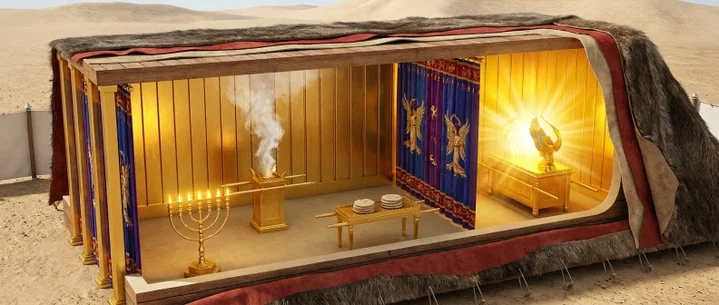
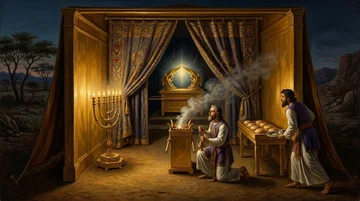
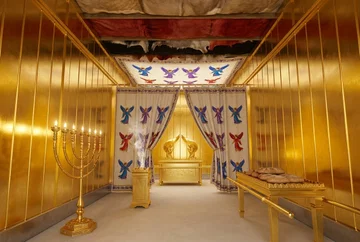
After the second veil is the inner second apartment of the sanctuary, called the Holiest of all or Most Holy Place, distinct from the holy place before it.GC88 411.1–412.3GC 410.3–411.1WLF 18.3–4 It was entered through a rich curtain inwrought with cherubim, and held the gold-covered ark with its solid-gold mercy seat, the cherubim above it, and the cloud of divine glory and revealed will between them.GC88 411.1–412.34SP 499.3–500.1GC88 684.6–685.28T 284.3–285.1RH Nov 9, 1905 There is a real temple in heaven with the same division, where beyond the second veil stands the ark with its cherubim, golden censer, and exceeding bright glory where God dwells.RH Jul 21, 1851CET 91.2–3ExVEGW 15.3–17.1LSEGW 100.1–3 At the close of His work in the outer apartment in 1844 Jesus passed within that heavenly second veil into the Most Holy Place to make the final atonement, cleanse the sanctuary, and blot out the sins of His people.4SP 499.3–500.1GC88 684.6–685.2SG1 158.1ExVEGW 25.3ExVEGW 24.2–25.1 There the ark holds beneath the mercy seat the Ten Commandments as the basis of God's covenant, whose light, especially the Sabbath command, now shines out to test God's people.ExVEGW 25.3ExVEGW 24.2–25.1RH Jun 29, 1911RH Nov 9, 19055MR 94.1–2
Earthly Tabernacle Described
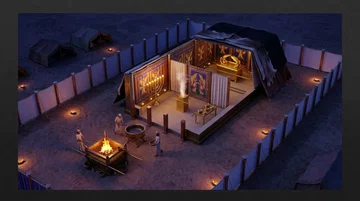
The room beyond the second veil is the Holiest of all, the Most Holy Place, the Holy of Holies, the inner and second apartment of the sanctuary, distinct from the first apartment or holy place.GC88 411.1–412.3GC 410.3–411.1WLF 18.3–4WLF 14.3–16.1RH Nov 8, 1915 The first covenant had ordinances of divine service and an earthly sanctuary made as a tabernacle, with a first apartment called the sanctuary and, after the second veil, another tabernacle called the holiest of all.RH Nov 8, 1915SG1 158.1 The veil separated the inner room from the holy place, and the ark of the covenant stood inside with the Ten Commandments, beneath the cherubim and before the mercy seat where God's glory was revealed.GC88 411.1–412.3SG1 158.1
The sanctuary had two veils or doors, and the second veil marked the entrance to the Most Holy Place.4SP 499.3–500.1GC88 684.6–685.28T 284.3–285.1 That second veil was a richly made curtain inwrought with cherubim guarding the entrance to the earthly symbol of God's dwelling-place sacred to His presence.8T 284.3–285.1GC 411.2–412.3 The two apartments were separated by that richly made curtain, the inner room containing the ark where God's presence was manifested in the cloud of glory between the cherubim.GC 411.2–412.3
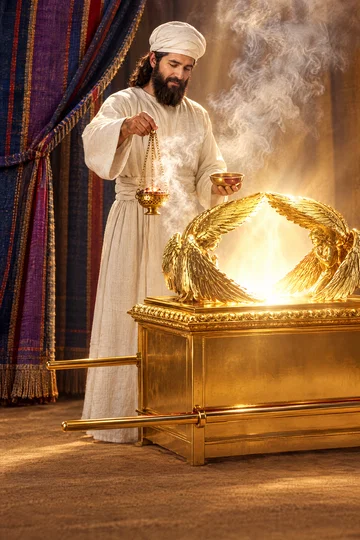
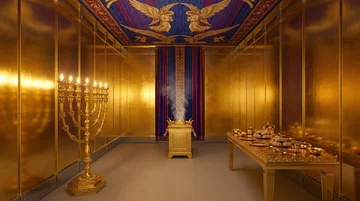
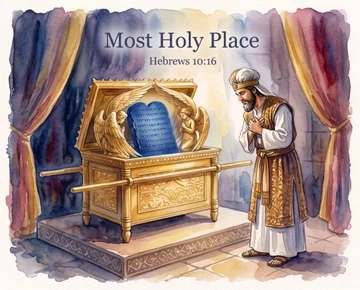
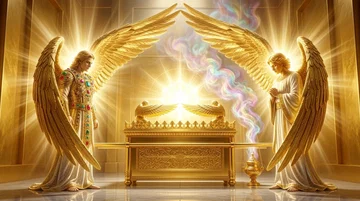
The Most Holy Place contained the ark of the covenant of precious wood overlaid with gold, which held the stone tablets bearing the Ten Commandments, the basis of God's covenant.RH Nov 9, 1905RH Nov 8, 1915 Its golden cover was the mercy seat of solid gold with a cherub at each end, whose posture represented heaven's reverence for God's law and interest in redemption.RH Nov 9, 1905RH Nov 8, 1915 Above the mercy seat between the cherubim the divine presence appeared in a cloud of glory like a throne, and from between the cherubim God made His will known.GC88 411.1–412.3RH Nov 9, 1905RH Nov 8, 1915
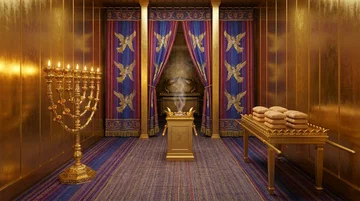
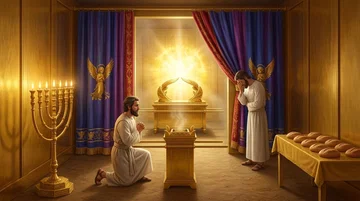
The holy place before that veil held the golden altar of incense directly before the veil where fragrance ascends daily with prayer, the candlestick with seven lamps on the south giving light day and night, and the table with the showbread on the north, whose glory is viewed first.RH Jul 21, 1851RH Nov 8, 1915 The rich curtain before the ark did not reach the top, so God's glory above the mercy seat could be seen from both apartments, though less clearly from the first.SG4 8.31SP 273.3 The golden incense altar stood before the ark separated from it by the curtain, its fire came from the Lord, and its incense filled the sanctuary with fragrance.SG4 8.31SP 273.3
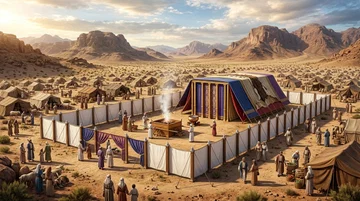
The wilderness tabernacle was a portable earthly sanctuary with ordinances of divine service built during Israel's wilderness journey.GC88 411.1–412.3GC 411.2–412.3 After Israel settled in Canaan Solomon's temple replaced it while keeping the same proportions, arrangement and furnishings, and it continued in that form until destroyed by the Romans in A.D. 70.GC88 411.1–412.3GC 411.2–412.3 The inner room was God's own dwelling place in the Jerusalem temple, beautiful for situation and the joy of the whole earth, holding more than a thousand years of guardian care.4RED 125.2–127.1 In that temple prophets spoke solemn warnings, burning censers sent incense up mingled with the prayers of worshipers, the blood of beasts flowed as a type of the blood of Christ, Jehovah revealed His glory above the mercy seat, and priests ministered in flowing robes and jeweled breastplates with pomp of symbol and ceremony for ages.4RED 125.2–127.1 All of this must come to an end, with the temple in ruins and not one stone left upon another, because Jerusalem sealed her own doom by rejecting Christ.4RED 125.2–127.1
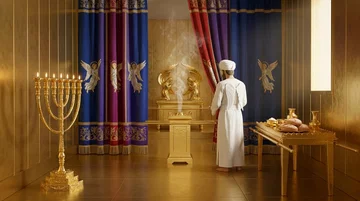
Only one hand might lift the second veil, only the high priest, and only on the one day of the year appointed for ministry there, entering with trembling while clouds of incense veiled the glory from his sight.8T 284.3–285.1 To intrude unbidden into its sacred mystery was death, for above the mercy seat and the bowed, worshiping angels dwelt the glory of the Holiest upon which no man might look and live.8T 284.3–285.1 While he ministered throughout the courts of the temple every sound was hushed, no priests ministered at the altars, and the hosts of worshipers bowed in silent awe sending up petitions for God's mercy.8T 284.3–285.1 At Christ's death that chamber beyond the second veil ceased to be sacred as the place where God's presence overshadowed the mercy seat, and God's acceptance or displeasure was no longer shown through the precious stones in the high priest's breastplate.COS 165.2–3 The temple offerings no longer had value because Christ, the Lamb of God, had become the sacrifice for the sins of the world.COS 165.2–3
Heavenly Temple Revealed
There is a real temple in heaven, in the Holy City, divided just as Hebrews 9:3 describes, with a holy place before a real second veil and, after the second veil, the Holy of Holies.RH Jul 21, 1851CET 91.2–3ExVEGW 15.3–17.1 The holy place before that veil holds the altar of incense, the candlestick with seven lamps, and the table with the shewbread or showbread, whose glory is seen first.RH Jul 21, 1851CET 91.2–3ExVEGW 15.3–17.1 Jesus himself raises the second veil to give entrance, and leads the believing witness within into the sacred inner room.WLF 18.3–4RH Jul 21, 1851CET 91.2–3LSEGW 100.1–3EW 25.6
Beyond the heavenly second veil is the ark covered with purest gold, with a lovely cherub on each end with wings spread over it and faces turned toward each other looking downward, and a golden censer between the angels.CET 91.2–3ExVEGW 15.3–17.1 Above the ark is an exceeding bright glory like a throne where God dwells, with Jesus standing by the ark.WLF 18.3–4CET 91.2–3ExVEGW 15.3–17.1LSEGW 100.1–3 Inside the heavenly ark are the golden pot of manna, Aaron's rod that budded, and the tables of stone folded together like a book, which Jesus opens to show the Ten Commandments written by the finger of God, four on one table and six on the other.ExVEGW 15.3–17.1 Angels look toward the commandments and the golden pot of manna, whose keeping would have made Israel strong and kept Jerusalem standing.Ms 5, 1849, par. 13–15
At the end of the 2300 days the Father went within the veil into the Holy of Holies and sat there, and Jesus was borne in a cloudy chariot with wheels like flaming fire to the Holiest where the Father sat.ExVEGW 43.1 There He stands before the Father as great High Priest, with a bell and a pomegranate, a bell and a pomegranate upon the hem of His garment.ExVEGW 43.1 Those who follow Him by faith send their prayers to Him in the Holiest, and He breathes upon them the Holy Spirit with light, power, love, joy and peace.ExVEGW 43.1
Christ's Final Atonement Ministry
The second veil marks the entrance where the antitypical Day of Atonement work is carried out, the center of the symbolic service of atonement and intercession belonging with the great day of atonement.4SP 499.3–500.1RH Nov 9, 1905Lt 253, 1903, par. 17 At the time opened to faith one door was shut and the other was open, and the open door gave access by faith to the place where the great High Priest blots out the sins of His faithful people.4SP 499.3–500.1GC88 684.6–685.2 After finishing His mediation in the outer apartment, at the seventh month in 1844 when the midnight cry was finished, Jesus passed within the second veil into the heavenly Most Holy Place clothed in priestly garments, shutting the door of the holy place and opening the door of the Most Holy Place.SG1 158.1ExVEGW 25.3ExVEGW 24.2–25.1ExVEGW 25.2EW 35.1 Within that second-veil tabernacle is the ark containing the two tables of stone on which the Ten Commandments are written, and it is there that the faith of Israel now reaches.ExVEGW 25.3ExVEGW 24.2–25.1Lt 5, 1849, par. 7–9
There He stands by the ark beneath the cherubim and before the mercy seat amid the divine glory to make a final atonement, cleanse the sanctuary, and blot out the sins of His faithful people.4SP 499.3–500.1GC88 684.6–685.2SG1 158.1EW 213.2–214.1 In the Holiest He receives the saints' prayers and offers them with the smoke of incense to the Father, and presents them before God amid the divine glory.CET 91.2–3EW 213.2–214.1LSEGW 100.1–3 There He accepts prayers, confessions and sacrifices, pardons transgressions, and breathes upon His followers the Holy Spirit with light, power, love, joy and peace.EW 39.2ExVEGW 43.1 Those who follow Him by faith send their prayers to Him in the Holiest, where He stands before the Father as great High Priest with a bell and a pomegranate upon the hem of His garment.ExVEGW 43.1
By faith the disappointed believers enter there with Him and find Jesus, renewing their hope and joy, which explains their experience after 1844 as God's leading.EW 216.1 His time in the Most Holy Place is nearly finished so the remaining time is brief.EW 48.3–49.1 Before He leaves it the work of rescuing people and preparing them for the coming storm must be done, for when He leaves no Priest will present prayers or confessions, the righteous will remain righteous and the unjust unjust, and those whose sins are blotted out will be sealed with the seal of the living God.EW 39.2EW 48.3–49.1
His entering beyond the second veil marks His departure from the holy place; from then on the churches that reject the light are left like the Jews and fill with corruption and evil spirits.SG1 190.1EW 234.2 Their prayers and profession concealing selfishness, fraud, deceit and pride do not make them acceptable to God.SG1 190.1 Their sins bring impending judgment and the wrath threatened by the third angel.SG1 190.1EW 234.2
Law and Sabbath Test
Beyond the second veil stands the tabernacle of the inner sanctuary, and within it rests the ark holding the law of God beneath the mercy seat.ExVEGW 25.3RH Jun 29, 1911 That ark contains the two tables of stone bearing the Ten Commandments written by the finger of God, which form the basis of His covenant, while the light of that law shines out upon the world.ExVEGW 25.3RH Jun 29, 1911RH Nov 9, 1905 The golden cover of the ark is the mercy seat, with cherubim whose reverent posture shows heaven's regard for the law and interest in redemption, and from between the cherubim above the mercy seat the divine presence appears and makes the divine will known.RH Nov 9, 1905
Among those commandments the fourth shines above all the others, marked by a halo of glory.ExVEGW 15.3–17.1SG2 82.1 It shines with that distinction because it alone identifies the living God as the Maker of heaven and earth.ExVEGW 15.3–17.1SG2 82.1 Since the door into the Most Holy Place was opened in 1844, when mediation in the holy place was finished and entrance was made within the second veil to stand by the ark, the commandments shine out with all their importance and God's people are tested on the Sabbath truth.ExVEGW 24.2–25.15MR 94.1–2Ms 1, 1849, par. 2–4
The Sabbath writing kept in the heavenly Most Holy Place still reads as it was given to Moses at Sinai, that the seventh day is the Sabbath of the Lord.ExVEGW 15.3–17.1 That unaltered writing proves that God never changes, that He has not changed the Sabbath to the first day, that the Sabbath was not nailed to the cross, and that the change to the first day was made by the Pope.ExVEGW 15.3–17.1 The holy Sabbath is and will be the separating wall between the true Israel of God and unbelievers.ExVEGW 15.3–17.1
Keeping the true Sabbath could become a test only since that door was opened, and it could not come until ministry in the holy place was finished and passage was made within the second veil at the seventh month in 1844 when the midnight cry was finished.ExVEGW 25.2EW 35.1Lt 5, 1849, par. 7–9 Christians who fell asleep before that time without keeping the true Sabbath had not received its light and had not faced that test, and therefore now rest in hope without condemnation.ExVEGW 25.2EW 35.1Lt 5, 1849, par. 7–9 To doubt the present Sabbath test because many good Christians died in triumphs of faith without keeping it is a temptation of Satan.ExVEGW 25.2
Angels look toward the commandments and toward the golden pot of manna kept with them.Ms 5, 1849, par. 13–15 Israel would have been strong and Jerusalem would have remained if the people had kept those commandments, and the redeemed keep the seventh-day Sabbath holy.Ms 5, 1849, par. 13–15 Because time in the Most Holy Place is nearly finished and the remaining time is brief, and because the Bible will judge people in the last day, God's commandments and the testimony of Jesus should occupy the mind in preparation for the sealing time.EW 48.3–49.1
Faith Prayer and Reverence
The ark of the testimony stood beyond the second veil with a curtain before it, and the glory of God above the mercy seat could be seen from both apartments of the sanctuary, though less clearly from the first.SG4 8.31SP 273.3 The golden altar of incense stood before the ark, separated from it by the curtain, its fire kindled from the Lord and its fragrant smoke filling the sanctuary, and the glory descended upon the mercy seat.SG4 8.31SP 273.3 As the priest offered incense he faced the hidden mercy seat and directed his prayer toward it in faith though he could not see it, knowing it was there.SG4 8.31SP 273.3 This represents God's people directing their prayers to Christ, their unseen Mediator before the mercy seat in the heavenly sanctuary, whom they cannot see with natural eyes, and claiming the benefits of His mediation with confidence.SG4 8.31SP 273.3
The second veil pictures the barrier that living faith must press through, for living faith presses through every obstacle and reaches into God's presence to grasp the promised blessing.RH Jan 10, 1856ExVEGW 59.2 True faith sends prayer within the second veil and lays hold of the promised blessing and claims it as its own before it is realized and felt, believing it received because the Word promises it.RH Jan 10, 1856ExVEGW 59.2 The sanctuary language of the Holiest of all also pictures earnest, united prayer ascending into God's presence, as when prayer for the children was followed by their beginning to pray, showing God at work for them.5MR 99.4
The second veil was inwrought with cherubim guarding the entrance to the most holy place, the earthly symbol of God's dwelling sacred to His presence.8T 284.3–285.1 No hand save one might lift it, and to intrude unbidden into its sacred mystery was death, for above the mercy seat and the bowed, worshiping angels dwelt the glory of the Holiest upon which no man might look and live.8T 284.3–285.1 On the one day of the year appointed for ministry there the high priest entered with trembling while clouds of incense veiled the glory from his sight.8T 284.3–285.1 Throughout the courts every sound was hushed, no priests ministered at the altars, and the hosts of worshipers bowed in silent awe sending up petitions for God's mercy.8T 284.3–285.1 These things happened by way of example and were written for admonition upon those upon whom the ends of the ages are come, requiring reverent silence before God in His holy presence.8T 284.3–285.1
The verse belongs to the present truth on the sanctuary question and the ministration in the heavenly sanctuary, one of the great pillars of faith.4MR 249.1–2 Its true understanding means much and came as light when earnestly sought from the Lord, with the Holy Spirit in a marked manner endorsing the preaching of this doctrine and revealing the error of new theories that questioned and opposed it for more than half a century.4MR 249.1–2 Any teaching that leads away from that light on the ministration in the heavenly sanctuary, including the ministration connected with the holy place seen in vision of the heavenly sanctuary, is to be rejected and its teacher not accepted.4MR 249.1–2 The Holiest of all after the second veil, containing the ark holding the law of God with the mercy seat as its cover and the angels at either end, belongs with the great day of atonement and with the mysteries of heaven that are to be left closed and undescribed.Lt 253, 1903, par. 17
Sources
Pioneers and periodicals
142 sources
After the second veil stood the inner second apartment of the earthly tabernacle, called the Holiest of all or Most Holy Place.RH Jan 23, 1855RH May 14, 1867ST Jun 4, 1885RH Jul 19, 1870RH Sep 2, 1852 It was divided by veils from the first apartment where priests ministered daily, and the high priest alone entered it once a year on the Day of Atonement with blood to cleanse the sanctuary and put away sin.RH May 14, 1867RH Jan 24, 1856RH Sep 21, 1905ST Oct 21, 1880RH Aug 31, 1916 That earthly tabernacle with its two holy places was the copy and shadow of the true sanctuary in heaven, which likewise has a holy place and a Most Holy Place with its ark and mercy seat.LDT 179.2RH Feb 5, 1867RH Aug 28, 1853RH Aug 28, 1853ST Jan 18, 1883 Christ began His heavenly ministry in the first apartment at His ascension, and on the tenth day of the seventh month in 1844, at the close of the 2300 days, He passed within the second veil into the heavenly Holiest of all to cleanse the sanctuary.RH Jan 13, 1859RH Jan 13, 1859RH Aug 19, 1851RH Nov 1850ST Jan 3, 1911 That closing work is the investigative judgment and blotting out of confessed sin, finishing atonement before probation ends and the sins of the righteous are laid upon Azazel.ST Dec 12, 1916ST May 20, 1875RH May 9, 1871ST Dec 21, 1915RH Jan 1, 1867 Those who held the inner room to typify heaven itself teach instead that Christ entered the heavenly holiest at His ascension to appear before God and intercede as the mercy seat.RH Jan 20, 1853RH May 8, 1856RH Jul 7, 1853
Wording of Verse
The tabernacle after the second veil is called the Holiest of all.RH Jan 23, 1855RH Sep 2, 1852RH Feb 18, 1858RH Nov 10, 1863 The words so rendered are literally Holy of Holies, with Holy in the singular and Holies in the plural, distinguishing the inner apartment from the outer sanctuary.RH Jan 23, 1855RH Sep 2, 1852 That inner apartment contained the golden censer and the ark of the covenant with its sacred contents and mercy seat, and with the outer apartment, court, and vessels belonged to the sanctuary of the first covenant, which served as a figure of the true sanctuary.RH Sep 2, 1852 The holy of holies was separated from the holy place by a double veil, was twenty cubits square, and was entered by no person but the high priest once a year on the great day of atonement, until the veil was rent at the Saviour's crucifixion to abolish the separation between Jews and Gentiles and open access to the throne of grace through the one Mediator to all mankind.RH Nov 10, 1863 In its full sense the Holiest of all, the Most Holy, the Holy of holies, the Sanctum sanctorum, is not the earthly sanctuary made with hands but the true heavenly tabernacle into which Christ has entered as High Priest, whose anointing was the last event of the seventy weeks, to do what Moses and Aaron did in its earthly pattern.RH Feb 18, 1858
The Greek phrase is hagia hagion.RH Oct 5, 1916RH Mar 8, 1870RH Jul 7, 1853RH Oct 5, 1916RH Feb 3, 1853 It is properly translated the holiest of all, the holy of holies, or the holiest.RH Oct 5, 1916RH Oct 5, 1916 It means the inner sanctuary or second apartment, the space beyond the second veil, the Most Holy Place as distinct from the first apartment of the earthly tabernacle.RH Oct 5, 1916RH Mar 15, 1870RH Oct 5, 1916RH Feb 3, 1853 That wording is different from the single word hagion, holies, used in Hebrews 8:2, Hebrews 9:8, and Hebrews 10:19 for the heavenly sanctuary.RH Mar 8, 1870RH Mar 15, 1870RH Jul 7, 1853RH Feb 3, 1853 Those plural forms refer to the holy places together, not only to the Most Holy Place, while the two-apartment earthly sanctuary was a pattern of the heavenly sanctuary where Christ ministers in both holy places.RH Mar 15, 1870RH Jul 7, 1853RH Feb 3, 1853
The singular phrase for the innermost holy place stands in contrast to the original term holy places in Hebrews 10:19 and to the plural phrase for the holy places in Hebrews 9:8, supporting the teaching that the heavenly sanctuary has two holy places corresponding to the two of the earthly tabernacle.ST May 16, 1878RH Jul 7, 1853RH Feb 25, 1858ST Jun 24, 1880 The specific designation holy of holies names the room beyond the second veil as distinct from the first apartment where the regular priestly ministry took place and from the broader plural term holy places for the two apartments together.RH Feb 25, 1858ST Jun 24, 1880 Those who held the other reading treated the phrase holiest of all itself as using a plural form that can mean holy places, arguing that Greek can use a plural where English uses a singular, so that in context it refers to the heavenly sanctuary corresponding to the two holy places rather than necessarily to a single apartment, and does not by itself establish that Christ began ministering in both at the same time.RH Aug 28, 1853RH Aug 28, 1853
Veils and Apartments
The word second marks an inner curtain distinct from a first veil at the entrance to the holy place, showing the tabernacle had two veils and two holy places.ST Sep 9, 1930RH Jan 13, 1859RH Jan 13, 1859RH Jul 20, 1876RH Apr 8, 1873 The Greek term for veil can therefore refer to different sanctuary curtains, and its meaning depends on context, with veil by itself able to denote either hanging.ST Sep 9, 1930RH Jul 20, 1876 The earthly arrangement was a pattern of the heavenly sanctuary, which is in heaven and has the same general form, so the earth is not its holy place and the sky is not the veil between its compartments.RH Jan 13, 1859 The reference to a second veil implies a first veil as well, and Christ's entering within the veil at His ascension therefore means He entered the first section to begin ministry in the holy place, not the Most Holy Place.RH Jan 13, 1859RH Jan 13, 1859RH Apr 8, 1873
Veil means a hanging covering or curtain, used for both the curtain at the entrance to the first apartment and the curtain separating that apartment from the Most Holy Place.RH Apr 8, 1873RH Oct 5, 1916ST Nov 21, 1892 The Greek Old Testament uses the same word for both, though the English translation calls the entrance curtain a hanging and the inner curtain a veil, while the Hebrew uses two different words, both meaning a veil or curtain.RH Apr 8, 1873 The Greek katapetasma is the only word used in the New Testament for the hanging of the temple or sanctuary and is always translated veil, here marked by the numeral second to specify the inner veil, in Hebrew designated paroketh.RH Oct 5, 1916RH Oct 28, 1909 That precise designation distinguishes it from the other sanctuary hangings, including those at the entrances to the outer court and the holy place, so the word veil alone does not necessarily refer to this dividing curtain.ST Sep 9, 1930RH Oct 28, 1909 By contrast the unmodified katapetasma in Hebrews 6:19 and Hebrews 10:20 means the first veil at the entrance to the holy place, through which Christ entered when He began His ministry in the sanctuary above.RH Oct 5, 1916ST Nov 21, 1892
The second veil is the beautiful curtain suspended from gold-plated pillars, with a similar veil closing the entrance of the first apartment, which Moses hung in front of the ark when erecting the tabernacle after putting the testimony in the ark and setting the mercy seat on it and carrying it inside.ST Jun 20, 1911RH Jan 6, 1853 It divided the holy place from the Most Holy Place, described as separated by a double veil, enclosing the second apartment entered from the holy place through a veil at the west end with no outside entrance.ST Jun 20, 1911RH Nov 10, 1863RH Jan 6, 1853RH Nov 17, 1863 Just before the veil stood the golden altar of incense, and beyond the veil in the most holy place stood the ark containing the tables of stone on which God Himself inscribed the Ten Commandments, its only article, covered by the mercy seat above which stood two golden cherubim, where the shekinah symbolized God's presence which only the high priest could behold.ST Jun 20, 1911ST May 28, 1896RH Nov 17, 1863 The holy of holies was twenty cubits square, and into it no person was admitted but the high priest, who entered it once a year on the great day of atonement.RH Nov 10, 1863
The veil was rent in twain at the Saviour's crucifixion, showing that the separation between Jews and Gentiles was abolished and that the privilege of the high priest was communicated to all mankind, who might henceforth have access to the throne of grace through the one great Mediator, Jesus Christ.RH Nov 10, 1863ST May 28, 1896 The torn temple veil signified that God's presence had left the earthly sanctuary and that it was open to common gaze, that the sacrificial system's type had reached its antitype, and that animal blood no longer had efficacy as an expression of faith.ST May 28, 1896 Because there were two veils, the phrase within the veil in Hebrews 6:19 does not by itself establish that Jesus entered the Most Holy Place at His ascension, nor does Christ's being within the veil in Paul's time by itself prove He was in the second apartment of the heavenly sanctuary.RH Jan 13, 1859RH Apr 8, 1873RH Jul 5, 1870 The veil Christ entered in Hebrews 6:19-20 is therefore identified as the first veil, and entering within it at His ascension means entering the first apartment, not the Most Holy Place, showing the heavenly tabernacle also has two apartments and that Christ's priestly ministry involves both.RH Jan 13, 1859RH Sep 30, 1852
Earthly Furnishings and Service
The earthly sanctuary had two sacred apartments divided by veils, the first or holy place and the second beyond the second veil called the Holiest of all, Most Holy Place, Holy of Holies, or innermost part.RH May 14, 1867ST Jun 4, 1885RH Jul 19, 1870RH Sep 21, 1905ST May 20, 1880 That inner apartment belonged to the sanctuary of the first covenant built by Moses, distinct from the first apartment with its own sacred furnishings.RH Jul 19, 1870ST May 20, 1880RH Dec 24, 1908 It was the place of priestly ministration by the offering of blood for themselves and for the errors of the people.RH Sep 21, 1905 It contained the golden censer and the ark of the covenant, which held the golden pot of manna, Aaron's budding rod, and the covenant tablets, with cherubim overshadowing the mercy seat above the ark.RH May 14, 1867
The first apartment held the golden candlestick with seven branches or seven lamps, the table for showbread, and the altar of incense.RH Sep 21, 1905ST Jan 18, 1883ST May 8, 1901ST Just before the inner veil stood the golden altar of incense, and beyond the veil in the Most Holy Place stood the ark containing the tables of stone inscribed with the Ten Commandments.ST Jun 20, 1911 In the tabernacle Moses built the veil separated this inner room from the holy place, with the ark within it while the table, candlestick, and incense altar were outside the veil.RH Mar 1, 1870 The second apartment held the ark of the covenant, a chest overlaid with gold holding the two tables of stone engraved with the ten commandments as the standard of righteousness.RH Sep 21, 1905 The Most Holy Place was half the size of the first, twenty cubits square, described as a perfect ten-cubit cube.ST May 8, 1901
The inner tabernacle beyond the second veil contained the golden censer and the gold-covered ark of the covenant with the pot of manna, Aaron's rod that budded, the tables of the covenant, and the cherubim of glory shadowing the mercy-seat.RH May 14, 1867RH Jan 6, 1853RH Mar 10, 1874 The incense item is understood as the censer, a movable instrument used by the priest to burn incense, not the altar of incense.ST Jul 26, 1910 The censer was portable and was used almost exclusively in that apartment, while incense offered in the first apartment was placed on the stationary altar of incense which stood before the veil.RH Jun 18, 1901 The following word wherein can refer to the tabernacle rather than the ark, so that the golden censer, the pot of manna, Aaron's rod, and the ark were in the Most Holy Place, while the tables of the covenant were inside the ark and are mentioned separately for emphasis. Hebrews describes the time of building, while at a later time only the tables were inside.RH May 14, 1867
Common priests served daily all year in the first apartment, while the high priest alone entered the second once each year.RH May 14, 1867RH Jan 24, 1856RH Aug 31, 1916 That yearly entrance was on the tenth day of the seventh month, when he brought sacrificial blood before the mercy seat to make atonement for himself and for the errors or ignorance of the people.RH Jan 24, 1856RH Sep 21, 1905ST Oct 21, 1880RH Aug 31, 1916RH Jan 1851 The underpriests performed the daily work receiving confessed sins by blood, but at the end of the ceremonial year the high priest alone took up all the sins brought into the sanctuary during the year and carried them into the second apartment before the ark.RH Sep 21, 1905RH Aug 31, 1916 There the final work of atonement was so far completed as to permit him to carry the sins out to the door and confess them on the scapegoat to be borne into an uninhabited wilderness, cleansing the sanctuary and completing the yearly service for putting away sin.RH Sep 21, 1905ST Oct 21, 1880RH Jan 1851
First Covenant Historical Setting
Hebrews 9:3 belongs to the description of the worldly sanctuary of the first covenant, the definite tabernacle Moses erected by God's express direction according to the pattern and fashion shown to him on the mount.RH Jan 6, 1853RH Sep 2, 1852ST Dec 8, 1881ST May 27, 1880RH Jan 9, 1855 That sanctuary had ordinances of divine service and two divided parts, with the inner tabernacle beyond the second veil called the Holiest of all, Holy of Holies, or Hagia Hagion, distinct from the first tabernacle called the sanctuary.RH Jan 6, 1853RH Sep 2, 1852RH Feb 11, 1858RH Aug 4, 1863ST Dec 8, 1881 This inner apartment contained the golden censer and the gold-covered ark of the covenant with the pot of manna, Aaron's rod that budded, the tables of the covenant, and the cherubim of glory shadowing the mercy-seat, together with court, vessels and outer apartment belonging to the first-covenant figure of the true sanctuary.RH Jan 6, 1853RH Sep 2, 1852RH Apr 6, 1869 That Mosaic tabernacle lasted from Sinai to Christ, succeeded by Solomon's temple and its rebuilt continuation in Zerubbabel's and Herod's temples, and its identification is the starting point for learning what the sanctuary now is under the second, new covenant.RH Feb 11, 1858RH Apr 6, 1869RH Aug 4, 1863
It was a definite God-appointed structure and dwelling place, the Lord's sanctuary during the first covenant, not the land of Canaan, Mount Zion, the earth or any part of the earth, or the church.RH Aug 4, 1863RH Oct 30, 1855RH Jan 9, 1855 The Bible never calls the earth the sanctuary, and in a single instance the word sanctuary never refers to this earth, while Hebrews names with distinctness the sanctuary of each of the two covenants and so settles the sanctuary question.RH Oct 30, 1855RH Jan 9, 1855 Its ordinances and Levitical services were temporary types, shadows, figures and patterns of the greater and more perfect heavenly tabernacle not made with hands, which the Lord pitched and not man, where Christ ministers as High Priest at the right hand of the throne of the Majesty in the heavens.RH Apr 6, 1869RH Oct 2, 1856RH Jun 9, 1851RH Jan 9, 1855 They could not themselves take away sin or make perfect, but pointed to the new-covenant sanctuary and priestly ministry that took the place of the type, and were abolished when Christ expired on the cross, the veil of the temple was rent in twain, and from that time God no longer had a sanctuary on earth.RH Oct 2, 1856RH Jun 9, 1851RH Jan 9, 1855 The earthly holiest made according to the pattern shown to Moses, which was the heavenly sanctuary itself, is thus a perfect guide to the heavenly substance and leads to a correct view of Christ's priesthood in the heavenly sanctuary after His ascension.RH Jun 9, 1851
Only 490 years of the 2300 days belonged to that worldly sanctuary and Jewish church before the new covenant was confirmed and its services ceased, with the remainder belonging to the antitypical sanctuary that took the place of the type.ST May 27, 1880RH Feb 18, 1858 At the end of that time the confirmation of the new covenant was finished, the old covenant passed away, the services of the worldly sanctuary forever ceased, and the Jewish church lost its pre-eminence above other peoples, so that since 1810 years still remained to complete the 2300 years when the sanctuary was to be cleansed, the sanctuary to be cleansed belongs to the second covenant.ST May 27, 1880RH Feb 18, 1858 The transition from earthly to heavenly comes near and about the end of the seventy weeks, when the earthly sanctuary was superseded by the heavenly sanctuary even as the Levitical priesthood gave place to the priesthood of the order of Melchisedec, with Daniel 9 as the appendix and explanation of Daniel 8 explaining that transfer and the 2300 days expiring in 1844 to the true tabernacle which the Lord pitched and not man.RH Aug 18, 1863 Its anointing was the final event of the seventy weeks, and as Moses and Aaron anointed the earthly sanctuary and its sacred things, Christ's work in heaven corresponds to that pattern.RH Aug 18, 1863RH Jan 20, 1853 Those who held the other reading identified the Holy of holies in Daniel 9:24 as heaven itself, consecrated when Christ ascended and entered it with His own blood to minister as high priest in the true tabernacle after the order of what Moses and Aaron did in the earthly pattern.RH Jan 20, 1853
Pattern of Heavenly Sanctuary
The earthly tabernacle with its second veil and Holiest of all is a figure, shadow, copy and pattern of the true sanctuary in heaven.LDT 179.2ST Jan 27, 1890ST Feb 7, 1906RH Sep 20, 1864RH Apr 6, 1869 That heavenly sanctuary is the greater and more perfect tabernacle which the Lord pitched and not man, where Christ ministers as High Priest by His own blood.LDT 179.2ST Feb 7, 1906RH Apr 6, 1869 The worldly sanctuary and its services correspond to the heavenly sanctuary, and the holy and most holy places with their services represented Christ's mediatorial work and ministry there.LDT 179.2ST Jan 27, 1890ST Feb 7, 1906 As part of that description the compartment beyond the second veil held the ark containing the Ten Commandments, serving as the pattern of the heavenly sanctuary where Jesus entered to make atonement for those who obey God and keep His commandments and now intercedes for those who come to God through Him.RH Feb 5, 1867RH Sep 20, 1864 The earthly sanctuary was the sanctuary of the first covenant only, and its services and priesthood pointed to Christ's ministry and were not the enduring sanctuary of the new covenant.LDT 179.2RH Apr 6, 1869
As the earthly copy had two holy places, the heavenly original also has two holy places or apartments divided by a literal second veil.RH Aug 28, 1853RH Aug 28, 1853ST Jan 18, 1883ST Jul 2, 1896 The inner room set apart from the first room by the second veil and called the Most Holy Place corresponds to a heavenly Most Holy Place with its ark and mercy seat, for if the original had only one there would be no true likeness.RH Aug 28, 1853RH Aug 28, 1853ST Jan 18, 1883 The first apartment contained the table of shewbread, the candlestick with seven lamps, and the golden altar of incense, while the second apartment beyond the second veil contained the ark of God's testament with the tables of the Ten Commandments written by the finger of God, and over it the mercy seat with the cherubim of glory overshadowing it.ST Jan 18, 1883 The earthly two-part sanctuary was made according to the pattern shown to Moses and is a copy and pattern of the temple of God in heaven, which also consists of holy places in the plural.RH Aug 28, 1853ST Jan 18, 1883 The second veil separates the two apartments, so the veil entered in Hebrews 6:19-20 is the first veil and entering within it at the ascension means entering the first apartment, not the Most Holy Place, and Christ's priestly ministry involves both apartments.RH Aug 28, 1853RH Sep 30, 1852 The two earthly apartments and their services represent the holy places and ministry of Christ in the true tabernacle, and their antitype belongs to the gospel period after Christ's death, not to the period of the shadow.RH Aug 28, 1853RH Aug 28, 1853
The service in the two earthly apartments indicates the order of Christ's ministration as High Priest in the heavenly temple.ST Aug 15, 1878ST Oct 22, 1874RH Mar 10, 1874ST Nov 20, 1879 That two-apartment structure was made only as the pattern of the sanctuary in heaven, the tabernacle the Lord pitched and not man, and the earthly sanctuary and its services belonged only to the first covenant.ST Aug 15, 1878RH Mar 10, 1874 While the first tabernacle stood the way into the holy places of the heavenly temple was not opened, but with the new covenant Christ became a great High Priest and by His own blood entered the temple of God.ST Aug 15, 1878 The Levitical service proceeded from the first apartment to the Most Holy Place and ended with the sanctuary's cleansing, a pattern for Christ's ministry which begins in the first apartment and ends with the cleansing of the heavenly sanctuary in the Most Holy Place.ST Aug 15, 1878RH Aug 28, 1853 His work in both apartments of the temple above can thus be traced in the New Testament, and to limit His work to one apartment would leave the greater part without an antitype.ST Aug 15, 1878RH Aug 28, 1853
The verse therefore settles what and where the sanctuary is that is to be cleansed: not the earth, not the people, but the heavenly sanctuary where Jesus ministers.RH Oct 30, 1855ST May 20, 1875RH Sep 24, 1914RH Feb 21, 1856 The sanctuary of the first covenant from the days of Moses to the first advent was the definite tabernacle Moses erected as a pattern of the true tabernacle in heaven, with its holy places, and not Mount Zion, the land of Canaan, the earth or the church, since the Bible never calls the earth the sanctuary.RH Oct 30, 1855 Together with its context it names with distinctness the sanctuary of each of the two covenants, for as the first covenant had a sanctuary and ordinances of divine service so the second covenant also has a sanctuary with divine service, made according to the pattern and fashion shown to Moses in the mount.ST May 27, 1880RH Oct 30, 1855 Daniel's vision of the 2300 days belongs to that definite tabernacle, covering about 490 prophetic days in the period of the typical sanctuary and Jewish church before the new covenant was introduced and the worldly services ceased, with the remainder in the period of the antitypical sanctuary that took the place of the type.ST May 27, 1880 During the typical dispensation the pattern of the true tabernacle stood by God's will in the midst of His chosen people, and at the close of that dispensation the true tabernacle of God in heaven with the more excellent ministry of Christ as great High Priest took its place.RH Feb 21, 1856 That heavenly tabernacle is the sanctuary of the Bible that is the subject of prophecy, the temple in heaven where Christ serves as High Priest, and its cleansing with blood, meaning the removing of sin and iniquity and not the removing of physical uncleanness, is the same cleansing spoken of in Daniel 8:14 to come at the termination of the 2300 years as the concluding work of His ministry for sinners, bringing that ministry to an end and completing the plan of salvation.ST May 27, 1880ST May 20, 1875RH Feb 21, 1856
Christ Two Phase Ministry
The heavenly sanctuary has two apartments, and the second veil marks the entrance to the inner one, so entering within the veil at the ascension meant entering the first apartment through the first veil to begin the daily ministration there, pleading for the world until the end of the 2300 days, and did not by itself prove entry into the Most Holy Place.RH Jan 13, 1859RH Jan 13, 1859RH Jul 5, 1870RH Sep 30, 1852 The word veil alone can refer to either curtain, and only when the second veil is specified is the Most Holy Place certainly meant, so the unqualified within the veil in Hebrews 6:19 and Hebrews 6:19-20 is the first veil and the earthly arrangement with two veils and two holy places shows the heavenly tabernacle also has two apartments for Christ's priestly ministry in both.RH Jan 13, 1859RH Jul 5, 1870RH Sep 30, 1852ST May 17, 1877
On the tenth day of the seventh month in 1844, when the 2300 days ended on October 22, He shut the door to the first apartment and passed in a literal transaction within the second veil into the heavenly Holiest of all, clothed in priestly garments with the breastplate of judgment bearing the names of the true Israel, there to appear before the Ancient of Days and confess their names before the Father and angels.RH Aug 19, 1851RH Nov 1850ST Dec 21, 1915RH Jan 1, 1867ST Mar 25, 1897 That change from the holy place to the most holy place began the second phase corresponding to the earthly Day of Atonement and cleansing of the sanctuary, when the high priest alone entered the second apartment once a year before the ark where the law was covered by the mercy seat to complete the atonement, cleanse the sanctuary from the record of sin, typically carry confessed sins out to the scapegoat, acquit the faithful, and cut off those who did not humble themselves and confess.RH Nov 1850ST Jan 3, 1911ST Dec 21, 1915RH Jan 1, 1867ST Mar 25, 1897 Believers by faith followed Him in and were shut up in communion with Him, and the opened door into the holiest with the Ten Commandments revealed became the basis of the third angel's message.RH Aug 19, 1851RH Nov 1850
That heavenly change explains why He did not descend in flaming fire in 1844, for the work was within the second veil in the tabernacle of the testimony rather than a coming to earth.RH Dec 23, 1851RH Apr 28, 1853 The opening of heaven's temple reveals the ark containing the Ten Commandments, with Sabbath truth shining out from the Most Holy to test God's people, under the sounding of the seventh angel and the third woe and the proclamation of the first angel.RH Dec 23, 1851GSAM 248.1ST Apr 13, 1904 His ministration before the ark in the second apartment is a brief closing period that blots out transgressions, completes His priestly rule, receives His throne and kingdom, and ends with the close of human probation, after which the seven last plagues are poured out only when that sanctuary work is complete, followed by His coming with kingdom and rewards.RH Dec 23, 1851RH Apr 10, 1856RH Apr 28, 1853
Those who held the other teaching held that the inner room typified heaven itself, consecrated as the Holy of holies of Daniel 9:24 when Christ ascended and entered it with His own blood to appear before God and intercede for sinners and to open a new and living way, while the first-apartment services represented the way of approach before His death.RH Jan 20, 1853RH Jul 7, 1853RH Jul 7, 1853 On that understanding Christ the great antitypical mercy seat has been in the heavenly holiest ever since He went to heaven to be man's mercy seat, since the mercy seat belongs only there, and He had to enter within the veil after ascending because the anointing of the earthly Most Holy Place came before the sin offering was presented before the mercy seat.RH May 8, 1856RH Dec 22, 1874
Cleansing Atonement and Judgment
The yearly entrance beyond the second veil into the Holiest of all was the Day of Atonement on the tenth day of the seventh month, when the high priest alone entered the inner apartment with blood for himself and for the errors or ignorance of the people while common priests had ministered daily in the first apartment all year receiving confessed sins by blood.RH Sep 21, 1905ST Oct 21, 1880RH Aug 31, 1916ST Oct 25, 1883RH Jan 20, 1874 That yearly service closed the ceremonial round, cleansed the sanctuary from Israel's uncleanness, and completed the putting away of sin so far as to permit the high priest to take up all the sins brought in during the year and carry them out to the door to confess them on the scapegoat to be borne into an uninhabited wilderness.RH Sep 21, 1905ST Oct 21, 1880ST Nov 23, 1904ST Mar 25, 1897 This regular system was distinct from the one-time dedication of the covenant and was intended to direct faith toward a permanent plan of salvation, foreshadowing priestly work in behalf of the world as a figure or shadow until the better service through the offering of blood for sin was established.RH Aug 31, 1916ST Oct 25, 1883 The earthly service in gifts and sacrifices signified that the way into the heavenly holiest was not yet clearly set forth while that figure stood.RH Aug 31, 1916ST Oct 25, 1883
Cleansing the sanctuary is the work of a high priest performed with blood as he concludes his work in God's tabernacle, meaning the removing of sin and iniquity and not the removing of physical uncleanness or work by fire upon the earth, the same cleansing spoken of in Daniel 8:14 that precedes the Second Advent and the close of priestly work.RH Feb 21, 1856RH Dec 5, 1854ST May 1, 1879RH Apr 28, 1853 Animal sacrifices and the blood of calves and goats could not take away sin but were types of Christ and the heavenly sanctuary, pointing to the true substance and only effective atonement in Christ's death as real sacrifice.ST May 1, 1879RH Aug 25, 1874RH Aug 22, 1854 As Aaron entered with the blood of a slain sin offering and not with the blood in his own veins, Christ entered heaven as High Priest by presenting the blood He shed as a sacrifice on the cross, bearing sin into God's presence by that once-for-all offering without dying again.RH Feb 21, 1856RH Dec 5, 1854ST May 1, 1879RH Aug 25, 1874
The earthly cleansing typifies the final ministry in the heavenly Most Holy Place, where the heavenly things themselves must be purified with better sacrifice, as described in Hebrews 8 and Hebrews 9 and Leviticus 16.ST Dec 12, 1916RH May 18, 1869ST Apr 20, 1904 That heavenly cleansing is the concluding work of ministry for sinners that brings the ministry to an end and completes the plan of salvation, when Christ the great High Priest makes atonement before God with His own blood and will come forth to pronounce the everlasting covenant of peace and come the second time to save His people.ST May 20, 1875ST Sep 18, 1884RH Jul 28, 1868RH May 18, 1869 It is the final blotting out of confessed sins of those who by confession, repentance, and faith placed the burden of their sins upon the sanctuary and its atoning blood and maintained the beginning of their confidence steadfast unto the end, sealing their enjoyment of its blessings beyond the possibility of loss and acquitting them before priesthood ends.ST Dec 12, 1916ST May 20, 1875RH Jan 23, 1900 That once-for-all service of atonement marks the most solemn period for the Christian church as the plan of salvation nears its conclusion.ST May 20, 1875RH Jul 28, 1868
That antitypical Day of Atonement and cleansing of the heavenly sanctuary began on October 22, 1844, and this work is the judgment, prefigured as the high priest entered the second apartment at the year's end to perform atonement and judgment before the second coming.ST Dec 21, 1915RH Jan 1, 1867ST Jul 24, 1893ST Mar 25, 1897 It is the investigative judgment with opening of the books and decision who shall receive immortality, including judgment of the righteous dead, in which those who do not humble themselves and confess are cut off.ST Dec 21, 1915RH Jan 1, 1867ST Mar 25, 1897 After the sanctuary is cleansed the slain goat's blood having represented Christ's work, the High Priest lays all the iniquities of all the people in all their sins upon the head of Azazel, who is Satan the originator of all sin.RH May 9, 1871ST Mar 25, 1897RH Jan 23, 1900 Satan then bears them unto a land not inhabited in the wasted and desolate earth for a thousand years, and only after that work is finished are the seven last plagues poured out.RH May 9, 1871RH Jan 23, 1900
Law Ark and Mercy
Beyond the second veil stood the Most Holy Place, whose chief furnishing was the ark of the covenant or testament overlaid with gold, a chest holding the two tables of stone on which God Himself inscribed the Ten Commandments by His finger as the standard of righteousness and rule for human life.ST Jun 20, 1911RH Sep 21, 1905RH Mar 10, 1874ST Apr 23, 1912ST Aug 8, 1878 Over the ark rested the mercy seat with the cherubim of glory overshadowing it, where the Shekinah manifested God's presence and He spoke from between the cherubim.RH May 14, 1867RH Mar 10, 1874ST Aug 8, 1878 The inner room also held the golden censer and, with the ark, the golden pot of manna and Aaron's budding rod, while the first apartment held the golden candlestick with seven branches or seven lamps, the table for showbread or shewbread, and the golden altar of incense standing just before the veil.ST Jun 20, 1911RH May 14, 1867RH Sep 21, 1905ST Aug 8, 1878 Common priests served daily all year in that first apartment, but the high priest alone entered the second once each year.RH May 14, 1867RH Sep 21, 1905
The placing of the mercy seat directly upon the ark holding the commandments shows that pardon for breaking the law is found there through Christ's blood, mingling mercy and justice at God's throne.RH May 27, 1852RH May 27, 1852ST Oct 22, 1874 The earthly arrangement corresponds to the heavenly sanctuary, where Christ ministers as High Priest before the ark of God's testament, standing before the ark and mercy seat to plead His own blood for transgressors rather than sitting upon it.RH May 27, 1852RH May 27, 1852RH Mar 4, 1862 On the one annual day the high priest entered before the ark where the law was covered by the mercy seat to complete the atonement and cleanse the sanctuary from the record of sin, a type of Christ's final ministry to cleanse the heavenly sanctuary, acquit His faithful people, and finish His work before His coming.ST Jan 3, 1911 The ceremonial system thus provided atonement for transgressors of the moral law in the ark and foreshadowed Christ's real atonement, with that law remaining the standard in the final work and the rule of judgment and of life.ST Jan 3, 1911
The ark's special construction and sacred location in the holiest place on earth show the honor given to God's covenant law and distinguish it from temporary laws of ordinances, with the stone tables as its chief contents tied to the written covenant.RH Feb 14, 1854RH Aug 5, 1851 Its presence was linked with the parting of the Jordan, the fall of Jericho's walls, and judgment on the men of Beth-shemesh who looked into it, and it stood at the center of Israel's religious system as a source of national glory.RH Aug 11, 1853RH Aug 5, 1851 The fourth commandment remains within that ark safe beneath the mercy seat, though rejected by men, and its place there upholds the Sabbath as still binding and not abolished without clear testimony.RH Oct 20, 1859RH Aug 11, 1853 The law is thus preserved as the standard of righteousness through all ages, with Sabbath reform belonging to preparation for Christ's coming.RH Oct 20, 1859RH Mar 12, 1914RH Aug 11, 1853
Because the earthly sanctuary with its two holy places and furnishings was a pattern of heavenly things, the heavenly sanctuary has a corresponding Most Holy Place with its ark, mercy seat, and law as the great original and antitype of the earthly ark containing the tables of the covenant written by the finger of God.RH May 27, 1852RH May 27, 1852ST Oct 22, 1874ST Dec 10, 1894RH Oct 7, 1873 When the 2300 days ended on October 22, 1844, Jesus the great High Priest entered that heavenly Most Holy, closing the door on His daily ministry in the outer sanctuary and opening the door into the holiest.RH Nov 1850 That opened door reveals the Ten Commandments to view, so that light on the commandments, Sabbath reform, sealing, and final mercy shines out from the Most Holy.RH Nov 1850RH Mar 12, 1914
Christian Experience and Application
The space beyond the second veil, the Most Holy Place, is a place of close communion with God where Jesus receives burdens and gives forgiveness and grace, and it describes the inward refuge and companionship provided even when far from home among the nations.RH Jun 24, 1902RH Sep 30, 1852RH Mar 14, 1912 Faith ascends to Christ within the heavenly sanctuary, firmly trusts His word will be fulfilled, presses through every obstacle into God's presence to grasp the promised blessing, and receives light that drives away darkness, doubt and fear.RH Jan 10, 1856RH Sep 30, 1852ST Aug 13, 1902 That inner room is applied to an inner place of prayer near the Father and hidden from the world, where one pleads for the world and finds renewed love.RH Jun 24, 1902RH Mar 14, 1912ST Aug 13, 1902 By faith believers enter the heavenly Most Holy Place with Christ in His final work of atonement and sanctuary cleansing and stand before the ark whose law remains unchanged, accepting His obedience to that law to be lived out in them.RH Dec 26, 1907ST Aug 13, 1902 Access begins with Christ's sacrificial death which removes sin's guilt and is followed by cleansing through the Holy Spirit, so that worshipers enter forever to dwell in God's presence and live in the light of the glory between the cherubim, while prayers that disregard His ministry there meet deception.RH Sep 30, 1852RH Dec 26, 1907ST Aug 13, 1902
The heavenly sanctuary has a most holy place after the second veil as a definite, literal apartment distinct from the holy place with its own special work, where the ark of the covenant, the law, the mercy seat and the great High Priest are brought into view.RH May 25, 1905RH Dec 3, 1903RH Mar 12, 1914 Christ as High Priest and Mediator entered this heavenly Most Holy Place in 1844 at the close of the latest prophetic period to cleanse the sanctuary, blot out His people's sins, complete His ministration and receive His kingdom and subjects, having changed His ministry from the holy to the most holy place.RH Jul 8, 1858ST Jun 28, 1905ST Jun 14, 1905 Knowing this definite place and special work in this generation makes a practical difference to individual experience and to teaching the gospel for this time, and together with the sanctuary services and the believer's relation to them it is the true test of the third angel's message that keeps believers anchored firmly and saves from confusion and trial.RH May 25, 1905RH Dec 3, 1903ST Jun 28, 1905 His ongoing work calls for patience and steady faith while awaiting His return, and those who by faith follow Him into that work have light in their dwellings.RH Jul 8, 1858ST Jun 28, 1905ST Jun 14, 1905 Those who reject the advent movement as a delusion are left in total darkness from which their organizations never recover, going on in formal services but having as truly lost the real living sacrifice as the Jews who went on with ceremonial services with a rent veil and a desolate house.RH Mar 12, 1914ST Jun 14, 1905
The sanctuary imagery also describes the inward refuge among the nations, the heart dedicated to God as a spiritual temple, and the heart's most private and treasured place where pure love is kept and where a light not of earth shines.RH Jun 24, 1902RH Jun 2, 1859ST Apr 21, 1914 The prayer of faith offered with a broken and contrite spirit is pictured as passing through the outer court and reaching even this innermost holy place.RH Mar 14, 1912RH Jun 2, 1859 Its grandeur does not make a humble church less holy, for the ancient sanctuary service pointed to Christian gospel ministry and Jesus' grace makes a humble house of prayer a sanctuary.RH Jun 24, 1902RH Mar 14, 1912RH May 30, 1912
The tabernacle after the second veil called the Holiest of all belongs to the sanctuary and ceremonial services included in the first covenant and the law dispensation, and Paul's description of the earthly sanctuary agrees exactly with Daniel's understanding of the temple of God at Jerusalem.RH Oct 8, 1857RH Mar 8, 1906 It is included among Paul's testimony supporting the authority of the Mosaic books and the laws recorded in Leviticus, and belongs to a condensed statement of the interior arrangement of the wilderness sanctuary and the priestly service with its object.ST Oct 21, 1930RH Jul 27, 1916 The sanctuary was built so God might dwell among His people, and the essence of the atonement shown there is God and people joined together in loving fellowship, which required a preparatory round of service.ST Oct 21, 1880RH Jul 27, 1916 The apartments described, including the tabernacle after the second veil where the high priest alone entered once every year with blood for himself and for the errors of the people, pointed to the great plan of atonement to be accomplished through the Lord Jesus, where blood is offered to meet the sinner's need.RH Mar 8, 1906ST Oct 21, 1880RH Jul 27, 1916 Hebrews 9 with Hebrews 7, 8 and 10 shows the full account of the ministrations of the two covenants, the Levitical priesthood with its ordinances performing the ministration of the first covenant and the more excellent ministry of Christ in all its branches fulfilling the ministration of the second.RH Mar 8, 1906ST Oct 21, 1880 The ark of God's testament is in the heavenly tabernacle where Christ ministers as well as in the earthly tabernacle, proving the tables remain the foundation of the divine government, distinct from its ministration given in the handwriting of ordinances, so that the glory of the shadow is swallowed up in the substance and the veil on Israel denotes that typical ministration of condemnation abolished in Christ, not God's law.RH Mar 8, 1906RH Jul 27, 1916 This revelation of Christ's work as great High Priest prefigured by the Mosaic ministry must be examined to find whether a preliminary work of judgment before the Lord comes belongs to His work and constitutes the burden of the everlasting gospel preached when the message of Revelation 14:6 is given.RH Mar 8, 1906ST Oct 21, 1880
Sources