Mark 3:1
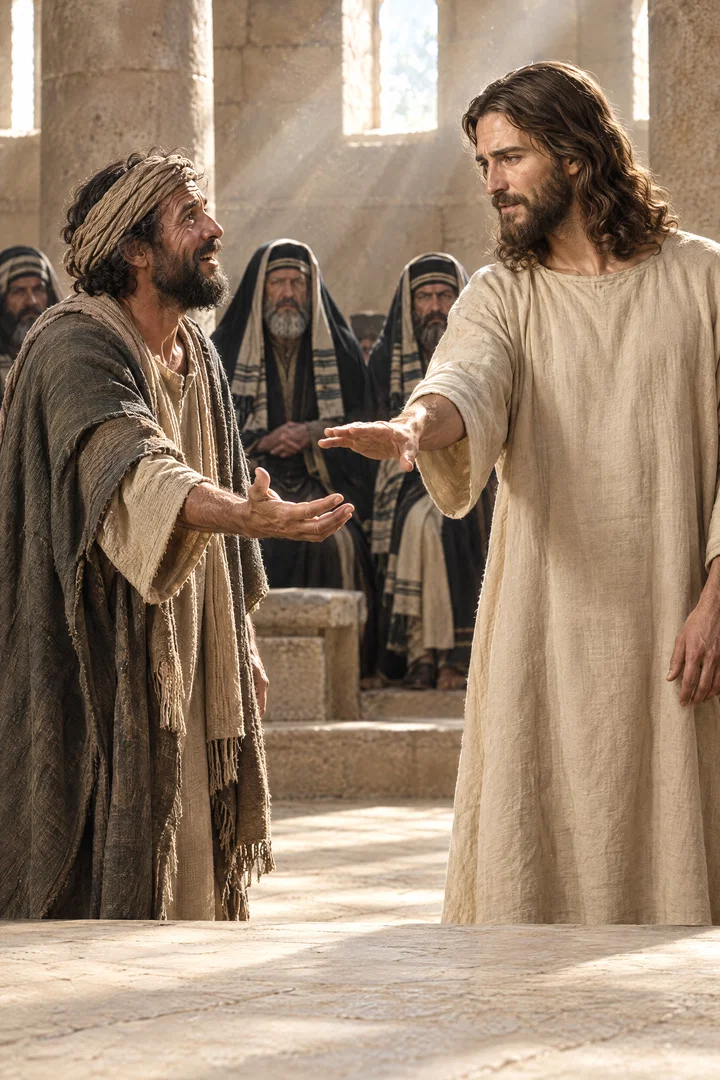
And he entered again into the synagogue; and there was a man there which had a withered hand.
Translations
American King James Version, King James Version, KJV Cambridge Paragraph Bible
And he entered again into the synagogue; and there was a man there which had a withered hand.
And he entered again into the synagogue; and there was a man there who had a withered hand.
And he entered again into the synagogue; and there was a man there which had his hand withered.
And he entered again into the synagogue; and there was a man there who had his hand withered.
And he entered again into the synagogue, and there was there a man having the hand withered,
And he entered again into the synagogue; and there was there a man having his hand dried up.
And he entered again into a synagogue, and there-was there, a man having, his hand, withered;
Berean Standard Bible, Majority Standard Bible
Once again Jesus entered the synagogue, and a man with a withered hand was there.
He entered again into the synagogue, and there was a man there whose hand was withered.
And he went again into the Synagogue; and there was a man there whose hand was dead.
And he entred againe into ye Synagogue, and there was a man which had a withered had.
Douay-Rheims (Challoner revision)
And he entered again into the synagogue, and there was a man there who had a withered hand.
Pictures
Cross-references
- Matthew 12:9-14
And when he was departed thence, he went into their synagogue:
Jesus heals the man’s withered hand and teaches that doing good is lawful on the Sabbath.
- Luke 6:6-11
And it came to pass also on another sabbath, that he entered into the synagogue and taught: and there was a man whose right hand was withered.
Parallel account of the Sabbath healing and the leaders’ anger.
- Exodus 20:8-11
Remember the sabbath day, to keep it holy.
Jesus’ healing honors the command to keep the Sabbath holy.
- Mark 2:23-28
And it came to pass, that he went through the corn fields on the sabbath day; and his disciples began, as they went, to pluck the ears of corn.
Jesus’ Sabbath teaching leads into the synagogue healing and continues the Sabbath controversy.
- Luke 13:10-17
And he was teaching in one of the synagogues on the sabbath.
Jesus heals on the Sabbath and defends relieving suffering that day.
- John 5:8-18
Jesus saith unto him, Rise, take up thy bed, and walk.
Jesus heals on the Sabbath, provoking opposition and persecution.
- Luke 14:1-5
And it came to pass, as he went into the house of one of the chief Pharisees to eat bread on the sabbath day, that they watched him.
Jesus heals on the Sabbath and challenges objections to healing.
- Luke 13:10
And he was teaching in one of the synagogues on the sabbath.
Both describe Jesus teaching in a synagogue on the Sabbath.
- John 5:8-9
Jesus saith unto him, Rise, take up thy bed, and walk.
Jesus heals an infirm man on the Sabbath and tells him to carry his bed.
- Mark 3:5
And when he had looked round about on them with anger, being grieved for the hardness of their hearts, he saith unto the man, Stretch forth thine hand. And he stretched it out: and his hand was restored whole as the other.
Jesus tells the man with the withered hand to stretch it out.
- Matthew 12:12
How much then is a man better than a sheep? Wherefore it is lawful to do well on the sabbath days.
Jesus identifies doing good on the Sabbath as lawful.
- Deuteronomy 5:12-15
Keep the sabbath day to sanctify it, as the LORD thy God hath commanded thee.
Cited as instruction about Sabbath observance.
- Mark 3:6
And the Pharisees went forth, and straightway took counsel with the Herodians against him, how they might destroy him.
The Pharisees and Herodians conspired to destroy Jesus.
- Mark 1:21
And they went into Capernaum; and straightway on the sabbath day he entered into the synagogue, and taught.
Jesus taught in the synagogue on the Sabbath.
Commentary
Each commentary is drawn from primary sources: the writings of Ellen G. White and Adventist pioneers and periodicals. Each commentary is separate. Its own words are not a quotation; follow the references to read the source passages.
Ellen G. White
15 sources
Jesus entered again into the synagogue where a man with a withered hand was present.4RED 50.1–22SP 197.3–198.12SP 367.3–368.1 The scribes and Pharisees watched Him with hostility for an opportunity to accuse Him if He healed on the Sabbath.4RED 50.1–22SP 197.3–198.12SP 294.2 He healed the man as a good work of mercy to relieve the afflicted and meet the needs of suffering people.2SP 367.3–368.13RED 70.1–2DA 538.1–2 Doing good and showing mercy are lawful on the Sabbath, so the day is no reason to leave one in need without help, and His act honored the Sabbath by upholding the fourth commandment as God gave it while rejecting human customs and restrictions.4RED 50.1–22SP 197.3–198.14RED 51.2Ms 3, 1879, par. 9–10 The religious leaders were enraged and used the healing as a pretext to condemn Him as a Sabbath-breaker, and the malice it aroused led Jesus with His disciples to withdraw to the seaside where crowds sought Him for healing.2SP 367.3–368.12SP 294.23RED 70.1–2DA 538.1–2ST Oct 16, 1879
Synagogue Setting and Healing
He returned to the synagogue, where a man with a withered hand was present.4RED 50.1–22SP 197.3–198.12SP 367.3–368.12SP 294.23RED 70.1–2 The Pharisees and scribes watched Him there with hostility, looking for an opportunity to accuse Him if He healed on the Sabbath.4RED 50.1–22SP 197.3–198.12SP 294.2 He knew they would use the healing to accuse Him, yet the man's condition became the occasion for what followed.2SP 197.3–198.12SP 367.3–368.13RED 109.2–3
He healed him on the Sabbath as a good work of mercy to relieve the afflicted and meet the needs of suffering people.2SP 367.3–368.13RED 70.1–23RED 109.2–321MR 139.4Ms 3, 1879, par. 9–10 That work shows the Sabbath does not prevent acts of mercy for the afflicted.DA 538.1–221MR 139.4Ms 3, 1879, par. 9–10 The Pharisees and other religious leaders were enraged at this good work on the Lord's day because they believed He had no right to do it then.2SP 294.23RED 70.1–2ST Oct 16, 1879
Sabbath Meaning and Vindication
Doing good and showing mercy are lawful on the Sabbath, and the Sabbath gives no reason to leave a person in need without help.4RED 50.1–22SP 197.3–198.1 The presence of the man with the withered hand in the synagogue became the occasion to establish that acts of mercy for the afflicted are permitted on that day.4RED 50.1–22SP 197.3–198.1Ms 3, 1879, par. 9–10 Healing him even while hostile watchers looked for grounds to accuse made clear that the Sabbath does not bar such relief of suffering.4RED 50.1–22SP 197.3–198.1Ms 3, 1879, par. 9–10
The healing corrected false teaching about the day by setting aside human customs and restrictions while upholding the fourth commandment as God gave it.4RED 51.2 That deed of mercy honored the Sabbath, while useless rites and ceremonies dishonored it.4RED 51.2 Relieving suffering in this way is proper Sabbath work, in contrast to unnecessary ordinary activities and pleasure-seeking pursuits.21MR 139.4
The compassionate character of the work done there exposed the nature of His actions and undercut the leaders' effort to condemn Him.ST Jun 13, 1878 The multitudes who witnessed such works of mercy for the relief of the afflicted and heard His pure and holy teachings recognized they were not the deeds and words of a Sabbath-breaker or blasphemer.DA 538.1–2
Hostility and Withdrawal
The Sabbath healing of the man with the withered hand was an act of mercy to relieve an afflicted person, yet the Pharisees seized upon such Sabbath healings as a pretext to accuse Jesus and condemn Him as a Sabbath-breaker.2SP 367.3–368.1DA 538.1–23RED 109.2–3 The miracle aroused great malice and hostility among the Jews.2SP 201.1ST Apr 19, 1877 Because of that hostility Jesus withdrew with His disciples to another and more favorable field of labor.2SP 201.1ST Apr 19, 1877
That withdrawal was to the seaside, where crowds sought Him for healing and deliverance from demons.4RED 53.1 They hated Him from the first because He exposed their hypocritical pretensions, tore aside the cloak of rigorous rites that hid their moral deformity, and condemned their hollow professions of piety by the pure religion He taught.DA 538.1–2 For His pointed rebukes they thirsted for revenge.DA 538.1–2
They tried to provoke Him to say or do something by which they could condemn Him, and tried every pretext to cut Him off from influencing the people.DA 538.1–2 They tried to arouse the Herodians against Him by representing that He sought to set up a rival kingdom, and consulted with them how they might destroy Him.DA 538.1–2 They also tried to excite the Romans against Him as one subverting their authority.DA 538.1–2
Sources
Pioneers and periodicals
41 sources
Jesus enters again into a synagogue on the seventh-day Sabbath, where a man with a long-useless withered right hand is present.RH Aug 18, 1868ST Apr 14, 1881ST Mar 12, 1894 Pharisees and Herodians watch to trap Him with a charge of Sabbath-breaking, though the man's condition is not urgent and he is not expecting healing.RH Feb 4, 1862RH Feb 20, 1908ST Nov 11, 1897 He keeps and honors the Sabbath as its Lord, doing what is lawful and adding to its sanctity rather than breaking, abolishing, or changing the day.ST Aug 1, 1878RH Dec 23, 1851ST Dec 17, 1894ST Jan 30, 1879ST Nov 18, 1880 Doing good, showing mercy, and restoring life and health are lawful and fitting on the Sabbath, while plotting harm is not.ST Jul 8, 1897ST Apr 19, 1877ST Oct 22, 1894 His merciful healing exposes the perversion of the Sabbath and arouses mad counsel to destroy Him.RH Feb 4, 1862RH Feb 4, 1862
Synagogue Setting Described
He entered again into a synagogue, unnamed, after leaving Jerusalem immediately after the Passover and returning to Galilee for freer air away from fierce religious fanaticism and malevolent hypocrisy, yet even there intense and persistent religious hatred met him, with rabbis and priests watching his every step for fresh occasion for accusation.ST Apr 14, 1881ST Oct 4, 1910ST Apr 14, 1881 There was a man there which had a withered hand, present in that synagogue setting, and this introduces the setting for the healing of the man and the dispute it occasioned.ST Oct 4, 1910ST Apr 14, 1881ST Nov 26, 1894 The watchful opponents use the man's condition to try to trap him with the question whether healing on the Sabbath is lawful, asking when he looks toward the man before he heals him.ST Apr 14, 1881
The scene occurs on the Sabbath, the seventh day, with Jesus entering the synagogue where the man with the withered hand was present.RH Aug 18, 1868ST Mar 12, 1894ST Nov 18, 1880ST Feb 27, 1912RH Apr 21, 1863 This Sabbath setting leads to the lesson that acts of mercy and charity are lawful on that day, and the healing that follows exemplifies doing good on the Sabbath against man-made prohibition of healing the sick.ST Mar 12, 1894ST Nov 18, 1880ST Feb 27, 1912 By beneficent action he added to its sanctity, showing the Sabbath permits works of mercy and healing and may be used to relieve suffering and do good.ST Nov 18, 1880ST Aug 3, 1904 The verse is part of the account of Christ's Sabbath miracles and the dispute they occasioned, drawing persecution from those who accused him of breaking the Sabbath.RH Apr 21, 1863ST Aug 3, 1904
The man present has a withered, right hand.ST Apr 14, 1881 His hand had been crushed by Herod's soldiers when he was a child, and it had remained useless until healed, a useless bandaged burden for long and weary years. He was unable to grasp a hammer and saw, nail and wood, to shut and open his hand and twirl a ring with nimble fingers, to know solids like oak and stone and iron, rough and smooth, straight and curved and round, to work to earn bread and clothes and home, or to smooth his wife's shining hair and touch her dimpled cheek.
The Pharisees watched to find accusation against him of violating the Sabbath, and the Pharisees and Herodians acting as the Sabbath association watched because he did not observe the Sabbath according to their ideas.RH Feb 4, 1862RH Feb 20, 1908 They watchfully use the man's condition to trap him and find accusation of Sabbath violation, even though his condition was not urgent and he was not expecting to be healed.RH Feb 4, 1862ST Nov 11, 1897 Their watching led to going out to take counsel with the Herodians how they might destroy him.RH Feb 4, 1862RH Feb 20, 1908 The verse begins the cure of the withered hand, one miracle piled upon miracle in rapid succession, told in much less space than in the longer Synoptic Gospels with wonderfully graphic force, showing Mark's characteristic movement from event to event with words like immediately and forthwith and focus on active work rather than long discourses.ST Oct 4, 1910ST Oct 4, 1910
Sabbath Day Affirmed
He entered the synagogue again on the Sabbath, the seventh day, and there a man with a withered hand was present, and the healing that followed shows him honoring and keeping the Sabbath as its Lord.ST Aug 1, 1878RH Dec 23, 1851RH Aug 18, 1868RH Nov 15, 1853ST Dec 17, 1894 What he did on that day was lawful and according to the law of the Sabbath, so he did not break, abolish, or change the Sabbath day but honored it and kept it.ST Dec 17, 1894ST Jan 30, 1879ST Nov 18, 1880 His beneficent work was appropriate to the Sabbath and added to its sanctity, rejecting human traditions that use the Sabbath law against love and doing good while leaving the Sabbath law itself in force.ST Jan 30, 1879ST Nov 18, 1880 He had authority to explain its meaning, and the episode shows that the Sabbath permits works of mercy and healing.ST Jan 30, 1879ST Nov 18, 1880
The account belongs to the seventh day and not to Sunday, with no application to the first day of the week.ST Apr 11, 1900 To characterize the synagogue scene and the healing of the withered hand as Jesus healing on Sunday and keeping Sunday wrongly describes the story.ST Apr 11, 1900 His Sabbath practice in that synagogue opposed the traditional restrictions of the Pharisees, and his actions and teaching on the Sabbath brought persecution and deep-seated hatred.ST Oct 3, 1900 His loyalty to the Sabbath according to the commandment preserved it as part of God's unchanging law, restored its observance from human traditions and meaningless rites to its original purity, and led to his death.ST Oct 3, 1900
The teaching of those who held a different position is that keeping the fourth commandment is not insisting on the mere letter to the neglect of the spirit, and least of all is it following man-made injunctions or interpretations as the voice of God.RH Apr 23, 1872 In that view, his healing on the Sabbath, which according to Pharisaic formula was breaking the Sabbath but in truth was keeping it, proves the Sabbath was made for man and not man for the Sabbath by defying Jewish prejudice and Pharisaic formalism to do good.RH Apr 23, 1872 From this they taught that Saturday was not fixed by divine decree as the Sabbath to the end of time without exception.RH Apr 23, 1872 In its spirit and ground, they held, observing the first day as the seventh day to commemorate in weekly rest and worship the resurrection of Jesus is precisely like this healing on the Sabbath.RH Apr 23, 1872
Mercy Lawful on Sabbath
The healing shows the Sabbath to be a sign and channel of divine power to deliver from Satan, to forgive sin, and to heal, so that genuine keeping of the day expresses merciful purpose rather than conformity to human tradition.ST Jul 8, 1897ST Apr 19, 1877ST Oct 22, 1894 Entering the synagogue where the man with the withered hand was present, Jesus made the day a blessing by doing good and preserving life, proving that caring for the sick and performing acts of mercy are lawful and fitting on the Sabbath.ST Apr 19, 1877ST Oct 22, 1894ST May 21, 1912ST Feb 27, 1912 His work of saving life and bringing happiness stands in contrast to murderous intent, for doing good and showing mercy on the Sabbath is righteous while plotting harm is not, and acts of mercy honor the Sabbath while complaints against such good dishonor it.ST Feb 10, 1904ST Feb 10, 1904ST Feb 27, 1912 The Sabbath law in its true intent is therefore honored rather than broken when need is helped, since the Pharisees' traditions had obscured that intent.ST Oct 22, 1894ST Feb 10, 1904
The Sabbath was made for man and not man for the Sabbath, so necessity and mercy are exceptions to the prohibition of Sabbath labor.RH Jun 18, 1861ST Oct 22, 1894RH Apr 23, 1872 Urgent needs such as illness or danger to life may call for action on that day, while ordinary activities remain governed by the commandment.RH Jun 18, 1861ST May 21, 1912 Those who held a differing position taught that keeping the fourth commandment is not insisting on the mere letter to the neglect of the spirit nor following man-made injunctions as God's voice, that Saturday was not fixed by divine decree without exception, and that observing the first day as the seventh to commemorate the resurrection in weekly rest and worship is in spirit precisely like this healing.RH Apr 23, 1872
The whole act of healing was speaking a word and the man stretching out his arm, and neither speaking nor stretching out the arm is forbidden by the law of the Sabbath.RH Feb 4, 1862 What was transgressed was only the tradition forbidding any healing on the Sabbath, and setting aside that wicked tradition was necessary to preserve the Sabbath itself for man.RH Feb 4, 1862 In doing so the work was done in behalf of the Sabbath, not against it.RH Feb 4, 1862
The man's condition was not urgent and he was not expecting healing, yet there was no delay in restoring his health and strength even though leaders were watching for grounds to accuse and the healing would increase their hostility.ST Nov 11, 1897 By healing on that day senseless restrictive customs were condemned and the fourth commandment was upheld as God gave it, correcting traditions that had obscured the Sabbath's purpose and burdened people with excessive rules.ST Feb 10, 1904ST Jul 15, 1897 Healing and doing good on the Sabbath thus accord with the law's true spirit contrary to restrictive traditions, making the episode a test of lawful obedience to God's commandments rather than conformity to human opinion, for God's view governs Sabbath observance.ST Jul 8, 1897ST Jun 11, 1894
Opposition and Persecution
The entering into the synagogue where the man with the withered hand was present while watchers sought accusation of Sabbath violation exposes the malignity of their hearts and their utter perversion of the Sabbath, showing the urgent need for authoritative correction of false teaching about it.RH Feb 4, 1862RH Feb 4, 1862 The whole act of healing was speaking a word and the man stretching out his arm, neither of which the law of the Sabbath forbids, so only the Pharisaic tradition forbidding any healing on the Sabbath was transgressed.RH Feb 4, 1862 Setting aside that wicked tradition was necessary to preserve the Sabbath itself for man, and in doing so the act was in behalf of the Sabbath, not against it.RH Feb 4, 1862 The unanswerable defense that a man is better than a sheep and it is lawful to do well on the Sabbath-days is proved when the hand is restored whole, and the Pharisees in madness go out to counsel with the Herodians how they might destroy him.RH Feb 4, 1862RH Feb 4, 1862
The merciful work was treated as Sabbath-breaking, distorting the commandment, and with fanatical zeal the rabbis condemned and anathematized him for healing on that day.ST Oct 19, 1882 Their rules helped turn religious leaders against him, yet the good work exposed his compassion and undermined their attempt to condemn him.ST Jun 13, 1878 Watched in the synagogue by Pharisees and Herodians acting as the Sabbath association because he did not observe according to their ideas, their watching led to taking counsel to destroy him.RH Feb 20, 1908 Enforcement of a religious institution by human authority breeds intolerance and persecution, the same spirit seen in modern Sunday legislation, and he was finally crucified because of loyalty to the true principles of Sabbath-keeping.RH Feb 20, 1908
The miracle aroused great malice and rage among the Jews because done on that day, though it was a good work, and led him and his disciples to withdraw to a more favorable field of labor.ST Apr 19, 1877ST Oct 16, 1879 Sabbath observance was so strictly watched that any supposed desecration brought constant collision and debate, watchfulness at every turn, trial and even violence.ST Oct 19, 1882 That heated contest and arrest provoked by Sabbath-breaking proves that if early Christians had desecrated the Sabbath the same collisions would have appeared in the records.ST Oct 19, 1882 At the healing others muttered at him and looked sour at the healed man, ready to cast him from the synagogue, while others withheld themselves from seeking healing because they feared the priests, though the healed man feared neither the rulers nor their disapproval.
Healing and Restoration
The scene presents Jesus as the model in whom power is joined with love, justice with humility, and regard for the least with regard for the greatest, whose care for sufferers and acts of relief are benevolence without selfish ambition.RH Oct 30, 1860 Healing of disease and forgiveness of sins belong together, and power to heal stands as evidence of power to forgive, since both are entirely beyond man.ST Jun 8, 1882 Sin is disease of the soul as sickness is disease of the body, and sickness and death are the result of sin, from which God alone can save.ST Jun 8, 1882 In the future state when sin is done away there shall be no more death, neither sorrow nor crying, neither shall there be any more pain, and the inhabitant shall not say I am sick, yet since God forgives sins when conditions are complied with and gives even here foretastes of heavenly glory, it is reasonable that He at times relieves the pain His followers suffer.ST Jun 8, 1882
Jesus saw the man's unspoken wish to be healed and called him forward into the midst.ST Feb 10, 1904 He set His own work of saving life and bringing happiness over against murderous intent, showing that doing good and showing mercy on the Sabbath is righteous while plotting harm is not.ST Feb 10, 1904 When the man obeyed and stretched out his hand it became whole, with life and strength restored to the disabled hand.ST Jul 21, 1898 The healing shows the Sabbath as a blessing for people, a day to seek and do good, show mercy, relieve burdens, and bring joy, not a day made oppressive by human rules.ST Jul 21, 1898
His hand had been a useless, bandaged burden for long and weary years, unable to grasp hammer and saw, nail and wood, to shut and open and twirl a ring with nimble fingers, to know solids like oak and stone and iron, rough and smooth, straight and curved and round, to work to earn bread and clothes and home, or to smooth his wife's shining hair and touch her dimpled cheek. Its restoration made that day the most blessed Sabbath of all Sabbaths, making him a man again for work and touch. His strong, true hand now made whole belongs wholly to Christ, to work or fight or do whatever Christ wills, for Christ has been the hand of God to him. Christ quietly goes about making poor half-men whole in hand and foot, in eye and ear and disordered mind. The man could not move his hand by his own ability, but when he trusted the power in Jesus' command to stretch it forth and obeyed, it was restored whole.ST Feb 11, 1897
Faith and Christian Life
The withered hand is a picture of indolence, which living faith heals. The man with the withered hand in the synagogue gives the illustration of stretching it forth as an act of faith.RH Jun 8, 1869 That act is doing what one can while trusting God to sustain and bless the effort.RH Jun 8, 1869
Sources