Mark 3:5
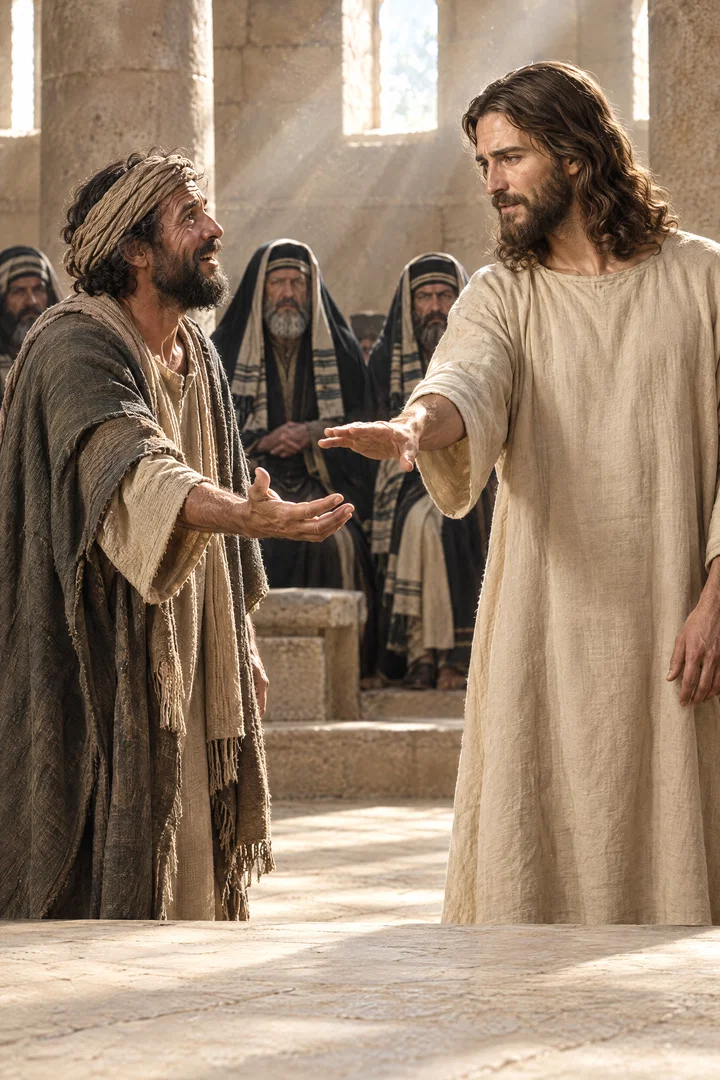
And when he had looked round about on them with anger, being grieved for the hardness of their hearts, he saith unto the man, Stretch forth thine hand. And he stretched it out: and his hand was restored whole as the other.
Translations
And when he had looked round about on them with anger, being grieved for the hardness of their hearts, he says to the man, Stretch forth your hand. And he stretched it out: and his hand was restored whole as the other.
King James Version, KJV Cambridge Paragraph Bible
And when he had looked round about on them with anger, being grieved for the hardness of their hearts, he saith unto the man, Stretch forth thine hand. And he stretched it out: and his hand was restored whole as the other.
And when he had looked around on them with anger, being grieved for the hardness of their hearts, he saith to the man, Stretch forth thy hand. And he stretched it out: and his hand was restored whole as the other.
And when he had looked round about on them with anger, being grieved at the hardening of their heart, he saith unto the man, Stretch forth thy hand. And he stretched it forth: and his hand was restored.
And when he had looked round about on them with anger, being grieved at the hardening of their heart, he saith unto the man, Stretch forth thy hand. And he stretched it forth; and his hand was restored.
And having looked round upon them with anger, being grieved for the hardness of their heart, he saith to the man, 'Stretch forth thy hand;' and he stretched forth, and his hand was restored whole as the other;
And looking round upon them with anger, distressed at the hardening of their heart, he says to the man, Stretch out thy hand. And he stretched [ it] out, and his hand was restored.
And, looking round upon them with anger, being at the same time grieved on account of the hardening of their heart, he saith unto the man—Stretch forth thy hand! and he stretched it forth, and his hand, was restored.
Jesus looked around at them with anger and sorrow at their hardness of heart. Then He said to the man, “ Stretch out your hand.” So he stretched it out, and it was restored.
Jesus looked around at them with anger and sorrow at their hardness of heart. Then He said to the man, “ Stretch out your hand.” So he stretched it out, and it was restored, as sound as the other.
When he had looked around at them with anger, being grieved at the hardening of their hearts, he said to the man, “ Stretch out your hand.” He stretched it out, and his hand was restored as healthy as the other.
And looking round on them he was angry, being sad because of their hard hearts; and he said to the man, Put out your hand. And he put it out, and his hand was made well.
Then hee looked rounde about on them angerly, mourning also for the hardnesse of their hearts, and saide to the man, Stretch foorth thine hand. And he stretched it out: and his hande was restored, as whole as the other.
Douay-Rheims (Challoner revision)
And looking round about on them with anger, being grieved for the blindness of their hearts, he saith to the man: Stretch forth thy hand. And he stretched it forth: and his hand was restored unto him.
Pictures
Cross-references
- Matthew 12:10-13
And, behold, there was a man which had his hand withered. And they asked him, saying, Is it lawful to heal on the sabbath days? that they might accuse him.
Jesus heals the withered hand on the Sabbath and teaches that doing good is lawful.
- Luke 6:6-11
And it came to pass also on another sabbath, that he entered into the synagogue and taught: and there was a man whose right hand was withered.
Parallel account of the Sabbath healing and the opposition it provokes.
- Mark 2:27-28
And he said unto them, The sabbath was made for man, and not man for the sabbath:
The Sabbath is made for human good, and Jesus’ healing illustrates its purpose and his authority over it.
- Luke 13:14-16
And the ruler of the synagogue answered with indignation, because that Jesus had healed on the sabbath day, and said unto the people, There are six days in which men ought to work: in them therefore come and be healed, and not on the sabbath day.
Jesus defends healing on the Sabbath as a merciful act.
- Luke 14:1-6
And it came to pass, as he went into the house of one of the chief Pharisees to eat bread on the sabbath day, that they watched him.
Both recount Jesus healing on the Sabbath and challenging objections to doing good.
- John 5:16
And therefore did the Jews persecute Jesus, and sought to slay him, because he had done these things on the sabbath day.
Christ was persecuted for his Sabbath practice.
- Matthew 12:1-2
At that time Jesus went on the sabbath day through the corn; and his disciples were an hungred, and began to pluck the ears of corn, and to eat.
Both accounts draw condemnation for Sabbath breaking.
- Exodus 20:8-11
Remember the sabbath day, to keep it holy.
The healing upheld the Sabbath commandment as God gave it.
- Matthew 12:14
Then the Pharisees went out, and held a council against him, how they might destroy him.
The Pharisees plot to destroy Jesus after the healing.
- Luke 6:11
And they were filled with madness; and communed one with another what they might do to Jesus.
Luke recounts the healing and the observers’ reaction.
- John 9:16
Therefore said some of the Pharisees, This man is not of God, because he keepeth not the sabbath day. Others said, How can a man that is a sinner do such miracles? And there was a division among them.
cited as another Sabbath healing opposed by tradition
- Luke 5:18-26
And, behold, men brought in a bed a man which was taken with a palsy: and they sought means to bring him in, and to lay him before him.
Healing demonstrates Jesus’ authority to forgive sins.
- John 5:1-9
After this there was a feast of the Jews; and Jesus went up to Jerusalem.
Jesus heals an infirm man on the Sabbath without delaying.
- Ephesians 4:26
Be ye angry, and sin not: let not the sun go down upon your wrath:
Anger need not be sinful.
- Mark 2:28
Therefore the Son of man is Lord also of the sabbath.
Jesus, Lord of the Sabbath, restores a man’s hand on the Sabbath.
Commentary
Each commentary is drawn from primary sources: the writings of Ellen G. White and Adventist pioneers and periodicals. Each commentary is separate. Its own words are not a quotation; follow the references to read the source passages.
Ellen G. White
22 sources
On another Sabbath in a synagogue a man with a withered hand stood forth while the watchers waited to condemn healing as transgression, and Jesus asked whether doing good and saving life are lawful on the Sabbath, then looked round with anger grieved at the hardness of hearts that would not answer, and told him to stretch forth his hand and it was restored whole.COS 73.5–74.7DA 286.2–3Ms 140, 1903, par. 47–49 His anger was righteous indignation against hypocrisy and grievous sin, not retaliation for personal abuse, felt in harmony with God in love and mercy toward those who cherished tradition and rejected light.ST May 2, 1878ST Apr 21, 1898 The healing shows that doing good, showing mercy and relieving suffering are lawful on the Sabbath and on every day and are in keeping with it, with kindness and compassion outweighing external observance and traditional rules that obstruct good.COS 73.5–74.7DA 286.2–3Ms 140, 1903, par. 47–494RED 50.1–22SP 197.3–198.1 By this merciful act He upheld the fourth commandment as God gave it while rejecting the added useless rites and restrictions, whose human exactions dishonored the Sabbath rather than His deed of relief.4RED 51.2DA 538.1–221MR 139.4ST Jun 13, 1878 The man's stretching forth his withered hand was a great stretch of faith, and that same stretch of faith reaches the point of deliverance from pain and sickness.3T 570.1
Sabbath Healing Setting
On another Sabbath in a synagogue a man with a withered hand was present while the Pharisees watched to see what Jesus would do.DA 286.2–3 He understood that healing on that day would be regarded as transgression, yet He did not hesitate to break down the wall of traditional requirements barricading the Sabbath.DA 286.2–3 He looked round on the observers with anger, being grieved for the hardness of their hearts as they refused to answer whether doing good and saving life are lawful on the Sabbath.COS 73.5–74.7DA 286.2–3Ms 140, 1903, par. 47–494RED 50.1–22SP 197.3–198.1 Their Sabbath restrictions kept them from recognizing mercy as good, and His grief and anger answered their silence and lack of compassion.4RED 50.1–22SP 197.3–198.1ST Apr 19, 1877
His anger was righteous indignation directed at hypocrisy and grievous sin, not retaliation for personal abuse.ST May 2, 1878 While feeling that indignation He remained in harmony with God, possessing love and mercy.ST May 2, 1878 His grief and anger were directed at religious leaders who cherished hypocrisy and traditions, rejected light and reproof, and treated obedience to God's requirements as unimportant.ST Apr 21, 1898 He saw through their hypocrisy and rebuked their sin.ST Apr 21, 1898
He told the afflicted man to stand forth and stretch forth his hand.DA 286.2–3 The man stretched it out, and his hand was restored whole as the other.COS 73.5–74.7DA 286.2–3Ms 140, 1903, par. 47–494RED 50.1–22SP 197.3–198.1 That work was a miracle wrought to heal the afflicted, good and merciful in character rather than criminal Sabbath-breaking.ST Jun 13, 1878
Sabbath Goodness Taught
Confronted with watchers waiting to condemn healing as transgression, He answered by asking whether it is lawful on the Sabbath to do good or to do evil, to save life or to kill, thus meeting the rabbis on their own maxim that to fail to do good when opportunity offers is to do evil and to neglect to save life is to kill.DA 286.2–3
The healing of the withered hand, restored whole as the other, declares that doing good and restoring life are lawful on the Sabbath.COS 73.5–74.72SP 197.3–198.1 Charity and benevolence are lawful on every day, and doing good, showing mercy, and relieving suffering are in keeping with the Sabbath.4RED 50.1–22SP 197.3–198.1 Christ worked on that day to relieve suffering humanity afflicted by Satan.21MR 139.4Ms 3, 1879, par. 9–10
Kindness and compassion outweigh mere external observance and traditional rules that obstruct doing good.Ms 140, 1903, par. 47–49 The restrictions that kept men from recognizing mercy as good must give way to mercy itself.4RED 50.1–2 By this act of mercy He set aside added useless rites, ceremonies, and restrictions while upholding the fourth commandment as God gave it, for those human additions, not His deed, dishonored the Sabbath.4RED 51.2
His Sabbath miracles were wrought wholly for the relief of the afflicted.DA 538.1–221MR 139.4 They were good and merciful in character, not criminal Sabbath-breaking, and not mere displays of power.21MR 139.4ST Jun 13, 1878 In them He revealed that relieving suffering is fitting work for the sacred day.21MR 139.4
Opposition and Faith Application
The healing of the withered hand on the Sabbath was a good work done on the Lord's day, and the Pharisees and scribes, though claiming God's special favor and to enjoy it, were filled with anger and enraged because of it.2SP 294.23RED 70.1–2ST Oct 16, 1879 They treated such acts of mercy and relief for the afflicted as grounds to condemn Him as a Sabbath-breaker.2SP 367.3–368.13RED 109.2–3DA 538.1–2 The miracle stirred such malice among the Jews that Jesus withdrew with His disciples to another field of labor, to a more favorable place to continue teaching and healing elsewhere.4RED 53.12SP 201.1ST Apr 19, 1877
That opposition continued from the first because He exposed their hypocritical pretensions, tore aside the cloak of rigorous rites hiding their moral deformity, and taught a pure religion that condemned their hollow professions of piety, so they hated Him and thirsted for revenge.DA 538.1–2 They tried to provoke Him to say or do something condemnable and several times attempted to stone Him.DA 538.1–2 They tried to arouse the Herodians by representing Him as seeking a rival kingdom and consulted with them how to destroy Him, and they tried to excite the Romans by representing Him as subverting their authority, to cut Him off from influencing the people.DA 538.1–2 Their attempts were foiled because the multitudes witnessing His works of mercy and hearing His pure and holy teachings knew He was no Sabbath-breaker or blasphemer, and even the officers sent could not lay hands on Him, so in desperation an edict was passed that any professing faith in Jesus should be cast out of the synagogue.DA 538.1–2
The accusation of Sabbath-breaking could not be supported by the facts, for His Sabbath work was miracles wrought wholly to heal the afflicted and restore the disabled whole, good and merciful in character rather than criminal Sabbath-breaking.ST Jun 13, 1878Ms 29a, 1885, par. 6–8 At His trial the priests and rulers dared not accuse Him of Sabbath-breaking for such healings, because examination would bring their healing character to light and defeat their determined aim to condemn Him, and if the charge could have been sustained they would not have needed false witnesses against Him.ST Jun 13, 1878Ms 29a, 1885, par. 6–8 The man's stretching forth his withered hand was a great stretch of faith, and that same stretch of faith in a sick person reaches the point of deliverance from pain and sickness.3T 570.1
Sources
Pioneers and periodicals
42 sources
On the Sabbath in the synagogue Jesus commanded a poor man whose right hand had been withered and useless for years to stretch it out, and at His word it was at once restored whole as the other.ST Jun 8, 1882RH Feb 4, 1862ST Apr 14, 1881
The healing proves it is lawful to do good, show mercy and save life on the Sabbath.ST Jan 16, 1912ST Nov 11, 1897ST Apr 19, 1877
He kept the Sabbath as its Lord without breaking or abolishing it, setting aside only the wicked human tradition that forbade healing in order to preserve the day for blessing and relief.ST Jul 8, 1897ST Dec 17, 1894ST Oct 22, 1894RH Feb 4, 1862ST Feb 10, 1904
As He looked round He felt anger joined with grief at the hardness of heart that valued restrictions above mercy, a righteous indignation against hypocrisy and sin that gives no license to ordinary human anger.ST May 2, 1878ST Nov 11, 1897RH Feb 7, 1854ST Jul 15, 1897ST Jan 30, 1879
The man could not heal himself, yet he obeyed in faith and the command carried power to obey, making him whole again to work and to serve Christ.ST Feb 11, 1897RH Jun 8, 1869
Setting and Miracle
The healing took place in the synagogue on the Sabbath, immediately after leaving the cornfield where the disciples ate, while watchers hoping to accuse Jesus of Sabbath-breaking looked on to see if He would heal.RH Feb 4, 1862ST Nov 11, 1897 They asked whether healing on the Sabbath is lawful, and their silence when He asked whether it is lawful to do good or evil, to save life or to kill, exposed hardness of heart that angered and grieved Him before He restored the hand.RH Feb 4, 1862ST Nov 11, 1897 His answer that a man is much better than a sheep that would be lifted from a pit on the Sabbath showed it is lawful to do well on the Sabbath days and exposed the perversion of the Sabbath that needed authoritative correction.RH Feb 4, 1862
The sufferer was a poor man whose right hand was withered, useless for long and weary years.ST Apr 14, 1881ST Nov 26, 1894 He had become a bandaged cumberer, a poor half-man, half-useful and unable to work to earn bread and clothes and home.ST Nov 26, 1894 Jesus commanded him to stretch forth his hand, and the man obeyed at once though accustomed to his infirmity and not expecting healing.RH Feb 4, 1862ST Nov 11, 1897 By spoken word and divine power the hand was immediately restored whole as the other, able again to shut and open, grasp hammer and saw, handle nail and wood and oak and stone and iron, and even to smooth hair and touch a cheek.ST Jun 8, 1882RH Feb 4, 1862 Neither the speaking nor the stretching breaks the law of the Sabbath.RH Feb 4, 1862
The case was not urgent and life was not in danger, so waiting a day or two would have made no material difference to him.ST Nov 11, 1897 Yet Jesus gave health and strength immediately when He saw affliction, no matter what the day, and did not put off the good work even though He knew the Jews were watching to find accusation and would seek to kill Him for His Sabbath miracles.ST Nov 11, 1897 The account belongs with Mark 3:1-6 and its parallels as one of thirty-six miracles in the Gospels reported in sixty-seven accounts besides many miracles noticed but not recorded in detail.ST Jan 16, 1896 Its place is Capernaum on the Sea of Galilee, and it is told with wonderfully graphic force as miracle upon miracle piled in rapid succession from event to event in much less space than the longer Synoptists.ST Jan 16, 1896ST Oct 4, 1910
Sabbath Mercy Lawful
The healing shows that doing good on the Sabbath is lawful, including doing well, showing mercy, preserving life and saving life, relieving the sick, helping people in trouble, and performing acts of mercy and charity.ST Jan 16, 1912ST Nov 11, 1897ST Apr 19, 1877ST Oct 22, 1894ST May 21, 1912 After challenging those who would condemn doing good on that day, Jesus restored the withered hand whole in the synagogue, demonstrating that such mercy accords with obedience to God's law.ST Jan 16, 1912ST Nov 11, 1897ST Oct 22, 1894 His question whether it is lawful to do good or evil on the Sabbath, to save life or to kill, exposed the hardness of heart that angered and grieved Him when met with silence.ST Nov 11, 1897ST Jul 15, 1897ST Jul 21, 1898 The Sabbath is therefore a day for doing good, showing mercy, bringing relief, and blessing people, not a burden that makes God's service oppressive.ST Jul 15, 1897ST Jul 21, 1898
As Lord of the Sabbath He honored the day and kept the fourth commandment as God gave it.ST Dec 17, 1894ST Feb 10, 1904 He did not break, change, or abolish the Sabbath law but upheld it, followed rather than broke it, interpreted it without abolishing it, and added to its sanctity by beneficial work proper to the day.ST Dec 17, 1894ST Oct 22, 1894ST Feb 10, 1904ST Nov 18, 1880ST Jan 30, 1879 His action followed the Sabbath command rather than breaking it, revealing its true intent that doing good and preserving life are lawful.ST Oct 22, 1894ST Jan 30, 1879 Those who complained about the healing dishonored the holy day, while restrictive customs stood condemned.ST Feb 10, 1904
The fury arose because He publicly set aside the wicked Pharisaic tradition that forbade doing anything toward healing the sick on the Sabbath.ST Jul 8, 1897RH Feb 4, 1862ST Mar 12, 1894 Neither commanding the man to stretch out his arm nor restoring it by spoken word breaks the law of the Sabbath.RH Feb 4, 1862 In healing when He knew He was watched to be accused, He acted against that tradition in behalf of the Sabbath itself to preserve it for man, showing that human opinions on the Sabbath are of no value and only God's thought about the Sabbath has weight.ST Jul 8, 1897RH Feb 4, 1862 His Sabbath teaching and practice therefore stood in direct conflict with burdensome, man-made Sabbath rules, and Sabbath-keeping is more than conformity to human traditions.ST Jul 8, 1897ST Mar 12, 1894
The Sabbath is the sign and the channel of God's power to deliver from the power of Satan.ST Jul 8, 1897 It carries the presence of the One who forgives all iniquities and heals all diseases, and the miracle is an object lesson of that power.ST Jul 8, 1897 His Sabbath-keeping reveals God's idea of true Sabbath-keeping and what God intended the Sabbath to be to man, established by God in Christ resting on the seventh day and by the blessing of His own presence in Christ in the day.ST Jul 8, 1897
The healing restores the Sabbath's original purity against human traditions that had distorted its observance.ST Jul 21, 1898 It shows the day is for blessing, relief, and doing good rather than an oppressive burden that prevents mercy and help.ST Jul 15, 1897ST Jul 21, 1898 Keeping the fourth commandment is not insisting on the mere letter to the neglect of the spirit, and least of all following man-made injunctions or interpretations as if they were the voice of God.RH Apr 23, 1872 Valuing Sabbath restrictions over doing good hardens the heart and provokes His anger joined with grief.ST Jul 15, 1897ST Jan 30, 1879
Proper Sabbath observance in the episode became a point of dispute and a test of obedience, since the deed of mercy kept the Sabbath's true purpose and did not violate God's law.ST Jun 11, 1894 The healing is cited as an example condemned by opponents of Sabbath-keeping for doing good on that day.RH Jul 12, 1864 The incident, done despite Jewish leaders' objection to healing on the Sabbath, is no evidence that Christ kept Sunday.
Those who held that Sunday observance is legitimate taught that healing on the Sabbath in defiance of Jewish prejudice and Pharisaic formalism is the same in spirit and ground as making the first day in observance the seventh day.RH Apr 23, 1872 On that view, substituting the Christian Lord's day for the Judaic Sabbath to commemorate in weekly rest and worship the resurrection of Jesus rests on the same principle as His Sabbath healing.RH Apr 23, 1872
Anger Grieved by Hardness
He looked round about on them with anger, being grieved for the hardness of their hearts, and the anger was joined with grief over their silence, their evil suspicion, and their valuing of Sabbath restrictions above doing good.ST Nov 11, 1897ST Jul 15, 1897ST Jan 30, 1879 When asked whether it is lawful to do good or evil on the Sabbath, to save life or to kill, their refusal to answer exposed the hardness that both angered and grieved Him before He restored the hand whole.ST Nov 11, 1897 To make the Sabbath a burden that prevents mercy and help misses its purpose, for traditions that obstruct love and service do not express what the law intends.ST Jul 15, 1897ST Jan 30, 1879
The word anger does not exactly express what He felt, and the added phrase being grieved qualifies it.RH Dec 11, 1855RH Dec 11, 1855 What moved Him was grief at hard-heartedness.RH Dec 11, 1855RH Dec 11, 1855 That grief is not wrong, while indulging anger in its common sense is contrary to what God requires.RH Dec 11, 1855
His anger was righteous indignation directed against wickedness, hypocrisy, and grievous sin, not retaliation for personal abuse.ST May 2, 1878RH Feb 7, 1854 It remained consistent with a spirit of love and holiness, and with harmony with God in love and mercy.ST May 2, 1878RH Feb 7, 1854 Anger can therefore be righteous when it opposes sin rather than arising from unholy temper.RH Feb 7, 1854
His grief and anger were directed at religious leaders who cherished hypocrisy and traditions, rejected light and reproof, and treated obedience to God's requirements as unimportant.ST Apr 21, 1898 He saw through their hypocrisy and rebuked their sin.ST Apr 21, 1898 The contrast is sharp: while they harbored hatred and even murderous purpose on God's holy day, He was saving life and bringing relief through love expressed in mercy.ST Feb 10, 1904
His example does not authorize followers to indulge ordinary anger or to imitate His anger as a virtue.RH Dec 11, 1855RH Dec 11, 1855RH Dec 11, 1855 Human ignorance and imperfection make them unfit to exercise anger and judgment as He did.RH Dec 11, 1855RH Dec 11, 1855 To use His look of anger, joined with grief over hardness of heart, as a right to indulge anger would also claim His prerogative to judge and punish offenders, which dependent followers would wrongfully assume for themselves.RH Dec 11, 1855RH Dec 11, 1855RH Dec 11, 1855
Opposition Plotting Death
The watchers were on guard because they knew He was ready to relieve the afflicted, and the Pharisees acted together with the Herodians against Him as a Sabbath association watching Him for not keeping the Sabbath according to their ideas.RH Feb 20, 1908RH Feb 4, 1862 After He restored the withered hand by spoken word and by the man stretching out his arm, neither of which breaks the Sabbath law, the Pharisees went out straightway and took counsel with the Herodians how they might destroy Him.RH Feb 20, 1908RH Feb 4, 1862 The fury came because He publicly set aside their wicked tradition forbidding any healing on the Sabbath, acting in behalf of the Sabbath itself to preserve it for man against the traditions by which they had perverted it.RH Feb 4, 1862 That healing according to God's intent rather than their rules became the occasion for the religious leaders to oppose Him and to seek even the aid of Rome to put Him to death.
He healed calmly though He knew the watchers were seeking counsel to destroy Him and knew they would in the end murder Him for ignoring their God-dishonoring traditions and for teaching by His life how the Sabbath should truly be kept.ST Sep 27, 1899 His loyalty to the true principles of Sabbath-keeping according to the commandment provoked intolerance and persecution, and His Sabbath teaching and practice in refusing their traditions contributed to His being crucified.RH Feb 20, 1908ST Oct 3, 1900 His healing work challenged human traditions that had distorted Sabbath observance and restored its original purity, and hostility over such Sabbath healing helped lead to His death. The miracle stirred such malice that He withdrew to continue His work elsewhere, and this good work enraged the Pharisees who claimed to enjoy God's favor.ST Apr 19, 1877ST Oct 16, 1879
The same intolerance and persecution always follows every attempt to enforce a religious institution by civil enactment, as repeated by modern associations seeking Sunday legislation.RH Feb 20, 1908 At His trial the priests and rulers dared not accuse Him of Sabbath-breaking for miracles wrought to heal the afflicted and restore the disabled whole.ST Jun 13, 1878 That Sabbath work was good and merciful in character rather than criminal, and an examination would have brought its healing character to light and defeated their determined aim to condemn Him.ST Jun 13, 1878 Sabbath work provokes watching, collision, debate, trial and even violence, and His healing drew condemnation and repeated anathemas from fanatical Rabbis.ST Oct 19, 1882 Since open Sabbath desecration inevitably produces such heated contests and arrests, the absence of such collisions against the early Christians proves they were not Sabbath-breakers.ST Oct 19, 1882
Faith Obedience Restoration
The man could not restore his withered hand by his own power, yet when commanded to stretch it out he acted in faith and his hand was restored, for the command itself carried the power to obey it, showing that one unable to change himself can still respond to God by choosing to obey.ST Feb 11, 1897 Faith brings new strength to what is powerless and makes restoration possible. His obedience in doing what he could while trusting God to sustain and help is faith expressed by action.RH Jun 8, 1869
The restored hand was made whole as the other, able again to shut and open, to grasp hammer and saw, to handle nail and wood and oak and stone and iron, to twirl a ring, to smooth hair and touch a cheek, and to work again to earn bread and clothes and home. From being a useless hold-the-hand, a bandaged cumberer, a poor half-man through long and weary years of uselessness, he was made a man again, a whole man instead of a useless cumberer. The restored hand now belongs wholly to Christ to work or fight for Him as He wills.
The healing reveals Jesus quietly going about making broken people whole in hand and foot and eye and ear and mind, acting as the hand of God to the sufferer. It shows power joined with love and justice, relieving burden without selfish ambition.RH Oct 30, 1860 It is evidence of divine power to relieve bodily suffering, even as He alone can forgive sins and save from sin and its results.RH Oct 30, 1860ST Jun 8, 1882
Sources