Mark 2:23
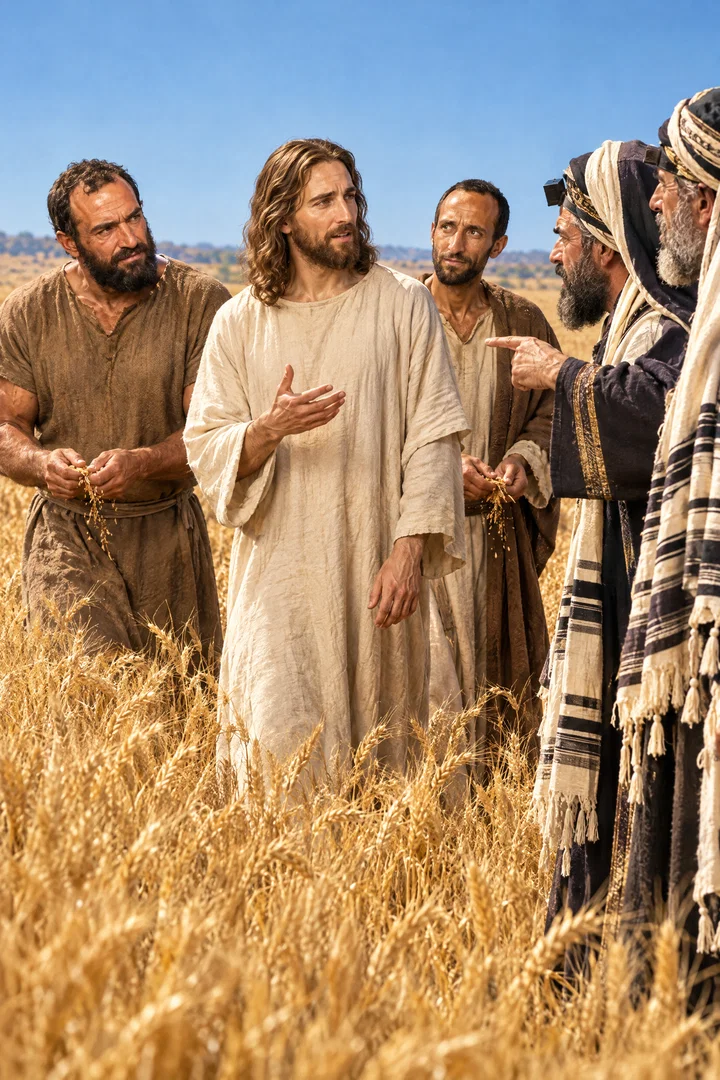
And it came to pass, that he went through the corn fields on the sabbath day; and his disciples began, as they went, to pluck the ears of corn.
Translations
American King James Version, King James Version, KJV Cambridge Paragraph Bible
And it came to pass, that he went through the corn fields on the sabbath day; and his disciples began, as they went, to pluck the ears of corn.
And it came to pass, that he went through the corn-fields on the sabbath; and his disciples began, as they went, to pluck the ears of corn.
And it came to pass, that he was going on the sabbath day through the cornfields; and his disciples began, as they went, to pluck the ears of corn.
And it came to pass, that he was going on the sabbath day through the grainfields; and his disciples began, as they went, to pluck the ears.
And it came to pass — he is going along on the sabbaths through the corn-fields — and his disciples began to make a way, plucking the ears,
And it came to pass that he went on the sabbath through the cornfields; and his disciples began to walk on, plucking the ears.
And it came to pass, that he, on the Sabbath, was passing through the cornfields, and his disciples began to be going forward, plucking the ears of corn.
Berean Standard Bible, Majority Standard Bible
One Sabbath Jesus was passing through the grainfields, and His disciples began to pick the heads of grain as they walked along.
He was going on the Sabbath day through the grain fields; and his disciples began, as they went, to pluck the ears of grain.
And it came about that on the Sabbath day he was going through the grain-fields; and while they were walking, his disciples took the heads of grain.
And it came to passe as hee went through the corne on the Sabbath day, that his disciples, as they went on their way, began to plucke the eares of corne.
Douay-Rheims (Challoner revision)
And it came to pass again, as the Lord walked through the corn fields on the sabbath, that his disciples began to go forward, and to pluck the ears of corn.
Pictures
Cross-references 20 of 28
- Matthew 12:1-8
At that time Jesus went on the sabbath day through the corn; and his disciples were an hungred, and began to pluck the ears of corn, and to eat.
The disciples pluck grain on the Sabbath, and Jesus defends their actions.
- Luke 6:1-5
And it came to pass on the second sabbath after the first, that he went through the corn fields; and his disciples plucked the ears of corn, and did eat, rubbing them in their hands.
The disciples pluck and eat grain on the Sabbath, prompting Jesus’ response.
- Mark 2:27-28
And he said unto them, The sabbath was made for man, and not man for the sabbath:
Jesus explains the Sabbath’s purpose and declares his authority over it.
- Exodus 20:10
But the seventh day is the sabbath of the LORD thy God: in it thou shalt not do any work, thou, nor thy son, nor thy daughter, thy manservant, nor thy maidservant, nor thy cattle, nor thy stranger that is within thy gates:
Both identify the seventh-day Sabbath as belonging to the Lord.
- Mark 3:1-5
And he entered again into the synagogue; and there was a man there which had a withered hand.
Jesus’ Sabbath healing continues the dispute over Sabbath practice.
- 1 Samuel 21:1-6
Then came David to Nob to Ahimelech the priest: and Ahimelech was afraid at the meeting of David, and said unto him, Why art thou alone, and no man with thee?
David receives and eats consecrated bread, an example Jesus recalls when answering the challenge about his hungry disciples.
- Mark 2:28
Therefore the Son of man is Lord also of the sabbath.
Jesus’ lordship over the Sabbath answers the accusation against his disciples.
- Genesis 2:2-3
And on the seventh day God ended his work which he had made; and he rested on the seventh day from all his work which he had made.
God rested on and blessed the seventh day, establishing the Sabbath at creation.
- Matthew 12:12
How much then is a man better than a sheep? Wherefore it is lawful to do well on the sabbath days.
Jesus teaches that doing good is lawful on the Sabbath.
- Deuteronomy 23:25
When thou comest into the standing corn of thy neighbour, then thou mayest pluck the ears with thine hand; but thou shalt not move a sickle unto thy neighbour’s standing corn.
The law permits hungry travelers to pluck grain by hand.
- Matthew 12:7
But if ye had known what this meaneth, I will have mercy, and not sacrifice, ye would not have condemned the guiltless.
Jesus says mercy, not sacrifice, means the disciples should not be condemned.
- John 5:16-18
And therefore did the Jews persecute Jesus, and sought to slay him, because he had done these things on the sabbath day.
Both texts connect Jesus’ actions on the Sabbath with opposition from the Jews.
- Isaiah 58:13
If thou turn away thy foot from the sabbath, from doing thy pleasure on my holy day; and call the sabbath a delight, the holy of the LORD, honourable; and shalt honour him, not doing thine own ways, nor finding thine own pleasure, nor speaking thine own words:
Both identify the Sabbath as the Lord’s holy day.
- Luke 13:10-17
And he was teaching in one of the synagogues on the sabbath.
both show Christ teaching what is lawful on Sabbath
- Matthew 12:3-5
But he said unto them, Have ye not read what David did, when he was an hungred, and they that were with him;
Jesus justifies the disciples’ Sabbath act by citing David’s need and lawful temple service.
- Luke 6:5
And he said unto them, That the Son of man is Lord also of the sabbath.
Cited as another passage using the same Sabbath term.
- Colossians 2:16
Let no man therefore judge you in meat, or in drink, or in respect of an holyday, or of the new moon, or of the sabbath days:
Its Sabbath wording is compared with the disciples plucking grain on the Sabbath.
- Matthew 12:10
And, behold, there was a man which had his hand withered. And they asked him, saying, Is it lawful to heal on the sabbath days? that they might accuse him.
Both show what is lawful on the Sabbath.
- John 7:22
Moses therefore gave unto you circumcision; ( not because it is of Moses, but of the fathers;) and ye on the sabbath day circumcise a man.
Cited as another passage using the same Sabbath term.
- Matthew 12:8
For the Son of man is Lord even of the sabbath day.
Included among the texts that call the seventh day the Sabbath.
Commentary
Each commentary is drawn from primary sources: the writings of Ellen G. White and Adventist pioneers and periodicals. Each commentary is separate. Its own words are not a quotation; follow the references to read the source passages.
Ellen G. White
9 sources
On the Sabbath Jesus and His disciples walked through a field of ripening, standing grain, returning from worship after late work, and the hungry disciples plucked heads of grain and rubbed out the kernels in their hands and ate them.DA 283.4–284.14RED 48.1STMW6 43.2PP 531.1–2ST Sep 16, 1913 The act was lawful under God's law, which allowed a traveler or hungry person passing through a neighbor's grain, orchard, or vineyard to gather by hand what he desired to eat to satisfy hunger, though not to harvest with a sickle.DA 283.4–284.14RED 48.1PP 531.1–2HSFM 165.2 The verse illustrates God's provision for the poor to take food from the land and that harvest gleanings were reserved for them, in contrast with later restrictions that denied the poor access to what grew in open fields.PP 531.1–2HSFM 165.2
The rabbis treated the act as Sabbath desecration and a double offense, counting gathering as reaping and rubbing in the hands as threshing.DA 283.4–284.1 Scribes and Pharisees and Jewish rulers, impatient to accuse and watching and spying on all His actions and words without finding fault, charged Jesus and His disciples with breaking and transgressing the Sabbath because they plucked and rubbed and ate the wheat.STMW6 43.218MR 155.1–3Ms 43b, 1891, par. 1Ms 43b, 1891, par. 9 The accusation against the Maker of the Sabbath showed blindness, as if the accusers had put out their own eyes, showing how those who insist on carrying God's work in their own way lose their bearings.18MR 155.1–3Ms 43b, 1891, par. 1
In walking through the fields they were keeping the Sabbath, for the act did not break the Sabbath commandment; Christ repelled the charge and declared and established the disciples guiltless and innocent, showing that the Sabbath permits what is in harmony with its command.ST Sep 16, 1913Ms 43b, 1891, par. 9 The event exposes how the Sabbath had been perverted by burdensome human requirements that reflected selfish men rather than the loving Heavenly Father, and Jesus went straight forward keeping the Sabbath according to God's law without conforming to those requirements, to clear away the misconception that Sabbath observance as God requires makes men hard-hearted and cruel.DA 283.4–284.1 Jesus is the Lord of the Sabbath who made the Sabbath.STMW6 43.218MR 155.1–3Ms 43b, 1891, par. 1Ms 43b, 1891, par. 9
The One who vindicated the disciples with a dignity He alone possessed and cast over them the shield of His own prerogatives was God in the flesh, His divine nature not transformed into human nature but divine and human united, with all the fullness of the Godhead bodily acting out the principles that govern heaven, with all things delivered to Him of His Father, with life in Himself as the Father has life in Himself, and with authority to execute judgment because He is the Son of man.Ms 43b, 1891, par. 9
Sources
Pioneers and periodicals
59 sources
On the Sabbath Jesus went through the grainfields with his disciples, and as they went the hungry disciples began to pluck ears of grain and eat them.ST Oct 22, 1894ST Nov 11, 1897ST Oct 22, 1894 The Pharisees charged the picking and rubbing as unlawful work like reaping and threshing, but Jesus judged the disciples guiltless under God's Sabbath law because they broke only human tradition, not the fourth commandment.ST Oct 22, 1894ST Nov 11, 1897ST Apr 14, 1881RH Nov 1850RH Feb 4, 1862 From this he taught that the Sabbath was made for humanity's highest good and benefit, to give rest and peace, not to harm life or lay grievous burden.ST Nov 11, 1897ST Nov 14, 1900RH Jun 24, 1858 Works of necessity and mercy are therefore in harmony with the Sabbath, so satisfying hunger to sustain strength is lawful like temple work on that day.ST Apr 14, 1881RH Apr 5, 1860ST Mar 13, 1879 The Sabbath so defended is the definite seventh day of the week, Saturday, of which he is Lord to protect and honor it, and his defense freed it from human rules without breaking, changing, abolishing or transferring it to Sunday.RH Nov 1850ST Nov 14, 1900ST Jan 6, 1881RH Dec 18, 1860
Scene Words and Setting
On the Sabbath Jesus went through the grainfields with his disciples, and as they went the hungry disciples began to pluck ears of grain and eat them.ST Oct 22, 1894ST Nov 11, 1897ST Oct 22, 1894RH Feb 4, 1862RH Apr 21, 1863 The issue raised was not merely their passing through the fields but whether plucking grain to satisfy hunger on the Sabbath was lawful, and this circumstance prompted the complaint against them.ST Nov 11, 1897RH Feb 4, 1862RH Apr 21, 1863ST Nov 26, 1894
The grain was ripening barley, wheat or corn, which the disciples picked and then rubbed or shelled in their hands and ate as they walked.ST Apr 14, 1881RH Nov 1850ST Mar 4, 1889ST Sep 19, 1911ST Sep 8, 1881 In its sweet, juicy milky unripe stage it was easily digested and fit to eat raw without cooking, containing only sugar and no starch.RH Jun 26, 1900RH Sep 10, 1901 As the grain ripens the soluble sugar is changed into starch so it can be preserved, and ripe grain must be cooked before it is suitable for food.RH Sep 10, 1901
The walk took place in Galilee shortly after the second Passover, on the Sabbath after the second day of the feast or on a Sabbath later.ST Apr 14, 1881 Nisan was the month of earing when the first sheaf was offered on the second day of Passover, so the fields were of ripening barley.ST Apr 14, 1881 The field was near a town, most likely Capernaum, and the distance walked was a lawful Sabbath distance of less than three-quarters of a mile, with other people including hostile watchers present.ST Apr 14, 1881 The disciples were hungry because no Jew broke fast until after the morning synagogue service, while law and Eastern custom left grain or grapes free to all to take enough to supply hunger.ST Apr 14, 1881
The Greek word rendered Sabbath day is the plural sabbata used with singular meaning by Hebrew idiom, as used for the Sabbath day in the first three Gospels.RH Jan 29, 1867RH Jan 5, 1864 Its wording is the same in the original as that translated Sabbath days in Colossians 2:16.RH Sep 20, 1853 Jesus himself is not described as plucking the grain.RH Oct 21, 1858 Those who held the other detail present Christ himself as joining the disciples in plucking and eating the corn in the field.RH Jun 26, 1900RH Sep 10, 1901
Charge and Vindication
The Pharisees and other hostile watchers who were present charged the disciples with unlawful Sabbath-breaking for plucking and eating as they went.ST Oct 22, 1894ST Apr 14, 1881RH Nov 5, 1861ST Mar 4, 1889 Picking the heads was treated as a kind of reaping, and rubbing or shelling them in the hands as a kind of threshing or grinding, with preparation of food required to be done on Friday before sunset.ST Oct 22, 1894ST Apr 14, 1881ST Mar 4, 1889 To break the Sabbath rather than suffer hunger a few hours was treated as guilt worthy of stoning.ST Apr 14, 1881 The same jealous scrutiny appeared in their repeated denunciations of Christ for healing on the Sabbath.ST Oct 22, 1894
The dispute was not about walking through the fields or making an unlawful journey, but whether satisfying hunger by plucking grain violated the Sabbath.RH Feb 4, 1862RH Apr 5, 1860RH Apr 21, 1863 The disciples were hungry and had no other way to satisfy their hunger, and their need for food outweighed merely human restrictions.ST Oct 22, 1894ST Oct 22, 1894ST Jan 30, 1879 God did not intend the Sabbath or any of his laws to harm people or to destroy them.ST Oct 22, 1894ST Oct 22, 1894
Jesus judged the disciples guiltless and vindicated them as lawful under God's Sabbath law and in perfect harmony with it.ST Nov 11, 1897RH Feb 4, 1862RH Jun 24, 1858ST Dec 17, 1894 They broke only Jewish tradition, the Mishnah and corruptions of Scripture, not the fourth commandment.RH Nov 1850ST May 17, 1910 He corrected mistaken views of the Sabbath's purpose, affirmed that it is lawful to do good on the Sabbath, and kept God's command according to God's intent rather than the Pharisees' interpretation.RH Nov 1850RH Jun 24, 1858 That faithfulness led them to treat him as a Sabbath breaker and seek his death.
Jesus never broke the Sabbath law but only interpreted it and did what was lawful, and the verse does not set the spirit against the letter but God's truth against human tradition.ST May 17, 1910 The claim that he and his disciples broke it is rejected, for if he had transgressed God's law he would have been a sinner and his sacrifice could not serve as the sinless ground of pardon and salvation.RH Nov 1, 1853
Sabbath Made for Humanity
From this walking through the grainfields Jesus taught that the Sabbath was made for humanity and not humanity for the Sabbath, a merciful and benign institution ordained for man's highest good and benefit to give rest and peace and to remind of the work of the Creator.ST Apr 14, 1881ST Nov 11, 1897ST Nov 14, 1900RH Jun 24, 1858ST Nov 7, 1900 It was not made to harm people, to interfere with the needs of life, or to bring pain, discomfort and grievous burden, nor as a Moloch to which man must be sacrificed, but as a blessing and not a curse or burden.ST Apr 14, 1881ST Nov 7, 1900 The conflict was between God's meaning of the Sabbath and human rules about keeping it, and in correcting the mistaken view of its purpose Jesus did not abolish it but taught its proper use and expressed its true meaning.ST Nov 14, 1900RH Jun 24, 1858 His answer recalled David and his hungry companions eating the consecrated bread of the sanctuary, showing that meeting human need for food and strength does not break the Sabbath, and the disciples plucking grain to satisfy hunger were excusable and guiltless, even more so than David.ST Apr 14, 1881ST Nov 11, 1897 To condemn them was to fail the mercy God desires rather than sacrifice, and the episode models a gentle and generous approach rather than condemning helpful or ordinary actions.ST Nov 11, 1897ST Jan 4, 1905
Made for man means made not only to be obeyed but for benefit, and to prove a real benefit it must be kept according to the commandment as holy and not common.RH Aug 15, 1854 It does not mean man may use the Sabbath as he pleases or live unto himself, nor does it give license for loose explanation, and its law runs not crosswise but parallel with every other law of divine origin.RH Aug 15, 1854ST Nov 7, 1900 The Sabbath meant is that made at creation when the heavens and earth and all their host were finished, renewedly enjoined in one of the Ten Commandments written by God on stone and guarded by promises and threatenings.RH Aug 15, 1854 Since Christ made both man and the Sabbath it was made for man and not against him, not as a toy to be used or abused for every whim, and since it was not made a fasting day satisfying hunger in the way the disciples did does not tread under foot the holy of the Lord.RH Aug 15, 1854ST Nov 7, 1900 Man not made for the Sabbath means man was made to glorify God, who is glorified by conscientious observance of His holy day, and those who so observe it are blessed in it and furthered toward glory.RH Aug 15, 1854
Works of necessity and mercy are in harmony with the Sabbath and are not forbidden.ST Mar 13, 1879ST Jun 20, 1911 Satisfying hunger, fatigue and need for strength is right and lawful, especially while engaged in the service of God where the service of God comes first, and plucking and eating grain to sustain bodily strength for use in God's service is right like the work done in the temple on the Sabbath, which is in harmony with the law though the same labor in ordinary business would violate it.ST Apr 14, 1881 People may meet their needs and perform merciful work, including visiting the sick and preaching or hearing the gospel even when this requires travel or physical effort, and the disciples' activity did not make the occasion an unlawful journey or diminish the Sabbath's sacredness.RH Apr 5, 1860 Their plucking grain, shelling it and eating as they walked was meeting a basic need and eating their own food, so it was a work of necessity, showing that Sabbath observance did not require forbidding what was needed for food.ST Sep 19, 1911ST The Sabbath is not a lazy rest but a day kept holy by setting aside self-serving labor and honoring God, made for all humanity and not for Jews alone, remaining a benefit and a binding institution wherever and whenever people live, distinguishing proper use from superstitious abuse.RH Apr 5, 1860ST Jun 20, 1911
God's laws are not meant to destroy people, and mercy takes precedence over ritual observance.ST Oct 22, 1894 Their need for food outweighed human traditions that restricted Sabbath conduct.ST Oct 22, 1894 Because God desires mercy rather than sacrifice, condemning the guiltless fails mercy.ST Nov 11, 1897
Christ opposed burdensome human rules that obscured the Sabbath's intended character as a day of rest, delight, holy joy and refreshing rest and turned it into a burden, and taught its proper observance according to the law's true letter and spirit.ST Jun 11, 1894 The Pharisees counted plucking as a kind of reaping and rubbing or shelling as threshing and therefore a violation of their traditional restrictions, though the disciples were taking food to meet hunger. Their restrictive rules about walking on grass and separating grain were human-made additions opposed to the Sabbath as Jesus taught and practiced it, and such Pharisaic observance stands condemned in contrast to proper keeping.ST Mar 12, 1894ST May 28, 1912 The Sabbath remained sacred with unnecessary labor forbidden, and keeping the day was treated as a test of obedience to God's commandments.ST Jun 11, 1894
Seventh Day Still Binding
The Sabbath in the incident is the definite seventh day of the week, Saturday, the same day observed by the Jews and recognized by the Pharisees, not Sunday or the first day and not Friday.RH Nov 5, 1861ST Sep 9, 1880RH Jun 5, 1860ST Apr 15, 1886 The Pharisees' accusation that plucking grain broke the Sabbath confirms which day the walk through the grainfields took place, and distinguishes that Sabbath from the first day of the week.RH Nov 5, 1861ST Sep 9, 1880ST Apr 15, 1886 The New Testament identifies that seventh day as the Sabbath.RH Jun 5, 1860
When Jesus declares himself Lord of the Sabbath he means that same seventh-day Sabbath named in the commandment as the Lord's, and the verse therefore identifies the seventh-day Sabbath as the day over which Christ is Lord.RH Dec 18, 1860ST Jan 28, 1903 His authority as Lord means that he loves and protects it, maintained it as his own divine institution and honored its sacredness through beneficent action.ST Jan 6, 1881ST Jan 28, 1903ST Nov 18, 1880 He upheld the true Sabbath of Sinai against counterfeit Pharisaic rules and taught his disciples to revere it, with plucking grain to relieve hunger shown to be a beneficial work consistent with the Sabbath and not an abolition of its law.ST Sep 15, 1887ST Nov 18, 1880
The Sabbath made for humanity was made by sanctifying the seventh day of the week as a memorial of God's rest from six days of creation labor, so the institution is made out of that day and is inseparable from it.RH Oct 24, 1871ST Feb 17, 1898 That particular seventh day God himself appointed is his memorial of completed creation and seal of his law, kept as one of the most important duties of loyalty to the Creator.ST Feb 17, 1898 Its blessing and sanctification remain with the seventh day, which came before the Roman Sunday, and are not transferred to the first day by human agreement, so that if the seventh-day Sabbath were abolished the Sabbath made for man would no longer exist.RH Oct 24, 1871ST Jul 23, 1912
What Jesus and his disciples did in plucking and rubbing grain to satisfy urgent hunger was lawful under the fourth commandment and a matter of necessity, not a violation, and Jesus' defense of them and his lordship do not mean that he changed or abolished it.RH Nov 1850RH Apr 18, 1871RH Jun 24, 1858 His correction of mistaken views of its purpose taught its proper use without abolishing it, expressing the true meaning of the Sabbath against human rules about Sabbath-keeping.ST Nov 14, 1900RH Jun 24, 1858 On that occasion he exercised his right as Lord to free the Sabbath from the traditions of men and to restore man and the Sabbath to the relative places designed by the Creator in the beginning, giving no claim directly or indirectly of a right to change the days and providing no law or authority for putting away the seventh day for the first day, nor showing that he abolished the seventh-day Sabbath or instituted Sunday.RH Nov 14, 1871ST Nov 8, 1883 He protected the Sabbath as a divine institution and upheld enlightened strict obedience to its requirements, proving the Sabbath law still binding in the gospel age, showing duty in regard to it, and making the Bible a sufficient rule of faith and practice on the question.RH Nov 1850RH Apr 18, 1871
The continued place of the Sabbath is shown by fifty-nine New Testament mentions of the seventh day or Sabbath of the Lord compared with only eight mentions of the first day of the week, giving no warrant for sanctification of the first day in commemoration of the resurrection.ST Mar 16, 1882 Even plucking grain to satisfy hunger was treated as Sabbath desecration, exposing how closely the Jews watched Sabbath conduct and how quickly they turned any breach into accusation, as seen also in their repeated denunciations for healing on the Sabbath.ST Oct 19, 1882 That strictness proves that if the early Christians had abolished the Sabbath, desecrated the old day for secular work, and begun keeping Sunday instead, the Jews would have watched them at every turn and made each desecration a source of constant collision, debate, trial and violence, which would have been recorded in Acts covering about thirty years; the perfect absence of such collisions proves the early disciples were not Sabbath-breakers and no change of days took place at the resurrection.ST Oct 19, 1882
The grain-field experience has been used to argue that the Sabbath was no longer binding and that Christ regarded it so, and the scene is sometimes invoked against keeping the Bible Sabbath.RH Feb 11, 1858 That use is rejected, for the dispute arose from the Jews' rules in the Mishnah and their corruptions of Scripture rather than the Bible, while Christ and his followers were guided by the Bible.RH Feb 11, 1858 The experience was regarded by the Jews as only a borderline act.
Scriptural Connections Illuminated
When accused of doing what was unlawful on the Sabbath, Jesus answered by recalling David and his hungry companions eating the consecrated bread of the sanctuary.ST Apr 14, 1881ST Nov 11, 1897 Meeting human need for food and strength does not break the Sabbath, and satisfying hunger and fatigue while engaged in the service of God comes first and is right even on that day.ST Apr 14, 1881ST Nov 11, 1897 The disciples' act of plucking and eating grain to sustain bodily strength for use in God's service was excusable and guiltless, even more so than David eating the holy bread when excessively hungry.ST Apr 14, 1881 Condemning them fails to show the mercy God desires rather than sacrifice, for the Sabbath was made for humanity and not humanity for the Sabbath, and the Son of man as Lord of the Sabbath acquits them from blame by appeal to the very statutes they were accused of violating, One above all question and above all law.ST Apr 14, 1881ST Nov 11, 1897 Plucking and eating to sustain strength is lawful like the work done in the temple on the Sabbath, which is in harmony with the law though the same labor in ordinary business would violate it.ST Apr 14, 1881
The Sabbath so defended is the Sabbath made at creation when the heavens and earth and all their host were finished, renewedly enjoined in one of the Ten Commandments written by God on stone and guarded by promises and threatenings.RH Aug 15, 1854 Made for man means made not only to be obeyed but for man's benefit, and to prove a real benefit man must keep it according to the commandment as holy and not common.RH Aug 15, 1854 It does not mean man may use the Sabbath as he pleases or live unto himself, and it gives no license for loose explanation of the commandment, which remains binding.RH Aug 15, 1854 Since the Sabbath was made for man and was not made a fasting day, satisfying hunger in the way the disciples did does not tread under foot the holy of the Lord.RH Aug 15, 1854 Man not made for the Sabbath means man was made to glorify God, who is glorified by conscientious observance of His holy day, and those who so observe it are blessed in it and furthered toward glory.RH Aug 15, 1854
The verse begins the parallel account to Matthew 12:1-13 about Jesus and the Sabbath, given for study of Sabbath observance as one of the most important duties of loyalty to the Creator.ST Feb 17, 1898 That loyalty is kept only on the particular seventh day God Himself appointed as His memorial of completed creation and seal of His law.ST Feb 17, 1898 The episode is evidence that the Sabbath and the weekly day-count were recognized in Jesus' time, as Jesus and His disciples passed through the fields on the Sabbath as observed by the Jews and He vindicated the disciples when accused of violating it.ST Nov 17, 1881 The grain's condition, plucked as ears as they walked through the fields on the Sabbath, is used as evidence that a Passover had recently been kept, fitting the proposed chronology of Jesus' visit to Jerusalem.RH Dec 5, 1907
Faithful Observance Today
The Sabbath remains sacred, with unnecessary labor forbidden, and keeping it is a test of obedience to God's commandments.ST Jun 11, 1894 It is one of the most important duties of loyalty to the Creator, kept only on the particular seventh day God Himself appointed as His memorial of completed creation and seal of His law.ST Feb 17, 1898 It is not a lazy rest, but a day kept holy by setting aside self-serving labor and honoring God, in which works of necessity such as the disciples' plucking and eating wheat are lawful and in harmony with the commandment.ST Jun 20, 1911 The disputes over that plucking became a point of contention because burdensome human rules had obscured the Sabbath's intended character as a day of rest, delight, and holy joy, which is restored by proper observance according to the law's true letter and spirit.ST Jun 11, 1894
The disciples were not breaking God's Sabbath law but only Jewish tradition, for the issue is not spirit against letter but God's truth against human tradition.ST May 17, 1910 Necessary work and works of mercy are not forbidden on that day, and each person must decide before God and conscience how much work is needed. That keeping demands judgment and mercy and faith as the first and weightier matters of the law, while not leaving undone the smallest duties, with all other things following in harmony with those great principles.ST May 17, 1910
Christ's conduct in the grainfield, alongside His Sabbath healing, challenges religious claims used to restrict others and bears against coercing people to observe Sunday instead of the seventh-day Sabbath.RH Sep 1, 1859 The Pharisees condemned the disciples simply because they did not observe the Sabbath according to straight-jacketed ideas, which is no more than is done by those who now prosecute Sabbath keepers for quiet Sunday work.ST Nov 21, 1895 Such prosecution exposes the evil and folly of forcing Sunday observance upon Christians in the face of God's positive command, since quiet work done without intent to offend is no nuisance on Sunday any more than on any other day.ST Nov 21, 1895 The episode shows how religious people can treat ordinary actions such as plucking and rubbing grain to satisfy hunger as grounds for accusation and try to impose their rules on others.RH Apr 23, 1872ST Feb 2, 1915 Keeping the Sabbath therefore does not mean enforcing human-made restrictions or its letter while neglecting its spirit.RH Apr 23, 1872
Sources