Translations
American King James Version, King James Version, KJV Cambridge Paragraph Bible, Webster Bible, Revised Version, American Standard Version
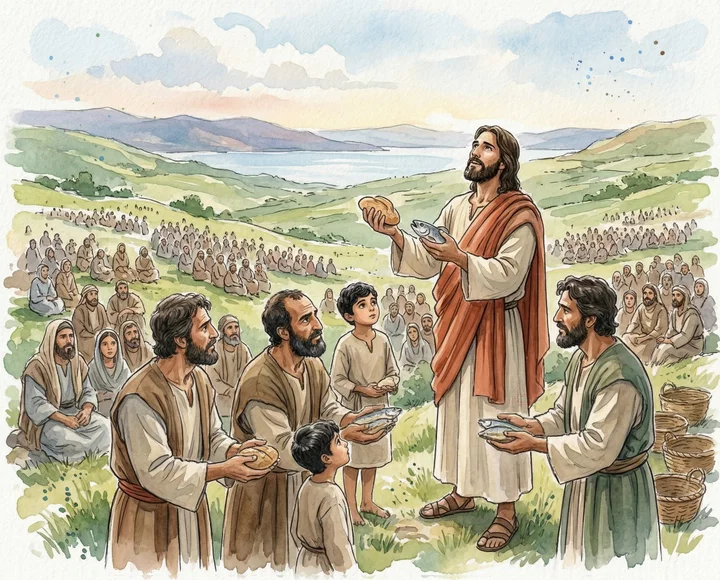
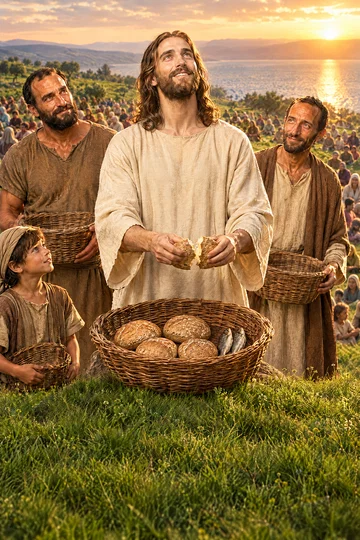
And they sat down in ranks, by hundreds, and by fifties.
and they sat down in squares, by hundreds, and by fifties.
And they sat down in ranks by hundreds and by fifties.
And they fell back, in companies, by hundreds and by fifties.
Berean Standard Bible, Majority Standard Bible
So they sat down in groups of hundreds and fifties.
They sat down in ranks, by hundreds and by fifties.
And they were placed in groups, by hundreds and by fifties.
Then they sate downe by rowes, by hundreds, and by fifties.
Douay-Rheims (Challoner revision)
And they sat down in ranks, by hundreds and by fifties.
Pictures
Cross-references
- John 6:10-13
And Jesus said, Make the men sit down. Now there was much grass in the place. So the men sat down, in number about five thousand.
Parallel account of the crowd sitting down, the food multiplied, and the fragments gathered.
- Matthew 14:19-21
And he commanded the multitude to sit down on the grass, and took the five loaves, and the two fishes, and looking up to heaven, he blessed, and brake, and gave the loaves to his disciples, and the disciples to the multitude.
Jesus seats the crowd in groups and feeds them miraculously.
- Luke 9:14-15
For they were about five thousand men. And he said to his disciples, Make them sit down by fifties in a company.
Jesus seats the crowd in groups of fifty before feeding them.
- Matthew 14:19
And he commanded the multitude to sit down on the grass, and took the five loaves, and the two fishes, and looking up to heaven, he blessed, and brake, and gave the loaves to his disciples, and the disciples to the multitude.
Jesus has the crowd sit down before feeding them.
- John 6:10
And Jesus said, Make the men sit down. Now there was much grass in the place. So the men sat down, in number about five thousand.
Both accounts describe the crowd sitting down before the loaves were distributed.
- 2 Kings 4:42-44
And there came a man from Baal-shalisha, and brought the man of God bread of the firstfruits, twenty loaves of barley, and full ears of corn in the husk thereof. And he said, Give unto the people, that they may eat.
Both texts describe miraculous feeding, with food left over.
- John 6:9
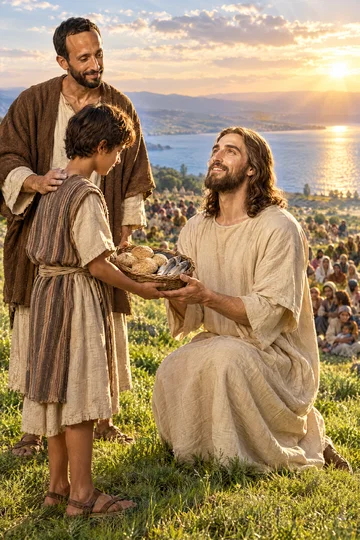
There is a lad here, which hath five barley loaves, and two small fishes: but what are they among so many?
meager loaves and fishes blessed and multiplied
- Mark 6:35-36
And when the day was now far spent, his disciples came unto him, and said, This is a desert place, and now the time is far passed:
gives desert setting and request to send crowd away
- John 6:11
And Jesus took the loaves; and when he had given thanks, he distributed to the disciples, and the disciples to them that were set down; and likewise of the fishes as much as they would.
feeding follows the seating
- Mark 8:1-9
In those days the multitude being very great, and having nothing to eat, Jesus called his disciples unto him, and saith unto them,
Christ feeds four thousand in the wilderness.
- Mark 6:31
And he said unto them, Come ye yourselves apart into a desert place, and rest a while: for there were many coming and going, and they had no leisure so much as to eat.
Jesus invites the disciples to withdraw and rest before the multitude seeks him.
- John 6:4
And the passover, a feast of the Jews, was nigh.
Places the feeding near Passover.
- John 6:13
Therefore they gathered them together, and filled twelve baskets with the fragments of the five barley loaves, which remained over and above unto them that had eaten.
same twelve baskets gathered after all were fed
Commentary
Each commentary is drawn from primary sources: the writings of Ellen G. White and Adventist pioneers and periodicals. Each commentary is separate. Its own words are not a quotation; follow the references to read the source passages.
Ellen G. White
47 sources
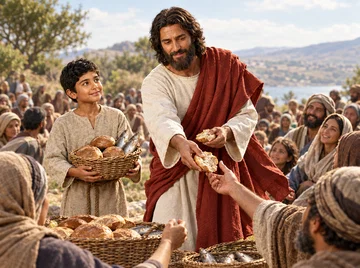
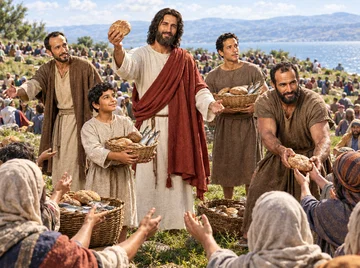
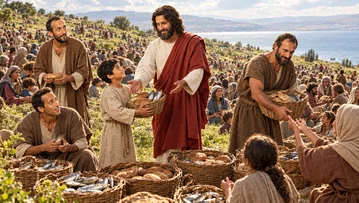
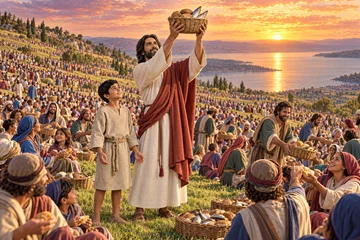
They sat down at His command on the green grass in orderly companies in ranks by hundreds and by fifties, and all obeyed and were seated in order in His presence.ST May 7, 1912Ms 87, 1909, par. 12–14ST May 10, 1883 The seating gave the weary multitude room to sit and rest comfortably and kept them from trampling one another while the food was distributed.ST May 7, 1912ST Aug 12, 1897ST Aug 12, 1897 It preserved order so the vast assembly could be served in an orderly way by the disciples and all could witness what He was about to do from the small supply of loaves and fishes.ST May 10, 18832SP 261.2–262.23RED 55.2ST Once marshaled they wondered what was to be done, then saw food portioned out to the whole assembly until every appetite was satisfied.Ms 87, 1909, par. 12–14Ms 197, 1907, par. 1–4ST May 20, 1886 The ordering teaches trust in God instead of unbelieving worry, for what seems meager in Christ's hands can become more than enough to satisfy and to share.STMW8 30.2–31.2Ms 114, 1899, par. 1–3Ms 66a, 1900, par. 30–31Lt 121, 1904, par. 14–16
Setting and Sequence
The sitting in ranks belongs to the feeding of the five thousand men besides women and children, more than ten thousand in all, who had followed on foot into a desert and wilderness place, a retired grassy plot near the shore of Galilee.Ms 87, 1909, par. 12–14ST Aug 19, 1897Ms 182, 1907, par. 21–23Ms 66a, 1900, par. 30–31Ms 64, 1910, par. 10–11 There like sheep without a shepherd they received teaching and healing all day till the day was far spent and evening came, growing hungry and faint and weary after listening so long.Ms 87, 1909, par. 12–14DA 364.2ST Aug 19, 1897Ms 182, 1907, par. 21–23Ms 64, 1910, par. 10–11 They had come without invitation or command and had used up their food, leaving them with nothing to eat in a place with no food nigh at hand.Ms 87, 1909, par. 12–14ST Aug 19, 1897Ms 64, 1910, par. 10–11
When the disciples urged sending the hungry multitude away into the country and villages to buy bread, Jesus refused and had them count the food.Ms 87, 1909, par. 12–14Ms 197, 1907, par. 1–4STMW8 30.2–31.2 Only five barley loaves and two small fishes could be found among so many.Ms 87, 1909, par. 12–14Ms 182, 1907, par. 21–23Ms 66a, 1900, par. 30–31Ms 123, 1909, par. 32–34Lt 121, 1904, par. 14–16 He then commanded the multitude to sit down on the green grass, a beautiful grassy spot and pleasant place, in orderly companies in ranks by hundreds and by fifties, in long lines.ST May 7, 1912Ms 87, 1909, par. 12–14ST May 10, 1883ST Aug 12, 1897ST May 20, 1886 The marshaling was fully carried out and all obeyed and were seated in order in his presence.Ms 87, 1909, par. 12–14Ms 197, 1907, par. 1–4ST May 20, 1886STMW8 30.2–31.2
While they sat a hymn was sung, and then Jesus took the loaves and fishes, looked up to heaven, blessed and broke them into small pieces, gave them to the disciples to set before the people and divided the fishes among them all.Ms 87, 1909, par. 12–14Ms 197, 1907, par. 1–46T 263.1Ms 182, 1907, par. 21–23Ms 64, 1910, par. 10–11 All ate until filled and satisfied, the supply increasing each time the distributors returned and continuing as they kept imparting what they received without running out.Ms 87, 1909, par. 12–14Ms 197, 1907, par. 1–4Ms 182, 1907, par. 21–23Ms 64, 1910, par. 10–11Ms 123, 1909, par. 32–34 The disciples also shared the food with Jesus.6T 263.1 Twelve baskets of fragments and of fishes were taken up on this occasion and seven on another, showing what Christ can do, and the report drew large numbers back to the shore the next morning.Ms 87, 1909, par. 12–14ST Dec 29, 1887Ms 123, 1909, par. 32–34
This miracle was performed three times in different localities so that people in different parts might learn the lessons he taught thereby.Ms 87, 1909, par. 12–14
Purpose of Orderly Arrangement
The seating in ranks by hundreds and by fifties made room for the great crowd and gave the weary people a place to sit and rest comfortably and be cared for before they were fed.ST May 7, 1912ST Aug 12, 1897ST Aug 12, 1897 Sitting down in orderly groups kept the people from trampling one another while the food was being distributed.ST May 7, 1912ST Aug 12, 1897ST Aug 12, 1897 Seating them in ordered companies of fifty and one hundred preserved order among the vast assembly so that all could be served and the distribution could be carried out in an orderly way by the disciples.2SP 261.2–262.23RED 55.2ST2SP 262.3–263.1ST Aug 12, 1897
Jesus had them seated in order before feeding them so that all could witness the miracle he was about to do from the small supply of loaves and fishes.ST May 10, 18832SP 261.2–262.2STST May 10, 1883ST Mar 1, 1877 The marshaling of the five thousand was fully carried out and they were all seated in order in his presence to preserve order and to behold what he would do.2SP 261.2–262.2STST May 20, 18862SP 262.3–263.1 Once thus marshaled and seated, they wondered what was to be done, and then saw food portioned out to the whole assembly from the small store until every appetite was satisfied.ST May 20, 1886
Divine Power and Provision
The feeding displays the same creative power that every day multiplies seed into harvest. ED 107.3 God continually feeds people through the produce of the earth, while men cooperate by tending the grain and preparing the bread. ED 107.3 Because that human labor can hide divine agency, the wilderness setting directs attention to His power and kindness in supplying food and warns against using His gifts selfishly. ED 107.3
In the wilderness no food was near at hand and apparently no means were at command, yet Jesus was placed there by providence and was one with the people in their need. DA 368.2–3ST Aug 19, 1897 The five thousand men besides women and children had come without invitation or command and had listened so long that they grew hungry and faint. ST Aug 19, 1897 He depended on His heavenly Father for means to relieve the necessity. DA 368.2–3ST Aug 19, 1897 This stands as a lesson for all time to depend wholly on God in full confidence when brought into strait places. DA 368.2–3ST Aug 19, 1897 Wisdom and judgment are to be exercised and trial is not to be entered recklessly, but His directions are to be followed, the means He provides used, and His help sought in every emergency. DA 368.2–3ST Aug 19, 1897 After following the best knowledge, trust is to rest on Him who has infinite resources to deliver and keep every soul brought into perplexity through trying to keep the way of the Lord. DA 368.2–3ST Aug 19, 1897
The miracle reveals omnipotent power and beneficence as part of Christ's mission of compassion and love. DA 364.2ST Aug 12, 1897Ms 18, 1898, par. 11 Moved with pity for the multitude as sheep without a shepherd, He gave them teaching and healing, attended to their weariness, and met their physical need for food. DA 364.217MR 252.3Ms 86, 1910, par. 14–18 He can still provide for bodily needs and give knowledge that helps in obtaining food, so that where hungry listeners gather it is felt that were He present He would supply them by divine power. 17MR 252.3Lt 3, 1859, par. 4–5 His care made practical effort to keep seekers after salvation from being left weary, hungry, or discouraged. ST Aug 12, 1897Ms 86, 1910, par. 14–18
The small provision of five loaves and two small fishes was blessed and multiplied until sufficient for the multitude and for the work entrusted to His servants. Ms 114, 1899, par. 1–3Ms 66a, 1900, par. 30–31Lt 121, 1904, par. 14–16 As God had multiplied bread for a hundred men through Elisha, so Christ made the scanty store feed five thousand men besides women and children, leaving twelve baskets of fragments. Ms 114, 1899, par. 1–3Ms 66a, 1900, par. 30–31Lt 121, 1904, par. 14–16 The event is an object lesson that even when gifts seem inadequate and the need appears hopeless, God can use them to do great things today. Lt 121, 1904, par. 14–16Ms 66, 1900, par. 11–12 What seems meager in Christ's hands becomes more than enough to satisfy and to share with others. Ms 66a, 1900, par. 30–31Lt 121, 1904, par. 14–16Ms 66, 1900, par. 11–12 To those who follow His direction He still gives tact, skill, and understanding to provide what is needed. Ms 66a, 1900, par. 30–31Ms 14, 1902, par. 4
The power that fed the hungry on the shores of Galilee was the same divine power He possessed while living a life of toil in the carpenter's shop at Nazareth to help support His family. RP 26.5–6CT 276.3–4 He did not use it to lessen His own burdens or lighten His toil. RP 26.5–6CT 276.3–4 Dwelling in a peasant's home, wearing coarse garments, mingling with the lowly, and toiling with patient hands as a common laborer, He showed that it is man's duty to be industrious and that useful, industrious labor is honorable. RP 26.5–6CT 276.3–4
Economy and Sharing
After the crowd had eaten until filled and satisfied, the remaining fragments were ordered to be gathered up so that nothing would be lost or wasted.STB 772.1–2Ms 182, 1907, par. 21–23ST Dec 15, 19092T 435.315MR 41.2–3 That gathering teaches order and economy and careful use of what God has given, applying to food and money as well as to spiritual opportunities.STB 772.1–2ST Dec 15, 19092T 435.315MR 41.2–3 It is a duty requiring industry, living within means, faithful stewardship of strength, and owing no one anything in order to place the family above want and dependence.2T 435.3 What God has given must be freely imparted to others and not wasted, gambled away, or gotten by robbing another.Ms 182, 1907, par. 21–23
The fragments were shared with others, just as those who receive spiritual bread should pass it on to satisfy the spiritual needs of others.ST Dec 15, 1909 Those who pass on what they receive can serve others and share in the blessings provided, and after the crowd had eaten the disciples themselves shared the food.6T 263.1ST Dec 15, 1909 Those who labor together in this work receive grace to give to people in need, and the gift increases in its distribution as it is handed out.6T 263.1ST Dec 15, 1909Lt 7, 1901, par. 1–3 The five loaves and two small fish were passed around the seated companies, illustrating the lesson of sharing what one has with those who lack it.Ms 180, 1907, par. 27–28Ms 182, 1907, par. 21–23Lt 7, 1901, par. 1–3
The orderly seating in companies and the gathering of what remained teach that the works continued in the present day by message or helpfulness are to be held as a credit and nothing wasted.Ms 64, 1910, par. 10–11 The incident is also an example of seating people on the ground and keeping a gathering's meal simple, without the extra cooking and many dishes that make preparation burdensome.Ms 7, 1873, par. 55
Spiritual and Practical Application
When the disciples anxiously asked that the hungry multitude be sent away into the villages to buy food, the answer was refusal and a command to sit down on the grass in orderly companies of fifties and hundreds, and the people obeyed by seating themselves in long lines.STMW8 30.2–31.2 To sit down thus with Christ is for partakers of the divine nature to come out from worldly influences and empty festivities into heart communion with the Redeemer, prepared to receive the bread of life through the disciples from His own hands.STMW8 30.2–31.2 It is a lesson in trust in God instead of unbelieving worry.STMW8 30.2–31.2 Churches and conferences in need of revival and feeding need not send to Battle Creek for someone to hold meetings for them, nor devise plans and entertainments to draw people, but are to come to Jesus with humble faith and prayer.STMW8 30.2–31.2 They are to be educated to receive the truth from their own shepherds, to pray over it and practice it, until souls grow in faith and intelligent knowledge with sufficiency and surplus.STMW8 30.2–31.2
The same Lord who multiplied and blessed the food given to the disciples to feed the five thousand multiplies and blesses gifts of means given with thanksgiving and prayer for soul-saving medical missionary and sanitarium work.STB 148.2–3STB 119.3–4 When the best use is made of the means available, God enables His workers to feed the multitudes who are starving for the bread of life.STB 148.2–3STB 119.3–4 Feeding so great a multitude from a very meager supply teaches that small, scattered means placed in missionary work will be multiplied by God as they are imparted to others, so that all may eat and be filled.2MR 283.1–284.2 Faith should lay hold upon God and expect success, and not stop work or measure advance by the means at hand, for that shows very limited faith.2MR 283.1–284.2 As God said to Moses to go forward, His human agents are to go forward and diffuse the gospel over the whole earth, planning and working in faith whether means are large or small and realizing their responsibility for the great work given them.2MR 283.1–284.2
The ordering and feeding of the crowd is an example of the Lord's methods to be studied in carrying forward food work.Lt 302, 1906, par. 5 It teaches disciples to care compassionately for people seeking salvation, making practical efforts to meet their needs so they are not left weary, hungry or discouraged.ST Aug 12, 1897 Christ led the crowd to a grassy plot and had them seated in order before feeding them from only five loaves and a few small fishes, enough for five thousand men besides women and children, because He was attentive to all who came needing help, acting as their sanctuary and helper and great leading Physician.Ms 186, 1907, par. 8–9 Those who are softened and subdued and sanctified by His Holy Spirit, who study to work the very works He worked and are dedicated to the Lord God of heaven, will be given His Holy Spirit so they can communicate to those in necessity.Ms 186, 1907, par. 8–9
Sources
Pioneers and periodicals
49 sources
Before blessing the small supply of loaves and fishes, Jesus had the great crowd of about five thousand men besides women and children sit down in orderly companies by hundreds and by fifties on the grass in the desert place near Bethsaida.ST May 7, 1912ST Jun 14, 1899ST Feb 1, 1899ST Sep 18, 1893 He seated them in this way to give the weary people rest, to preserve order and prevent confusion while the food was given out, and so that all could witness what he was about to do.ST May 7, 1912ST May 10, 1883ST Aug 12, 1897STST Dec 22, 1887 The arrangement made the multitude manageable for the disciples to serve conveniently so that no one would be overlooked, showing that God is a God of order and not of confusion.ST Feb 15, 1905ST Oct 12, 1904RH May 13, 1862ST Feb 1, 1899 He then multiplied the five barley loaves and two small fishes as he broke and gave them to the disciples to give to the people, until all ate to fullness with twelve baskets gathered afterward.ST May 20, 1886ST Apr 11, 1906ST Dec 22, 1887 The feeding reveals his compassion as shepherd and his united humanity and divinity, infinite in resources and able to sustain those he commands through every emergency.ST Aug 12, 1897RH Oct 30, 1860ST Mar 26, 1912RH Jul 16, 1901RH May 20, 1909
Setting of the Miracle
Jesus and his disciples had been so pressed by the work that they had no leisure even to eat, and they withdrew to seek rest in a deserted place.ST Oct 12, 1904ST Apr 25, 1900ST May 25, 1904 The crowds followed them there, and the needs of the people interrupted that rest.ST Apr 25, 1900ST May 25, 1904 After a full day spent in teaching and healing, the disciples feared the multitude would go hungry.ST Oct 12, 1904
The feeding took place in a desert and wilderness place far from home.STST Sep 18, 1893 It lay on the northern bank of the Sea of Galilee near Bethsaida, on a plain by the sea where green grass was plentiful.ST Sep 18, 1893STST May 20, 1886ST Jul 7, 1898 The people had nothing to eat and no ready means to buy food.STST Sep 18, 1893ST May 20, 1886
About five thousand men besides unnumbered women and children sat down, as the parallel account in John also tells.ST Feb 1, 1899ST May 20, 1886 They had come without invitation or command and had listened so long to the instruction that they grew hungry and faint.ST Aug 19, 1897 The church was there with them, seeing the great need of the suffering multitude.ST Sep 18, 1893
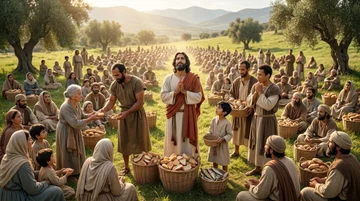
Jesus had the multitude sit down in orderly ranks by hundreds and by fifties on the grass and on the ground.ST May 7, 1912ST Jun 14, 1899ST Jun 14, 1899ST Jun 6, 1900 This seating in companies of about fifty within groups of a hundred and fifty was done in obedience to the order given through the disciples.ST May 20, 1886 It took place before he blessed the food and before the loaves and fishes were distributed to be eaten until all were filled.ST Jun 14, 1899ST Jun 14, 1899ST Jun 6, 1900ST May 20, 1886
Purpose of Orderly Arrangement
The seating in ranks by hundreds and by fifties made room for the great crowd, gave the weary people opportunity to rest comfortably, and kept them from trampling one another while the food was being distributed.ST May 7, 1912ST Aug 12, 1897ST Aug 12, 1897 Jesus directed the disciples to seat the people on the grass in groups of fifty and one hundred in order to preserve order and so that all could witness the miracle he was about to perform from the small supply of loaves and fishes.ST May 10, 1883STST May 20, 1886ST Mar 1, 1877ST Dec 22, 1887 The marshaling was fully carried out, and the five thousand were all seated in order in his presence, wondering what was to be done, before they saw food portioned out to the whole assembly from the small store until every appetite was satisfied.ST May 20, 1886ST May 10, 1883ST Dec 22, 1887
The organized seating made the multitude manageable for the disciples to serve, so that the food could be served conveniently and without disorder.ST Aug 12, 1897ST Oct 12, 1904ST Feb 1, 1899 In that orderly arrangement no one would be overlooked, showing that Jesus already knew how he would provide for them.ST Feb 15, 1905ST Oct 12, 1904 The crowd obeyed the order given through the disciples to sit down on the green grass, in quietude instead of moving here and there in tumult and confusion.RH May 13, 1862ST May 20, 1886 They were arranged in orderly companies of about fifty within groups of a hundred and fifty, fully marshaled and seated and ready before the blessing and distribution.ST May 20, 1886RH May 13, 1862ST May 20, 1886
Their orderly arrangement illustrates that the Lord's work is characterized by order and is therefore thorough, for God is a God of order and not of confusion.RH May 13, 1862ST Feb 1, 1899
Manner of the Miracle
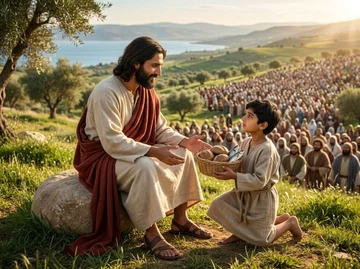
Neither surprised nor frustrated by the lack of food, Jesus commanded the arrangement of the multitude in preparation for feeding them. Once they were seated in orderly companies on the grass, He took the five thin barley loaves and two small fishes brought by a lad from a boy's basket.RH Feb 6, 1908STST May 20, 1886 He looked up to heaven and invoked God's favor on the coarse food, then blessed, broke it and gave it to the disciples to give to the people, so that the crowd obeyed and sat ready before He had the disciples distribute the loaves and fishes for all to eat as much as they wanted.ST May 20, 1886
The food multiplied as He broke it, multiplied as the disciples broke from what they held, and multiplied as the people received and ate. The bread on the hillside multiplied as it was broken and shared, portioned out to the whole assembly from the small store until every appetite was satisfied, all ate to fullness and were refreshed.ST May 20, 1886ST May 29, 1884ST May 13, 1880 They had been seated beforehand in groups of fifty and one hundred to keep order and let everyone witness the miracle, all seated before Him in His presence wondering what was to be done as He distributed enough to satisfy them.ST May 20, 1886ST Mar 18, 1913ST Dec 22, 1887 Twelve baskets of fragments were gathered afterward, more than twelve times the original quantity, so that five thousand men besides unnumbered women and children were fed to fullness.
The seating and feeding really happened and can only be denied or admitted as a miracle of creative power by the creative word, with no juggling of words able to make it mean something else. It describes a literal event in which the people were organized into groups while being fed, not merely a symbolic feeding of the soul.ST Jul 25, 1911
The miracle was witnessed by thousands, for the people who ate the bread and fish could testify to what had been done.ST Nov 1, 1910 Afterward many in the crowd wanted to make Jesus a temporal king because He had provided bread.ST Aug 2, 1905 He sent the crowd and His disciples away and went alone into the mountain to pray, yet the report of the feeding drew large numbers back to the shore the next morning.ST Dec 29, 1887ST Aug 2, 1905
The disciples gathered the leftover fragments afterward, showing that the small amount of food did not limit provision.RH Apr 17, 1900ST Sep 22, 1881 Christ had them gather the remaining food so nothing would be wasted, showing that economy applies to food and money as well as spiritual opportunities.ST Dec 15, 1909 The bread and fish given to Him were blessed, distributed, and then gathered as fragments.RH Apr 17, 1900
Christ Revealed in Feeding
The feeding shows benevolence and care for people, compassion in providing for hunger, and the character of a selfless Deliverer and King who pitied the crowd as sheep without a shepherd on their way to the Passover.RH Oct 30, 1860ST Mar 26, 1912ST Nov 11, 1886 The people were seated in orderly groups before the food was shared, and what was small when placed in his hands became enough for many.RH Oct 30, 1860ST Mar 26, 1912 The miracle reveals omnipotent power and beneficence, with humanity and divinity united in him.ST Aug 12, 1897RH May 20, 1909 He is infinite in resources and able to sustain those he commands, and the same Lord who fed the multitude and sent the disciples across the sea was able to keep them through contrary winds and a rough night.RH Jul 16, 1901 Because they did not consider the miracle of the loaves their heart was hardened and they spent the night in discouragement, doubt and unbelief, whereas considering it would have spared them such a hard night, teaching not to limit the Holy One but to come with humble, childlike faith and confidence for all supplies, trusting he can save by few or by many and that with his blessing a mighty work can be done in and for the world.RH Jul 16, 1901 The miracle is applied to Christian service as calling for faith that lays hold of Christ in self-denial and self-sacrifice and unites with him, and for compassionate care for people seeking salvation by practical efforts so they are not left weary, hungry or discouraged.ST Aug 12, 1897RH May 20, 1909
Placed where he was by providence in the wilderness with a hungry crowd far from home and without ready means to buy food, with no food at hand and apparently no means at command, he was one with them in their need and depended on his heavenly Father, who has resources for every emergency.STST Aug 19, 1897 This teaches dependence on God in times of need.STST Aug 19, 1897 It gives a lesson for all time to depend wholly on God in full confidence when brought into strait places, exercising wisdom and judgment and not plunging recklessly into trial, but after following the best knowledge trusting him who has infinite resources.ST Aug 19, 1897 God will then deliver and keep every soul brought into perplexity through trying to keep the way of the Lord, for the five thousand men besides women and children had come without invitation or command and had listened so long that they grew hungry and faint.ST Aug 19, 1897
God's power multiplies responsive human effort, for at the end of a day of teaching and healing in a deserted place the disciples feared the crowd would go hungry, yet he multiplied their small supply and fed everyone abundantly with food left over, the seated companies of hundreds and fifties making the multitude manageable as the disciples served.ST Oct 12, 1904 Though he had power to provide food by other means, he used the small amount of food offered to satisfy hunger, teaching hope and trust.ST Oct 12, 1904RH Apr 10, 1900 The feeding of the multitude in the wilderness is an image of heaven where everyone is sure to have enough to eat.RH Mar 9, 1916
Sharing Through Disciples
Jesus gave the blessed food to his disciples, and they passed on to the seated companies what they themselves had received from him, so that receiving from Christ they became channels of blessing to others.ST Apr 11, 1906RH Jul 11, 1912 The order of the miracle was supply through the disciples, with the people sitting in groups while the food came to them by that appointed means.RH Jul 11, 1912 With God's blessing what his people have and do in this way can carry the bread of life to the whole world.RH Jul 11, 1912
The people themselves also shared with one another as the distribution went forward. The treasure on the hillside of Galilee multiplied as it was broken and shared, proving that such a gift is not given to be selfishly hoarded but to be passed on.ST May 13, 1880 The fragments that remained were shared with others, just as those who receive spiritual bread should pass it on to satisfy the spiritual needs of others.ST Dec 15, 1909
The church was present there seeing the great need of the suffering multitude and yet feeling powerless to help, because its whole apparent supply was only five loaves of bread and two little fishes.ST Sep 18, 1893 At the Master's command to give the multitude to eat they obeyed and engaged in the good work.ST Sep 18, 1893 His blessing upon their little store made it more than enough, illustrating how the cry of hard times is met by God's resources.ST Sep 18, 1893
The same Jesus who multiplied the five loaves and two fishes by the seaside to feed the multitude then can multiply the means in the hands of his people now to carry his work to completion among the nations of the earth and warn the world.RH Jul 11, 1912RH Jul 16, 1901 God is not dependent on the world for money, though he will use what is put into his treasury from worldly people, and needs only what his people have, which he can bless and multiply to be ample and sufficient.RH Jul 16, 1901 The greatness and vastness of the work should drive God's people in helplessness to Jesus for his blessing on the mere pittance in their hands, for he must bless and increase it in order for the work to be done.RH Jul 16, 1901 The same lesson is shown in that the Jewish nation had talents of intellect and means which God would have increased to bless and enlighten the whole world through them by blessing and breaking and distributing, but they would not.RH Jul 16, 1901
Lessons for Daily Life
Mark 6:40 is an example to require more order in families and around tables when asking heaven's blessing on food, to be known by children at a young age.RH May 13, 1862 Before blessing and breaking the bread Jesus commanded the people to be seated, and they sat in ranks in order and quietude instead of moving here and there in tumult and confusion while He looked up to heaven and asked God's blessing on their scanty yet more than plentiful portion, for God is a God of order and not of confusion.RH May 13, 1862 The miracle teaches careful use of God's gifts, for Christ had the disciples gather the remaining food so nothing would be wasted, showing that economy applies to food and money as well as spiritual opportunities.ST Dec 15, 1909 The fragments were shared with others, just as those who receive spiritual bread should pass it on to satisfy others' spiritual needs.ST Dec 15, 1909
The miracle teaches not to limit the Holy One but to come with humble, childlike faith and confidence for all supplies, trusting that He can save by few or by many.RH Jul 16, 1901 Jesus is infinite in resources and able to sustain those He commands, and the same Lord who multiplied the bread from five loaves and two fishes before the disciples' eyes and fed the multitude was able to keep those He sent across the sea through contrary winds and a rough night.RH Jul 16, 1901 Because they considered not the miracle of the loaves their heart was hardened, and they spent the night in discouragement, doubt and unbelief, whereas had they considered the miracle they would not have had such a hard night.RH Jul 16, 1901 With His blessing on the loaves and fishes in hand a mighty work can be done in and for the world.RH Jul 16, 1901
What seems too little, when placed in the Master's care, can become enough to feed many, as shown when Jesus fed a multitude with a boy's small supply of bread and fish seated in orderly groups before the food was shared.RH Feb 6, 1908ST Mar 26, 1912 The account shows His compassion in providing for people's hunger and illustrates what the Lord can accomplish through little beginnings.ST Mar 26, 1912RH Aug 11, 1910 Gifts placed in His hands may be multiplied to bless many.RH Feb 6, 1908ST Mar 26, 1912ST Mar 26, 1912 God blesses and transforms what is yielded to Him, while what a person gives and the direction of past choices shape what follows, as seen where bread and fish given to Jesus were blessed, distributed, and gathered afterward as fragments.RH Apr 17, 1900
Believers need faith that lays hold of Christ, accepts self-denial and self-sacrifice, and unites them with Him, for the feeding of the five thousand shows humanity and divinity united in Christ.RH May 20, 1909 The miracle reveals His omnipotent power and beneficence in arranging the crowd in orderly groups of hundreds and fifties before feeding them.ST Aug 12, 1897 It teaches His disciples to care compassionately for people seeking salvation, making practical efforts to meet their needs so they are not left weary, hungry, or discouraged.ST Aug 12, 1897 The feeding proves that a great work can grow out of a mere moment in the life of one of God's servants, where a moment spent uttering words feeds five thousand and even five hundred thousand, for it is often a single sentence rather than a whole sermon that sends God's arrows to the heart.
Sources