Mark 6:41
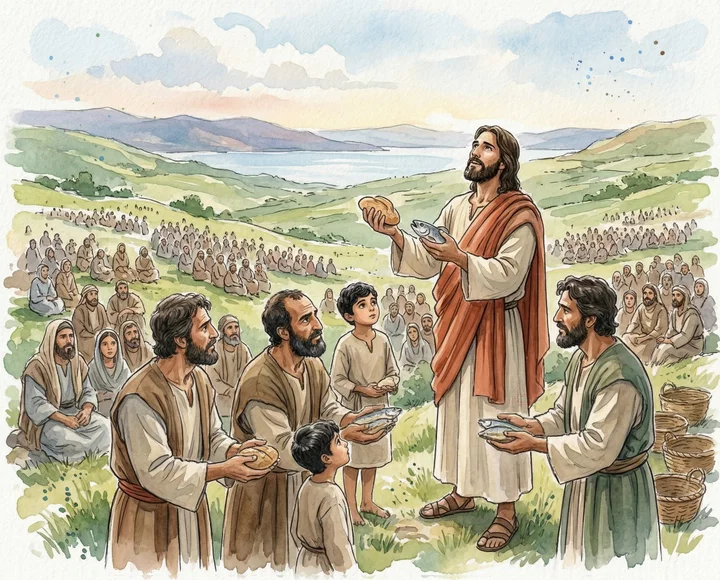
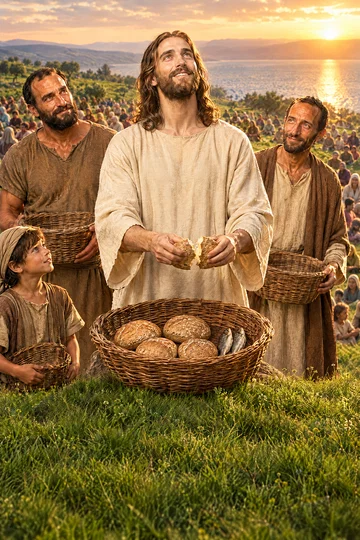
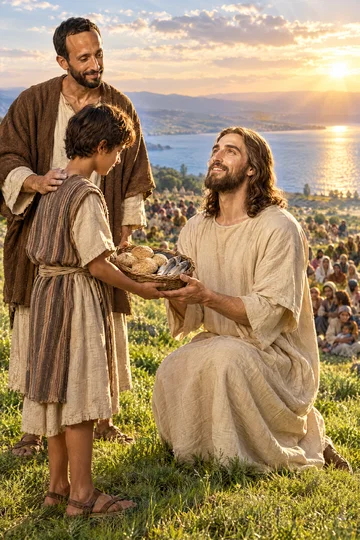
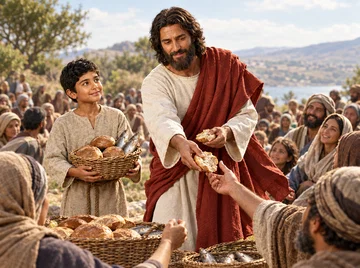
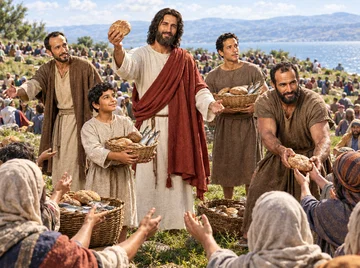
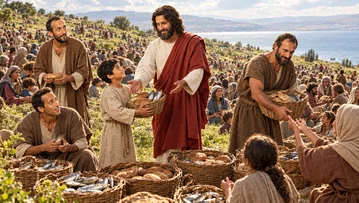
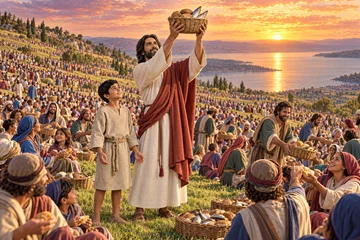
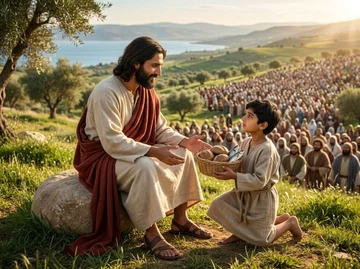
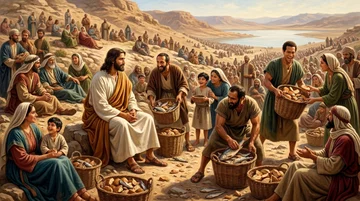
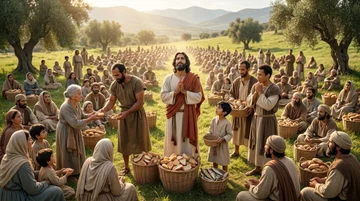
And when he had taken the five loaves and the two fishes, he looked up to heaven, and blessed, and brake the loaves, and gave them to his disciples to set before them; and the two fishes divided he among them all.
Translations
And when he had taken the five loaves and the two fishes, he looked up to heaven, and blessed, and broke the loaves, and gave them to his disciples to set before them; and the two fishes divided he among them all.
King James Version, KJV Cambridge Paragraph Bible
And when he had taken the five loaves and the two fishes, he looked up to heaven, and blessed, and brake the loaves, and gave them to his disciples to set before them; and the two fishes divided he among them all.
And when he had taken the five loaves, and the two fishes, he looked up to heaven, and blessed, and broke the loaves, and gave them to his disciples to set before them; and the two fishes he divided among them all.
Revised Version, American Standard Version
And he took the five loaves and the two fishes, and looking up to heaven, he blessed, and brake the loaves; and he gave to the disciples to set before them; and the two fishes divided he among them all.
And having taken the five loaves and the two fishes, having looked up to the heaven, he blessed, and brake the loaves, and was giving to his disciples, that they may set before them, and the two fishes divided he to all,
And having taken the five loaves and the two fishes, looking up to heaven, he blessed, and broke the loaves, and gave [ them] to his disciples that they might set [ them] before them. And the two fishes he divided among all.
And, taking the five loaves, and the two fishes, looking up into heaven, he blessed, and brake up the loaves, and began giving unto the disciples, that they might set before them, and, the two fishes, divided he, unto all.
Berean Standard Bible, Majority Standard Bible
Taking the five loaves and the two fish and looking up to heaven, Jesus spoke a blessing and broke the loaves. Then He gave them to His disciples to set before the people. And He divided the two fish among them all.
He took the five loaves and the two fish; and looking up to heaven, he blessed and broke the loaves, and he gave to his disciples to set before them, and he divided the two fish among them all.
And he took the five cakes of bread and the two fishes and, looking up to heaven, he said words of blessing over them; and when the cakes were broken, he gave them to the disciples to put before the people; and he made division of the two fishes among them all.
And he tooke the fiue loaues, and the two fishes, and looked vp to heauen, and gaue thanks, and brake the loaues, and gaue them to his disciples to set before them, and the two fishes he deuided among them all.
Douay-Rheims (Challoner revision)
And when he had taken the five loaves, and the two fishes: looking up to heaven, he blessed, and broke the loaves, and gave to his disciples to set before them: and the two fishes he divided among them all.
Pictures
Cross-references 20 of 27
- John 6:11
And Jesus took the loaves; and when he had given thanks, he distributed to the disciples, and the disciples to them that were set down; and likewise of the fishes as much as they would.
Jesus gives thanks, then distributes the loaves and fishes to feed the crowd.
- Matthew 14:19
And he commanded the multitude to sit down on the grass, and took the five loaves, and the two fishes, and looking up to heaven, he blessed, and brake, and gave the loaves to his disciples, and the disciples to the multitude.
Jesus blesses and distributes the loaves and fish to feed the multitude.
- Luke 9:16
Then he took the five loaves and the two fishes, and looking up to heaven, he blessed them, and brake, and gave to the disciples to set before the multitude.
Jesus blesses and breaks the loaves and fishes, then gives them to the disciples to distribute.
- John 6:35
And Jesus said unto them, I am the bread of life: he that cometh to me shall never hunger; and he that believeth on me shall never thirst.
The feeding illustrates Christ’s provision of the bread of life to needy souls.
- Matthew 14:21
And they that had eaten were about five thousand men, beside women and children.
Both accounts give the same count of about five thousand, besides women and children.
- 2 Kings 4:42-44
And there came a man from Baal-shalisha, and brought the man of God bread of the firstfruits, twenty loaves of barley, and full ears of corn in the husk thereof. And he said, Give unto the people, that they may eat.
Both accounts show God multiplying limited food to feed a crowd.
- Mark 8:1-9
In those days the multitude being very great, and having nothing to eat, Jesus called his disciples unto him, and saith unto them,
Both texts recount Christ feeding a multitude with loaves and fish.
- Matthew 15:36
And he took the seven loaves and the fishes, and gave thanks, and brake them, and gave to his disciples, and the disciples to the multitude.
Jesus gives thanks and breaks bread while feeding the multitude.
- Mark 6:37
He answered and said unto them, Give ye them to eat. And they say unto him, Shall we go and buy two hundred pennyworth of bread, and give them to eat?
Christ commands the disciples to feed the people despite scarcity, teaching dependence on God for provision.
- Mark 8:19-20
When I brake the five loaves among five thousand, how many baskets full of fragments took ye up? They say unto him, Twelve.
Jesus recalls the baskets left over from both feedings.
- John 6:9
There is a lad here, which hath five barley loaves, and two small fishes: but what are they among so many?
same question about loaves and fishes among many
- Mark 6:35-36
And when the day was now far spent, his disciples came unto him, and said, This is a desert place, and now the time is far passed:
shares desert setting and request to send crowd away
- Luke 24:30
And it came to pass, as he sat at meat with them, he took bread, and blessed it, and brake, and gave to them.
Jesus blesses and breaks bread at Emmaus.
- John 6:48-51
I am that bread of life.
Jesus teaches about the bread of life after the feeding.
- John 6:26
Jesus answered them and said, Verily, verily, I say unto you, Ye seek me, not because ye saw the miracles, but because ye did eat of the loaves, and were filled.
The crowd seeks Jesus after being fed by the miracle.
- Exodus 16:4
Then said the LORD unto Moses, Behold, I will rain bread from heaven for you; and the people shall go out and gather a certain rate every day, that I may prove them, whether they will walk in my law, or no.
The feeding is compared with God feeding Israel in the wilderness.
- John 6:14-15
Then those men, when they had seen the miracle that Jesus did, said, This is of a truth that prophet that should come into the world.
After the feeding, the crowd recognizes Jesus as the promised Prophet and tries to make him king.
- Mark 6:52
For they considered not the miracle of the loaves: for their heart was hardened.
Their failure to understand the loaves left them amazed and hardened.
- John 21:13
Jesus then cometh, and taketh bread, and giveth them, and fish likewise.
Jesus gives bread and fish to his disciples.
- Luke 24:35
And they told what things were done in the way, and how he was known of them in breaking of bread.
Jesus is known through the breaking of bread.
Commentary
Each commentary is drawn from primary sources: the writings of Ellen G. White and Adventist pioneers and periodicals. Each commentary is separate. Its own words are not a quotation; follow the references to read the source passages.
Ellen G. White
52 sources
Jesus took the five barley loaves and two small fishes, looked up to His Father in heaven in thanks and blessing, broke the bread and divided the fish, and gave them to His disciples to set before the seated multitude, and the food multiplied in His hands and as it was passed along until all ate and were filled and twelve baskets of fragments were gathered so nothing was lost.ST May 7, 1912Ms 87, 1909, par. 12–14ST May 10, 1883RH Apr 8, 1909ST May 20, 1886 The act reveals His tender compassion for weary, hungry people and His omnipotent divine power to provide abundantly from plainly inadequate human resources where He would not use a miracle for Himself.ST May 7, 1912ST Aug 12, 1897DA 365.3–366.1ED 107.3ST Mar 18, 1913 In His human nature depending on His Father for food when none was at hand He gives a lasting lesson to depend wholly upon God with full confidence when in strait places after exercising wisdom, trusting that a meager supply can become enough to share.DA 368.2–3ST Aug 19, 1897Ms 66a, 1900, par. 30–31Ms 114, 1899, par. 1–3 What is wisely used and unselfishly shared in His service increases in the giving, with the disciples as His cooperating agents receiving from Him and passing to others, and believers softened by the Holy Spirit to do the same works of helpfulness.Ms 197, 1907, par. 1–42SP 261.2–262.26T 263.1Ms 182, 1907, par. 21–23DA 370.4 Though He satisfied hunger by miracle He taught careful stewardship that divine power does not excuse waste, and the same blessing that enlarged the loaves will multiply small means given with thanksgiving and prayer to feed multitudes starving for the bread of life.STB 772.1–2STB 148.2–3Ms 66a, 1900, par. 30–31ST Dec 15, 1909DA 370.4
Setting and Arrangement
This feeding belongs to the time when Jesus had withdrawn for quiet and the crowds followed Him, near the Passover, in a desert place on a barren shore near Galilee.DA 364.1ST Dec 29, 18876RED 64.2 The assembled crowd numbered about five thousand men besides women and children, more than ten thousand in all.DA 364.16RED 64.2
Jesus had made Himself one with the people, traveling on foot from place to place to teach and heal so that all might have opportunity to hear His words and follow Him.Ms 87, 1909, par. 12–14Ms 64, 1910, par. 10–11 Those who were healed joined the crowds already following Him, and after listening all day to His teaching they were weary and hungry and faint when the day was far spent and evening drew on.Ms 87, 1909, par. 12–14ST May 20, 1886ST Aug 19, 1897Ms 64, 1910, par. 10–11Ms 73, 1909, par. 20–21 In one account the following had continued for three days in a retired grassy place until their own food was used up.Ms 64, 1910, par. 10–11
When there was nothing to eat, the disciples urged sending the crowd away into the country and villages to buy bread.Ms 87, 1909, par. 12–14 Jesus instead asked how many loaves they had, and the only food to be found was five barley loaves and two small fishes, a boy's simple food scarcely sufficient for twenty persons.Ms 87, 1909, par. 12–14ST May 20, 1886ST3RED 55.2DA 365.3–366.1
He then commanded all to sit down upon the green grass in orderly companies and ranks by hundreds and by fifties, and a hymn was sung.Ms 87, 1909, par. 12–14Ms 197, 1907, par. 1–4ST May 20, 1886 This seating gave the weary people rest and comfort before the food was distributed.ST May 7, 1912ST Aug 12, 1897 It preserved order and allowed all to witness what was done, providing a simple practical arrangement for feeding many without a variety of dishes.ST May 20, 18863RED 55.2DA 365.3–366.1
The same miracle was performed three times in different localities so that people in different parts might learn its lessons.Ms 87, 1909, par. 12–14 After this feeding on the barren shore the news of the miracle spread, so that crowds returned the next morning.ST Dec 29, 1887
Blessing and Distribution
Taking the five loaves and the two fishes, He looked up to heaven to His Father, gave thanks and asked blessing over the small store, blessed and broke the loaves, and divided the two fishes among them all.ST May 7, 1912Ms 87, 1909, par. 12–14ST May 10, 1883ST Aug 12, 1897DA 365.3–366.1 The food was a boy's simple provision of ordinary barley bread and two small fishes, and the blessing met a genuine physical need as well as spiritual need, showing goodness and truth in care for temporal as well as spiritual wants.ST May 7, 1912Ms 87, 1909, par. 12–14ST Aug 12, 1897DA 365.3–366.1 The weary people were given rest before distribution by being seated, and the orderly seating also let all witness what was done.ST May 7, 1912Ms 87, 1909, par. 12–14ST Aug 12, 1897DA 365.3–366.1
He gave the broken bread and fish to His disciples to set before the people, and the disciples distributed it through their hands to the waiting crowd.ST May 7, 1912ST May 10, 1883ST Aug 12, 1897RH Apr 8, 1909ST The supply passed from Him through the disciples to the people, so the disciples served as the means through which abundant provision was made.ST May 10, 1883ST Aug 12, 1897ST2SP 261.2–262.2 In this way five barley loaves and two small fishes were made to feed five thousand men besides women and children.Ms 87, 1909, par. 12–14RH Apr 8, 1909ST
The food multiplied as it was passed along and did not diminish in His hands, but increased from hand to hand until the hungry multitude was satisfied.ST May 10, 1883RH Apr 8, 1909ST May 20, 18862SP 261.2–262.23RED 55.2 As often as the disciples gave out all they had and returned for a fresh supply, more was furnished them, and as they put the pieces into the hands of the hungry they came back for more, continually imparting what they received.Ms 197, 1907, par. 1–4ST May 10, 1883ST May 20, 18862SP 261.2–262.23RED 55.2 Every appetite was fully satisfied from a slender store scarcely sufficient for twenty persons, to boundless amazement, leaving a lasting impression of truth on those healed and fed.Ms 197, 1907, par. 1–4ST May 20, 18863RED 55.2 A hymn was sung as the people sat down before the blessing and breaking.Ms 197, 1907, par. 1–4
They all ate and were filled, and twelve baskets of fragments and of the fishes were afterward gathered up so that nothing was lost.Ms 87, 1909, par. 12–14RH Apr 8, 1909ST May 20, 1886ST3RED 55.2 The twelve baskets remaining after five thousand men besides women and children were satisfied teach that what seems a meager supply can become enough for oneself and something to share.Ms 87, 1909, par. 12–14RH Apr 8, 1909STLt 121, 1904, par. 14–16
Compassion and Divine Power
Taking the five loaves and two fishes, looking up to heaven, blessing and breaking them, and giving them to the disciples to set before them all, He met a genuine bodily need with simple ordinary barley bread and fish rather than luxury, and with rest as well as food by having the weary crowd sit down on the grass before distribution.ST May 7, 1912ST Aug 12, 1897DA 365.3–366.1 In that act He cared for temporal needs as well as spiritual need, revealing goodness and truth and tender love, compassion and generosity as the world's Redeemer.ST May 7, 1912ST Aug 12, 1897ST Aug 12, 1897 The orderly seating gave rest and comfort and let all witness what was done, while the food multiplied as it was passed along through His hands and the disciples' hands until every appetite was fully satisfied.STDA 365.3–366.1ST Mar 1, 1877ST Mar 18, 1913 The plain food itself carried instruction, that God's natural provisions are good while appetite and taste can be perverted, so that a plain diet can serve better than a luxurious feast.ST Aug 12, 1897 That increase was the same divine power by which God continually produces the harvest and provides daily bread through the growth of crops, so ordinary harvests are evidence of His continual care and should lead to giving Him glory rather than crediting only human effort or natural processes, and receiving His gifts as blessings.ED 107.3ST Aug 12, 1897
The multiplication showed omnipotent power able to provide where human resources were plainly inadequate, with only a boy's small store of five barley loaves and two fishes.ST May 10, 1883ST Mar 18, 1913ST Aug 12, 1897 The same power was His in daily toil, yet He would not use a miracle to satisfy His own hunger or to lessen His burdens and make His labor easier, while He would not let the following people go without food.ST May 10, 1883RP 26.5–6CT 276.3–4 His example in this makes useful work honorable and lays the duty to be industrious.CT 276.3–4 His question about obtaining food tested the disciples' faith, though He already knew how He would provide.ST May 10, 1883
The abundant provision was seen as proof of divine power, and with His teaching and healing it convinced the people He was the Messiah.STST Mar 18, 19132SP 262.3–263.1 The small supply fed five thousand men besides women and children until all were satisfied, with twelve baskets of fragments remaining.ST Yet they wrongly wanted to make Him an earthly king.2SP 262.3–263.1
His command to feed the multitude rested on the same power by which He supplied the food, so the small amount in hand did not make giving impossible.DA 369.1 That command was also a promise that He could provide.DA 369.1
Dependence and Trust
In His human nature Jesus depended on His heavenly Father for food to relieve the multitude when no food was readily at hand and He apparently had no means at His command.DA 368.2–3ST Aug 19, 1897 In the wilderness He fed five thousand men besides women and children who had come without invitation or command and after listening long to His instruction were hungry and faint, and He was one with them in their need.ST Aug 19, 1897 The providence of God had placed Him where He was, and His dependence gives His followers in all time a lesson of dependence upon God.DA 368.2–3ST Aug 19, 1897
When people are brought into difficult circumstances and strait places while following God's directions, they are to seek help and wisdom from Him who has infinite resources at His command.DA 368.2–3ST Aug 19, 1897 This dependence is to come after exercising wisdom and judgment, not recklessly plunging into trial and not neglecting provided means.ST Aug 19, 1897 Then God's people are to depend wholly upon Him in fullest confidence without discouragement, and He will deliver and keep every soul brought into perplexity through trying to keep the way of the Lord.DA 368.2–3ST Aug 19, 1897
The miracle teaches trust and calls for more faith, for what seems a meager supply can become enough for oneself and something to share with others.Ms 66a, 1900, par. 30–31Ms 114, 1899, par. 1–3Lt 121, 1904, par. 14–16Ms 123, 1909, par. 32–34Ms 66, 1900, par. 11–12 By divine power Jesus blessed the small supply of five loaves and two small fishes, broke it into small pieces, and increased it so it met the needs of the hungry multitude until all were satisfied and twelve baskets of fragments remained.Ms 66a, 1900, par. 30–31Ms 114, 1899, par. 1–3Lt 121, 1904, par. 14–16Ms 123, 1909, par. 32–34 God can likewise bless and enlarge scanty resources given and used with unselfishness, making a scant portion sufficient and increasing it abundantly to supply what is needed for His work through His servants.Ms 66a, 1900, par. 30–31Ms 114, 1899, par. 1–3Ms 66, 1900, par. 11–12 He can still do great things for His people today, so resources that seem far too small can in His hands become sufficient for helping others, and those who come into line with Him can receive tact, skill and understanding for their work.Ms 123, 1909, par. 32–34Ms 66, 1900, par. 11–12Ms 14, 1902, par. 4
Cooperation and Increase
Jesus gave thanks over the small supply of loaves and fish and then placed it in the hands of His disciples to set before the waiting crowd, and under His hand the supply kept growing until all had enough with food left over.2SP 261.2–262.2STMW8 30.2–31.2ED 286.1Lt 24a, 1896, par. 22–24 The food did not run out as it was handed out but was continually furnished as the disciples gave out all they had and returned for more.2SP 261.2–262.2STMW8 30.2–31.2Lt 24a, 1896, par. 22–24 Their part was to take the loaves from Him and pass on what He supplied, and in this they served as the means through which He provided abundantly.2SP 261.2–262.2ED 286.1Lt 24a, 1896, par. 22–24Lt 7, 1901, par. 1–3 This arrangement illustrates cooperation in service, showing that those who work with God pass divine grace to people in need.ED 286.1Lt 7, 1901, par. 1–3 By this same pattern His purposes are carried out by workers who lift up, encourage, and restore others.Lt 7, 1901, par. 1–3
What Christ gives can be shared with those in need, and blessing accompanies such giving, for the disciples themselves also ate with Him from the provision.6T 263.1 Blessing and giving multiplies the food, so that as He kept passing and imparting it into the hands of the hungry the supply did not fail but accumulated until all were filled and hunger was satisfied.Ms 182, 1907, par. 21–23DA 370.4 What is wisely and economically used in God's service increases as it is shared, and the gift of divine grace increases in the giving.DA 370.4Lt 7, 1901, par. 1–3 This trust in His power sustains His workers and enables them to give others the bread of life even in the most difficult circumstances.DA 370.4 Imparting what God has given is therefore right, instead of gaining means by gambling or by robbing another.Ms 182, 1907, par. 21–23
By action He taught far-reaching principles that leave a lasting impression of truth on the minds of those healed and fed.Ms 197, 1907, par. 1–4 After seating the multitude a hymn was sung, then He blessed the bread as He broke it and divided the fishes and placed the pieces in the disciples' hands, and as they put them into the hands of the hungry they came back for more, continually imparting what they received until all were satisfied.Ms 197, 1907, par. 1–4Ms 186, 1907, par. 8–9Ms 64, 1910, par. 10–11 Believers softened and subdued and sanctified by the Holy Spirit are to work the very works He worked, and if they dedicate themselves to the Lord God of heaven He will give His Holy Spirit so they can communicate to those in necessity what they need in Jesus Christ.Ms 186, 1907, par. 8–9 The works of Christ manifested in the present day by message or by any helpfulness are to be held as a credit to Him.Ms 64, 1910, par. 10–11 Every such act is a lesson never to be lost, requiring plainness and simplicity with no extravagance in building sanitariums, while still making room to care for and impress those served.Ms 197, 1907, par. 1–4
He took pity on the hungry crowd and used the little food available to feed them through the disciples.Ms 180, 1907, par. 27–28Ms 182, 1907, par. 21–23 His example calls for selfless service in passing around what one has and in considering those who lack the truth, sharing it widely.Ms 180, 1907, par. 27–28 He noticed the multitude weary and hungry and fainting after following Him, asked what food was at hand, took the five loaves and few fishes, seated the five thousand besides women and children in companies, asked the blessing upon the food, and gave it to the disciples to set before the people.Ms 182, 1907, par. 21–23
Economy and Provision
Though He miraculously satisfied the hunger of the multitude, Christ was careful that the food that remained was not wasted, and after feeding the five thousand He required the fragments to be gathered so that nothing would be lost.STB 772.1–22T 435.315MR 41.2–3 Divine power does not excuse waste but establishes the duty of careful stewardship, industry, order, economy and thrift, living within means, owing no one anything, and faithfully using strength and laboring for small wages as well as large to place the family above want and dependence.2T 435.315MR 41.2–3 His attention to this practical detail shows that even while engaged in great work He noticed the ordinary needs of life.15MR 41.2–3 This is a lesson in economy and thrift with special application for trying circumstances when close economy is required, requiring those in charge of institutions to act wisely, to refuse to spend one dollar that can be saved by frugality and thrift, and to put Bible principles of economy and thrift into daily practice in order to safeguard the interests entrusted to them.STB 772.1–2
When the disciples said there was nothing to feed the five thousand except a few loaves and fishes, He had them sit down, a hymn was sung, then He blessed the bread as He broke it and divided the fishes and placed the pieces in the disciples' hands, and as they put them into the hands of the hungry they came back for more, continually imparting what they received until all were satisfied.Ms 197, 1907, par. 1–4 The miracle leaves a lasting impression of truth on the minds of those healed and fed, and the command to gather the fragments and let nothing be lost means more than saving food, for every such act is a lesson never to be lost.Ms 197, 1907, par. 1–4 It requires plainness and simplicity with no extravagance in building sanitariums, while still making room to care for and impress those served.Ms 197, 1907, par. 1–4 It is a model for carrying forward food work simply and economically, without selfish interests obstructing the work.Lt 302, 1906, par. 5
The multiplying of the loaves was an act of divine power, and it illustrates the power God continually uses to produce the harvest and feed people.ED 107.3 The daily increase of seed and provision of bread are miracles of the same creative power, even when people overlook God's agency and credit only natural or human causes.ED 107.3ST Aug 12, 1897 Recognizing that agency helps people receive God's gifts as blessings and should lead them to give Him glory rather than crediting human effort or natural processes alone.ED 107.3ST Aug 12, 1897 The food itself conveyed a lesson in meeting a genuine need with simple food, that God's natural provisions are good while appetite and taste can be perverted, so that a plain diet can serve better than a luxurious feast.ST Aug 12, 1897
God's gifts, material and spiritual, are not to be wasted, and this applies to material resources and to spiritual opportunities that can benefit others.ST Dec 15, 1909 The bread blessed by Christ was shared with people beyond the original crowd, illustrating that spiritual nourishment blessed by Him is also to be passed on.ST Dec 15, 1909
Mission and Spiritual Application
The feeding teaches workers to trust Christ Himself to supply spiritual food for needy souls rather than to rely on elaborate plans or outside help.STMW8 30.2–31.2Lt 24a, 1896, par. 22–24 The disciples' part was simply to receive from His hand and pass on what He provided, for after He asked His Father's blessing on the small store of loaves and fish the supply kept growing under His hand until the hungry crowd had enough, with food left over.STMW8 30.2–31.2Lt 24a, 1896, par. 22–24 That coming to Jesus is to be with humble faith and prayer, bringing spiritual food to needy people from Him who alone can increase it.STMW8 30.2–31.2Lt 24a, 1896, par. 22–24
When people make the best use of the means they have and give them with thanksgiving and prayer to God's work, He can bless, enlarge and multiply them to feed multitudes starving for the bread of life.STB 148.2–3Ms 66a, 1900, par. 30–31DA 370.4STB 119.3–4 What is wisely and economically used in God's service increases as it is shared, for the small supply in Christ's hands remained undiminished until the multitude was satisfied, and the food blessed and broken and placed in the disciples' hands was made enough for the five thousand.STB 148.2–3DA 370.4STB 119.3–4 The same blessing and multiplying rests on gifts sent in for soul-saving medical missionary work, and trust in God's power thus sustains His workers and enables them to give others the bread of life even in the most difficult circumstances.Ms 66a, 1900, par. 30–31DA 370.4STB 119.3–4
God will multiply a small scattered supply placed in missionary work as it is imparted to others, so that all may eat and be filled.STB 119.3–42MR 283.1–284.2 Workers are therefore not to stop work or measure advance in the work by the means at hand, for that shows very limited faith.2MR 283.1–284.2 Instead they are to lay hold upon God, expect success, plan and work in faith realizing their responsibility as His human agents, and go forward to diffuse the gospel over the whole earth.2MR 283.1–284.2
The miracle, wrought by omnipotent power and beneficence, shows Jesus as the world's Redeemer and teaches His disciples compassion and practical care for people seeking salvation.ST Aug 12, 1897Ms 86, 1910, par. 14–18 The weary and hungry are not to be neglected, but every effort is to be made to help them hear the word of life without making the way to Christ burdensome or discouraging.ST Aug 12, 1897 So Christ provided for the great weary crowd of five thousand that followed Him because of the power of His teaching, for whom a place was prepared, and in this the Father is glorified and His disciples bear fruit.ST Aug 12, 1897Ms 86, 1910, par. 14–18
Though Christ miraculously satisfied hunger, He was careful that what remained was not wasted, and the feeding stands as a lesson in economy and thrift with special application when close economy is required in trying circumstances.STB 772.1–2 Those in charge of institutions are to act wisely, to refuse to spend one dollar that can be saved by frugality and thrift, and to put Bible principles of economy and thrift into daily practice in order to safeguard the interests entrusted to them.STB 772.1–2
Sources
Pioneers and periodicals
61 sources
In a desert place at evening far from towns, with about five thousand hungry men besides women and children who had followed and listened all day, Jesus took a lad's five barley loaves and two small fishes, looked up to heaven and gave thanks and blessing, broke and divided them, and gave them to his disciples to set before the people in orderly companies.ST Aug 12, 1897ST Oct 12, 1904ST Jun 6, 1900ST Feb 1, 1899ST Sep 18, 1893 The food multiplied by creative power as he broke and as it passed from hand to hand, without diminishing until all ate and were filled, and twelve baskets of fragments more than the original amount were then gathered so nothing would be lost.RH Apr 8, 1909ST Jul 26, 1905ST Jun 6, 1900ST Jan 2, 1907 The act reveals his compassionate care for bodily need as well as spiritual need, and his working in the union of humanity and divinity, as man sharing ordinary food and as God manifest in the flesh creating food for the multitude.ST Jul 26, 1905RH Oct 30, 1860ST May 1, 1907RH Jul 6, 1916RH Jul 6, 1916 He made the disciples channels of blessing to distribute what they received from him, choosing to bless and multiply the small offering placed in his hands so that what is given to God grows through giving.ST Apr 11, 1906RH Apr 17, 1900ST Mar 22, 1899ST May 13, 1880RH Mar 27, 1900 His looking to the Father teaches whole dependence on God in strait places and gratitude before meals, his gathering teaches economy that neither material gifts nor spiritual opportunities are to be wasted, and his care teaches practical compassion that does not leave the weary and hungry to others.STST Aug 19, 1897ST Dec 12, 1878RH Jun 22, 1905
Setting and Surrounding Circumstances
Jesus and his disciples had crossed the sea to find quiet rest, but the crowd followed them there and cut that rest short, and the press of his ministry continued upon him even when he and his disciples had no time to eat.ST Apr 25, 1900ST May 25, 1904 The place was a desert region away from towns, on the northern bank of the Sea of Galilee near Bethsaida, on a plain east of Capernaum, a mountain and barren shore where there was much green grass.ST Feb 1, 1899ST Sep 18, 1893STST May 20, 1886ST Jul 7, 1898 It was evening with night at hand, and the people were far from home.ST Dec 29, 1887ST
About five thousand men were present besides unnumbered women and children, and the time was near the Passover.ST May 20, 1886ST Feb 1, 1899ST Sep 18, 1893 They had followed because of his signs upon the sick, and having listened all day to his teaching and received healing, they were like sheep without a shepherd.ST May 20, 1886ST Feb 1, 1899ST Nov 11, 1886 By evening they were hungry and faint, with food not nigh at hand and many without means to buy.STST Aug 19, 1897ST Sep 18, 1893
After testing Philip, Jesus received through Andrew a lad's small supply of five barley loaves and two small fishes, the only food to be found.ST May 20, 1886ST Feb 1, 1899 He then had the weary people sit down on the grass in orderly companies of fifties and by hundreds.ST May 7, 1912ST Aug 12, 1897ST May 20, 1886ST May 20, 1886 This preserved order and quietude instead of tumult, so that all could rest and witness the miracle.ST May 7, 1912ST Aug 12, 1897ST May 20, 1886RH May 13, 1862
The account describes a literal feeding of bodies, not merely a symbolic feeding of souls.ST Jul 25, 1911 Its taking, blessing, breaking and giving of bread could describe an ordinary meal and does not by itself prove observance of the Lord's Supper.RH Jul 21, 1868 It is a great miracle recorded by all four Gospel writers, whose comparison shows important points.
The feeding was public, witnessed by the multitude, including hostile scribes who ate of the bread and fishes.ST Nov 1, 1910 Some had come to catch Jesus in his words but tarried to be fed of his bounty.ST Nov 1, 1910 Afterward Jesus sent the crowd away and went into the mountain to pray while the disciples crossed the sea, were caught in a storm, and he came to them walking on the water and stilled the tempest, and the next morning crowds returned because news of the miracle had spread.ST Dec 29, 1887ST Jul 7, 1898
Actions and Multiplication Process
Jesus took the five thin barley loaves and two small fishes, brought by a lad, into his own hands in a place away from towns, looked up to heaven, invoked God's favor, gave thanks and blessed the coarse food, broke the loaves, divided the two fishes among them all, and gave them to his disciples to set before the multitude in orderly companies of about fifty on the green grass in ranks by hundreds and by fifties, numbering about five thousand men besides women and children, giving as much as they would.ST Jul 26, 1905ST Oct 12, 1904ST Feb 1, 1899ST May 20, 1886
The feeding met a real physical need from that small supply, with more left over than was begun with, and God's power multiplies responsive human effort.ST Oct 12, 1904ST Jun 6, 1900
The food multiplied by creative power through his creative word as he broke, as the disciples broke from the pieces they held and returned for a fresh supply, and as the people received and ate, passing from hand to hand until all appetites were fully satisfied and all ate and were filled.ST May 10, 1883ST Jul 26, 1905ST Jun 6, 1900RH Jan 6, 1859
It did not diminish in his hands but increased as it was passed along, enough to satisfy the whole crowd, filling them with amazement and awe at his power.ST May 10, 1883ST May 20, 1886RH Jan 6, 1859ST Dec 22, 1887
Twelve baskets of broken fragments were then gathered so nothing would be lost, as a lesson in economy.RH Apr 8, 1909ST May 20, 1886STST Jul 26, 1905
The fragments were still bread and fish, amounted to more than was begun with, more than twelve times the original quantity, precious as food and as evidence of power and benevolence.RH Apr 8, 1909ST Jul 26, 1905RH Apr 17, 1900
The feeding was a true, direct and usually instantaneous act of the Creator, creating thousands of loaves in the twinkling of an eye without time, means or other visible agencies, wholly outside known natural law.ST Jan 2, 1907
It is different from the yearly growth of wheat where seed carried on the back yields wagon loads at harvest, which belongs to the established order of nature and should be called a mystery or marvel rather than a miracle.ST Jan 2, 1907
The food was plain, coarse and substantial, like the manna God gave Israel in the wilderness, the same food Jesus and his disciples ate, received from the Father.ST Aug 12, 1897
Yet multiplying it required the same divine power God uses to provide daily food through the growth of crops and the daily multiplication of seed into ears, so ordinary harvests are also evidence of God's continual care and should lead to giving him glory rather than crediting human effort or natural processes alone.ST Aug 12, 1897ST Aug 26, 1880
Power and Divine Character
The taking of the five loaves and two fishes, the look to heaven, the blessing and breaking and giving to the disciples to set before the people, with multiplication until all ate and were filled and twelve baskets remained, reveals power and disinterested benevolence in providing for the people.ST Jul 26, 1905RH Oct 30, 1860 The same act meets bodily need as well as spiritual need, showing goodness and truth, care for people, and creative power to provide abundantly.ST May 7, 1912ST Aug 12, 1897 It is power with compassionate care for the hungry, omnipotent power and beneficence belonging to the world's Redeemer.ST Mar 1, 1877RH Oct 30, 1860
He eats and drinks and shares ordinary food with His disciples as a man, while creating food for the multitude as God.ST May 1, 1907RH Jul 6, 1916RH Jul 6, 1916 Divine power acts through His human life, and the feeding is done through the union of humanity and divinity by God manifest in the flesh.RH Jul 6, 1916RH May 20, 1909ST Jul 26, 1905 That union both supplies physical need and supplies the deeper need for the bread of life.RH May 20, 1909ST Jul 26, 1905
Food was not nigh at hand and He apparently had no means at command, and He had not invited the multitude to follow Him there, yet they came without invitation and after listening all day were hungry and faint far from home with night at hand and many without means to purchase.STST Aug 19, 1897 He who for their sake had fasted forty days in the wilderness would not suffer them to return fasting to their homes, though He would not use a miracle to satisfy His own hunger.ST May 10, 1883ST The providence of God had placed Him where He was, and though He owned all things He depended on His heavenly Father for means to relieve the necessity, giving thanks and asking blessing before breaking bread.STST Aug 19, 1897ST Dec 12, 1878 His question about obtaining food tested the disciples' faith, though He already knew how He would provide where human resources were plainly inadequate.ST May 10, 1883ST
He commanded them to be seated before blessing and breaking, so that all was order and quietude instead of tumult and confusion as He looked up to heaven and asked God's blessing on the scanty yet more than plentiful portion.RH May 13, 1862 This shows God is a God of order and not of confusion.RH May 13, 1862
As infinite Lord with unlimited resources, His multiplying the bread before their eyes proved that He who commanded them to cross the sea was able to sustain them.RH Jul 16, 1901 That proof should have kept them steady when winds were contrary and their cherished hope of making Him king was defeated, but because they considered not the miracle their heart was hardened.RH Jul 16, 1901 So though He kept His eye on them and came to them in the night walking upon the water, they endured a hard night of doubt and unbelief and after reaching land were sore amazed beyond measure and wondered.RH Jul 16, 1901 The people likewise took the provision as reason to make Him a temporal king, mistaking His mission for the fulfillment of their political hopes.RH Jul 16, 1901ST Aug 2, 1905
The people saw the miracle as proof of divine power and were convinced that He was the Messiah.STST Mar 18, 1913 The feeding and the baskets of leftovers showed that the disciples need not fear lacking food while He was with them, however little bread they had.ST Sep 22, 1881 The same pity for those like sheep without a shepherd shows the Lord supplies the needs of His people and will sustain and comfort His tempted, weary servants.ST Nov 11, 1886 The feeding in the wilderness also pictures heaven as a place where everyone has ample food.RH Mar 9, 1916
Disciples as Distributing Channels
Christ gave the blessed loaves and fishes to his disciples to set before the people and distribute to them, and by receiving that bounty from his hands they became channels of blessing to others.ST Apr 11, 1906ST Mar 22, 1899 In this he supplies the bread of life and heavenly food to those united to him, who then pass on what they receive to others, so that through their service he provides abundant spiritual and temporal food to those in need.ST Mar 22, 1899RH Mar 27, 1900 The bread he blessed was shared even beyond the original crowd, showing that spiritual nourishment is likewise to be passed on and not kept back.ST Dec 15, 1909
Though he had power to provide food in abundance by other means, he chose to work with the small amount offered to him, blessing and breaking the bread and fish the disciples had placed in his hands and then passing them through the disciples to the crowd.RH Apr 17, 1900RH Apr 10, 1900 The fragments gathered afterward were still bread and fish, and the life given to God likewise remains the person's own life, blessed and made radiant with God's life.RH Apr 17, 1900 In this choice to use what was given is a lesson of hope and trust.RH Apr 10, 1900
The meal came from a boy's small supply, from a little lad's basket, and his small offering placed in the Master's care became enough for everyone so that every person was satisfied.RH Jul 28, 1903RH Feb 6, 1908ST The barley loaves had been prepared by a woman who could not have known that her ordinary work would help provide this meal for five thousand people in the desert place as evening came after they had listened to teaching and received healing.ST May 29, 1884ST So a small gift entrusted to God can help meet a much greater need, and a small unnoticed act can become part of a much greater good.RH Feb 6, 1908ST May 29, 1884
The bread broken on the hillside of Galilee multiplied as it was shared, illustrating that a treasure from God is not to be selfishly hoarded but grows through giving it to others.ST May 13, 1880 Gifts given prayerfully and cheerfully may in the same way be multiplied to bless many.ST Mar 26, 1912 Followers are responsible for what they are given, and gifts shared according to ability and in love for Jesus and those he died for are blessed by God as they distribute what they have and look to him for more.RH Mar 27, 1900 His care for the food, together with the gathering of what remained, teaches that God's gifts are not to be wasted, whether material resources or spiritual opportunities to do good, for the gathered fragments are precious as food and as evidence of God's power and benevolence.ST Dec 15, 1909 The food itself was plain and substantial, like the manna God gave Israel in the wilderness, and it was the same food Jesus and his disciples ate.
Spiritual Meaning and Connections
Taking the lad's five barley loaves and two fishes across the Sea of Galilee on a mountain where there was much grass, giving thanks and blessing, breaking the loaves and giving them to the disciples to set before about five thousand seated men near the Passover who had followed because of signs done on the sick, after testing Philip and receiving the food through Andrew, and dividing the fishes among them all as much as they would until twelve baskets of broken pieces from the five loaves were gathered that nothing be lost, reveals Jesus as the bread of life and the Prophet that cometh into the world.ST Feb 1, 1899ST Jul 26, 1905 Blessing and breaking the loaves and fishes before giving them to the disciples to distribute shows that as God manifest in the flesh he provides for physical needs and can supply the deeper spiritual need for the bread of life.ST Feb 1, 1899ST Jul 26, 1905
Meeting a genuine need by blessing and distributing simple food conveys a lesson in the food itself that God's natural provisions are good while appetite and taste can be perverted, so that a plain diet can serve better than a luxurious feast.ST Aug 12, 1897 Multiplying the loaves requires the same divine power God uses to provide daily food through the growth of crops, so ordinary harvests are also evidence of his continual care and should lead to giving him glory rather than crediting human effort or natural processes alone.ST Aug 12, 1897 Feeding the multitude with bread and fish, food that came from living creatures, shows that Scripture does not forbid taking the life of anything for food and that the earth is given for humanity's welfare and blessing.ST Jun 6, 1906
The miracle of the loaves and fishes shows what the Lord can accomplish from little beginnings.RH Aug 11, 1910 As Jesus used what was placed in his hands to feed a multitude, so a moment spent speaking words for God can bring nourishment and blessing to thousands, and a single sentence may have a far-reaching effect.
Lessons for Daily Living
When providence places God's people in strait places, they are to depend wholly upon God in fullest confidence without discouragement.STST Aug 19, 1897 The feeding took place in the wilderness where food was not nigh at hand and there was apparently no means at command, for the multitude had come without invitation or command eager to be in his presence, and after listening all day to instruction were hungry and faint far from home with night at hand and many without means to purchase food.STST Aug 19, 1897 He who for their sake had fasted forty days in the wilderness would not suffer them to return fasting, but being one with them in their need of food depended on his heavenly Father for means to relieve the necessity.STST Aug 19, 1897 After exercising wisdom and judgment, and not recklessly plunging into trial or neglecting provided means, his followers in all time are to seek help and wisdom in every emergency from him who has infinite resources at command, and he will deliver and keep every soul brought into perplexity through trying to keep the way of the Lord.STST Aug 19, 1897
His blessing multiplies small resources to meet great need, for on the northern bank of the Sea of Galilee in a desert place about five thousand men beside women and children were with nothing to eat and the whole apparent supply was only five loaves and two little fishes.ST Oct 12, 1904ST Sep 18, 1893 When told to feed the people the disciples obeyed and engaged in the good work, and Jesus taking the five loaves and two fishes, looking toward heaven, blessing, breaking and giving to the disciples to distribute, fed the multitude abundantly with more left over than they began with.ST Oct 12, 1904ST Sep 18, 1893 Scarcity and hard times are therefore reason to enlarge plans and keep dealing out to a hungry world in faith in him who never fails, and workers should bring the little they have to Jesus who can make it ample for those hungry for the gospel.ST Sep 18, 1893ST Mar 26, 1912 With God's blessing upon what his people have and do, small means become enough to carry the bread of life to all the world and to carry his work to completion and warn the world, since God is not dependent on the world for money and needs only what his people have to bless and multiply until ample and sufficient.RH Jul 11, 1912RH Jul 16, 1901 The greatness of the work should drive his people in helplessness to Jesus for his blessing on the mere pittance in their hands, coming with humble childlike faith and confidence for all supplies without limiting the Holy One, trusting that with his blessing a mighty work can be done for he can save by few or by many.RH Jul 16, 1901RH Jul 16, 1901 Multiplying the bread before their eyes as infinite Lord with unlimited resources proved that he who commanded the crossing of the sea was able to sustain in contrary winds and defeated hopes, a lesson the disciples missed to their hardening and a hard night of doubt and unbelief and sore amazement.RH Jul 16, 1901
His giving thanks to the Father and asking his blessing before breaking bread, even though he owned all things, teaches those who depend wholly on God to acknowledge him with gratitude for food and other blessings.ST Dec 12, 1878 His care for the food together with the command to gather what remained teaches that God's gifts are not to be wasted.ST Dec 15, 1909 After having the people arranged in groups of fifties on the grass he took the five thin barley loaves and two small fishes in his hands, looked up to heaven, invoked God's favor upon the coarse food, broke and gave to the disciples to set before the multitude, and the food multiplied as he broke and as the disciples broke from the pieces they held and as the people received and ate until five thousand men plus unnumbered women and children ate and were filled. Twelve baskets of fragments were then gathered as a lesson in economy, leaving more than twelve times the original quantity, and the fragments remain precious as food and as evidence of God's power and benevolence. This applies to material resources and blessings and to spiritual opportunities to do good that can benefit others, and the bread blessed by him shared even beyond the original crowd shows spiritual nourishment is also to be passed on, with plain substantial food like the manna given Israel in the wilderness, the same food he and his disciples ate, calling for no waste of material blessings or opportunities.ST Dec 15, 1909
His compassionate care for hungry people is an example of compassionate service that does not avoid difficult work or leave the needy to others.ST Aug 12, 1897RH Jun 22, 1905 He pitied the people on their way to the Passover as sheep without a shepherd and provided food, showing the Lord supplies the needs of his people and will sustain and comfort his tempted weary servants.ST Aug 12, 1897ST Nov 11, 1886 As the world's Redeemer with omnipotent power and beneficence he teaches disciples to show compassion and practical care for people seeking salvation, not neglecting the weary or hungry but making every effort to help them hear the word of life without making the way burdensome or discouraging.ST Aug 12, 1897RH Jun 22, 1905ST Nov 11, 1886 His keeping of order in commanding them to be seated before blessing and breaking, so that all was order and quietude instead of tumult and confusion as he looked up to heaven and asked God's blessing on the scanty yet more than plentiful portion, requires Sabbath-keeping families to have order in their families and around their tables when asking heaven's blessing on food, teaching the children of the remnant at a young age that God is a God of order and not of confusion.RH May 13, 1862 The miracle performed through the union of humanity and divinity illustrates the need for believers to lay hold of him by faith, take up self-denial and self-sacrifice, and leave wrong habits and practices behind so they can be united with him, a faith needed in sanitariums as well.RH May 20, 1909
Sources