Mark 9:5
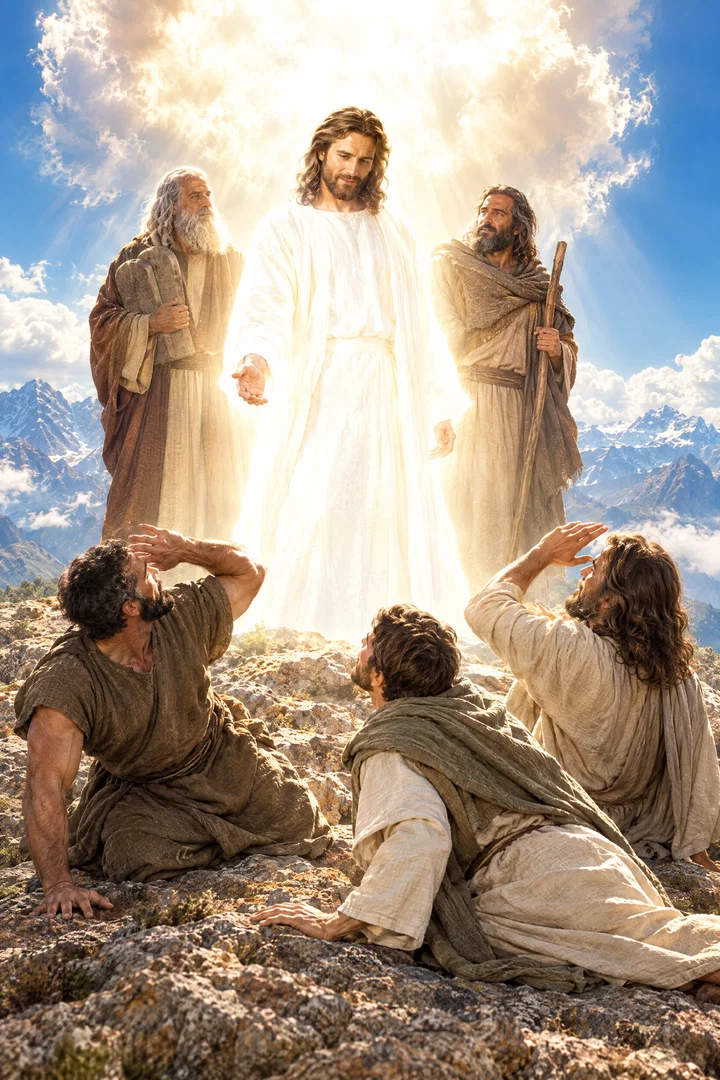
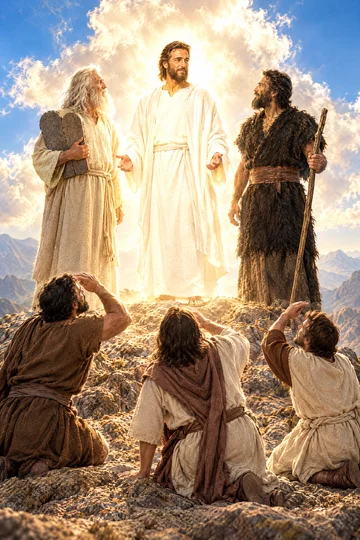
And Peter answered and said to Jesus, Master, it is good for us to be here: and let us make three tabernacles; one for thee, and one for Moses, and one for Elias.
Translations
And Peter answered and said to Jesus, Master, it is good for us to be here: and let us make three tabernacles; one for you, and one for Moses, and one for Elias.
King James Version, KJV Cambridge Paragraph Bible
And Peter answered and said to Jesus, Master, it is good for us to be here: and let us make three tabernacles; one for thee, and one for Moses, and one for Elias.
And Peter answered and said to Jesus, Master, it is good for us to be here: and let us make three tabernacles; one for thee, and one for Moses, and one for Elijah.
Revised Version, American Standard Version
And Peter answereth and saith to Jesus, Rabbi, it is good for us to be here: and let us make three tabernacles; one for thee, and one for Moses, and one for Elijah.
And Peter answering saith to Jesus, 'Rabbi, it is good to us to be here; and we may make three booths, for thee one, and for Moses one, and for Elijah one:'
And Peter answering says to Jesus, Rabbi, it is good that we should be here; and let us make three tabernacles, for thee one, and for Moses one, and for Elias one.
And Peter, answering, saith unto Jesus—Rabbi! it is, delightful, for us to be, here,—let us therefore make three tents, for thee, one, and, for Moses, one, and, for Elijah, one;
Peter said to Jesus, “ Rabbi, it is good for us to be here. Let us put up three shelters — one for You, one for Moses, and one for Elijah.”
Peter said to Jesus, “ Rabbi, it is good for us to be here. Let us put up three shelters— one for You, one for Moses, and one for Elijah.”
Peter answered Jesus, “ Rabbi, it is good for us to be here. Let’s make three tents: one for you, one for Moses, and one for Elijah.”
And Peter said to Jesus, Master, it is good for us to be here: and let us make three tents; one for you, one for Moses, and one for Elijah.
Then Peter answered, and said to Iesus, Master, it is good for vs to be here: let vs make also three tabernacles, one for thee, and one for Moses, and one for Elias.
Douay-Rheims (Challoner revision)
And Peter answering, said to Jesus: Rabbi, it is good for us to be here: and let us make three tabernacles, one for thee, and one for Moses, and one for Elias.
Pictures
Cross-references
- Matthew 17:1-5
And after six days Jesus taketh Peter, James, and John his brother, and bringeth them up into an high mountain apart,
Parallel account of the transfiguration and Peter’s proposal.
- Luke 9:28-36
And it came to pass about an eight days after these sayings, he took Peter and John and James, and went up into a mountain to pray.
parallel account of same event
- 2 Peter 1:16-18
For we have not followed cunningly devised fables, when we made known unto you the power and coming of our Lord Jesus Christ, but were eyewitnesses of his majesty.
Peter recalls the transfiguration as eyewitness evidence of Christ’s majesty and coming.
- 2 Kings 2:11
And it came to pass, as they still went on, and talked, that, behold, there appeared a chariot of fire, and horses of fire, and parted them both asunder; and Elijah went up by a whirlwind into heaven.
Elijah appears with Jesus in the scene.
- Mark 9:1
And he said unto them, Verily I say unto you, That there be some of them that stand here, which shall not taste of death, till they have seen the kingdom of God come with power.
The transfiguration gives a glimpse of the kingdom coming with power, fulfilling Jesus’ promise.
- Matthew 16:28
Verily I say unto you, There be some standing here, which shall not taste of death, till they see the Son of man coming in his kingdom.
The transfiguration fulfills Jesus’ promise that some disciples would see the Son of Man coming in his kingdom.
- Deuteronomy 34:5-6
So Moses the servant of the LORD died there in the land of Moab, according to the word of the LORD.
Moses died and was buried, yet appears with Jesus at the transfiguration.
- Luke 9:33
And it came to pass, as they departed from him, Peter said unto Jesus, Master, it is good for us to be here: and let us make three tabernacles; one for thee, and one for Moses, and one for Elias: not knowing what he said.
Parallel account of Peter’s offer to build tabernacles.
- Matthew 17:1-3
And after six days Jesus taketh Peter, James, and John his brother, and bringeth them up into an high mountain apart,
Moses and Elias appear with Jesus during the transfiguration.
- Jude 1:9
Yet Michael the archangel, when contending with the devil he disputed about the body of Moses, durst not bring against him a railing accusation, but said, The Lord rebuke thee.
Moses’s resurrection is inferred from the dispute over his body.
- Matthew 17:5
While he yet spake, behold, a bright cloud overshadowed them: and behold a voice out of the cloud, which said, This is my beloved Son, in whom I am well pleased; hear ye him.
At the transfiguration, God’s voice testified that Christ is His Son.
- Malachi 4:5
Behold, I will send you Elijah the prophet before the coming of the great and dreadful day of the LORD:
Peter recognizes Elijah as the prophet foretold to come.
- 1 Kings 18:36-39
And it came to pass at the time of the offering of the evening sacrifice, that Elijah the prophet came near, and said, LORD God of Abraham, Isaac, and of Israel, let it be known this day that thou art God in Israel, and that I am thy servant, and that I have done all these things at thy word.
Elijah prays at Carmel, and the people witness God’s glory.
- Luke 9:28
And it came to pass about an eight days after these sayings, he took Peter and John and James, and went up into a mountain to pray.
Describes the same event as occurring about eight days later.
- Luke 9:35
And there came a voice out of the cloud, saying, This is my beloved Son: hear him.
voice from cloud acknowledged Jesus as Son of God
- Matthew 26:37
And he took with him Peter and the two sons of Zebedee, and began to be sorrowful and very heavy.
same three disciples with Christ in his agony
- Luke 9:27
But I tell you of a truth, there be some standing here, which shall not taste of death, till they see the kingdom of God.
The promise of seeing the kingdom is fulfilled in the transfiguration.
- Revelation 1:13-16
And in the midst of the seven candlesticks one like unto the Son of man, clothed with a garment down to the foot, and girt about the paps with a golden girdle.
Cited in connection with Christ’s glorious appearance.
Commentary
Each commentary is drawn from primary sources: the writings of Ellen G. White and Adventist pioneers and periodicals. Each commentary is separate. Its own words are not a quotation; follow the references to read the source passages.
Ellen G. White
32 sources
On a lonely mountainside at night Jesus steps apart to pray for strength and for His disciples to see His glory, and when Peter, James and John awake from sleep to the transfigured brightness Peter in overwhelmed joy proposes making three shelters so they can remain there.DA 419.1–4Lt 354, 1907, par. 4–102SP 330.2–3ST Jun 7, 1877 He mistakenly supposes Elijah has come as foretold and Christ's earthly kingdom is about to be established, imagining the heavenly visitors will shield Jesus from death in Jerusalem and forgetting that suffering and death must complete salvation.2SP 330.2–3ST Jun 7, 18773RED 119.2–120.1 The scene is the kingdom of God come with power in miniature, with Jesus unveiled in shining glory as much as mortals can bear while the Father's voice from the radiant cloud declares Him the beloved Son to be heard.2SP 336.2ST Jun 7, 1877EW 134.1SG1 43.2EW 131.3 Moses stands there as one raised from the dead and Elijah as one translated without death, together picturing those raised and those translated at the second coming and showing law and prophets embraced in the gospel, sent to comfort Jesus and speak with Him of His coming death because they know earth's trials.Lt 354, 1907, par. 4–102SP 336.2ST Jun 7, 1877EW 134.1EW 131.3 The manifestation proves Jesus the divine Son and Messiah and is given to strengthen Him and the disciples for His humiliation and crucifixion, so that Peter as eyewitness can testify of His power and coming, and so that nearness to Christ is shown afterward in self-sacrificing labor for the suffering below.EW 131.3SG1 40.13RED 122.1AA 534.2ST Jan 22, 1902
Setting and Peter's Plea
The words are spoken on a lonely mountainside at night, after a day spent in traveling and teaching followed by a wearying climb as the light of the setting sun fades from hill and valley.DA 419.1–4 Jesus steps a little aside from Peter, James, and John to pray with strong crying and tears for strength to endure the test in behalf of humanity, for a fresh hold on Omnipotence to contemplate the future, and for His disciples that their faith may not fail in the hour of the power of darkness.DA 419.1–4 His burden is that they may be given a manifestation of the glory He had with the Father before the world was, that His kingdom may be revealed to human eyes and they may be strengthened to behold it.DA 419.1–4 At first they unite their prayers with His in sincere devotion, then overcome with weariness they fall asleep even while trying to retain interest in the scene.DA 419.1–4
Only Peter, James, and John are taken up, because not all even of the twelve can receive the revelation.DA 419.1–4 These three are in closest relationship with Christ, and they are the ones who are also to witness His anguish in Gethsemane.DA 419.1–4RH Apr 27, 1911 Judas is not among those chosen to witness the transfiguration, and his exclusion stirs his jealousy.ST Dec 17, 1912
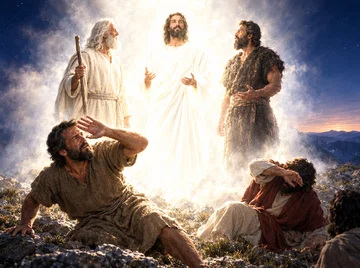
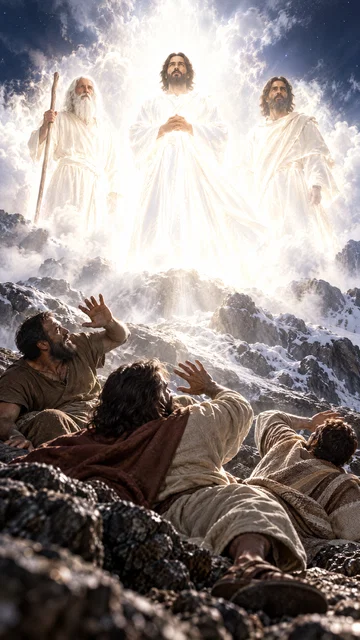
Awakened to the transfiguration glory, Peter is overwhelmed, overjoyed, and amazed, and he declares it is good to be there.Lt 354, 1907, par. 4–102SP 330.2–3ST Jun 7, 18773RED 119.2–120.1SG4 58.2 He proposes making three shelters, one for Jesus, one for Moses, and one for Elijah, wanting to remain in the glorious scene.Lt 354, 1907, par. 4–102SP 330.2–3ST Jun 7, 18773RED 119.2–120.1SG4 58.2 In his excitement he believes Elijah has come as prophecy foretold and that Christ's kingdom is about to be established on earth.2SP 330.2–3ST Jun 7, 18773RED 119.2–120.1 He even imagines the heavenly visitors will protect Jesus from the death awaiting Him in Jerusalem and help establish His earthly authority.2SP 330.2–3ST Jun 7, 18773RED 119.2–120.1 In his joy he forgets that suffering and death are necessary, and that salvation can be completed only through Jesus' suffering and death to fulfill the plan of redemption.2SP 330.2–3ST Jun 7, 18773RED 119.2–120.1
The mountain scene lasts only a brief space, in which Jesus is transfigured by the glory of God before the favored disciples, talks with the messengers of Heaven, and is proclaimed the Son of God by the Father's voice from radiant glory.2SP 336.1DA 429.2–430.1 Then He descends to meet the demon-afflicted child, distorted and in agony, to lift the victim of Satan, free him from the demon's power, and restore him to his father.2SP 336.1DA 429.2–430.13RED 125.2 The suffering below stands in sharp contrast to the heavenly glory just revealed above.3RED 125.2
Kingdom Glory Revealed
The transfiguration is the fulfillment of Christ's promise that some standing with Him would not see death till they saw the kingdom of God come with power, showing the kingdom of Christ in miniature.2SP 336.2ST Jun 7, 1877EW 134.1SG1 43.23RED 126.1 In that miniature kingdom Jesus was clothed with the glory of heaven and proclaimed by the Father's voice to be the Son of God.2SP 336.2ST Jun 7, 18773RED 126.1 The disciples beheld His excellent majesty, His countenance changed and shining like the sun and His clothing white and glistening.SG1 43.2SG1 40.1 His divine glory, normally veiled by His humanity, shone through, as much of that glory as human beings could bear, while God lifted Him above humanity to commune with Him.SG1 43.2SG1 40.1Lt 64, 1900, par. 4
From the overshadowing radiant cloud God in terrible majesty declared Jesus to be His beloved Son in whom He is well pleased and commanded that He be heard.EW 134.1SG1 43.2SG1 40.1AA 534.2 The disciples beheld in fear and astonishment under that cloud and heard that voice in fearful majesty.SG1 43.2SG1 40.1 With His baptism, this is one of two occasions when God's voice so proclaimed Him as Son.Ms 101, 1897, par. 30–32 Peter was there as eyewitness of that majesty, seeing Christ receive honor and glory from God the Father and hearing the voice from the excellent glory.EW 131.3AA 534.2
Moses present there represents those who will be raised from the dead at the second coming of Christ.2SP 336.2ST Jun 7, 1877EW 134.1SG1 43.23RED 126.1 Elijah present there, who was translated to heaven without seeing death, represents those who will be living on earth at the time of Christ's second appearing and at the close of earth's history will in a moment, in the twinkling of an eye at the last trump, be changed from mortal to immortal and be translated to heaven without seeing death, without tasting death.2SP 336.2ST Jun 7, 1877EW 134.1SG1 43.2PK 227.2 In these glorified ones the disciples saw in miniature a representation of the kingdom of the redeemed, beholding Jesus clothed with the light of heaven.PK 227.2 Together Moses and Elijah also represented the law and the prophets, showing that Old Testament teachings were not set aside by the gospel but agreed with it and were embraced by the new dispensation.Lt 354, 1907, par. 4–10
Moses, who had been resurrected, and Elijah, who had been translated, were sent to bear God's glory to Christ and to comfort and strengthen Him.SG1 40.1ST Jun 7, 1877SG4 58.2 They talked with Him concerning His sufferings and death and about the suffering He would face in Jerusalem.EW 131.3SG1 40.1ST Jun 7, 1877SG4 58.2 They were chosen for this ministry instead of angels because they had experience in the trials of earth.SG1 40.1
Strength for Coming Suffering
The mountaintop gave strong proof that Jesus is the promised Messiah, truly divine and of a surety the Son of God.EW 131.3SG1 40.13RED 122.13RED 115.1–116.12SP 327.1 God Himself declared Him to be His Son who must be heard, and Moses and Elijah honored Him, and the manifestation of His divinity removed doubts about His being the Son of God.SG1 40.13RED 122.13RED 115.1–116.12SP 327.1 Moses and Elijah were sent to talk with Him concerning His sufferings and death, chosen instead of angels because they had experience in earth's trials.EW 131.3SG1 40.1 A few followers were permitted to behold His face lighted with divine glory and His raiment white and glistening, and to hear the voice of God in fearful majesty, so that in bitter sorrow and disappointment they would not cast away confidence when He was crucified.EW 131.3SG1 40.1
The manifestation was given to lighten grief by assurance that their faith had not been in vain, and to comfort them with the knowledge that His shameful death is part of the plan of redemption.DA 419.1–4 It strengthened them to behold His kingdom and to endure His coming humiliation and crucifixion, assuring them that His death was necessary for His glory, the Father's glory, and humanity's sharing in that glory.Lt 354, 1907, par. 4–103RED 122.13RED 115.1–116.12SP 327.1Ms 202, 1899, par. 12 It was given as a visible sign and symbol of His kingdom to strengthen faith and help understand His mission.Ms 202, 1899, par. 12
The glory with which Jesus was glorified by the Father also strengthened Jesus Himself before His betrayal and crucifixion for the sufferings ahead.SG4 268.41T 353.3 Remembering the glory around Jesus and God's voice from the cloud reassured the disciples in Gethsemane that God had taken Jesus in charge and that an angel was present to protect Him.5RED 22.1–3 That same memory strengthened their faith that He was the Son of God and gave them hope during His trial that He would reveal His power and deliver Himself.EW 139.3
Peter was on the holy mount as an eyewitness of Christ's majesty, seeing Him receive honor and glory from God the Father and hearing the voice from the excellent glory declare Him the beloved Son in whom He is well pleased.AA 534.2 There he saw and heard much that pertained to the kingdom of God, which qualifies him to speak of God's purposes concerning the human race.AA 534.2 His message about the power and coming of the Lord Jesus Christ is therefore not cunningly devised fables but truth.AA 534.2 Recognizing the goodness of being in Christ's presence on the mount is not an end in itself, for below people wait to be freed through faith and prayer, and closeness to Christ is shown in self-sacrificing labor for their salvation.ST Jan 22, 1902 The transfiguration also points to the glory that will attend God's faithful people in their final conflict.1T 353.3
Sources
Pioneers and periodicals
70 sources
As Moses and Elijah depart from Jesus, Peter answers in fear without knowing what he says by proposing to make three shelters, one for Jesus, one for Moses and one for Elijah.ST Jan 16, 1901ST Jul 18, 1900 He thinks the glory before him is the kingdom of God come with power and wants to remain in that heavenly setting rather than return to suffering and death below.RH Dec 8, 1874RH Jan 4, 1912RH Jun 8, 1869 The scene is a miniature of Christ's glorious second coming, with Jesus revealed as the glorified King, Moses representing the dead who will be raised to immortality, and Elijah representing the living who will be translated without seeing death.RH Dec 8, 1874ST Jan 11, 1905ST Jun 15, 1904ST Jun 2, 1898ST Jan 16, 1901 His proposal to honor the three side by side is set aside when God directs attention to His beloved Son alone with the command to hear Him, and Moses and Elijah disappear leaving Jesus only.ST Jun 10, 1889ST Nov 13, 1893ST Sep 8, 1909 Though it is good to be with Jesus on the mount, the vision is not meant to last, and its strength is given to send His followers down to serve suffering people waiting below.RH Jan 4, 1912ST Dec 17, 1896ST Aug 16, 1905RH Jan 4, 1912ST Jun 23, 1909
Mountain Scene and Setting
The transfiguration follows the disciples' distress over Jesus' coming suffering and death and is given to encourage them with a glimpse of his glory and kingdom.ST Oct 6, 1881ST Jan 16, 1901ST Sep 7, 1904 It takes place about a week after Jesus spoke of his suffering, death, resurrection and coming kingdom.ST Jan 11, 1905 It comes six days after his promise that some standing there would not taste death till they see the kingdom of God come with power, and it fulfills that promise.ST Jun 15, 1904ST Mar 31, 1898ST Oct 6, 1881RH Jul 31, 1866ST Sep 7, 1904 Mark says it occurred after six days while Luke says about eight days after, a difference in stating the timing of the same event.RH Nov 24, 1868
It occurs on a secluded mountain for prayer, apart from worldly concerns.ST Oct 6, 1881ST Jan 15, 1880 It is identified as a spur or peak of Mount Hermon near Caesarea Philippi rather than Mount Tabor, though tradition dating from before the fourth century places it on Mount Tabor in Galilee.ST Oct 6, 1881ST Mar 31, 1898RH Apr 26, 1906 On the long-held belief that it happened on Mount Tabor, the round-domed mountain seen to the east from above Nazareth, three churches were later built on its summit in carrying out Peter's proposal for three tabernacles.ST May 19, 1898
Jesus takes only Peter, James and John up the mountain.ST Dec 17, 1912RH Apr 27, 1911ST Apr 11, 1900 Judas is not chosen and his exclusion stirs his jealousy.ST Dec 17, 1912 The same three are later chosen to be near Jesus in Gethsemane because they had witnessed his glory.RH Apr 27, 1911ST Apr 11, 1900 While Jesus is on the mountain with the three, the father brings his demon-possessed child to the other disciples below, who fail to heal him.ST Jan 9, 1912
Heavy with sleep and then awake, the disciples see Jesus with altered countenance and white glistering raiment, see his glory and Moses and Elijah standing with him talking about his decease to be accomplished at Jerusalem.ST Jan 16, 1901 Then a cloud overshadows them, they fear as they enter it, a voice out of the cloud declares Jesus the beloved Son to be heard, and when the voice passes Jesus is found alone.ST Jan 16, 1901 In the same scene Jesus is clothed with heavenly glory and the apostles see Christ as he will appear in glory at his second coming and hear God's voice from heaven proclaiming him the Son of God.ST Jun 7, 1877ST Feb 15, 1883
The people and things seen and heard were actually present as real persons and real events, even though the whole scene was a supernatural vision.ST Jul 23, 1885ST Apr 9, 1902ST Jan 11, 1905 A vision means a seeing and may be real, not a trance or merely spirits or a spiritualistic appearance.ST Apr 9, 1902ST Jan 9, 1901ST Jan 11, 1905 Moses and Elijah were present and talking with him not as merely spirits but as glorified men, and Moses was literally present and literally seen.ST Jul 23, 1885RH Oct 16, 1860
Peter's Proposal and Mind
As Moses and Elijah departed from Jesus, Peter answered that it was good for them to be there and proposed making three shelters or tabernacles, one for Jesus, one for Moses, and one for Elijah.ST Jan 16, 1901ST Jul 18, 1900ST Jul 4, 1899ST Apr 11, 1911 He spoke as the parting came after he and those with him, heavy with sleep and then awake, had seen Jesus with altered countenance and white glistering raiment, seen his glory and the two men standing with him talking about his decease to be accomplished at Jerusalem.ST Jan 16, 1901ST Jul 18, 1900ST Jul 4, 1899 His offer placed the three side by side in honor, one dwelling each.ST Apr 11, 1911ST Nov 13, 1893
He spoke overcome with fear and unsure what to say, not knowing what he said.ST Jan 16, 1901ST Jul 18, 1900 It was an unstudied utterance and an unreasonable suggestion.ST Jul 4, 1899ST Mar 8, 1905
He thought the transfiguration was the kingdom of God come with power, and so he wanted to make the tabernacles and stay there and remain in that heavenly setting.RH Dec 8, 1874RH Jan 4, 1912RH Jun 8, 1869ST Aug 16, 1905RH Jan 4, 1912 He was caught up in the goodness of the mountaintop experience and reluctant to leave its special spiritual blessing for ordinary duties.RH Jan 4, 1912ST Jun 23, 1909 He responded with joy, awe and delight at the glory, overwhelmed by it and readily welcoming God's approval and signs.ST Jun 7, 1877ST Jan 27, 1904RH Jun 8, 1869ST Oct 11, 1905
He believed Elijah had come as prophecy foretold and that Christ's kingdom was about to be established on earth.ST Jun 7, 1877 He mistakenly thought the heavenly visitors would protect Jesus from the death awaiting him in Jerusalem and establish his earthly authority, forgetting in his excitement that salvation can be completed only through Jesus' suffering and death.ST Jun 7, 1877
Kingdom Preview in Miniature
The transfiguration was a miniature representation, type, pattern and vision of Christ's second, personal, glorious coming with power and of the future kingdom of glory, fulfilling His promise made six days before that some standing there would not taste death till they see the kingdom of God come with power, made about a week after He spoke of His suffering, death, resurrection and coming kingdom.RH Dec 8, 1874ST Jan 11, 1905ST Jun 15, 1904ST Jun 2, 1898ST Sep 2, 1880 It was given to teach the true nature of the eternal kingdom, to correct a wrong idea of the Messianic kingdom, and to encourage the disciples in coming trials and delay.ST Jan 16, 1901ST Sep 7, 1904 Peter thought it was the kingdom come with power and therefore wanted to make three tabernacles and stay there, but it was only an earnest or miniature of the kingdom yet to come.RH Dec 8, 1874ST Apr 11, 1911ST Feb 17, 1909
Jesus glorified on the mount, with shining face, altered countenance and regal robes of exceeding white glistening garments, with the glory of the Father present in the bright cloud and voice, pictures His second coming as the glorified King, the center and glory of the kingdom, clothed as He will appear when crowned King of kings, displaying the majesty He will reveal when He comes.RH Dec 8, 1874ST Sep 2, 1880ST Jan 16, 1901RH Feb 14, 1854RH Jun 13, 1854 The earth lay beneath Him as its center and glory, showing Christ coming in His glory when His reign in glory and power will begin.ST Jan 16, 1901RH Feb 14, 1854ST Feb 17, 1909 His glory there previews His glory at that coming.ST Sep 2, 1880ST Feb 17, 1909
Moses appearing in glory represents the saints who sleep, who died and will be raised from the dead and clothed with glory and immortality at Christ's coming, having been raised from the dead by Michael the Prince of Life.ST Jun 7, 1877ST Jun 15, 1904ST Jun 2, 1898ST Sep 2, 1880ST Jan 16, 1901 He stands as representative of those who died and will be resurrected at the last day, raised from death to be clothed with glory.ST Jun 7, 1877RH Dec 8, 1874ST Jun 15, 1904ST Jun 2, 1898ST Sep 2, 1880 Elijah represents the living saints who will be alive at Christ's coming, translated without seeing death and changed from mortal to immortal in the twinkling of an eye.ST Jun 7, 1877RH Dec 8, 1874ST Jun 15, 1904ST Jun 2, 1898ST Sep 2, 1880 He was translated as representative of those who will not taste death but be changed, taken to heaven without dying.ST Jun 7, 1877RH Dec 8, 1874ST Jun 15, 1904ST Jun 2, 1898ST Apr 11, 1911
Together they picture the two classes of righteous subjects at Christ's coming, showing the great essentials of the kingdom, the King, the subjects and their condition.ST Jan 11, 1905ST Sep 7, 1904 Moses represents the righteous dead, raised from death, and Elijah represents the living faithful, translated without dying, seen as real persons in a real sight.ST Jan 11, 1905ST Sep 7, 1904 The scene assures Christ's followers that He will return to redeem both the faithful dead and the faithful living, the sleeping dead then raised and the living then translated.ST Jan 11, 1905ST Sep 7, 1904 Because this display took place on earth, it teaches that God's kingdom will be revealed on earth when Christ appears, set up at the period of the second advent with the resurrection and change of the just to immortal life.ST Sep 2, 1880RH Jun 13, 1854
Peter as eyewitness of Christ's transfigured majesty on the holy mount later testifies that the apostles had not followed cleverly devised fables about the power and coming of Jesus, giving strong evidence for the promise of His coming.ST Sep 2, 1880ST Jul 23, 1885RH Feb 14, 1854RH Apr 3, 1855RH Mar 12, 1908 He identifies the scene as an eyewitness display of Jesus' majesty and a revelation and preview of His power and coming and of the kingdom of God.ST Sep 2, 1880ST Jul 23, 1885RH Feb 14, 1854RH Apr 3, 1855RH Mar 12, 1908 Yet seeing and hearing alone are not presented as the surest foundation, since human senses can be mistaken.ST Sep 2, 1880ST May 3, 1899
Moses and Elijah Present
Elijah is he who went to heaven without dying and was taken away in a chariot of fire, while Moses died and was buried by God with the place of his grave unknown, so the account does not describe two men who both died and were buried with funeral ceremonies.ST Feb 25, 1875ST Jan 15, 1880RH Feb 4, 1875 Moses is present on the mount in a resurrected body brought from heaven, not as proof that the soul is immortal.ST The devil disputed with Michael over the body of Moses to thwart God's purpose and prevent its resurrection before the time, but at Michael's word, The Lord rebuke thee, Christ disputed Death's right to the body and brought the man of God from the grave and from the enemy's land.STST Sep 7, 1904 That deliverance was a crisis in the great controversy between Christ and Satan, life and death, given as an illustrative partial fulfillment of God's promise of deliverance from death to strengthen faith after death had reigned from Adam to Moses, demonstrating Christ's power and the faithfulness of his promise and his ability as Captain of salvation to release all captives from death and filling his people with courage to defy the foe.ST Sep 7, 1904
If Moses was physically present there he must have been raised from the dead, since he had died and the dead know nothing and have no thoughts.ST Apr 9, 1902 The text does not speak of the soul of Moses, so any claim that his soul was or was not on the mount is assumption with nothing in the text to support it.RH Oct 16, 1860 The issue is whether Moses was literally present and literally seen on the mount or whether the disciples only saw in vision something that looked like Moses while Moses was not really there, and Moses was literally seen, a question raised by his appearing on the mount.RH Oct 16, 1860RH Oct 16, 1860 Those who held the differing position taught that their appearing alive to Peter, James and John is evidence that the souls of the righteous live after their bodies are dead, and that they were not resurrected bodies since Christ had not yet died and risen.RH Jun 26, 1866 The account creates difficulty about the immortality of the soul and consciousness in death, and their appearance does not show that both had died and remained conscious.ST Jan 16, 1901RH Feb 4, 1875
Peter, James and John recognized Moses and Elijah and knew them by name without being introduced, since Peter distinguished Christ, Moses and Elijah by name when he proposed making three shelters. This proves that knowledge continues in the next world and the redeemed will not meet as strangers but will know each other, including those who were intimate friends on earth, and that Moses and Elijah themselves knew each other. Moses had viewed Canaan from Mount Nebo but did not enter it, and Moses and Elijah came to speak with Jesus about his decease to be accomplished at Jerusalem, his agony and cross and the suffering he will face there, sent to comfort and strengthen him.ST Jun 7, 1877RH Jan 8, 1875ST Jan 15, 1880 The scene therefore points ahead to his death, burial and resurrection, which Moses and Elijah discuss with him, though if treated as a real event rather than a vision it is used to depict Moses taking part in earthly affairs despite the teaching that the dead know nothing.RH Jan 8, 1875ST Sep 8, 1909RH Apr 16, 1872
Christ Alone Exalted
The scene shows Jesus clothed with heavenly glory with the Father's voice proclaiming him the Son of God, revealing his divinity and majesty.ST Jun 7, 1877RH Oct 30, 1860ST Jul 29, 1897 It belongs to the Gospel portrait of Jesus as a glorious King whose character unites power with love, benevolence with justice, and majesty with humility, worthy of admiration and love.RH Oct 30, 1860 That same divine glory was also present in his loving ministry among ordinary people, even when no outward light was visible.ST Jul 29, 1897
Peter's proposal to make three shelters places Jesus, Moses, and Elijah side by side in honor, one for each.ST Jun 10, 1889ST Nov 13, 1893ST Sep 8, 1909 The proposal is rebuked, for God directs attention to his beloved Son alone with the command to hear him, and the disciples are not to be drawn into building tabernacles but are to heed Jesus.ST Nov 13, 1893ST Sep 8, 1909 Then the glory vanishes and Moses and Elijah disappear, leaving the disciples overwhelmed with fear seeing Jesus only, the Pattern revealed on the mount.ST Jun 10, 1889ST Nov 13, 1893ST Jan 15, 1880
Moses, who had viewed Canaan from Mount Nebo but did not enter it, and Elijah, who had been taken away in a chariot of fire, had come to speak with Jesus about his agony and cross and about his death, burial, and resurrection.ST Sep 8, 1909ST Jan 15, 1880 Their withdrawal leaves Jesus alone exalted, teaching that Christ's honor is not to be shared with other religious figures or gods.ST Nov 13, 1893
Call to Come Down
Peter and the others felt it was good to be with Jesus on the mountain during the vision of the kingdom of heaven, and Peter wanted to build shelters for Jesus, Moses and Elijah so they could remain there.RH Jan 4, 1912RH Jan 4, 1912 They did not yet understand the lesson, for they wished to stay in the heavenly vision while Jesus descended to help the suffering people below.ST Aug 16, 1905 They nevertheless had to come down from the mountain, where suffering people still needed help and work remained to be done, and his words illustrate the reluctance to leave a special spiritual blessing and return to ordinary duties and the needs of others.RH Jan 4, 1912RH Jan 4, 1912
Being on the mountain listening to Jesus and to Moses and Elijah with rejoicing hearts and feeling the blessing that the place and the voices give means that blessing is meant to send to service, because demon-tormented people are waiting on the plain below.ST Dec 17, 1896 Being with Christ there prepares followers to serve people in need below, including casting out evil spirits.ST Jun 13, 1900 After the glory revealed on the mountain, Christ's life and power were given to the needy, demon-haunted multitude in the valley, so the mountain experience leads to service among those in need.ST May 8, 1901
Peter, overwhelmed by the glory of Christ's transfiguration, said it was good to be there and proposed three tabernacles, for Jesus, Moses and Elijah, but the moment was a glimpse of Christ's glory and his work was not to remain on the mountain; he was to serve in the valleys of human need.ST Jan 27, 1904 The mount experience is not an end in itself, for below people are waiting to be freed through faith and prayer, and closeness to Christ is shown in self-sacrificing labor for their salvation.ST Jan 22, 1902 Faithful service in whatever work God assigns leads toward sharing in the future transformation when mortality puts on immortality.ST Jan 27, 1904
The vision was not meant to last, and its remembered light and strength were to sustain the disciples through ordinary days and daily duty, making life below reflect the pattern revealed on the mountain.ST Jun 23, 1909 To want to remain in exalted spiritual enjoyment is to be too high for service.ST May 27, 1897 A mountaintop experience that leaves a man for years without leading souls to Christ is wrong, and the right course is to come down from the mount to work for souls.ST May 27, 1897
A person makes such a sacred, heavenly experience a true home through doing a great, hard duty in its strength.ST May 29, 1884 The words it is good to be here express the joy of being in Jesus' loving, pure and gracious presence, making a person wish the communion could last forever.RH Aug 26, 1862 That expression is applied to the feeling of enjoying the Lord's presence, and it presses whether that confidence holds amid trials, discouragement and everyday difficulties.RH Apr 3, 1879
Those same words also describe the spiritual comfort and blessing of gathering for social worship, where Jesus is present and the assembly is strengthened by prayer.
Sources