Mark 9:4
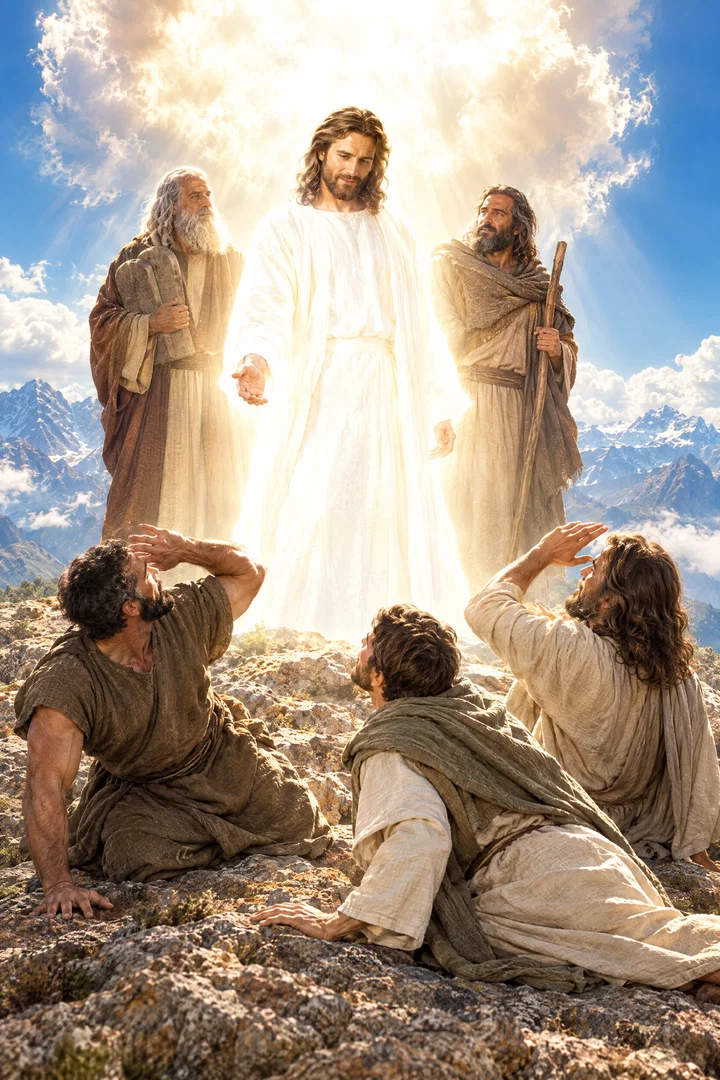
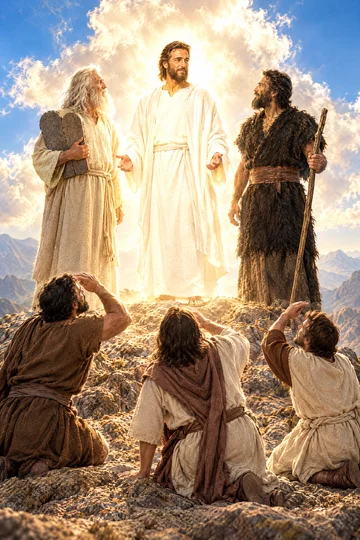
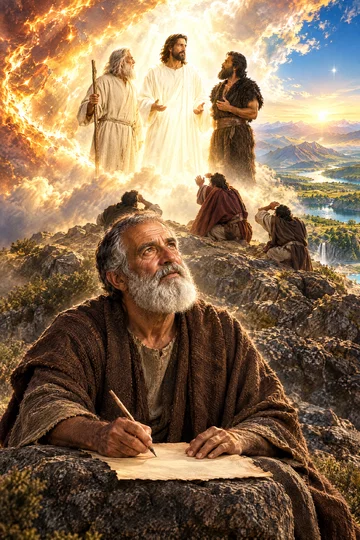
And there appeared unto them Elias with Moses: and they were talking with Jesus.
Translations
And there appeared to them Elias with Moses: and they were talking with Jesus.
King James Version, KJV Cambridge Paragraph Bible
And there appeared unto them Elias with Moses: and they were talking with Jesus.
And there appeared to them Elijah, with Moses: and they were talking with Jesus.
Revised Version, American Standard Version
And there appeared unto them Elijah with Moses: and they were talking with Jesus.
And there appeared to them Elijah with Moses, and they were talking with Jesus.
And there appeared to them Elias with Moses, and they were talking with Jesus.
And there appeared unto them Elijah, with Moses,—and they were conversing with Jesus.
Berean Standard Bible, Majority Standard Bible
And Elijah and Moses appeared before them, talking with Jesus.
Elijah and Moses appeared to them, and they were talking with Jesus.
And there came before them Elijah with Moses, and they were talking with Jesus.
And there appeared vnto them Elias with Moses, and they were talking with Iesus.
Douay-Rheims (Challoner revision)
And there appeared to them Elias with Moses; and they were talking with Jesus.
Pictures
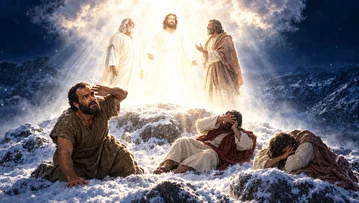
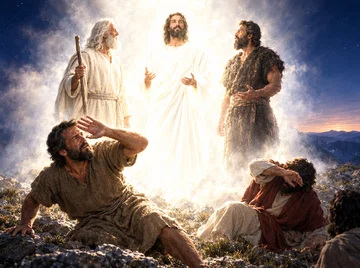
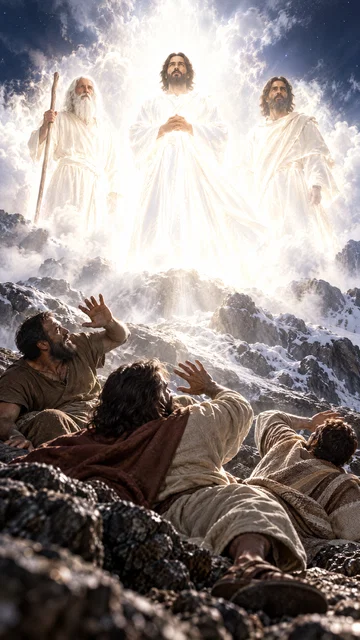
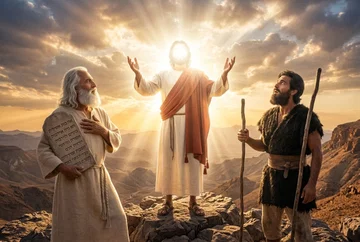
Cross-references 20 of 21
- Matthew 17:1-3
And after six days Jesus taketh Peter, James, and John his brother, and bringeth them up into an high mountain apart,
Parallel account of Moses and Elijah appearing with Jesus at the transfiguration.
- Luke 9:28-36
And it came to pass about an eight days after these sayings, he took Peter and John and James, and went up into a mountain to pray.
Parallel account of Moses and Elijah talking with Jesus.
- 2 Peter 1:16-18
For we have not followed cunningly devised fables, when we made known unto you the power and coming of our Lord Jesus Christ, but were eyewitnesses of his majesty.
Peter recalls the transfiguration as eyewitness evidence of Christ’s majesty and coming.
- 2 Kings 2:11
And it came to pass, as they still went on, and talked, that, behold, there appeared a chariot of fire, and horses of fire, and parted them both asunder; and Elijah went up by a whirlwind into heaven.
Elijah is taken up to heaven without dying.
- Jude 1:9
Yet Michael the archangel, when contending with the devil he disputed about the body of Moses, durst not bring against him a railing accusation, but said, The Lord rebuke thee.
The dispute over Moses’ body is linked to his resurrection and appearance with Jesus.
- Deuteronomy 34:5-6
So Moses the servant of the LORD died there in the land of Moab, according to the word of the LORD.
Records Moses’ death and burial before his appearance on the mount.
- Matthew 16:28
Verily I say unto you, There be some standing here, which shall not taste of death, till they see the Son of man coming in his kingdom.
Jesus’ promise that some would see the Son of Man coming in his kingdom is fulfilled at the transfiguration.
- Exodus 33:11
And the LORD spake unto Moses face to face, as a man speaketh unto his friend. And he turned again into the camp: but his servant Joshua, the son of Nun, a young man, departed not out of the tabernacle.
Moses speaks with God face to face.
- Luke 9:28-30
And it came to pass about an eight days after these sayings, he took Peter and John and James, and went up into a mountain to pray.
The transfiguration fulfills the promise that some would see the kingdom of God.
- Luke 9:30
And, behold, there talked with him two men, which were Moses and Elias:
Identifies the two men talking with Jesus as Moses and Elijah.
- 1 Kings 18:36-38
And it came to pass at the time of the offering of the evening sacrifice, that Elijah the prophet came near, and said, LORD God of Abraham, Isaac, and of Israel, let it be known this day that thou art God in Israel, and that I am thy servant, and that I have done all these things at thy word.
Elijah prays on Carmel during the contest with Baal’s prophets.
- 1 Kings 17:21-22
And he stretched himself upon the child three times, and cried unto the LORD, and said, O LORD my God, I pray thee, let this child’s soul come into him again.
Elijah raises the widow’s son, recalling the question raised by the transfiguration.
- Matthew 17:1
And after six days Jesus taketh Peter, James, and John his brother, and bringeth them up into an high mountain apart,
Parallel account places the transfiguration after six days.
- Malachi 4:5
Behold, I will send you Elijah the prophet before the coming of the great and dreadful day of the LORD:
The disciples connect Elijah’s appearance with the prophecy of his coming.
- Luke 9:28
And it came to pass about an eight days after these sayings, he took Peter and John and James, and went up into a mountain to pray.
Parallel account describes the event as about eight days later.
- 2 Peter 1:18
And this voice which came from heaven we heard, when we were with him in the holy mount.
Peter identifies the event as occurring on the holy mount.
- Luke 9:35
And there came a voice out of the cloud, saying, This is my beloved Son: hear him.
The voice from the cloud identifies Jesus as God’s Son at the transfiguration.
- Exodus 3:1-6
Now Moses kept the flock of Jethro his father in law, the priest of Midian: and he led the flock to the backside of the desert, and came to the mountain of God, even to Horeb.
The passage alludes to Moses encountering God at the burning bush on Horeb.
- Exodus 19:16-19
And it came to pass on the third day in the morning, that there were thunders and lightnings, and a thick cloud upon the mount, and the voice of the trumpet exceeding loud; so that all the people that was in the camp trembled.
Moses meets God amid thunder and lightning at Sinai.
- Hebrews 11:24-26
By faith Moses, when he was come to years, refused to be called the son of Pharaoh’s daughter;
Moses chose affliction and Christ’s reproach over Egypt’s riches.
Commentary
Each commentary is drawn from primary sources: the writings of Ellen G. White and Adventist pioneers and periodicals. Each commentary is separate. Its own words are not a quotation; follow the references to read the source passages.
Ellen G. White
31 sources
On a lonely mountainside at night, after Jesus had stepped aside to pray for strength to endure the test for humanity, Moses in a resurrected glorified body and Elijah translated without seeing death appeared in glory and talked with Him about His sufferings and death at Jerusalem and the finishing of His mission.DA 419.1–42SP 328.1–329.13RED 117.1–118.1EW 131.31SP 343.1
The Father sent these two men who had known human sorrow and trial, rather than angels, to bring heaven's light to the Son, to comfort and strengthen Him for betrayal, agony and crucifixion, while His divinity shone through His humanity.2SP 328.1–329.13RED 117.1–118.1EW 131.3ST Jun 7, 1877
For the three witnesses Peter, James and John, it was a glimpse of His future majesty and the Father's voice proclaiming Him the beloved Son to be heard, to assure them He is of a surety the Son of God and promised Messiah and that His shameful death is part of the plan of redemption, so their faith would not fail in the darkness of the cross.DA 419.1–4Lt 354, 1907, par. 4–10EW 131.3AA 534.2
It fulfilled His promise that some would see the kingdom of God come with power, showing in miniature His second appearing clothed in heavenly glory, with Moses representing those who will be raised from the dead to immortal life and Elijah representing those who will be living and changed and translated without seeing death.2SP 336.2ST Jun 7, 1877EW 134.1SG1 43.2
Their presence together shows that the law and the prophets agree with His gospel and are not abolished by it, and sets Moses, who had long prayed to enter the inheritance, standing on the goodly mountain in the heritage of his people bearing witness to Christ.Lt 354, 1907, par. 4–10PP 479.2–480.2
Setting and Heavenly Visitors
The appearing takes place at night on a lonely mountainside reached by a toilsome evening ascent after a day of traveling and teaching.DA 419.1–4 Jesus brings only Peter, James, and John, the same three who will witness His anguish in Gethsemane, because not even all the twelve can receive the revelation He desires to give.DA 419.1–4 While He steps aside to pray with strong crying and tears for strength to endure the test in behalf of humanity, for a fresh hold on Omnipotence to contemplate the future, and for His disciples that their faith may not fail in the hour of the power of darkness, the weary disciples first join Him and then fall asleep.DA 419.1–4 The appearing of Elias with Moses talking with Jesus is the answer to that prayer, a manifestation of the glory He had with the Father before the world was, so that His kingdom is revealed to human eyes and His disciples are strengthened to behold it.DA 419.1–4
The three witnesses are Peter, James, and John, brought into the closest relationship with Christ and permitted to see Him glorified on the mount.7RED 68.1BS 45.1–3RH Apr 27, 1911 Mark 9:2-8 belongs to that transfiguration witnessed by James together with Peter and John.RH Apr 27, 1911 Judas is not among them, and his exclusion makes him jealous.ST Dec 17, 1912
Moses appears with a resurrected, glorified body after having died, having been raised from the dead.3RED 117.1–118.1ST Jun 7, 1877SG4 58.2 He had been greatly honored, privileged to speak with God on Sinai face to face as a man speaks with a friend, and shown God's excellent glory as He had never shown to any other.1SP 343.1DA 421.1–2SG4 58.2 Elijah appears having been translated to heaven without seeing death, granted the rare privilege of never experiencing death.3RED 117.1–118.1ST Jun 7, 18771SP 343.1DA 421.1–2
Moses and Elijah speak with Jesus about His sufferings and death at Jerusalem and the completion of His mission.2SP 328.1–329.13RED 117.1–118.1EW 131.3SG1 40.1ST Jun 7, 1877 They are sent by the Father to bring Him heaven's glory and to comfort and strengthen Him in His coming agony.2SP 328.1–329.13RED 117.1–118.1ST Jun 7, 1877 In talking with Him about His sufferings they bear God's glory and light from the Father to the Son.ST Jun 7, 18771SP 343.1SG4 58.2
Comfort for Son and Disciples
The Father sent Moses and Elijah to bring heaven's glory to Jesus and to comfort, strengthen and glorify Him before His betrayal, agony and crucifixion, as they talked with Him of the completion of His mission and especially of the sufferings and death He would face at Jerusalem.2SP 328.1–329.13RED 117.1–118.1ST Jun 7, 18773RED 115.1–116.12SP 327.1 His divine glory shone through His humanity as much as human beings could bear, as God acknowledged Him and exalted Him above humanity to commune with Him.SG4 268.4 They were chosen because they had lived as human beings and experienced earthly sorrow, suffering and trials, so they could sympathize with Jesus, rather than angels being chosen for the talk.2SP 328.1–329.13RED 117.1–118.1EW 131.3SG1 40.1ST Jun 7, 1877 Elijah's prophetic work had in some degree represented Christ's, and Moses had led Israel in Christ's place, communing with Him and following His directions under Christ.2SP 328.1–329.13RED 117.1–118.1ST Jun 7, 1877
The scene gave the disciples a glimpse of Christ's future glory and a manifestation of His divinity to strengthen their faith for His humiliation and crucifixion, lightening their gloom with assurance that their faith had not been in vain and comforting them for His supreme agony.DA 419.1–4Lt 354, 1907, par. 4–102SP 327.1 With Moses and Elijah appearing in heavenly glory and paying homage to Jesus, together with the Father's voice issuing from radiant glory and the overshadowing cloud proclaiming Him the beloved Son to be heard, it confirmed to the three that He is of a surety the Son of God and the promised Messiah.DA 419.1–43RED 122.1 It showed that His shameful death is part of the plan of redemption and necessary for His glory and the Father's glory and for humanity's sharing in that glory, so that in bitter sorrow and disappointment they would not entirely cast away their confidence.DA 419.1–4EW 131.3SG1 40.1 That public witness of the Father here was one of two before the cross, the other being His baptism.DA 419.1–4
The disciples did not understand that Jesus must suffer and die to complete salvation and the plan of salvation.2SP 330.2–3 They mistook Elijah's appearance for the fulfillment of prophecy that would bring an earthly kingdom, and Peter thought the heavenly visitors would protect Jesus from death and establish His rule on earth while they saw Him glorified and honored by these favored servants of God.2SP 330.2–3
Peter's eyewitness sight of His majesty and hearing of the voice in the holy mount, pertaining to the kingdom of God and God's purposes for the human race, with honor and glory received from God the Father, qualified him to speak of the power and coming of the Lord Jesus Christ, showing believers' hope is certainty and not fable.AA 534.2 The disciples remembered that glory and voice from the cloud in Gethsemane, where heavenly glory revealed again had shown them that God was with Jesus.5RED 22.1–3 There the glory and the angel's presence reassured them that God had taken Jesus in charge and would protect Him by the angel from His foes.5RED 22.1–3
In a brief space, only a few short hours after the mount, He descended to grief where He stooped to lift the demon-tormented lunatic child wallowing on the ground with distorted countenance and restored him to his father freed from the demon's power.2SP 336.1 The divine glory proclaimed as the Son of God contrasted with that descent presents redemption as the Divine One stooping to save the lost.DA 429.2–430.1 It sets the mount experience of spiritual illumination against the work awaiting His servants among people enslaved by Satan in the plain, who need faith and prayer to be set free.DA 429.2–430.1ST Jan 22, 1902
Miniature of Coming Kingdom
The appearance fulfills the promise that some standing with Him would not see death, or taste death, till they saw the kingdom of God come with power, by showing the kingdom of Christ in miniature, a small-scale picture of His second appearing.2SP 336.2EW 134.1SG1 43.2 In it Jesus is clothed with the glory of Heaven and excellent majesty, His countenance changed and shining like the sun and His raiment white and glistening, and He is proclaimed by the Father's voice to be the Son of God, the beloved Son to be heard.2SP 336.2SG1 43.2 The disciples beheld this under the overshadowing cloud with fear and astonishment, hearing God's voice in terrible majesty.SG1 43.2
Moses present there represents those who will be raised from the dead to immortal life at Christ's second coming, second appearing, or second advent.2SP 336.2ST Jun 7, 1877EW 134.13RED 126.1SG1 43.2 Elijah, who was taken to Heaven without dying and translated without seeing death, represents those who will be living on earth at Christ's second appearing and coming and will be changed from mortal to immortal and translated to Heaven without seeing death.2SP 336.2ST Jun 7, 1877EW 134.13RED 126.1SG1 43.2 Their presence together makes the transfiguration a miniature of Christ's kingdom and of the events at His return and second appearing.ST Jun 7, 18773RED 126.13RED 125.2 In that heavenly glory witnessed by the disciples, Moses stands as one raised from the dead and Elijah as one translated without dying.3RED 125.2
Their presence together represents the law and the prophets and shows that Old Testament teachings agree with Christ's gospel and are not abolished by it, for the new dispensation includes the old.Lt 354, 1907, par. 4–10 Moses' presence also fulfills his long-standing prayer to enter the inheritance, for he who had died and been raised to immortal life stood on the goodly mountain in the heritage of his people alongside Elijah who had been translated.PP 479.2–480.2 There both were sent as bearers of light and glory from the Father to the Son, and Moses stood bearing witness to Christ in whom the promises to Israel center.PP 479.2–480.2
Sources
Pioneers and periodicals
87 sources
On a high mountain apart Peter, James and John saw Jesus glorified in shining raiment with Moses and Elijah appearing with him and talking with him, in fulfillment of his promise that some would see the kingdom come with power.ST Jan 16, 1901ST Mar 31, 1898ST Oct 6, 1881RH Nov 24, 1868
Moses and Elijah were truly and bodily present in glory, not mere figures or disembodied spirits, with Moses himself there in the same glorified condition as Elijah.RH May 28, 1861ST Jul 23, 1885ST Jul 6, 1915RH Dec 28, 1911
They talked with Jesus about his coming suffering, death at Jerusalem and resurrection, sent to comfort and strengthen him and to instruct the disciples.ST Jun 7, 1877ST Jan 16, 1901ST Mar 5, 1902RH Jan 8, 1875ST Nov 13, 1893
The scene was the kingdom in miniature, a preview of Christ's glorious coming, with Jesus as the glorified King, Moses as the type of the dead who will be raised, and Elijah as the type of the living who will be translated without dying.RH Dec 8, 1874ST Jun 2, 1898ST Apr 7, 1909ST Jun 15, 1904
Moses could thus appear only because God had raised him from the dead after the dispute over his body, a pledge of the resurrection of all the sleeping saints, and his appearing does not prove that souls are conscious in death, for the dead sleep unconsciously until raised.RH May 28, 1861STST Apr 7, 1909ST Feb 12, 1902
Scene Time Place
Mark 9:4 records the transfiguration of Christ, the same event told in Matthew and Luke with only additional details differing.ST Jan 16, 1901RH Nov 24, 1868 About eight days, or six days, after Jesus promised that some standing there would not taste of death till they see the kingdom of God come with power, he took Peter and James and John up a high mountain apart to pray.ST Jan 16, 1901ST Mar 31, 1898ST Oct 6, 1881ST Apr 11, 1911RH Jul 31, 1866 The scene fulfils that promise, for the disciples saw Christ's kingdom in miniature and his coming in his kingdom with power.RH Dec 8, 1874ST Jan 11, 1905ST Mar 31, 1898ST Oct 6, 1881ST Apr 11, 1911 It is paralleled in Luke 9:28-42 and recalled by Peter in 2 Peter 1:16-18, and belongs to the transfiguration and the events immediately following it.ST Mar 31, 1898
On the mount the fashion of his countenance was altered, his raiment became white and glistering and exceeding white, and his glory was revealed.ST Jan 16, 1901ST Sep 7, 1904ST Feb 15, 1883 He received honor and glory from God the Father, whose voice from heaven proclaimed him God's beloved Son.ST Jul 23, 1885ST Oct 6, 1881ST May 3, 1899ST Feb 15, 1883 The apostles thus saw Christ in the glory in which he will appear at his second coming.ST Feb 15, 1883
The secluded mountain was likely a spur of Mount Hermon near Caesarea Philippi rather than Mount Tabor.ST Oct 6, 1881ST May 19, 1898RH Apr 26, 1906 Tradition dating from before the fourth century places it on Mount Tabor in Galilee, and some think it was Mount Hermon.ST Mar 31, 1898 That traditional mount is the round-domed mountain east of Nazareth where three churches were later built to carry out Peter's proposal for three shelters.ST May 19, 1898 Peter had proposed to make three shelters when Moses and Elijah were talking with Jesus.ST May 19, 1898
The chosen witnesses were Peter, James, and John, brought into closest relationship with Christ and permitted to witness the transfiguration of the Saviour.ST Dec 17, 1912RH Apr 27, 1911 They saw Moses and Elias talking with Jesus and heard the voice from heaven, and with that prior knowledge of his glory they later accompanied him in Gethsemane.ST Apr 11, 1900 Judas was not chosen among the three, and his exclusion made him jealous.ST Dec 17, 1912 Whether Moses was literally present remains raised as a question with no answer given.RH Oct 16, 1860
Real Bodily Presence
Moses and Elijah were genuinely, literally and bodily present with Jesus on the mount and talking with him, not an unreal appearance or what only looked like Moses.RH May 28, 1861ST Jul 23, 1885RH Oct 28, 1858RH Oct 16, 1860RH Dec 28, 1911 They were not merely spirits or disembodied souls, but glorified men in real bodily persons.ST Jul 23, 1885RH Dec 28, 1911 The scene was vivid and real, not only moonlight and snow on the mountain. The verse says nothing about the soul of Moses and mentions no soul.RH Oct 28, 1858
The supernatural scene was a real event and was also called a vision, where vision means a sight, a seeing, or a spectacle.ST Apr 9, 1902ST Jan 9, 1901ST Apr 9, 1902 The people seen were not unreal because called a vision, for a vision in the sense of seeing may be real.ST Jan 9, 1901ST Jan 11, 1905 The disciples were told not to report what they had seen until after Jesus rose from the dead.ST Apr 9, 1902
Moses himself, and not merely his spirit, appeared in the same bodily, glorified, heavenly condition as Elijah, with no difference in physical condition between them.ST Jul 6, 1915RH Dec 28, 1911ST Jan 11, 1905 One was just as real as the other.RH Dec 28, 1911 Their appearance was real and not a deception, yet those who held this taught they were not resurrected bodies, since Christ had not yet died and risen.RH Jun 26, 1866
Talking With Jesus
Moses and Elijah appeared in glory from the realms of light and talked with Jesus about his decease to be accomplished at Jerusalem.ST Jan 16, 1901ST Nov 13, 1893ST Sep 8, 1909 Their conversation concerned his coming agony and the shadow of the cross, his trial, his death at Calvary, his burial, and his resurrection.ST Jan 16, 1901RH Jan 8, 1875ST Sep 8, 1909 They spoke with him shortly before the crucifixion about the trials he was to face and his approaching death at Jerusalem.RH Jan 8, 1875ST Mar 12, 1912RH Apr 16, 1872
They were sent by the Father to comfort and strengthen Jesus and to bring heaven's glory as they spoke of the completion of his mission and especially his coming suffering and death at Jerusalem.ST Jun 7, 1877 Both had lived through human sorrow and suffering and therefore could sympathize with him.ST Jun 7, 1877 Their work on earth had in important ways represented and anticipated his mission and its completion.ST Jun 7, 1877
They were also sent to instruct and strengthen the disciples, who listened and heard them discussing Jesus' death and his coming trial.ST Mar 5, 1902RH Jun 26, 1866 They disappear and leave Jesus only, whom the Father commands the disciples to hear.ST Nov 13, 1893 Their presence therefore does not place them alongside Jesus as equal objects of religious honor.ST Nov 13, 1893
Kingdom in Miniature
The transfiguration was a miniature representation, type, preview and partial fulfillment of Christ's second, personal, glorious coming with power and of the future kingdom of glory, showing its arrangement, its King, its subjects and their condition.RH Dec 8, 1874ST Jun 2, 1898ST Jun 15, 1904ST Sep 2, 1880ST Feb 17, 1909 It fulfilled the promise made six days before, or about eight days before, that some standing there would not taste death till they see the kingdom of God come with power and the Son of man coming in his kingdom.ST Jun 15, 1904ST Mar 31, 1898RH Jul 31, 1866ST Sep 7, 1904 Jesus glorified on the mount and talking with Moses and Elijah represents himself at his second coming.ST Jun 2, 1898ST Apr 11, 1911ST Feb 17, 1909 The scene contained the great essentials of what the second coming will be.ST Sep 7, 1904
Jesus appears as the glorified King in kingly garments, shining robes, altered countenance, exceeding white glistening garments, personal glory, beauty and heavenly light, as he will appear when crowned King of kings and seated on the throne of his glory.RH Dec 8, 1874ST Apr 11, 1911ST Jan 16, 1901ST Jan 16, 1907ST Sep 7, 1904 With him was the glory of the Father present in the bright cloud, and the voice of the Father direct from heaven was heard saying This is my beloved Son in whom I am well pleased.ST Sep 2, 1880ST May 3, 1899 Peter mistook the scene for the arrival of the kingdom itself and wanted to build tabernacles and remain there, but he afterward understood it only as an illustration of the kingdom yet to come and still looked forward to Christ's coming as a future event.RH Dec 8, 1874
Moses, who had died and was raised, who had been resurrected after Michael who is Christ as Archangel and Prince of Life prevailed over the devil in the dispute over his body, appears as representative, type and pledge of those who died, the sleeping saints, the righteous dead, who will be raised from the dead at Christ's coming and clothed with glory and immortal life.RH Dec 8, 1874ST Jun 2, 1898ST Apr 7, 1909ST Jun 15, 1904ST Jul 6, 1915 Elijah, who was translated without dying and without seeing death, appears as representative and type of those who will be alive, changed from mortal to immortal in the twinkling of an eye, translated without dying and taken to heaven without seeing death at Christ's appearing.RH Dec 8, 1874ST Jun 2, 1898ST Apr 7, 1909ST Jun 15, 1904ST Jul 6, 1915 Together Moses and Elijah are the two classes of heirs and subjects who will share that glory, the two groups of Christ's people, the redeemed who will make up the kingdom's subjects, the two classes of the saved made immortal at that coming.ST Mar 5, 1902ST Jan 16, 1901ST Oct 11, 1905ST Mar 3, 1909
The scene took place on earth with the earth beneath Jesus as central glory, and teaches that God's kingdom will be revealed on earth at Christ's appearing when the real kingdom with eternal splendor is reached, confirming Daniel's prophetic teaching about that kingdom.RH Jun 13, 1854RH Feb 14, 1854ST May 21, 1902 The apostles could inspect Jesus' glorious body on the Mount of Transfiguration, and the sight was a foretaste of Christ's coming in glory in which those who faithfully do the work God gives them will share in the future transformation when mortality puts on immortality.ST Jan 27, 1904RH Apr 18, 1854 Peter later points to the scene, paralleled in Luke 9:28-42 and recalled in 2 Peter 1:16-18, as eyewitness proof seen with eyes and heard with ears that the apostles had not followed cunningly devised fables about Christ's majesty, power and coming.ST Mar 31, 1898RH Jun 13, 1854RH Feb 14, 1854ST May 3, 1899RH Mar 12, 1908 Yet what was seen and heard there is not the strongest possible evidence, because human faculties damaged by long custom to sin and imperfection are liable to see and hear incorrectly, so God does not let the evidence rest alone on what men saw and heard even with that exalted privilege, but gives the more sure word of prophecy in which there is no possible place for mistake.ST May 3, 1899
The vision of future coming and glory in miniature was given to encourage the disciples concerning the true nature of the Messianic kingdom and in coming trials, to keep them from discouragement while they waited for a coming which Jesus knew would be future and seemingly long deferred.ST Jan 16, 1901ST Sep 7, 1904ST Mar 3, 1909
Moses Raised Proof
Moses stands on the mount in bodily resurrected life because bodily presence was possible only by resurrection from the dead, proving God released him by a special resurrection and brought him from heaven to the mount about fifteen hundred years after he died.RH May 28, 1861STST Feb 12, 1902RH Mar 4, 1862ST Oct 29, 1885 He is genuinely present with Jesus and talking with him, not an unreal appearance, and it is Moses himself, not merely his spirit or his immortal soul, who appears.RH May 28, 1861STST Jul 6, 1915ST Feb 12, 1902RH Mar 4, 1862 He had first slept unconsciously in death, so his appearance gives no support to consciousness in death or to the immortality of the soul.STST Feb 12, 1902RH Mar 4, 1862 The scene does not reveal when his raising occurred.ST Jul 6, 1915
The raising was secured when the devil disputed with the archangel about the body of Moses to thwart God's purpose and prevent its resurrection before the time, but the archangel's word, The Lord rebuke thee, secured the resurrection.STST Sep 7, 1904 This was the crisis of the controversy between Christ the Prince of Life and Satan, between life and death, when Christ disputed death's right to the body of Moses.STST Sep 7, 1904 Michael, who is Christ as Archangel and Prince of Life whose voice and power raise the dead, prevailed as victor over the devil in that dispute over the body of Moses.ST Apr 7, 1909ST Jan 16, 1901 By bringing Moses out of the enemy's land Christ won a faith-inspiring victory over death and the grave.ST Sep 7, 1904
That victory demonstrates his ability to release all captives from death, gives his people courage to defy the foe, and was given as an illustrative, partial fulfillment of the promised resurrection to strengthen the faith of dying humanity.ST Sep 7, 1904 Moses' resurrection is a pledge of the resurrection of the dead, with Moses representing the saints who sleep and will be raised at Christ's coming while Elijah, translated without dying, represents those to be translated then.ST Apr 7, 1909ST Jul 6, 1915ST Jan 16, 1901 Death continued to reign and was not broken in Moses' day, though Moses with Elijah, Enoch, and the saints raised at Christ's crucifixion were rescued from its power as pledges of its final defeat.ST Oct 29, 1885 Christ being the firstfruits of them that slept does not deny this earlier resurrection, because firstfruits means first in rank rather than first in time, and his titles as first-born and first-begotten refer to pre-eminent rank and importance in the work of resurrection, not necessarily to being first in time, a fact connected with Moses being present through resurrection.ST May 6, 1897RH May 28, 1861RH Jan 21, 1875
Elijah had been taken to heaven without dying in a chariot of fire and was not buried or given funeral ceremonies, while God buried Moses and his burial place was unknown, so their appearance is not accurately described as two men who both died and were buried in the ordinary way, nor does it show that both had died and remained conscious.ST Feb 25, 1875ST Nov 16, 1888RH Feb 4, 1875 Moses is in heaven with Enoch and Elijah as representatives of redeemed humanity and, with Jesus, as firstfruits of the resurrection.ST Nov 16, 1888 Moses is identified with the mountain where he viewed Canaan before death and with Mount Nebo where he viewed Canaan but did not cross the Jordan, and Elijah with his departure in the fiery chariot and his prayer on Mount Carmel, both appearing in heavenly glory and light.ST Jan 15, 1880ST Jan 15, 1880 Moses had chosen affliction with God's people and the reproach of Christ over Egypt's riches and honor, and God honored him, raised him after death, and took him to glory, so his appearance in celestial glory shortly before the crucifixion shows he did not regret choosing faithfulness over worldly greatness and honored him despite his earlier failure after God buried him.RH Feb 25, 1915ST Mar 12, 1912 In one presentation his bodily resurrection is offered only as a possible explanation and as a pledge of the resurrection, while the narrative itself is said not to state that it had happened.RH Apr 12, 1860
Teaching and Service
The appearing of Moses with Elijah talking with Jesus does not prove immortality of the soul, consciousness in death, that spirits of the dead can appear to the living, or that the dead are consciously living in heaven.ST Feb 12, 1902RH Jan 23, 1866ST Feb 25, 1875ST Jan 28, 1889 Moses had first slept unconsciously in death and the dead sleep until the resurrection and know nothing, and God released Moses from death by a special resurrection to be present as a real, resurrected being representing the resurrected saints.ST Feb 12, 1902RH Jan 23, 1866ST Jan 28, 1889ST Apr 9, 1902 Elijah had not died but had been taken to heaven without dying, while God buried Moses and his burial place was unknown, so their appearance does not show that both had died and remained conscious.ST Feb 25, 1875ST Apr 9, 1902 The scene was a real supernatural appearance, though also called a vision, and belongs to a literal transfiguration presenting in miniature the glorious kingdom soon to appear, with Moses representing the sleeping saints who will be raised and Elijah the living righteous who will be translated without dying.RH Jan 23, 1866ST Apr 9, 1902 Moses is the sole person who had died to appear then, since Elijah had not died, making the scene the only appearance of a human being after death before Christ's resurrection, and Moses and Elijah are named but not called angels and are distinct from angels.ST Oct 2, 1879
Those who held otherwise taught that Moses and Elijah alive and speaking with Jesus while Peter, James and John watched, after their bodies had slumbered hundreds of years, proves the existence of spirits and the immortality of the soul and forms the basis of Christ's discourses, and evidences that the righteous live after their bodies are dead.RH Jun 26, 1866RH Feb 10, 1859 Their appearance in that differing teaching was real and not a deception, yet not resurrected bodies since Christ had not yet died and risen, and the disciples heard them discussing Jesus' death.RH Jun 26, 1866 Moses and Elijah are now alive in heaven and had returned to speak with the Savior, Moses having been raised from the dead and Elijah translated without dying, making them examples of the resurrection and translation at Christ's coming and when he comes again.ST The disciples recognized Moses and Elijah and called them by name, and Moses and Elijah knew each other, proving that identity is not lost and that the redeemed in the next world will know each other and will know those who were their intimate friends on earth.ST Jan 28, 1889 Elijah himself appeared, not John the Baptist, as representative of that class who will be translated without seeing death in the representation of the second coming in glory and the kingdom of God.ST Apr 21, 1898
Jesus stands in the scene as the glorious King and the one true hero in history, spotless in character and altogether lovely, combining power with love, benevolence with justice, and empire with humility.RH Oct 30, 1860 He respected the rights of the least equally with the greatest, showed sympathy with suffering without ambition to exalt himself above those he benefits, always relieved the burdened while bearing the heaviest burdens in his own person, and stood as a tower of defense amid foes, a noble model of character, a Deliverer, a King, a Conqueror, brave and true, of noble birth and ancient family and highest and boundless empire, with purest most disinterested benevolence in every act, giving the model of perfection needed amid the ruin of nations, together with his stilling the waves, healing the diseased, and feeding the five thousand with a few loaves.RH Oct 30, 1860 The glory links humanity to God in Jesus the Head of love's brotherhood, with love's glory linking the human race to God, and the same divinity seen in snow-white flame on the mount is present in the ministering paths trod down among the toiling crowds.ST Jul 29, 1897 There no glorious light shines for the outward eye, but inner sight sees humanity divinely fair in his glorious ministry of love and his care for all, his footprints shining in lowly paths of love as on the mount divine, and those who follow his steps aright in his ministering ways behold the same matchless, bright blaze of divinity.ST Jul 29, 1897 The scene points to Jesus as the source of life and light and as the Pattern revealed on the mount where the disciples saw his majesty and glory, whose supernatural revelation can also be reflected in a human life, and whose glory clothed Moses and Elijah as the glory that clothed Adam and Eve before sin removed that covering and left them naked and ashamed.ST Jun 10, 1889ST Feb 4, 1903ST Apr 7, 1914
The disciples were overwhelmed by heavenly glory, longed to remain enjoying the heavenly atmosphere and God's approval, and wished to build tabernacles and remain there forever, but the vision did not put an end to earth's needs and was not meant to last or to be lived in apart from service.RH Jan 4, 1912RH Jun 8, 1869ST May 27, 1897ST Jun 23, 1909 The mountaintop was a high spiritual experience and an unusual view of the kingdom of heaven and God's triumphant kingdom apart from the rest of the world, yet to stay on the mount for years without leading souls to Christ is to get too high for service, which is wrong.RH Jan 4, 1912ST May 27, 1897 The vision and the Father's approving voice encouraged Jesus, but he descended to help the suffering and needy.ST Aug 16, 1905 Being with Christ on the mount prepares his followers to serve others and confront evil in the valley, and Christ and the disciples had to come down to the multitude at the foot where sick and demon-possessed souls and suffering and sorrow still called for relief because there was still work to be done where it was.RH Jan 4, 1912ST Dec 17, 1896ST Jun 13, 1900 That mountaintop gift and enrapturing blessing from listening to his voice and to the accents of those immortals stands over against the plain below where demon-tortured brothers wait for help and call for service, where people enslaved by Satan need faith and prayer to be set free.ST Jan 22, 1902ST Dec 17, 1896 Mountaintop glory leads into labor, travail, pain, and the triumph of saving souls, ministering to sick bodies and dying souls, after which Jesus gave the glory of his life to the needy, demon-haunted multitude in the valley below.ST May 8, 1901 The remembered light of the exalted hour strengthens people for daily duties below, and the life lived below should reflect the pattern shown on the mountain.ST Jun 23, 1909
Sources