Luke 23:8
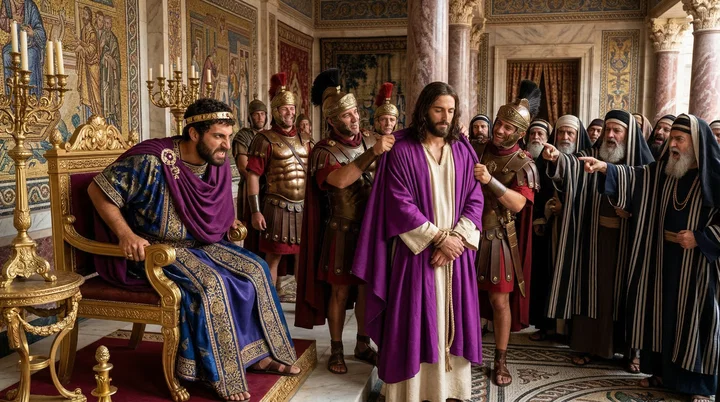
And when Herod saw Jesus, he was exceeding glad: for he was desirous to see him of a long season, because he had heard many things of him; and he hoped to have seen some miracle done by him.
Translations
American King James Version, King James Version, KJV Cambridge Paragraph Bible
And when Herod saw Jesus, he was exceeding glad: for he was desirous to see him of a long season, because he had heard many things of him; and he hoped to have seen some miracle done by him.
And when Herod saw Jesus, he was exceeding glad: for he had been for a long time, desirous to see him, because he had heard many things of him; and he hoped to see some miracle done by him.
Revised Version, American Standard Version
Now when Herod saw Jesus, he was exceeding glad: for he was of a long time desirous to see him, because he had heard concerning him; and he hoped to see some miracle done by him.
And Herod having seen Jesus did rejoice exceedingly, for he was wishing for a long [time] to see him, because of hearing many things about him, and he was hoping some sign to see done by him,
And when Herod saw Jesus he greatly rejoiced, for he had been a long while desirous of seeing him, because of hearing many things concerning him, and he hoped to see some sign done by him;
And, Herod, seeing Jesus, rejoiced exceedingly; for he had been, a considerable number of times, wishing to see him,—because he had heard concerning him, and was hoping, some sign, to behold, by him, brought to pass.
When Herod saw Jesus, he was greatly pleased. He had wanted to see Him for a long time, because he had heard about Him and was hoping to see Him perform a miracle.
When Herod saw Jesus, he was greatly pleased. He had wanted to see Him for a long time, because he had heard many things about Him and was hoping to see Him perform a miracle.
Now when Herod saw Jesus, he was exceedingly glad, for he had wanted to see him for a long time, because he had heard many things about him. He hoped to see some miracle done by him.
Now when Herod saw Jesus he was very glad, having for a long time had a desire to see him, for he had had accounts of him, and was hoping to see some wonders done by him.
And when Herod sawe Iesus, hee was exceedingly glad: for he was desirous to see him of a long season, because he had heard many things of him, and trusted to haue seene some signe done by him.
Douay-Rheims (Challoner revision)
And Herod, seeing Jesus, was very glad; for he was desirous of a long time to see him, because he had heard many things of him; and he hoped to see some sign wrought by him.
Pictures
Cross-references
- Matthew 14:1-2
At that time Herod the tetrarch heard of the fame of Jesus,
Herod heard reports of Jesus’ works and connected them with John risen from the dead.
- Mark 6:16
But when Herod heard thereof, he said, It is John, whom I beheaded: he is risen from the dead.
Herod’s report identifies Jesus with John, whom Herod had beheaded.
- Isaiah 53:7
He was oppressed, and he was afflicted, yet he opened not his mouth: he is brought as a lamb to the slaughter, and as a sheep before her shearers is dumb, so he openeth not his mouth.
Jesus remains silent before Herod’s demands and threats, fulfilling the prophecy.
- Luke 23:4
Then said Pilate to the chief priests and to the people, I find no fault in this man.
Pilate declares Jesus innocent before yielding to the crowd.
- Mark 6:17-20
For Herod himself had sent forth and laid hold upon John, and bound him in prison for Herodias’ sake, his brother Philip’s wife: for he had married her.
Herod knew John was righteous and heard him gladly, though John rebuked his unlawful marriage.
- Mark 15:2-5
And Pilate asked him, Art thou the King of the Jews? And he answering said unto him, Thou sayest it.
Jesus’ trial includes his silence under accusation before Pilate.
- Luke 9:9
And Herod said, John have I beheaded: but who is this, of whom I hear such things? And he desired to see him.
Herod had earlier expressed a desire to see Jesus.
- John 18:28-40
Then led they Jesus from Caiaphas unto the hall of judgment: and it was early; and they themselves went not into the judgment hall, lest they should be defiled; but that they might eat the passover.
A parallel account of Jesus’ trial before Pilate.
- Matthew 27:11-31
And Jesus stood before the governor: and the governor asked him, saying, Art thou the King of the Jews? And Jesus said unto him, Thou sayest.
A parallel account of Jesus’ trial and condemnation.
- Matthew 14:3
For Herod had laid hold on John, and bound him, and put him in prison for Herodias’ sake, his brother Philip’s wife.
same Herod Antipas described
- Luke 23:14-15
Said unto them, Ye have brought this man unto me, as one that perverteth the people: and, behold, I, having examined him before you, have found no fault in this man touching those things whereof ye accuse him:
Pilate and Herod both find no grounds for punishment.
- Mark 6:20
For Herod feared John, knowing that he was a just man and an holy, and observed him; and when he heard him, he did many things, and heard him gladly.
Both show Herod’s curiosity without love.
- Luke 13:32
And he said unto them, Go ye, and tell that fox, Behold, I cast out devils, and I do cures to day and to morrow, and the third day I shall be perfected.
same Herod Antipas described
- Matthew 14:10
And he sent, and beheaded John in the prison.
Identifies Herod as the one who ordered John's beheading.
- John 12:20-21
And there were certain Greeks among them that came up to worship at the feast:
shares desire to see Jesus
- Matthew 12:38-39
Then certain of the scribes and of the Pharisees answered, saying, Master, we would see a sign from thee.
Both show people seeking a sign from Jesus.
Commentary
Each commentary is drawn from primary sources: the writings of Ellen G. White and Adventist pioneers and periodicals. Each commentary is separate. Its own words are not a quotation; follow the references to read the source passages.
Ellen G. White
28 sources
When Pilate sent Jesus to Herod as the ruler of Galilee, Herod was exceeding glad to see Him at last after long desiring it from hearing many reports of Him and His works.Ms 112, 1897, par. 7–8DA 723.1–724.1SG1 55.1–2COS 141.2–3ST Nov 30, 1882 His gladness was idle curiosity and desire for entertainment and spectacle, not a broken heart seeking healing or readiness to receive truth and salvation.Ms 112, 1897, par. 7–8SG1 55.1–2ST Nov 2, 1882 He pressed Jesus with many questions and commanded crippled and afflicted persons to be brought in, urging Him to prove His power by healing them before the crowd and to save Himself and secure His release by a miracle.Ms 129, 1897, par. 4–5ST Nov 2, 1882COS 143.1–3 Jesus answered with complete silence and unmoved majesty, for He would not use His divine power for His own benefit or to gratify wicked curiosity, since His miracles were for the salvation of others and He would not avoid the suffering men face.Ms 112, 1897, par. 7–8Ms 129, 1897, par. 4–5SG1 55.1–2ST Nov 2, 18825RED 56.1 He closed His lips and withheld elevating truth from a hard-hearted ruler whose heart was hardened by sin and stained with the blood of John, whose light he had rejected, and His refusal teaches those who have the truth to likewise refuse to work miracles to prove they are favored of God.Ms 112, 1897, par. 7–8ST Jan 24, 1900ST Jul 11, 1878COS 144.2–3RH Apr 1, 1875
Trial Setting and Meeting
This meeting belongs to the trial before the authorities before the crucifixion, when Pilate learned Jesus was from Galilee and sent Him to Herod, the ruler of Galilee, hoping to shift responsibility for the case.DA 723.1–724.1COS 141.2–3 He was dragged away by soldiers amid jeers and insults, passing through successive tribunals and abuses on the way to the cross.COS 141.2–3ST Nov 30, 1882 Reports of Him and His works had already reached people in power.DA 723.1–724.1 The ordeal was one of betrayal, condemnation, humiliation, and rejection by a crowd that had once welcomed Him, a sudden turn of public favor that did not wholly surprise disciples who had seen how quickly favor could change.4RED 102.2–103.1
When He was brought before Herod amid the pressing, accusing crowd crying out charges, Herod commanded silence and had Jesus unbound so He could interrogate and question Him in person.ST Jun 3, 18895RED 55.2ST Nov 2, 1882 Herod looked on Him with curiosity mingled with some pity as He stood pale, sad, exhausted, suffering, and wearied.3SP 135.2ST Jun 3, 18895RED 55.2ST Nov 2, 1882 That suffering face was still marked with deep wisdom and purity.COS 143.1–3ST Jun 3, 18895RED 55.2ST Nov 2, 1882 Herod knew, as Pilate also knew from the character of the Jews, that Jesus was innocent and that malice and envy had led the Jewish leaders to condemn Him.3SP 135.2COS 143.1–3ST Jun 3, 18895RED 55.2ST Nov 2, 1882
He submitted passively to indignity with unparalleled serenity and dignity, already lacerated by the cruel scourge.5RED 59.2ST Jun 3, 1889DA 780.3 He spoke no word but what was essential and tended to glorify God, bearing Himself with dignity through the disgraceful farce of a trial from insult to renewed insult and from mockery to mockery, twice tortured by the scourge through scene after scene all night without failing.Ms 95, 1897, par. 10–12DA 780.3 Herod found nothing in Him to condemn and dared not ratify the Jews' condemnation or pronounce sentence against Him.5RED 59.2ST Jun 3, 1889Ms 95, 1897, par. 10–12 Yet there Jesus was mocked and insulted, crowned with thorns, and heaped with every insult before Herod sent Him back to Pilate.5RED 59.2Ms 95, 1897, par. 10–12DA 780.3
Herod stands among those who mocked, insulted, and condemned Jesus.4SP 481.2–482.2 In the final judgment he sees the trial scenes again and recognizes his guilt as an actor in Christ's suffering.4SP 481.2–482.2 Jesus, rejected before Pilate and Herod, is now in the heavenly courts interceding for those who refused Him.Lt 31, 1898, par. 36 God will call the world to judgment to avenge His death.Lt 31, 1898, par. 36
Herod's Curious Gladness
Herod Antipas was exceeding glad to see Jesus because for a long season he had been desirous to see Him after hearing many reports of Him and His widespread fame, hoping to see some miracle done by Him as a spectacle proved true before his eyes.Ms 112, 1897, par. 7–8SG1 55.1–2ST Nov 2, 1882ST Jan 24, 1900COS 143.1–3 His interest was idle curiosity and desire for entertainment, not readiness to receive truth, need of a broken heart seeking healing, or desire for salvation, for Christ came to heal the brokenhearted, not to gratify princes, rulers, scribes, priests, or peasants.Ms 112, 1897, par. 7–8SG1 55.1–2ST Jan 24, 1900 His heart was hardened by sin and depraved, and his hands were stained with the blood of John.Ms 112, 1897, par. 7–8COS 144.2–3 Though John's teaching had deeply impressed him he had not changed his life, had rejected the light received through John the prophet, and had later ordered John's death to please Herodias.Ms 112, 1897, par. 7–8ST Jul 11, 1878COS 144.2–3
Herod pressed Jesus to prove His claims and divine power by a sign, commanding decrepit, maimed, crippled and deformed persons to be brought into His presence and ordering Him to heal them before the crowd.Ms 129, 1897, par. 4–5ST Nov 2, 1882COS 143.1–35RED 56.1 He urged that if He could save the sick for others He should work now for His own good to save His life and procure His release, arguing that if the reported cures were true He still had power to do the same.Ms 129, 1897, par. 4–5ST Nov 2, 18825RED 56.1 He promised to release Him if He performed one, hoping to prove Jesus was no impostor and to gain grounds for releasing Him.ST Nov 2, 1882DA 730.1–5 He treated His claim to be king with ridicule and demanded a miracle as proof He could save Himself.5RED 56.13SP 138.1–2 When met with silence he grew excited, repeated his own exalted position and what he had done to a prophet, and angrily threatened to intimidate Him.Ms 129, 1897, par. 4–5ST Nov 2, 1882
His eager curiosity gave way to fear, perplexity, and conviction.5RED 59.2 Jesus' pure, pale face and silence spoke to his heart and stirred fear that He was not a common man but a god come down to earth, as He submitted passively to indignity with unparalleled serenity.5RED 59.2ST Jun 3, 1889 Even some mockers who bowed in mockery looked into the sufferer's kinglike face and turned back ashamed of their audacity.5RED 59.2 Hardened Herod was left ill at ease, convicted in heart yet daring not to ratify the condemnation.5RED 59.2ST Jun 3, 1889
Christ's Silent Refusal
To Herod's many questions, demands and threats Jesus answered with complete silence and Godlike majesty, remaining as one who heard and saw not, unmoved and closed to him, with no word, look or sign that He heard.Ms 112, 1897, par. 7–8Ms 129, 1897, par. 4–5ST Nov 2, 1882ST Jan 24, 1900DA 730.1–5 Though Herod commanded silence for interrogation and pressed Him to prove His claims, ordered decrepit and maimed persons brought in to be healed before the crowd, urged Him to work for His own good and release, promised release for a sign, and repeated his own exalted position and what he had done to a prophet to intimidate Him, Jesus gave no response.Ms 129, 1897, par. 4–5ST Nov 2, 18823SP 136.1–2DA 730.1–5 His silence stood amid demands and threats as majesty that would not be broken.Ms 129, 1897, par. 4–5ST Nov 2, 1882ST Jan 24, 19003SP 136.1–2DA 730.1–5
He would not perform a miracle to satisfy wicked and idle curiosity, to win the ruler's favor, or to secure His release and spare Himself suffering.SG1 55.1–2ST Nov 2, 18825RED 56.13SP 136.1–2DA 730.1–5 Having taken human nature He would not avoid the pain and humiliation men face in such circumstances nor use His divine power for His own benefit, even when urged that if He could save the sick for others He should save His own life and prove He was no impostor.SG1 55.1–2ST Nov 2, 18825RED 56.1EW 142.1–2 His miraculous power was for the salvation of others, not for self-preservation or display.SG1 55.1–2ST Nov 2, 18825RED 56.1EW 142.1–2
He came to heal the brokenhearted, not to gratify princes, rulers, scribes, priests or peasants.Ms 112, 1897, par. 7–8Ms 129, 1897, par. 4–5 His deportment and silence were eloquent, withholding the precious gems of elevating truth that are not to be cast before swine from hard-hearted minds that could no more understand His pure, elevated words than brute creation and would reject and abuse them.Ms 112, 1897, par. 7–8Ms 129, 1897, par. 4–5ST Jan 24, 1900 He would not have kept silent if any word could have healed sin-sick souls and the bruises of the sin-sick, for His interest was not met by readiness to receive truth or seek salvation but by curiosity and desire for spectacle.Ms 112, 1897, par. 7–8ST Jan 24, 1900DA 728.2–729.3 The ear ever open to human woe had no room for Herod's words, the eyes ever resting in pitying, forgiving love on the penitent sinner had no look to bestow on Herod, and the lips ever uttering impressive truth and tenderest entreaty and ever ready to speak pardon to the most hardened sinner were closed to him.Ms 112, 1897, par. 7–8Ms 129, 1897, par. 4–5
Herod with Pilate asked from aroused curiosity, not faith, while Jesus was on trial for His life, and He worked no miracle to gratify them.RH Apr 1, 1875 His refusal means those who have the truth should likewise refuse when tempted, as Satan tempted Christ, to manifest power and work miracles to give evidence of being favored of God and having the truth.RH Apr 1, 1875
Sources
Pioneers and periodicals
39 sources
Herod Antipas, the weak and wicked ruler of Galilee, was delighted at last to meet Jesus because he had long wanted to see him after hearing many reports of his deeds, hoping to watch him do a miracle as a spectacle.ST Nov 2, 1882RH Nov 12, 1861ST Oct 12, 1904ST Oct 17, 1895RH Jul 16, 1861 This belongs to Luke's distinctive account in which, during the night proceedings leading to his death, Jesus was sent from Pilate to Herod and then returned to Pilate.ST Nov 30, 1882RH Jul 16, 1861ST Aug 21, 1907 His eagerness was mere idle curiosity and desire for entertainment, not earnest seeking, love of truth, or readiness to receive who Jesus was.RH Nov 12, 1861ST Oct 23, 1884ST Oct 17, 1895 Jesus answered his many questions with silence and worked no miracle to gratify him, for Herod had rejected the light given through John and such words and wonders would only be wasted and abused and add to his guilt.ST Nov 2, 1882ST Jan 24, 1900RH Jun 27, 1871ST Oct 23, 1884ST Feb 6, 1907 His demand stands as a warning against seeking visible signs as proof of faith, for eternal truth known by the Spirit is greater evidence than any miracle, which Satan can counterfeit, and those who have the truth must likewise refuse to work wonders to satisfy scoffers.RH Jun 27, 1871RH Jan 1, 1901RH Apr 9, 1901ST Feb 17, 1904
Herod, Setting and Wording
The Herod who saw Jesus was Herod Antipas, son of Herod the Great, governor of Galilee.RH Nov 12, 1861ST Oct 17, 1895 He was a weak and wicked ruler, one of the wicked rulers in the unjust trial, exercising unjust authority as an emissary of evil and used by the enemies of Jesus.RH Jul 16, 1861RH Dec 3, 1857 Although he would have preferred to put Jesus to death, he feared losing influence with Caesar.RH Jul 16, 1861
The meeting belongs to Luke's distinctive account, not recorded by the other evangelists, of Jesus taken to Herod in the course of the judicial proceedings that led to his death.ST Apr 28, 1909ST Mar 15, 1877 In that sequence Jesus was sent from Pilate to Herod and then returned to Pilate, Herod professing deference to Pilate and leaving the fate of Jesus in Pilate's hands.RH Jul 16, 1861ST Aug 21, 1907 He was brought before Herod once, mocked, and then condemned.ST Nov 30, 1882
It was the last scene of Jesus' earthly life, when unjustly condemned he was hurried from tribunal to tribunal by night and stood before Herod's judgment seat enduring cruel mockery and sarcasm.ST Jan 13, 1898RH Jun 10, 1862 After being before Herod and returned to Pilate he was led toward Calvary carrying his cross until he fainted.ST Aug 21, 1907 His desire to see Jesus turned to mockery, mocking him as one who called himself a king and challenging him to save himself, putting on him an old purple robe of scorn and crowning him with thorns.ST Jan 13, 1898
The wording means Herod was very glad and delighted to see Jesus.ST Jan 24, 1900ST Nov 12, 1894 For a long season he had wanted to meet him, having heard many reports of his deeds.ST Nov 2, 1882ST Jan 24, 1900ST Nov 12, 1894ST Apr 28, 1909 He hoped to watch him do a miracle as a spectacle, pressing him to demonstrate power and even to heal disabled people brought before him.ST Nov 2, 1882ST Oct 12, 1904ST Jun 18, 1912
Curiosity Without Faith
Herod's gladness at seeing Jesus was mere idle curiosity and inquisitiveness about the truth without loving it, not earnest seeking or readiness to receive truth, teaching, or recognition of who He was.ST Jan 24, 1900RH Nov 12, 1861ST Oct 23, 1884 He had long wanted to meet Him because he had heard many reports of His deeds, and he hoped to watch Him do a miracle as a spectacle and entertainment.ST Oct 23, 1884ST Nov 12, 1894ST Jan 17, 1911 His desire represents one class among the varied motives of all classes who desired to see Jesus during His ministry, especially after the resurrection of Lazarus and from the triumphal entry into Jerusalem until the crucifixion.ST Oct 17, 1895 That curiosity and hope for a spectacle did not lead him to faith or to any meaningful response, for elevating words would be wasted on one who would reject and abuse them.ST Jan 24, 1900ST Nov 12, 1894ST Jan 17, 1911
He met Jesus with glad curiosity and desire to interrogate Him in person, and when Jesus was brought before him amid the pressing crowd crying out charges, he commanded silence and ordered Him to be unbound so he could question Him.ST Jun 3, 1889ST Nov 2, 1882 He looked on the pale, sad, pure face, marked with deep wisdom and purity yet extreme weariness and suffering, with curiosity mingled with pity.ST Jun 3, 1889ST Nov 2, 1882 He pressed Jesus to demonstrate power, even by healing disabled people brought before him, hoping to prove He was no impostor and to gain grounds for releasing Him.ST Nov 2, 1882ST Jul 11, 1878 Even after witnesses had testified to Jesus' miracles, he still demanded a sign for himself, and Jesus remained silent despite demands and threats.ST Nov 2, 1882ST Jul 11, 1878ST Jan 17, 1911
Herod knew from the character of the Jews that malice and envy had caused them to condemn an innocent man, a knowledge Pilate also shared from acquaintance with that character.ST Jun 3, 1889ST Nov 2, 1882 Seeing Jesus submit passively to indignity with unparalleled serenity, he feared Jesus might be no common man but a god come down to earth, and the very silence of Jesus convicted his heart.ST Jun 3, 1889 Hardened yet ill at ease, he dared not ratify the condemnation of the Jews and sent Jesus back to Pilate.ST Jun 3, 1889 His eagerness without repentance, like Pilate's, shows that a person can feel sorrow yet continue in sin, without the godly sorrow that turns the heart from sin.RH Sep 22, 1863
Silence and Refused Miracle
He answered Herod with nothing at all despite many questions, demands and threats.ST Nov 2, 1882ST Jan 24, 1900ST Jul 11, 1878ST Apr 12, 1883 He remained composed and cheerful while abuse and disgrace were heaped upon him, enduring without a word of complaint.RH Aug 25, 1859RH Jun 15, 1911 That silence was itself a wonder to Herod as well as to Pilate and to all who beheld it.RH Jun 15, 1911
He was silent because, having taken human nature, he would not step aside from the pain and humiliation that people face in like circumstances.ST Nov 2, 1882ST Jul 11, 1878 Herod had rejected the light he had received through John the prophet, and Jesus knew the wickedness of those before him.ST Jan 24, 1900ST Jul 11, 1878 Elevating words would have been wasted upon hearers with no ears to hear, who would only reject and abuse them.ST Jan 24, 1900ST Feb 6, 1907 His silence was therefore both judicial and merciful, to avoid wasting words and to avoid adding to Herod's guilt.ST Feb 6, 1907
He worked no miracle to satisfy wicked curiosity and idle curiosity, nor to answer demands that tested him and challenged him to prove his power while he was on trial for his life.ST Nov 2, 1882ST Jul 11, 1878RH Jun 27, 1871ST Oct 23, 1884 Herod pressed him to demonstrate power by healing disabled people brought before him, hoping to prove he was no impostor and to gain grounds for releasing him, and even after witnesses had testified to his miracles demanded a sign for himself.ST Nov 2, 1882ST Jul 11, 1878 He would not use power to spare himself suffering and the insults that followed, for the Lord does not lend his wisdom or power to gratify idle curiosity.ST Nov 2, 1882ST Jul 11, 1878ST Mar 11, 1875ST Oct 23, 1884
When he would not satisfy that curiosity, Herod's glad opportunity became an occasion for mockery and abuse.ST Mar 22, 1899 With his soldiers he mocked and mistreated him before sending him back to Pilate.ST Jun 18, 1912 He mocked him as one who called himself a king and challenged him to save himself, putting on him an old purple robe of scorn and crowning him with thorns.ST Jan 13, 1898
Trial, Prophecy and Sacrifice
Herod welcomed the chance to see Jesus because he had long wanted to meet him and hoped to watch him perform a miracle, and the account of Jesus before Herod forms part of the fulfillment of the prophecy that he would remain silent under accusation.ST Oct 12, 1904 Herod acted as an agent of pagan Rome, which is the fourth head of the Satan-controlled beast system of government.ST Jun 27, 1911 Satan knew the Man Child was to be born and watched and waited to destroy him, and he stirred up pagan Rome under Herod and Pilate to do his will and to destroy Jesus, the Hope of the race, though pagan Rome itself did not know it, but the attempt failed.ST Jun 27, 1911
Jesus was sent to Herod and then returned to Pilate, and Herod professed deference to Pilate and left his fate in Pilate's hands.RH Jul 16, 1861 Herod found him worthy of no punishment.ST Oct 27, 1898 Herod was a weak and wicked ruler used by Jesus' enemies, and although he would have preferred to put Jesus to death, he feared losing influence with Caesar.RH Jul 16, 1861 He was one of the wicked rulers in the unjust trial, an emissary of Satan exercising unjust authority.RH Dec 3, 1857 At Herod's bar of justice the hearing became a tide of ridicule with false accusation allowed and no defense heard.ST Oct 12, 1876 Prejudice turned Pilate away from the truth, so although he declared Jesus innocent he gave in to the crowd and sent him to the cross.ST Aug 20, 1896 Pilate with his soldiers could have silenced the false accusers and stemmed that ridicule until the defense was heard, and by failing to do so he failed to place himself on the side of justice and humanity.ST Oct 12, 1876
The cruel mocking of Jesus in Herod's court, described in Luke 23:8-11, was one step of sacrifice in giving his life for a lost and sinful race. It was one part of the great all-comprehending divine sacrifice in behalf of fallen man that includes his temptation in the wilderness, his prayers during the long cold nights in the mountains, and his giving of life in teaching and healing. It includes also the agony of Gethsemane, the trials before Annas and Caiaphas, the scourging and crowning with thorns, and the unjust condemnation at last. It includes the journey from the Roman praetorium to the cross, culminating in the crucifixion and death of Jesus, the King of the Jews.
Doctrine and Christian Example
Herod's hope was linked with sight rather than with God's promises and faith, and stands as a warning against seeking visible proof and signs and wonders; the verse is an example of people eagerly seeking miracles after hearing reports about him out of long-standing curiosity.RH Jan 1, 1901 Miracles are not to be demanded as proof of faith nor done at human will, but power for them is granted by God only when they serve His work or glory.ST Feb 17, 1904 Truth, eternal truth, is greater than miracles and is recognized by its flavor, the Spirit of truth inseparable from it, which is far greater evidence than any miracle and the supreme test of truth, because visible signs and wonders and apparent miracles can be successfully counterfeited by Satan but that flavor cannot.RH Apr 9, 1901
Herod's demand, Show us a miracle, is still made with the presentation of every great truth.RH Apr 9, 1901 Even when heaven-born principles are presented in practical and self-evident form, people clamor for something sensational, remarkable, unusual and supernatural because plain substantial truth alone does not seem sufficient, wrongly regarding miracle-working as the greatest test of divine origin and the detector of error in any teaching or movement.RH Apr 9, 1901 Jesus, while on trial for His life, worked no miracle to gratify aroused curiosity without faith or to satisfy idle curiosity and the demands of those testing Him, which teaches that scoffers testing the truth need not be answered on their own terms.RH Apr 1, 1875RH Jun 27, 1871 Those who have the truth should likewise refuse when tempted, as Satan tempted Christ, to manifest power and work miracles to give evidence of being favored of God and having the truth.RH Apr 1, 1875RH Jun 27, 1871
Jesus in humiliation and submission before Herod, though His rights extended over the whole universe and it was in His power to maintain them, did not stand up for His rights but was led as a lamb to the slaughter and as a sheep before her shearers is dumb opened not His mouth.RH Jul 15, 1875 Those whose affections are on things above and not on things on the earth must follow Him, bear the cross and come after Him, and need not mind when they are misused or run over, for the disciple is not above his master nor the servant above his lord.RH Jul 15, 1875 His entering Herod's palace and judgment hall as He reached people of every station teaches His followers to serve wherever they can.ST Jul 9, 1894
Sources