Matthew 14:7
Whereupon he promised with an oath to give her whatsoever she would ask.
Translations
Whereupon he promised with an oath to give her whatever she would ask.
King James Version, KJV Cambridge Paragraph Bible
Whereupon he promised with an oath to give her whatsoever she would ask.
Upon which he promised with an oath to give her whatever she would ask.
Revised Version, American Standard Version
Whereupon he promised with an oath to give her whatsoever she should ask.
whereupon with an oath he professed to give her whatever she might ask.
whereupon he promised with oath to give her whatsoever she should ask.
wherefore, with an oath, he promised to give her, whatsoever she should ask for herself;
Berean Standard Bible, Majority Standard Bible
so much that he promised with an oath to give to her whatever she asked.
Therefore he promised with an oath to give her whatever she should ask.
So he gave her his word with an oath to let her have whatever she might make request for.
Wherefore he promised with an othe, that he would giue her whatsoeuer she would aske.
Douay-Rheims (Challoner revision)
Whereupon he promised with an oath, to give her whatsoever she would ask of him.
Pictures
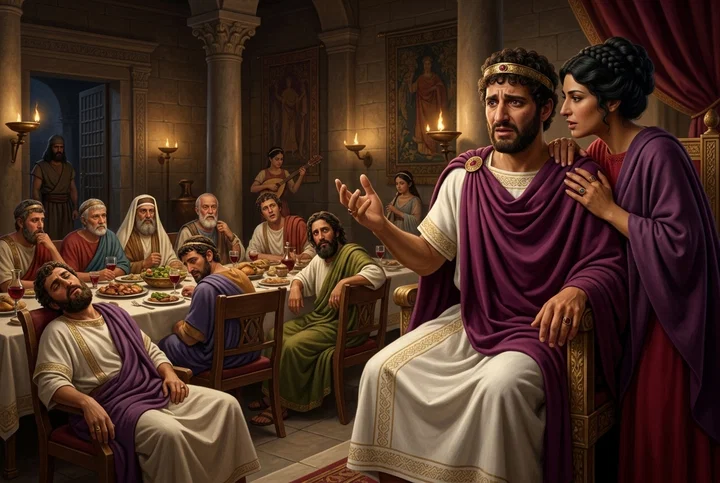
Cross-references
- Mark 6:22-23
And when the daughter of the said Herodias came in, and danced, and pleased Herod and them that sat with him, the king said unto the damsel, Ask of me whatsoever thou wilt, and I will give it thee.
Mark recounts Herod’s promise and oath to the dancer.
- Matthew 14:11
And his head was brought in a charger, and given to the damsel: and she brought it to her mother.
The oath’s outcome was John’s beheading, and his head was brought on a charger.
- Luke 3:19-20
But Herod the tetrarch, being reproved by him for Herodias his brother Philip’s wife, and for all the evils which Herod had done,
Herod is reproved by John and then imprisons him.
- Mark 6:24-28
And she went forth, and said unto her mother, What shall I ask? And she said, The head of John the Baptist.
The daughter’s request and Herod’s response follow the oath.
- Mark 6:21
And when a convenient day was come, that Herod on his birthday made a supper to his lords, high captains, and chief estates of Galilee;
feast where the oath was made
- Matthew 14:3
For Herod had laid hold on John, and bound him, and put him in prison for Herodias’ sake, his brother Philip’s wife.
Herod’s incestuous union with Herodias leads to John’s murder.
- Mark 6:20
For Herod feared John, knowing that he was a just man and an holy, and observed him; and when he heard him, he did many things, and heard him gladly.
same Herod curious about truth without loving it
- Esther 5:3
Then said the king unto her, What wilt thou, queen Esther? and what is thy request? it shall be even given thee to the half of the kingdom.
A king promises to grant a request, echoing Herod’s offer.
- Luke 23:8
And when Herod saw Jesus, he was exceeding glad: for he was desirous to see him of a long season, because he had heard many things of him; and he hoped to have seen some miracle done by him.
same Herod curious about truth without loving it
- Luke 23:11
And Herod with his men of war set him at nought, and mocked him, and arrayed him in a gorgeous robe, and sent him again to Pilate.
Herod mocked Jesus during his sufferings.
Commentary
Each commentary is drawn from primary sources: the writings of Ellen G. White and Adventist pioneers and periodicals. Each commentary is separate. Its own words are not a quotation; follow the references to read the source passages.
Ellen G. White
28 sources
Matthew 14:7 records Herod's rash promise at his birthday feast, made while intoxicated and carried away by revelry, feasting and the dance of Herodias's daughter.DA 220.6–221.3ST Mar 15, 18832SP 76.1–77.1 With an oath he bound himself to give her whatever she asked, even as much as half his kingdom, without considering the consequences.DA 220.6–221.3STLt 107, 1897, par. 4–5 Herodias had arranged the display to exploit that weakness, knowing Herod honored John as a true prophet and intended to release him, and using indulgence to becloud his senses and make right decision impossible.2SP 76.1–77.1RH Mar 11, 1873 The pledge led directly to John's execution when she demanded his death in revenge, though Herod knew him to be a true prophet and was reluctant and remorseful.DA 220.6–221.33SP 135.1COS 144.2–3 Herod treated the drunken vow as binding even for murder, exalting his honor above God's commandment against killing, which warns how intemperance perverts judgment, paralyzes moral principle, and calls for Christian temperance instead.RH Apr 8, 1873ST Mar 15, 1883RH Apr 8, 1873ST
The Oath at Herod's Feast
The promise was made at Herod's birthday feast while he was intoxicated, self-indulgent, and eager to impress his guests, his senses debased by wine and his judgment carried away by revelry, feasting and dancing.DA 220.6–221.3ST Mar 15, 18832SP 76.1–77.1COS 144.2–3Ms 107, 1893, par. 1 He was moved by the impression made upon him by the dance of Herodias's daughter before him, and entrapped by that captivating performance into offering her anything she might ask.DA 220.6–221.3ST Mar 15, 18832SP 76.1–77.1Ms 107, 1893, par. 1RP 14.1 Intoxication and self-indulgence had weakened reason and perverted judgment, impaired self-control, and revealed how intemperance and sin had hardened him.ST Mar 15, 18832SP 76.1–77.1COS 144.2–3 Such entertainment could influence a person and lead toward ruin.RP 14.1SPBC 147.3
With an oath he bound himself to give her whatsoever she would ask, even as much as half his kingdom.DA 220.6–221.3STLt 107, 1897, par. 4–5SPBC 147.3 It was a rash, thoughtless pledge made without consideration of its consequences.DA 220.6–221.3STLt 107, 1897, par. 4–5 That oath-bound promise set the condition for what followed.DA 220.6–221.3Lt 107, 1897, par. 4–5SPBC 147.3
Herodias had deliberately arranged the feast and the dance to exploit that weakness and secure John's death.2SP 76.1–77.1RH Mar 11, 1873 She knew Herod honored and feared John as a true prophet of God, that John's truthful reproof of Herod's unlawful life had struck terror to his guilty conscience, and that Herod designed to release John from prison, so she could not obtain his death while Herod's intelligence controlled him.2SP 76.1–77.1RH Mar 11, 1873 She therefore looked to his birthday as an occasion of gluttony and intoxication, using costly preparations for feasting, luxurious food, stimulating drinks, pleasure, amusement and dancing to indulge appetite, arouse passion, excite the lower passions, enervate and deaden the moral as well as the physical powers, lower the tone of mental and moral character, becloud the senses, remove the fear of God, deaden sensibility to moral improvement and to the appeals of the Spirit, and make it impossible to see facts clearly and make right decisions.RH Mar 11, 1873 Under that unnatural exhilaration Herod was thrown off his guard and made the rash promise.2SP 76.1–77.1RH Mar 11, 1873
The background was Herod's conflict with John, who had rebuked Herod's marriage to his brother's wife and was imprisoned for it, with Herod's wife afterward influencing his beheading.SG1 29.2–30.1SLP 255.2 The Herod of this promise was Herod Antipas, the great-uncle of Agrippa.SG1 29.2–30.1SLP 255.2
The oath led directly to John's execution when Herodias in revenge used it to demand his death, and her daughter requested John's death.DA 220.6–221.33SP 135.1COS 144.2–3Ms 107, 1893, par. 1STB 55.4 Herod had known John was a true prophet, had been nearly persuaded to become his disciple, had felt remorse for killing him, and was reluctant to kill him, but his moral sense grew dull as he turned from the truth and intemperance and continued sin hardened him.DA 220.6–221.33SP 135.1COS 144.2–3 When John's bleeding head was brought in before the guests they felt horror at the sight, and Herod himself could not endure it or close his vision to the painful scene.Ms 107, 1893, par. 1 After a year had passed with time to consider his own life and character, he still remained with his unlawful wife Herodias while going through the formal ceremonies as a Jew observing the annual Passover.Ms 107, 1893, par. 1 In the setting of his conflict with John, he later boasted that he had punished John for reproving him, and John lost his life for delivering his message.STB 55.4ST Nov 2, 1882
Herod treated the oath as binding even when the demand was to have John killed, choosing the guilt of murder over the supposed disgrace of breaking his promise.RH Apr 8, 1873RH Apr 8, 1873ST He was brought to the test before his guests whether to humble himself and ask to be released from his rash oath or to violate the law of God by sacrificing the life of an innocent man, one of the greatest prophets God sent to earth, whose lips had faithfully declared to Herod the necessity of reform.RH Apr 8, 1873RH Apr 8, 1873ST Under the delusion that to save his own reputation he must keep an oath made while intoxicated, and that his honor and dignity as king required it, he exalted his oath above the commandment of God, Thou shalt not kill, and made the promise on account of his lordly guests to appear constant and of superior judgment and not to appear fickle or rash.RH Apr 8, 1873RH Apr 8, 1873 He gave his guests opportunity to speak for John and virtually invited them to release him, telling them he would not abide by his oath if it would not be considered a special mark of dishonor to them, and it was on their account he carried it out.RH Apr 8, 1873 No voice was raised to keep him from his mad vow because the guests were intoxicated with wine, their senses benumbed with nothing to be reverenced and their tongues paralyzed.RH Apr 8, 1873RH Apr 8, 1873 The very act he thought while perverted was maintaining his honor and dignity branded him forever with dishonor and made his name detestable when he commanded the executioner to sever the head of the honored prophet of God.RH Apr 8, 1873RH Apr 8, 1873ST The oath was made under the influence of intoxication and the excitement of feasting, dancing, revelry and wine, when reason and judgment were perverted, reason was servant to baser passions, intellect and manhood were sacrificed to sensual indulgence in eating and drinking, moral principles, the only safeguard of the soul, were paralyzed, and Herod and his guests were as slaves in the lowest bondage to brute appetite.RH Apr 8, 1873RH Apr 8, 1873 If vigor of intellect had been preserved, calm reason would have borne sway and recoiled with horror at beheading an exalted prophet of God; when the feast began Herod would have answered like Hazael, Is thy servant a dog that he should do this, but in sober reason he would have protested himself incapable of such a deed, while under wine the vow led to results he would not cease to regret as long as life should last.RH Apr 8, 1873RH Apr 8, 1873
The disciples regarded John's violent death under this oath-bound promise as an inglorious end.2SP 182.3DA 380.1–2 John's death troubled them and made them fear that Jesus might suffer a similar fate.2SP 182.3DA 380.1–2 It raised their anguished question about why Jesus had not saved John.2SP 182.3DA 380.1–2
Temperance Honor and Faithfulness
The oath warns against intemperance, for it was made under intoxication and self-indulgence when reason was made servant to baser passions, intellect and manhood were sacrificed to sensual eating and drinking, judgment was perverted, and moral principle, the only safeguard of the soul, was paralyzed.RH Apr 8, 1873ST Mar 15, 1883RH Apr 8, 1873 In that state Herod and his guests were slaves in the lowest bondage to brute appetite, with senses benumbed, tongues paralyzed, and nothing left to be reverenced, so that no voice was raised to hold him back from his mad vow.RH Apr 8, 1873 Especially in rulers such indulgence impairs judgment, self-control, and the sense of right and wrong with deadly consequences, and here it allowed Herodias to exploit the moment and turned a birthday feast of revelry, dancing, and wine into decisions that cost John the Baptist his life.ST Mar 15, 18832SP 76.1–77.12SP 80.1 The feast therefore calls for Christian temperance instead of the course that weakens reason and enslaves to appetite.2SP 80.1
Herod was under the delusion that an oath made when nothing was too sacred to profane must be kept to preserve his honor and dignity as king, and to save his reputation before his lordly guests and not appear fickle or rash.RH Apr 8, 1873RH Apr 8, 1873 He exalted that drunken oath above the commandment of God, Thou shalt not kill, and chose to violate the law of God by sacrificing an innocent man, one of the greatest prophets God sent to earth, rather than humble himself and ask to be released.RH Apr 8, 1873 He was even brought to the test before his guests and virtually invited them to release him, telling them he would not abide by it if they would not count it dishonor, yet it was on their account that he carried it out.RH Apr 8, 1873 If vigor of intellect had been preserved, calm reason would have borne sway and recoiled with horror at beheading an exalted prophet of God, as when the feast began he would have answered like Hazael, Is thy servant a dog that he should do this thing, but under wine the vow led to results he would not cease to regret as long as life should last.RH Apr 8, 1873 The very act he thought while perverted was maintaining his honor branded him forever with dishonor and made his name detestable when he commanded the executioner to sever the head of the honored prophet whose lips had faithfully declared to him the necessity of reform.RH Apr 8, 1873
The oath also shows how worldly entertainment can allure and deceive, for the dance of Herodias's daughter made an impression on Herod that moved him to bind himself with an oath to grant whatever she asked.RP 14.1CT 340.2SPBC 147.3 That impression became part of a course of action that brought ruin, illustrating how entertainment can influence people and lead them toward ruin.RP 14.1SPBC 147.314MR 122.1 Such actions are recorded in heaven and will be seen in their true light at the judgment.CT 340.2 The same kind of impression is made by cheap, common talk, words of flattery, and foolish joking spoken to create a laugh.STB 845.2Lt 57, 1895, par. 25 Such speech reveals the treasure of the heart, it is the merchandise of Satan, and all who indulge in it are trading in his goods.Lt 57, 1895, par. 25 Every such transaction is recorded in the books of heaven and will appear in its true light before the guilty at the last great day, when all will discern in it the alluring, deceptive working of the devil to lead souls into the broad road and the wide gate that opens to ruin.Lt 57, 1895, par. 25
The oath belongs to the account of John's fearless and pointed prophetic message, for his plain reproof of Herod's sin brought hatred and danger and set the condition for his death when Herod bound himself to grant the demand that followed.Lt 107, 1897, par. 4–5STB 55.4MWISDAP 34.2 Herod's oath led to the request for John's head and to John losing his life for delivering his message, even as he continued to deliver it at the cost of his life.STB 55.4MWISDAP 34.2MOPP 14.3–4 John's example shows that a pointed message of truth may cost the messenger his life.STB 377.2MOPP 14.3–4Lt 399, 1904, par. 14–15 Yet the testimony of God must be given whether people accept it or reject it.Lt 107, 1897, par. 4–5
Sources
Pioneers and periodicals
61 sources
The verse records Herod's birthday feast where the dancing of Herodias's daughter in the midst of the guests pleased him and led him to bind himself by oath to give her whatever she would ask.ST Mar 2, 1904ST Mar 3, 1898ST Mar 16, 1904 It was a rash, foolish and hasty vow, made while his judgment was clouded and his self-control weakened by feasting, revelry and freely partaken intoxicating wine.ST Dec 15, 1887ST Mar 3, 1898ST Mar 10, 1898ST Dec 15, 1887ST Dec 15, 1887 Herodias had long plotted John's death for his faithful rebuke of her unlawful union with Herod, and she arranged the dance and counted on the enormous oath-bound promise to gain her opportunity for revenge.RH Mar 11, 1873ST Dec 15, 1887ST Dec 15, 1887ST Mar 2, 1904 When the demand came for John's head, Herod exalted his oath above the commandment Thou shalt not kill and chose to be called a murderer rather than a promise-breaker, fearing shame and dishonor before his guests if he refused.RH Apr 8, 1873RH Apr 8, 1873ST Apr 20, 1882ST Sep 13, 1910 The verse therefore stands as a standing example of the folly of making rash, thoughtless vows, teaching that such an oath did not oblige him to do wrong and was better broken than kept, with an incidental temperance warning against decisions made under wine.ST Mar 3, 1898ST Mar 10, 1898ST Mar 3, 1898RH Sep 11, 1860ST Oct 9, 1884
Feast Setting and Persons
The oath was made at Herod's birthday feast, when the dancing of the daughter of Herodias in the midst of the guests pleased him and moved him to promise with an oath to give her whatsoever she would ask.ST Mar 2, 1904ST Mar 3, 1898ST Mar 2, 1904ST Feb 18, 1886 The pledge was rash, binding himself to grant whatever she should ask, and it set in motion the demand that led to the death of John the Baptist.ST Mar 16, 1904ST Dec 24, 1894ST Mar 2, 1904 The feast was held in the fortress Machaerus on the borders of Arabia.ST Mar 3, 1898ST Mar 3, 1898 That fortress stood on a very high rocky hill surrounded by valleys of very great depth, built by Alexander Janneus and rebuilt and fortified by Herod the Great with strongly fortified walls, beautiful palaces, implements of warfare, reservoirs of water, and natural fountains hot and cold, bitter, sweet, and medicinal.
The oath is also placed in Herod's palace on a summit overlooking the valley, and at Tiberias where John was imprisoned nearby.RH Aug 29, 1865ST Sep 6, 1910 There Herod made a supper for his lords and high captains and chief estates of Galilee, and amid the banquet he was entertained by the dancing and encouraged by the applause of his half-drunken guests to make the lavish promise.RH Aug 29, 1865ST Sep 6, 1910ST Sep 13, 1910 The scene is set at his birthday celebration, with the daughter present at the feast and dancing before the king and his guests, so that the oath became the opening through which the plot against John could be carried out.ST Sep 6, 1910ST Sep 13, 1910 The promise was stated as even to half his kingdom.RH Aug 29, 1865
The events belonged to the third year of the ministry of Jesus, while Jesus was in Galilee with His disciples, after John had been imprisoned one year, ending in John's martyrdom at age thirty-three.ST Mar 3, 1898ST Mar 3, 1898 The account of John's death at Herod's hand closes the span from Christ's baptism in Jordan by John to the parable of the tares and the wheat, John's work having prepared the way and continued until the work of Jesus was well established.ST Mar 10, 1898 Herod is Herod Antipas the tetrarch, son of Herod the Great who tried to kill Jesus in His infancy, and distinct from Herod Agrippa.RH Nov 12, 1861ST May 7, 1902 He is the Herod who murdered John the Baptist, inquisitive about the truth without loving it, crafty, incestuous, superstitious, hardened by prosperity, weak and susceptible to Herodias's designs, and the one who mocked Jesus in His last sufferings.RH Nov 12, 1861RH Aug 29, 1865ST Aug 7, 1901
He had put away his lawful wife, the daughter of Aretas king of Arabia, and taken Herodias, his brother's wife.ST Feb 7, 1911 John had faithfully rebuked this unlawful life and called rulers and corrupt leaders to repentance, proclaiming God's truth to a licentious ruler at the cost of Herodias's hatred.RH Mar 11, 1873RH Nov 11, 1858 Herod had once bent his proud neck with prince and plebeian to listen reverently under conviction of sin to John's preaching in the wilderness of Judea, and he honored and feared John as a true prophet of God, with his reproof striking terror to a guilty conscience, so that he designed to release John from prison.RH Mar 11, 1873ST Feb 7, 1911 He later boasted to Jesus that he had punished John for reproving him, yet he killed John to satisfy Herodias's revenge despite knowing him to be a true prophet.ST Nov 2, 1882ST Jul 11, 1878
The dancer was Salome, daughter of Herodias, and Herod with judgment clouded by feasting and wine was anxious to bestow a princely gift for the dancing.ST Dec 15, 1887ST Sep 6, 1910ST Mar 3, 1898 Following the custom by which dancing girls received valuable presents from those they entertained, he gave her the right to say what the gift should be in order to make it more highly prized.ST Mar 3, 1898 Inflamed by the beauty of the shameless daughter of the more shameless Herodias dancing before him, with heart merry and flushed with wine, he promised with an oath to give her whatsoever she would ask, even to half the kingdom, swearing by the temple his father built.RH Aug 29, 1865ST Sep 6, 1910ST Jan 31, 1906 The account belongs to the tidings of the death of John the Baptist that came to Jesus while He was teaching.ST Feb 15, 1905 After that report Jesus took His disciples toward some quiet retreat for meditation, where He could instruct them better concerning the nature of His kingdom and work, because He and they had become physically weary from the great throngs constantly coming and going.ST Feb 15, 1905
Oath Promise and Intoxication
The promise was a rash, foolish and hasty vow by which Herod bound himself with an oath, like the vow of Jephthah, made in confusion and recklessness to impress his lordly guests.STST Dec 15, 1887ST Mar 3, 1898ST Mar 10, 1898ST Dec 15, 1887
Herod had been partaking freely of intoxicating wine, with heart merry with wine and flushed with wine, amid feasting and revelry with music, luxurious food, stimulating drinks, pleasure and amusement.ST Mar 15, 1883ST Dec 15, 1887ST Mar 3, 1898ST Dec 15, 1887ST Sep 6, 1910
That indulgence clouded judgment, perverted reason, weakened self-control, impaired reverence, enslaved appetite, and left him thrown off guard and vulnerable to the scheme against John the Baptist.ST Mar 15, 1883ST Dec 15, 1887ST Dec 15, 1887ST Dec 15, 1887
In that unnatural exhilaration intellect and manhood were sacrificed to sensual indulgence in eating and drinking, when reason became servant to baser passions.RH Apr 8, 1873RH Apr 8, 1873
Moral principle, the only safeguard of the soul, was paralyzed, the senses were benumbed, the fear of God was removed, and sensibility to moral improvement and to the appeals of the Spirit was deadened.RH Apr 8, 1873RH Apr 8, 1873RH Mar 11, 1873
It was made impossible to see facts clearly and to make right decisions, so that calm reason which, with vigor of intellect preserved, would have borne sway and recoiled with horror, answering like Hazael, Is thy servant a dog that he should do this, no longer ruled.RH Apr 8, 1873RH Apr 8, 1873RH Mar 11, 1873
The feast and its outcome warn against intemperance and the pursuit of pleasure, showing how lust and strong drink combine to lead to crime.ST Dec 12, 1906ST Dec 15, 1887
They show especially how intemperance in men in authority impairs just action, since the oath-bound promise made at the birthday feast with impaired judgment led to failure to act justly and to John's martyrdom.ST Dec 12, 1906ST Dec 15, 1887
Herodias's Plot and Motives
Herodias had long plotted the death of John for his rebuke of her unlawful life, seeking revenge and waiting for opportunity to carry out her design.ST Mar 15, 1883ST Mar 2, 1904ST Mar 3, 1898 She arranged the birthday feast herself and sent her daughter to dance before the intoxicated men, counting on Herod to grant an enormous request he would scarcely dare refuse.ST Mar 2, 1904ST Mar 3, 1898 During that feast Herod bound himself by oath to grant Herodias's daughter whatever she asked, a rash promise arising in indulgence and intoxication that weakened judgment and self-control and left him vulnerable to the scheme against John.ST Mar 15, 1883ST Dec 15, 1887ST Dec 15, 1887 His anxiety to bestow a princely gift for the dancing led him to let the dancer name what it should be in order to make it more highly prized, following the custom by which dancing girls received valuable presents from those they entertained.ST Mar 3, 1898 Thus custom and opportunity combined to make her deep-laid scheme a success, and the result of the dancing fulfilled her plans and expectations, giving her the opening to seek John's death.ST Dec 15, 1887ST Mar 3, 1898ST Sep 6, 1910
The intemperance was deliberately planned, for Herodias knew Herod honored and feared John as a true prophet of God whose truthful reproof had struck terror to his guilty conscience, and that Herod designed to release John from prison.RH Mar 11, 1873 She knew she could not obtain John's death while his intelligence controlled him, and therefore looked to his birthday as an occasion of gluttony and intoxication.RH Mar 11, 1873 She used costly preparations for feasting, luxurious food, stimulating drinks, pleasure, amusement, and dancing to indulge appetite, arouse passion and excite the lower passions.RH Mar 11, 1873 By that means she sought to enervate and deaden the moral as well as the physical powers, lower the tone of mental and moral character, becloud the senses, remove the fear of God, deaden sensibility to moral improvement and to the appeals of the Spirit, and make it impossible to see facts clearly and make right decisions.RH Mar 11, 1873 Under that unnatural exhilaration Herod was thrown off his guard and made the rash promise when flushed with wine.RH Mar 11, 1873ST Sep 6, 1910
Herodias persuaded Salome to dance by promises of jewels, marriage to a tetrarch, and a palace.ST Sep 6, 1910 At the same time she taught her to regard John the prophet as an enemy whose death was deserved.ST Sep 6, 1910
Keeping Oath and Execution
The oath-bound promise to give whatever was asked set in motion the events leading to John's death, giving Herodias the opening she had waited for and enabling the demand for his head in a charger that very day while the feast was still going on.ST Mar 16, 1904ST Dec 24, 1894ST Dec 15, 1887ST Mar 2, 1904RH Aug 29, 1865 It was a rash pledge made with judgment clouded by feasting and wine and pressed by the influence of the guests, after John had rebuked Herod for putting away his lawful wife the daughter of Aretas king of Arabia, though Herod had once with prince and plebeian listened reverently under conviction to John's preaching in the wilderness of Judea.RH Apr 8, 1873ST Dec 15, 1887ST Mar 2, 1904ST Feb 7, 1911 Herodias had arranged the feast and sent her daughter to dance before the intoxicated men, counting that the king would grant an enormous request he would scarcely dare refuse.ST Mar 2, 1904
When the demand came Herod saw he could refuse and wavered, for he knew John was a just, holy and exalted prophet and did not want him killed.ST Sep 13, 1910ST Sep 13, 1910ST Sep 13, 1910 He virtually invited his guests to release him, telling them he would not abide by the oath if they would not count it dishonor, yet no voice was raised to stop the mad vow because the guests were intoxicated, benumbed in senses and paralyzed in tongue.RH Apr 8, 1873ST Sep 13, 1910 When he looked at their sneering faces he feared being laughed at, and thought breaking the oath would be shame, fickleness and dishonor to his reputation, judgment, honor and dignity as king.RH Apr 8, 1873ST Apr 20, 1882ST Sep 13, 1910ST Sep 13, 1910
He was thus brought to the test whether to humble himself and ask release from the rash oath or to violate God's law, and under delusion he exalted his oath above the commandment Thou shalt not kill.RH Apr 8, 1873RH Apr 8, 1873 With reason made servant to baser passions and intellect and manhood sacrificed to sensual indulgence, when nothing was too sacred to profane, he chose to be called a murderer rather than a promise-breaker and with reckless bravado kept it, choosing the guilt of murder over the supposed disgrace of breaking his promise.RH Apr 8, 1873STST Apr 20, 1882ST Sep 13, 1910 Calm reason would have recoiled with horror and answered like Hazael, Is thy servant a dog that he should do this, but under wine the vow led to results he would not cease to regret as long as life should last.RH Apr 8, 1873
He commanded a soldier to go to John's cell and bring back his head on a large charger taken from the banquet table.ST Sep 13, 1910ST Sep 13, 1910 The executioner was sent to the gloomy prison room where John had long been confined, a repulsive and fierce appearing Roman soldier named Rufas with a sword who entered suddenly and ordered him to prepare to die.ST Sep 13, 1910ST Sep 27, 1910ST Sep 13, 1910 John was alone except for Matthias his disciple and had fallen upon his knees in prayer, with calm and beautiful face shining with the light of heaven, while the soldier stood beside him with black face like a fiend.ST Sep 27, 1910ST Sep 13, 1910 The sword flashed in the afternoon sunlight streaming through the tiny iron-barred window set in the west wall, and in another instant the bloody head fell and stained the raiment of the witness standing by.ST Sep 27, 1910 While the oath was being fulfilled Salome continued dancing with even more reckless abandon and did not pause until Rufas returned with his garment bespattered and his fingers dripping with blood to deliver the charger to the king.ST Sep 13, 1910
The head was brought in a charger and given to the girl, and Herod handed the platter with its ghastly burden to the dancer, who carried it to her mother Herodias as proof that her enemy had fallen.RH Aug 29, 1865ST Sep 13, 1910ST Sep 13, 1910 Thus John the prophet was murdered, perishing at Herod's hand to satisfy revenge, and in that sense Herod lost his head through a woman.ST Jul 11, 1878ST Mar 8, 1899ST Sep 13, 1910
Aftermath and Scriptural Connections
Keeping the oath cost Herod his peace, which would never again rest in him, leaving him trembling lest the Pharisee doctrine of resurrection be true and this just man rise from the dead to condemn him, though his fathers were Sadducees who believed not in a resurrection from the dead.ST Sep 13, 1910 The murder failed to silence John's teaching and instead led many who had been secretly convinced to become his disciples openly.ST Dec 15, 1887 That beheading, brought about by the oath-bound promise to grant the girl whatever she asked, became an event known throughout Galilee and Judea.ST Dec 15, 1887ST Sep 27, 1910 The proud and rash oath in the palace, leading while the feast was still going on to the beheading and the bringing of the head in a charger to the girl, stands as a comment on the vanity of worldly greatness, for Herod and Herodias and his great guests are gone and the palace where they feasted lies in ruins.RH Aug 29, 1865
The oath-bound promise that led to John's death foreshadowed Jesus' own suffering and death. The imprisonment and death of John belongs to the life of Christ and the prophecies relating to the Saviour's first advent.RH Apr 3, 1900 Because the oath-promise leads to John's death, his career ends in eclipse and not gloriously, and this divides John from Elijah, who was translated and did not see death.ST Aug 7, 1901 John met apostasy in cold, hypocritical formalism and preached God's truth in its beauty to prepare Israel for the coming King, while Elijah met foul rebellion in sun-worship and sought to restore Israel to true worship, so John's violent end proves John alone does not meet all the requirements of the Elijah type.ST Aug 7, 1901
Herod's oath leads to John's death, and John's death is presented as a victory of faith, showing that suffering and apparent loss for the truth can bring a triumph that lasts through eternity.RH Sep 15, 1904 John's head falling at the executioner's block looked like defeat but was success in God's measure.ST Dec 2, 1889 God measures by a different rule than the world, which sees only what is near, and the apparent earthly issue is seldom the real.ST Dec 2, 1889 John was a victor, and his heroism was not heroism stimulated by victory but heroism developed by duty and by love of the pure, the good, and the true, so that apparent defeat in entering Herod's prison and being executed did not undo the victory of a life faithful to duty and to what is pure, good, and true.ST Dec 2, 1889ST Feb 4, 1913
Doctrinal and Moral Lessons
Matthew 14:7 stands as a standing example of the folly of making rash, thoughtless vows or promises, teaching that folly directly and giving incidentally a temperance lesson against decisions made under wine.ST Mar 3, 1898ST Mar 10, 1898ST Mar 3, 1898ST Mar 3, 1898 The promise was a foolish, hasty binding like the vow of Jephthah, made at the birthday feast in the fortress Machaerus on the borders of Arabia in the third year of the ministry of Jesus while Jesus was in Galilee with His disciples, after John had been imprisoned one year and ending in John's martyrdom at age thirty-three.ST Mar 3, 1898ST Mar 3, 1898 Herod had been partaking freely of intoxicating wine and was anxious to bestow a princely gift for the dancing in the midst, giving the dancer the right to say what it should be in order to make it more highly prized, according to the custom by which dancing girls received valuable presents from those they entertained.ST Mar 3, 1898ST Mar 3, 1898 Herodias had long been plotting John's death, and the feast gave her the opportunity to carry out her design, so that custom and opportunity combined to make her deep-laid scheme a success when the result of the dancing fulfilled her plans and expectations.ST Mar 3, 1898
Some oaths are better broken than kept, and the oath-bound promise to give whatever was asked did not oblige carrying out a request leading to execution when fulfilling it would do wrong.RH Sep 11, 1860ST Oct 9, 1884 The dancing that drew the oath shows that dancing and dancing parties have evil associations of such a character that indulging in that pastime requires being off one's head, and it is marvelous for Christians to take pleasure in the ball-room and dancing parties.ST Aug 17, 1904 At a drunken court after an indecent dance, lust and strong drink combined to lead to crime, with the head of John the Baptist, the first Baptist minister, danced off through the oath and beheading that followed the promise.ST Dec 12, 1906ST Aug 17, 1904 The daughter's dancing before a mixed company belongs to the promiscuous dance of miscellaneous parties and the ball-room, whose whole trend is against moral purity and spirituality because it inflames passion and endangers Christian character.ST Apr 14, 1881
Her part is the opposite of the example of Dorcas and Lydia, so Christian daughters are not to leave the godly pattern and learn her part.ST Apr 14, 1881 John's fidelity to his God-given mission as forerunner cost him imprisonment and his head, showing that faithful Gospel work may bring severe consequences.ST Feb 1, 1905 Proclaiming God's message therefore requires humility and single-minded purpose rather than seeking honor or self-exaltation.ST Feb 1, 1905
Sources