Matthew 14:11
And his head was brought in a charger, and given to the damsel: and she brought it to her mother.
Translations
American King James Version, King James Version, KJV Cambridge Paragraph Bible, Revised Version
And his head was brought in a charger, and given to the damsel: and she brought it to her mother.
And his head was brought in a dish, and given to the damsel: and she brought it to her mother.
And his head was brought on a platter, and given to the damsel: and she brought it to her mother.
and his head was brought upon a plate, and was given to the damsel, and she brought [it] nigh to her mother.
and his head was brought upon a dish, and was given to the damsel, and she carried [ it] to her mother.
And his head was brought upon a charger, and given unto the maiden, and she brought it to her mother.
Berean Standard Bible, Majority Standard Bible
John’s head was brought in on a platter and presented to the girl, who carried it to her mother.
His head was brought on a platter and given to the young lady; and she brought it to her mother.
And his head was put on a plate and given to the girl; and she took it to her mother.
And his head was brought in a platter, and giuen to the maide, and shee brought it vnto her mother.
Douay-Rheims (Challoner revision)
And his head was brought in a dish: and it was given to the damsel, and she brought it to her mother.
Pictures
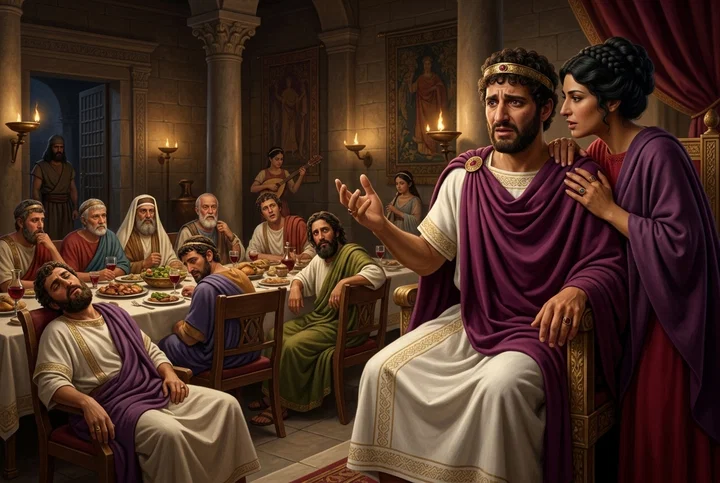
Cross-references
- Mark 6:27-28
And immediately the king sent an executioner, and commanded his head to be brought: and he went and beheaded him in the prison,
John is beheaded, and his head is brought to the girl and her mother.
- Luke 3:19-20
But Herod the tetrarch, being reproved by him for Herodias his brother Philip’s wife, and for all the evils which Herod had done,
John rebukes Herod, who imprisons him before his execution.
- Luke 9:9
And Herod said, John have I beheaded: but who is this, of whom I hear such things? And he desired to see him.
Herod recalls beheading John and wonders who Jesus is.
- Mark 6:22
And when the daughter of the said Herodias came in, and danced, and pleased Herod and them that sat with him, the king said unto the damsel, Ask of me whatsoever thou wilt, and I will give it thee.
gives dance that prompted demand
- Matthew 14:7
Whereupon he promised with an oath to give her whatsoever she would ask.
Herod says he kept his oath by giving the head
- Matthew 14:4
For John said unto him, It is not lawful for thee to have her.
John’s reproof is sealed by his beheading.
- Mark 6:23
And he sware unto her, Whatsoever thou shalt ask of me, I will give it thee, unto the half of my kingdom.
gives oath up to half the kingdom
- Mark 6:16
But when Herod heard thereof, he said, It is John, whom I beheaded: he is risen from the dead.
Herod identifies Jesus as John the Baptist risen from the dead.
- Mark 6:21
And when a convenient day was come, that Herod on his birthday made a supper to his lords, high captains, and chief estates of Galilee;
shares feast for lords and captains
- Matthew 3:13-17
Then cometh Jesus from Galilee to Jordan unto John, to be baptized of him.
This begins the period that ends with John’s death.
- Matthew 14:2
And said unto his servants, This is John the Baptist; he is risen from the dead; and therefore mighty works do shew forth themselves in him.
Herod fears Jesus is John risen from the dead.
- Matthew 17:12-13
But I say unto you, That Elias is come already, and they knew him not, but have done unto him whatsoever they listed. Likewise shall also the Son of man suffer of them.
Jesus identifies John the Baptist as the Elijah who had already come and suffered.
- Luke 7:19-28
And John calling unto him two of his disciples sent them to Jesus, saying, Art thou he that should come? or look we for another?
Both recount events surrounding John the Baptist’s imprisonment and death.
- John 1:29
The next day John seeth Jesus coming unto him, and saith, Behold the Lamb of God, which taketh away the sin of the world.
John’s testimony is recalled before his beheading.
Commentary
Each commentary is drawn from primary sources: the writings of Ellen G. White and Adventist pioneers and periodicals. Each commentary is separate. Its own words are not a quotation; follow the references to read the source passages.
Ellen G. White
31 sources
The severed head was carried on a platter into the birthday feast and handed to Herodias's daughter, who took it to her mother Herodias, ending the revelry in horror before Herod and his guests.STDA 214.1DA 220.6–221.3RH Apr 8, 1873DA 221.4–222.1
John had been imprisoned for faithfully condemning Herod's unlawful marriage to his living brother's wife, and Herodias used her daughter's dancing to secure the demand, which Herod in drunken weakness and fear of breaking his oath granted by ordering the murder.DA 214.12SP 76.1–77.1COS 144.2–3
Herodias received it with exultant revenge as silencing the voice that troubled conscience, while Herod who had feared and honored John as a true prophet and nearly become his disciple was left with deep remorse that later dulled as he turned from light.STRH Apr 8, 18733SP 135.1Ms 107, 1893, par. 12SP 81.1
The execution sealed lips that had called sinners to repentance and made John a holy martyr, yet it did not silence his influence, for his reproofs and example were remembered, enshrined in hearts, and extended to every generation.RH Apr 8, 18732SP 80.2ST Mar 3, 1881
Indulgence in gluttony, drink and pleasure beclouded judgment and made the martyrdom possible, showing that straight testimony against wrong may cost the messenger his life and that Christ does not always work a miracle to deliver His servants from a smooth path of trial.ST Mar 15, 1883Lt 107, 1897, par. 4–5RH Mar 11, 1873Ms 87, 1897, par. 14DA 380.1–2
The Murder at the Feast
John's severed head was brought in on a platter or charger and handed to Herodias's daughter, Salome, who carried it to her mother Herodias.STDA 214.1DA 220.6–221.32SP 76.1–77.1EW 124.3–125.1 That delivery completed the beheading and fulfilled the demand Herodias had arranged through her daughter.DA 220.6–221.32SP 76.1–77.1ST Mar 3, 1881 Herodias's influence had secured the execution, and the head passed from the executioner to the girl and then to her mother.STST Mar 3, 1881EW 124.3–125.1
The bringing in happened at Herod's birthday feast after Herod commanded the executioner to take John's life.RH Apr 8, 1873DA 221.4–222.12SP 80.2 The head was carried in before the king and his guests, and the night of frivolity and excess ended in the sacrifice and death of a prophet.DA 221.4–222.12SP 80.22SP 80.1 The sight horrified the guests and was more than Herod, who had heard John preach, could endure.Ms 107, 1893, par. 1
John had been imprisoned by Herod Antipas after faithfully telling him that marrying his living brother's wife was unlawful.DA 214.11RED 44.3 Herodias sought revenge for that truthful reproof of her unlawful life, and arranged the demand through her daughter's dancing before Herod.DA 214.12SP 76.1–77.1ST Herod, in weakness and drunken revelry, yielded to the demand under a foolish oath, choosing the guilt of murder to please the wicked Herodias and to satisfy revenge rather than risk being called an oath-breaker, though he knew John to be a true prophet.DA 214.12SP 76.1–77.1COS 144.2–33SP 135.1ST
Conscience and Lasting Aftermath
Herodias received the bloody severed head with fiendish satisfaction and exultation, insulting John through it in triumph over her enemy.STRH Apr 8, 18732SP 81.1 She believed she had secured her revenge and had at last silenced his voice, so that Herod's conscience would no more be disturbed by his reproofs.RH Apr 8, 18732SP 81.1 What she took for victory was the insulting handling of the head of a murdered prophet, delivered by her daughter into her own hands.STRH Apr 8, 18732SP 81.1
Herod knew John to be a true prophet of God, honored and feared him, and was stirred to the depths by reproofs that laid open the secrets of his heart and life and made his proud heart tremble.RH Apr 8, 18733SP 135.1RH Mar 11, 1873ST Jul 11, 18785RED 55.1 In many things he had reformed his dissolute life under that conviction, had designed to release John from prison, and had very nearly become his disciple.RH Mar 11, 1873ST Jul 11, 18785RED 55.1 He trembled with horror at the demand for John's head, yet put to death a man he knew to be a true prophet to gratify the revenge of a cruel and licentious woman.3SP 135.1ST Jul 11, 18785RED 55.1 Afterward he felt deep remorse and the keen stings of conscience for the deed, and the memory of the crime later troubled him and weighed upon him.ST3SP 135.1ST Jul 11, 18785RED 55.1 By turning from light into darkness his conscience grew dull and far less sensitive, his moral perceptions were degraded until his sins appeared as trifles, and about a year later he was still with Herodias, his unlawful wife, observing the Passover ceremonies.3SP 135.1Ms 107, 1893, par. 1ST Jul 11, 1878
The very act by which Herod, with reason and judgment perverted, thought to maintain his honor and dignity branded him forever with dishonor and made his name detestable.RH Apr 8, 1873 Herodias by this inhuman, satanic conduct made her name notorious and abhorred, and her corrupt life and satanic revenge stand upon the page of sacred history making her name infamous.RH Apr 8, 1873 The murder formed part of the Herodian family's history of crimes against God's servants, and the disasters that later befell the family showed God's displeasure with those crimes.SLP 255.2
The execution sealed lips that had faithfully told Herod why he could not be his disciple, had declared the necessity of reform in his life, and had called sinners to repentance in trumpet tones never to be heard again.RH Apr 8, 18732SP 80.2 The death was ignominious, the sacrifice of a great messenger of God after a night of frivolity and excess, and it made John a holy martyr.2SP 80.22SP 81.12SP 182.3 It grieved his disciples and filled them with fear about what might happen to Jesus.ST Mar 3, 18812SP 182.3 Yet it did not silence his influence, for his disciples and many who had been aroused and convinced by his teachings but had not had moral courage to stand openly now declared themselves his disciples, and his reproofs and example in reform were remembered and enshrined in hearts, bringing sorrow and regret to many, and were to extend down through every generation to the close of time.RH Apr 8, 18732SP 81.1
Faithfulness, Providence and Warning
The bringing of the head on a charger warns that indulgence in food, drink, pleasure and voluptuous dissipation can undermine justice and mercy and lead to decisions with terrible consequences.ST Mar 15, 1883RH Mar 11, 18732SP 80.1 Herodias waited for the birthday occasion of gluttony and intoxication, making costly preparations for feasting and voluptuous dissipation to entice Herod to indulge appetite, pleasure and amusement, throw him off his guard, arouse passion and excite the lower passions, and lower the tone of mental and moral character.RH Mar 11, 1873 She did so because she knew she could not obtain John's death under ordinary circumstances while intelligence controlled Herod, and because luxurious food and stimulating drinks were constantly enervating and deadening his moral as well as physical powers and warring against the earnest appeals of the Spirit of God that convicted him to put away his sins.ST Mar 15, 1883RH Mar 11, 1873 That unnatural exhilaration beclouds the senses, lowers the sensibilities to moral improvement, removes the fear of God, makes it impossible for deadened sensibilities to see facts clearly and make right decisions, makes men spiritless to the nobler demands of effort and duty, and makes it impossible for holy impulses to affect the heart and hold government over the passions.RH Mar 11, 1873 So John's martyrdom resulted from intemperance among people in authority, and the dancing of Herodias's daughter before Herod shows how alluring actions can make a destructive impression and lead people toward ruin.2SP 80.114MR 122.1
The head given to the damsel and carried to her mother illustrates that those who give straight, pointed testimony reproving wrongdoing may be hated, and that a faithful, God-given message can cost the messenger his life.Lt 107, 1897, par. 4–5STB 377.2MWISDAP 34.2Lt 399, 1904, par. 14–15 Herodias would not rest until John's head was brought to her on a platter because she hated his straight testimony.Lt 107, 1897, par. 4–5 John's pointed message cost him his life, showing the danger of speaking plainly against wrongdoing.MWISDAP 34.2Lt 399, 1904, par. 14–15 Yet his faithful message was not to be softened to keep people from being deceived.STB 377.2
John was beheaded while Christ worked no miracle to save His servant.Ms 87, 1897, par. 14 His violent death led the disciples to question why Jesus, who had great power, had not saved him, and they were inclined to reproach Christ for not saving John.Ms 87, 1897, par. 14DA 380.1–2 The bringing of the head means Christ does not promise His followers a smooth and easy path and does not always intervene miraculously to deliver them or humiliate their enemies.Ms 87, 1897, par. 14 Christ told the truth about the future beforehand so believers today will not become dissatisfied, discouraged, doubtful and offended when trial comes and when Christ does not act for them as they expect.Ms 87, 1897, par. 14
John lived a sorrowful and self-denying life proclaiming Christ's advent.Lt 1, 1858, par. 22–25 He knew that when Jesus fully established Himself as a teacher he himself would die.Lt 1, 1858, par. 22–25 The bringing of his head belongs to the gathering storm against him when he was soon to be killed.4RED 23.1
Sources
Pioneers and periodicals
58 sources
The head of John the Baptist, severed in prison, was carried on a platter into the midst of Herod's birthday feast and handed to the daughter of Herodias, who bore it to her mother as the price Herod had promised.STST Mar 2, 1904ST Mar 3, 1898ST Dec 24, 1894RH Aug 29, 1865 He died because he faithfully confronted Herod's unlawful union with his brother's wife, which awakened Herodias's bitter hatred and revenge, while Herod, convicted yet weakened by indulgence, drunkenness, lust, fear of his guests, and a rash oath, chose murder rather than seem an oath-breaker.ST Mar 15, 1883ST Dec 15, 1887ST Mar 2, 1904ST Mar 8, 1899RH Nov 11, 1858 To the last John remained true, sealing with his blood his witness to truth and righteousness rather than seeking worldly reward, and his death was not failure but success that won his Master's approval.ST Mar 3, 1898ST Mar 16, 1904ST Mar 2, 1904ST Feb 4, 1913 The scene stands as a warning against intemperance in food and drink and pleasure, against rash vows that are better broken than kept by wrongdoing, and against a neglected heart from which come the issues of life.ST Mar 15, 1883STST Mar 10, 1898ST Dec 12, 1906 His slaying foreshadowed the suffering and violent death of Jesus himself, warning Christ that His labors in Galilee must soon end through rejection.ST Jun 14, 1899
Execution Setting and Details
The head was severed in prison after the order to behead John the Baptist was given, then brought in on a charger or platter and handed to the damsel, the daughter of Herodias, who carried it to her mother Herodias in answer to her demand and in fulfillment of the command.STST Mar 2, 1904ST Mar 3, 1898ST Mar 3, 1898ST Mar 16, 1904 The completion of the martyrdom is recorded here, for the martyred forerunner of the Saviour suffered death because he faithfully proclaimed the truth, yet won his Master's approval.ST Mar 3, 1898ST Mar 16, 1904ST Dec 24, 1894 Herodias exulted over the severed head and insulted John through it, and the memory of the crime afterward troubled Herod and weighed on his conscience.ST
The delivery took place at Herod's birthday feast while the feast was still going on, when the head was carried on a tray into the banquet hall and into the revelry before Herod and his guests and given to the girl to take to her mother.ST Dec 24, 1894RH Aug 29, 1865ST Mar 3, 1898 The setting was among the columns of the royal palace on the hilltop at a supper for his lords and high captains and chief estates of Galilee, where the daughter of Herodias, Herod's brother's wife, had danced before Herod after his oath-bound promise to give whatever she asked, even to half his kingdom.RH Aug 29, 1865 Herod's heart had been hardened by prosperity as he sat looking over the beautiful valley, and with Herod and Herodias and his great men now gone and only palace ruins remaining, the bringing of the head into that revelry stands as a comment on the vanity of worldly greatness.RH Aug 29, 1865
The imprisonment, feast, and execution are located at Machaerus, the fortress prison on the borders of Arabia where John was held and killed, with the execution taking place at the feast probably at Machaerus where he was imprisoned.ST Dec 24, 1894ST Mar 3, 1898 Those who placed it otherwise located the same events at Herod Antipas's palace at Tiberias on the Sea of Galilee, with John shut in a lonely cell nearby during Antipas's birthday celebration.ST Sep 6, 1910ST Jan 17, 1911 In ministry time the martyrdom came in the third year of the ministry of Jesus while Jesus was in Galilee with His disciples, after John had been imprisoned one year and at the age of thirty-three.ST Mar 3, 1898 It stood at the close of the course from Christ's baptism in Jordan at John's hands to the parable of the tares and wheat, after thirty years of preparation for three and one-half years of work, while opposition to Christ grew stronger from the middle of the second year onward, and it brought John's preparatory work in connection with Christ's ministry to an end when that work had continued until the work of Jesus was well established.ST Mar 3, 1898ST Mar 10, 1898
In the Gospel the verse belongs to the account in Matthew 14:1-21 in which Herod Antipas, Herod the tetrarch, imprisoned and put John to death, an account that also includes the feeding of the five thousand.ST Jan 20, 1909ST May 7, 1902ST Apr 8, 1897 At the table Herod himself supplied the charger, seizing a large platter from the banquet and openly ordering the beheading by calling for Rufas the burly soldier, son of Varro, commanding him to go to the cell and bring back the head upon it, and urging haste when the soldier hesitated in astonishment before horrified guests.ST Sep 13, 1910 John was alone in his cell except that Matthias his disciple had just entered to tell him of Jesus' mighty miracles.ST Sep 13, 1910 Herod then himself first took the charger from the executioner, turning livid and hesitating with staring eyes at the ghastly burden, laying his hand upon the gory head as if compelled and lifting a long strand of hair dripping crimson drops and laying it carefully beside the head, then dazed and trembling handing the platter to the dancing girl, who received it seized with violent trembling.ST Sep 13, 1910ST Sep 13, 1910ST Sep 13, 1910 No guest stood to defend John, Chuza was horrified and at first unable to speak, and the ghastly tragedy in which the prophet was murdered marked the king's house as a house of blood.ST Sep 13, 1910ST Sep 13, 1910
Causes and Human Responsibility
John had brought Herod face to face with God's law by faithfully reproving his unlawful relationship with his brother's wife and warning that he could not share in the Messiah's kingdom while continuing in it.ST Dec 15, 1887RH Nov 11, 1858 The saving truth John preached could have saved Herod if he had accepted it, and the beheading that followed the righteous reproof shows that faithful rebuke cost John his life.RH Nov 11, 1858ST Apr 28, 1898RH Mar 3, 1904
The execution fulfilled Herodias's determined revenge and bitter hatred against John for telling Herod the truth and reproving their unlawful life and condemning her.RH Mar 11, 1873ST Mar 2, 1904ST Dec 15, 1887 She received the bloody head with fiendish satisfaction and joy, exulting that she had her revenge, and by this inhuman conduct made her name notorious, abhorred and infamous.RH Mar 11, 1873ST Feb 10, 1881 She even dishonored the dead by piercing his tongue with a bodkin. She had long held the grudge and waited for an opportunity to act against him, knowing she could not obtain his death under ordinary circumstances while intelligence controlled Herod after her unsuccessful attempts to gain Herod's consent to have him slain.RH Mar 11, 1873ST Sep 6, 1910
Herodias schemed through her daughter, urging Salome to dance before Herod and then to demand John's head on a charger as the reward for her dance.ST Sep 6, 1910ST Feb 7, 1911ST Sep 6, 1910 She used promises of gifts, wealth and status to persuade her and to prepare her to make the request at the king's birthday feast.ST Sep 6, 1910ST Sep 6, 1910ST Sep 6, 1910 In this way she arranged through her daughter's request the carrying of the severed head on a platter to the girl and by the girl to her mother, and John faithfully sealed his testimony with his blood after being imprisoned and put to death through that scheme rather than receiving worldly reward.ST Mar 2, 1904ST Apr 20, 1882ST Feb 7, 1911
Herod was convicted by John's reproofs, which told him why he could not be a disciple, laid open his heart and life, made his proud heart tremble and struck terror to his guilty conscience.RH Apr 8, 1873RH Mar 11, 1873ST Dec 15, 1887 He honored and feared John as a true prophet of God, wished to do right and to break free from sin, had in many things reformed his dissolute life, designed to release him from prison, and very nearly became his disciple.RH Mar 11, 1873ST Jul 11, 1878ST Dec 15, 1887ST Apr 20, 1882 He delayed release only through fear of displeasing Herodias, and at the point of decision fell into the snare and commanded the head of the remarkable prophet to be severed to gratify revenge, sealing lips that had faithfully declared the necessity of reform and never again would be heard calling sinners to repentance.RH Apr 8, 1873RH Mar 11, 1873ST Jul 11, 1878
Herodias covered her hatred and waited for Herod's birthday as an occasion of gluttony and intoxication with costly preparations for feasting and voluptuous dissipation.RH Mar 11, 1873 Her course was through gratification of intemperate appetite, because luxurious food and stimulating drinks were constantly enervating and deadening Herod's moral as well as physical powers and warring against the earnest appeals of the Spirit that convicted him to put away his sins.RH Mar 11, 1873 She sought thereby to entice him to indulge appetite, pleasure and amusement, throw him off his guard, arouse passion and excite the lower passions, and lower the tone of mental and moral character.RH Mar 11, 1873 That unnatural exhilaration beclouds the senses, lowers sensibilities to moral improvement, removes the fear of God, makes it impossible for deadened sensibilities to see facts clearly and make right decisions, makes men spiritless to the nobler demands of effort and duty, and makes it impossible for holy impulses to affect the heart and hold government over the passions.RH Mar 11, 1873
Weakened reason and distorted judgment from intemperance allowed Herodias to bring about the death of God's prophet, for indulgence in food, drink and pleasure can undermine justice and mercy and lead to decisions with terrible consequences.ST Mar 15, 1883ST Mar 8, 1899 Drunkenness with concern for reputation before his guests, together with the guests' silent failure to speak in John's defense, helped bring about the execution of God's innocent prophet, and the frivolity and dissipation of one night led to the sacrifice of a great prophet who had faithfully called Herod to reform.ST Dec 15, 1887ST Dec 15, 1887 The drunken court with strong drink and lust joined to Salome's dance in the crime that followed, when the head was brought to the girl and she took it to her mother.ST Dec 12, 1906 Herod's heart had been hardened by prosperity as he feasted his lords, high captains and chief estates, and with reason and judgment perverted he chose the guilt of murder rather than be called an oath-breaker, losing judgment and self-command under a woman's influence through his foolish oath, weakness and lack of courage.ST Mar 8, 1899ST Apr 20, 1882RH Aug 29, 1865 The bringing of the head into that revelry while the feast was still going on stands as a comment on the vanity of worldly greatness.RH Aug 29, 1865
The dancing at the feast led directly to John's death, when the daughter's dance prompted Herod's promise and, at her mother's urging, the request for John's head.ST Feb 18, 1886ST Aug 17, 1904 The head received on a platter and taken to her mother records the deadly outcome of the dance and the beheading.ST Feb 18, 1886ST Aug 17, 1904 Salome and Herodias are therefore presented as figures associated with that dance, making it an example used to warn against dancing.ST Apr 28, 1909
John's Faithfulness and Martyrdom
John was the martyred forerunner of the Saviour, who sealed his testimony with his blood when his severed head was carried on a platter and given to the daughter and taken to her mother in fulfillment of the plot against him.ST Mar 3, 1898ST Mar 2, 1904ST Apr 20, 1882 He suffered death because he faithfully proclaimed the truth and faithfully rebuked wrongdoing, bringing him imprisonment and death rather than worldly reward.ST Mar 16, 1904ST Apr 20, 1882 His faithful rebuke of wrongdoing and Herodias's ambition joined with Herod's weakness and lack of courage, despite conscience and wish to do right, brought about that end.ST Apr 20, 1882 Yet in dying so he won his Master's approval, and that approval is the proper aim of life.ST Mar 16, 1904
To the last he rang true with his never-varying testimony, Behold the Lamb of God who takes away the sins of the world, rebuking the sins of rich and powerful and swaying multitudes with burning eloquence.ST Jan 17, 1911 His last words were spoken with undying faith and courage as a heroic martyr, after being shut in a lonely cell and then murdered by the executioner's sword.ST Jan 17, 1911 The lips that had told of the necessity of reform and why continuance in sin barred discipleship, and that had called sinners to repentance in trumpet tones, were then sealed and never heard again.RH Apr 8, 1873
His death was not failure and not the true defeat, though his life ended in prison with his head delivered away and his career ended in eclipse rather than glory.ST Feb 4, 1913ST Aug 7, 1901 His life was successful because he remained true to duty and to what was pure, good, and true, showing that earthly defeat does not decide eternal success but its effect on eternal issues does.ST Feb 4, 1913 The cowardly ruler who ordered the killing suffered the real defeat. That ending in eclipse contrasts with Elijah, who was translated without seeing death and whose career ended gloriously, proving that John and his times did not meet all the requirements of the type in Elijah, just as Elijah and his times did not meet all of the antitype in John.ST Aug 7, 1901
His faithful witness cost him his head, a sacrifice made for God that illustrates the cost of fulfilling prophecy.RH Apr 8, 1909 His work prepared the way for Christ and continued until the work of Jesus was well established, and his death brought that preparatory work in connection with Christ's ministry to an end.ST Mar 10, 1898 That close stood at the end of the course from Christ's baptism in Jordan at John's hands to the parable of the tares and wheat, after thirty years of preparation for three and one-half years of actual work, while opposition among the Jews grew constantly stronger from the middle of the second year to the end.ST Mar 10, 1898
Aftermath and Lasting Influence
Herodias received the bloody head with fiendish satisfaction and joy, exulting that she had her revenge and that Herod's conscience would no more be disturbed.STRH Apr 8, 1873ST Feb 10, 1881 She insulted John through it, and by this inhuman and satanic conduct made her name notorious and abhorred, with her corrupt life and revenge standing on the page of sacred history to make her infamous.STRH Apr 8, 1873 Her satisfaction at receiving it did not bring her happiness.ST Dec 15, 1887
The very act by which Herod thought, with reason and judgment perverted, to maintain his honor and dignity branded him forever with dishonor and made his name detestable.RH Apr 8, 1873 He trembled with horror at the request, and afterward felt the keen stings of remorse for putting to death a man he knew to be a true prophet to gratify the revenge of a cruel woman.STST Jul 11, 1878 He called it a costly gift because it cost him a peace that would never rest in his bosom again, driving the trembling girl quickly out of his sight with the accursed thing.ST Sep 13, 1910 He trembled lest the Pharisees' doctrine of resurrection from the dead be true, though his fathers were Sadducees who do not believe in resurrection, fearing that John as a just man would rise to condemn him.ST Sep 13, 1910 His conscience afterward grew far less sensitive, and licentious life degraded his moral perceptions until his sins appeared as trifles, for men once convicted by the Spirit of truth who turn from light into darkness become capable of the worst crimes.ST Jul 11, 1878
Herodias could not silence the influence of John's reproofs and example in reform, which were remembered and enshrined in the hearts not only of his disciples but of very many who had been aroused and convinced by his teachings yet had not moral courage to stand openly.RH Apr 8, 1873ST Mar 8, 1883 They brought sorrow and regret to many hearts, and were to extend down through every generation to the close of time.RH Apr 8, 1873ST Mar 8, 1883 His murder made him a holy martyr and strengthened his influence, so that people who had been privately convinced by his teaching publicly became his disciples.ST Dec 15, 1887
The death grieved the disciples and troubled them with fear about what might happen to Jesus.ST Mar 3, 1881 The fact of the slaying was carried to Bethsaida and Capernaum so that his disciples there might go to bury him.ST Sep 27, 1910
The bringing of John's head into that revelry, while the feast was still going on among the columns of the royal palace on the hilltop at a supper for his lords and high captains and chief estates of Galilee, with Herod and Herodias and his great men now gone and only palace ruins remaining, stands as a comment on the vanity of worldly greatness.RH Aug 29, 1865 It belongs to the Herodian family's history of violence against God's servants, whose members died or were disgraced soon after, or as a direct consequence of, such acts.ST Feb 26, 1885
The account of a hero who gave his life for his Master may inspire admiration in teenagers, but its gruesome details of the head carried on a tray into the banquet hall and given to the girl can frighten very young children.
Moral and Practical Warnings
The bringing of the head on a platter is a temperance lesson, showing the deadly result when rulers indulge appetite for food, drink and pleasure.ST Mar 15, 1883ST Mar 10, 1898ST Dec 12, 1906ST Dec 15, 1887ST Mar 3, 1898 At Herod's birthday feast weakened reason and distorted judgment let revenge succeed against God's prophet, for indulgence undermined justice and mercy and led to a decision with terrible consequences.ST Mar 15, 1883ST Mar 10, 1898ST Dec 15, 1887 The drunken court and the dance ended in crime, joining strong drink and lust to murder, and Herod had been drinking freely of intoxicating wine when the head was carried in.ST Mar 15, 1883ST Dec 12, 1906ST Dec 15, 1887ST Mar 3, 1898 The feast therefore stands as a warning against pleasure-seeking and intemperance among those entrusted with authority.ST Mar 15, 1883ST Mar 10, 1898ST Dec 15, 1887
The same platter is a direct lesson on the folly of making rash vows or promises.STST Mar 10, 1898ST Mar 3, 1898RH Sep 11, 1860 Herod's foolish oath, with the mistaken belief that it must be kept, made him choose the guilt of murder rather than risk being called an oath-breaker.STST Mar 3, 1898RH Sep 11, 1860 A vow of that kind is better broken than kept when keeping it would do wrong.STST Mar 3, 1898RH Sep 11, 1860 The need laid open here is to keep the heart with all diligence, because out of it are the issues of life.ST Mar 10, 1898
Faithfulness unto death in this death receives a crown of life.ST Mar 2, 1904ST Mar 16, 1904 John suffered death because he faithfully proclaimed the truth, yet he won his Master's approval, and that approval is the proper aim of life.ST Mar 2, 1904ST Mar 16, 1904 His death as a righteous prophet made the banquet a scene of murder, after the dance before Herod and his guests.ST Sep 13, 1910ST Jan 17, 1911 Herod Antipas, the bloody, weak, detestable and execrable ruler of Galilee, whose power was feared and whose character was abhorred, murdered John the Baptizer, the prophet of the wilderness, by the executioner's sword flashing in the afternoon sunlight after John had been shut in a lonely cell at Tiberias on the Sea of Galilee, and to the last John rang true with his testimony, Behold the Lamb of God who takes away the sins of the world, rebuking the sins of rich and powerful and speaking his last words with undying faith and courage as a heroic martyr.ST Sep 13, 1910ST Jan 17, 1911
Prophecy Types and Connections
John's death foreshadowed Jesus' own suffering and death. The news of John's death reached Jesus and led Him to take the apostles apart for rest.ST Jun 14, 1899 That news warned Christ that His labors in Galilee must also soon end through the people's rejection of Him, and it held before Him the shadow of His own violent death as well.ST Jun 14, 1899
Herod was the nominal local ruler in John's day, bewitched by Herodias, a low designing woman.ST Aug 7, 1901 Their time was one of apostasy marked by cold self-righteous ceremonial hypocritical formalism, infidel critical loose liberalism, low business morals, and gross commercialism invading even the temple precincts.ST Aug 7, 1901 John as the messenger of Christ heralded the impending coming of the Lord indicated by prophecy and called people to repent and turn to obedience to God to prepare for Christ's coming.ST Aug 7, 1901 Together with the day of Elijah, when the people of God joined the world in Baal or sun-worship led by Jezebel the daughter of Ethbaal the Zidonian sun-worshiping king in an unholy union ending in treading down God's law and persecution ending in union of church and state, the condition around Herod and Herodias typifies the last days.ST Aug 7, 1901 God has used individuals of the past as archetypes of a class, the one little country as the type of the world, and the one people as the type of all who profess His name, and it takes both Elijah and John to typify the work and character of God's servants in the last days.ST Aug 7, 1901
John was slain, his head brought in and given away, so his career ended in eclipse rather than glory.ST Aug 7, 1901 This contrasts with Elijah, who was translated and did not see death, whose career ended gloriously.ST Aug 7, 1901 The contrast proves John and his times did not meet all the requirements of the type in Elijah, just as Elijah and his times did not meet all of the antitype in John.ST Aug 7, 1901
Sources