Translations
American King James Version, Douay-Rheims (Challoner revision)
Is it lawful for us to give tribute to Caesar, or no?
Is it lawful for us to give tribute unto Cæsar, or no?
is it lawful for us to give tribute unto Cesar, or no?
Is it lawful for us to give tribute to Cesar, or not?
Is it lawful for us to give tribute unto Caesar, or not?
Is it lawful for us to give tribute unto Cæsar, or not?
Is it lawful to us to give tribute to Caesar or not?'
Is it lawful for us to give tribute to Caesar, or not?
Is it allowable for us to give, unto Caesar, tribute, or not?
Berean Standard Bible, Majority Standard Bible
Is it lawful for us to pay taxes to Caesar or not?”
Is it lawful for us to pay taxes to Caesar, or not?”
Is it right for us to make payment of taxes to Caesar or not?
Is it lawfull for vs to giue Cesar tribute or no?
Pictures
Cross-references
- Matthew 22:17-21
Tell us therefore, What thinkest thou? Is it lawful to give tribute unto Caesar, or not?
Jesus answers the question about paying Caesar’s tribute and giving God His due.
- Mark 12:13-17
And they send unto him certain of the Pharisees and of the Herodians, to catch him in his words.
Jesus answers the tribute trap by distinguishing what is due Caesar from what is due God.
- Romans 13:7
Render therefore to all their dues: tribute to whom tribute is due; custom to whom custom; fear to whom fear; honour to whom honour.
Commands rendering tribute and other dues to governing authorities.
- Luke 23:2
And they began to accuse him, saying, We found this fellow perverting the nation, and forbidding to give tribute to Cæsar, saying that he himself is Christ a King.
Jesus is falsely accused of forbidding tribute to Caesar.
- 1 Peter 2:13
Submit yourselves to every ordinance of man for the Lord’s sake: whether it be to the king, as supreme;
Believers are urged to submit to civil authorities, including in matters of tribute.
- Acts 5:29
Then Peter and the other apostles answered and said, We ought to obey God rather than men.
God’s authority takes precedence when civil demands conflict with his commands.
- Mark 12:17
And Jesus answering said unto them, Render to Cæsar the things that are Cæsar’s, and to God the things that are God’s. And they marvelled at him.
Jesus distinguishes what is due to Caesar from what is due to God.
- Matthew 22:21
They say unto him, Cæsar’s. Then saith he unto them, Render therefore unto Cæsar the things which are Cæsar’s; and unto God the things that are God’s.
Christ answers the question about paying tribute to Caesar.
- Luke 20:26
And they could not take hold of his words before the people: and they marvelled at his answer, and held their peace.
shows spies silenced by the answer
- Acts 4:19
But Peter and John answered and said unto them, Whether it be right in the sight of God to hearken unto you more than unto God, judge ye.
Both ask whether obedience to human authority conflicts with what is right before God.
Commentary
Each commentary is drawn from primary sources: the writings of Ellen G. White and Adventist pioneers and periodicals. Each commentary is separate. Its own words are not a quotation; follow the references to read the source passages.
Ellen G. White
14 sources
Spies asked Jesus whether Jewish law permitted paying tribute to Rome, a tribute many Jews denied Rome had any right to demand and paid only unwillingly as the penalty for the nation's apostasy.Ms 78, 1897, par. 15–16ST Feb 8, 1899 It was a trap demanding yes or no, for approval of the tax would forfeit popular favor and seem against divine law, while rejection would expose Him to arrest by the governor as a rebel against Rome.Ms 78, 1897, par. 15–16DA 601.1–602.5 He did not evade it but answered plainly by distinguishing what belongs to Caesar from what belongs to God, pointing to Caesar's image on the coin and thereby escaping both snares.Ms 78, 1897, par. 15–16DA 725.3–6 His answer requires those living under a government to support it and remain peaceably subject to its laws, as He Himself paid tribute and taught His disciples to do.DA 601.1–602.5ST Jun 29, 1882ST Apr 25, 1878 That submission holds only so long as civil law does not conflict with higher duty, for first allegiance belongs to God and His claims.DA 601.1–602.5ST Jun 29, 1882ST Apr 25, 1878
The Trap and Setting
The question put to Jesus was whether it was lawful for Jews to pay tribute to Caesar, a point then in sharp dispute because many denied that Rome as a foreign power had any right to demand it and held that payment violated Jewish law, so that even the Pharisees who raised it paid only unwillingly.Ms 78, 1897, par. 15–16ST Feb 8, 1899ST Jun 29, 1882ST Apr 25, 1878 Israel's subjection to Rome itself was the penalty for the nation's apostasy from God.ST Apr 25, 18783SP 129.3–130.1 The tribute money in circulation bore Caesar's image and inscription, marking the power under which the people lived.3SP 129.3–130.1
The question was not honest inquiry but a trap laid by spies seeking to catch Him in His words and force Him into a yes-or-no answer from which there seemed no escape.Ms 78, 1897, par. 15–163SP 42.2Lt 59, 1890, par. 18–19Ms 71, 1897, par. 27 If He said tribute was lawful, He would lose favor with the people and be accused before the Jews as opposed to divine law.DA 601.1–602.5ST Feb 8, 18993SP 42.2ST Jun 29, 1882 If He said it was unlawful, He would appear rebellious to Rome and be reported to the Roman authorities and to the governor for arrest as a rebel.DA 601.1–602.5ST Feb 8, 18993SP 42.2ST Jun 29, 1882
It was posed under false pretenses, with insincere praise of Him as a truthful teacher, though those words were true and would stand as testimony against the questioners themselves.DA 601.1–602.53SP 41.3–4 The Herodians had been arranged to be present to witness the answer so it could be used against Him at His trial.3SP 41.3–4 The spies intended to twist whatever He said to suit their own minds, to deceive the people and create a false, misleading issue that would cloud their minds.Lt 59, 1890, par. 18–19Ms 71, 1897, par. 27 Roman observers present saw the plot fail, yet the question and answer were afterward misrepresented as evidence that He opposed paying tribute.DA 725.3–6
Duty to Caesar and God
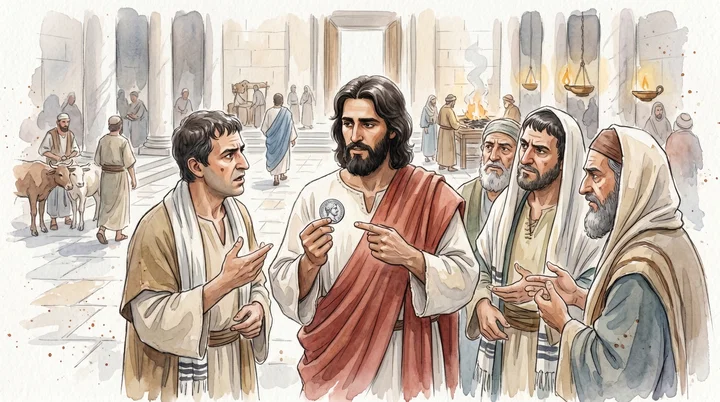
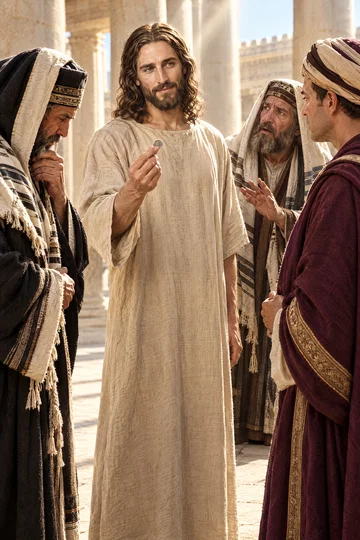
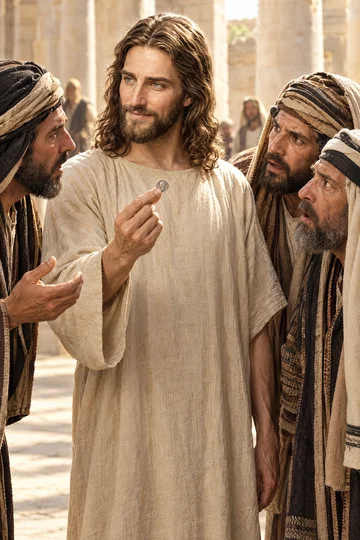
Jesus did not evade the tribute question but met it with a candid and plain and intelligent answer that drew a clear line between what belongs to Caesar and what belongs to God.Ms 78, 1897, par. 15–16ST Feb 8, 1899 He called for the tribute money and pointed to Caesar's image and inscription upon it, thereby exposing the hypocrisy of those who used the coin while denying the obligation it implied.DA 725.3–63SP 129.3–130.1ST Jul 4, 1878 In doing so He avoided both snares at once, neither forfeiting popular favor by appearing opposed to divine law nor laying Himself open to charge as a rebel against Rome.ST Feb 8, 18993SP 42.2 The principle He stated settled the vexed question for many hearers, bringing light to minds and sowing seeds of truth, though some remained dissatisfied.ST Feb 8, 1899
The answer establishes that those living under Roman protection should render support to the civil and governing power under which they live.DA 601.1–602.5ST Jun 29, 1882ST Apr 25, 1878 They are to remain peaceably subject to the laws of the land and uphold the authority that shelters them.ST Jun 29, 1882ST Apr 25, 1878ST Jun 29, 1882 Jesus Himself lived this rule, for He obeyed the ruling power, paid tribute Himself, and taught His disciples to do the same.3SP 129.3–130.1ST Jul 4, 18785RED 49.2–50.1
This submission to civil law holds only so far as it does not conflict with a higher duty.DA 601.1–602.5ST Jun 29, 1882ST Apr 25, 1878 First allegiance belongs to God, in obedience to Him and in meeting His claims.DA 601.1–602.5ST Jun 29, 1882ST Apr 25, 1878 What the state rightly claims may be given, provided duty to God is kept supreme.ST Jun 29, 1882ST Apr 25, 1878ST Jun 29, 1882
Sources
Pioneers and periodicals
15 sources
Spies sent by the scribes and Pharisees with the Herodians flattered Jesus as truthful and impartial and then pressed Him with a crafty trap over paying tribute to Caesar, where answering lawful would turn the Jews against Him as disloyal to His nation and unfit to be Messiah, and answering unlawful would expose Him to Pilate and Rome as guilty of sedition.ST Sep 24, 1894ST Oct 18, 1899ST Oct 28, 1913ST Oct 30, 1901 He exposed their hypocrisy, had them admit the coin bore Caesar's image and superscription, and answered to render to Caesar the things that are Caesar's and to God the things that are God's.ST Sep 24, 1894ST Jan 30, 1907ST Oct 18, 1899 His answer lays down the abiding rule that civil government is ordained of God only for outward civil things such as protection of life, property and reputation and support by taxes and tribute, while duty to God lies wholly between the soul and its Maker with love to the Lord first.ST Jun 29, 1882ST Sep 24, 1894ST Oct 30, 1901 Christians are therefore to live peaceably under the laws of the land and pay tribute even under unjust rule so long as obedience does not contravene duty to God, but human laws that conflict with God's law are not to be obeyed, for what bears Caesar's mark goes to Caesar and what bears God's mark, as the Sabbath does, belongs to God alone.ST Jun 29, 1882ST Sep 24, 1894ST Jan 30, 1907ST Oct 30, 1901
Trap and Setting
The question was a crafty, captious trap laid to ensnare Jesus in His talk.ST Sep 24, 1894ST Oct 18, 1899ST Oct 28, 1913ST Oct 30, 1901ST Oct 10, 1906 Spies were sent, with scribes, Pharisees and Sadducees behind them, sending their own disciples together with the Herodians.ST Sep 24, 1894ST Oct 18, 1899ST Oct 28, 1913 They came flattering Him as true and impartial and as one who regarded not the person of men.ST Sep 24, 1894ST Oct 18, 1899
It forced a yes-or-no answer with ruin on either side.ST Oct 30, 1901ST Oct 10, 1906 To say tribute was lawful would cost Him popular favor and turn the Jews against Him, making Him appear disloyal to His nation, opposed to God's law, and a failure as the Messiah to free Israel.ST Feb 8, 1899ST Jun 29, 1882ST Apr 25, 1878ST Oct 30, 1901 To say it was unlawful would expose Him to accusation of sedition and treason before the governor Pilate and the Roman authorities, as liable to arrest and crucifixion.ST Jun 29, 1882ST Apr 25, 1878ST Oct 30, 1901ST Oct 10, 1906
It was put to Him in the Temple at Jerusalem in A.D. 31, after the parable of the marriage of the king's son and of the husbandmen had exposed the Pharisees, and before the discourse on the destruction of Jerusalem and the second coming.ST Oct 18, 1899 It arose amid Jewish contention and anger over Rome's right to demand tribute from a foreign ruler, with some holding that payment violated Jewish law, while Roman authorities watched closely for resistance.ST Feb 8, 1899ST Jun 29, 1882ST Apr 25, 1878ST Oct 26, 1882 The passage about the question identifies the Roman armies as an abomination of desolation and presents Rome as a desolating power.
Render to Caesar and God
Jesus saw through the craftiness and wickedness of those tempting Him, called them hypocrites, called for the tribute money to be shown, forced them to acknowledge that the image and superscription on the coin were Caesar's, and answered that what is Caesar's is to be rendered to Caesar and what is God's to God.ST Sep 24, 1894ST Oct 18, 1899ST Oct 30, 1901 The coin bearing Caesar's mark belongs to Caesar, while what belongs to God must be rendered to God, on the principle that people acknowledge as lord the king whose money circulates among them.ST Sep 24, 1894ST Jan 30, 1907RH Mar 9, 1869 He Himself lived obedient to the governing Roman power, paid tribute Himself and taught His disciples to pay it, so the later charge that He forbade payment was false.ST Jul 4, 1878ST Sep 30, 1886ST Oct 26, 1882 Those living under Roman protection are to render support to that government.ST Jun 29, 1882ST Apr 25, 1878ST Jun 29, 1882
His answer laid down a universal and eternal principle separating duties to God and to man and settling how religious duty relates to civil government.ST Oct 30, 1901 Civil government is ordained by God only for things civil, for without government anarchy would exist.ST Oct 30, 1901 To Caesar belongs only the outward, overt acts between man and his fellows, such as respect for life, property, chastity and reputation, and payment of taxes or tribute for government support and protection.ST Oct 30, 1901 Duty to God lies wholly between the individual soul and its Maker, with the first duty to love the Lord with all heart, mind, soul and strength.ST Oct 30, 1901
Christians are therefore to pay tribute and live peaceably and remain peaceably subject to the laws of the land.ST Jun 29, 1882ST Apr 25, 1878ST Jun 29, 1882ST Sep 24, 1894 They obey truly civil laws not only for fear of penalty but for conscience' sake, even under unjust oppression, so long as obedience does not contravene duty to God.ST Oct 30, 1901 Human laws that conflict with God's law are not to be obeyed, for to obey man by disobeying God is disobedience to God.ST Sep 24, 1894ST Oct 30, 1901 What bears Caesar's mark is to be rendered to Caesar, but what bears God's mark belongs to Him, and the State has no rightful authority over religion.ST Sep 24, 1894ST Jan 30, 1907ST Oct 30, 1901 The Sabbath bears God's mark and belongs to Him, so civil government has no authority over it.ST Jan 30, 1907
Israel's subjection to Rome stood as the penalty for the nation's apostasy from God.ST Apr 25, 1878 His answer was candid rather than evasive, giving a clear principle that settled the vexed question for many hearers.ST Feb 8, 1899 They marveled at it, were not able to take hold of His saying before the people, held their peace, and left Him and went their way confused, though some remained dissatisfied.ST Oct 18, 1899RH Mar 9, 1869 The raising of this civil matter of tribute is an example of religious leaders leaving their proper work of proclaiming the Gospel and turning instead to civil power and lawmaking on religious matters, paralleling how religious lawmakers use the state to silence those who do not follow their traditions.ST
Sources