Matthew 17:25
He saith, Yes. And when he was come into the house, Jesus prevented him, saying, What thinkest thou, Simon? of whom do the kings of the earth take custom or tribute? of their own children, or of strangers?
Translations
He says, Yes. And when he was come into the house, Jesus prevented him, saying, What think you, Simon? of whom do the kings of the earth take custom or tribute? of their own children, or of strangers?
King James Version, KJV Cambridge Paragraph Bible
He saith, Yes. And when he was come into the house, Jesus prevented him, saying, What thinkest thou, Simon? of whom do the kings of the earth take custom or tribute? of their own children, or of strangers?
He saith, Yes. And when he had come into the house, Jesus anticipated him, saying, What thinkest thou, Simon? from whom do the kings of the earth take custom or tribute? from their own children, or from strangers?
Revised Version, American Standard Version
He saith, Yea. And when he came into the house, Jesus spake first to him, saying, What thinkest thou, Simon? the kings of the earth, from whom do they receive toll or tribute? from their sons, or from strangers?
And when he came into the house, Jesus anticipated him, saying, 'What thinkest thou, Simon? the kings of the earth — from whom do they receive custom or poll-tax? from their sons or from the strangers?'
He says, Yes. And when he came into the house, Jesus anticipated him, saying, What dost thou think, Simon? the kings of the earth, from whom do they receive custom or tribute? from their own sons or from strangers?
He saith—Yea. And, coming into the house, Jesus anticipated him, saying, How, to thee, doth it seem, Simon? The kings of the earth, of whom receive they dues or tax? from their sons, or from the aliens?
Berean Standard Bible, Majority Standard Bible
“ Yes,” he answered.When Peter entered the house, Jesus preempted him. “ What do you think, Simon?” He asked. “ From whom do the kings of the earth collect customs and taxes: from their own sons, or from others?”
He said, “ Yes.”When he came into the house, Jesus anticipated him, saying, “ What do you think, Simon? From whom do the kings of the earth receive toll or tribute? From their children, or from strangers?”
He says, Yes. And when he came into the house, Jesus said to him, What is your opinion, Simon? from whom do the kings of the earth get payment or tax? from their sons or from other people?
He sayd, Yes. And when he was come into the house, Iesus preuented him, saying, What thinkest thou, Simon? Of whome doe the Kings of the earth take tribute, or polle money? of their children, or of strangers?
Douay-Rheims (Challoner revision)
He said: Yes. And when he was come into the house, Jesus prevented him, saying: What is thy opinion, Simon? The kings of the earth, of whom do they receive tribute or custom? of their own children, or of strangers?
Pictures
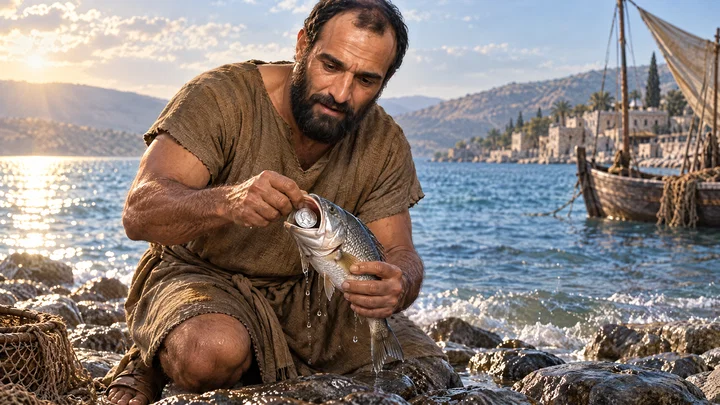


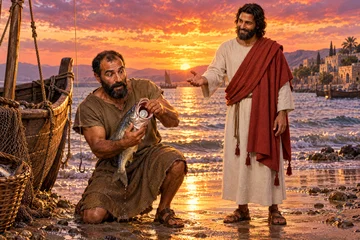
Cross-references
- Exodus 30:13-16
This they shall give, every one that passeth among them that are numbered, half a shekel after the shekel of the sanctuary: (a shekel is twenty gerahs:) an half shekel shall be the offering of the LORD.
Prescribes the half-shekel contribution for sanctuary service, the basis of the tribute.
- Matthew 22:17
Tell us therefore, What thinkest thou? Is it lawful to give tribute unto Caesar, or not?
The passage distinguishes the temple tribute from Caesar’s tax.
- Romans 13:7
Render therefore to all their dues: tribute to whom tribute is due; custom to whom custom; fear to whom fear; honour to whom honour.
Jesus paying tribute exemplifies rendering dues.
- Luke 20:22-25
Is it lawful for us to give tribute unto Cæsar, or no?
Jesus answers a question about paying tribute to Caesar.
- Mark 12:14-17
And when they were come, they say unto him, Master, we know that thou art true, and carest for no man: for thou regardest not the person of men, but teachest the way of God in truth: Is it lawful to give tribute to Cæsar, or not?
Jesus answers a question about paying tribute to Caesar.
- Matthew 22:21
They say unto him, Cæsar’s. Then saith he unto them, Render therefore unto Cæsar the things which are Cæsar’s; and unto God the things that are God’s.
Distinguishes earthly obligations from what is owed to God.
Commentary
Each commentary is drawn from primary sources: the writings of Ellen G. White and Adventist pioneers and periodicals. Each commentary is separate. Its own words are not a quotation; follow the references to read the source passages.
Ellen G. White
8 sources
The episode belongs to Jesus's return to Capernaum, where He sought a quiet setting to instruct His disciples after telling them of His coming death, resurrection, and betrayal, at a time when the disciples were disputing over who would be greatest.DA 432.1–2 The tribute at issue was the annual religious contribution required of Jews for the temple.DA 432.3–433.3 Peter hastily told the collector that Jesus would pay, without consulting Jesus.DA 432.3–433.3 Priests, Levites, and prophets were exempt, so demanding the contribution treated Jesus as an ordinary person and set aside His claim as a prophet or teacher, and either paying or refusing could be used to discredit Him.DA 432.3–433.3
When Peter came into the house, Jesus anticipated him by asking whether earthly kings take custom or tribute from their own children or from strangers and others, and Peter answered that they collect from others or strangers.DA 433.4–434.5Ms 22b, 1895 [Copy 2], par. 39–40 The question establishes that a king's children are exempt, and as the Son of God Jesus was not obligated to pay the temple tribute, unlike ordinary Israelites who supported God's service.DA 433.4–434.5 The demand involved indignity and lacked right, yet His decision to provide payment did not concede that the claim was just or deny His divine status, but displayed His divine character while avoiding needless offense.DA 433.4–434.5Ms 22a, 1895 [Copy 1], par. 35
Jesus had no money to pay the required tax and obtained the small sum needed through a miracle.Lt 119, 1893, par. 15 He willingly submitted to and paid the tribute in obedience to the governing and ruling authority, and taught His disciples to pay it.Ms 22a, 1895 [Copy 1], par. 353SP 129.3–130.1ST Jul 4, 1878Ms 22b, 1895 [Copy 2], par. 39–40 When questioned about paying Caesar's tribute, He pointed to Caesar's image and inscription on the coin and taught that what belonged to Caesar should be rendered to him.3SP 129.3–130.1 His conduct proves false the claim that He forbade payment of tribute to Caesar.ST Jul 4, 1878
His example teaches that His servants should pay what is demanded of them, including fines, rather than give offense.Ms 22a, 1895 [Copy 1], par. 35 Servants may submit to imposed payments or penalties, even when unjust, rather than cause offense, unless doing so would bring them into conflict with God.Ms 22b, 1895 [Copy 2], par. 39–40
Sources
Pioneers and periodicals
29 sources
When Peter came into the house at Capernaum after telling the collectors that Jesus paid the tribute, Jesus spoke first and anticipated him, for prevented means went before, and by children He meant the king's own family and by strangers outsiders or subjects, so that Peter's answer Of strangers established that a king's children are free.ST Jul 12, 1899ST Oct 27, 1881ST Jun 2, 1898ST Mar 26, 1896ST Mar 26, 1896 The tribute in question was the yearly half-shekel required of Jewish males for the service of the temple as an offering to God, not a Roman civil tax.ST Jul 12, 1899ST Mar 26, 1896ST Mar 26, 1896 As the Son of God whose Father's house the temple is, Jesus was not lawfully bound to pay it, and the demand upon Him was unjust.ST Oct 27, 1881RH Jul 4, 1907ST Jul 12, 1899 He is also the King and Lord of the temple and its glory, not a common worshiper or stranger who owes the tax, and approach to the Father is only through Him as the Son of the King.ST Jul 12, 1899ST Jul 22, 1913ST Mar 26, 1896 Though free, He waived His right and provided the coin for Himself and Peter by miracle from a fish's mouth so as to give no needless offense or impression that He despised the temple, giving an example of meekness that it is better to yield an unjust demand than to contend for rights when no principle is surrendered.RH Jul 4, 1907ST Jul 12, 1899RH Jan 27, 1863 His paying shows subjection to ruling authority and civil law for Christ's sake, so that Christians though belonging to God's heavenly family still render custom and tribute and obey public laws and pay taxes even when oppressive, except where God's law is violated.ST Jan 30, 1901RH Sep 18, 1866
Words and Setting
The collectors had asked Peter outside whether his master paid the tribute, and Peter had answered yes, and afterward when Peter came into the house at Capernaum Jesus spoke first and took up the matter before Peter could raise it.ST Jun 2, 1898ST Mar 26, 1896ST Mar 26, 1896RH Jan 7, 1873 In that older use prevented means went before or anticipated, not hindered or obstructed.RH Jan 7, 1873 The question about earthly kings and their taking of custom or tribute therefore belongs to this indoor exchange in which Jesus anticipates Peter after his hasty outside assurance.ST Jun 2, 1898ST Mar 26, 1896ST Mar 26, 1896
By children is meant the king's own family and household, and by strangers is meant outsiders, subjects, and other people's children, and the contrast introduces who is liable for tribute.ST Jul 12, 1899ST Oct 27, 1881ST Jan 20, 1909ST Oct 27, 1881 Peter answers, Of strangers, and the answer establishes the principle that a king's children and sons are free and exempt from dues collected for the king.ST Jul 12, 1899ST Oct 27, 1881ST Jul 12, 1899RH Jul 4, 1907
Son Free from Temple Tax
The tribute at issue was the annual half-shekel or two drachms required of Jewish males as a temple contribution for the temple's service to God, regarded as given to God, and not a Roman civil or census tax.ST Jul 12, 1899ST Mar 26, 1896ST Mar 26, 1896ST Mar 26, 1896ST Mar 26, 1896 Jesus drew the contrast between a king's own children and strangers or outsiders to show that a king's son is exempt from dues collected for the king, and Peter's answer, Of strangers, established that exemption.ST Jul 12, 1899ST Mar 26, 1896ST Mar 26, 1896 Since this offering supported the temple service, the question pointed to exemption for the One whose service it supported.ST Mar 26, 1896ST Mar 26, 1896ST Mar 26, 1896
As the Son of God, Jesus was free from that temple tax because the temple is His Father's house and its service supports His Father, so He was not lawfully required or obligated to pay it.ST Oct 27, 1881RH Jul 4, 1907RH Jul 4, 1907ST Oct 27, 1881ST Jul 22, 1913 The temple tax was for His Father's temple and His Father's house, giving Him a rightful claim to exemption as God's Son rather than standing as a subject bound to support it.ST Oct 27, 1881RH Jul 4, 1907RH Jul 4, 1907ST Oct 27, 1881 The demand upon Him was therefore unjust, though He did not insist on that right publicly lest others misunderstand and accuse Him of refusing a religious duty.RH Jul 4, 1907ST Oct 27, 1881
He was also the King and great King, the Lord of the temple and its glory to whom the temple belonged, and not merely a common worshiper nor an alien or stranger who owes the tax.ST Jul 12, 1899ST Jul 22, 1913ST Mar 26, 1896ST Jul 12, 1899ST Mar 26, 1896 Those who came to the temple came as subjects of God's house, while Jesus stood as Son of the King, and people could approach the Father only through Him.ST Mar 26, 1896RH Jan 7, 1873 This reasoning belonged to tribute collected for His Father's service and did not apply to tribute paid to Caesar, since He was not Caesar's son.ST Mar 26, 1896
Peter had rashly assured the collectors that Jesus would pay, treating Him as bound to pay it and forgetting the divine Sonship he had recently confessed.ST Mar 26, 1896ST Mar 26, 1896 His quick yes reflected that Jesus customarily met the demands made of Him and paid the taxes and tributes common where He lived.ST Mar 26, 1896RH Jan 7, 1873 Jesus used the question to impress His exalted dignity more deeply upon Peter.ST Mar 26, 1896ST Mar 26, 1896
Obedience and Example
Though free from the demand, Jesus waived his personal right and arranged to pay for both himself and Peter, sending Peter to find the coin in a fish's mouth by miracle.ST Jul 12, 1899ST Jun 2, 1898RH Jul 4, 1907ST Oct 27, 1881 He did so to avoid needless offense and stumbling, wrong impression and friction, and opposition, lest people think he despised the temple and its service.RH Jul 4, 1907ST Jul 12, 1899RH Jul 4, 1907ST Oct 27, 1881 Others would have misunderstood and accused him of refusing a religious duty if he had insisted on his exemption publicly.ST Oct 27, 1881 In giving up his own right rather than contending for it, he gave an example of meekness.RH Jul 4, 1907RH Jan 27, 1863 That example teaches that when no principle is surrendered it is better to yield to an unjust demand than to argue over one's rights and cause someone to stumble.RH Jul 4, 1907
His paying tribute and teaching his disciples to do so shows obedience and subjection to ruling authority and civil law for Christ's sake, even when taxes are oppressive or unjust.ST Jan 30, 1901ST Mar 26, 1896RH May 9, 1865 Those adopted into God's heavenly family belong to a higher kingdom and are only subordinate citizens of earthly governments, yet this does not cancel the duty to obey the government under which they live.RH Sep 18, 1866 Christians must render the custom, tribute, fear and honor due to the State, obey public laws where they live, and pay taxes levied by public authority rather than rebelling to reform national politics.ST Jan 30, 1901RH Sep 18, 1866ST Mar 26, 1896 The miraculous way the coin was produced proved he was Creator even of the very powers he was obeying.ST Jan 30, 1901 Governmental powers are of divine institution, because their protection preserves religious and personal liberties and their law restrains violations of personal rights when fear of God does not, which is why prayer is made for kings and all in authority that a quiet and peaceable life in godliness may be led.ST Jan 30, 1901
No subjection is required to any statutory requirement that violates God's law.ST Jan 30, 1901 Paying tribute is compatible with refusing personally to fight, even though the government may use the money to pay soldiers, since Christians need not personally fight or pay others specifically to fight for them.RH May 9, 1865 Civil power rightly extends over Christ and his people, and the charge that he forbade payment to Caesar was false.RH Nov 29, 1870 He had no coin to pay his tax until the fish furnished it, and Peter himself had little silver and gold of his own to pay with.RH Nov 4, 1873RH Apr 15, 1875RH Oct 4, 1870 This shows Jesus lived poor and destitute, dependent, homeless, and without property or grave of his own from manger to ministry to death.RH Nov 4, 1873
His poverty was voluntary, he who was rich becoming poor that others through his poverty might be rich, and his life is therefore the greatest example against covetousness and gives force to his command to take heed and beware of covetousness.RH Nov 4, 1873 In contrast, one who exempts himself and his clergy from the temporal sword and authority is contrary to Christ and is antichrist, since Christ paid tribute and put himself under temporal authority instead of exempting himself.RH Nov 29, 1870 Christ paid tribute while the pope takes tribute.ST Jun 15, 1904 Peter's poverty, with no money and no costly possessions, exposes the wealth claimed by his professed successor, such as an $8,000 ring set with pearls, rubies and diamonds.RH Apr 15, 1875 The paying of the tribute money has been misused in disputes over civil and spiritual authority as evidence that Christ recognized temporal power as superior to spiritual power.RH Dec 12, 1907
Sources