Matthew 21:13
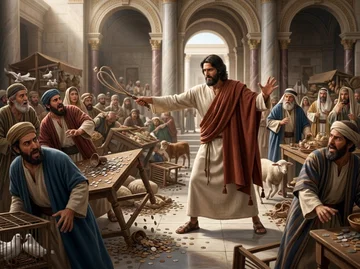
And said unto them, It is written, My house shall be called the house of prayer; but ye have made it a den of thieves.
Translations
And said to them, It is written, My house shall be called the house of prayer; but you have made it a den of thieves.
And said unto them, It is written, My house shall be called the house of prayer; but ye have made it a den of thieves.
and said unto them, It is written, My house shall be called the house of prayer; but ye have made it a den of thieves.
And said to them, It is written, My house shall be called the house of prayer, but ye have made it a den of thieves.
Revised Version, American Standard Version
and he saith unto them, It is written, My house shall be called a house of prayer: but ye make it a den of robbers.
and he saith to them, 'It hath been written, My house a house of prayer shall be called, but ye did make it a den of robbers.'
And he says to them, It is written, My house shall be called a house of prayer, but ye have made it a den of robbers.
and saith unto them—It is written, My house, a house of prayer, shall be called; but, ye, are making it, A den of robbers!
And He declared to them, “ It is written: ‘ My house will be called a house of prayer.’ But you are making it ‘ a den of robbers.’”
And He declared to them, “ It is written: ‘ My house will be called a house of prayer.’ But you have made it ‘ a den of robbers.’”
He said to them, “ It is written, ‘ My house shall be called a house of prayer,’ but you have made it a den of robbers!”
And he said to them, It is in the Writings, My house is to be named a house of prayer, but you are making it a hole of thieves.
And said to them, it is written, My house shall be called the house of prayer: but ye haue made it a denne of theeues.
Douay-Rheims (Challoner revision)
And he saith to them: It is written, My house shall be called the house of prayer; but you have made it a den of thieves.
Pictures
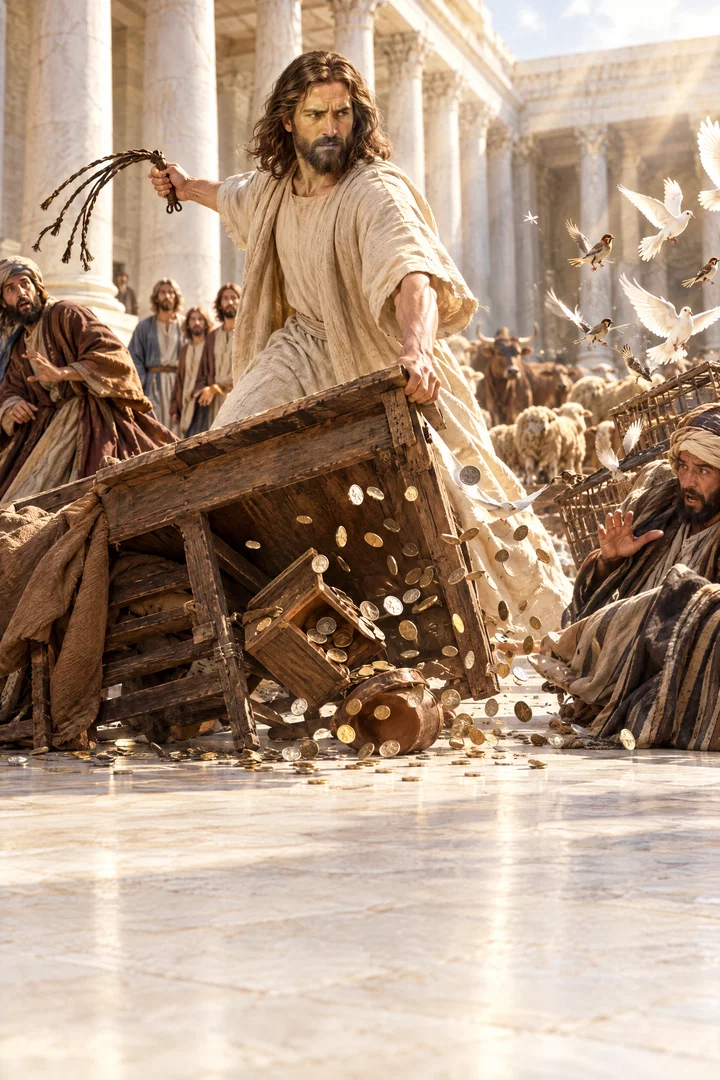
Cross-references
- John 2:14-16
And found in the temple those that sold oxen and sheep and doves, and the changers of money sitting:
Jesus drives traders from the temple and rebukes its misuse.
- Isaiah 56:7
Even them will I bring to my holy mountain, and make them joyful in my house of prayer: their burnt offerings and their sacrifices shall be accepted upon mine altar; for mine house shall be called an house of prayer for all people.
Calls God’s house a house of prayer for all people.
- Jeremiah 7:11
Is this house, which is called by my name, become a den of robbers in your eyes? Behold, even I have seen it, saith the LORD.
Both condemn God’s house as a den of robbers.
- Mark 11:15-17
And they come to Jerusalem: and Jesus went into the temple, and began to cast out them that sold and bought in the temple, and overthrew the tables of the moneychangers, and the seats of them that sold doves;
Jesus drives out merchants and condemns the temple’s misuse.
- Luke 19:45-46
And he went into the temple, and began to cast out them that sold therein, and them that bought;
Parallel account of Jesus cleansing the temple and restoring it as a house of prayer.
- John 2:15
And when he had made a scourge of small cords, he drove them all out of the temple, and the sheep, and the oxen; and poured out the changers’ money, and overthrew the tables;
Christ drives exploitative sellers from the temple with a scourge.
- Matthew 23:38
Behold, your house is left unto you desolate.
Jesus declares the temple left desolate after its rejection.
- Psalms 69:9
For the zeal of thine house hath eaten me up; and the reproaches of them that reproached thee are fallen upon me.
Jesus’ zeal for God’s house is shown in the temple cleansing.
- Matthew 21:23
And when he was come into the temple, the chief priests and the elders of the people came unto him as he was teaching, and said, By what authority doest thou these things? and who gave thee this authority?
The leaders question Jesus’ authority after the temple cleansing.
- 1 Corinthians 3:16-17
Know ye not that ye are the temple of God, and that the Spirit of God dwelleth in you?
Believers are God’s holy temple, called to keep it pure and undefiled.
- Malachi 3:1-3
Behold, I will send my messenger, and he shall prepare the way before me: and the Lord, whom ye seek, shall suddenly come to his temple, even the messenger of the covenant, whom ye delight in: behold, he shall come, saith the LORD of hosts.
The coming Lord purifies his temple and his people.
- Matthew 27:51
And, behold, the veil of the temple was rent in twain from the top to the bottom; and the earth did quake, and the rocks rent;
The temple veil was torn at Christ’s death, marking the temple’s rejection.
- Mark 11:15-16
And they come to Jerusalem: and Jesus went into the temple, and began to cast out them that sold and bought in the temple, and overthrew the tables of the moneychangers, and the seats of them that sold doves;
Jesus drives out merchants and forbids carrying vessels through the temple.
- Mark 11:18
And the scribes and chief priests heard it, and sought how they might destroy him: for they feared him, because all the people was astonished at his doctrine.
The chief priests and scribes plotted against Jesus after his temple action.
Commentary part 1 of 2
Each commentary is drawn from primary sources: the writings of Ellen G. White and Adventist pioneers and periodicals. Each commentary is separate. Its own words are not a quotation; follow the references to read the source passages.
Ellen G. White
126 sources
It was spoken at His second cleansing of the temple near the close of His ministry, declaring that the temple belongs to God and is set apart for prayer, yet its outer court had been turned into a noisy cattle market and money exchange.9T 75.1–2Ms 120, 1901, par. 3–4Lt 78, 1903, par. 5–81RED 74.1–2ST Mar 28, 1878
The den of thieves was dishonest gain made from worship, as priests and traders together profited by forcing worshipers, especially the poor and those from afar, to pay unjust prices for offerings and coin.Ms 120, 1901, par. 3–4Lt 41, 1890, par. 26–29Ms 105, 1898, par. 22–25Ms 63, 1899, par. 20–22Ms 51, 1897, par. 2–3
With divine authority as heaven's King He cast out buyers and sellers, overthrew tables and seats, and then guarded His house by healing and teaching there.STGC 21.48T 92.3Lt 113, 1903, par. 19–20Ms 7a, 1886, par. 8–11Ms 23, 1908, par. 37–38
The two cleansings together foreshadow the final warning work and judgment on impenitence, pointing to Jerusalem's ruin and to Christ again cleansing His temple before His second coming.Ms 32, 1898, par. 4–8STOM 31.1STBk 39.1–40.14MR 242.1Ms 11, 1903, par. 15–17
That same cleansing must be repeated in God's institutions when commercial work supplants sacred service, and in the heart where selfishness and love of money defile the soul Christ bought for Himself.RH Dec 31, 1908SPBC 166.68T 92.4RH Aug 26, 1909Ms 148, 1899, par. 20–22
Temple Cleansing Occurred
The saying was uttered at a second driving of traders from the temple near the close of earthly ministry, three years after a first driving at the commencement of public ministry.Lt 78, 1903, par. 5–8Ms 32, 1898, par. 4–8STOM 31.1COS 99.1ST Mar 28, 1878 The earlier and later cleansings are distinct acts, the one at the beginning and the one almost at the close, together forming a twofold work.Ms 51, 1897, par. 2–3STOM 31.1ST Mar 28, 1878 On this second visit He again found the same abominable practices and the same defilers in buying and selling and exchange of money.COS 99.1ST Mar 28, 1878 He interfered with the merchandise in the courts and set aside the profitable arrangement of stalls, condemning robbery and oppression that desecrated them.Lt 78, 1903, par. 5–8Ms 51, 1897, par. 2–3Ms 32, 1898, par. 4–8 Priests and rulers had become familiar with sacred blood yet lost sight that sin made the shedding of beasts necessary, that it prefigured the blood of God's dear Son to be shed for the life of the world, and that sacrifice was to direct men to a crucified Redeemer.ST Mar 28, 1878
It was Passover time, when Jerusalem was crowded with people from a distance and large crowds were already going to the temple early in the morning.Ms 120, 1901, par. 3–41RED 74.1–2 Each person attending brought money paid to the priests on entering, and foreign coins and different denominations had to be changed to accommodate strangers.1RED 74.1–2 The outer court had been arranged as a cattle market and place of general traffic, with stalls for beasts and tables where priests themselves acted as money-brokers and exchangers.1RED 74.1–23MR 61.4 What began under the plea of accommodating those who came from far and could not bring sacrificial offerings had grown into disgraceful traffic and a source of great profit, with sales made immense by the many beasts sacrificed yearly.Ms 120, 1901, par. 3–41RED 74.1–2 The courts stood like an ordinary active market, full of noisy clamor with buying and selling and exchange of produce.Ms 70, 1886, par. 93MR 61.4
Dealers and priesthood profited together, realizing large gain shared with avaricious men of authority.Ms 51, 1897, par. 2–31RED 74.1–2 Sellers were oppressed by being made to sell sacrificial animals cheaply, then worshipers coming from a distance who could not bring offerings and were forced to buy in Jerusalem were robbed by resale of cattle, sheep, doves and sparrows at exorbitant prices.Ms 120, 1901, par. 3–4Ms 105, 1898, par. 22–25Ms 63, 1899, par. 20–2215MR 35.2–4 Men sat counting money gained by fraudulent transactions and money-changing, taking unjust advantage of circumstances while professing to obey truth.Ms 120, 1901, par. 3–4Ms 63, 1899, par. 20–2215MR 35.2–4 Hypocritical speculators under cover of holy profession practiced extortion and false dealing, making sacred office a source of personal revenue.1RED 74.1–23SP 21.1–2 The sacrifices meant to point to Christ's blood soon to be shed were treated as profit, and leaders failed to value what they represented.3SP 21.1–2
The court became a noisy cattle market rather than the sacred temple of God.ST Jan 4, 18771RED 74.1–2 There was sharp bargaining, buying and selling, lowing of cattle, bleating of sheep, cooing of doves, chinking of coin, and angry disputation.1RED 74.1–2 Buying, selling and noise disturbed worshipers and drowned out their words to God.ST Jan 4, 18771T 471.2–473.1 Turning sacred things down to a level with common things, with trade excused by the plea that articles were for offerings but aimed at gain and accumulation, made the service of God contemptible.Ms 51, 1897, par. 2–31T 471.2–473.1 Busy trading showed no regard for sacredness, as in a Sunday market at Nimes compared to those courts.Ms 70, 1886, par. 93MR 61.4
He cast out all who sold and bought, drove out sellers and buyers with majesty and power that stopped the traffic and made them flee.Ms 105, 1898, par. 22–25Ms 23, 1908, par. 37–38 He drove the sheep and cattle from the precincts, poured out the changers' money, and overthrew the tables of the money-changers and the seats of those selling doves.STGC 21.48T 92.3Ms 23, 1908, par. 37–38Ms 63, 1899, par. 20–22Lt 138, 1901, par. 10–11 At times He took a scourge of small cords used to drive cattle, with eye flashing with indignation at fraudulent transactions, robbery and extortion.Ms 63, 1899, par. 20–2215MR 35.2–4 He commanded the trade to be removed and restored the purpose of prayer against greed and avarice.
After the expulsion He acted as guardian of the place, asserting that it belonged to God and was to be treated as sacred.Ms 7a, 1886, par. 8–11 His authority and purity silenced those present and cleared the way for people to come for healing in body and soul.Ms 7a, 1886, par. 8–11Ms 2, 1885, par. 22–23 The courts were filled with sick and dying seeking Him as their only hope, and the blind and the lame came to Him in the temple and He healed them, which was true medical missionary work following at once upon cleansing.Ms 2, 1885, par. 22–23Ms 63, 1899, par. 20–22ST Mar 28, 1878 He taught the people while children praised Him as the Son of David, fulfilling God's word despite leaders' attempts to silence praise.GC 367.1–2COL 272.3–273.1 Priests and elders, struck with conviction that He was no common man, yet remained prejudiced and jealous.COL 272.3–273.1
Sacred House Profaned
The temple is God's own house, set apart by Him for prayer and sacred service, belonging to Him and to be treated as holy.3SP 23.1–24.1Ms 7a, 1886, par. 8–11DA 589.1–590.21RED 76.1–3LC1 76.1–78.1 It was meant to be a house of prayer, but buying and selling there profaned it and turned it into a place of dishonest gain and exploitation.9T 75.1–23SP 23.1–24.1Ms 7a, 1886, par. 8–11 Jesus asserted that ownership and sacredness when He cleansed it of traffic and bartering, surveying the scene first with calm dignity and then with stern judgment, driving out the traders and their animals and clearing the way for people to come to Him for healing.3SP 23.1–24.1Ms 7a, 1886, par. 8–111RED 76.1–3 His words carry divine authority and final warning as Israel's King, condemning the corruption and commanding the trade to be removed, showing that His love and mercy do not exclude stern justice toward desecration.3SP 23.1–24.1Lt 113, 1903, par. 19–20DA 589.1–590.2 His face lit with divine light and His form towered in commanding authority, reading every heart and hidden motive until the crowd felt arraigned before God, His clear ringing voice echoing through the arches like the voice that shook Mount Sinai, as the Majesty of Heaven standing like the Judge at the last day and acknowledged for the moment as Master.1RED 76.1–3LC1 76.1–78.1 His zeal for the temple reflected that authority, and His presence made the temple sacred even as His rebuke exposed the guilt of those who desecrated it.LC1 76.1–78.1
To call it a den of thieves means prayer had been replaced by thievery, worship turned into merchandise, and a place devoted to God turned into a place of dishonest gain, robbery, oppression and sacrilegious profit.9T 75.1–2Lt 84a, 1896, par. 3–48T 92.3Ms 37, 1894, par. 1–2Lt 56, 1896, par. 8–9 A place set apart for prayer had been made into a place of dishonest trade and unholy buying and selling, and Christ's cleansing by overturning the tables of the money-changers and driving out sheep and cattle expressed God's righteous indignation at that corruption.Ms 2, 1902, par. 11Lt 84a, 1896, par. 3–48T 92.3Ms 37, 1894, par. 1–2 The selling and money-changing dishonored God and oppressed worshipers by making access to sacrificial offerings costly, and His words were a decisive judgment on the priests and rulers who took part in the traffic.Ms 37, 1894, par. 1–2Lt 56, 1896, par. 8–9 The sacred house meant for prayer had been turned into a place of theft and the worship of wealth, and divinity flashing through His humanity made priests and rulers flee before Him as from a flashing sword or as from an avenging angel.Lt 84a, 1896, par. 3–4Lt 56, 1896, par. 8–9
The thievery was robbery of worshipers, especially the poor and those from afar who could not bring their offerings and were forced to buy in Jerusalem, by exacting exorbitant prices for beasts for sacrifice and by money-changing.Ms 120, 1901, par. 3–4Lt 41, 1890, par. 26–29Ms 37, 1894, par. 1–2Ms 128, 1899, par. 16–18Ms 63, 1899, par. 20–22 Priests and rulers took unjust advantage of circumstances while professing to obey truth, buying animals for offerings cheaply and selling them at exorbitant prices.Ms 120, 1901, par. 3–4Ms 105, 1898, par. 22–25 They first oppressed sellers by buying sacrificial animals cheaply, then robbed worshipers by reselling cattle, sheep, doves and sparrows at excessive prices under pretense of serving the Passover worship.Ms 105, 1898, par. 22–25Ms 63, 1899, par. 20–22 Men sat counting money gained by fraudulent transactions and money-changing, and during Passover traffickers sold sacrificial animals and birds at high prices until Christ with flashing eye of indignation took a scourge of small cords used to drive cattle, drove out buyers and sellers, and overthrew the tables of the money-changers and the seats of dove-sellers.Ms 128, 1899, par. 16–18Ms 63, 1899, par. 20–22 Yet Christ and His disciples gave all possible dignity and sacredness to the temple and its services, which by God's appointment were to continue until type met antitype in the death of the Lamb of God, even though the temple would be destroyed a few years later.Ms 120, 1901, par. 3–4
Their greed and avarice had overcome religious duty, making leaders and traders no better than thieves in God's sight.Lt 113, 1903, par. 19–20DA 589.1–590.2RH Feb 13, 1900ST Mar 28, 18783SP 20.2 At the close of His mission Christ found the temple desecrated by buying, selling and money-changing with its leaders themselves driven by greed, and He spoke with authority and power to expose the corruption.Lt 113, 1903, par. 19–20RH Feb 13, 1900 The Jews had turned the Father's house into a place of theft and extortion, violating the spirit of the law while claiming to keep its letter, and the cleansing exposes the contrast between outward religious appearance and true inner holiness.2SP 129.2–130.24RED 13.2–14.3 Avarice was the besetting sin of the Jews and the point on which Judas was overcome, and because the profitable arrangement of stalls for sales brought great profits, setting it aside and condemning it made the service of God contemptible in their eyes and aroused their most bitter enmity, so that any interference with this extortion and commercial income would not be tolerated.Ms 51, 1897, par. 2–3 The temple's beauty did not make its worshipers or services holy, for priests and rulers exploited worshipers through dishonest, exorbitant prices while claiming to serve God acceptably, and Christ's cleansing showed He was a truer friend to its sacred purpose than the leaders who violated it.2SP 129.2–130.2Ms 120, 1901, par. 5–6 The law forbade hatred and theft, yet the people profaned God's house while claiming to serve Him, and their hypocrisy appeared further in condemning children's joyful praise as polluting the sacred place while tolerating angry disputes, buying and selling, and animals within its precincts.2SP 129.2–130.2ST Mar 28, 1878
Divine Authority Revealed
He spoke the sentence with divine authority, exposing corruption and commanding the trade to be removed from the courts meant for prayer.Lt 113, 1903, par. 19–20Ms 127, 1899, par. 1–4DA 590.3–591.1 His clear ringing voice echoing through the arches was like the voice that shook Mount Sinai, and as the Majesty of Heaven He stood for the moment acknowledged as Master by all.1RED 76.1–3 With calm dignity passing into stern judgment He surveyed the buying and selling, read every heart and hidden motive, and made the crowd feel arraigned before God as before the final Judge.1RED 76.1–3LC1 76.1–78.12SP 117.1–3 The guilty understood His words, feared His judgment, and obeyed without resistance, while His zeal made His presence itself consecrate the place He defended.Ms 127, 1899, par. 1–4LC1 76.1–78.1
Divinity flashed through His humanity as He cleansed the place profaned by unholy traffic and exploitation.Lt 84a, 1896, par. 3–43SP 23.1–24.1ST Feb 10, 1898 His face lit with divine light and His form towered in commanding authority, expressing God's righteous indignation and righteous anger at the dishonor.Lt 84a, 1896, par. 3–4Ms 32, 1898, par. 4–81RED 76.1–3 The priests and rulers fled before Him as if confronted by a flashing sword, as if pursued by armed soldiers, as from the presence of an offended God and an avenging angel.Lt 84a, 1896, par. 3–4Ms 105, 1898, par. 22–25ST Feb 10, 1898 Their terror at His rebuke revealed the authority of divinity shining through His humanity.Ms 88, 1899, par. 1–4Ms 32, 1898, par. 4–8
Their flight before a humble Galilean, even though no visible divine judgment afterward fell upon them, stands as sufficient evidence of His divinity.ST Feb 10, 1898 His soul-searching look alone was so powerful that even a murderous crowd would have been compelled to flee from His presence.COS 127.2–4
His love and mercy did not exclude stern justice toward desecration, and His authority and purity silenced those present and drove them from the temple.3SP 23.1–24.1Ms 2, 1885, par. 22–23ST Mar 28, 1878 They obeyed His command to remove animals and merchandise without resistance, an authority the priests and elders afterward could not deny even when they challenged it.Ms 127, 1899, par. 1–4COL 272.3–273.1COL 273.2–3 The act was His final warning and authoritative command as Israel's King, condemning greedy buying, selling, money-changing and extortion that made its perpetrators no better than thieves, and commanding the defilement to be removed.DA 589.1–590.2DA 590.3–591.1ST Aug 4, 1909 That display of divine authority should have led the people to worship Him, though the authorities feared losing their power and the cleansing left the traffickers unable to remain.ST Feb 15, 18992SP 120.2–121.1 The disciples remembered how the desecrators fled as if pursued by armed soldiers, and hoped He would act with the same power at His trial to disperse the crowd and prove Himself Israel's King, but He did not.SG1 51.2EW 139.3
Judgment And Prophecy Foretold
The cleansing at the beginning of public ministry and the cleansing almost at the close of ministry together foreshadow the last work for the warning of the world.STOM 31.1STBk 39.1–40.14MR 242.1 In that final warning two distinct calls are made to the churches.STOM 31.1STBk 39.1–40.14MR 242.1 Those two calls are the second angel's message and the heavenly call for God's people to come out of Babylon.STA 39.1Lt 1f, 1890, par. 16–17
The cleansing pointed to Jerusalem's doom, dispersion and ruin for wickedness and impenitence.3SP 20.1ST Aug 4, 1909ST Jan 10, 1878 Like the withering of the fruitless fig tree, the nation made a show of privilege and devotion while lacking piety and good works and being separated from God, and its rejection of Christ brought destruction upon Jerusalem and its temple.Ms 32, 1898, par. 4–8ST Feb 15, 1899 Christ's warning and call to repentance and His weeping over Jerusalem reach rejecters today who reject truth when it conflicts with their practices and inclinations.3SP 12.1 The purification of the temple at the beginning and close of ministry shows that God purifies His church too through tests and trials for its present and eternal good.9T 228.2Ms 34, 1900, par. 47RH Sep 24, 1903 Those trials deepen piety, strengthen the church, express His care, and fit it to carry the gospel throughout the world.9T 228.2Ms 34, 1900, par. 47
Before His second advent Christ will again cleanse His temple and purify it in displeasure, because commercial work has been brought into it and God has been forgotten.Ms 11, 1903, par. 15–17 The picture of a den of thieves also applies to a world made corrupt by love of money and display just before Christ's second coming.PK 650.3–651.1 There wealth is gained through fraud and oppression while poor laborers are deprived so the rich can indulge extravagance or hoard.PK 650.3–651.1 The cleansing near the end of His life, with words carrying the force of judgment, foreshadowed judgment on those who reject heaven's messages and refuse offered pardon.Lt 56, 1896, par. 8–9STMW7 54.1–2 Then hidden sins will be solemnly declared, and like the priests and rulers fleeing the temple as from an avenging angel, the impenitent will be powerless to respond.Lt 56, 1896, par. 8–9STMW7 54.1–2
Institutions Must Be Cleansed
God's publishing house becomes a den of thieves, in a defilement worse and tenfold more disastrous in result than the defilement of the temple, when it prints and sends out matter that should never be placed in the hands of workers in His institution.STGC 21.48T 92.3Lt 138, 1901, par. 10–11 The cleansing Christ performed by overturning the tables of the money-changers and driving sheep and cattle from the precincts applies to the Review and Herald Office, the Echo office, and every publishing house dedicated to God, which He would cleanse as He cleansed the courts at Jerusalem.8T 92.3Ms 47, 1898, par. 28–306MR 268.1–269.3Lt 129, 1895, par. 1–3 Such matter dishonors the Redeemer, unsettles faith in Christianity, sows seeds of doubt and unbelief about Scripture, argues that Christ was only a man, educates infidels, brings in Satan and his sophistry, promotes false doctrines, and poisons workers' minds like the desecration of the temple in Christ's day.Ms 47, 1898, par. 28–306MR 268.1–269.3Lt 46, 1903, par. 9–10 Therefore the pernicious, degrading and doubt-sowing matter must be discarded, no longer printed and forever excluded, and only what honors God and serves prayer and truth published instead.6MR 268.1–269.3Lt 138, 1901, par. 12–13
It becomes a den of thieves by transgressing God's law and betraying His cause, putting commercial work first and letting it assume supremacy over printing and circulating stirring appeals for truth and literature of the purest quality and most elevating character.8T 92.4STGC 22.1Lt 138, 1901, par. 12–13 Some of that commercial work is of a most objectionable character, and when it receives the time and talent of the workers while the sacred work gets little or no attention, the sacred purpose for which the institutions were established to publish present truth for the last days is lost sight of through perverted spiritual perception and contracts entered merely for gain.8T 92.4Lt 140, 1901, par. 1–4Lt 138, 1901, par. 12–13 That means absorbing in other work the time, talent and energies that should prepare God's truth for circulation, wasting time, misapplying talent, misappropriating money, and leaving undone the work that ought to have been done.8T 92.4STGC 22.1Lt 138, 1901, par. 12–13 It means exalting Satan's sentiments and printing his theories by presses that should circulate God's truth, and coveting promotion while under the ban of God's displeasure, so that loss is infinitely better than dishonorable gain.8T 92.4STGC 22.1Lt 138, 1901, par. 12–13 Those who brought it in must repent before God whose wrath is kindled against them, and more time must be given to publishing and circulating books containing present truth unto perfection to diffuse the light of heaven and warn the world that the end of all things is at hand.Lt 138, 1901, par. 12–13
The same rebuke falls on unholy traffic and unrighteous barter in publishing houses, on unjust, dishonest and selfish schemes, and on practices that deprive people of their rights, which are not Christ's order but Satan's and which God weighs and angels record.Ms 2, 1902, par. 11Ms 2, 1902, par. 12Lt 76, 1895, par. 9–1118MR 218.1–3 It falls on harsh, domineering treatment of the ignorant and helpless, on overbearing men inducing brethren to sell rights and publications by specious reasoning, and on unfaithful conduct by workers in religious institutions that violates justice like the abuses in the temple courts and brings them to account.Ms 7, 1902, par. 20Lt 4, 1895, par. 11SPBC 166.6 Heaven sees such transactions, sacred institutions must not be turned from their God-given purpose into places of exploitation, and God will not indefinitely tolerate such wrongdoing but will cleanse as He cleansed the temple courts.Ms 7, 1902, par. 20Lt 4, 1895, par. 1118MR 218.1–3
What Christ did at Jerusalem He would do to the publishing houses, the Review and Herald office, the Echo office, and the institutions at Battle Creek, which have been turned into desecrated shrines for unholy merchandise and traffic.STGC 38.2–39.118MR 218.1–3Lt 31, 1898, par. 9–12 There injustice and fraud are carried on, and selfishness, malice, envy, passion, cherished selfishness and love of money, and strife bear sway, with everyone seeking gain for himself, while those leading in wrong principles are unconscious of their wrong course and treat warnings and reproof as idle tales.STGC 38.2–39.1Lt 31, 1898, par. 9–12 Jerusalem, favored as depositary of sacred trusts yet perverting truth, despising entreaties and warnings, and polluting the temple courts with merchandise and robbery, stands as representation and warning of what every church will become by rejecting God's warnings, repeating her sin until by long departure from just and righteous principles light and truth, justice and mercy are no longer discerned.STGC 38.2–39.1Lt 31, 1898, par. 9–12 Christ comes to investigate and sorrows and weeps over churches and institutions of learning that fail to meet God's demand, having done all that could be done and flashed light to keep sins from reaching the boundary where repentance cannot be felt.STGC 38.2–39.1Lt 31, 1898, par. 9–12
The temple's need for cleansing is the model for cleansing churches, sanitariums, schools, boards and courts, for institutions in Battle Creek called temples needing purification when corruption dishonors His name and the pursuit of control displaces evangelical religion.Lt 83, 1896, par. 38–40Lt 225d, 1906, par. 15–16STMW6 45.2 The Lord will likewise cleanse the Board of unfit members whose dishonest, unchristian conduct and wrong spirit in management make the work an offense to God, and sanitariums must likewise be cleansed of commercial enterprises that corrupt a house of prayer.Lt 225d, 1906, par. 15–16Lt 57, 1891, par. 7–9 That cleansing must come before true healing and godly work can follow, for after the cleansing all the sick were brought to Him and He healed them, revealing true godliness and true righteousness and the true practical use of the temple that brings no defilement.4MR 244.1 A cleansing of temple and courts must be done in the church, as begun at the General Conference to be carried to every Seventh-day Adventist church in America with earnestness, fervor, true zeal and God's blessing, yet failing of completion because Satan interposed with prepared deception, faith of many was dead being alone, and especially those in responsible positions quenched the Spirit; life and power cannot be manifested until faith which works by love and sanctifies the soul is seen.Lt 163, 1899, par. 9–10 So too the publishing office must be cleansed to become an educating place where young people are led to give hearts to the Lord and servants are pious and devoted to holy purposes.SPBC 166.6Lt 83, 1896, par. 38–40
To call God's organized, commandment-keeping church a den of thieves is an erroneous use of Scripture.RCOC 9.1–5 Yet churches that retain on their books names of those who sin and refuse to repent and fail to separate them from fellowship would come to the place where they need this reproof, lest saints be held accountable for evil deeds of the unrepentant, and churches filled with sacrilegious things that dishonor God's purpose and corrupt or abuse His house fall under the same warning.11MR 208.1–3Lt 215, 1902, par. 1–10Ms 37, 1894, par. 15 The rebuke falls on turning churches into places of feasting and unholy trade conducted in religion's name to encourage appetite, greed or pleasure and replenish the treasury, which Jesus would drive out as He drove the money-changers who desecrated a place devoted to prayer.GC88 474.2GC 474.2–475.1 It falls on selling indulgences by church authority to build St. Peter's church with proceeds of wrongdoing, treating grace as merchandise, and on introducing merchandise and peddling in a series of meetings for gain and accumulation, even selling publications on present truth in connection with preaching, which diverts minds from solemn impressions and destroys fruit of labor and levels sacred things with common things.1T 471.2–473.14SP 101.3ST Jul 12, 1883 It falls on fashionable dress that distracts from Christ and the sermon, dishonors God's house, makes the poor reluctant to enter, and calls for driving out desecrators, and on Sunday trading like Nimes market that shows no regard for sacredness.1T 471.2–473.14T 642.4–643.1
Applied to schools, the cleansing means Christ would banish corrupting books that mislead students, promote false principles and misrepresent God, removing what defiles as He banished what defiled the temple.CT 25.2FE 174.2 In their place He would put sound knowledge, principles and teachings fit to guide heart and conduct.CT 25.2FE 174.2
Soul Temple Cleansed
The courts crowded with unholy trade represent a heart defiled by sinful desires, selfish lusts and evil habits, and by cleansing the temple Jesus announced His mission to cleanse the heart from sin.RH Dec 31, 1908ST Aug 15, 18783SP 12.1 The soul is Christ's temple, bought with His blood, where Christ should be enshrined, but selfishness, love of the world and of money, mammon, malice, envy, pride, passion and unholy passions cherished within corrupt its courts and turn them into places of unholy traffic.RH Aug 26, 19093SP 12.15T 72.3TBC1882 54.2–3 Sin and rebelliousness desecrate that inner temple just as traffic desecrated Jerusalem's courts, and a heart that rejects mercy and warnings becomes open to robbers and a den of thieves, bringing ruin.ST Aug 15, 18785T 72.3 The Jerusalem temple was meant to witness to the high destiny open to every person of becoming a temple for God's Spirit.RH Dec 31, 1908 Christ's warning and call to repentance reach people today, yet many reject truth when it conflicts with their practices and natural inclinations.3SP 12.1
The driving of buyers and sellers from the temple must be repeated in the soul temple.Ms 148, 1899, par. 20–22Lt 102, 1905, par. 8–11 The buyers and sellers are worldly merchandise and commercial burdens mingled with God's sacred entrusted goods of means and physical and mental powers, with cherished sins and whatever tarnishes or corrupts, including a selfish grasping spirit that uses sacred courts for merchandise and dishonest buying and selling in violation of fairness and justice.Ms 148, 1899, par. 20–22Ms 7, 1902, par. 24–25Lt 102, 1905, par. 8–11 Those entrusted goods are to be kept unmingled and invested wisely in the Master's service to increase the talents and accomplish results as far reaching as eternity, with doing the Master's bidding and promoting His work as the one aim and purpose of life.Lt 102, 1905, par. 8–11 The leaven of worldliness permeates the mind and destroys accountability as God's servants and spiritual discernment, so cleansing brings upward growth, the Holy Spirit working on the heart to transform the character, a mind not stagnant or reproached for doing nothing, a generous spirit shown in kindness and tender regard for others, and self hid with Christ in God through beholding Christ's character unto His likeness.Lt 102, 1905, par. 8–11 Such conduct dishonors the sacred character of truth and turns what is devoted to God into a place of wrongdoing.Ms 7, 1902, par. 24–25
When truth does not abide in the heart and sanctify the whole person, the soul becomes like the temple defiled by buyers and sellers.Lt 5b, 1891, par. 13 Truth as it is in Christ must have a lasting place within and, through the Holy Spirit, shape everything a person does and says and hold the citadel of the soul.Lt 5b, 1891, par. 13Lt 41, 1890, par. 23–25 When truth thus holds the citadel and God is enthroned in the heart, there is no selfish buying and selling for the Saviour, who still searches the heart as He searched the temple, to condemn.Lt 41, 1890, par. 23–25 In a Christian physician this means selfishness is emptied out, Christ fills the heart, and he will not charge exorbitant prices or take more than is honestly due, but will serve with unselfish love for souls.Lt 41, 1890, par. 23–25
The soul belongs to Christ, who alone can cleanse and keep His temple, so a person defiled by yielding thoughts or feelings to Satan should promptly confess sin, seek cleansing through Christ, and commit the soul to His care.Ms 73, 1893, par. 14–16 Every worker should thus cleanse his own soul-temple and cooperate with Christ in purifying sacred work, for the house made for prayer is the place for sacred work, and mingling the sacred and the common until the sacredness of God's work is lost makes it a den of thieves.Ms 133, 1901, par. 4–7Lt 31, 1891, par. 23–26 Unholy traffic to be cast out is works of a worldly character that charm the senses and fill the mind but give no spiritual nourishment, no true idea of Christian life, and no instruction in common duties, breathing an atmosphere detrimental to solid Christian experience and weakening spiritual life, out of place in work entrusted with sacred things.Ms 133, 1901, par. 4–7Lt 31, 1891, par. 23–26
Unjust gain in work done for God brings Christ's rebuke as it did upon the priests and rulers, who exacted exorbitant prices for beasts for sacrifice until He overthrew the tables of the money-changers and the seats of dove-sellers with divinity flashing through humanity.Lt 41, 1890, par. 26–29 The same words condemn practicing physicians called Christians who charge exorbitant prices for their services, since the medical profession is under the Lord's jurisdiction with a standard of righteousness no less than that of the farmer, the merchant, or the minister.Lt 41, 1890, par. 26–29Lt 41, 1890, par. 23–25 Christ drives extortioners from His courts with the scourge of small cords to cleanse unlawful practice from sacred work, for the den of thieves is a noble or philanthropic profession, especially medicine, governed by selfishness, fraud, extortion and overcharge for simple service.1MR 211.1 Selfishness is an attribute of Satan, and the principles that control action determine character and destiny in probationary time, so a multitude of sins covered under the profession are witnessed in every unholy transaction and met with a just verdict in every case.1MR 211.1 Many things thought lawful and right are unlawful and must be driven out, and as a general thing the medical profession has become such a den, though many good and merciful acts have been done by physicians; in connection with the cause of God the Christian physician's work is to be beautified by Christ's presence and cooperation through self-denial, but when men become extortioners all Christ can do is drive them out.1MR 211.1
The same condemnation requires cleansing and purifying of marketplaces, merchandise stores, courts of justice, lawyers' offices, the medical fraternity, and medical missionary work from every dishonest transaction, because God will not join dishonesty or be a party to any dishonest transaction.Ms 63, 1899, par. 20–2215MR 35.2–4 The temple courts had been corrupted when Pharisees and doctors of the law led buyers and sellers to buy cattle at the lowest prices and sell them at high prices to people coming from a distance who could not bring their offerings and were forced to buy in Jerusalem, while men sat counting money gained by fraudulent transactions and money-changing, until with eye flashing with indignation Christ took a scourge of small cords used to drive cattle and drove out buyers and sellers and overthrew the tables and seats.Ms 63, 1899, par. 20–2215MR 35.2–4 God's house is for prayer, not dishonest gain, and its cleansing was followed at once by true medical missionary work when the blind and lame came to Him in the temple and He healed them.Ms 63, 1899, par. 20–22 Sabbathkeepers stamped with the sign of God's government must honor that sign by righteous and honest dealing and by following Christ's compassionate methods.Ms 63, 1899, par. 20–2215MR 35.2–4
God will visit with judgment those who profess to serve Him yet really serve mammon.ST Nov 17, 18814T 252.2ST Oct 25, 1910 Disregarding the Lord's express command in order to advantage themselves heaps future woe upon themselves.ST Nov 17, 1881 Like the Jews, God's people make the temple a place of merchandise and a den of thieves when they sacrifice religion for worldly gain, preserve a form of piety while giving all the mind to temporal pursuits, turn His house into a place of trade for their own gain, and fail to consider God's law first of all and obey it in spirit and in letter.ST Nov 17, 18814T 252.2ST Oct 25, 1910 The temple cleansing condemns robbery and oppression even when practiced by people engaged in sacred work, and Christ's rebuke of Jerusalem applies to people in every age who profess godliness while acting unjustly, greedily seeking gain, and oppressing others; unless they repent, they will face God's judgment.Lt 25, 1894, par. 4–6 It calls the church to examine whether it is repeating the Jews' misuse of the temple, which was meant to be a house of prayer but had been turned into a place of commerce and theft.4T 252.2
Christ cleansed the temple by driving out those who bought and sold there, rebuking profanation, while still longing for the defilers to recover from the enemy's snare.Lt 45, 1891, par. 3–4 In this condition of cherished selfishness and defilement His love is despised, His speaking by mercies is unacknowledged, His solemn warnings are rejected and ridiculed, and His ambassadors are treated with indifference as if their words were idle tales.TBC1882 54.2–3 Jesus views His professed followers today as He viewed the Jews in their neglect and rejection of present opportunities, seeing base ingratitude, hollow formalism, hypocritical insincerity, Pharisaical pride and apostasy.TBC1882 54.2–3 Rejecting His mercies and warnings leaves the soul's temple defiled, and over such impenitence and ingratitude of every individual to the close of time fall the tears He shed on the crest of Olivet over Jerusalem.5T 72.3TBC1882 54.2–3
Worldly interests and selfish use of what God has entrusted must be driven out, so that the life is kept sacred for service to God.RH Aug 26, 1909 The office is to be made a house of prayer, and when made so God will be present in religious exercises and in work.RH Aug 26, 1909Ms 101, 1901, par. 34 Plans devised under Satan's influence corrupt sacred work when God's warnings are ignored, as attractive presentations and pleasing words turn sacred work away from its true purpose and conceal error, turning God's house meant for prayer into a place serving dishonest purposes.Lt 301, 1903, par. 4–6 Turning a place or work devoted to God into a den of thieves by scheming, false representation, and dishonest business dishonors God's character, for managing sacred work does not justify sharp or dishonest dealing.Lt 80, 1897, par. 4–5Ms 7, 1902, par. 24–25Ms 120, 1901, par. 7 Such wrongdoing calls for full repentance and restitution, and those who disregard God's commands will suffer the consequences of transgression.Lt 80, 1897, par. 4–5Ms 120, 1901, par. 7
Sources