Matthew 21:11
And the multitude said, This is Jesus the prophet of Nazareth of Galilee.
Translations
American King James Version, King James Version, KJV Cambridge Paragraph Bible, Webster Bible
And the multitude said, This is Jesus the prophet of Nazareth of Galilee.
Revised Version, American Standard Version
And the multitudes said, This is the prophet, Jesus, from Nazareth of Galilee.
And the multitudes said, 'This is Jesus the prophet, who [is] from Nazareth of Galilee.'
And the crowds said, This is Jesus the prophet who is from Nazareth of Galilee.
And, the multitudes, were saying—This, is the prophet Jesus,—He from Nazareth of Galilee.
Berean Standard Bible, Majority Standard Bible
The crowds replied, “ This is Jesus, the prophet from Nazareth in Galilee.”
The multitudes said, “ This is the prophet, Jesus, from Nazareth of Galilee.”
And the people said, This is the prophet Jesus, from Nazareth of Galilee.
And the people said, This is Iesus that Prophet of Nazareth in Galile.
Douay-Rheims (Challoner revision)
And the people said: This is Jesus the prophet, from Nazareth of Galilee.
Pictures
Cross-references
- Luke 19:37-40
And when he was come nigh, even now at the descent of the mount of Olives, the whole multitude of the disciples began to rejoice and praise God with a loud voice for all the mighty works that they had seen;
Jesus enters Jerusalem amid public praise and says the stones would cry out if the disciples were silenced.
- John 12:13
Took branches of palm trees, and went forth to meet him, and cried, Hosanna: Blessed is the King of Israel that cometh in the name of the Lord.
The crowd welcomes Jesus with palm branches and royal acclamations.
- Mark 11:1-10
And when they came nigh to Jerusalem, unto Bethphage and Bethany, at the mount of Olives, he sendeth forth two of his disciples,
The crowd welcomes Jesus into Jerusalem as the coming king.
- Zechariah 9:9
Rejoice greatly, O daughter of Zion; shout, O daughter of Jerusalem: behold, thy King cometh unto thee: he is just, and having salvation; lowly, and riding upon an ass, and upon a colt the foal of an ass.
Foretells the Messiah’s humble royal entry into Jerusalem.
- Psalms 118:26
Blessed be he that cometh in the name of the LORD: we have blessed you out of the house of the LORD.
The crowd’s hosannas echo the blessing for the one who comes in the Lord’s name.
- John 12:17-18
The people therefore that was with him when he called Lazarus out of his grave, and raised him from the dead, bare record.
Witnesses testified about Lazarus’s resurrection, drawing people to meet Jesus.
- Matthew 21:15-16
And when the chief priests and scribes saw the wonderful things that he did, and the children crying in the temple, and saying, Hosanna to the Son of David; they were sore displeased,
Children praise Jesus in the temple, echoing the multitude’s public praise.
- John 12:19
The Pharisees therefore said among themselves, Perceive ye how ye prevail nothing? behold, the world is gone after him.
Records the rulers’ alarm that the world was following Jesus.
- Matthew 27:22-23
Pilate saith unto them, What shall I do then with Jesus which is called Christ? They all say unto him, Let him be crucified.
The crowd later demands that Jesus be crucified.
- Isaiah 42:1-4
Behold my servant, whom I uphold; mine elect, in whom my soul delighteth; I have put my spirit upon him: he shall bring forth judgment to the Gentiles.
The prophecy describes Christ’s gentle work and mission.
- Luke 19:41-44
And when he was come near, he beheld the city, and wept over it,
Jesus weeps over Jerusalem and warns of its destruction.
- Exodus 12:3-14
Speak ye unto all the congregation of Israel, saying, In the tenth day of this month they shall take to them every man a lamb, according to the house of their fathers, a lamb for an house:
Jesus is presented at Passover as the antitypical Lamb.
- Matthew 23:39
For I say unto you, Ye shall not see me henceforth, till ye shall say, Blessed is he that cometh in the name of the Lord.
Christ’s coming is welcomed with words of blessing.
Commentary
Each commentary is drawn from primary sources: the writings of Ellen G. White and Adventist pioneers and periodicals. Each commentary is separate. Its own words are not a quotation; follow the references to read the source passages.
Ellen G. White
27 sources
The multitude's answer was given as Jesus rode into Jerusalem on a donkey amid a rejoicing crowd, publicly identifying Him as Jesus the prophet from Nazareth of Galilee.DA 569.3–4GC88 367.2Ms 128, 1899, par. 13–14DA 569.1–2DA 569 The crowds flocking from the surrounding region had been drawn by firsthand accounts of His works of mercy and by the raising of Lazarus, and they spread garments and branches while praising God and honoring Him as King.Ms 128, 1899, par. 13–144RED 120.21T 57.3–58.13SP 250.3Ms 128, 1899, par. 1 They hailed Him as Messiah, King, and Son of David, with hopes rising for a new kingdom and with the disciples expecting Him to take an earthly throne, free Israel from Rome, and restore its independence.DA 569.3–44RED 120.2EW 206.4 The ride fulfilled Zechariah 9:9 of Israel's King coming to Jerusalem, He accepted their homage as prophecy had to be fulfilled, and the acclaim publicly directed attention to Him before His approaching sacrifice.GC 367.1–2DA 569.1–2EW 206.42SP 384.1–385.11T 57.3–58.1 That deliberate display at Passover pointed to His crowning sacrifice as Redeemer and as the antitypical Lamb voluntarily set apart for the sins of the world.2SP 384.1–385.1ST Jun 8, 1882DA 571.2–4 The triumph shortly before His crucifixion foreshadowed His future coming in the clouds with power and glory with angels and rejoicing saints, while His tears over Jerusalem were a final appeal of rejected love pointing to the city's coming doom for failing to recognize its Redeemer.Lt 82, 1907, par. 93SP 20.13SP 9.1
Entry Setting and Crowd
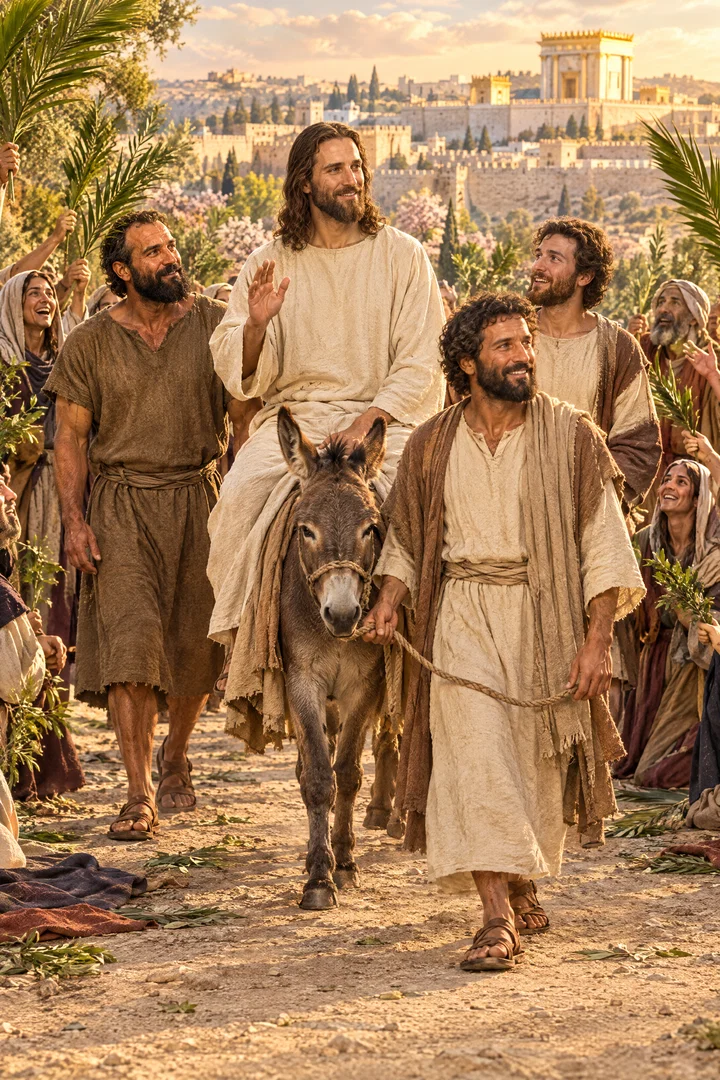
This is Jesus riding in royal entry into Jerusalem, coming on a donkey amid a rejoicing multitude.DA 569.1–2DA 569Lt 80, 1890, par. 43SP 250.3 The scene belongs to His triumphal riding into the city, with joyful shouts echoing on the slopes of the Mount of Olives.DA 569Lt 80, 1890, par. 43SP 250.3
The multitude's words publicly answer who He is, identifying Him as Jesus the prophet of Nazareth of Galilee.DA 569.3–4GC88 367.2Ms 128, 1899, par. 13–14DA 569.1–2DA 569 That declaration was made amid the crowds accompanying Him into Jerusalem and amid praise for His merciful works, which many had experienced firsthand and recounted, stirring the whole multitude to acclaim Him.DA 569.3–4Ms 128, 1899, par. 13–14 It was a public recognition during His entry into the city, when hopes for a new kingdom were rising.DA 569.3–4DA 569.1–2
The entry drew growing crowds flocking from all the surrounding region to join His progress into Jerusalem.1T 57.3–58.1ST Jun 8, 1882 They welcomed Him joyfully with palm branches and spread garments in His path, hailing Him as the Son of David.1T 57.3–58.1COS 90 The public excitement and welcome drew attention to Jesus, while the rulers were alarmed that so many people were following Him.ST Jun 8, 1882
The crowd was drawn by His works of mercy recounted firsthand by those He had healed and rescued.Ms 128, 1899, par. 13–144RED 120.2 The raising of Lazarus had deeply affected the people and helped draw the multitude, and many wanted to see Him.4RED 120.2Ms 128, 1899, par. 1 The procession displayed the results of that work, as those He had healed or rescued, and Lazarus whom He had raised from the dead, praised God and honored Jesus as their King.4RED 120.2
Hopes for a new kingdom were rising, and the crowds hailed Him as Messiah, King, and Son of David.DA 569.3–44RED 120.22SP 384.1–385.11T 57.3–58.1DA 570.1–571.1 They believed their emancipation from Roman rule and Israel's independence were near.DA 570.1–571.1 The disciples shared the expectation that He would take an earthly, temporal kingdom and rule as a temporal prince, to be crowned to reign on David's throne.EW 206.41T 57.3–58.1
Priests, elders, and rulers sought to still the multitude.1T 57.3–58.1 They threatened those who acknowledged Him as the Christ, and at one point the adult crowd fell silent under the priests' and rulers' threats.GC 367.1–2GC88 367.23SP 14.1–2
Prophecy Fulfillment and Foreshadowing
The ride on the colt fulfilled Zechariah's prophecy, including Zechariah 9:9, of Israel's King coming to Jerusalem in the Messiah's royal entry, and Jesus accepted the people's homage as that King.DA 569.1–2EW 206.4DA 570.1–571.1 Prophecy had to be fulfilled, so that even the stones would cry out if the people held their peace.1T 57.3–58.1 The multitude's naming of Him as Jesus the prophet of Nazareth of Galilee belongs to that fulfillment and records the crowd's recognition of Him during His entry into the city.DA 569.1–2
The public acclaim confessed His kingdom and honored Him as the Son of David with titles foretold by the prophets, hailing Him as Messiah and King.GC 367.1–22SP 384.1–385.13SP 14.1–2 That recognition came despite the authorities' threats against those who acknowledged Him as the Christ, and it publicly directed attention to Him before His approaching sacrifice.2SP 384.1–385.13SP 14.1–2 When priests and rulers silenced the adult crowd, children continued the praise in the temple courts.GC 367.1–2GC88 367.2 Their praise fulfilled prophecy, and God's use of children to proclaim Jesus at His first advent shows He can also use children to give the message of His second advent to all peoples and lands.GC 367.1–2GC88 367.2
Isaiah's prophecy connected with the entry presents Christ as God coming to His people, ruling with power and caring for them like a shepherd who gathers and carries the lambs, amid the people's praise and rejoicing.Ms 151, 1899, par. 5 The entry deliberately drew all eyes to Jesus at Passover time to point to His crowning sacrifice as Redeemer at the end of His mission to a fallen world.2SP 384.1–385.1ST Jun 8, 1882DA 571.2–4 As the antitypical Lamb He by a voluntary act set Himself apart as an oblation for the sins of the world.ST Jun 8, 1882 The startling public demonstrations were ordered before His death to call the attention of all people to the sacrifice itself, to be the talk of every tongue and bring Jesus before every mind, to cause all eyes to follow His rapid progress to the final end, so that every fact connected with His death would be verified beyond doubt and the church in all future ages would make His death a subject of deep thought and study.ST Jun 8, 1882 In this one triumphant scene of His earthly life He remained true to the humiliation He had accepted, bearing the burden of humanity instead of appearing escorted by heavenly angels and heralded by the trumps of God, until His life was given for the life of the world.ST Jun 8, 1882
After His crucifixion these events would be remembered and connected with His trial and death, leading people to search the prophecies, prove Him the Messiah, recognize Him, and multiply converts to faith in Him in all lands.ST Jun 8, 1882DA 571.2–4 The disciples' high hopes were shattered when the Master they believed would reign was stretched upon the cruel cross beneath mocking, taunting Pharisees and then crucified and buried, with the darkness of death closing about them in a disappointment greater than the disappointment over 1844.EW 206.41T 57.3–58.1 After He rose and appeared to them their hope revived, showing He was true to His promises with sweet consolation for His people and rich reward for the true and faithful.EW 206.41T 57.3–58.1
The triumphal ride shortly before His crucifixion foreshadowed His future coming in the clouds with power and glory, accompanied by the triumph of angels and the rejoicing of the saints.3SP 9.1 The entrance together with His tears over Jerusalem pointed to the city's coming doom for failing to recognize its Redeemer, with His tears as a final appeal of rejected love and compassion to a people who rejected Him.3SP 20.1ST Jan 10, 1878ST Feb 15, 1899 The chapter's fruitless fig tree and the fig-tree lesson immediately following warn against professing to serve God without bearing fruit in one's life to His glory.Lt 82, 1907, par. 9ST Feb 15, 1899
Call to Faithful Response
Christ's riding into Jerusalem is the coming of the Son of God to this world to draw all men unto Himself.Ms 5, 1882, par. 11 That coming calls His followers to walk in the light of His glorious example.Ms 5, 1882, par. 11 It calls them to maintain the truth in its purity.Ms 5, 1882, par. 11 It calls them to push the triumphs of His cross and to extend His kingdom without questioning the cost in labor and trial and suffering.Ms 5, 1882, par. 11
Preaching this entry exalts and lifts up Jesus.Lt 27, 1880, par. 8 Such preaching proves that keeping the law is not being saved by law, but exalts Jesus even more than do those who bring that charge.Lt 27, 1880, par. 8 The message draws large crowds.Lt 27, 1880, par. 8 It brings conviction that leads to baptism and to uniting with the church.Lt 27, 1880, par. 8
The account of Christ's journey to Jerusalem at the time of His triumphal entry expresses the longing to see the despised and rejected Christ crowned and seated on His throne.Lt 82, 1907, par. 9
Sources
Pioneers and periodicals
43 sources
The verse is the crowd's answer when Jerusalem was stirred by his arrival and asked who he was, publicly identifying him as the prophet from Nazareth of Galilee and bearing testimony to his prophetic mission in his triumphal entry.ST Apr 14, 1898ST Apr 14, 1898ST Jul 2, 1894ST Sep 27, 1899 The rejoicing multitudes welcomed him as the Son of David with shouts of blessing in the name of the Lord, spreading garments and branches in the way after seeing his healings and raising of the dead, while children sang his praise in the temple courts.ST Oct 5, 1904ST He came riding on an ass and its colt as the meek King and Prince of peace, not as a hero of war, in fulfillment of Zechariah 9:9.ST Oct 5, 1904RH Nov 18, 1862ST Mar 27, 1901ST Feb 6, 1901 The homage strengthened the disciples' hope that he would then take the throne as a temporal king, and their hopes were shattered a few days later when he went to the cross instead of a palace, a bitter disappointment deeper than that of 1843.ST Aug 13, 1902RH Jul 25, 1865ST Jul 27, 1882 That disappointment was part of God's plan, for coming at Passover as the antitypical Lamb he deliberately drew all eyes to himself to point to his crowning sacrifice for the sins of the world, even as he wept over the city that would reject him and face destruction for not knowing its visitation.ST Jun 8, 1882ST Jan 10, 1878STRH Jul 25, 1865RH Aug 24, 1869
Entry and Identification
The multitude's answer when Jerusalem was stirred by Jesus' arrival and asked, Who is this, was that this is Jesus the prophet from Nazareth of Galilee, bearing public testimony to his prophetic mission during his triumphal entry.ST Apr 14, 1898ST Apr 14, 1898ST Jul 2, 1894ST Sep 27, 1899 That identification belongs to the disciples' joyful public welcome of Christ at his first advent, a loud cry of praise and honor to him.ST Jul 2, 1894ST Oct 5, 1904 The rejoicing crowds welcomed him as the Son of David, crying Hosanna to the Son of David, Blessed is he that cometh in the name of the Lord, Hosanna in the highest, after witnessing his mighty works of healing the sick and raising the dead.ST Oct 5, 1904STRH Feb 6, 1866 Most spread their garments in the way and others cut branches from trees and spread them in the way, while those going before and following cried out, and children sang Hosanna in the temple courts.RH Apr 11, 1912ST Oct 5, 1904RH Feb 6, 1866 The growing crowds joined his entry and the public excitement and welcome drew attention to him.ST Jun 8, 1882
He entered Jerusalem riding upon an ass and a colt the foal of an ass procured by two disciples, in the role of meek King, that prophecy might be fulfilled.ST Oct 5, 1904RH Nov 18, 1862 It is the only record of Jesus riding except in a boat, observed as Palm Sunday and as the Fiesta de Ramos, part of a week that includes Holy Thursday, Good Friday, and Holy Saturday.ST Oct 5, 1904ST Feb 11, 1903 The procession moved over Olivet toward Jerusalem about thirty-three years after his birth, with Jesus seated on the ass, majestic in mien and benign in countenance, while the whole city was moved to ask who he was.RH Nov 25, 1873
The entrance took place near the end of his ministry at Passover time, only a few days before his crucifixion, when he allowed the multitudes to give him full public honor in a striking scene before Gethsemane.ST Nov 8, 1883ST Feb 14, 1878ST Jul 22, 1886RH Jul 6, 1869 It stands at the close of the first advent and immediately before the temple cleansing and expulsion of the money changers and merchants, the fig-tree lesson, the parables of the two sons, the wicked husbandmen and the marriage feast, the betrayal, trial, crucifixion and resurrection.ST Aug 27, 1912ST Feb 14, 1878 The next event of importance afterward was the institution of the Lord's Supper.ST Luke gives the fullest account of the triumphal entry scene, which is also found in Matthew 21, Mark 11 and John 12.ST
Prophecy and Fulfillment
The humble entry riding on a young donkey fulfills the prediction of the coming meek King in Zechariah 9:9, Tell ye the daughter of Zion, Behold, thy King cometh unto thee, meek, and riding upon an ass, and the people's spreading of garments and cut branches and crying Hosanna to the Son of David accorded with that prophecy.ST Oct 5, 1904RH Nov 18, 1862ST Mar 27, 1901ST Nov 8, 1883 The entry took place near the end of his ministry only a few days before his crucifixion, when he came to Jerusalem about thirty-three years after his birth in a rejoicing procession over Olivet, seated on an ass procured by two disciples, majestic in mien and benign in countenance, while the whole city was stirred to ask who he was.ST Oct 5, 1904ST Nov 8, 1883RH Nov 25, 1873 What Zechariah foretold was meant literally, and his coming in this manner proves it.RH Nov 25, 1873
The shouting of the believing disciples and little children, Hosanna to the Son of David, thereby fulfilled prophecy.RH Feb 6, 1866 They rejoiced with mistaken expectations about the nature of the event, yet their mistakes did not prevent them from fulfilling Scripture.RH Aug 24, 1869 Their experience parallels correctly announcing the end of prophetic time and the coming of God's judgment while being disappointed about how it would be fulfilled.RH Aug 24, 1869
Jesus deliberately ordered the demonstrations before his death to draw all eyes to himself and point to the crowning sacrifice that would end his mission to a fallen world.ST Jun 8, 1882 Coming to Jerusalem at Passover time as the antitypical Lamb, by a voluntary act he set himself apart as an oblation for the sins of the world, remaining true to the humiliation he had accepted and bearing the burden of humanity instead of appearing escorted by heavenly angels and heralded by the trumps of God until his life was given for the life of the world.ST Jun 8, 1882 The startling public events were meant to be the talk of every tongue and bring Jesus before every mind, so that every fact connected with his death would be verified beyond doubt, prophecies would afterward be searched to prove him the Messiah, converts to faith in him would be multiplied in all lands, and the church in all future ages would make his death a subject of deep thought and study.ST Jun 8, 1882
Those who held for a change of the Sabbath teach that Matthew 21:1-12 fulfills Psalm 118:22-24, where the stone the builders rejected becomes the head stone of the corner, showing by divine appointment that the Sabbath was changed from the seventh to the first day to commemorate the resurrection day as a greater event than creation.RH May 10, 1860 The same passage, as those who opposed that teaching hold, contains no mention of the resurrection day, the seventh day, the Sabbath, or a change of the Sabbath, and gives no command or authority for keeping the first day.RH May 10, 1860
Christ and His Mission
The multitude's answer when Jerusalem asked who was arriving identified Jesus as the prophet from Nazareth of Galilee, bearing public testimony to his prophetic mission during the triumphal entry.ST Sep 27, 1899 His entry on the ass presented him as the Prince of peace, not a hero of war or display.ST Mar 27, 1901 It displayed the self-denying love of his kingdom in contrast to the force and military power used by earthly rulers.ST Mar 27, 1901ST Feb 6, 1901
In this chapter he comes as a businessman and special agent of his Father to attend to his Father's business.ST Nov 20, 1884 The Father had planted a vineyard and let it out to husbandmen who refused to make returns when called upon by authorized collectors, until finally the Son came to attend to the business.ST Nov 20, 1884 Coming to Jerusalem at Passover time as the antitypical Lamb, by a voluntary act he set himself apart as an oblation for the sins of the world.ST Jun 8, 1882 He deliberately ordered the demonstrations before his death to draw all eyes to himself and point to the crowning sacrifice that would end his mission, so that the startling public events would call the attention of all people to the sacrifice itself and cause all eyes to follow his rapid progress to the final end.ST Jun 8, 1882 In this one triumphant scene of his earthly life he remained true to the humiliation he had accepted, bearing the burden of humanity instead of appearing escorted by heavenly angels and heralded by the trumps of God, until his life was given for the life of the world.ST Jun 8, 1882
To call him the prophet of Nazareth is not enough if he is treated only as a human ideal to admire and imitate.RH Dec 3, 1908 He is both Son of man and Son of God, and his divinity and the need to receive his righteousness are essential, not optional additions to his example.RH Dec 3, 1908 In the surrounding temple-entry scene children sang Hosanna in the temple courts, and their praise anticipates children in the last days proclaiming the final warning message.RH Apr 11, 1912
Expectation, Rejection and Judgment
The shouting of the crowds as he rode into Jerusalem fed the hope that he would then take the kingdom, be proclaimed king, be crowned and seated on Israel's throne and reign as a temporal king, an outburst moved by sight rather than faith.ST Aug 13, 1902ST Jul 27, 1882ST Mar 27, 1901RH Aug 26, 1915RH Apr 20, 1916 The disciples shared that expectation that he would establish his kingdom there at that time.RH Jul 25, 1865ST Jul 27, 1882ST Mar 27, 1901RH Aug 26, 1915RH Apr 20, 1916 The hope was shattered only a few days later when instead of being hailed as king in a royal palace he went to the cross as his only throne and was laid lifeless in Joseph's new tomb.ST Aug 13, 1902RH Jul 25, 1865ST Jul 27, 1882RH Apr 20, 1916RH Jul 6, 1869 The disappointment was bitter and deep, ten times greater than that of those disappointed in 1843, and some lost hope that he was the Messiah because they could not reconcile his death with their expectation of a king.ST Aug 13, 1902ST Jul 27, 1882ST Mar 24, 1887RH Apr 20, 1916RH Jul 6, 1869
That bitter disappointment was nevertheless part of God's plan, and it shows that a failed expectation does not by itself prove a doctrine false.RH Jul 25, 1865ST Jul 27, 1882ST Mar 24, 1887 The disciples rejoiced but misunderstood the nature of the event, yet their mistakes did not prevent them from fulfilling Scripture.RH Jul 25, 1865RH Aug 24, 1869RH Feb 14, 1871 Their experience parallels that of the Advent people, who correctly announced the end of prophetic time and the coming of God's judgment but were disappointed about how the message would be fulfilled.RH Jul 25, 1865RH Aug 24, 1869 Their mistaken views did not justify rejecting the gospel they preached, and those who shouted were nevertheless blessed in receiving the truths they had heard.ST Jul 27, 1882RH Feb 14, 1871
The public excitement and welcome drew attention to him and displayed his influence among the people, but the rulers, chief priests and scribes were alarmed that so many followed him, envied him, and rejected him.ST Jun 8, 1882ST Mar 27, 1901ST Jun 16, 1898RH Apr 29, 1909 The great ovation came only a few days before he was delivered to Pilate.ST Mar 27, 1901ST Jun 16, 1898 The nation's fate was sealed when the people acclaimed him but they rejected him, and the multitude's faith weakened when he did not meet their further expectations.ST Mar 27, 1901RH Apr 29, 1909
The city's welcome proved fickle and short-lived, for those who joined the praise soon called for his crucifixion.STSTST Jul 30, 1894ST Mar 14, 1906 What had made it a proud thing to be his disciple at the public welcome became unpopular a few days later, so that Peter feared the sneers and persecution of being identified as his follower.STSTST Mar 14, 1906 The change in public favor shows that warm reception and worldly friendship are not safe to rely on.STST Jul 30, 1894ST Mar 14, 1906
Amid the rejoicing he knew Jerusalem would reject him and face destruction, and wept over the city in compassion as his last appeal to a people who rejected him.ST Jan 10, 1878STRH Apr 29, 1909 Because the city did not recognize its time of visitation its doom was shown by the events surrounding the entrance and by the fig-tree lesson that immediately follows, which exposes Jerusalem's failure to recognize its Redeemer.ST Jan 10, 1878ST Feb 15, 1899RH Apr 29, 1909 Though national salvation was no longer possible, saving mercy remained available to individuals who proved faithful.RH Apr 29, 1909 The entry led into his entrance into the temple and expulsion of the money changers and merchants, and the cleansing that followed teaches that God's temple must be cleansed before he takes up his abode in it.ST Feb 14, 1878ST Mar 27, 1901
Connections and Applications
The entry stands only days before the crucifixion and leads directly into the cleansing of the temple of money changers and merchants, and in that setting it warns that privileges can be neglected and divine warnings disregarded while probationary time is still running out.ST Feb 14, 1878 The cleansing that followed teaches that the temple must be made clean before God takes up His abode in it, and that lesson holds for human beings as God's temple.ST Mar 27, 1901 Public favor proved changeable, for the welcome that made it a proud thing to be His disciple soon gave way to unpopularity, when to be identified as His follower brought fear of sneers and persecution, as seen in Peter.ST Jul 30, 1894ST Mar 14, 1906 Warm reception therefore does not make worldly friendship safe to rely upon.ST Jul 30, 1894
Believers showed loyalty to Christ as He entered Jerusalem even though what was coming was not yet clear, and their grief after His crucifixion stood in contrast to those who did not love Him and His appearing, so that disappointment exposed the difference between the two classes.RH Feb 26, 1867 The bitter disappointment the disciples felt when the One they had escorted into the city was crucified shows how disappointment and trial can develop character among God's people.ST Mar 24, 1887 The account of the triumphal entry belongs to the Gospel testimony concerning the life and work of Jesus, so that to reject it is to reject that testimony.RH Mar 8, 1906 The identification of Him by the crowd as the prophet from Nazareth of Galilee at that entry is likened to the passage of the emperor through the colonies.ST Jan 18, 1899
Sources