Numbers 28:4
The one lamb shalt thou offer in the morning, and the other lamb shalt thou offer at even;
Translations
The one lamb shall you offer in the morning, and the other lamb shall you offer at even;
King James Version, KJV Cambridge Paragraph Bible, Revised Version, American Standard Version
The one lamb shalt thou offer in the morning, and the other lamb shalt thou offer at even;
The one lamb shalt thou offer in the morning, and the other lamb shalt thou offer at evening.
the one lamb thou preparest in the morning, and the second lamb thou preparest between the evenings;
The one lamb shalt thou offer in the morning, and the other lamb thou shalt offer between the two evenings;
The one lamb, shalt thou offer in the morning,—and the other lamb, shalt thou offer between the two evenings;
Berean Standard Bible, Majority Standard Bible
Offer one lamb in the morning and the other at twilight,
You shall offer the one lamb in the morning, and you shall offer the other lamb at evening,
Let one be offered in the morning, and the other at evening;
One lambe shalt thou prepare in the morning, and the other lambe shalt thou prepare at euen.
Douay-Rheims (Challoner revision)
One you shall offer in the morning, and the other in the evening:
Pictures
Cross-references
- Exodus 29:38-42
Now this is that which thou shalt offer upon the altar; two lambs of the first year day by day continually.
Prescribes the regular morning and evening lamb offerings.
- Exodus 30:7-8
And Aaron shall burn thereon sweet incense every morning: when he dresseth the lamps, he shall burn incense upon it.
Daily incense accompanies the morning and evening offerings and sanctuary service.
- Numbers 28:9-10
And on the sabbath day two lambs of the first year without spot, and two tenth deals of flour for a meat offering, mingled with oil, and the drink offering thereof:
The Sabbath offerings doubled the daily offerings.
- 2 Chronicles 2:4
Behold, I build an house to the name of the LORD my God, to dedicate it to him, and to burn before him sweet incense, and for the continual shewbread, and for the burnt offerings morning and evening, on the sabbaths, and on the new moons, and on the solemn feasts of the LORD our God. This is an ordinance for ever to Israel.
Both describe the regular morning and evening offerings in the Temple.
- Hebrews 10:3-4
But in those sacrifices there is a remembrance again made of sins every year.
Repeated animal sacrifices recalled sin but could not take it away.
- Hebrews 10:11-12
And every priest standeth daily ministering and offering oftentimes the same sacrifices, which can never take away sins:
Christ’s one offering replaces the repeated sacrifices.
- 1 Kings 18:36
And it came to pass at the time of the offering of the evening sacrifice, that Elijah the prophet came near, and said, LORD God of Abraham, Isaac, and of Israel, let it be known this day that thou art God in Israel, and that I am thy servant, and that I have done all these things at thy word.
Elijah prayed at the time of the evening sacrifice.
- Hebrews 8:5
Who serve unto the example and shadow of heavenly things, as Moses was admonished of God when he was about to make the tabernacle: for, See, saith he, that thou make all things according to the pattern shewed to thee in the mount.
Earthly sanctuary services were a pattern of heavenly things.
- Revelation 5:6
And I beheld, and, lo, in the midst of the throne and of the four beasts, and in the midst of the elders, stood a Lamb as it had been slain, having seven horns and seven eyes, which are the seven Spirits of God sent forth into all the earth.
The heavenly Lamb answers the daily earthly lambs.
- John 1:29
The next day John seeth Jesus coming unto him, and saith, Behold the Lamb of God, which taketh away the sin of the world.
Jesus is identified as the Lamb who takes away sin.
- Ezekiel 43:26-27
Seven days shall they purge the altar and purify it; and they shall consecrate themselves.
eighth day and so forward means every day
- Hebrews 7:27
Who needeth not daily, as those high priests, to offer up sacrifice, first for his own sins, and then for the people’s: for this he did once, when he offered up himself.
Contrasts the priests’ daily sacrifices with Christ’s once-for-all offering.
- Hebrews 9:6
Now when these things were thus ordained, the priests went always into the first tabernacle, accomplishing the service of God.
Describes the priests’ daily service in the holy place.
- Ezra 9:5
And at the evening sacrifice I arose up from my heaviness; and having rent my garment and my mantle, I fell upon my knees, and spread out my hands unto the LORD my God,
Ezra prays at the evening sacrifice.
- Psalms 141:2
Let my prayer be set forth before thee as incense; and the lifting up of my hands as the evening sacrifice.
Prayer is compared to the evening sacrifice.
- Hebrews 9:26
For then must he often have suffered since the foundation of the world: but now once in the end of the world hath he appeared to put away sin by the sacrifice of himself.
Christ’s once-for-all sacrifice fulfills the sanctuary service.
- Leviticus 6:12-13
And the fire upon the altar shall be burning in it; it shall not be put out: and the priest shall burn wood on it every morning, and lay the burnt offering in order upon it; and he shall burn thereon the fat of the peace offerings.
Both require the altar fire to be kept continually burning.
- Numbers 29
And in the seventh month, on the first day of the month, ye shall have an holy convocation; ye shall do no servile work: it is a day of blowing the trumpets unto you.
Appoints feast offerings alongside the daily service.
- Isaiah 53:7
He was oppressed, and he was afflicted, yet he opened not his mouth: he is brought as a lamb to the slaughter, and as a sheep before her shearers is dumb, so he openeth not his mouth.
The suffering servant is portrayed as a lamb led to slaughter.
Commentary
Each commentary is drawn from primary sources: the writings of Ellen G. White and Adventist pioneers and periodicals. Each commentary is separate. Its own words are not a quotation; follow the references to read the source passages.
Ellen G. White
3 sources
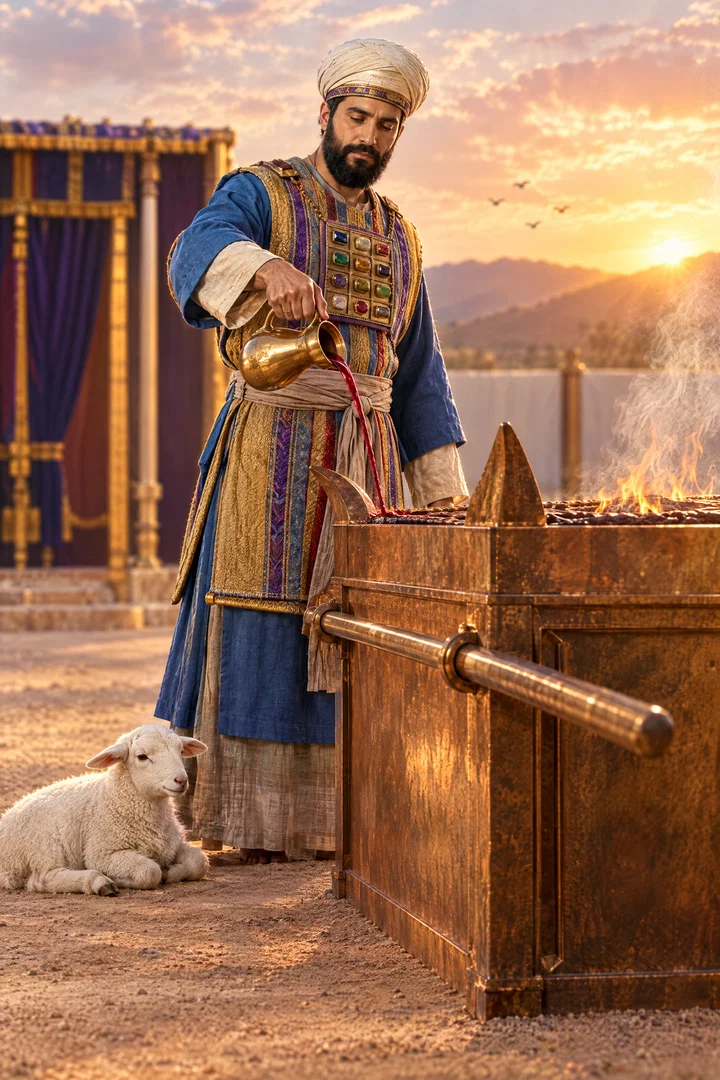
The law required one lamb to be presented in the morning and the other in the evening, so the daily offering was made in two parts as a continual offering.COS 32.1–24T 477.1 Kept continually upon the altar, it signified an unceasing obligation of gratitude and devotion owed to God.4T 477.1 The daily sacrifice pointed to the death of the Saviour.COS 32.1–2 Even in childhood Jesus grasped from it that He Himself was the Lamb of God who would die for the sins of humanity.COS 32.1–2
In the home this pattern is fulfilled when the father serves as priest of the household, presenting the morning and evening offering to God.ST Apr 17, 1884 Wife and children unite with him in prayer and praise at those times.ST Apr 17, 1884 Such morning and evening worship forms a home in which Jesus delights to dwell.ST Apr 17, 1884
Sources
Pioneers and periodicals
29 sources
The verse appoints the regular daily burnt offering of two lambs each ordinary day, one in the morning and one at evening, as the priests' continual ministration in the holy place for the whole congregation to atone for its sins.RH Sep 16, 1852ST Oct 13, 1909ST Sep 6, 1910 The morning lamb was offered about the third hour and the evening lamb about the ninth hour, each with its grain and drink offering and with sweet incense burned on the golden altar at the same times.RH Jan 22, 1914ST Apr 2, 1912RH Sep 16, 1852RH Jan 16, 1913RH Feb 2, 1911 Continual means regular and constant rather than unceasing, and this daily service pointing forward in faith to the coming Redeemer is the first great division of the ministration that foreshadows Christ's more excellent ministry in the true tabernacle in heaven.ST Apr 2, 1912RH Mar 8, 1870STST Aug 26, 1913 On the Sabbath the offering was doubled to two lambs instead of one, so that more sanctuary service was done on that day yet the priests were blameless, proving that earnest work done for God in worship and ministry does not break the Sabbath.ST Oct 31, 1906ST Aug 30, 1905ST Sep 23, 1913ST Nov 11, 1889 The appointed morning and evening times set the pattern for prayer and family worship and for daily consecration of life to God through Christ's merit, offered only as pleading His sacrifice.ST Apr 17, 1884RH Sep 12, 1871ST Sep 12, 1900RH Apr 17, 1879RH Oct 23, 1913
The Daily Offering Described
The verse lays down the regular daily burnt offering of the earthly sanctuary, two lambs on each ordinary day, one in the morning and the other at evening, belonging to the priests' continual daily ministration in the holy place, the first apartment.RH Sep 16, 1852RH Feb 3, 1853RH Mar 8, 1870 This morning-and-evening offering was part of the priests' regular sanctuary service, made with its appointed grain offering and drink offering.RH Sep 16, 1852 The morning lamb was offered about the third hour, or nine o'clock, and the afternoon or evening lamb about the ninth hour, or three o'clock.RH Jan 22, 1914RH Jan 16, 1913 The evening offering fell between the two evenings, understood as between three and six o'clock.RH Jan 22, 1914RH Jan 16, 1913
The lambs were of the first year and were accompanied by a meal offering with oil, a grain offering and a drink offering.ST Apr 2, 1912RH Sep 16, 1852ST Apr 1, 1913 Sweet incense was burned on the golden altar in the Holy Place morning and evening at the same times as the lambs.RH Sep 16, 1852RH Feb 2, 1911ST Apr 1, 1913 The offering is called continual to mean regular and constant rather than unceasing.RH Jul 10, 1860ST Nov 28, 1892ST Oct 13, 1909 It was made daily throughout the year in the priests' regular round of service in the holy place, the first tabernacle, where the priests went continually.ST Apr 2, 1912STST Aug 26, 1913ST Nov 28, 1892ST Oct 13, 1909 It was never omitted because of other offerings, with other offerings added as individuals and special times required, alongside the Sabbath offerings and the other appointed offerings.STST Aug 26, 1913ST Nov 28, 1892ST Oct 13, 1909
The daily lambs were offered for the whole congregation every day of the year, not as an individual offering.ST Oct 13, 1909ST Sep 6, 1910ST Apr 1, 1913 Only the priest laid a hand on it in confession, and it atoned for sins of the whole congregation, even sins they did not know about.ST Oct 13, 1909ST Sep 6, 1910 It was distinct from offerings for individual sins and from the added offerings for the Sabbath, the new moon, and the special feasts.ST Oct 13, 1909ST Sep 6, 1910ST Apr 1, 1913 The time of the evening offering is the time the Passover lamb was killed on the night of Israel's deliverance from Egypt.RH Jan 16, 1913ST Jun 30, 1898 The evening oblation at which Elijah prayed on Mount Carmel in 1 Kings 18:36 was this appointed daily evening sacrifice of a lamb at even.RH Jan 16, 1913ST Jun 30, 1898
Shadow of Christ's Ministry
The daily lambs offered morning and evening throughout the year, accompanied by meal offering and oil, continually recalled sin while expressing the worshipers' faith in the coming Redeemer.ST Apr 2, 1912 They pointed forward to their future antitype.ST Apr 2, 1912 The morning and evening lamb was offered for the whole congregation every day of the year as part of the continual service of the earthly sanctuary, never omitted on account of other offerings.ST Oct 13, 1909 That continual earthly service prefigured the heavenly sanctuary.ST Oct 13, 1909
The regular morning and evening burnt offering belonged to the daily service in the holy place, the first apartment of the earthly sanctuary.RH Mar 8, 1870 That daily service is the first of two grand divisions of the ministration performed by the Levitical priesthood.RH Mar 8, 1870 The second is the yearly work in the most holy place for the sins of the people and for the cleansing of the sanctuary.RH Mar 8, 1870 This whole earthly ministration is the example and shadow of Christ's more excellent ministry in the true tabernacle in heaven, and its regular morning and evening offerings formed part of the service that served as a pattern of that heavenly ministry.RH Mar 8, 1870RH Mar 28, 1854
The ordinance belongs to Israel's church laws regulating assembly and worship, which were binding as law on Israel but are not legally binding on later peoples, though their underlying principles remain applicable.RH Nov 12, 1908 Its sacrificial rites have ended because Christ's one offering has perfected those who are sanctified.RH Sep 12, 1871
Sabbath Service and Worship
On the Sabbath the prescribed offering was doubled, with two lambs offered instead of the one lamb in the morning and the one at evening required on ordinary days, so that twice as much labor was required and more sanctuary service was performed on the Sabbath than on other days, including the morning and evening lambs with incense offered at the same times, yet the priests who performed this service were blameless.ST Oct 31, 1906ST Aug 30, 1905ST Sep 23, 1913ST Nov 11, 1889RH Feb 2, 1911 The daily amount was thus half as great as that required on the Sabbath.ST Aug 30, 1905 These added Sabbath services show that religious ministry was permitted on the Sabbath.ST Sep 23, 1913ST Nov 11, 1889
Work done for God does not break the Sabbath commandment, which forbids doing one's own ways and finding one's own pleasure but allows earnest spiritual service and active spiritual exercise, so the Sabbath is a day of worship and active service rather than idleness, laziness or slackness.ST Oct 31, 1906ST Jan 31, 1911 Carrying out ordinances God has given, such as feet-washing and the Lord's Supper, on the Sabbath is therefore blameless.ST Oct 31, 1906 The appointed morning and evening times of the lamb sacrifices, called continual to mean regular and constant rather than unceasing, illustrate the duty to pray frequently and persistently.RH Jul 10, 1860
The sacrifices marked the morning and evening hours of prayer, when the people prayed as the priests offered sacrifice and incense on their behalf.RH Sep 12, 1871ST Sep 12, 1900 The order of morning and evening prayer with exhortation corresponds to the whole action of slaying the lamb in the morning and in the evening and placing each upon the altar.RH Apr 17, 1879 In that service the symbols of the body and blood of Christ signify that only as pleading Christ's sacrifice can any act of worship be presented to God.RH Apr 17, 1879 The sacrifices accompanied morning and evening worship and prayer and represented the daily consecration of life to God through Christ's merit, with Christ's life within enabling the offering.ST Sep 12, 1900
The morning sacrifice and evening oblation provide the pattern and setting for family worship with songs of praise and with families gathering for praise and prayer.RH Sep 12, 1871RH Nov 15, 1864 The father as priest of the household offers the morning and evening sacrifice to God while wife and children join in prayer and praise, forming a home in which Jesus will love to dwell.ST Apr 17, 1884 The twice-daily pattern of an offering made once in the morning and once in the evening illustrates a daily, repeated surrender to God, not a sacrifice made once for all, in which believers deny themselves harmful things and yield themselves wholly to God because they belong to him.RH Oct 23, 1913 The lamb's morning-and-evening offering is linked with the ritual binding of the lamb, which is replaced by bowing twice.ST May 27, 1897
Sources