Philemon 1:9
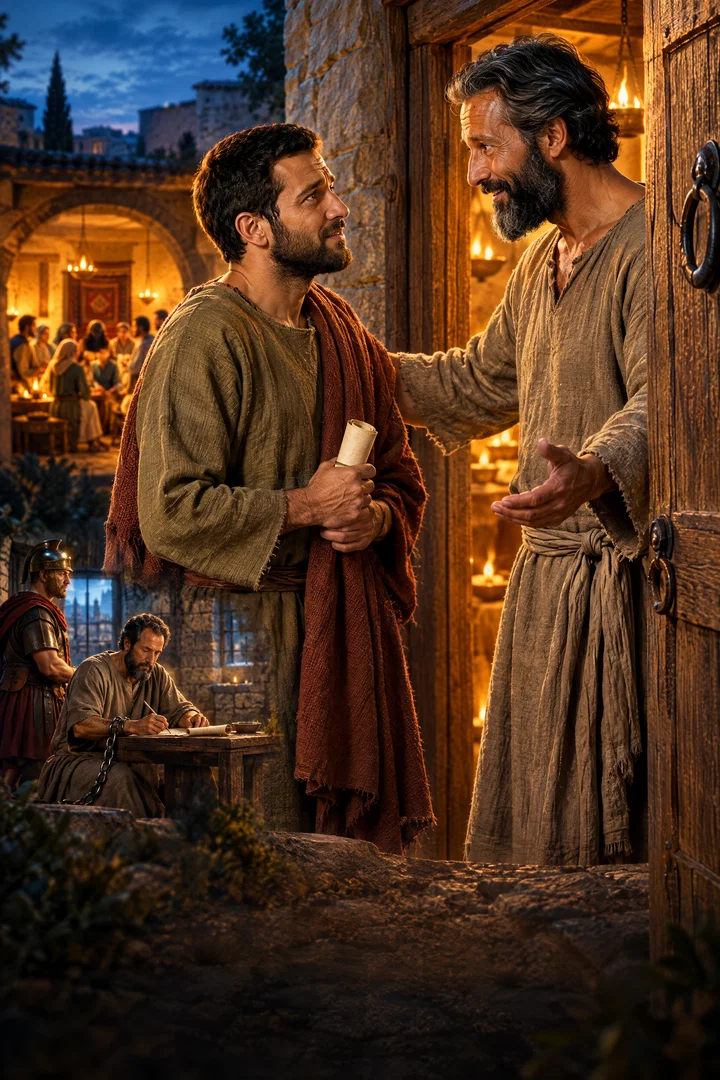
Yet for love’s sake I rather beseech thee, being such an one as Paul the aged, and now also a prisoner of Jesus Christ.
Translations
Yet for love’s sake I rather beseech you, being such an one as Paul the aged, and now also a prisoner of Jesus Christ.
Yet for love’s sake I rather beseech thee, being such an one as Paul the aged, and now also a prisoner of Jesus Christ.
yet for love’s sake I rather beseech thee, being such a one as Paul the aged, and now also a prisoner of Jesus Christ.
Yet for love's sake I rather beseech thee, being such one as Paul the aged, and now also a prisoner of Jesus Christ.
Revised Version, American Standard Version
yet for love’s sake I rather beseech, being such a one as Paul the aged, and now a prisoner also of Christ Jesus:
because of the love I rather entreat, being such an one as Paul the aged, and now also a prisoner of Jesus Christ;
for love's sake I rather exhort, being such a one as Paul the aged, and now also prisoner of Jesus Christ.
Yet, for loves sake, I rather exhort,—being, such a one, as Paul the aged, now, also, even a prisoner of Christ Jesus,—
I prefer to appeal on the basis of love. For I, Paul, am now aged, and a prisoner of Christ Jesus as well.
I prefer to appeal on the basis of love. For I, Paul, am now aged, and a prisoner of Jesus Christ as well.
yet for love’s sake I rather appeal to you, being such a one as Paul, the aged, but also a prisoner of Jesus Christ.
Still, because of love, in place of an order, I make a request to you, I, Paul, an old man and now a prisoner of Christ Jesus:
Yet for loues sake I rather beseeche thee, though I be as I am, euen Paul aged, and euen nowe a prisoner for Iesus Christ.
Douay-Rheims (Challoner revision)
For charity sake I rather beseech, whereas thou art such a one, as Paul an old man, and now a prisoner also of Jesus Christ.
Pictures




Cross-references
- Acts 28:16
And when we came to Rome, the centurion delivered the prisoners to the captain of the guard: but Paul was suffered to dwell by himself with a soldier that kept him.
Paul arrives in Rome as a prisoner.
- Philemon 1:18-19
If he hath wronged thee, or oweth thee ought, put that on mine account;
Paul’s offer to repay Onesimus’s debt supports his appeal for his reception.
- Philemon 1:14
But without thy mind would I do nothing; that thy benefit should not be as it were of necessity, but willingly.
Paul seeks Onesimus’s help only with Philemon’s consent, so the service is freely given.
- Philemon 1:16
Not now as a servant, but above a servant, a brother beloved, specially to me, but how much more unto thee, both in the flesh, and in the Lord?
Paul asks Philemon to receive Onesimus as a beloved brother, not merely a servant.
- Colossians 4:7-9
All my state shall Tychicus declare unto you, who is a beloved brother, and a faithful minister and fellowservant in the Lord:
The passage says Onesimus carried this letter and the letter to Colosse.
- Colossians 4:18
The salutation by the hand of me Paul. Remember my bonds. Grace be with you. Amen.
Paul refers to his chains in his closing words.
- Ephesians 6:20
For which I am an ambassador in bonds: that therein I may speak boldly, as I ought to speak.
Paul describes himself as an ambassador in chains.
- Philippians 1:13
So that my bonds in Christ are manifest in all the palace, and in all other places;
His bonds in Christ become known in Rome.
- 2 Timothy 4:6-7
For I am now ready to be offered, and the time of my departure is at hand.
Both describe Paul near the end of his life, enduring imprisonment and having finished his course.
- Acts 28:11-15
And after three months we departed in a ship of Alexandria, which had wintered in the isle, whose sign was Castor and Pollux.
same prisoner journey and welcome
- 2 Corinthians 5:20
Now then we are ambassadors for Christ, as though God did beseech you by us: we pray you in Christ’s stead, be ye reconciled to God.
Urges people to be reconciled to God.
- Romans 12:1
I beseech you therefore, brethren, by the mercies of God, that ye present your bodies a living sacrifice, holy, acceptable unto God, which is your reasonable service.
Begins an appeal to present oneself to God.
- Acts 28:30-31
And Paul dwelt two whole years in his own hired house, and received all that came in unto him,
Paul preaches Christ in Rome while under guard.
- 2 Timothy 4:10
For Demas hath forsaken me, having loved this present world, and is departed unto Thessalonica; Crescens to Galatia, Titus unto Dalmatia.
Demas leaves aged, imprisoned Paul for love of the present world.
Commentary
Each commentary is drawn from primary sources: the writings of Ellen G. White and Adventist pioneers and periodicals. Each commentary is separate. Its own words are not a quotation; follow the references to read the source passages.
Ellen G. White
9 sources
Paul deliberately set aside his right and authority to command what was Philemon's duty as a Christian, choosing instead the language of entreaty for love's sake.RH Dec 14, 1911AA 457.2–3SLP 286.1–2RH Dec 14, 1911 He would not urge by command but would beseech, appealing on the ground of love rather than simply asserting authority.RH Dec 14, 1911AA 457.2–3SLP 286.1–2RH Dec 14, 1911 He grounded that entreaty in his personal standing, describing himself as an aged man and now also a prisoner of Jesus Christ.RH Dec 14, 1911AA 457.2–3SLP 286.1–2RH Dec 14, 1911 The force of the appeal drew upon his age and his present imprisonment for Christ.RH Dec 14, 1911AA 457.2–3SLP 286.1–2RH Dec 14, 1911
The entreaty was made on behalf of Onesimus, his repentant convert, whom he asked Philemon to receive.RH Dec 14, 1911AA 457.2–3 His title as prisoner of Jesus Christ was literal on his way to Rome, where he was fettered and stigmatized and bound by a chain with no release.AA 447.2 He arrived in circumstances different from what he had hoped for in proclaiming the gospel, yet his sufferings only endeared him the more to the Christians in Italy.AA 447.2 They had eagerly looked forward to his visit since his letter to the Romans, and came out to meet and welcome him.AA 447.2
The description of the aged prisoner fits Paul in chains preaching Christ in the stronghold of the Caesars, as one of the few and despised bearers of God's truth.ST Feb 16, 1915 The same description fits Paul writing from his prison in Rome to set before his fellow believers the unsearchable riches of Christ, the treasure of grace freely offered to fallen humanity.5T 729.3–730.2RH Oct 22, 1908ST May 14, 1902 From that prison-house at Rome he wrote to the brethren in Ephesus about those riches.ST May 14, 1902 It was a theme that human language is inadequate to express in its fullness.ST May 14, 1902
Sources
Pioneers and periodicals
17 sources
Paul writes as an aged prisoner in chains in Rome to Philemon, a Christian of Colosse, concerning Onesimus, his runaway slave who was converted under Paul and was being sent back to be received again.RH Dec 14, 1911ST Jan 9, 1907ST Nov 7, 1900 For love's sake he chooses loving, personal entreaty rather than command or assertion of authority, pleading that Onesimus be received no longer as a servant but as a beloved Christian brother, with his own pledge to pay what was owed.RH Dec 14, 1911ST Jan 9, 1907 He calls himself the aged, though comparatively young when his work ended, because unremitting toil, persecution, cares and suffering for Christ had burdened him and made him old before his time.ST Nov 23, 1915RH Jul 28, 1903RH Dec 22, 1868 His course shows that gospel work and practical Christian fellowship use loving entreaty rather than force.ST Nov 7, 1900RH Aug 4, 1910 His age and imprisonment concerned him far less than his sons and daughters in the gospel and the faith and joy of believers, whom from prison he still sought to strengthen with the truth most needful against temptation and with the unsearchable riches of Christ freely offered to fallen men.RH Oct 22, 1908RH Dec 22, 1868ST Jan 23, 1896
Setting and Wording
Paul wrote while an aged prisoner in chains at Rome, about A.D. 64, confined in a Roman dungeon and prison-house.ST Jan 9, 1907ST May 6, 1875ST Jan 23, 1896 His age and imprisonment as a prisoner of Jesus Christ form the ground from which he appeals to Philemon for love's sake on behalf of Onesimus.ST Jan 9, 1907ST Nov 7, 1900 From prison he knew how each little community in Greece and Asia Minor was situated and where it was weakest, dispatching the advice and portion of truth most needful against Satan's fetters of temptation.ST Jan 23, 1896
The letter is addressed to Philemon, a Christian of Colosse, a devout acquaintance and young friend whom Paul had led to Christ.ST Nov 7, 1900RH Jul 28, 1903 That young friend faced the pastoral care of recent converts amid the temptations of a pagan city, while Paul himself expected execution and saw no earthly future.RH Jul 28, 1903 It concerns Onesimus, Philemon's runaway servant and slave, who had become converted under Paul in Rome and was being sent back carrying the letter to be received back by his master.ST Jan 9, 1907ST Nov 7, 1900
For love's sake Paul chooses loving, personal, tactful and self-denying appeal and entreaty rather than urging by command or simply asserting authority.RH Dec 14, 1911RH Dec 14, 1911RH Jul 28, 1903 He draws force for his plea from his standing as an aged man and a prisoner of Jesus Christ, with his age and imprisonment for Christ giving weight to an appeal grounded in love.RH Dec 14, 1911RH Dec 14, 1911RH Jul 28, 1903 Onesimus is commended to be received no longer as a servant but as a beloved Christian brother and repentant convert, with Paul giving his pledge to pay whatever Onesimus owed Philemon when he ran away.RH Dec 14, 1911ST Nov 7, 1900
Paul calls himself the aged though comparatively young when his work ended.ST Nov 23, 1915 Wearing, unremitting toil for Christ had spent his life, and persecution and constant labor had made him old before his time.ST Nov 23, 1915RH Jul 28, 1903 His age and imprisonment reflect a life burdened by cares, labor and suffering.RH Dec 22, 1868
Ministry and Example
Gospel work advances by loving entreaty rather than by force, and the appeal for love's sake to receive Onesimus no longer as a servant but as a beloved Christian brother, with pledge to pay whatever he owed when he ran away, stands as a touching model of practical Christian fellowship.ST Nov 7, 1900RH Aug 4, 1910 The aged apostle in prison at Rome pleads on behalf of the runaway servant converted under him there and sent back carrying the letter to his master, choosing personal appeal over command.ST Nov 7, 1900RH Aug 4, 1910 His standing as an aged man and a prisoner of Christ gives weight to that entreaty rather than to compulsion.ST Nov 7, 1900RH Aug 4, 1910
His own age and imprisonment concerned him far less than his sons and daughters in the Gospel who had received the Gospel by him and had honestly entered the race for immortality.RH Dec 22, 1868ST Jan 23, 1896 Around them Satan forged ceaselessly fetters of strong temptation, and his anxiety lest they should fail shows both the blessedness of victory and the sad consequences of failure, with the meaning win at all hazards.ST Jan 23, 1896 From prison he knew just how each little community in Greece and Asia Minor was situated and at what point it was weakest, dispatching to each the advice, admonition, and portion of truth most needful in danger.ST Jan 23, 1896 Though he felt it would be better for him to die, he believed it needful to remain alive for a time to further the believers' faith and joy, burdened as he was by cares, labor, and suffering.RH Dec 22, 1868 From his prison-house at Rome he endeavored to set before his brethren the unsearchable riches of Christ, the treasure of grace freely offered to fallen men, which language is inadequate to express in its fulness.RH Oct 22, 1908ST May 14, 1902
Persecution and constant labor had made him old before his time as he appealed on the basis of love rather than command to a young friend he had led to Christ, who faced pastoral care of recent converts amid temptations of a pagan city.RH Jul 28, 1903 Expecting execution and seeing no earthly future, he yet looks back without regret and faces the future without fear.RH Jul 28, 1903RH Jul 28, 1903 In his later letters to Timothy and Titus his long service gives weight to his example as he speaks cheerfully and consolingly about the service of the Lord.ST Aug 20, 1885 His words from prison, though little regarded in Rome at first, later stirred believers in Ephesus, Colosse, and Philippi and continued to influence wherever his letters spread.RH Aug 22, 1865 The same is pictured in Paul in chains preaching Christ in the stronghold of the Caesars, as one of the few and despised bearers of God's truth.ST Feb 16, 1915
His condition as aged and a prisoner for Jesus Christ in a Roman dungeon waiting for the executioner's ax, after finishing a course of self-denial and cross-bearing, makes the abandonment by Demas especially stark.ST May 6, 1875RH Jul 13, 1869 Demas, his fellow laborer, had long hidden sin in his heart while comforting himself that he was sure of Paradise, then forsook Paul and returned to Thessalonica, probably his native land.ST May 6, 1875 In losing sight of the next world to grasp this world as solace and joy, he dropped substance to grasp shadow.ST May 6, 1875 In turning his back on Paul in his age and imprisonment he turned his back on Christ also, who had bought him with his own blood, leaving his name as a warning to Christian ministers in all coming time.ST May 6, 1875RH Jul 13, 1869
Sources