Translations
American King James Version, King James Version
How shall we sing the LORD’s song in a strange land?
How shall we sing the Lord’s song
In a strange land?How shall we sing the LORD'S song in a foreign land?
How shall we sing the LORD’S song in a strange land?
How shall we sing Jehovah’s song
In a foreign land?How do we sing the song of Jehovah, On the land of a stranger?
How should we sing a song of Jehovah's upon a foreign soil?
How shall we sing the song of Yahweh, on a foreign soil?
Berean Standard Bible, Majority Standard Bible
How can we sing a song of the LORD
in a foreign land?How can we sing the LORD’s song in a foreign land?
How may we give the Lord's song in a strange land?
Howe shall we sing, said we, a song of the Lord in a strange land?
Douay-Rheims (Challoner revision)
How shall we sing the song of the Lord in a strange land?
Pictures
Cross-references
- 2 Chronicles 36:17-20
Therefore he brought upon them the king of the Chaldees, who slew their young men with the sword in the house of their sanctuary, and had no compassion upon young man or maiden, old man, or him that stooped for age: he gave them all into his hand.
Judah’s wickedness leads to Jerusalem’s destruction and the people’s exile to Babylon.
- Daniel 5:1-4
Belshazzar the king made a great feast to a thousand of his lords, and drank wine before the thousand.
The Babylonian king profanes Jerusalem’s temple vessels while feasting in exile.
- Micah 4:10
Be in pain, and labour to bring forth, O daughter of Zion, like a woman in travail: for now shalt thou go forth out of the city, and thou shalt dwell in the field, and thou shalt go even to Babylon; there shalt thou be delivered; there the LORD shall redeem thee from the hand of thine enemies.
Zion is exiled to Babylon, where the people lament their displacement.
- Exodus 15:21
And Miriam answered them, Sing ye to the LORD, for he hath triumphed gloriously; the horse and his rider hath he thrown into the sea.
Red Sea triumph prompts singing, contrasted with muted harps in exile.
- 1 Kings 8:46-48
If they sin against thee, (for there is no man that sinneth not,) and thou be angry with them, and deliver them to the enemy, so that they carry them away captives unto the land of the enemy, far or near;
Captives in a foreign land turn toward Jerusalem and pray.
- Exodus 15:1-2
Then sang Moses and the children of Israel this song unto the LORD, and spake, saying, I will sing unto the LORD, for he hath triumphed gloriously: the horse and his rider hath he thrown into the sea.
Israel sang to the Lord after deliverance, unlike its silence in captivity.
- Zechariah 2:7
Deliver thyself, O Zion, that dwellest with the daughter of Babylon.
Addresses the Jews dwelling in Babylon.
- Psalms 137:8
O daughter of Babylon, who art to be destroyed; happy shall he be, that rewardeth thee as thou hast served us.
Names Babylon as the captor of the Jewish exiles.
- Hebrews 11:13-16
These all died in faith, not having received the promises, but having seen them afar off, and were persuaded of them, and embraced them, and confessed that they were strangers and pilgrims on the earth.
God’s people are strangers on earth, seeking a heavenly homeland.
- Revelation 15:3
And they sing the song of Moses the servant of God, and the song of the Lamb, saying, Great and marvellous are thy works, Lord God Almighty; just and true are thy ways, thou King of saints.
It pictures joining the heavenly hosts in song.
- Daniel 3:12-18
There are certain Jews whom thou hast set over the affairs of the province of Babylon, Shadrach, Meshach, and Abed-nego; these men, O king, have not regarded thee: they serve not thy gods, nor worship the golden image which thou hast set up.
The exiles refuse the foreign king’s demand to worship an idol.
Commentary
Each commentary is drawn from primary sources: the writings of Ellen G. White and Adventist pioneers and periodicals. Each commentary is separate. Its own words are not a quotation; follow the references to read the source passages.
Ellen G. White
3 sources
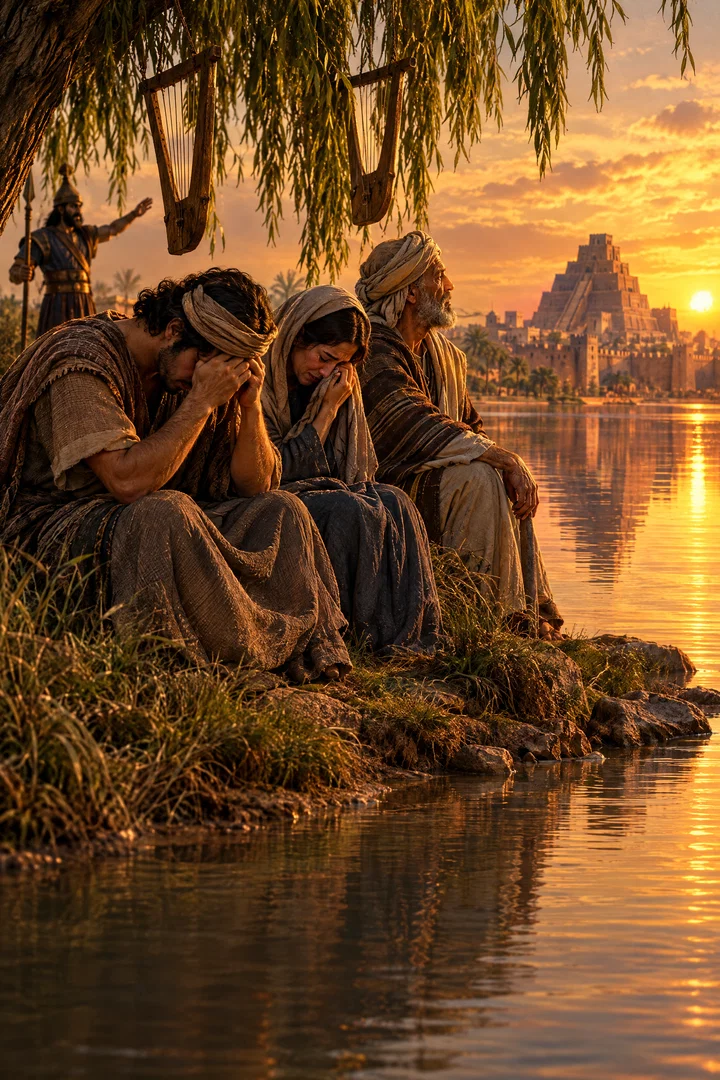
The verse gives voice to the grief of exiled captives who feel they cannot sing the Lord's song in a foreign and strange land.Lt 2c, 1892, par. 22–26Ms 117a, 1901, par. 10Ms 1, 1869, par. 22 Its image of Zion's harps hung on the willows shows how songs of praise can be silenced.Lt 2c, 1892, par. 22–26 In contrast to those captives, God's people now are called to sing the songs of Zion as a living testimony to victories won through earnest prayer.Ms 1, 1869, par. 22
The songs of Zion can be sung when tempted as a weapon against discouragement.Ms 117a, 1901, par. 10 They should be learned by heart so they can be sung even without an instrument.Ms 117a, 1901, par. 10 When selfishness withholds God's message from people, praise is silenced, but a true missionary spirit and loving work to save the lost will restore the songs.Lt 2c, 1892, par. 22–26
Sources
Pioneers and periodicals
40 sources
The verse belongs to a song that grew out of the exile and was sung by the captive Israelites in Babylon beside its rivers.ST May 13, 1908ST Dec 10, 1912ST By those streams they wept as they remembered Zion, hung their harps unused on the willows, while their captors pressed them to sing songs of Zion for mirth.ST Apr 19, 1910ST Sep 24, 1894RH Apr 22, 1915ST Apr 29, 1903ST May 25, 1904 The question expresses how painful and alien it felt to offer sacred praise while taken to the land of an enemy conqueror far from homeland and longing to return to Jerusalem.ST Apr 19, 1910ST Apr 1, 1913ST Aug 28, 1884 In that foreign land grief made songs of Zion feel like laments rather than praise, so the captive harpists fell silent rather than expose the Lord's song to a tyrant's jest and Gentile scorn.RH May 27, 1858ST Dec 19, 1916ST Apr 1, 1913RH Sep 11, 1913ST Jan 30, 1896 That weeping was anguish longing for the Deliverer and for Israel's salvation, a waiting that terminates when Jesus is born in Bethlehem as the Shiloh to whom the gathering of the nations belongs.ST Oct 8, 1896ST May 16, 1911ST Apr 29, 1903ST Dec 9, 1908 It also describes the believer's present life on an earth darkened by sin far from the heavenly home, where the ransomed will sing together when Christ comes to gather them, yet God's people can take courage and keep singing praises through the painful journey because they are nearing home.ST Feb 11, 1886ST Apr 1, 1913ST Apr 1, 1913RH Aug 13, 1861
Exile Setting and Sorrow
The verse belongs to a song that grew out of the exile and was sung by the captive Israelites in Babylon.ST May 13, 1908ST Dec 10, 1912 It was written beside the rivers of Babylon by the exiles, and in its final form was written after the Babylonian captivity by one who had endured its worst.STST Aug 25, 1909 The psalm is a prophecy of the Babylonian captivity and recalls Israel's captivity and exile.RH Mar 12, 1861ST Jan 23, 1893 That captivity is linked to Babylon's role in carrying them away, and the grief it records is connected with return and restored worship at the rebuilding of the temple.ST May 24, 1883ST Jan 23, 1893
The psalm concerns the sorrows and afflictions of the Hebrew captives during the Babylonian captivity.RH Aug 31, 1916 That sorrow was greatest in its latter part under Belshazzar, when persecution and distress were at their height.RH Aug 31, 1916 By Babylon's streams the exiles wept as they remembered Zion and Jerusalem.ST Apr 29, 1903RH Jan 23, 1855RH Oct 20, 1859 They hung their harps unused on the willows and set aside their songs while grieving far from home.RH Apr 22, 1915ST Apr 29, 1903ST May 25, 1904RH Jan 23, 1855ST Jul 23, 1896
Their captors pressed them to sing songs of Zion and demanded mirth and entertainment, which sharpened their sorrow.ST Apr 19, 1910ST Sep 24, 1894RH Apr 22, 1915 The question how to sing the Lord's song in a strange land expresses how painful, difficult, and alien it felt to offer sacred praise in captivity far from home.ST Apr 19, 1910ST Sep 28, 1904ST Dec 19, 1916 They had been taken to the land of an enemy conqueror where they did not want to be, in an unpleasant place that felt strange to them.ST Aug 28, 1884 They did not want to sing there because they were exiled from their homeland, separated from the place they remembered with grief, and longing to return to Jerusalem.ST Apr 19, 1910ST Apr 1, 1913
The exile came after wickedness caused God to remove His protecting arm.ST May 16, 1911 Disobedience left Israel to wander lone and forsaken, and Sabbath-breaking brought its consequences of entanglement and unavailing crying in Babylon.ST Jan 30, 1896RH Mar 19, 1901 Jerusalem was ruined, the land of promise laid waste, the city destroyed, and the people made captive.RH Sep 11, 1913ST Nov 19, 1902 Their familiar joyful gatherings at the annual feasts ceased and the land was left desolate, so that songs of Zion became painful and difficult to sing.RH Sep 11, 1913ST Nov 19, 1902
Sacred Song Withheld
In a foreign land the exiles could not joyfully sing the Lord's songs or rejoice in Him, for mourning their separation from Zion made praise feel impossible.RH May 27, 1858ST Apr 1, 1913RH Sep 11, 1913 Grief and homesickness turned the songs of Zion into laments and songs of sorrow rather than praise, so that by the streams of Babylon they sang with sorrow while exiled far from Zion.ST Apr 1, 1913RH Sep 11, 1913RH Oct 20, 1859RH Aug 12, 1858 The destruction of their city and the captivity of their people made those songs painful and difficult to sing.RH Sep 11, 1913
Their sacred songs belonged to their homeland and worship, and amid the revelry around them in Babylon the captive harpists grieved and fell silent.ST Dec 19, 1916ST Jan 30, 1896 Timbrel, harp, and horn were left mute rather than expose the Lord's song as entertainment to a tyrant's jest and Gentile scorn, with no censer burning round the altar.ST Jan 30, 1896 In that land without temple offerings, God does not prize the blood of goats and the flesh of rams but accepts a contrite heart and humble thought as His sacrifice.ST Jan 30, 1896
Refusing to perform their worship songs to satisfy captors demanding mirth proves their sacred music was their own original expression of individual and national life and not copied or borrowed from surrounding nations.RH Apr 22, 1915 Though they refused to sing there, Lamentations became another and last song they did sing in foreign captivity, a funeral dirge marking that their former glory never returned and closing as the swan song of a once mighty nation.RH Apr 22, 1915 The captors' demand for a song of Zion sharpened their sorrow over ruined Jerusalem and a laid-waste land of promise, and so the verse shows how worship and music are affected when the cause of God languishes, with joyful worship ceasing in captivity and the familiar joyful gatherings at the annual feasts ceasing while the land lay desolate.ST Sep 24, 1894ST Nov 19, 1902 The difficulty of singing Zion's sacred songs in a foreign setting warns against fitting those songs to worldly, lighter music, since this makes sacred worship conform to the surrounding culture.RH Oct 30, 1855
Longing for Deliverance
In Jerusalem while obedient to God the church could sing His praise in the joy and prosperity of His presence, but in captivity away from that joy she mourned what she had lost and could not sing as before.ST Oct 8, 1896ST May 16, 1911ST Apr 29, 1903 The question about singing the Lord's song in a strange land expresses that loss and longing for deliverance, in contrast to the joy of praising God in Jerusalem.ST Oct 8, 1896ST Apr 29, 1903 Their captivity marks the beginning of the church's anguish and waiting for deliverance.ST Oct 8, 1896ST Apr 29, 1903
Sitting and weeping by the rivers of Babylon with harps hung on willows and unable to sing means anguish, crying, and travailing longing for the Deliverer and for Israel's salvation and the coming One.ST May 16, 1911ST Apr 29, 1903ST Dec 9, 1908 In captivity she longed for salvation to come out of Zion, waiting anxiously for the Desire of all nations.ST May 16, 1911 That weeping begins six centuries of pain and longing after being carried to Babylon about six hundred years before Christ.ST Oct 8, 1896ST May 16, 1911 It terminates when Jesus is born in Bethlehem as the Shiloh of the tribe of Judah to whom the gathering of the nations belongs, for whom they waited anxiously as the Desire of all nations.ST May 16, 1911
Babylon's overthrow became a pledge that captivity would end and that liberty and restoration would come.RH Jan 23, 1855 They wept as they remembered Zion and hung their harps by Babylon's streams, and that overthrow assured their grief in exile would give way to liberty and restoration.RH Jan 23, 1855
Pilgrims Nearing Home
The question of singing in a strange land also describes present life on an earth darkened by sin and sorrow, far from the heavenly home, where full and joyful singing of Zion's songs is not yet possible but is awaited until the Lord comes and the believer reaches that home.ST Feb 11, 1886 Those songs of Zion are the Lord's songs, which the ransomed remnant will sing together when Christ comes to gather them home in glory, and to have a share in that singing requires being filled with the Spirit that was in Christ and being prepared for that glorious day.RH Aug 13, 1861 Even now the exiles' song can give listeners a glimpse of the heavenly home and rest for which earth's wandering pilgrims long.ST Dec 19, 1916 Keeping the songs of home in the heart while harps hang idle, and choosing to sing of that home and its rest even amid confusion and sorrow, can touch and soften the hearts of others.ST Dec 19, 1916ST Dec 19, 1916
For God's people on pilgrimage, though the journey is painful and grief and homesickness can make praise feel like lament, there is reason to take courage and keep singing praises through the way because they are nearing home and the journey will end upon reaching home.ST Apr 1, 1913ST Apr 1, 1913 Its psalms of homesickness carry a longing for home like that of a soldier exiled far from family and homeland.ST Mar 4, 1913
Present Call to Sing
Sorrow in exile raises the question how to sing the Lord's song in a strange land, yet suffering is no reason to give up song and cheerfulness.ST Oct 19, 1904 Paul and Silas sang while imprisoned and painfully confined, showing that praise need not cease in bonds.ST Oct 19, 1904 Even in the face of death one can answer with hope in Christ, who holds the keys of death and hell.ST Oct 19, 1904
The Lord's song can still be sung while doing difficult work, even doing extra labor despite a crippled hand, as when Cyrus Dunning would do extra painting and sing it as he worked.ST Sep 5, 1900 A tired believer whose heart is overshadowed with sadness and who longs for a view of the Lord may instead leave the harp uninspired by any song.RH Mar 21, 1865 With the path dreary and without shelter and the feet bleeding and weary, its strings give no echo of gladness and remain tuneless.RH Mar 21, 1865 Christians also lose that song of Zion they once delighted in through close contact with people whose notes do not rise as high, until they imitate their lesser twittering instead.ST Apr 24, 1901
Sources