Psalms 137:3
For there they that carried us away captive required of us a song; and they that wasted us required of us mirth, saying, Sing us one of the songs of Zion.
Translations
American King James Version, King James Version, Webster Bible
For there they that carried us away captive required of us a song; and they that wasted us required of us mirth, saying, Sing us one of the songs of Zion.
For there they that carried us away captive required of us a song;
And they that wasted us required of us mirth,
Saying, Sing us one of the songs of Zion.For there they that led us captive required of us songs, and they that wasted us required of us mirth, saying, Sing us one of the songs of Zion.
For there they that led us captive required of us songs,
And they that wasted us required of us mirth, saying,
Sing us one of the songs of Zion.For there our captors asked us the words of a song, And our spoilers — joy: 'Sing ye to us of a song of Zion.'
For there they that carried us away captive required of us a song; and they that made us wail [ required] mirth, [ saying,] Sing us [ one] of the songs of Zion.
For, there, our captors asked of us words of song, and our plunderers—gladness,—Sing us of the songs of Zion!
Berean Standard Bible, Majority Standard Bible
for there our captors requested a song;
our tormentors demanded songs of joy:
“ Sing us a song of Zion.”For there, those who led us captive asked us for songs.
Those who tormented us demanded songs of joy:
“ Sing us one of the songs of Zion!”For there those who had taken us prisoners made request for a song; and those who had taken away all we had gave us orders to be glad, saying, Give us one of the songs of Zion.
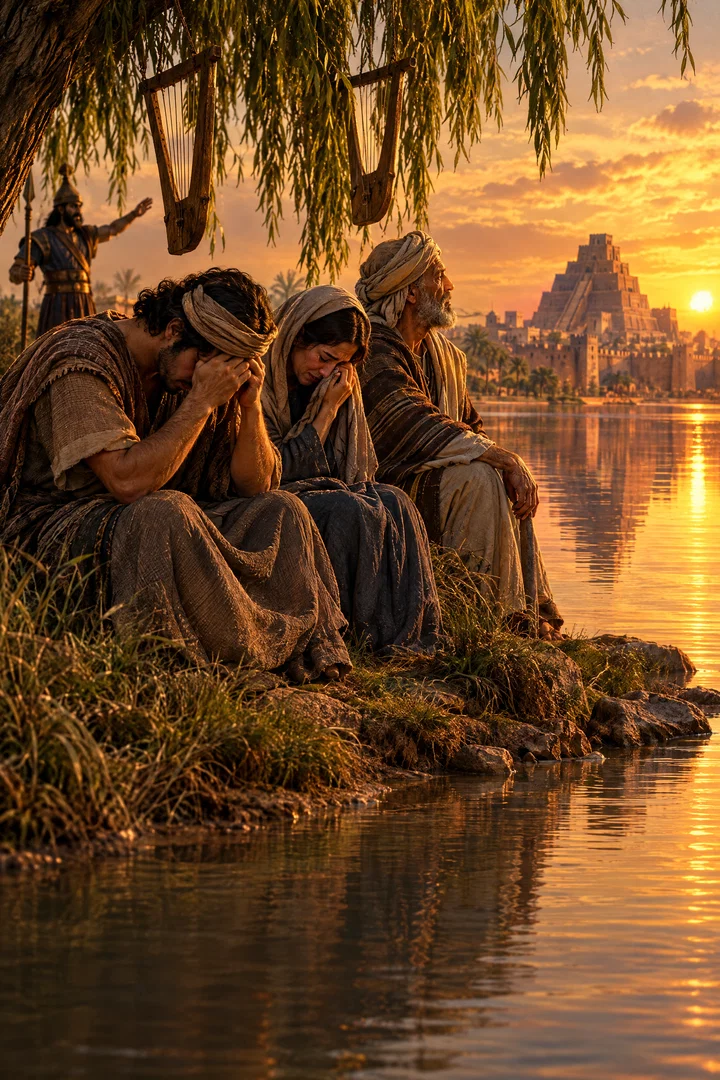
Then they that ledde vs captiues, required of vs songs and mirth, when wee had hanged vp our harpes, saying, Sing vs one of the songs of Zion.
Douay-Rheims (Challoner revision)
For there they that led us into captivity required of us the words of songs. And they that carried us away, said: Sing ye to us a hymn of the songs of Sion.
Pictures
Cross-references
- Micah 4:10
Be in pain, and labour to bring forth, O daughter of Zion, like a woman in travail: for now shalt thou go forth out of the city, and thou shalt dwell in the field, and thou shalt go even to Babylon; there shalt thou be delivered; there the LORD shall redeem thee from the hand of thine enemies.
Zion’s travail leads to exile in Babylon and promised deliverance.
- Revelation 14:3
And they sung as it were a new song before the throne, and before the four beasts, and the elders: and no man could learn that song but the hundred and forty and four thousand, which were redeemed from the earth.
The redeemed sing a new song before the throne.
- 2 Chronicles 36:20
And them that had escaped from the sword carried he away to Babylon; where they were servants to him and his sons until the reign of the kingdom of Persia:
Describes Judah’s captivity, the history behind the lament.
- Jeremiah 52:12
Now in the fifth month, in the tenth day of the month, which was the nineteenth year of Nebuchadrezzar king of Babylon, came Nebuzar-adan, captain of the guard, which served the king of Babylon, into Jerusalem,
The burning of the temple and city explains their mourning for Zion.
- Zechariah 2:7
Deliver thyself, O Zion, that dwellest with the daughter of Babylon.
Addresses Zion living among the daughter of Babylon.
- Psalms 137:8
O daughter of Babylon, who art to be destroyed; happy shall he be, that rewardeth thee as thou hast served us.
Names Babylon as the power that brought the captives’ suffering.
- Jeremiah 52:4
And it came to pass in the ninth year of his reign, in the tenth month, in the tenth day of the month, that Nebuchadrezzar king of Babylon came, he and all his army, against Jerusalem, and pitched against it, and built forts against it round about.
The siege of Jerusalem marks the beginning of the calamities mourned during captivity.
- Daniel 5:30-31
In that night was Belshazzar the king of the Chaldeans slain.
Babylon falls during Belshazzar’s feast, bringing the exiles hope of release and restoration.
- Psalms 126
When the LORD turned again the captivity of Zion, we were like them that dream.
Listed alongside Psalm 137 as a related passage.
- Psalms 14:7
Oh that the salvation of Israel were come out of Zion! when the LORD bringeth back the captivity of his people, Jacob shall rejoice, and Israel shall be glad.
Both express longing for Israel’s deliverance and salvation from Zion.
- Jeremiah 51:1-2
Thus saith the LORD; Behold, I will raise up against Babylon, and against them that dwell in the midst of them that rise up against me, a destroying wind;
Further prophecy foretells Babylon’s desolation.
- Jeremiah 52:6-7
And in the fourth month, in the ninth day of the month, the famine was sore in the city, so that there was no bread for the people of the land.
The city’s fall and breached walls contribute to the exiles’ grief.
Commentary
Each commentary is drawn from primary sources: the writings of Ellen G. White and Adventist pioneers and periodicals. Each commentary is separate. Its own words are not a quotation; follow the references to read the source passages.
Ellen G. White
4 sources
In the setting of the verse, captive Israel hung their harps on the willows while those who had carried them away demanded mirth and the songs of Zion.Lt 2c, 1892, par. 22–26 Those songs of Zion can be sung again when pride and selfishness are turned from to missionary love and service.Lt 2c, 1892, par. 22–26 The present is the time to sing them as a living testimony of victories won through earnest prayer and personal spiritual struggle.Ms 1, 1869, par. 22
They can be sung when temptation comes and used as a weapon against discouragement.Ms 117a, 1901, par. 10 They can be sung to encourage oneself and others, strengthening hope and turning darkness to light.Lt 91, 1887, par. 10 Sung in this way, the song becomes an expression of comfort and praise as God's promises brighten the journey toward heaven.Lt 91, 1887, par. 10
Sources
Pioneers and periodicals
50 sources
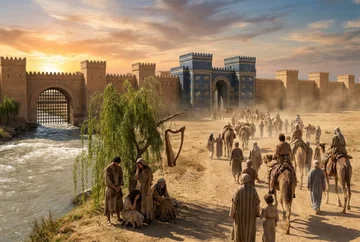
Beside Babylon's rivers the exiles carried from ruined Jerusalem were tauntingly ordered by their conquerors to perform Zion's joyful worship music for heathen amusement.ST Apr 19, 1910ST May 13, 1908ST Dec 10, 1912ST Oct 8, 1896ST May 24, 1883 They sat down and wept remembering Zion and hung their harps tuneless on the willows, refusing to turn the Lord's music into entertainment in a strange land.RH May 27, 1858ST Apr 1, 1913ST Sep 24, 1894RH Apr 22, 1915ST Dec 19, 1916 The songs demanded of them were sacred songs of praise to God in worship, incomparable above all other songs and the sweetest part of religion, not to be confused with lighter worldly tunes.RH Apr 22, 1915RH Oct 30, 1855RH Jul 29, 1862ST Feb 21, 1906 Their weeping shows the condition of the church when through great wickedness she lost God's protecting arm and was carried to Babylon, unable in that bereft state to sing His praise as in obedient joy at Jerusalem.ST May 16, 1911ST Aug 28, 1884RH Sep 11, 1913 Yet those same songs become joy and thanksgiving after deliverance and a heart-moving witness of hope shining into darkness, calling believers still journeying toward the heavenly home to keep singing with courage despite scorn and sorrow.ST Feb 11, 1886ST Apr 1, 1913RH Sep 16, 1915RH May 20, 1915RH Nov 17, 1910
Exile Setting and Authorship
Psalm 137 belongs to Israel's captivity in Babylon, beside the rivers of Babylon where the exiles had been carried away from Jerusalem, and the song grew out of that exile.ST May 13, 1908ST Dec 10, 1912ST May 24, 1883ST Aug 25, 1909 Babylon is the carrying-away power that took the Jews captive, and the request for a song of Zion is set within that captivity.ST May 13, 1908ST May 24, 1883
The psalm was composed during the latter part of the Babylonian captivity under Belshazzar, who knew not Daniel, when persecution and distress of the Jews were greatest, by Asaph, Ethan and others.RH Aug 31, 1916 It expresses the sorrows and afflictions of the Hebrew captives in exile, mingled with exhortation and encouragement and assurance of divine help and final deliverance from their persecutors.RH Aug 31, 1916 It is also placed after the Babylonian captivity, after the restoration, as the work of one of God's children who had endured the worst of the captivity.ST It is further understood as a prophecy of the Babylonian captivity.RH Mar 12, 1861
The exiles knew themselves to be in the land of an enemy and conqueror, an unwelcome and painful condition in separation from Zion.ST Aug 28, 1884RH Sep 11, 1913 Jerusalem lay ruined and devastated, its king captive and its people in exile, and they mourned Zion and the devastation of their homeland.RH Sep 11, 1913RH Oct 20, 1859 Their captors demanded a song and joy from those who had been devastated, mocking their grief until singing felt impossible.ST Aug 28, 1884RH Sep 11, 1913RH Oct 20, 1859
Demand for Mirthful Song
Those who carried Israel away captive and wasted them demanded songs and mirth from the exiles taken from Jerusalem.ST Apr 19, 1910ST Oct 8, 1896ST Nov 21, 1900ST Sep 28, 1904ST Apr 1, 1913 The call to sing one of the songs of Zion was made tauntingly, scornfully and derisively, as a demand for entertainment and amusement.ST Apr 19, 1910ST Nov 21, 1900ST Sep 28, 1904ST Jan 30, 1896 It mocked their grief over separation from Zion, pressing cheer from mourners longing for their native land and for the Deliverer until contempt was satiated.ST Oct 8, 1896ST Nov 21, 1900ST Apr 1, 1913ST Jan 30, 1896
The demand sets the joy of worship in Jerusalem against the sorrow of captivity in a strange foreign land.ST Apr 1, 1913ST Sep 24, 1894 Songs that once expressed worship and hope could not be offered as entertainment in a foreign land for heathen amusement.ST Apr 1, 1913ST Sep 24, 1894RH Apr 22, 1915 Israel therefore refused to perform the Lord's music there, laying aside instruments in grief while remembering Zion.ST Sep 24, 1894RH Apr 22, 1915
Sorrow and longing for the lost home and for the Deliverer made joyful singing and rejoicing in the Lord feel impossible.RH May 27, 1858ST Feb 11, 1886ST Dec 19, 1916RH Mar 21, 1865 The captives sat down and wept remembering Zion, hung their harps on the willows, and left them tuneless by Babel's streams with no echo of gladness.RH May 27, 1858RH Jan 23, 1855ST Oct 19, 1904RH Mar 21, 1865 Their music was silenced amid the tyrant's jest and the nations' scorn, giving the psalm its homesick note of grief and captivity.ST Feb 11, 1886ST Dec 19, 1916ST Jan 30, 1896
Nature of Zion's Songs
The songs of Zion are sacred songs of praise to God in worship, incomparable and standing above all other songs.RH Oct 30, 1855RH Jul 29, 1862ST Feb 21, 1906 They are the sweetest part of religious worship, to be set in contrast with lighter worldly tunes.RH Oct 30, 1855RH Jul 29, 1862
Israel's vocal and instrumental music was an original sacred literature of its own, with both words and music composed to memorialize God's great acts and personal deliverances, not copied or borrowed from surrounding nations.RH Apr 22, 1915 This is proved by the refusal to perform the Lord's music in a foreign land for heathen amusement when Babylonian captors demanded sacred mirth as entertainment from Zion's repertoire, for the captives laid aside their instruments in grief while remembering Zion.RH Apr 22, 1915 The only song afterward given to be sung even in that foreign captivity was the funeral song of Lamentations, the swan song and funeral dirge of a once mighty and glorious nation whose former glory never returned.RH Apr 22, 1915
The songs of Zion are songs for religious education and worship that every child should be taught to sing, since no religious education is complete without them, and singing them was a practice and a study in David's day.RH Jul 29, 1862 They are songs about God used to teach His word, so that even a boy only thirteen years old and recently turned from heathenism can teach them to little heathen children, offering prayer and telling simple Bible stories and closing the meeting with song and benediction, taking a leader's place and leading others to the Lord in the last days.RH Nov 19, 1914 They are songs for congregational worship in which a leader helps the whole church sing together without confusion so that everyone can take part.RH May 10, 1870
The songs of Zion must cause harmony and union of feeling and sentiment among God's people as they meet for prayer and praise.RH Feb 7, 1865 They must come from the heart with joyful lips to ascend to heaven as grateful incense before the Lord.RH Feb 7, 1865 Paying worldly professionals to lead them — an opera singer from the theater and an organist from balls and parties, at a cost exceeding the minister's salary and supported by thousand-dollar pew rents that exclude the poor — is not worship but solemn mockery that dishonors God.RH Feb 7, 1865 God will not accept praise from such lips under such circumstances, and the true church will not hire out its worship but will praise Him from the heart.RH Feb 7, 1865
The songs of Zion are the songs of heaven sung by the redeemed playing on harps, a picture found only in the Bible and not in the sacred books of other religions.RH Jun 10, 1915 Songs sung in Christian worship on earth are practice for the songs of heaven.RH Jun 10, 1915 Those who hope to join the one hundred and forty-four thousand in singing the new song at Christ's soon return must join reverently in the sacred songs of the gospel now, with the same reverence that will hallow the anthems of heaven.RH Jun 10, 1915
Church Captivity and Deliverance
Psalm 137:3 shows the condition of the church, the daughter of Zion, when her wickedness grew so great that God removed His protecting arm and she was carried to Babylon about six hundred years before Christ.ST May 16, 1911 In Jerusalem while obedient to God she could sing His praise in the joy and prosperity of His presence, but in a strange land bereft of protection she sat down and wept remembering Zion and hanged her harps on the willows, unable to sing the Lord's song when those who carried her away captive and wasted her required a song and mirth.ST May 16, 1911 Her weeping is the beginning of six centuries of travailing, anguish, crying and longing for the Deliverer, mourning the worship and prosperity she had lost in Jerusalem and waiting anxiously for His coming.ST May 16, 1911ST Apr 29, 1903 That travail of the church in captivity continued until Jesus was born, for the captive Israelites wept as they longed for the coming Messiah.ST May 16, 1911ST Apr 29, 1903ST Dec 9, 1908
Their grief and longing for Zion beside Babylon's streams became a pledge of deliverance, liberty and restoration when Babylon fell and their oppressors were overthrown.RH Jan 23, 1855 Babylon's daughters belong to Babylon and are included as part of the city, which supports understanding the great Babylon as embracing all corrupt Christianity.RH Sep 2, 1851 Israel's sorrow over the lost home and worship in Babylonian captivity included an unavailing regret for Sabbath-breaking.RH Mar 19, 1901
Worship Witness and Hope
The songs of Zion are the praises sung by souls brought straight out of heathen darkness into the light of faith as they press along the highway toward the holy city of God.RH Sep 16, 1915RH May 20, 1915RH Nov 17, 1910 Singing them expresses joy and thanksgiving for deliverance, joined with praying and working for others, and stands as a heart-moving witness of hope and light shining into a dark place.RH May 20, 1915RH Nov 17, 1910 Even those only lately from heathenism can speak them intelligently with tears of joy streaming from their eyes, proving that the gospel transforms lives and calls for going forward with men and means to hungry souls in darkness.RH Nov 17, 1910 Singing them marks a change from dull and unintelligent looks of degradation to bright-faced, keen-eyed life ambitious to learn and climbing upward every day.RH Oct 7, 1915 That change comes quickly, often within two or three months, and makes those who sing look absolutely of a different tribe from their own villagers who remain in darkness.RH Oct 7, 1915 Even a boy only thirteen years old and recently turned from heathenism can take a leader's place, teaching them to little heathen children with offered prayer and simple Bible stories and closing the meeting with song and benediction, leading others to the Lord in the last days.RH Nov 19, 1914
A captive's song about the peaceful heavenly home and its promised rest, sung when captors demand amusement, moves the ruler and others to tears, sadness and reflection.ST Dec 19, 1916ST Dec 19, 1916 Such songs of faith can touch even hardened hearts and bless others.ST Dec 19, 1916 Being asked to sing in sorrow becomes a challenge not to put away hope or cheerfulness during sickness or in the face of death.ST Oct 19, 1904 Singing those songs brings cheer and comfort to one in pain.ST Mar 10, 1914 They lift those who weep amid deep sorrow, lonely and sore hearts, dead love, fled hope, and earthly joys no more, by calling them to remember the glorious bright fair country and pearly gate where angels wait with loving welcome, the hastening glad day of days and long bright journey to the skies rising on tireless pinions with angel guide, the arising of the dead from dusty bed and desert waste and ocean cave amid trumpets' blare and shouts of victory over the grave, the rapturous flight toward endless day and endless glory past suns and systems and stars to jasper walls and gleaming many mansions, and the entrance of the tried and true cohort through the pearly gates of paradise.RH Mar 30, 1911
The demand that grieving exiles furnish amusement in a foreign land, where songs that once expressed worship and hope feel impossible to offer as entertainment, becomes a call for modern believers to keep singing with courage as they journey toward their heavenly home.ST Apr 1, 1913 On an earth darkened by sin the soul longs for its heavenly home until Christ comes, when the faithful will join the angels and sing Zion's songs with immortal voices.ST Feb 11, 1886 That longing is for a share with the faithful remnant in their song when Christ gathers the redeemed home, despite the world's scorn and hardship.RH Aug 13, 1861 The memory of Zion's songs remains among the sweetest in memory because heard often in youth, through the lasting influence of songs sung by parents at home.RH Jun 24, 1902 Those songs express the joy and courage of people united in Christ and enjoying fellowship in the Spirit.RH May 7, 1872
The reference to Zion's songs warns professed Christians who may appear to share in their spirit while worldliness makes their lives contradict their profession.RH Oct 11, 1906 It also applies to Christians who once delighted in Zion's songs but, through close contact with people whose interests are less elevated, lose that delight and adopt their companions' lesser notes.ST Apr 24, 1901
Sources