1 Kings 19:8
And he arose, and did eat and drink, and went in the strength of that meat forty days and forty nights unto Horeb the mount of God.
Translations
And he arose, and did eat and drink, and went in the strength of that meat forty days and forty nights to Horeb the mount of God.
King James Version, KJV Cambridge Paragraph Bible, Revised Version
And he arose, and did eat and drink, and went in the strength of that meat forty days and forty nights unto Horeb the mount of God.
Webster Bible, Darby Translation
And he arose, and ate and drank, and went in the strength of that food forty days and forty nights to Horeb the mount of God.
And he arose, and did eat and drink, and went in the strength of that food forty days and forty nights unto Horeb the mount of God.
and he riseth, and eateth, and drinketh, and goeth in the power of that food forty days and forty nights, unto the mount of God — Horeb.
So he arose, and did eat and drink,—and journeyed, in the strength of that eating, forty days and forty nights, as far as the mountain of God—Horeb.
Berean Standard Bible, Majority Standard Bible
So he got up and ate and drank. And strengthened by that food, he walked forty days and forty nights until he reached Horeb, the mountain of God.
He arose, and ate and drank, and went in the strength of that food forty days and forty nights to Horeb, God’s Mountain.
So he got up and took food and drink, and in the strength of that food he went on for forty days and nights, to Horeb, the mountain of God.
Then he arose, and did eate and drinke, and walked in the strength of that meate fourtie dayes and fourtie nights, vnto Horeb the mount of God.
Douay-Rheims (Challoner revision)
And he arose, and ate, and drank, and walked in the strength of that food forty days and forty nights, unto the mount of God, Horeb.
Pictures
Cross-references 20 of 31
- Exodus 34:28
And he was there with the LORD forty days and forty nights; he did neither eat bread, nor drink water. And he wrote upon the tables the words of the covenant, the ten commandments.
Moses and Elijah both fasted for forty days and nights.
- Exodus 3:1
Now Moses kept the flock of Jethro his father in law, the priest of Midian: and he led the flock to the backside of the desert, and came to the mountain of God, even to Horeb.
Both identify Horeb as the mountain of God.
- 1 Kings 19:4
But he himself went a day’s journey into the wilderness, and came and sat down under a juniper tree: and he requested for himself that he might die; and said, It is enough; now, O LORD, take away my life; for I am not better than my fathers.
Elijah’s despair under the juniper tree preceded God’s strengthening provision.
- Matthew 4:2
And when he had fasted forty days and forty nights, he was afterward an hungred.
Jesus also fasted for forty days.
- 2 Kings 2:11
And it came to pass, as they still went on, and talked, that, behold, there appeared a chariot of fire, and horses of fire, and parted them both asunder; and Elijah went up by a whirlwind into heaven.
Elijah is taken to heaven without descending to the tomb.
- Exodus 16:15
And when the children of Israel saw it, they said one to another, It is manna: for they wist not what it was. And Moses said unto them, This is the bread which the LORD hath given you to eat.
God provided manna for Israel in the wilderness, miraculously supplying food as he did for Elijah.
- Exodus 24:18
And Moses went into the midst of the cloud, and gat him up into the mount: and Moses was in the mount forty days and forty nights.
Both describe a forty-day and forty-night stay on the mountain.
- 1 Kings 17:6
And the ravens brought him bread and flesh in the morning, and bread and flesh in the evening; and he drank of the brook.
Elijah’s earlier flesh-food diet contrasts with his miraculous feeding before traveling to Horeb.
- 1 Kings 18:36-39
And it came to pass at the time of the offering of the evening sacrifice, that Elijah the prophet came near, and said, LORD God of Abraham, Isaac, and of Israel, let it be known this day that thou art God in Israel, and that I am thy servant, and that I have done all these things at thy word.
faith cast down idolatry before flight
- Exodus 19:18
And mount Sinai was altogether on a smoke, because the LORD descended upon it in fire: and the smoke thereof ascended as the smoke of a furnace, and the whole mount quaked greatly.
Horeb is the mount where the Lord descended in fire.
- Deuteronomy 9:9
When I was gone up into the mount to receive the tables of stone, even the tables of the covenant which the LORD made with you, then I abode in the mount forty days and forty nights, I neither did eat bread nor drink water:
Both describe a forty-day stay on the mountain; Moses fasted, while Elijah was sustained by food.
- Luke 4:2
Being forty days tempted of the devil. And in those days he did eat nothing: and when they were ended, he afterward hungered.
Both recount a forty-day fast.
- 1 Kings 19:2
Then Jezebel sent a messenger unto Elijah, saying, So let the gods do to me, and more also, if I make not thy life as the life of one of them by to morrow about this time.
Jezebel’s threat sends Elijah fleeing.
- Exodus 16:4
Then said the LORD unto Moses, Behold, I will rain bread from heaven for you; and the people shall go out and gather a certain rate every day, that I may prove them, whether they will walk in my law, or no.
Both show God miraculously supplying food in the wilderness.
- Malachi 4:5
Behold, I will send you Elijah the prophet before the coming of the great and dreadful day of the LORD:
Elijah’s experience and commandment-centered work connect with the promised Elijah before the day of the Lord.
- James 5:17
Elias was a man subject to like passions as we are, and he prayed earnestly that it might not rain: and it rained not on the earth by the space of three years and six months.
Elijah’s prayer during the famine frames the account of his journey to Horeb.
- 1 Kings 18:46
And the hand of the LORD was on Elijah; and he girded up his loins, and ran before Ahab to the entrance of Jezreel.
Elijah’s exhausting run precedes his need for heavenly food.
- Deuteronomy 9:18
And I fell down before the LORD, as at the first, forty days and forty nights: I did neither eat bread, nor drink water, because of all your sins which ye sinned, in doing wickedly in the sight of the LORD, to provoke him to anger.
Moses fasted forty days and nights.
- Exodus 20:1-17
And God spake all these words, saying,
Horeb is identified as Sinai, where God gave the law.
- Exodus 17:6
Behold, I will stand before thee there upon the rock in Horeb; and thou shalt smite the rock, and there shall come water out of it, that the people may drink. And Moses did so in the sight of the elders of Israel.
Moses brought water from the struck rock at Horeb.
Commentary
Each commentary is drawn from primary sources: the writings of Ellen G. White and Adventist pioneers and periodicals. Each commentary is separate. Its own words are not a quotation; follow the references to read the source passages.
Ellen G. White
20 sources
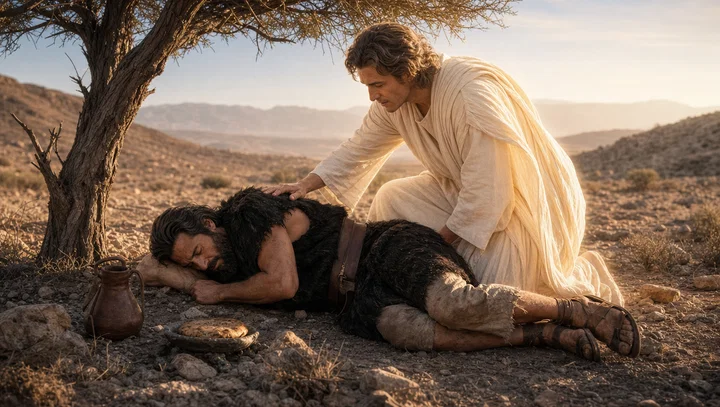
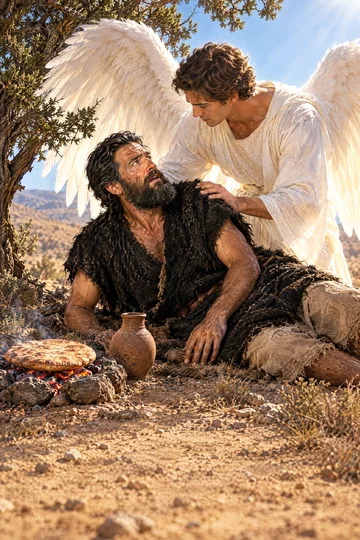
After Carmel Jezebel threatened his life, and though God had just shown His power Elijah lost courage and fled without being sent.RH Oct 7, 1873Lt 62, 1900, par. 3–6ED 151.1–2 Exhausted from labor without food and sunk in discouragement and bitter disappointment, he asked to die under the juniper tree.RH Oct 7, 1873RH Oct 30, 1913RH Oct 7, 1873 An angel twice bade him eat and drink, and in the strength of that miraculously supplied food he journeyed forty days and forty nights through the wilderness to Horeb, where he lodged in a cave.3T 289.1–2RH Oct 7, 1873PK 166.2ST Jun 16, 18872SP 25.1–26.1 God did not forsake him in despair but with pitying tenderness watched over him and abundantly supplied the strength needed for the trial.Lt 62, 1900, par. 9–10RH Oct 16, 1913RH Oct 7, 1873GC88 512.1ST Jun 16, 1887 The history brings hope to all who labor self-sacrificingly and grow despondent, teaching them to trust God rather than fear, to remain in duty, and to wait patiently for Him to defend them.RH Oct 16, 1913RH Oct 30, 191313MR 362.1Ms 6, 1889, par. 57
Flight to Horeb
This verse belongs to Elijah's flight into the wilderness after his work on Mount Carmel, when Jezebel threatened his life and he lost courage and lost sight of God's care despite God's recent display of power, fleeing without being sent.Lt 62, 1900, par. 3–6ED 151.1–2 That journey was a rash and faithless flight for life from Jezebel, made without God's warning to flee and without waiting for the Lord to speak.RH Oct 7, 1873 He should instead have trusted God for protection and waited with faith and patience for God to shield him and give another victory with judgment upon Jezebel.RH Oct 7, 1873
He had toiled all day without food, including running before Ahab's chariot to the gate of the city, and was left exhausted, weary, prostrate, broken-hearted and discouraged.RH Oct 7, 1873RH Oct 7, 1873 This was the reaction that follows exalted faith and marked success, and in it he murmured and asked God to take his life because he was no better than his fathers.RH Oct 7, 1873RH Oct 7, 1873 He was disappointed that Israel had not become true and faithful and that Jezebel's influence over Ahab had not ended after the display of God's power.RH Oct 7, 1873 As a weary, travel-worn fugitive fleeing for his life before the rage of an infuriated woman, with bitter disappointment crushing his spirits, he forgot that the same all-powerful and pitiful God who had granted fire from heaven in answer to prayer and then granted rain remained unchanged.RH Oct 7, 1873RH Oct 30, 1913
An angel twice bade him arise and eat cake baked on coals and drink water, warning that the journey was too great for him.RH Oct 7, 1873RH Oct 7, 1873 In the strength of that food he arose and traveled forty days and forty nights through the wilderness to Horeb the mount of God.3T 289.1–2RH Oct 7, 1873PK 166.23T 291.2RH Oct 7, 1873 There he found refuge in a cave, lodging there at night for protection from wild beasts, and received the Lord's question about what he did there.3T 289.1–2RH Oct 7, 1873PK 166.23T 291.2RH Oct 7, 1873 The food was supplied by miracle for a long journey when it could be obtained from no other source.ST Jun 16, 18872SP 25.1–26.11RED 20.1LC1 20.1
Divine Care and Lessons
Discouragement did not cut Elijah off from God, for His eye still rested on His suffering servant asleep under the juniper tree, knowing the sore anguish of a heart pressed by temptation and severe conflict.RH Oct 7, 1873 He loved the prophet no less in that forsaken feeling than when fire flashed from heaven on Carmel in answer to prayer, and with pitying tenderness He ministered to him.RH Oct 16, 1913RH Oct 7, 1873 Twice the angel woke him and bade him arise and eat cake baked on the coals and drink water, warning that the journey was too great for him.Lt 62, 1900, par. 9–10RH Oct 16, 1913RH Oct 7, 1873 In the strength of that refreshment Elijah went through the wilderness forty days and forty nights to Horeb the mount of God, where he found refuge in a cave, lodging there at night for protection from wild beasts.Lt 62, 1900, par. 9–10RH Oct 16, 1913RH Oct 7, 1873 This is the care of the heavenly family for faithful servants.Lt 62, 1900, par. 9–10
The food put strength into him that carried him the whole way, proving that God abundantly bestows on His servants the strength they need for test and trial.RH Oct 16, 1913 It proves His watchful care to preserve the life of His servants and to supply the necessities of a journey He requires, feeding His prophet by miracle for a long journey when food could be obtained from no other source.ST Jun 16, 1887 It is one example of how holy angels have in all ages been sent on missions of mercy to minister to God's people when about to perish from weariness and hunger in the desert.GC88 512.1
The same watchful care of the Father that fed Elijah and rained manna from heaven for Israel preserved Joseph and his family on the journey to Egypt and while tarrying in that land of strangers.ST Jun 16, 1887ST Sep 27, 1877 It sustained the poor earthly parents of Jesus through the costly gifts brought to the infant Saviour by the wise men.ST Jun 16, 1887ST Sep 27, 1877
By one failure of faith, in letting go of faith and yielding to human weakness and error and fleeing before Jezebel's threats to pray alone in the desert that he might die, Elijah cut short his life-work.ED 151.1–2ST Nov 17, 1909 The work he had begun he was not to complete, for God bade him anoint another to be prophet in his stead.ED 151.1–2ST Nov 17, 1909 Yet God had marked the heart-service of His servant, and in mercy did not leave him to perish in discouragement and solitude in the wilderness.ST Nov 17, 1909 Not for him the descent to the tomb, but the ascent with God's angels to the presence of His glory.ST Nov 17, 1909
Sin brings only shame and loss and unbelief means failure, but God's mercy reaches to the deepest depths and faith lifts the repenting soul to share the adoption of the sons of God.ST Nov 17, 1909 The trial belongs to an account in which natural impulses and spiritual life are brought into conflict, exposing what is impure in character.Ms 6, 1889, par. 60 God's work in it brings the fine gold to light and consumes the dross, a refining each person undergoes in an individual way.Ms 6, 1889, par. 60
The history teaches God's people facing difficulty to trust in the Lord rather than human wisdom when difficulties arise.13MR 362.1Ms 6, 1889, par. 57 Each one is to remain in the way of duty without yielding to fear or letting fear discourage him.13MR 362.1Ms 6, 1889, par. 57 He is to wait patiently and prayerfully for God to defend him and display His power, giving room for God to work.13MR 362.1Ms 6, 1889, par. 57
Becoming discouraged and desponding under trying circumstances, pressed beyond measure and seeing nothing desirable in life, is nothing strange or new even for men of spiritual power and one of the mightiest of prophets.RH Oct 30, 1913 For all who spend their lives in self-sacrificing labor and are tempted to give way to despondency and distrust, Elijah's experience on Horeb brings hope and courage in the assurance of God's watchful care, love, and power.RH Oct 30, 1913 It speaks especially to those whose zeal for God's cause is misunderstood or unappreciated, whose counsels and reproofs are slighted, whose efforts at reform are repaid with hatred and opposition, and who are burdened by those from whom help and support should come.RH Oct 30, 1913 When hope was gone and his life-work seemed threatened with defeat as a weary, travel-worn fugitive before the rage of an infuriated woman with bitter disappointment crushing his spirits, Elijah learned one of the deepest lessons of his life.RH Oct 30, 1913 In the hour of his greatest weakness he learned the need and the possibility of trusting God under circumstances the most forbidding, with the assurance that Heaven never forsakes those who maintain integrity.RH Oct 30, 1913
Sources
Pioneers and periodicals
61 sources
After his triumph on Carmel Elijah fled for his life when Jezebel threatened him, and under a juniper tree an angel twice woke him to eat bread baked on coals and drink water, in whose strength he went forty days and forty nights through the wilderness to Horeb the mount of God where he lodged in a cave.RH Oct 7, 1873ST Aug 20, 1885ST Aug 17, 1904ST Jul 7, 1898 God did not forsake His weary discouraged servant but tenderly nursed him with sleep, rest and food until he was able to go.ST Sep 7, 1904ST Aug 17, 1904 He fed him by miracle where no other food could be obtained, showing He is not limited in resources and can sustain His servants beyond ordinary means.ST Jun 16, 1887RH Sep 25, 1913ST Oct 22, 1902 That wilderness feeding is a type of His care for His commandment-keeping people in the last days when driven into the wilderness, whose plain bread and water shall be sure.RH Mar 31, 1868RH Jul 9, 1867RH Oct 18, 1870 The flight itself was rash and faithless, cutting short his work, yet at Horeb God met him, taught him, and sent him back with fresh strength to anoint others and take Elisha.RH Oct 7, 1873ST Nov 17, 1909ST Aug 19, 1889ST May 24, 1905ST May 13, 1908
Flight and Journey Setting
After the day of anxiety and triumph on Carmel and the sixteen-mile run before Ahab's chariot to the entrance of Jezreel, the weary prophet became fearful and discouraged contrary to his usual manner when Jezebel sent word that his life must pay for his slaying of the false prophets, so that he fled for his life into the wilderness worn, wearied, travel-worn and prostrate, with bitter disappointment crushing his spirits and praying that he might die.RH Oct 30, 1913ST May 13, 1908 Toiling all day without food, including running before the chariot to the gate of the city, he was exhausted, broken-hearted and prostrated with discouragement in the reaction that follows exalted faith and marked success, murmuring that he was no better than his fathers because Israel had not become true and faithful and Jezebel's influence over Ahab had not ended after the display of God's power.RH Oct 7, 1873RH Oct 7, 1873 His journey was a rash, faithless flight made without God's warning to flee and without waiting for the Lord to speak, when he should have trusted God for protection and waited with faith and patience for God to shield him and give another victory with judgment upon Jezebel, forgetting that the same all-powerful and pitiful God who had granted his requests for fire from heaven and for rain remained unchanged.RH Oct 7, 1873 By that one failure of faith in letting go of faith and yielding to human weakness and error before the threats of Jezebel and the rage of an infuriated woman, he cut short his life-work so that the work he had begun he was not to complete and another must be anointed prophet in his stead, proving that sin brings only shame and loss and unbelief means failure.ST Nov 17, 1909 Yet becoming discouraged and desponding under trying circumstances, pressed beyond measure and seeing nothing desirable in life even to enforced retirement and wishing to die, is nothing strange or new even for men of spiritual power and one of the mightiest of prophets, and God did not forsake him but kept His eye upon him in sore anguish, loving him no less discouraged under the bush than when fire fell on Carmel.RH Oct 30, 1913RH Oct 7, 1873
Alone in the wilderness under the juniper tree and sleeping there, he was twice aroused in that night by an angel with pitying tenderness to arise and eat and drink cake baked on coals and water from an angel's hand, with sleep and rest between the meals, warned that the journey was too great for him.RH Oct 7, 1873ST Aug 20, 1885 God twice provided the exhausted and hungry man with that simple meal of bread and water, first feeding the hungry man and giving bodily strength before speaking a word to his discouraged heart, and abundantly bestowing on His servant the strength needed for test and trial.RH Oct 16, 1913ST Aug 20, 1885 The angel's care met his need for strength for a journey too great for him, and after the second coming he arose and ate and drank and answered at Horeb that he had been very jealous for the Lord God of hosts because Israel had forsaken the covenant, thrown down the altars and slain the prophets, leaving him alone with his life sought.RH Sep 16, 1909ST Aug 20, 1885 Bread and water in the desolation of the desert from the hand of an angel is infinitely better than the richest dainties in the luxury of kings' palaces from the hand of a Jezebel, illustrating that simple food and temperance are sufficient for the work and preparation God requires.ST Aug 20, 1885
In the strength of that food and drink he pressed on and traveled forty days and forty nights, about two hundred miles from Beer-sheba through rugged country, unto Horeb the mount of God, also called Mount Sinai.ST Aug 17, 1904ST Jul 7, 1898RH Sep 25, 1913 The meal restored the exhausted prophet and physically restored him so he could continue to the mountain, God tenderly and patiently nursing him until able to go there, where he received a thorough spiritual replenishing and encountered manifestations of God's glory.ST Aug 17, 1904ST Aug 17, 1904 This special case illustrates that God can sustain the body and its endurance by means beyond ordinary food.RH Sep 25, 1913 At Horeb he lodged in a cave at night for protection from wild beasts, where the word of the Lord came asking what he did there.RH Oct 7, 1873RH Oct 7, 1873
The verse belongs to the wholly historical narrative of 1 Kings 3-21 and to the history of the two separate kingdoms of Judah and Israel for about eighty years, from the revolt of the ten tribes to the death of Jehoshaphat, and forms part of the extraordinary ministry of the prophet Elijah.RH May 25, 1916ST Apr 26, 1910 It stands in a sad record full of important lessons of general downward moral tendency from the time of David, broken by times of reviving, showing that whenever the people sought God, God wrought for them and through them abundantly, and that great responsibility rested on leaders who molded the people immensely for good when faithful and strong for God but caused the people to fail with them when they failed to lead in right ways.ST Apr 26, 1910 It describes a time when Israel had largely turned from the true God to Baal worship in apostasy, when Elijah believed he alone remained faithful while God preserved a faithful people and hidden remnant that answered the prophet's call, hidden from his view.RH Feb 21, 1865 It shows God's great and mighty prophet, devoted and earnest, who could slay the prophets of Baal and pray for rain that the Lord sent, yet became discouraged when overcome by weariness, and it belongs to his earlier flight and experience at Horeb about ten years before his ascension when God translated him.ST May 20, 1913ST
Horeb is Mount Sinai, specially noted as the place where God came down in great majesty to rehearse His holy law before the children of Israel, which in their long apostasy and slavery had been practically forgotten.ST Aug 17, 1904 It was a rugged region of Arabia that had earlier served as a place of training for Moses and later as a refuge for Paul. There his eyes and heart were gladdened by a heavenly vision, honored by God's presence, and he spent forty days and nights there with God in the mountains, a setting associated with divine communion.RH Nov 17, 1859ST Sep 20, 1899 There God tested his ability to discern the divine presence, not identified by dramatic outward power in wind, earthquake and fire, for God was not in those disturbances, but afterward speaking in a still, small voice, which is God's word.ST Feb 10, 1904ST May 2, 1906
The setting involves Jezebel, Ahab's wife, who killed the Lord's prophets, led Ahab into idolatry and supported the prophets of Baal.RH Feb 12, 1857 It is connected with Elijah fleeing her cruel persecution and being hidden in a cave on the top of Mount Carmel near Haifa, about half an hour's walk from the foot of the mountain where Haifa stands.RH Dec 7, 1911 Close by is the cave where Elijah started his first school of the prophets, fifty-five feet long, thirty-one feet wide and nineteen feet high.RH Dec 7, 1911
Divine Provision and Care
God pitied His worn, wearied and discouraged servant fleeing for his life from Jezebel into the wilderness and wanting to die, and did not forsake him but kept His eye upon him in sore anguish.RH Oct 16, 1913ST Sep 7, 1904 He loved Elijah no less discouraged under the bush than when fire fell in answer to prayer on Carmel after the victory that drew Jezebel's threat, and sent His messenger with food to nourish and encourage him.RH Oct 16, 1913ST Sep 7, 1904 The angel twice aroused him in that night to eat and drink the angel-prepared cake baked on coals and water, warning with pitying tenderness that the journey was too great for him.RH Oct 16, 1913 He was tenderly and patiently nursed with sleep and rest between the meals and with refreshment until able to go, and the effect of the second meal physically restored him so that in the strength of that food he pressed on forty days and forty nights unto Horeb the mount of God, where he lodged in a cave and was asked what he did there.RH Oct 16, 1913ST Aug 17, 1904 The forty days gave the tired prophet opportunity to commune with God and learn his Maker's purpose and how to serve, and there at Horeb he received a thorough spiritual replenishing.ST Aug 17, 1904ST May 24, 1905 Horeb is Mount Sinai, specially noted as the place where God came down in great majesty to rehearse His holy law before the children of Israel, which in their long apostasy and slavery had been practically forgotten.ST Aug 17, 1904
That becoming discouraged and desponding under trying circumstances, pressed beyond measure and seeing nothing desirable in life even to wishing to die, is nothing strange or new even for men of spiritual power and one of the mightiest of prophets, a fugitive weary and travel-worn before the rage of an infuriated woman with bitter disappointment crushing his spirits.RH Oct 30, 1913 For all who spend their lives in self-sacrificing labor and are tempted to give way to despondency and distrust, whose zeal for God's cause is misunderstood or unappreciated, whose counsels and reproofs are slighted, whose efforts at reform are repaid with hatred and opposition, and who are burdened by those from whom help should come, Elijah's experience brings hope and courage in the assurance of God's watchful care, love and power.RH Oct 30, 1913 When hope was gone and his life-work seemed threatened with defeat, he learned in his greatest weakness the need and possibility of trusting God under the most forbidding circumstances, with the assurance that Heaven never forsakes those who maintain integrity and that God abundantly bestows on His servants the strength they need for test and trial.RH Oct 16, 1913RH Oct 30, 1913
The Lord fed His prophet by miracle for the long journey when food could be obtained from no other source, as when he lay under the juniper tree in the wilderness ready to perish after fleeing the wrath of Jezebel.ST Jun 16, 1887ST Oct 22, 1902ST Dec 2, 1880 After eating but two meals he went in the strength of that food forty days and forty nights through rugged country, proving the Lord is not limited in resources nor in ways and means for sustaining His people.RH Sep 25, 1913ST Oct 22, 1902 This special case illustrates that God can sustain the body and its endurance by means beyond ordinary food, and He strengthened Elijah in the wilderness.RH Sep 25, 1913RH Nov 3, 1863 It is an example of what God has done for His people in such helpless circumstances and what He will do again under similar circumstances because His promise cannot fail, the same watchful care that rained manna from heaven for Israel and that preserved Joseph, Mary and Jesus on the flight into Egypt and sojourn there and supplied the necessities of a journey He requires through the valuable offerings of the wise men.ST Jun 16, 1887ST Feb 11, 1886 Yet He works such a direct miracle to support His people when provision is beyond their own power to secure, and it does not warrant expecting Him to work a direct miracle for support so long as provision is possible by using the means He has ordained, for such expectation is not faith.ST Feb 11, 1886
Angels are shown as faithful messengers of deliverance in doing God's work, where an angel found Elijah under a bush in the desert.RH Aug 7, 1916RH Nov 21, 1907 He first baked a cake to feed the hungry man and gave bodily strength and encouragement in discouragement before speaking a word to his discouraged heart.RH Aug 7, 1916RH Mar 30, 1916 Elijah received that food and drink and continued in the strength they gave him on his journey to Horeb.RH Nov 21, 1907RH Mar 30, 1916
The food twice provided when he was exhausted and hungry was a simple, healthful meal of cake baked on coals, the staff of life, and water, with sleep and rest between the meals, and God could have strengthened him for the journey without food but chose to sustain him by these two meals.RH Jul 9, 1867 Strengthened by this food he traveled forty days and nights to Horeb, where he encountered manifestations of God's glory, illustrating God's care for His servant and presenting simple food and temperance as sufficient for the work and preparation God required.RH Jul 9, 1867 The diet here omits flesh, showing a change from the former part of his experience by the brook Cherith when ravens brought him flesh as well as bread, and near the close of his work God gave him a vegetarian diet.RH Dec 14, 1905RH Jul 9, 1867 This is compared with those connected with the message who will be translated when Christ comes, who will be free from a flesh diet, for the bread and water given to Elijah is what will be given to the saints in the time of trouble, when bread shall be given and water shall be sure.RH Dec 14, 1905RH Jul 9, 1867
The verse also presents Elijah as fasting forty days and forty nights on his way to Horeb the mount of God, which is Mount Sinai, sustained by the food and drink he had received.ST May 19, 1881ST May 12, 1881ST Jul 30, 1894 His fast is cited as an example of a faithful and devoted servant of God fasting in a time of spiritual anguish.ST May 19, 1881ST May 12, 1881 Both Moses and Elijah fasted at Mount Sinai, a parallel in the Old Testament to Jesus fasting forty days and forty nights when tempted in the wilderness, and both underwent the same long fast as Jesus.ST Jul 30, 1894ST Feb 17, 1890 The place to which Jesus went to be tempted is not stated, leaving open that He was at that same place where the mount burned with fire and where Elijah's forty days and nights of travel ended near Sinai.ST Jul 30, 1894ST Nov 18, 1886 It illustrates that servants of God on special spiritual occasions when in an unusually spiritual frame of mind think less about eating than under ordinary circumstances.ST Feb 17, 1890
Prophecy of Last Days
Elijah's receiving of bread and water from God's angel and going in the strength of that food for forty days is a type of God's people in the last days.RH Mar 31, 1868RH Jul 9, 1867 They will keep and teach God's commandments, face persecution, be driven from their homes into the wilderness, and receive food from angels during the time of trouble.RH Mar 31, 1868RH Oct 18, 1870 The angel fed Elijah twice with a simple, healthful diet of cake baked on the coals and water, with sleep and rest between the meals, sustaining him to Horeb the mount of God.RH Jul 9, 1867 God could have strengthened Elijah for the journey without food, but chose to sustain him by two meals of the staff of life, and that bread and water is what will be given to the saints when bread shall be given and water shall be sure.RH Mar 31, 1868RH Jul 9, 1867 The plain fare illustrates what they may receive, for near the day of the Lord all the saints, rich and poor alike with no difference between them, will depend for their bread upon the ministering hand of the angel of the Lord.RH Mar 31, 1868RH Oct 18, 1870 The diet here omits flesh, showing a change from the former part of Elijah's experience by the brook Cherith when ravens brought him flesh as well as bread.RH Jul 9, 1867
The history of Elijah in 1 Kings 17-19 pictures the reformatory, converting work of John the Baptist at the first advent.RH Jul 9, 1901 Still more directly it pictures the same kind of work by those who fear the Lord and obey Him on tithes and offerings just before the great and dreadful day of the Lord.RH Jul 9, 1901 That is when God makes up His jewels and spares them as a man spares his own serving son.RH Jul 9, 1901
The Jezebel linked with this account was Ahab's wife, who killed the Lord's prophets, led Ahab into idolatry, and supported the prophets of Baal.RH Feb 12, 1857 Her name is used figuratively for the Papal abominations.RH Feb 12, 1857
Even this great and mighty prophet, devoted and earnest in God's work, who could slay the prophets of Baal and pray for rain that the Lord sent, became discouraged when overcome by weariness.ST Nov 17, 1909ST May 20, 1913 Letting go of faith and yielding to human weakness and error, he fled before the threats of Jezebel and prayed alone in the desert that he might die.ST Nov 17, 1909 By that one failure of faith Elijah cut short his life-work, and the work he had begun he was not to complete, God bidding him anoint another to be prophet in his stead.ST Nov 17, 1909 Yet God had marked the heart-service of His servant, and in mercy did not leave him to perish in discouragement and solitude in the wilderness.ST Nov 17, 1909 Not for him the descent to the tomb, but translation and ascent with God's angels to the presence of His glory.ST Nov 17, 1909ST May 20, 1913 Sin brings only shame and loss and unbelief means failure, but God's mercy reaches to the deepest depths and faith lifts the repenting soul to share the adoption of the sons of God.ST Nov 17, 1909
Links to Other Scripture
Both Moses and Elijah fasted forty days and forty nights at Mount Sinai, for Horeb the mount of God to which Elijah went is Mount Sinai.ST Jul 30, 1894 That Old Testament fasting parallels the fasting of Jesus for forty days and forty nights when tempted in the wilderness, and since the place of His temptation is not stated it is left open that He may have been at that same place.ST Jul 30, 1894 Elijah spent those forty days and nights at Horeb communing with God, where he neither ate nor drank.ST Aug 27, 1896
The same watchful care that fed Elijah by miracle for a long journey when food could be obtained from no other source also rained manna from heaven for Israel.ST Jun 16, 1887ST Sep 27, 1877 That care supplied the necessities of a journey He requires and proved His purpose to preserve the life of His servants.ST Jun 16, 1887ST Sep 27, 1877 It preserved Joseph and Mary and Jesus on the flight into Egypt and during the sojourn there, sustaining the poor earthly parents of Jesus in that land of strangers through the costly and valuable gifts brought to the infant Saviour by the wise men.ST Jun 16, 1887ST Sep 27, 1877
Elijah, weary and disheartened, fled from the hate of Jezebel to the mount of God at Horeb because mountains are places of communion with God, where stillness and grandeur invite meeting with Him.ST Sep 20, 1899ST Apr 24, 1901ST Sep 10, 1902 There he sought communion with his Maker to learn man's littleness and God's strength and to be fitted for work.ST Sep 10, 1902 Just so Moses was fitted by such communion in the mount of God to lead Israel out of Egypt's low dark plains, and Israel was brought to that same mountain to learn the same lesson.ST Sep 10, 1902 Just so Jesus often entered and ascended the mountains with His disciples or entirely alone to pray to His Father, sometimes continuing all night in prayer to God, to be strong for the next day's work.ST Sep 10, 1902
Horeb was a rugged region of Arabia that had earlier served as a place of training for Moses and later as a refuge for Paul. Angels provided Elijah with food and drink, and in the strength of that food he traveled forty days and nights until he reached Mount Horeb, leaving the scene of his recent triumphs behind. Though hidden from people in retreat from danger and discouragement, he was known to God.RH Oct 23, 1913 At this mount, after he had eaten and drunk, his eyes and heart were gladdened by a heavenly vision.RH Nov 17, 1859
Food giving strength for a journey illustrates spiritual food received through Christ's grace, on which prayerful reflection in the days afterward nourishes disciples and strengthens them for faithful duty and cheerful daily service, a provision of grace not to be wasted or treated carelessly.RH Jan 6, 1859 The spiritual food received from visiting fellow believers sustains a lonely Sabbath keeper for more than forty days, while God continues to feed him in their absence.RH Jul 22, 1852 God's goodness gave Elijah food that sustained him for forty days, and so the believers' joyful anticipation of Christ's coming in the seventh month was a slight spiritual repast that strengthened them through trial and disappointment.RH Aug 19, 1851 Rising and going on for forty days in the strength of what God has given pictures the spiritual strength received when prayer brings assurance of God's abiding love and care, which can sustain a person through a long effort or trial even for forty days if necessary.RH Feb 5, 1914 Earnest, persistent prayer supplies the strength and refreshment needed to bear life's burdens and progress toward God's kingdom, as food sustained Elijah in the wilderness on his journey to Horeb, even as ordinary food gives strength to continue a long journey until eating again in the evening.RH Jun 21, 1906 Truth that faith rests in Jesus and not in personal faith gives cheer for the whole way.RH Jan 6, 1859RH Feb 5, 1914
Warning and Encouragement Applied
The forty days' journey to Horeb was a rash flight for life undertaken without divine warning and without waiting for the Lord to speak, when trust in God's protection with faith and patience would have brought another victory and judgment upon Jezebel.RH Oct 7, 1873 Weary and prostrate after Carmel, Elijah became discouraged and murmuring, asking for death on the plea that he was no better than his fathers, disappointed that Israel had not turned faithful and Jezebel's power over Ahab had not ended, forgetting that the same all-powerful and pitiful God who had answered with fire from heaven and with rain remained unchanged.RH Oct 7, 1873 In weakness and weariness he let go of faith and yielded to human error, fleeing before Jezebel's threats and praying alone in the desert to die, and by that single failure of faith he cut short his life-work so that the work he had begun he was not to complete and another must be anointed prophet in his stead.ST Nov 17, 1909 Sin brings only shame and loss, and unbelief means failure.ST Nov 17, 1909
Becoming discouraged and desponding under trying circumstances, pressed beyond measure until nothing in life seems desirable and even death is asked for, is nothing strange or new even for men of spiritual power and one of the mightiest of prophets.RH Oct 30, 1913 Even courage and faith can be cast down to despair when driven into enforced retirement, for the strongest share human weakness.ST Apr 20, 1882 The despair and isolation beneath the juniper tree warns against becoming absorbed in a lonely, forlorn condition, and teaches the value of remaining faithful amid danger.RH Feb 4, 1915
God meets such discouragement by setting to work, arousing the one who casts himself down wishing to die and strengthening him with food for the journey to Horeb, then commissioning him to go and anoint Hazael and Jehu.ST Aug 19, 1889 The forty days gave the tired prophet rest and refreshment with opportunity to commune with God and learn how to serve and understand his Maker's purpose.ST May 24, 1905 At Horeb after the day of anxiety and triumph at Carmel and the sixteen-mile run before Ahab's chariot to Jezreel, when Jezebel's threat for the destruction of the false prophets had made the weary prophet fearful and discouraged contrary to his usual manner, God did not forsake him but taught him a wonderful lesson and sent him back to do His work and to take Elisha with him.ST May 13, 1908 Prolonged grief that borders on selfishness is remedied by finding other employment for the mind, and it is a blessed privilege to forget personal sorrow and disappointment in carrying forward God's broader plans.ST Aug 19, 1889
The journey to the mount of God is therefore a fresh start after failure, for God helps those who remain willing to be led. When Elijah was faint and weary an angel strengthened him with food and sent him onward, and sustained by that food he continued his journey and obeyed the Lord, illustrating that God gives strength to His servants to continue their work.RH Feb 15, 1912 Discouraged and fleeing for his life, Elijah was fed and encouraged by an angel, and in the strength of that food traveled forty days and forty nights to Horeb the mount of God to commune with Him.ST Aug 8, 1906 When he thought God's cause had failed, God nourished and encouraged him and brought him to the mount to commune with Him.ST Aug 8, 1906 There at the mount he found hope, for the Lord strengthened him and sent him back to work, marking a new start after discouragement.
For all who spend their lives in self-sacrificing labor and are tempted to give way to despondency and distrust, Elijah's experience on Horeb brings hope and courage in the assurance of God's watchful care, love, and power.RH Oct 30, 1913 It speaks to those whose zeal for God's cause is misunderstood or unappreciated, whose counsels and reproofs are slighted, whose efforts at reform are repaid with hatred and opposition, and who are burdened by those from whom help and support should come.RH Oct 30, 1913 When hope was gone and his life-work seemed threatened with defeat, Elijah learned in his greatest weakness the need and possibility of trusting God under the most forbidding circumstances, with the assurance that Heaven never forsakes those who maintain integrity.RH Oct 30, 1913 God's mercy reaches to the deepest depths, not leaving His servant to perish in discouragement and solitude nor to descend to the tomb but lifting him at last with angels to glory, and faith lifts the repenting soul to share the adoption of the sons of God.ST Nov 17, 1909 Bread and water in the desolation of the desert from the hand of an angel, cake baked on coals eaten after the angel came a second time because the journey was too great, is infinitely better than the richest dainties in the luxury of kings' palaces from the hand of a Jezebel who sought his life while he pleaded jealousy for the Lord because Israel had forsaken the covenant, thrown down the altars, and slain the prophets.ST Aug 20, 1885 The account belongs with God's extraordinary signs given to support the weakness of His servants.ST Aug 7, 1901
Sources