1 Kings 18:46
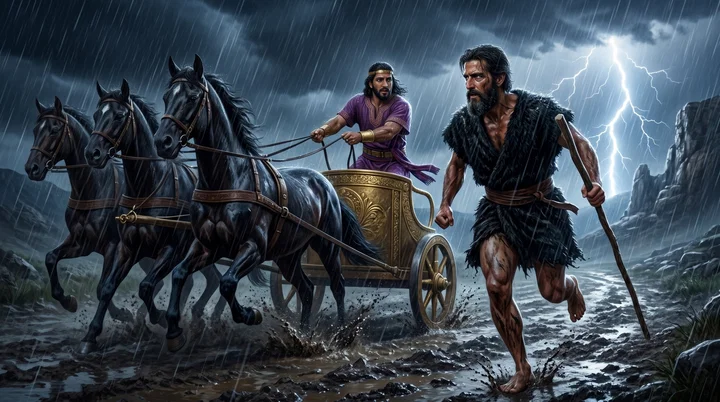
And the hand of the LORD was on Elijah; and he girded up his loins, and ran before Ahab to the entrance of Jezreel.
Translations
American King James Version, King James Version
And the hand of the LORD was on Elijah; and he girded up his loins, and ran before Ahab to the entrance of Jezreel.
And the hand of the Lord was on Elijah; and he girded up his loins, and ran before Ahab to the entrance of Jezreel.
And the hand of the LORD was on Elijah; and he girded his loins, and ran before Ahab to the entrance of Jezreel.
and the hand of the LORD was on Elijah; and he girded up his loins, and ran before Ahab to the entrance of Jezreel.
and the hand of Jehovah was on Elijah; and he girded up his loins, and ran before Ahab to the entrance of Jezreel.
and the hand of Jehovah hath been on Elijah, and he girdeth up his loins, and runneth before Ahab, till thine entering Jezreel.
And the hand of Jehovah was upon Elijah; and he girded up his loins, and ran before Ahab to the entrance of Jizreel.
but, the hand of Yahweh, came upon Elijah, so he girded his loins,—and ran before Ahab, until thou enterest Jezreel.
Berean Standard Bible, Majority Standard Bible
And the hand of the LORD came upon Elijah, and he tucked his cloak into his belt and ran ahead of Ahab all the way to Jezreel.
The LORD’s hand was on Elijah; and he tucked his cloak into his belt and ran before Ahab to the entrance of Jezreel.
And the hand of the Lord was on Elijah; and he made himself strong, and went running before Ahab till they came to Jezreel.
And the hand of the Lord was on Eliiah, and he girded vp his Ioynes, and ran before Ahab till he came to Izreel.
Douay-Rheims (Challoner revision)
And the hand of the Lord was upon Elias, and he girded up his loins and ran before Achab, till he came to Jezrahel.
Pictures
Cross-references 20 of 29
- 1 Kings 18:38
Then the fire of the LORD fell, and consumed the burnt sacrifice, and the wood, and the stones, and the dust, and licked up the water that was in the trench.
God sends fire to consume Elijah’s sacrifice, demonstrating divine power before his run.
- 1 Kings 19:4
But he himself went a day’s journey into the wilderness, and came and sat down under a juniper tree: and he requested for himself that he might die; and said, It is enough; now, O LORD, take away my life; for I am not better than my fathers.
contrasts courage before Ahab with despair under juniper
- 1 Kings 18:40
And Elijah said unto them, Take the prophets of Baal; let not one of them escape. And they took them: and Elijah brought them down to the brook Kishon, and slew them there.
Elijah’s execution of Baal’s prophets precedes his Spirit-empowered service to Ahab.
- 1 Kings 17:1
And Elijah the Tishbite, who was of the inhabitants of Gilead, said unto Ahab, As the LORD God of Israel liveth, before whom I stand, there shall not be dew nor rain these years, but according to my word.
Elijah’s announced drought ends in the account of his running before Ahab.
- 1 Kings 19:2-3
Then Jezebel sent a messenger unto Elijah, saying, So let the gods do to me, and more also, if I make not thy life as the life of one of them by to morrow about this time.
Jezebel threatens Elijah, prompting him to flee for his life.
- 1 Kings 18:21
And Elijah came unto all the people, and said, How long halt ye between two opinions? if the LORD be God, follow him: but if Baal, then follow him. And the people answered him not a word.
Elijah calls Israel to choose whom to follow.
- James 5:17-18
Elias was a man subject to like passions as we are, and he prayed earnestly that it might not rain: and it rained not on the earth by the space of three years and six months.
Elijah’s prayers brought drought and its end through returning rain.
- 1 Kings 18:19
Now therefore send, and gather to me all Israel unto mount Carmel, and the prophets of Baal four hundred and fifty, and the prophets of the groves four hundred, which eat at Jezebel’s table.
Jezebel supported and fed Baal’s prophets at her table.
- 1 Kings 19:5-8
And as he lay and slept under a juniper tree, behold, then an angel touched him, and said unto him, Arise and eat.
God sustained Elijah after his exertion.
- 1 Kings 18:17-18
And it came to pass, when Ahab saw Elijah, that Ahab said unto him, Art thou he that troubleth Israel?
Ahab accuses Elijah of troubling Israel; Elijah attributes the trouble to forsaking God’s commandments.
- Malachi 4:5
Behold, I will send you Elijah the prophet before the coming of the great and dreadful day of the LORD:
Promises an Elijah-like messenger before the dreadful day of the Lord.
- 1 Kings 17:2-7
And the word of the LORD came unto him, saying,
The Lord guides Elijah and provides for him during his ministry.
- 1 Kings 19:3
And when he saw that, he arose, and went for his life, and came to Beer-sheba, which belongeth to Judah, and left his servant there.
Elijah flees in fear after his earlier courage.
- 1 Kings 18:36-37
And it came to pass at the time of the offering of the evening sacrifice, that Elijah the prophet came near, and said, LORD God of Abraham, Isaac, and of Israel, let it be known this day that thou art God in Israel, and that I am thy servant, and that I have done all these things at thy word.
Elijah prays that Israel will know the LORD and turn back to him.
- 2 Kings 2:11
And it came to pass, as they still went on, and talked, that, behold, there appeared a chariot of fire, and horses of fire, and parted them both asunder; and Elijah went up by a whirlwind into heaven.
taken to heaven without death
- John 1:21
And they asked him, What then? Art thou Elias? And he saith, I am not. Art thou that prophet? And he answered, No.
John denies being Elijah, though he came in Elijah’s spirit and power.
- 1 Kings 19:10-14
And he said, I have been very jealous for the LORD God of hosts: for the children of Israel have forsaken thy covenant, thrown down thine altars, and slain thy prophets with the sword; and I, even I only, am left; and they seek my life, to take it away.
Continues Elijah’s story and describes him feeling alone.
- 1 Kings 18:1
And it came to pass after many days, that the word of the LORD came to Elijah in the third year, saying, Go, shew thyself unto Ahab; and I will send rain upon the earth.
The Lord sends Elijah to deliver a message to Ahab.
- 1 Kings 16:31-33
And it came to pass, as if it had been a light thing for him to walk in the sins of Jeroboam the son of Nebat, that he took to wife Jezebel the daughter of Ethbaal king of the Zidonians, and went and served Baal, and worshipped him.
Ahab turns from Israel’s God to worship Baal.
- Matthew 17:3
And, behold, there appeared unto them Moses and Elias talking with him.
Elijah appears with Jesus alongside Moses.
Commentary
Each commentary is drawn from primary sources: the writings of Ellen G. White and Adventist pioneers and periodicals. Each commentary is separate. Its own words are not a quotation; follow the references to read the source passages.
Ellen G. White
15 sources
The hand of the Lord upon Elijah was the Spirit and power of God coming upon him and girding him with strength to gird up his garment and run on foot before and beside Ahab's chariot to the gate of Jezreel.3T 287.1PK 155RH Oct 7, 1873 He ran in living faith in God's promise of rain, having prayed humbly until a little cloud appeared and then acting at once without waiting to see the heavens grow black.3T 287.1PK 155.1–156.2 He ran to do homage to Ahab as his king and to guide his course through darkness, wind and blinding rain when Ahab could not see his way.RH Oct 7, 18733T 287.3RH Oct 2, 1913 Though exalted by triumph on Carmel, his willingness to perform a menial's service shows that God's servants must remain humble and not refuse needful work for fear of lowering their dignity.RH Oct 7, 1873RH Oct 2, 1913PK 158.1–2 He ran strong in courage and high hope that Israel would return to God and reform would follow, yet that exaltation was swiftly followed by discouragement when Jezebel threatened, when he should have remained at his post of duty at Jezreel trusting God for protection and victory.3T 290.3–291.1PK 160.1–161.1PK 168.1RH Oct 7, 1873
Strengthened Run to Jezreel
The hand of the Lord upon Elijah was the Spirit and power of God coming upon him, nerving him and strengthening him, God Himself girding him with strength.PK 155RH Oct 7, 18733T 287.3RH Oct 2, 1913PK 158.1–2 Thus strengthened he girded up his coarse garment about him and ran on foot before and beside Ahab's royal chariot to the entrance of the gate of Jezreel.3T 287.1RH Oct 7, 18733T 287.3RH Oct 2, 1913PK 158.1–2 The Lord's hand coming upon him enabled him to run ahead of Ahab to the entrance of Jezreel.3T 287.1PK 155
He ran in harmony with faith in God's promise of rain after the reformation on Carmel.PK 155.1–156.2 He had told Ahab of the sound of abundance of rain when no clouds or thunder were in sight, speaking only from the moving of the Spirit and from confidence that God rewards right-doing with rain.PK 155.1–156.2 He prayed in humility with his face between his knees and sent his servant repeatedly to look toward the sea until a little cloud like a man's hand appeared, in which he beheld by faith an abundance of rain.PK 155.1–156.2 He did not wait to see the rain or for the heavens to gather blackness, but acted quickly in harmony with his faith by sending to Ahab to prepare his chariot and get down before the rain stopped him.3T 287.1PK 155.1–156.2
He ran to guide Ahab's course, for in night, darkness, wind, and blinding rain Ahab could not see his way.RH Oct 7, 18733T 287.3RH Oct 2, 1913PK 158.1–23T 287.4 He ran before Ahab's chariot and guided it to the entrance of the gate of the city.RH Oct 7, 18733T 287.3RH Oct 2, 1913PK 158.1–23T 287.4 He did this after a day of great excitement, labor, exhausting toil, and physical strain, toiling all day without food.RH Oct 7, 18733T 287.43T 290.3–291.1
The run followed most signal triumphs, in which his word had locked dew and rain from the earth for three years and then unlocked heaven to bring clouds and showers of rain.RH Oct 7, 1873PK 158.1–23T 287.4 He had before called down fire from heaven, and God had honored his simple prayer before the king and thousands of Israel with fire from heaven consuming the sacrifice and kindling the altar on Carmel.RH Oct 7, 1873PK 158.1–23T 287.4 His hand had executed God's judgment in slaying the idolatrous prophets, eight hundred and fifty priests of Baal.PK 158.1–23T 287.4
Homage and Humble Service
Elijah's run before Ahab to Jezreel was an act of special homage and respect to the king.RH Oct 7, 18733T 287.3RH Oct 2, 1913PK 158.1–23T 287.2 As God's prophet he had that day humiliated Ahab before his subjects, rebuked him to his face for his crimes and sins, and in obedient service defending God's honor at personal risk had slain his idolatrous priests, yet by running he showed to Israel that he still acknowledged Ahab as his king and Israel's sovereign and served him.RH Oct 7, 18733T 287.3PK 158.1–23T 287.43T 287.2 He ran on foot before and to guide the royal chariot, serving the same sovereign he had not feared to rebuke.RH Oct 7, 18733T 287.3PK 158.1–23T 287.4 This willingness came after the most signal triumphs, when his word had locked dew and rain from the earth and then unlocked heaven to bring rain, God had honored his simple prayer before the king and thousands with fire from heaven consuming the sacrifice, and his hand had executed God's judgment in slaying the priests of Baal.RH Oct 7, 1873PK 158.1–23T 287.4 Though thus exalted by great prophetic victories, he was willing to perform the service of a menial.RH Oct 7, 1873RH Oct 2, 1913PK 158.1–23T 287.4
That willingness is a lesson in humility for young men bearing God's message and for all who claim to be servants of God.RH Oct 7, 1873RH Oct 2, 1913PK 158.1–23T 287.4 They must not be exalted in their own estimation, feel above needful service, count necessary duties beneath them, or refuse work that appears menial for fear of lowering ministerial dignity and being found doing a servant's work.RH Oct 7, 1873RH Oct 2, 1913PK 158.1–23T 287.4 Even those who have nothing remarkable in experience must not feel exalted above such duties.3T 287.4 They must come down from ministerial dignity to do needful service.RH Oct 7, 1873RH Oct 2, 1913PK 158.1–23T 287.4
Courage Hope and Discouragement
Elijah ran before the chariot to the gate of Jezreel strong in courage and full of high hope that Israel as a nation would return to allegiance to God and be reinstated in His favor, even after toiling all day on Carmel without food and under physical strain.3T 290.3–291.1PK 160.1–161.1RH Oct 7, 1873 He expected much from the miracle on Carmel, hoping the display of God's power would end Jezebel's influence over Ahab and bring a speedy reform throughout Israel.PK 160.1–161.1 He was full of zeal and intense concern for apostate Israel to vindicate God's glory.Ms 6, 1889, par. 55–56 In that spirit he sought to challenge Israel to serve either God fully or Baal fully.Ms 6, 1889, par. 55–56
That run stood at an elevation of faith and marked, glorious success, an exaltation to Pisgah's top.3T 290.3–291.1RH Oct 7, 1873 Such moments of high faith and glorious success are frequently followed by reaction into discouragement, depression, and humiliation to the lowliest valley in faith and feeling.PK 160.1–161.1RH Oct 7, 1873 So it was with Elijah, for though his courage was strong in the run, he soon became deeply discouraged when the hoped-for reform did not follow the events on Carmel, and fear that the reformation begun on Carmel would not last brought loss of hold on God when Jezebel's threat sounded.PK 160.1–161.1RH Oct 16, 1913RH Oct 7, 1873 Yet God loved him no less while broken-hearted and feeling forsaken than when in answer to his prayer fire flashed from heaven illuminating Carmel.RH Oct 7, 1873
Jezreel, where he had guided the chariot, was his post of duty where he should have remained instead of making a hasty flight into the wilderness which God did not send him to make.PK 160.1–161.1PK 168.1 That flight stood in contrast to the work God commissioned him to do in returning to Israel and standing against the idolatrous priests on Carmel.PK 168.1 He should have met Jezebel's threat with an appeal for protection to the God who commissioned him, telling the messenger that God would protect him and making God his refuge and strength by standing steadfast for truth.PK 160.1–161.1 Remaining would have brought shielding from harm, another signal victory through judgments on Jezebel, and a great reformation through the impression made on the king and the people.PK 160.1–161.1
Sources
Pioneers and periodicals
35 sources
The hand of the Lord upon Elijah was the Spirit and power of God nerving and strengthening him to outrun Ahab's chariot to the gate of Jezreel and guide it through blinding rain and darkness.RH Oct 7, 1873RH Oct 2, 1913ST Aug 10, 1904ST Oct 15, 1902
Though his word had shut and opened heaven and called down fire, and though he had rebuked the king and slain his idolatrous priests, he willingly took a servant's place to show homage to his sovereign.RH Oct 7, 1873RH Oct 2, 1913
He ran strong in courage and high hope that Israel would return to God, the court be reformed, and even Jezebel acknowledge Jehovah.RH Jul 6, 1869
That Pisgah-top triumph was at once followed by flight, weariness, and broken-hearted discouragement under the juniper tree when the hoped-for revival did not come.RH Oct 16, 1913RH Sep 23, 1909
Yet God loved him no less in prostration than on Carmel or on the run, showing that even faithful servants may face bitter disappointment after mighty work for God.RH Oct 7, 1873RH Jul 6, 1869RH Sep 23, 1909
Wording and Immediate Context
The hand of the Lord upon Elijah was the coming of the Spirit and power of God upon him, nerving and strengthening him to do what he could not have done by his own strength.RH Oct 7, 1873RH Oct 2, 1913ST Aug 10, 1904RH Nov 21, 1912ST Oct 15, 1902 That power came after the rain was restored in answer to prayer and enabled him to gird up his loins and run.ST Aug 10, 1904RH Nov 21, 1912 It upheld him as the expression of his faith and consecration to God.ST Oct 15, 1902
Having girded up his loins, or girded his coarse garment about him, he ran ahead of Ahab's chariot or carriage to the entrance or gate of Jezreel.RH Oct 7, 1873RH May 25, 1916ST Aug 10, 1904ST Oct 15, 1902 He guided the chariot to the city and entered the city before the king.RH Oct 7, 1873RH Oct 2, 1913 The run took place at night through blinding rain, wind, and darkness that kept Ahab from seeing his course.RH Oct 7, 1873RH Oct 2, 1913 In that darkness Elijah ran before the chariot to guide it to the entrance of the gate of the city.RH Oct 7, 1873RH Oct 2, 1913
It was a long, hard run from Mount Carmel to Jezreel, run as many miles, as twenty miles, and as twenty-five miles.ST Nov 14, 1900 He ran it as a hardy mountain-dweller and messenger of the Most High, without fatigue, after toiling all day without food.RH Oct 7, 1873RH Sep 23, 1909RH Feb 13, 1900 He ran strong in courage, filled with hope and without fatigue after a day of exhausting labor.RH Oct 7, 1873RH Sep 23, 1909RH Feb 13, 1900
The run followed sevenfold prayer for rain answered by only a little cloud seen on the seventh lookout over the sea against brazen heavens.ST Nov 14, 1900 Upon that answer Elijah warned Ahab, rain was restored in abundance, and the false prophets who had brought a curse on Israel were discomfited and slain.RH Nov 21, 1912ST Nov 14, 1900 The people at first rejoiced and king and prophet were honored, but Jezebel's hostility remained and Elijah was soon forced to flee into the wilderness.ST Aug 11, 1909 The conflict had taken place on Carmel near the mountain's summit, with Jezreel visible in the distance.ST Nov 14, 1900
Carmel Triumph and Faith
On Carmel Elijah stands triumphant in the midst of an unbelieving host, more than conqueror through mighty faith that even piled up difficulties in the way by soaking the wood and the sacrifice and filling the trench with water, and God more than met that faith in the test of rival systems of worship where the God that answered by fire was to be acknowledged the true God.RH Oct 19, 1916 He repaired the broken-down altar of the Lord, put the wood in order and laid the bullock upon it, and prayed that it would be known that the Lord is God in Israel and that He had turned the people's heart back again.RH Oct 19, 1916 God answered by consuming the sacrifice and the wood and the stones and the dust and the water in the trench.RH Oct 19, 1916
He stood seemingly with no human support before Ahab on Carmel, alone for the unpopular truth against 450 prophets of the popular religion, illustrating that obedience to God may require resisting the majority despite opposition.ST Jul 1, 1880ST Jul 4, 1878 He lived when all the people had turned away from the true God to Baal, breaking the first commandment by worshiping Baal while still acknowledging the authority of the commandment.RH Dec 6, 1864 With courage he stood for worship of God according to the commandment and tried to turn the people back to keeping the law of God which they had forsaken, urging Israel to abandon Baal worship and return to God's commandments.RH Dec 6, 1864RH May 25, 1876 That reform was treated as a threat to the commonwealth, and he was accused of being a troubler of Israel who makes division and confusion.RH Dec 6, 1864RH May 25, 1876 He was persecuted by the authorities seeking to slay him but was delivered by the Lord, and after suffering and doing the will of God in reproving an apostate church he was translated to heaven without tasting death.RH Dec 6, 1864
The test by answering fire was fair and made on the worshipers of Baal's own ground, for Baal was looked upon as the sun god presiding over fire and lord of the forces of nature who ought to have been able to answer by fire in consuming the sacrifice.ST Dec 29, 1909ST Sep 7, 1904 His failure before a large and varied assembly was disastrous to the claims of his prophets.ST Sep 7, 1904 In sending fire to consume the sacrifice Elijah made ready, God was not acting in a new and strange way but revealing Himself again as the God who accepts every true-hearted offering, as He had done before.ST Dec 29, 1909 That sending was the remarkable vindication of Elijah's word on Carmel after three and a half years of drought, bringing the conflict between God and Baal to a test.ST Dec 29, 1909ST Jul 27, 1904RH Aug 14, 1868
Elijah's faith and consecration to God were expressed in the Lord's power upon him as he ran before Ahab to Jezreel, and those who carry forward the work in Elijah's spirit and power are likewise upheld by God.ST Oct 15, 1902RH Feb 13, 1900ST Sep 17, 1896 Strengthened by God he did what he could not do by his own strength, running ahead of the chariot without fatigue while boldly serving God in opposition to Ahab and the false prophets.RH Dec 11, 1913RH Feb 13, 1900ST Sep 17, 1896 His calm faith looked to God to uphold what is of God, which will endure by its own worth and by God's power, whitened and hardened by opposition, without being bolstered by tradition, false teaching, or civil law.ST Dec 7, 1904 So those who believe their work is of God can trust God calmly to sustain it, for what is not of God will perish with all who identify themselves with it to the end, while what God has planted endures through His grace enabling those who boldly serve Him.ST Oct 15, 1902ST Dec 7, 1904ST Sep 17, 1896
Humble Service to Ahab
Running before Ahab was an act of special homage by which Elijah showed to Israel that he still acknowledged Ahab as his king and served the sovereign, though he had humiliated Ahab before the people, rebuked him to his face for his crimes and sins, and slain his idolatrous priests.RH Oct 7, 1873RH Oct 2, 1913 Though his word had locked the dew and rain for three years, had called down fire from heaven, and had unlocked heaven to bring clouds and rain, and though he had labored through a day of great excitement, labor, exhausting toil and most signal triumph, he girded his coarse garment about him and was willing to perform the service of a menial and take a servant's place, running ahead of the chariot and carriage from Mount Carmel to the entrance of Jezreel.RH Oct 7, 1873 He was nerved and empowered by the Spirit and power of God coming upon him because he had been obedient and had done God's will in executing the idolatrous priests.RH Oct 7, 1873 God's servants, and young men bearing His message who feel exalted and above menial duties, must not consider necessary service beneath them but come down from ministerial dignity to do needful service.RH Oct 7, 1873RH Oct 2, 1913
Hope Turning to Discouragement
Strengthened for the run to Jezreel, Elijah ran strong in courage and full of high hope.RH Oct 7, 1873RH Sep 23, 1909 He expected Israel as a nation to return to allegiance to God and to be reinstated in His favor.RH Oct 7, 1873RH Sep 23, 1909 He looked for the king's court to be reformed and for a great revival to follow the victory at Carmel.RH Jul 6, 1869 He even hoped that Jezebel herself would acknowledge Jehovah as God.
That hope was disappointed, for Jezebel's hostility remained despite the people's initial rejoicing and the honor given to the king and to Elijah.ST Aug 11, 1909 Instead of reform, Elijah was soon forced to flee into the wilderness for his life.ST Aug 11, 1909RH Jul 6, 1869 After the night journey he rested, believing the victory secure, yet he entered the city before the king and lay down wearily by the city gate discouraged at the spiritual apathy of Israel.
What had been a Pisgah-top experience of elevation of faith and marked, glorious success was immediately followed by reaction into the lowliest valley of discouragement in faith and feeling.RH Oct 7, 1873RH Sep 23, 1909 Strong courage gave way to deep discouragement, prostration, broken-heartedness, and humiliation under the juniper tree when the hoped-for reform did not follow Carmel.RH Oct 16, 1913RH Oct 7, 1873RH Sep 23, 1909 Yet God's eye was still upon His servant in that valley.RH Sep 23, 1909 God loved him no less when broken-hearted and feeling forsaken of God and man than when fire flashed from heaven illuminating Carmel or when he ran before the king.RH Oct 7, 1873RH Sep 23, 1909
So his course shows that even God's servants can face bitter disappointment after mighty work for God.RH Jul 6, 1869
Prophecy Doctrine and Connections
The work recorded in 1 Kings 17-19 is typical of John the Baptist and antitypical of those who do a reformatory, converting work answering to Elijah and to John before the coming of the great and dreadful day of the Lord.RH Jul 9, 1901 The great apostasy in Elijah's days was backsliding from which recovery was possible, not utter apostasy from which there is no recovery. In that apostasy God found a faithful remnant who responded to His prophet's call, illustrating those who come out of apostasy in every age as the remnant according to the election of grace.
The fire falling from heaven was the sign between the prophets of Baal and the prophet of God, and the test was made on the worshipers' own ground because Baal was looked upon as the sun god presiding over fire who, if true and living, ought to answer by fire in consuming the sacrifice.ST Dec 29, 1909 In sending fire to consume the sacrifice Elijah made ready, God was not acting in a new and strange way but revealing Himself again as the God who accepts every true-hearted offering, as He had done before.ST Dec 29, 1909 That fire sign will not be required again, because all sacrifices for sin were offered when Jesus Christ died on the cross, because bringing fire from heaven is not among the signs God has given for the last days, and because the truest signs of the true God are souls recreated by His power who keep the commandments of God and the faith of Jesus.ST Dec 29, 1909
The fire from heaven in Elijah's time was an act of God, with Satan restrained from publicly bringing it down, so that Satan could not perform that sign then.RH Apr 3, 1855RH Jun 22, 1869 In the last days Satan working in the deceivableness of unrighteousness will bring seeming fire from heaven to connect his devotees with the Elijah of old.ST Dec 29, 1909 The two-horned beast in his character of false prophet will give this same sign in proof that he is a true prophet, to deceive and to lead away from God into disobedience to His commands.RH Apr 3, 1855ST Dec 16, 1889 He will use it to show that God approves the formation of the image and the worship of the beast and his image and the reception of his mark, and Elijah's example in slaying the prophets of Baal after proving his mission by fire will then be used to justify the decree for the slaughter of those who refuse to worship the beast.
The history of Ahab's wife Jezebel, who slew the prophets of the Lord, led her husband into idolatry, and fed the prophets of Baal at her own table, furnishes a figure exactly denoting the corruptions, persecution, and papal abominations associated with the papal church.RH Jun 17, 1862 That figure applies to what was suffered when the church in the Thyatira period allowed papal monks to preach and teach among true believers.RH Oct 16, 1856 The chapter belongs to the commanded daily morning and evening sacrifice in Exodus 29, when pious Jews offered prayer while priests interceded for the people through sacrifice and incense.RH Sep 12, 1871 Though the days of burnt offerings and sacrifices for sin are gone because Christ by one offering has perfected forever them that are sanctified, and though there is no holy temple to go up to morning and evening, the morning and evening hour remains for every Christian family of husband and wife, father and mother, son and daughter to gather at the family altar with grateful praise and earnest supplication that rises before the throne of mercy sweeter than any sweet-savor offering made by fire, where the Lord meets His children as He met Israel before the door of the tabernacle.RH Sep 12, 1871
The verse records the Lord empowering Elijah to run ahead of Ahab to the entrance of Jezreel as part of the extraordinary ministry and miraculous works of the prophet, which are true events rather than pious legends or myths.RH May 25, 1916ST Jan 24, 1906 It belongs to the account of rain withheld and then given again through prayer in answer to Elijah's prayer for rain, illustrating the power of prayer.RH Feb 23, 1905
Sources