1 Samuel 16:12
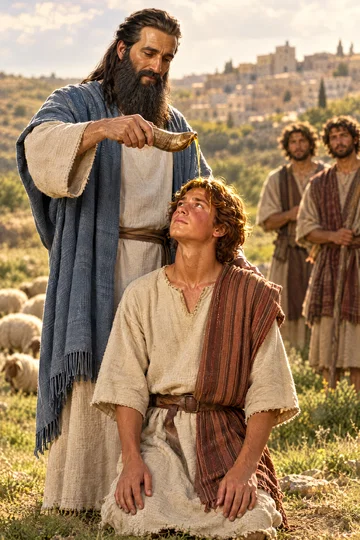
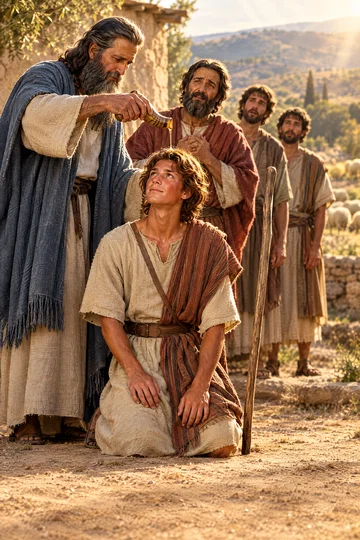
And he sent, and brought him in. Now he was ruddy, and withal of a beautiful countenance, and goodly to look to. And the LORD said, Arise, anoint him: for this is he.
Translations
And he sent, and brought him in. Now he was ruddy, and with of a beautiful countenance, and goodly to look to. And the LORD said, Arise, anoint him: for this is he.
And he sent, and brought him in. Now he was ruddy, and withal of a beautiful countenance, and goodly to look to. And the LORD said, Arise, anoint him: for this is he.
And he sent, and brought him in. Now he was ruddy, and withal of a beautiful countenance, and goodly to look to. And the Lord said, Arise, anoint him: for this is he.
And he sent, and brought him in. Now he was ruddy, and also of a beautiful countenance, and a good appearance. And the LORD said, Arise, anoint him: for this is he.
And he sent, and brought him in. Now he was ruddy, and withal of a beautiful countenance, and goodly to look upon. And the LORD said, Arise, anoint him: for this is he.
And he sent, and brought him in. Now he was ruddy, and withal of a beautiful countenance, and goodly to look upon. And Jehovah said, Arise, anoint him; for this is he.
And he sendeth, and bringeth him in, and he [is] ruddy, with beauty of eyes, and of good appearance; and Jehovah saith, 'Rise, anoint him, for this [is] he.'
And he sent and brought him in. And he was ruddy, and besides of a lovely countenance and beautiful appearance. And Jehovah said, Arise, anoint him; for this is he.
So he sent, and brought him in. Now, he, was ruddy, a stripling with handsome eyes, and noble mien. Then said Yahweh—Rise—anoint him, for, this, is, he.
Berean Standard Bible, Majority Standard Bible
So Jesse sent for his youngest son and brought him in. He was ruddy, with beautiful eyes and a handsome appearance. And the LORD said, “ Rise and anoint him, for he is the one.”
He sent, and brought him in. Now he was ruddy, with a handsome face and good appearance. The LORD said, “ Arise! Anoint him, for this is he.”
So he sent and made him come in. Now he had red hair and beautiful eyes and pleasing looks. And the Lord said, Come, put the oil on him, for this is he.
And he sent, and brought him in: and he was ruddie, and of a good countenance, and comely visage. And the Lord saide, Arise, and anoynt him: for this is he.
Douay-Rheims (Challoner revision)
He sent therefore and brought him Now he was ruddy and beautiful to behold, and of a comely face. And the Lord said: Arise, and anoint him, for this is he.
Pictures



Cross-references 20 of 36
- 1 Samuel 16:7
But the LORD said unto Samuel, Look not on his countenance, or on the height of his stature; because I have refused him: for the Lord seeth not as man seeth; for man looketh on the outward appearance, but the LORD looketh on the heart.
God judges the heart rather than outward appearance when choosing David.
- 1 Samuel 16:1
And the LORD said unto Samuel, How long wilt thou mourn for Saul, seeing I have rejected him from reigning over Israel? fill thine horn with oil, and go, I will send thee to Jesse the Beth-lehemite: for I have provided me a king among his sons.
God sends Samuel to anoint David, the king he has chosen.
- Psalms 78:70-72
He chose David also his servant, and took him from the sheepfolds:
God chose David from tending sheep to lead and shepherd Israel.
- 1 Kings 19:16
And Jehu the son of Nimshi shalt thou anoint to be king over Israel: and Elisha the son of Shaphat of Abel-meholah shalt thou anoint to be prophet in thy room.
The Lord commissions a prophet to anoint leaders, as he commissions Samuel to anoint David.
- 2 Samuel 7:12-16
And when thy days be fulfilled, and thou shalt sleep with thy fathers, I will set up thy seed after thee, which shall proceed out of thy bowels, and I will establish his kingdom.
God promises David an enduring throne and kingdom through his seed.
- 1 Samuel 13:14
But now thy kingdom shall not continue: the LORD hath sought him a man after his own heart, and the LORD hath commanded him to be captain over his people, because thou hast not kept that which the LORD commanded thee.
David is described as a man after God's own heart.
- 2 Samuel 7:8
Now therefore so shalt thou say unto my servant David, Thus saith the LORD of hosts, I took thee from the sheepcote, from following the sheep, to be ruler over my people, over Israel:
The Lord took David from tending sheep and made him ruler over Israel.
- 1 Samuel 17:34-37
And David said unto Saul, Thy servant kept his father’s sheep, and there came a lion, and a bear, and took a lamb out of the flock:
David recalls killing a lion and a bear.
- 1 Samuel 17:28
And Eliab his eldest brother heard when he spake unto the men; and Eliab’s anger was kindled against David, and he said, Why camest thou down hither? and with whom hast thou left those few sheep in the wilderness? I know thy pride, and the naughtiness of thine heart; for thou art come down that thou mightest see the battle.
Eliab’s envious words to David reveal resentment after David’s anointing.
- 1 Samuel 15:28
And Samuel said unto him, The LORD hath rent the kingdom of Israel from thee this day, and hath given it to a neighbour of thine, that is better than thou.
Says the kingdom was taken from Saul and given to another.
- Psalms 89:19-20
Then thou spakest in vision to thy holy one, and saidst, I have laid help upon one that is mighty; I have exalted one chosen out of the people.
God chooses and anoints David, establishing the line through which the Messiah is promised.
- 1 Samuel 17:42
And when the Philistine looked about, and saw David, he disdained him: for he was but a youth, and ruddy, and of a fair countenance.
Both describe David as ruddy using the same Hebrew root.
- 2 Samuel 12:7
And Nathan said to David, Thou art the man. Thus saith the LORD God of Israel, I anointed thee king over Israel, and I delivered thee out of the hand of Saul;
Identifies David as the one anointed king over Israel.
- 1 Chronicles 2:13-15
And Jesse begat his firstborn Eliab, and Abinadab the second, and Shimma the third,
Lists Jesse’s sons through David, identified as the seventh.
- 2 Samuel 5:2
Also in time past, when Saul was king over us, thou wast he that leddest out and broughtest in Israel: and the LORD said to thee, Thou shalt feed my people Israel, and thou shalt be a captain over Israel.
Israel acknowledges God’s earlier choice of David as king.
- Ruth 4:22
And Obed begat Jesse, and Jesse begat David.
Jesse begat David, whom the LORD anointed at Bethlehem.
- 1 Samuel 17:12
Now David was the son of that Ephrathite of Beth-lehem-judah, whose name was Jesse; and he had eight sons: and the man went among men for an old man in the days of Saul.
States that Jesse had eight sons.
- 1 Samuel 16:6
And it came to pass, when they were come, that he looked on Eliab, and said, Surely the LORD’s anointed is before him.
Samuel mistakes Eliab’s appearance for God’s anointed.
- Hebrews 1:9
Thou hast loved righteousness, and hated iniquity; therefore God, even thy God, hath anointed thee with the oil of gladness above thy fellows.
God anoints the Son above his companions.
- 1 Samuel 23:17
And he said unto him, Fear not: for the hand of Saul my father shall not find thee; and thou shalt be king over Israel, and I shall be next unto thee; and that also Saul my father knoweth.
Jonathan acknowledged that David would become king.
Commentary
Each commentary is drawn from primary sources: the writings of Ellen G. White and Adventist pioneers and periodicals. Each commentary is separate. Its own words are not a quotation; follow the references to read the source passages.
Ellen G. White
17 sources
The lad brought in from the sheepfold was Jesse's youngest son, a ruddy and handsome shepherd boy of beautiful face but not lofty stature, whom the Lord pointed out to be anointed from among his brothers with the horn of oil, after which the Spirit came upon him for rule in Saul's place.6T 196.3–197.11SP 367.3–368.1SG4 77.4–78.1YCDCP 2.1PP 638.2–641.1 His good looks and form did not make him worthy, for human judgment looks on outward appearance while the Lord looks on the heart.CT 43.2–44.1RH Feb 13, 19131SP 367.3–368.1 Samuel at first favored the fine stature and dignified appearance of the elder sons, but God refused them all, since Eliab's heart was not right and he would have made a proud and exacting ruler.RH Feb 13, 1913SG4 77.4–78.1YCDCP 2.1 God chose David because in the humble office of shepherd he had proved faithful, humble, courageous, reverent and receptive to the Holy Spirit, with sincerity, simplicity and capacity to be trained that fitted him to save Israel and rule as a wise and beloved monarch after God's own heart.1SP 367.3–368.1SG4 77.4–78.1PP 638.2–641.1SG4 85.2–3SG4 83.1 The anointing gave him the promise of the throne while Saul still reigned and sought to hold power, and by trusting that word though helpless in himself he withstood Saul, proving that faith in God's word overcomes the power of the whole world.RH Nov 11, 1915ED 254.2–3SG4 83.1RH Dec 24, 1908PP 698.2–3
Anointing at Bethlehem
David was Jesse's youngest son, a youthful shepherd left alone keeping the sheep and his father's sheepfold while his brothers attended Samuel's service at Bethlehem.RH Feb 13, 19136T 196.3–197.1YCDCP 2.1PP 638.2–641.1Ms 163, 1902, par. 4 He was called from the field and brought before Samuel, for Samuel would not sit down or proceed without him until he came.RH Feb 13, 19136T 196.3–197.1YCDCP 2.1PP 638.2–641.1 Startled by the messenger's unexpected call and wondering why the prophet and judge of Israel wanted him, he obeyed without delay.PP 638.2–641.1
He was ruddy and handsome in face and form, a manly yet modest shepherd boy of beautiful countenance, but not of lofty stature.1SP 367.3–368.1SG4 77.4–78.1PP 638.2–641.1 Samuel beheld him with pleasure as he stood before him.PP 638.2–641.1 His beautiful countenance expressed humility, honesty and true courage.SG4 77.4–78.1
The Lord identified him as the one to be anointed, commanding Samuel to arise and anoint him, for God had chosen him to be captain and ruler of His people in Saul's place.1SP 367.3–368.1SG4 77.4–78.1PP 638.2–641.1 Samuel then anointed him with the horn of oil from among his brethren.PP 638.2–641.1 From that day forward the Spirit of the Lord came upon David, and God gave him a prudent and understanding heart for exchanging his shepherd's work for the sceptre.1SP 367.3–368.1SG4 77.4–78.1PP 638.2–641.1
God Looks on Heart
David's good looks, beautiful countenance and stature did not make him worthy or fit to be anointed, for human judgment looks on the outward appearance while the Lord looks on the heart.CT 43.2–44.1RH Feb 13, 19131SP 367.3–368.1YCDCP 2.1STE 203.1 Though he was Jesse's youngest son and only a youth called from the field, he was the one God chose and commanded Samuel to anoint.CT 43.2–44.1RH Feb 13, 1913YCDCP 2.1 By outward appearance no one can tell in advance which young person will prove most promising and render the best service to God.CT 43.2–44.1RH Feb 13, 1913YCDCP 2.1
Samuel at first judged by outward appearance, thinking the handsome countenance and fine stature of Jesse's elder sons marked the Lord's anointed.RH Feb 13, 1913YCDCP 2.1 He was guided by God not to judge by high stature and dignified appearance, and God refused all the noble-looking older sons.RH Feb 13, 1913SG4 77.4–78.1YCDCP 2.1 Eliab's heart was not right with God, and he would have made a proud, exacting ruler.SG4 77.4–78.1
God chose David because he had proved brave and faithful in the humble office of shepherd.1SP 367.3–368.1SG4 77.4–78.1PP 638.2–641.1 God saw in him humility, honesty, courage, faithfulness and fear of the Lord, and simplicity, sincerity, receptiveness to the Holy Spirit and capacity to be trained that his brothers lacked.1SP 367.3–368.1SG4 77.4–78.1Ms 163, 1902, par. 4ED 266.1–3 His beautiful countenance expressed that inward character rather than lofty stature.1SP 367.3–368.1SG4 77.4–78.1
His religious character was sincere and fervent, strict in observance, bold with unwavering trust in God, and marked by fidelity, reverence, firmness, humility, love of justice and decision of character.SG4 85.2–3 Those traits qualified him to carry out God's high purposes, to instruct Israel in devotion, and to rule them as a generous and wise monarch.SG4 85.2–3 While he was thus true to God, God calls him a man after His own heart, greatly beloved and honored by his people, and chose him as a righteous deliverer to save Israel from its enemies.SG4 85.2–3SG4 83.1
Promise Faith and Training
The anointing appointed David to rule Israel and gave him the promise of the throne, even though he had not yet taken the throne.RH Nov 11, 1915RH Dec 24, 1908PP 698.2–3 Saul was still reigning as the established monarch and was determined to hold fast to his power and keep it.RH Nov 11, 1915ED 254.2–3RH Dec 24, 1908 David was only a shepherd lad when he was brought before Samuel and identified by God as the one to anoint.RH Nov 11, 1915ED 254.2–3RH Dec 24, 1908
Though utterly helpless in himself, David by trusting that word withstood Saul.ED 254.2–3 His stand proves that faith in God's word overcomes the power of the whole world.ED 254.2–3 God had left Saul to his own guilty course, yet Saul still ruled Israel and dared to attempt murder by trying to slay God's chosen deliverer.SG4 83.1 By those cruel acts Israel was given living evidence of the extremes of guilt and crime reached by a king who rebels against God and is governed by his own passions.SG4 83.1 The Lord had chosen David as a righteous person to save Israel out of the hand of their enemies.SG4 83.1
Human judgment cannot tell in advance which young person will prove most promising and render the best service to God, nor which one of a family will prove efficient and effective in the work of God.CT 43.2–44.1RH Feb 13, 19136T 196.3–197.1YCDCP 2.1 David was the youngest son, a mere youth called from the field and from humble work as a shepherd, yet he was the one God chose and commanded Samuel to anoint.CT 43.2–44.1RH Feb 13, 19136T 196.3–197.1YCDCP 2.1STE 203.1 His youth and humble work did not bar God's choice, and his good looks, countenance and stature did not determine his worthiness or suitability.CT 43.2–44.1STE 203.1 Selecting only a few promising youth is therefore not enough.YCDCP 2.1
For that reason all children and youth and all members of the family must receive thorough general education and training with opportunities for service.RH Feb 13, 19136T 196.3–197.1YCDCP 2.1 That training is to inspire them to become laborers together with God, fitted for usefulness and qualified for places of responsibility in private and public life.RH Feb 13, 1913YCDCP 2.1 All young people should have access to education and its opportunities for service because no one can determine beforehand who will become most effective in God's service.RH Feb 13, 19136T 196.3–197.1YCDCP 2.1
God in His providence trained and prepared David for His service and purposes after calling him from his father's sheepfold and choosing him to be anointed king of Israel.Ms 163, 1902, par. 4 God saw in him someone receptive to the Holy Spirit, and Christ was the master-builder of his character.Ms 163, 1902, par. 4 His early training began in his family home at Bethlehem through reverent teaching about God and His works.RH Oct 30, 1900
Sources
Pioneers and periodicals
60 sources
He was Jesse's youngest son, a youthful shepherd lad called in from keeping sheep in the field, ruddy and handsome in countenance, whom the Lord marked out as the chosen one and whom Samuel anointed with oil in the midst of his brethren.RH Feb 13, 1913ST Nov 14, 1895ST Jul 2, 1885ST Nov 18, 1903ST Aug 19, 1889 Samuel had been sent to Bethlehem to anoint a king after Saul's rejection, and seven elder sons were presented and refused before David the eighth had to be sent for without delay.ST Dec 22, 1914RH Feb 18, 1873ST Apr 22, 1903RH Nov 18, 1862 God himself chose him to succeed Saul as Israel's second king, looking not on outward appearance, stature or rank but on the heart and character as a man after his own heart.ST Nov 14, 1895ST Jul 2, 1885ST Dec 12, 1895ST Sep 20, 1883 In him the promised line was narrowed from Abraham to Judah to Jesse to David alone and to none of his seven elder brothers, making him the ancestor of Jesus according to the flesh, while the word anoint itself points to Christ, which in Greek and Messiah in Hebrew mean the Anointed.RH Nov 18, 1862ST Sep 30, 1889ST Jul 20, 1904ST Nov 18, 1903ST Oct 15, 1896 From that day the Spirit of the Lord came upon him with power, yet he returned to his shepherd work and waited in humility without seizing the throne, his humble labor with the flock and contemplation of God having trained him to bear the greater rule of Israel.RH Nov 11, 1915ST Nov 14, 1895ST Apr 22, 1903ST Apr 29, 1908ST Jan 17, 1906
David's Youth and Appearance
David was Jesse's youngest son, a mere youth and shepherd lad called in from keeping sheep in the field to pass before Samuel.RH Feb 13, 1913ST Nov 14, 1895ST Jul 2, 1885RH Sep 3, 1914RH Apr 11, 1854
He was about fifteen years old when brought in, and probably not twenty.ST Nov 14, 1895ST Apr 22, 1903
He was ruddy and handsome, of beautiful countenance and goodly to look at.ST Nov 14, 1895ST Jul 2, 1885RH Sep 3, 1901RH Dec 24, 1867
Yet he did not have Saul's tall, noble, kingly appearance, and his outward appearance did not make him seem fit to be king by human judgment.ST Dec 12, 1895RH Nov 18, 1909
The word rendered ruddy comes from the same root as the name Adam, meaning to show blood or to flush rosy, and it indicates perfect health rather than red skin color.ST Apr 14, 1898
Anointing at Bethlehem
Samuel was sent to Bethlehem, David's city, to anoint one of Jesse's sons as king after the Lord rejected Saul, and the commission did not name which son was chosen but left God to make His choice known when the sons were presented.ST Dec 22, 1914ST Mar 31, 1909ST Dec 22, 1914 The choice was a grave responsibility, since selecting the wrong man would bring calamity, yet God stopped Samuel from anointing the eldest and rejected each of the next in turn, making His will known quickly, accurately, and in clear and timely direction though no audible voice is recorded.ST Dec 22, 1914ST Dec 22, 1914
Jesse presented seven of his sons before Samuel and each was rejected, while David the eighth and youngest had been slighted from his earliest youth and left tending sheep as one his father considered too young.RH Feb 18, 1873RH Nov 18, 1862RH Jul 1, 1862ST Dec 22, 1914 He had to be sent for without delay, and the company refused to sit down till he came.ST Apr 22, 1903ST Dec 22, 1914 When summoned he was revealed by God through the same silent, mysterious communication that had guided Samuel in considering the other sons to be the chosen king of Israel.ST Dec 22, 1914
David was of the stock of Israel and the tribe of Judah, of the house of his father, and the great-grandson of Ruth the believing Moabitess.ST Apr 22, 1903RH Dec 18, 1913ST Feb 17, 1904 He was born in Bethlehem and kept his father's sheep on its plains, and it was there Samuel came with the divine mission to anoint him king in Saul's place.ST Apr 22, 1903RH Dec 18, 1913ST Feb 17, 1904 Bethlehem was thus David's city by lineage, and for that reason Joseph, being of his house and family, later went there to be registered.ST Dec 15, 1898ST Apr 28, 1914
The Lord identified David as the one He had chosen and directed Samuel to rise and anoint him, marking him as taken from the tribe of Judah, from the house of his father, and from among his father's sons to make him king over all Israel and over Israel forever.ST Nov 14, 1895ST Nov 18, 1903ST Aug 19, 1889 Samuel anointed him with a horn of oil in the midst of his brethren and in their presence, though David's selection over Eliab, who was older and striking in appearance and expected he himself might be chosen, stirred Eliab's envy and disappointed ambition.ST Apr 22, 1903RH Sep 3, 1901 The call to do this anointing also gave Samuel purposeful work while he was grieving over Saul.ST Aug 19, 1889
The anointing was carried out quietly through Samuel's ordinary sacrificial visit rather than publicly, and it was kept secret for fear of Saul.ST Nov 14, 1895ST Aug 19, 1889 This secrecy kept it from provoking confusion or national rebellion and from bringing David prematurely to the kingdom, so that even his brethren present did not grasp its meaning.ST Nov 14, 1895ST Aug 19, 1889
From that day forward the Spirit of the Lord came upon David with power, so that this was the first of three steps by which he rose under God's direction to complete dominion over all Israel, anointed and Spirit-guided but not yet crowned.ST Nov 14, 1895ST Apr 22, 1903 Yet he returned obediently to the same shepherd occupation, and that obedience and humility in the fear of the Lord was true greatness.ST Nov 14, 1895
God Chooses the Heart
God himself chose David to succeed Saul and be Israel's second king over Israel, exercising his reserved right to choose Israel's king.ST Sep 20, 1883RH Aug 14, 1856ST Jun 19, 1884 The kingdom remained first God's kingdom with God himself as ruler, and it became David's only secondarily by the gift of God, not by any first right of his own and not by choice of the people.RH Aug 14, 1856 God had chosen David to be king and ruler in place of Saul before Saul died, and David's later recognition by all the tribes fulfilled that earlier choice.ST Jun 19, 1884ST Jul 16, 1885
Samuel was sent to Bethlehem to anoint one of Jesse's sons as king, but the chosen son was not named in the commission, and God made his choice known only when the sons were presented.ST Dec 22, 1914ST Dec 22, 1914 God stopped Samuel from anointing the eldest and rejected each of the next six, giving clear and timely direction about whom he had chosen, though no audible voice is recorded.ST Dec 22, 1914ST Dec 22, 1914 Samuel's own judgment was not enough to identify the person God had chosen and misled him, so he needed the Lord's direct guidance, for human fallibility belongs even to the prophet while infallibility rests in divine inspiration.ST Aug 10, 1904 The choice was a grave responsibility, since selecting the wrong man would bring calamity, yet God rejected each son presented and made his will known to Samuel quickly and accurately through the same silent, mysterious communication that guided him to David when David was summoned from tending sheep though his father had considered him too young.ST Dec 22, 1914ST Dec 22, 1914
The Lord's choice rested on the heart and not on outward appearance, countenance, stature, rank or reputation, for the Lord looks on the heart.ST Nov 14, 1895ST Jul 2, 1885RH Apr 11, 1854 David was ruddy, handsome in appearance and goodly to look at, and was a man after God's own heart, yet he did not have Saul's tall, noble and kingly appearance, and his outward appearance did not make him seem fit to be king.ST Nov 14, 1895ST Dec 12, 1895RH Dec 24, 1867 God chose him for his courage and character, showing that even one poor in outward appearance may be one with whom the Lord delights to dwell.ST Dec 12, 1895 God chose David, the youngest son and a humble shepherd boy from Bethlehem keeping sheep in the field, to be Israel's future king.RH Dec 24, 1867RH Apr 11, 1854
That selection shows God sees beyond human judgment, for his choice is almost sure to fall on one whom people would not select.ST Jul 21, 1909RH Dec 18, 1913 Father, brothers, parents, people and even Samuel might not have selected David and had overlooked him as an unlikely shepherd lad, yet God summoned him from the sheepfold and identified him as the one to anoint.RH Aug 18, 1910ST Mar 15, 1910ST Mar 17, 1887ST Jul 21, 1909 In this God chooses people the world rejects to bring life and salvation to those who follow his providence, and an unlikely-looking child may be chosen by God for his work and for leadership.RH Aug 18, 1910ST Jul 21, 1909 This choosing was a temporal appointment to a special work and one narrowing step in the earthly line of the promised Seed through a special family, not a decision about eternal salvation.ST Oct 15, 1896ST Apr 10, 1907 It did not ensure David's eternal salvation nor assure the salvation of those chosen as earthly progenitors of the Messiah, and it did not condemn or reject the brothers who were passed over for salvation.ST Oct 15, 1896ST Apr 10, 1907
Messiah and Promised Line
The bringing in of the ruddy youth marks one narrowing step in the earthly line of the promised Seed.ST Oct 15, 1896 After the flood the first promise that the Seed would come through a special family or line was given to Abraham.ST Oct 15, 1896 That line then narrows from Abraham to Isaac and not Ishmael, from Isaac to Jacob and not Esau, from Jacob's twelve sons to Judah, from the families of Judah to Jesse, from Jesse's sons to David, and from David's sons to Solomon.ST Oct 15, 1896 This choosing did not reject the others for salvation and did not assure the salvation of those chosen, but chose them as the earthly progenitors of the Messiah.ST Oct 15, 1896
Messiah was to derive his origin from David alone and from none of Jesse's seven elder sons.RH Nov 18, 1862 David, the youngest of Jesse's eight sons, being chosen and anointed proves that descent, and Jesus Christ fulfills it as the son of David.RH Nov 18, 1862RH Jul 5, 1915 The command to anoint because this is he marks him as taken from the tribe of Judah, from the house of his father, and from among the sons of his father to make him king over all Israel forever.ST Nov 18, 1903 In that chosen son of Jesse whom God commanded Samuel to anoint, David became the ancestor of Jesus according to the flesh.ST Nov 18, 1903RH Jul 5, 1915
Priests, prophets, and kings were anointed by the Lord's command, as the Lord directed Samuel to anoint David as king.ST Sep 30, 1889 Christ is the Anointed One, for Christ in Greek and Messiah in Hebrew mean the Anointed.ST Sep 30, 1889 In the Greek Septuagint of First Samuel the word for anoint is Christ, so the command to anoint David is one of many uses of the title Christ in First Samuel, with the English anointed being equivalent to Christ in Greek.ST Jul 20, 1904
David was anointed to be king of Israel, and Satan knew he had been anointed.ST Mar 30, 1904 Satan stirred up Saul against the youthful David in his court, which explains Saul's seemingly erratic course toward him, the satanic spirit shown when he attempted to take David's life, and the persistency with which he sought to kill him.ST Mar 30, 1904 David was destined to be not only the ruler of Israel but one of the greatest of the prophets, through whom came the most blessed promises and encouragements in the Bible, and the father of the son who followed him with wonderful teachings of wisdom.ST Mar 30, 1904 Satan wanted to kill David to forestall that kingship, those prophecies and promises, and that wisdom.ST Mar 30, 1904
Boy David was a shepherd on the hills girding Bethlehem, seated on the dewy ground amid a quiet flock in the sheep-folds, playing his harp and pouring out deep and strong inspired song as a shepherd bard.RH Dec 15, 1859 The prophetic starlight that lit his inner vision is the same Orb of Prophecy now rising on the horizon to herald the world's Redeemer in His mystery of earth-hood and divinity combined.RH Dec 15, 1859 That light now calls meek-hearted shepherds on that same mountainside to leave their sheep and follow their angel guide to find the long-expected King as a newborn babe reposing in a Bethlehem manger.RH Dec 15, 1859
Preparation and Life Lessons
David was a humble, dutiful shepherd lad, probably not twenty years old, whose early training took place in his family home at Bethlehem through reverent teaching about God and His works.RH Oct 30, 1900ST Nov 14, 1895ST Apr 29, 1908 His life in contact with nature, faithfully caring for his father's sheep and for the tender ones of the flock, contemplating the works of God, and singing praises with his harp, trained him and fitted him to bear the greater responsibilities of ruling Israel and for a leading position in the nation.ST Nov 14, 1895ST Apr 29, 1908 After the Lord identified him as the chosen king and he was anointed, the Spirit came upon him with power, yet he returned obediently to the same shepherd occupation, and that obedience and humility in the fear of the Lord was true greatness.ST Nov 14, 1895
Faithful attention to ordinary, humble, active and useful labor preceded his call to greater honor and service, for he was called and anointed while occupied as a shepherd.RH Jul 14, 1910ST Oct 18, 1877RH Jan 28, 1902 His example shows that high aspirations do not make humble duties beneath a person, but that one faithfully does the work at hand before receiving greater responsibility, and that God calls His workers from useful occupation.RH Jul 14, 1910RH Jan 28, 1902 Though anointed to be king while Saul still reigned as the established monarch determined to hold power, David trusted that God would fulfill His choice and promise of the throne in His own time and way.RH Nov 11, 1915RH Dec 24, 1908ST Jan 17, 1906 He waited while God's chosen purpose remained hidden and did not seize the throne by force or answer a tyrant's hostility with rebellion.RH Mar 4, 1873 God worked by means through plans deep and wisely laid in raising him from tending the flock to be anointed for the crown, yet reaching the crown required afterward enduring the hatred and envy of a king and his courtiers before he could wear it.RH Aug 22, 1865
The prophet's words and the anointing remained vivid to David during his early flight from Saul, when he was marked as the one chosen to become king after Saul.ST Dec 30, 1913 The call to anoint him gave Samuel purposeful work while he was grieving over Saul.ST Aug 19, 1889 That anointing of David, the son of a shepherd in Bethlehem, as Israel's future king also gave Samuel consolation as he foresaw Israel's revival under David's reign.ST Oct 19, 1888 David was young, ruddy and handsome, and the Lord identified him as the one to anoint in the presence of his brothers, and his selection over Eliab, who was older and striking in appearance, stirred Eliab's envy and disappointed ambition despite Eliab's expectation that he himself might be chosen.RH Sep 3, 1901 That anointing of the youngest brother by the aged prophet set him above his envious brothers and stirred bitter hatred and jealousy in Eliab that lasted from that day onward.ST Aug 17, 1904ST Mar 1, 1910
Eliab was a proud, handsome man, proud of his splendid proportions and handsome face, able to be polite and courteous on occasions, yet at home accustomed to treating David with nothing but discourtesy.ST Aug 17, 1904 His jealousy broke out without restraint or decency when David defeated the giant of Gath, making a spectacle of himself before thousands of Israel and the Philistines, and proving by his failure to govern himself his utter unfitness to rule over any people.ST Aug 17, 1904 Human judgment cannot tell by outward appearance, countenance and stature who will be most promising and render the best service to God, because man looks on the outward appearance while the Lord looks on the heart and had refused the noble-looking elder sons of Jesse.RH Feb 13, 1913RH May 9, 1907 No one can determine which one of a family will prove efficient in the work of God, so all members and all youth must receive general education and training to be inspired to become laborers together with God, fitted for usefulness and qualified for places of responsibility in private and public life.RH Feb 13, 1913
A young person's appearance does not reveal the possibilities or usefulness of life, and God's choice is almost sure to fall on one whom people would not select, as when He passed over the tall, noble-looking boys to choose David to be anointed.RH Nov 18, 1909RH May 9, 1907RH Dec 18, 1913 David was distinguished by his love of work, obedience to his parents, love for God, and readiness to face Goliath, showing that children can prepare to serve God by faithfully doing their duties.RH Nov 18, 1909 Because no one knows which child the Lord will choose, parents should plan, even at sacrifice, to continue the education of all their children in a higher school after church-school work at home is finished.RH Dec 18, 1913 The Lord can reveal a person's appointed work by sending someone else to speak for Him, for God chooses His instruments and makes His plans known through different means, including circumstances and providential opportunities.RH Jan 28, 1902 Saul's stubborn disobedience led to his rejection and loss of the kingdom, while David was chosen and anointed by God as king to receive the place Saul forfeited.RH Jul 24, 1860
Sources