2 Chronicles 36:10
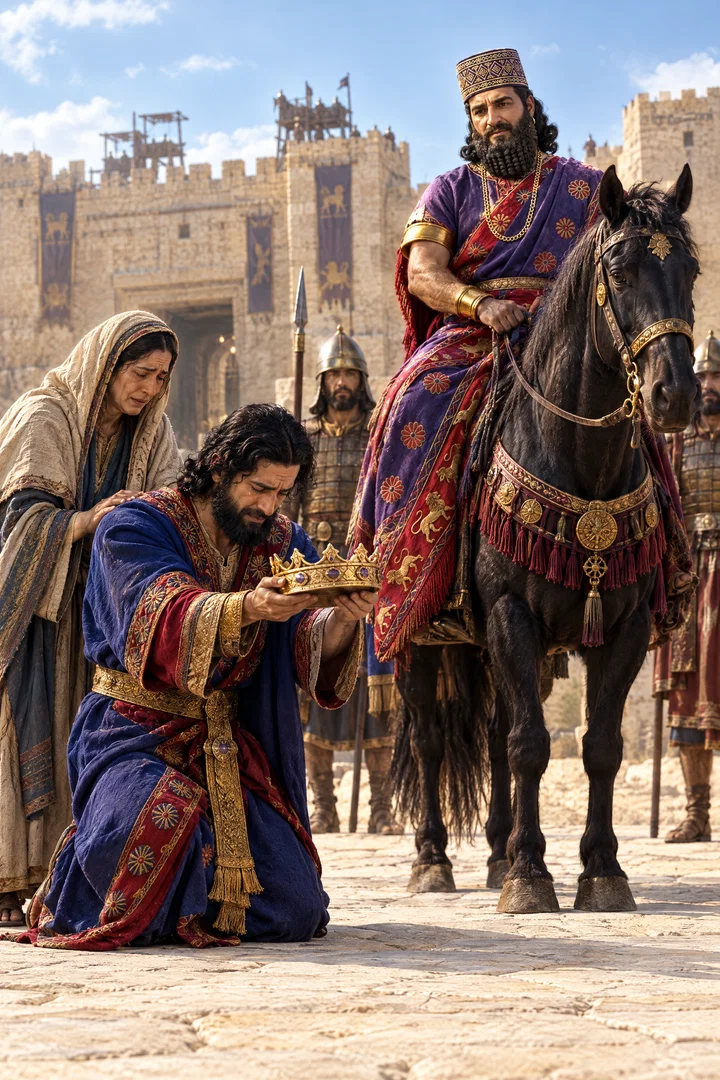
And when the year was expired, king Nebuchadnezzar sent, and brought him to Babylon, with the goodly vessels of the house of the LORD, and made Zedekiah his brother king over Judah and Jerusalem.
Translations
American King James Version, King James Version
And when the year was expired, king Nebuchadnezzar sent, and brought him to Babylon, with the goodly vessels of the house of the LORD, and made Zedekiah his brother king over Judah and Jerusalem.
And when the year was expired, king Nebuchadnezzar sent, and brought him to Babylon, with the goodly vessels of the house of the Lord, and made Zedekiah his brother king over Judah and Jerusalem.
And when the year had expired, king Nebuchadnezzar sent, and brought him to Babylon, with the goodly vessels of the house of the LORD, and made Zedekiah his brother king over Judah and Jerusalem.
And at the return of the year king Nebuchadnezzar sent, and brought him to Babylon, with the goodly vessels of the house of the LORD, and made Zedekiah his brother king over Judah and Jerusalem.
And at the return of the year king Nebuchadnezzar sent, and brought him to Babylon, with the goodly vessels of the house of Jehovah, and made Zedekiah his brother king over Judah and Jerusalem.
and at the turn of the year hath king Nebuchadnezzar sent and bringeth him in to Babylon, with the desirable vessels of the house of Jehovah, and causeth Zedekiah his brother to reign over Judah and Jerusalem.
And at the turn of the year king Nebuchadnezzar sent and had him brought to Babylon, with the precious vessels of the house of Jehovah; and he made Zedekiah his brother king over Judah and Jerusalem.
and, when the year came round, King Nebuchadnezzar sent, and carried him to Babylon, with the precious utensils of the house of Yahweh,—and made Zedekiah his brother king over Judah and Jerusalem.
Berean Standard Bible, Majority Standard Bible
In the spring, King Nebuchadnezzar summoned Jehoiachin and brought him to Babylon, along with the articles of value from the house of the LORD. And he made Jehoiachin’s relative Zedekiah king over Judah and Jerusalem.
At the return of the year, King Nebuchadnezzar sent and brought him to Babylon, with the valuable vessels of the LORD’s house, and made Zedekiah his brother king over Judah and Jerusalem.
In the spring of the year King Nebuchadnezzar sent and took him away to Babylon, with the beautiful vessels of the house of the Lord, and made Zedekiah, his father's brother, king over Judah and Jerusalem.
And when the yeere was out, King Nebuchadnezzar sent and brought him to Babel with the precious vessels of the house of the Lord, and he made Zedekiah his brother King ouer Iudah and Ierusalem.
Douay-Rheims (Challoner revision)
And at the return of the year, king Nabuchodonosor sent, and brought him to Babylon, carrying away at the same time the most precious vessels of the house of the Lord: and he made Sedecias his uncle king over Juda and Jerusalem.
Pictures
Cross-references 20 of 25
- 2 Kings 24:10-17
At that time the servants of Nebuchadnezzar king of Babylon came up against Jerusalem, and the city was besieged.
Parallel account of Jehoiachin’s capture and Zedekiah’s appointment.
- Jeremiah 25:11-12
And this whole land shall be a desolation, and an astonishment; and these nations shall serve the king of Babylon seventy years.
The conquest begins the predicted seventy-year captivity, after which Babylon’s rule ends.
- Ezra 1:1
Now in the first year of Cyrus king of Persia, that the word of the LORD by the mouth of Jeremiah might be fulfilled, the LORD stirred up the spirit of Cyrus king of Persia, that he made a proclamation throughout all his kingdom, and put it also in writing, saying,
Cyrus’s first year marks the end of the seventy years and the captives’ return from Babylon.
- Ezra 1:7
Also Cyrus the king brought forth the vessels of the house of the LORD, which Nebuchadnezzar had brought forth out of Jerusalem, and had put them in the house of his gods;
vessels taken by Nebuchadnezzar returned
- Daniel 1:1-2
In the third year of the reign of Jehoiakim king of Judah came Nebuchadnezzar king of Babylon unto Jerusalem, and besieged it.
contrasts first partial taking of vessels with later takings
- Daniel 5:2
Belshazzar, whiles he tasted the wine, commanded to bring the golden and silver vessels which his father Nebuchadnezzar had taken out of the temple which was in Jerusalem; that the king, and his princes, his wives, and his concubines, might drink therein.
Belshazzar profaned the vessels taken from the temple in Jerusalem.
- Ezekiel 17:15-16
But he rebelled against him in sending his ambassadors into Egypt, that they might give him horses and much people. Shall he prosper? shall he escape that doeth such things? or shall he break the covenant, and be delivered?
Describes Zedekiah’s appeal to Egypt against Babylon and his broken covenant.
- Jeremiah 32:1-5
The word that came to Jeremiah from the LORD in the tenth year of Zedekiah king of Judah, which was the eighteenth year of Nebuchadrezzar.
Places Zedekiah’s reign amid the siege of Jerusalem.
- Jeremiah 37:5-10
Then Pharaoh’s army was come forth out of Egypt: and when the Chaldeans that besieged Jerusalem heard tidings of them, they departed from Jerusalem.
Egypt’s attempt to aid Jerusalem fails, and the Chaldeans return to destroy the city.
- Jeremiah 39:1-10
In the ninth year of Zedekiah king of Judah, in the tenth month, came Nebuchadrezzar king of Babylon and all his army against Jerusalem, and they besieged it.
Details Jerusalem’s capture and the people’s deportation.
- Jeremiah 44:30
Thus saith the LORD; Behold, I will give Pharaoh-hophra king of Egypt into the hand of his enemies, and into the hand of them that seek his life; as I gave Zedekiah king of Judah into the hand of Nebuchadrezzar king of Babylon, his enemy, and that sought his life.
Both identify Zedekiah’s defeat by Nebuchadnezzar during this period.
- 2 Chronicles 36:17-20
Therefore he brought upon them the king of the Chaldees, who slew their young men with the sword in the house of their sanctuary, and had no compassion upon young man or maiden, old man, or him that stooped for age: he gave them all into his hand.
Describes Jerusalem’s conquest and Judah’s removal to Babylon.
- 2 Kings 25:1-21
And it came to pass in the ninth year of his reign, in the tenth month, in the tenth day of the month, that Nebuchadnezzar king of Babylon came, he, and all his host, against Jerusalem, and pitched against it; and they built forts against it round about.
Recounts Jerusalem’s fall, the temple’s destruction, and Judah’s deportation to Babylon.
- Jeremiah 25:1
The word that came to Jeremiah concerning all the people of Judah in the fourth year of Jehoiakim the son of Josiah king of Judah, that was the first year of Nebuchadrezzar king of Babylon;
dates first captivity beginning sequence leading to later takings
- Jeremiah 29:10
For thus saith the LORD, That after seventy years be accomplished at Babylon I will visit you, and perform my good word toward you, in causing you to return to this place.
Predicts return after the captivity period.
- 2 Kings 24:1
In his days Nebuchadnezzar king of Babylon came up, and Jehoiakim became his servant three years: then he turned and rebelled against him.
Names Nebuchadnezzar’s campaign against Jehoiakim that the Chronicles record supports.
- Matthew 1:17
So all the generations from Abraham to David are fourteen generations; and from David until the carrying away into Babylon are fourteen generations; and from the carrying away into Babylon unto Christ are fourteen generations.
Dates the period from the Babylonian captivity to Christ’s birth.
- Habakkuk 1:6
For, lo, I raise up the Chaldeans, that bitter and hasty nation, which shall march through the breadth of the land, to possess the dwellingplaces that are not theirs.
The Chaldeans are described as an invading nation, fulfilling the conquest of Judah.
- Daniel 2:38
And wheresoever the children of men dwell, the beasts of the field and the fowls of the heaven hath he given into thine hand, and hath made thee ruler over them all. Thou art this head of gold.
Nebuchadnezzar is identified as the head of gold.
- Jeremiah 9:16
I will scatter them also among the heathen, whom neither they nor their fathers have known: and I will send a sword after them, till I have consumed them.
Forsaking God’s law brings scattering among the nations.
Commentary
Each commentary is drawn from primary sources: the writings of Ellen G. White and Adventist pioneers and periodicals. Each commentary is separate. Its own words are not a quotation; follow the references to read the source passages.
Pioneers and periodicals
17 sources
When the year expired Nebuchadnezzar came again to Jerusalem after Jehoiachin's brief three-month reign, carried him to Babylon with the costly vessels of the house of the Lord, and set his uncle Mattaniah on the throne under the name Zedekiah.ST Aug 20, 1885ST Mar 4, 1889 The carrying away took the royal family and court with the wealthy, the skilled workmen and much treasure, leaving only the poorest in the land, and Ezekiel went among those captives.ST Aug 20, 1885ST Aug 9, 1899 It was the second plundering of the sanctuary after the first taking in the third year of Jehoiakim in B.C. 606 when Daniel and his companions were removed, followed by the final destruction in B.C. 586, from which first captivity the seventy years run to the first year of Cyrus in B.C. 536.ST Jul 4, 1911RH May 18, 1876ST Aug 9, 1899 Judah was thus conquered and exiled for turning from God to idolatry and wickedness under its last kings, chiefly for Sabbath transgression that denied allegiance to Jehovah as Creator and Sanctifier.ST May 21, 1896ST Mar 7, 1906ST Mar 4, 1889ST Jul 23, 1885 To seize vessels dedicated to the service of God was to rob God, which is not mere injustice toward man but sacrilege and treason against the King.RH Jul 22, 1873
Judah Taken to Babylon
After Jehoiachin had reigned three months, Nebuchadnezzar returned to Jerusalem when the year was expired and took him to Babylon with the goodly vessels of the house of the Lord.ST Aug 20, 1885ST Mar 4, 1889RH Jun 15, 1916SMV 22.1–24.1 He suspected Jehoiachin's loyalty, deposed him, and set Mattaniah — Jehoiachin's uncle — on the throne over Judah and Jerusalem under the name Zedekiah.ST Aug 20, 1885SMV 22.1–24.1RH Oct 22, 1861 This was a stage in Judah's subjection to Babylon after Josiah's reign and the beginning of Israel's scattering through disobedience, though its completion extended to Jerusalem's later destruction.ST Mar 4, 1889SMV 22.1–24.1RH Oct 22, 1861
The deportation carried away the royal family and the court with many people and much treasure, including wealthy people and skilled artisans, and left only the poorest people in the land.ST Aug 20, 1885ST Aug 9, 1899 It was the second captivity, in which Ezekiel and many others were taken captive.ST Aug 20, 1885ST Aug 9, 1899
It belongs to a succession of rebellions and Babylonian campaigns, for Jehoiachin rebelled and was deported with his court and many people, and Zedekiah whom Nebuchadnezzar placed on the throne later rebelled, leading to Jerusalem's siege and destruction.ST Jan 11, 1916ST Aug 20, 1885 The siege and invasion are documented in 2 Chronicles 36 even though 2 Kings 24:1 does not use the word siege, since that verse plainly identifies Nebuchadnezzar's coming against Jehoiakim and Jehoiakim's submission and rebellion.ST Jan 11, 1916
Jehoiachin's removal to Babylon and Zedekiah's rise stand within Judah's rapid final decline, which ran through Jehoahaz, Jehoiakim, Jehoiachin, and Zedekiah.ST May 7, 1912ST Jul 4, 1911 That decline ended with Jerusalem laid waste and the holy house burned in 586 B.C.ST May 7, 1912ST Jul 4, 1911
Captivity Dates and Prophecy
At the first captivity in the third year of Jehoiakim only part of the vessels of God's house was taken to Babylon, during the earlier capture of Jerusalem that removed leading people including Daniel and his companions.ST Nov 28, 1911 The taking described here continues that plunder in a second invasion, and Jerusalem was taken twice subsequently, when the last of the treasures were taken.RH May 18, 1876ST Nov 28, 1911 That second invasion followed Jehoiachin's evil conduct and occurred in 599 B.C.RH May 18, 1876
This taking is the second stage of God forsaking the sanctuary at Jerusalem, after the first taking under Jehoiakim in B.C. 606 and before the final destruction under Zedekiah.RH Sep 11, 1856 Jehoiachin's conduct as son of Jehoiakim brought Nebuchadnezzar up again against Jerusalem in about B.C. 599, when he further ravaged the house of the Lord and its goodly vessels.RH Sep 11, 1856RH May 18, 1876 The second captivity is dated in B.C. 598, when Ezekiel and many others were taken captive with much treasure.ST Aug 9, 1899
The third captivity and final destruction, with the taking of many to Babylon and the complete destruction of Jerusalem, is dated in B.C. 586.ST Jul 4, 1911ST Jan 4, 1905ST Aug 9, 1899 That final decline ending under Jehoahaz, Jehoiakim, Jehoiachin, and Zedekiah is distinct from the first great captivity in B.C. 606 that began the seventy years' captivity.ST Jul 4, 1911ST Jan 4, 1905 The carrying away into Babylon from which Matthew counts to Christ is dated from that first captivity in B.C. 606, which was 602 years before Christ's birth four years before the common era.ST Jan 4, 1905 By another reckoning Jerusalem was conquered by Nebuchadnezzar in 606 B.C. and the people were removed to Babylon by 588 B.C., when Jerusalem was taken and the last of the treasures were taken.ST Jul 23, 1885ST Nov 28, 1911
The seventy years of captivity run from the first captivity in B.C. 606, when Daniel and his companions were taken, to B.C. 536, the first year of Cyrus in his rule over all Medo-Persia including Babylon.ST Aug 9, 1899 After the captivity the people were allowed to return, but the Jews never again became an independent nation, remaining subject to successive empires until Rome destroyed Jerusalem in A.D. 70.ST Jul 23, 1885 The subjection of Judah after Josiah's reign, when Jehoiachin was taken to Babylon, the temple vessels carried away, and Zedekiah made king, is used to date the end of the Jewish years of release and jubilees to 607 B.C.; thereafter the people and land could not be redeemed, and the land lay desolate while the people were in enemy territory.SMV 22.1–24.1 The deportation began Israel's scattering and fulfilled the warning that disobedience to God's commandments would bring national calamity and exile, though its completion may have extended to Jerusalem's later destruction by the Romans.RH Oct 22, 1861
Sin Judgment and Lessons
2 Chronicles 36:10 belongs to the account of Judah's failure to obey God and the punishment that followed, when the people were taken into exile and captivity in Babylon.ST Mar 7, 1906ST Mar 4, 1889ST Jul 23, 1885 It records a stage in that defeat, when Nebuchadnezzar took the king and the temple's valuable vessels to Babylon and set Zedekiah as king.ST Mar 7, 1906ST Mar 4, 1889RH Jun 15, 1916 The history of the chapter is bound up with the people's turning from God, neglecting His Sabbath, and falling into idolatry, and their unfaithfulness led to Jerusalem's destruction and exile.ST Mar 7, 1906ST Mar 4, 1889 It belongs to the account of Judah's final kings and the consequences of their wickedness, when Jerusalem was conquered by Nebuchadnezzar in 606 B.C. and the people were removed to Babylon by 588 B.C.ST Mar 4, 1889ST Jul 23, 1885 After the seventy-year captivity they were allowed to return, but the Jews never again became an independent nation, remaining subject to successive empires until Rome destroyed Jerusalem in A.D. 70.ST Jul 23, 1885
The overthrow and Babylonian captivity resulted chiefly from Sabbath transgression.ST May 21, 1896 The Sabbath marked Israel's allegiance to Jehovah as Creator and Sanctifier, in contrast to the Babylonians' worship of another god, and keeping it was associated with remembering the Lord.ST May 21, 1896 The verse is part of the historical record of Judah's kings and the events shaping the chosen people's destiny.RH Jun 15, 1916 Such history provides the setting for Scripture's events and carries spiritual lessons within God's revelation, which culminates in Christ.RH Jun 15, 1916
By carrying away the vessels of the sanctuary to Babylon, Nebuchadnezzar robbed God.RH Jul 22, 1873 To steal from a man is injustice, but to steal from God is sacrilege and treason against the King.RH Jul 22, 1873 His act added profaneness to violence by breaking into the temple and taking things dedicated to the service of the Deity.RH Jul 22, 1873 It stands among the open crimes charged with robbing God, yet that charge falls not only on notorious criminals like him but on common people in their own houses and in the house of God.RH Jul 22, 1873
Sources