2 Kings 2:6
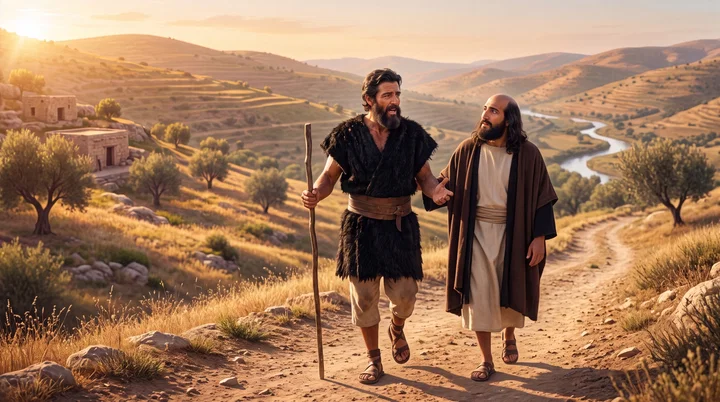
And Elijah said unto him, Tarry, I pray thee, here; for the LORD hath sent me to Jordan. And he said, As the LORD liveth, and as thy soul liveth, I will not leave thee. And they two went on.
Translations
And Elijah said to him, Tarry, I pray you, here; for the LORD has sent me to Jordan. And he said, As the LORD lives, and as your soul lives, I will not leave you. And they two went on.
And Elijah said unto him, Tarry, I pray thee, here; for the LORD hath sent me to Jordan. And he said, As the LORD liveth, and as thy soul liveth, I will not leave thee. And they two went on.
And Elijah said unto him, Tarry, I pray thee, here; for the Lord hath sent me to Jordan. And he said, As the Lord liveth, and as thy soul liveth, I will not leave thee. And they two went on.
And Elijah said to him, Tarry here, I pray thee; for the LORD hath sent me to Jordan. And he said, As the LORD liveth, and as thy soul liveth, I will not leave thee. And they two went on.
And Elijah said unto him, Tarry here, I pray thee; for the LORD hath sent me to Jordan. And he said, As the LORD liveth, and as thy soul liveth, I will not leave thee. And they two went on.
And Elijah said unto him, Tarry here, I pray thee; for Jehovah hath sent me to the Jordan. And he said, As Jehovah liveth, and as thy soul liveth, I will not leave thee. And they two went on.
And Elijah saith to him, 'Abide, I pray thee, here, for Jehovah hath sent me to the Jordan;' and he saith, 'Jehovah liveth, and thy soul liveth, if I leave thee;' and they go on both of them,
And Elijah said to him, Abide here, I pray thee; for Jehovah has sent me to the Jordan. And he said, As Jehovah liveth, and as thy soul liveth, I will not leave thee! And they two went on.
And Elijah said to him—Tarry here, I pray thee, for, Yahweh, hath sent me to the Jordan. And he said—By the life of Yahweh and by the life of thine own soul, I will not leave thee. So they two, went on.
Berean Standard Bible, Majority Standard Bible
And Elijah said to Elisha, “ Please stay here, for the LORD has sent me on to the Jordan.”But Elisha replied, “ As surely as the LORD lives and as you yourself live, I will not leave you.”So the two of them went on.
Elijah said to him, “ Please wait here, for the LORD has sent me to the Jordan.”He said, “ As the LORD lives, and as your soul lives, I will not leave you.” Then they both went on.
Then Elijah said to him, Come no farther, for the Lord has sent me to Jordan. But he said, As the Lord is living and as your soul is living, I will not be parted from you. So they went on together.
Moreouer Eliiah saide vnto him, Tarie, I pray thee, here: for the Lord hath sent me to Iorden. But he saide, As the Lord liueth, and as thy soule liueth, I will not leaue thee. So they went both together.
Douay-Rheims (Challoner revision)
And Elias said to him: Stay here, because the Lord hath sent me as far as the Jordan. And he said: As the Lord liveth, and as thy soul liveth, I will not leave thee; and they two went on together,
Pictures
Cross-references
- 1 Kings 19:19-21
So he departed thence, and found Elisha the son of Shaphat, who was plowing with twelve yoke of oxen before him, and he with the twelfth: and Elijah passed by him, and cast his mantle upon him.
Elisha accepts Elijah’s call, leaves his plowing, and serves him.
- 2 Kings 2:11
And it came to pass, as they still went on, and talked, that, behold, there appeared a chariot of fire, and horses of fire, and parted them both asunder; and Elijah went up by a whirlwind into heaven.
Elijah is taken up into heaven after reaching the Jordan with Elisha.
- 2 Kings 2:2
And Elijah said unto Elisha, Tarry here, I pray thee; for the LORD hath sent me to Beth-el. And Elisha said unto him, As the LORD liveth, and as thy soul liveth, I will not leave thee. So they went down to Beth-el.
Elisha pledges not to leave Elijah as they set out for Bethel.
- Ruth 1:16-17
And Ruth said, Intreat me not to leave thee, or to return from following after thee: for whither thou goest, I will go; and where thou lodgest, I will lodge: thy people shall be my people, and thy God my God:
Both refuse to turn back when urged, remaining steadfastly with their companions.
- 2 Kings 2:16-17
And they said unto him, Behold now, there be with thy servants fifty strong men; let them go, we pray thee, and seek thy master: lest peradventure the Spirit of the LORD hath taken him up, and cast him upon some mountain, or into some valley. And he said, Ye shall not send.
Reports the search for Elijah and that he was not found.
- 2 Kings 2:1
And it came to pass, when the LORD would take up Elijah into heaven by a whirlwind, that Elijah went with Elisha from Gilgal.
states purpose of Elijah's journey
- Luke 9:30-31
And, behold, there talked with him two men, which were Moses and Elias:
Elijah, taken up to heaven, appears in glory to the disciples.
- 2 Kings 2:10
And he said, Thou hast asked a hard thing: nevertheless, if thou see me when I am taken from thee, it shall be so unto thee; but if not, it shall not be so.
Elisha’s faithfulness to Elijah is tied to receiving the requested blessing.
- 2 Kings 4:30
And the mother of the child said, As the LORD liveth, and as thy soul liveth, I will not leave thee. And he arose, and followed her.
Both women insist they will not leave the prophet, echoing Elisha’s words to Elijah.
- Genesis 5:24
And Enoch walked with God: and he was not; for God took him.
God took Enoch, paralleling Elijah’s translation.
- 2 Kings 6:1-7
And the sons of the prophets said unto Elisha, Behold now, the place where we dwell with thee is too strait for us.
both cited as records of later schools
Commentary
Each commentary is drawn from primary sources: the writings of Ellen G. White and Adventist pioneers and periodicals. Each commentary is separate. Its own words are not a quotation; follow the references to read the source passages.
Ellen G. White
21 sources
Elijah tells Elisha to stay behind while the Lord sends him on to the Jordan, but Elisha binds himself by oath not to leave him, and the two go on together as the repeated chances to turn back test his faith and allegiance.Lt 12, 1897, par. 24–28Ms 114, 1901, par. 3–4Lt 12, 1897, par. 31–33 This going on to the Jordan belongs to Elijah's last journey before his translation to heaven, leading to Elisha's request for a double portion of his spirit to fill his place and to Elijah's being taken up in a whirlwind.PK 226.2–227.1 Elisha clings to his master in faithful humility to learn all he can before he is taken away, and by persisting through the whole journey he is further prepared for service and made able to witness the departure and receive the prophetic mantle.Ms 114, 1901, par. 3–4Ms 191, 1907, par. 17–20Lt 12, 1897, par. 31–33PK 225.2–226.1Lt 64, 1897, par. 9–13 God is moving Elijah from place to place so that he will not settle into ease and familiar ways, breaking up settled habits to gain spiritual power and grow in moral greatness, that his life may widen the experience of many and teach workers to depend on God as companion and guide through continual changes.RH May 2, 19079MR 11.1–2Lt 59, 1901, par. 18–23 In Elijah's letting Elisha choose to remain and in Elisha's refusal to leave is seen the training of younger workers through faithful companionship with experienced ministers, and the steadfastness of those who stay with God's people through trial until they witness the strengthening of the last message and receive the latter rain.Ms 8, 1859, par. 23–24RH Nov 19, 1903YGBCOEP 49.1
Journey to Jordan
The verse stands in Elijah's final journey before his translation to heaven, with the going to the Jordan as one stage on that closing way.PK 226.2–227.1 What follows is Elisha's request for a double portion of Elijah's spirit, made so he could fill the place to which God had called him.PK 226.2–227.1 That request is answered when Elijah is taken up in a whirlwind.PK 226.2–227.1
This last work on earth was a visitation of the schools of the prophets in Israel to give them divine instruction.FE 512.2RH Jan 11, 1912Ms 99, 1907, par. 2Ms 29, 1908, par. 4 Elijah went from school to school repeating important lessons he had given before.FE 512.2Ms 99, 1907, par. 2 The burden was that simplicity should shape education, so that students would be molded by heaven and fitted to serve in the ways of the Lord.FE 512.2Ms 99, 1907, par. 2 The journey to the Jordan belonged to this farewell round of teaching, accomplished just before he ascended to heaven in a chariot of fire to the heavenly courts.FE 512.2RH Jan 11, 1912Ms 99, 1907, par. 2Ms 29, 1908, par. 4
The time was dark and troubled, marked by idolatry and widespread wickedness.Ms 31, 1889, par. 77 Into it Elijah was chosen as a preacher of righteousness.Ms 31, 1889, par. 77 He did his work under God's direction, guided by the Holy Spirit.Ms 31, 1889, par. 77
God was moving Elijah from place to place so he would not settle into ease nor into familiar methods and customs.RH May 2, 19079MR 11.1–2Lt 59, 1901, par. 18–23 The continual change broke up settled habits and kept him gaining spiritual power.RH May 2, 1907Lt 59, 1901, par. 18–23 By it he grew in moral greatness and spiritual soundness in preparation for translation.RH May 2, 19079MR 11.1–2Lt 59, 1901, par. 18–23 His life thus prepared and his influence were meant to help many gain a wider and more helpful, fuller spiritual experience.RH May 2, 19079MR 11.1–2 So the journey shows God as companion and guide leading workers through continual changes of place and circumstance to shape character and strengthen dependence on Him.RH May 2, 1907
Elisha's Steadfast Loyalty
Elijah told Elisha to remain behind at that stage, declaring that the Lord had sent him on to the Jordan, but Elisha refused to leave him.Lt 12, 1897, par. 24–28Ms 114, 1901, par. 3–4Lt 12, 1897, par. 31–33 He bound his refusal with a solemn pledge by the life of the Lord and by the life of Elijah that he would not leave him, and the two went on together.Lt 12, 1897, par. 24–28Ms 114, 1901, par. 3–4PK 225.2–226.1 The urging to stay behind was not given once only but as repeated opportunities to turn back.Lt 12, 1897, par. 24–28PK 225.2–226.1 Those repeated invitations tested his faith, his resolve, and his allegiance as he stood ready to succeed Elijah.Lt 12, 1897, par. 24–28Lt 12, 1897, par. 31–33PK 225.2–226.1 His refusal to remain behind and his continuing with Elijah to the Jordan carried into his new duty as successor what guiding the plow had already taught him.ED 60.1–2ED 59.2–3
That earlier labor had trained him not to fail, not to give up, and not to be discouraged, and that same steadfastness now marked his following of his master.ED 60.1–2ED 59.2–3 He stayed close to his master because he wanted to learn all he could before Elijah was taken away.Ms 114, 1901, par. 3–4PK 225.2–226.1 Such persistence expressed faithfulness, humility, and willingness to serve.Ms 114, 1901, par. 3–4PK 225.2–226.1 His faithful attendance, begun in humble service and continued through the whole of their travels, revealed character tested by trial and reliance on God.Ms 114, 1901, par. 3–4PK 225.2–226.1Lt 64, 1897, par. 9–13 That close continuance gave him further preparation for service before Elijah's translation.Ms 114, 1901, par. 3–4PK 225.2–226.1
He remained faithfully beside Elijah even though he knew the Lord was about to take Elijah away, determined that he would not abandon his master.Ms 191, 1907, par. 17–20Lt 12, 1897, par. 31–33 Elijah's request that he stay behind tested that resolve, and his answer held firm that they should continue together to the Jordan.Lt 12, 1897, par. 24–28Lt 12, 1897, par. 31–33 His persistence carried him through the whole final journey at his master's side.Ms 191, 1907, par. 17–20Lt 12, 1897, par. 31–33Lt 64, 1897, par. 9–13 By so enduring to the end he was present to witness Elijah's departure.Ms 191, 1907, par. 17–20 That presence opened the way for him to receive the prophetic mantle.Ms 191, 1907, par. 17–20
Training Future Workers
Elijah's telling Elisha he may remain behind as he goes on to the Jordan, met by Elisha's firm refusal to leave him, is the pattern of an experienced worker giving a younger worker opportunity to learn through faithful companionship and service.RH Nov 19, 1903 The setting shows the training of younger workers by more experienced ministers, with Elijah's ministry giving Elisha opportunity to learn how to serve and teach others.RH Nov 19, 1903YGBCOEP 49.1 In this the older worker does not hold the work to himself but educates the younger for usefulness alongside him.RH Nov 19, 1903YGBCOEP 49.1
That educating work teaches that experienced workers are to prepare younger men and women to carry God's work forward rather than bearing every burden themselves.Ms 82, 1899, par. 6–7 Provision is thus made for succession, so that when the elder is removed the younger is fitted to take up the charge.Ms 82, 1899, par. 6–7
Elisha's determination to follow on and see what would happen is also the steadfastness of those who remain with God's people, share their trials, and press on with them.Ms 8, 1859, par. 23–24 Such will witness the mighty angel descend from heaven to strengthen the third angel's message.Ms 8, 1859, par. 23–24 Such will receive the latter rain.Ms 8, 1859, par. 23–24
Sources
Pioneers and periodicals
28 sources
Elijah is on his final journey to the Jordan before he is taken up in a whirlwind, and when he bids Elisha to tarry because the Lord has sent him onward, Elisha vows not to leave him, so the two go on together.ST Aug 27, 1885ST May 27, 1913ST Jul 21, 1898ST Aug 28, 1901ST The bidding to tarry is not because staying is best but a repeated test revealed stage by stage to prove his faith, constancy and fidelity as Elijah's successor, which his unfaltering refusal fully meets.ST Jul 21, 1898STST Elijah is really taken to heaven without dying, and his translation is the type and example of the righteous who are alive at the coming of the Lord and will be changed without sleeping in death.ST Sep 7, 1904ST Mar 5, 1902ST Jul 28, 1898ST Apr 20, 1876 Elisha's steadfast following to Jordan qualifies him to succeed Elijah and receive the double portion of his spirit, proving that those who through God venture much and ask for great things receive much.ST Jul 21, 1898RH Dec 23, 1915ST Sep 17, 1896 Their onward passage pictures steadfast obedience and trust through life, and the faithfulness and dependability God requires in His work.RH Jul 20, 1916ST Jun 7, 1899
Final Journey to Jordan
The verse belongs to Elijah's final journey, when he and Elisha go on together to the Jordan before Elijah is taken up in a whirlwind.ST Aug 27, 1885ST May 27, 1913ST Aug 28, 1901 Elisha refuses to leave Elijah on that journey because he knows Elijah is about to be taken away, and his determination keeps him with his master to the end.ST Aug 27, 1885ST Aug 27, 1885 Afterward Elijah is not found, even when the sons of the prophets search for him.ST Aug 28, 1901
Elijah tells Elisha to tarry where he is because the Lord has sent him to Jordan, and Elisha vows by the life of the Lord and by his soul that he will not leave him, so they two go on.ST Jul 21, 1898ST Aug 28, 1901ST The bidding to tarry is not given because staying behind is best for Elisha but as a repeated test, the third proving, revealed one stage at a time to try his faith, constancy and fidelity as Elijah's successor.ST Jul 21, 1898STST Sep 13, 1877RH Dec 29, 1868 His firm, unfaltering reply shows a steadfast spirit that will not turn back even when invited to do so as a trial of faithfulness, needing no entreaty not to love the world or turn back.ST Jul 21, 1898STST Sep 13, 1877 Because he stands firm through the repeated test, Elijah then bids him ask what should be done for him before being taken away, and he receives a double portion of Elijah's spirit.ST Sep 13, 1877RH Dec 29, 1868
Elisha perseveres through each stop to the Jordan despite the warnings of the sons of the prophets that Elijah will be taken away, continuing with unshaken purpose to remain with his master and trust in his master's God.RH Nov 9, 1916ST Aug 27, 1885 Elijah in humility did not seek to have even his servant witness his departure.ST The journey is Elijah's last work on earth, a farewell round visiting the schools of the prophets to give the students divine instruction before he ascends in a chariot of fire to the heavenly courts.RH Jan 11, 1912RH Dec 6, 1906 It touches three prominent schools operating in that period at Bethel and Jericho, established in later times after Samuel's schools at Ramah and Kirjath-jearim, and each school knows that Elijah is going to be translated.ST Jun 22, 1882RH Mar 18, 1915RH Dec 6, 1906
At the Jordan God's power again divides and piles up the river's waters to leave dry ground so they can continue unhindered.ST Aug 20, 1902 After Elijah is taken, the waters divide again for Elisha, marking his way into his prophetic mission.ST Aug 20, 1902 The event assures God's servants that all things are possible for Him who sends them.ST Aug 20, 1902 God moves Elijah from place to place as He prepares him for translation, keeping him from settling into ease and building spiritual power so his life and influence help many gain a wider, more helpful experience.RH May 2, 1907 The narratives of Elijah and Elisha are true events, not pious legends or myths.ST Jan 24, 1906
Type of Living Translation
Elijah was really removed from the earth and taken to heaven without dying or seeing death.ST Mar 5, 1902ST Jul 28, 1898ST Apr 20, 1876ST Jul 13, 1904 His going up was real, unlike the death of ordinary men who remain dead awaiting the resurrection day.ST Mar 5, 1902ST Jul 28, 1898 He was taken up by a whirlwind into Heaven, the habitation of the Father.RH Nov 15, 1853ST Apr 20, 1876 This shows that heaven is glory, and it is connected with his appearing in glory to the disciples in vision.RH Nov 15, 1853 It also shows the destiny of the living translated saints to go to heaven to dwell with God.ST Apr 20, 1876
His translation is a type and example of the righteous who are alive and remain to the coming of the Lord.ST Sep 7, 1904ST Apr 20, 1876 They will be changed to immortality without sleeping in death and taken to the heavenly mansions to Christ.ST Sep 7, 1904ST Mar 5, 1902ST Apr 20, 1876 Though Elijah was a man of like passions with others, his translation, like that of Enoch, has special significance for the remnant church preparing for the same experience.ST Jul 13, 1904 Scores of thousands of saints will be living on the earth when the Lord comes, and these will be taken to heaven without seeing death, never tasting death.ST Jul 13, 1904
Elisha's steadfast following to Jordan and his fidelity qualify him to succeed Elijah and receive the double portion of his spirit.ST Jul 21, 1898RH Dec 23, 1915STST Sep 13, 1877RH Dec 29, 1868 The journey was revealed one stage at a time, and the bidding to tarry was not because staying was best for him but a repeated test, the third proving, to try his faith, constancy and fidelity and prove whether he would turn back.ST Jul 21, 1898STST Sep 13, 1877RH Dec 29, 1868 His unfaltering refusal shows a steadfast spirit that will not turn back even when invited to do so and does not need to be entreated not to love the world.ST Jul 21, 1898STST Sep 13, 1877 Because he stood firm through the repeated test, Elijah then bade him ask what should be done for him before being taken away.ST Sep 13, 1877RH Dec 29, 1868 His bold, persevering faith ventured much in order to ask for more of God's Spirit than Elijah had, and his request was granted, proving that those who through God ask for great things and venture much receive much, unlike Gehazi who served for Naaman's gain and gained it with leprosy attached.RH Dec 23, 1915ST Sep 17, 1896 Elijah in humility did not seek to have even his servant witness his departure.ST
Faithful Following Today
Their continuing on together toward the Jordan pictures steadfast obedience and trust on the journey through life toward death, relying on God's guidance and daily grace. Elisha's refusal to leave when bidden to tarry illustrates faithfulness and dependability in God's work.RH Jul 20, 1916 That refusal shows the close devotion of the pupil and the spiritual formation belonging to the schools of the prophets, as evidence of the profound development such education can produce.ST Jun 7, 1899 Elijah's giving opportunity to remain behind, met by firm refusal to leave, provides an example of how an experienced worker can give a younger worker opportunity to learn through faithful companionship and service.RH Nov 19, 1903
The coming translation was the central thought in the minds of the sons of the prophets in the last days of Elijah on earth at one stage of his visit with Elisha to three prominent schools just before he was taken.RH Dec 6, 1906 That thought of translation should be paramount in all the teaching of schools as well as churches, because rightly revealed it adds zeal and courage to those who receive it for the saving of souls.RH Dec 6, 1906 The journey also illustrates that God may still lead workers through continual changes of place and circumstance as their companion and guide, shaping character and strengthening dependence on Him, keeping them from settling into ease and preparing life and influence with spiritual power for wider and more helpful experience to many.RH May 2, 1907
Sources