Daniel 3:5
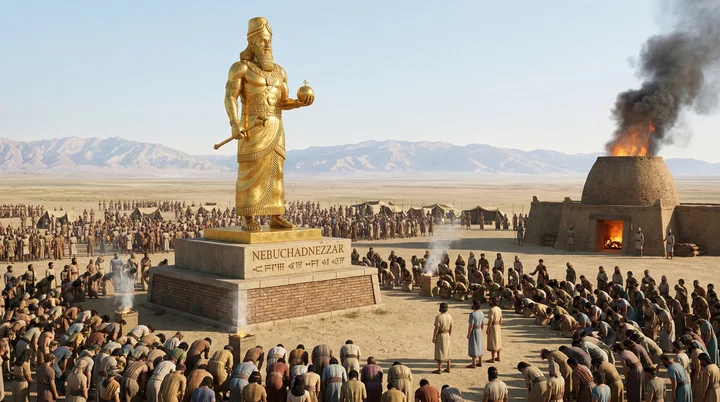
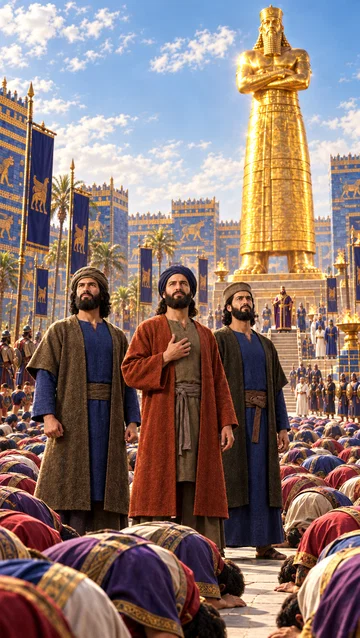
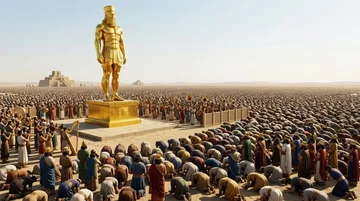
That at what time ye hear the sound of the cornet, flute, harp, sackbut, psaltery, dulcimer, and all kinds of musick, ye fall down and worship the golden image that Nebuchadnezzar the king hath set up:
Translations
That at what time you hear the sound of the cornet, flute, harp, sackbut, psaltery, dulcimer, and all kinds of music, you fall down and worship the golden image that Nebuchadnezzar the king has set up:
That at what time ye hear the sound of the cornet, flute, harp, sackbut, psaltery, dulcimer, and all kinds of musick, ye fall down and worship the golden image that Nebuchadnezzar the king hath set up:
that at what time ye hear the sound of the cornet, flute, harp, sackbut, psaltery, dulcimer, and all kinds of musick, ye fall down and worship the golden image that Nebuchadnezzar the king hath set up:
That at what time ye hear the sound of the cornet, flute, harp, sackbut, psaltery, dulcimer, and all kinds of music, ye fall down and worship the golden image that Nebuchadnezzar the king hath set up.
that at what time ye hear the sound of the cornet, flute, harp, sackbut, psaltery, dulcimer, and all kinds of music, ye fall down and worship the golden image that Nebuchadnezzar the king hath set up:
that at what time ye hear the sound of the cornet, flute, harp, sackbut, psaltery, dulcimer, and all kinds of music, ye fall down and worship the golden image that Nebuchadnezzar the king hath set up;
at the time that ye hear the voice of the cornet, the flute, the harp, the sackbut, the psaltery, the symphony, and all kinds of music, ye fall down and do obeisance to the golden image that Nebuchadnezzar the king hath raised up:
that at what time ye hear the sound of the cornet, pipe, lute, sambuca, psaltery, bagpipe, and all kinds of music, ye fall down and worship the golden image that Nebuchadnezzar the king hath set up;
At what time ye shall hear the sound of the horn, the pipe, the lyre, the harp, the psaltery, the bagpipes, and all kinds of instruments of music, ye shall fall down and adore the image of gold, which Nebuchadnezzar the king hath set up;
Berean Standard Bible, Majority Standard Bible
As soon as you hear the sound of the horn, flute, zither, lyre, harp, pipes, and all kinds of music, you must fall down and worship the golden statue that King Nebuchadnezzar has set up.
that whenever you hear the sound of the horn, flute, zither, lyre, harp, pipe, and all kinds of music, you fall down and worship the golden image that Nebuchadnezzar the king has set up.
That when the sound of the horn, pipe, harp, trigon, psaltery, bagpipe, and all sorts of instruments, comes to your ears, you are to go down on your faces in worship before the image of gold which Nebuchadnezzar the king has put up:
That when ye heare the sound of the cornet, trumpet, harpe, sackebut, psalterie, dulcimer, and all instruments of musike, ye fall downe and worship the golden image, that Nebuchad-nezzar the King hath set vp,
Douay-Rheims (Challoner revision)
That in the hour that you shall hear the sound of the trumpet, and of the flute, and of the harp, of the sackbut, and of the psaltery, and of the symphony, and of all kind of music; ye fall down and adore the golden statue which king Nabuchodonosor hath set up.
Pictures
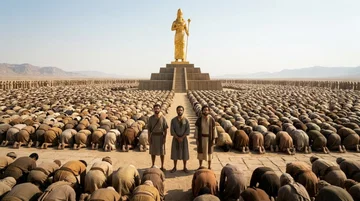
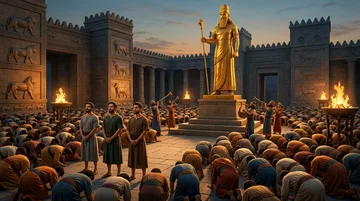
Cross-references 20 of 32
- Daniel 3:16-18
Shadrach, Meshach, and Abed-nego, answered and said to the king, O Nebuchadnezzar, we are not careful to answer thee in this matter.
The three Hebrews refuse the king’s command to worship the image and trust God.
- Daniel 2:31-45
Thou, O king, sawest, and behold a great image. This great image, whose brightness was excellent, stood before thee; and the form thereof was terrible.
The all-gold image challenged the dream’s vision of successive kingdoms.
- Revelation 13:15
And he had power to give life unto the image of the beast, that the image of the beast should both speak, and cause that as many as would not worship the image of the beast should be killed.
A commanded image worship is enforced with a death threat.
- Daniel 3:24-28
Then Nebuchadnezzar the king was astonied, and rose up in haste, and spake, and said unto his counsellors, Did not we cast three men bound into the midst of the fire? They answered and said unto the king, True, O king.
Christ is with the faithful men in the furnace and God delivers them.
- Exodus 20:4-5
Thou shalt not make unto thee any graven image, or any likeness of any thing that is in heaven above, or that is in the earth beneath, or that is in the water under the earth:
God forbids making and worshiping images.
- Acts 5:29
Then Peter and the other apostles answered and said, We ought to obey God rather than men.
Both reject human commands that conflict with obedience to God.
- Revelation 14:9-12
And the third angel followed them, saying with a loud voice, If any man worship the beast and his image, and receive his mark in his forehead, or in his hand,
The image-worship test contrasts with faithful loyalty to God and warns of judgment.
- Daniel 3:28
Then Nebuchadnezzar spake, and said, Blessed be the God of Shadrach, Meshach, and Abed-nego, who hath sent his angel, and delivered his servants that trusted in him, and have changed the king’s word, and yielded their bodies, that they might not serve nor worship any god, except their own God.
Nebuchadnezzar praises God for delivering those who refused to worship the image.
- Jeremiah 27:6
And now have I given all these lands into the hand of Nebuchadnezzar the king of Babylon, my servant; and the beasts of the field have I given him also to serve him.
God gives Nebuchadnezzar authority over kingdoms and calls him his servant.
- Daniel 4:34-37
And at the end of the days I Nebuchadnezzar lifted up mine eyes unto heaven, and mine understanding returned unto me, and I blessed the most High, and I praised and honoured him that liveth for ever, whose dominion is an everlasting dominion, and his kingdom is from generation to generation:
Nebuchadnezzar is humbled and acknowledges God’s sovereignty, who abases the proud.
- Daniel 3:1
Nebuchadnezzar the king made an image of gold, whose height was threescore cubits, and the breadth thereof six cubits: he set it up in the plain of Dura, in the province of Babylon.
Introduces the golden image set up for worship.
- Daniel 3:29
Therefore I make a decree, That every people, nation, and language, which speak any thing amiss against the God of Shadrach, Meshach, and Abed-nego, shall be cut in pieces, and their houses shall be made a dunghill: because there is no other God that can deliver after this sort.
The king honors God after delivering those who refused to worship the image.
- Matthew 4:10
Then saith Jesus unto him, Get thee hence, Satan: for it is written, Thou shalt worship the Lord thy God, and him only shalt thou serve.
Both declare that worship belongs to God alone.
- Daniel 6:10
Now when Daniel knew that the writing was signed, he went into his house; and his windows being open in his chamber toward Jerusalem, he kneeled upon his knees three times a day, and prayed, and gave thanks before his God, as he did aforetime.
Daniel continued praying to God despite a royal decree forbidding it.
- Daniel 3:15
Now if ye be ready that at what time ye hear the sound of the cornet, flute, harp, sackbut, psaltery, and dulcimer, and all kinds of musick, ye fall down and worship the image which I have made; well: but if ye worship not, ye shall be cast the same hour into the midst of a burning fiery furnace; and who is that God that shall deliver you out of my hands?
The king repeats the musical test and threatens those who refuse to worship.
- Daniel 2:31-33
Thou, O king, sawest, and behold a great image. This great image, whose brightness was excellent, stood before thee; and the form thereof was terrible.
The golden image was modeled on the image Nebuchadnezzar saw in his dream.
- Daniel 3:12
There are certain Jews whom thou hast set over the affairs of the province of Babylon, Shadrach, Meshach, and Abed-nego; these men, O king, have not regarded thee: they serve not thy gods, nor worship the golden image which thou hast set up.
Shadrach, Meshach, and Abed-nego refused to worship the golden image.
- Daniel 3:27
And the princes, governors, and captains, and the king’s counsellors, being gathered together, saw these men, upon whose bodies the fire had no power, nor was an hair of their head singed, neither were their coats changed, nor the smell of fire had passed on them.
The men emerged from the fiery furnace without harm or even the smell of smoke.
- Daniel 3:19
Then was Nebuchadnezzar full of fury, and the form of his visage was changed against Shadrach, Meshach, and Abed-nego: therefore he spake, and commanded that they should heat the furnace one seven times more than it was wont to be heated.
The king ordered the furnace heated after their refusal.
- Acts 4:19
But Peter and John answered and said unto them, Whether it be right in the sight of God to hearken unto you more than unto God, judge ye.
Both texts contrast obedience to human commands with obedience to God.
Commentary
Each commentary is drawn from primary sources: the writings of Ellen G. White and Adventist pioneers and periodicals. Each commentary is separate. Its own words are not a quotation; follow the references to read the source passages.
Ellen G. White
48 sources
At the sound of every kind of music all peoples under Nebuchadnezzar were commanded to fall down and worship the costly golden image he had set up in the plain of Dura, about ninety feet high, on pain of being at once cast into a burning fiery furnace.ST Sep 2, 1897BS 31.2–3Lt 132, 1901, par. 7–15Ms 110, 1904, par. 50–51ST Oct 19, 1882 The image set forth Babylon's glory and especially Nebuchadnezzar himself as an object of worship, to exalt the king, demand supreme loyalty, and turn the nations from the living God after His warning in the dream of the head of gold had been read through pride and ambition.Lt 132, 1901, par. 7–15Ms 110, 1904, par. 50–51Ms 84b, 1897, par. 9–11PK 505.2Lt 109a, 1898, par. 5–8 Bowing at the musical signal was worship belonging to God alone, so the decree made idolatry the established national religion and set human law against God's law to force conscience and test loyalty to Jehovah.ST Sep 2, 1897Lt 132, 1901, par. 7–1521MR 59.1–60.1Ms 84b, 1897, par. 9–11ST Dec 24, 1912 The three Hebrew captives refused to dishonor their Creator at the risk of life, and for loyalty to the God of heaven were cast into the furnace, where Christ Himself walked with them and preserved them unharmed before the idolatrous nation.PK 503Lt 132, 1901, par. 7–1521MR 59.1–60.1Ms 84b, 1897, par. 9–11Ms 168, 1898, par. 1–3 That enforced worship will be repeated in the last days when civil power commands reverence for Sunday, the spurious sabbath without Scripture authority, in place of the seventh-day Sabbath of the fourth commandment, punishing with imprisonment and death all who will not yield.Ms 136, 1899, par. 14–16PK 512.119MR 243.1–4Ms 32, 1898, par. 11–12Ms 24, 1891, par. 18–21
Setting and Royal Decree
Nebuchadnezzar had for a little time been influenced by the fear of God after light from heaven, but years of prosperity filled his heart with pride until he forgot the living God and resumed idol worship with increased zeal and bigotry, his heart still ruled by worldly ambition and self-exaltation.BS 31.2–3PK 503.2ST Oct 19, 1882 From treasures obtained in war he made an exceedingly costly and magnificent golden image to represent the one he had seen in his dream, about ninety feet high and nine feet broad, imposing and majestic to an idolatrous people.BS 31.2–3ST Oct 19, 188213MR 60.1–61.2 He set it up in the plain of Dura and by proclamation called all rulers, officers and people of the kingdom to assemble at its dedication.BS 31.2–3ST Oct 19, 1882Lt 351, 1905, par. 9
At what time they heard the sound of the cornet, flute, harp, sackbut, psaltery, dulcimer and all kinds of music, people of every nation and language under his rule were commanded to fall down and worship the golden image, and anyone who failed was to be at once cast into the midst of a burning fiery furnace.ST Sep 2, 1897Lt 132, 1901, par. 7–15Ms 110, 1904, par. 50–51ST Dec 24, 1912PK 506.1 The sound of the music was the signal for the assembled officials and the multitude from many nations to bow down together.Ms 110, 1904, par. 50–51ST Dec 24, 1912PK 506.1ST Nov 5, 1896 The great golden image set up in Daniel's time thus required all the people under his rule to worship it on pain of death.ST Sep 2, 1897ST Nov 5, 1896Lt 351, 1905, par. 9
The image represented Babylon's glory, magnificence, power and excellence, and more particularly Nebuchadnezzar himself, magnifying the king who ruled it and setting him before the people as an object of worship.Lt 132, 1901, par. 7–15PK 505.2Ms 168, 1898, par. 1–3Ms 47a, 1898, par. 2–513MR 60.1–61.2 Worshipping it therefore gave to the king honor that belonged to God alone.Lt 132, 1901, par. 7–15Ms 84b, 1897, par. 9–11 In a land where idol worship was widespread the decree made the image an object of worship as a sign of supreme loyalty to Babylonian power.Lt 132, 1901, par. 7–15PK 505.2Lt 109a, 1898, par. 5–8
The command was intended to honor Babylon, exalt the king, demand supreme loyalty, and convert all nations to that worship, with enforced universal worship supposed to be of sufficient authority to turn all nations to idolatry.Ms 110, 1904, par. 50–51Lt 109a, 1898, par. 5–8Ms 168, 1898, par. 1–3Ms 47a, 1898, par. 2–5 It was also intended to obscure the prophecy of the kingdoms that would follow Babylon.Ms 110, 1904, par. 50–51 It grew out of the dream of the great image in which his kingdom was represented by the head of gold, read through his own idolatrous mind and ambition and brought into harmony with his human understanding instead of in the light of the living oracles, with flattery from heathen counselors who exalted Babylon because each later kingdom was shown by a baser metal as nations separated from God and decreased in value.Ms 168, 1898, par. 1–3Ms 47a, 1898, par. 2–513MR 60.1–61.2
Nebuchadnezzar had lost sight of God's purpose concerning the nations, and the command on the plain of Dura was the act of his proud spirit.PK 514.2 An idolater by birth and training at the head of an idolatrous people, he yet had an innate sense of justice and right that God could use as an instrument for punishing the rebellious and fulfilling the divine purpose.PK 514.2 There before the multitude his proud spirit was humbled until he once more acknowledged that God's kingdom is an everlasting kingdom and His dominion is from generation to generation.PK 514.2
Worship and Loyalty Test
At the sound of cornet, flute, harp, sackbut, psaltery, dulcimer and all kinds of music, falling down before the golden image was not mere civil respect but an act of worship and homage that belongs to God alone.21MR 59.1–60.1Ms 84b, 1897, par. 9–11 Because the image represented Nebuchadnezzar himself, to worship it was also to give to the king honor that belongs to God alone.21MR 59.1–60.1Ms 84b, 1897, par. 9–11
The command made that worship the established religion of the country, a state and national religion imposed upon people of every nation and language under his rule.ST Sep 2, 1897ST Dec 24, 1912ST Sep 2, 1897 It was a public act of worship at the dedication, with music as the signal for all to bow together.ST Sep 2, 1897PK 506.1ST Sep 2, 1897 In that public bowing it demanded supreme loyalty to Babylonian power and sought to make image-worship part of the land's permanent order.Lt 132, 1901, par. 7–15PK 506.1PK 505.2
That human law stood in direct opposition to God's law, forcing obedience to man against obedience to Jehovah.ST Sep 2, 1897ST Dec 24, 1912ST Sep 2, 1897 It made public worship a test of loyalty to the king in place of loyalty to the true God, which the three Hebrew captives who cherished the knowledge of the true God refused to violate.Lt 132, 1901, par. 7–15ST Dec 24, 191213MR 60.1–61.2 It was an attempt by a ruler to force religious obedience and to control conscience, a right that belongs to God alone.13MR 60.1–61.2Ms 78, 1897, par. 40
The imposing display and beautiful music were fitted to charm the senses, to draw the multitude into idolatry and to turn them from allegiance to God and from the worship of God.12MR 218.2–220.112MR 220.2–3Lt 90, 1897, par. 13–18 The attractive golden image had no inward purity and beauty, but depended on outward display and on human authority to force worship.12MR 218.2–220.112MR 220.2–3 Worship so secured gives honor not to God but to the prince of darkness, and the same principle appears whenever a church lacking inward holiness and the Spirit of God depends on parade, ceremonies, display, ornaments, shrines, embroidered altars and magnificent architecture to attract and hold the senses, concealing spiritual poverty and apostasy and entrapping men by the enemy.12MR 218.2–220.112MR 220.2–3Lt 90, 1897, par. 13–18
The verse therefore means forced idol worship by human power against God.Ms 136, 1899, par. 14–1614MR 93.1–94.1Ms 7a, 1896, par. 15–17 That compulsion is enforced by oppression, binding, imprisoning, condemning, and causing suffering of body and mind to make God's chosen ones untrue to God and to transgress His holy law.14MR 93.1–94.1Ms 7a, 1896, par. 15–17 It includes compelling violation of loyalty to God, as in compelling worship of an unauthorized sabbath set up in place of God's sanctified seventh day.Ms 136, 1899, par. 14–1614MR 93.1–94.1Ms 7a, 1896, par. 15–17
Faithfulness and Deliverance
At the sound of the music all peoples of every nation and language were ordered to fall down and worship the golden image Nebuchadnezzar had set up, an image that stood for Babylon itself and for the king himself.Lt 132, 1901, par. 7–1521MR 59.1–60.1Ms 84b, 1897, par. 9–11ST Nov 5, 1896ST Sep 2, 1897 To bow at that signal was an act of worship and homage belonging to God alone, so that worship of the image also gave to the king honor belonging to God alone.21MR 59.1–60.1Ms 84b, 1897, par. 9–11ST Dec 24, 1912 The order made that public worship a test of loyalty to the king, an established state and national religion imposed by human law in direct opposition to God's law and requiring worship of an idol rivaling the God of heaven.Lt 132, 1901, par. 7–15ST Dec 24, 1912ST Nov 5, 1896ST Sep 2, 1897 Shadrach, Meshach, and Abed-nego, the three Hebrew captives and faithful companions and worthies, cherished the knowledge of the true God and would not dishonor the God who made all things by obeying it.21MR 59.1–60.1ST Dec 24, 1912ST Nov 5, 1896ST Sep 2, 189713MR 60.1–61.2 They remained loyal to Jehovah and to God's commandments even at the risk of their lives, determined to serve Him who is King of kings and Lord of lords at any cost rather than obey human authority requiring an act against Him.Lt 132, 1901, par. 7–1521MR 59.1–60.1ST Dec 24, 1912ST Nov 5, 1896ST Sep 2, 1897
For that loyalty to the God of heaven they were cast into the burning fiery furnace.PK 503Ms 84b, 1897, par. 9–1113MR 60.1–61.2 There they were seen walking unharmed, because Christ, the Lord Jesus Himself, walked with them through the fire, preserved them from all harm and manifested Himself to them.PK 503Ms 84b, 1897, par. 9–11Ms 168, 1898, par. 1–3Ms 47a, 1898, par. 2–513MR 60.1–61.2
That history tested the integrity of Daniel and his companions and demonstrated before an idolatrous nation the power and faithfulness of the God of Israel.Lt 118, 1910, par. 2BS 29.1 It sets forth important principles regarding the working out of the Lord's purpose for the children of obedience and the children of disobedience.Lt 118, 1910, par. 2 The miracle wrought upon Nebuchadnezzar's heart so that he believed in God and acknowledged His superior power.Ms 168, 1898, par. 1–3Ms 47a, 1898, par. 2–5 Setting God aside and trusting in one's own wisdom and cherishing the thoughts and feelings Nebuchadnezzar cherished brings danger of passing through a trying experience.13MR 60.1–61.2
End-Time Parallel
The state-commanded test on the plain of Dura will be repeated in the last days as the pattern for demanding that people honor human religious laws in place of God's law.PK 512.119MR 243.1–4Ms 24, 1891, par. 18–21Ms 71, 1896, par. 10Ms 110, 1904, par. 58–61 As the golden image was set up then, an idol sabbath will be set up, a rival, spurious sabbath exalted like the image, with rulers using legislation to compel conscience, enforce false worship, and suppress religious liberty.19MR 243.1–4Ms 71, 1896, par. 10Ms 110, 1904, par. 58–61 In that conflict the fourth-commandment Sabbath is the central issue, for the Sabbath identifies God as Creator while the papal counterfeit is exalted and enforced through laws that demand worship.19MR 243.1–4Ms 24, 1891, par. 18–21 The demand to bow to the image parallels Satan's final effort to compel worship through national laws and threats to people's protection and rights, growing out of vain glory and oppression.Ms 24, 1891, par. 18–21Ms 110, 1904, par. 58–61
The order to fall down and worship at the signal, triggered by music, under penalty foreshadows a time when innocent servants of God will be given over to suffer humiliation and abuse at the hands of those inspired by Satan and filled with envy and religious bigotry.PK 512.114MR 90.3–91.4Ms 7a, 1896, par. 15–17 Especially those who hallow the Sabbath of the fourth commandment will arouse the wrath of men, and at last a universal decree will denounce them as deserving of death for refusing to yield, with punishment by imprisonment and death.PK 512.114MR 90.3–91.4Ms 7a, 1896, par. 6–7 The verse means compelled worship enforced by oppression, binding, imprisoning, condemning, and causing suffering of body and mind to make God's chosen ones untrue to God and transgress His holy law, and the same compulsion is repeated in trying to compel them to worship an idol sabbath which has not one text of Scripture for its authority.14MR 90.3–91.4Ms 7a, 1896, par. 15–17 That idol sabbath has been set up in the same way, a Sunday institution that God has not blessed but the Catholic church instituted, and a corrupt union has formed to tear down God's memorial of creation, the sanctified and blessed seventh day of the fourth commandment.Ms 7a, 1896, par. 15–17Ms 7a, 1896, par. 6–7 A time is coming when everyone will take sides between the Sabbath of the Lord and the spurious sabbath of the man of sin, and as death was decreed for all who would not bow and worship, so a proclamation will punish with imprisonment and death all who will not reverence Sunday, trampling the Sabbath of the Lord under foot in a united effort to make void the law of God.Ms 7a, 1896, par. 6–7
Those who do this work of compulsion are not following the Lamb whithersoever He goes, have guile in their mouths, and follow the leader who was expelled from heaven and falsified God, developing the attributes of Satan as co-workers with him.Ms 7a, 1896, par. 15–17 This is contrary to Christ, who came not to break down the moral power of men but to restore it and to break the power of oppression and release those in bondage to Satan, and they show that if they had opportunity and power they would spy on and condemn Christ to death as did the unbelieving Jews at His first advent.Ms 7a, 1896, par. 15–17 That same refusal made by the three worthies will be required in the Southern States when the period comes to stand as they stood, and that time will force a decision for or against the commandments of God.Lt 35, 1895, par. 1–3 Until that time comes believers must not act presumptuously to bring on the crisis or close their own way into fields not yet worked.Lt 35, 1895, par. 1–3
The image represented the kingdom of Babylon and more particularly Nebuchadnezzar himself and the excellence of Babylon, and the enforced universal worship was supposed to be of sufficient authority to convert all nations to that worship.Ms 168, 1898, par. 1–3 It came because he read the interpretation of his dream in accordance with his own idolatrous mind, bringing the dream into harmony with his human understanding instead of reading it in the light of the living oracles.Ms 168, 1898, par. 1–3 The three faithful servants would not bow the knee to the idolatrous image, and Christ Himself walked with them in the fiery furnace, and the miracle wrought upon Nebuchadnezzar's heart so that he believed in God and His superior power.Ms 168, 1898, par. 1–3 The episode foreshadows the end of the world, when Babylon again falls in an hour of feasting and reveling and only the prepared will be ready.Ms 168, 1898, par. 1–3
The command is an example of a ruler trying to force religious obedience and control the conscience, a right that belongs to God alone, a state power commanding false worship and compelling conscience against loyalty to God.Ms 78, 1897, par. 4013MR 71.1–72.1 It will be repeated when the law of God is made void by a national act, when Sunday is exalted and sustained by law, and when keeping the seventh day as the Sabbath is counted disloyalty to the laws of the land, paralleling future laws restricting religious liberty, especially the conflict over the seventh-day Sabbath.Ms 78, 1897, par. 4013MR 71.1–72.1 Christ resisted Satan's offer of worldly power, and His victory shows that His followers can also resist the enemy.Ms 24, 1891, par. 18–21 Then the people of God must not give up loyalty to God, but must make manifest the same principle that the three Hebrews manifested, with increased zeal for obedience, making the value of God's law as a rule of conduct manifest when truth is overborne by falsehood, and God will intervene for His loyal, commandment-keeping people.Ms 24, 1891, par. 18–21Ms 78, 1897, par. 4013MR 71.1–72.1
Sabbath Counterpart
As the golden image was lifted up on the plain of Dura to be worshiped at the signal of music, an idol sabbath has been set up in the same way.11MR 354.2–355.1Ms 127, 1897, par. 20–21Ms 7a, 1896, par. 6–7 The exaltation of that golden image is repeated in the exaltation of a rival, spurious, false sabbath, the first day of the week and Sunday institution, over God's memorial.Ms 32, 1898, par. 11–12Ms 127, 1897, par. 20–21Ms 7a, 1896, par. 6–7 That memorial is the sanctified seventh day of the fourth commandment, the blessed seventh day of creation and the sign between Him and His commandment-keeping people.Ms 32, 1898, par. 11–12Ms 7a, 1896, par. 6–7 In this exalting of the human institution as though it were sacred, God's law is trampled, made void, and His memorial is made a thing of naught to be despised and trampled under foot.Ms 32, 1898, par. 11–12Ms 7a, 1896, par. 6–7
Sunday has no sanctity and bears no divine sanction, for the first day of the week has no sanctity and is nowhere commanded in God's Word to be revered or kept holy.19MR 183.1–2Lt 21, 1902, par. 10–11Ms 88, 1897, par. 19–20 It has not one text of Scripture for its authority, was not blessed by God, but was instituted by the Catholic church.Ms 7a, 1896, par. 15–17Ms 7a, 1896, par. 6–7 Human authority cannot change God's law.Ms 88, 1897, par. 19–20 Observing the seventh day keeps God's creation in mind, and replacing it with Sunday tramples God's law.Ms 56, 1902, par. 23–24
In this age men claiming to be Christians call the world to worship the image they have made.Ms 32, 1898, par. 11–12 That work is the mystery of iniquity devised by satanic agencies and carried into effect by the man of sin, in a corrupt union formed to tear down God's memorial of creation.Ms 32, 1898, par. 11–12Ms 7a, 1896, par. 6–7 Their worship is as churches exalting the papal Sabbath and worshiping the image of the beast and receiving its mark instead of keeping God's seventh-day Sabbath.Lt 60, 1898, par. 28–30
As Cain set aside God's holy command and offered a sacrifice of his own choice which met rejection, so men have set aside God's holy Sabbath for a day that bears no divine sanction.Ms 136, 1899, par. 14–16 As Cain was filled with bitterness against Abel, so those who worship that day are enraged against those who keep God's Sabbath because their obedience casts reflection on false worship.Ms 136, 1899, par. 14–16 Those who do this work of compulsion to make God's chosen ones untrue to God and transgress His holy law, by oppression, binding, imprisoning, condemning, and causing suffering of body and mind, are not following the Lamb whithersoever He goes and have guile in their mouths.Ms 7a, 1896, par. 15–17 They follow the leader who was expelled from heaven and falsified God, developing the attributes of Satan as his co-workers, contrary to Christ who came not to break down the moral power of men but to restore it and to break the power of oppression and release those in bondage.Ms 7a, 1896, par. 15–17 They show that with opportunity and power they would spy on and condemn Christ to death as did the unbelieving Jews at His first advent.Ms 7a, 1896, par. 15–17
In that conflict the fourth-commandment Sabbath is the central issue, for the Sabbath identifies God as Creator while the papal counterfeit is exalted and enforced through laws that demand worship.19MR 243.1–4 Rulers will use legislation to compel conscience and exalt a spurious sabbath, and all who will not observe it are placed under oppressive laws.Ms 32, 1898, par. 11–12Ms 71, 1896, par. 10 The ceremony and formalism, vainglory and oppression seen in Nebuchadnezzar's course is being and will continue to be manifested to the close of earth's history.Ms 32, 1898, par. 11–12 As Nebuchadnezzar set up a golden image and exalted himself, Satan exalts a false Sabbath and uses human authority to direct worship away from God's commandment.Ms 65, 1897, par. 7–9 Compelling people to honor this man-made requirement makes human commands equal to or higher than God's requirements and renders their worship null and void.Ms 65, 1897, par. 7–9
A time is coming when everyone will take sides between the Sabbath of the Lord and the spurious sabbath of the man of sin.Ms 7a, 1896, par. 6–7 The law of God is to be made void by a national act, when Sunday is exalted and sustained by law, and keeping the seventh day as the Sabbath is counted disloyalty to the laws of the land.13MR 71.1–72.1 As Nebuchadnezzar decreed death for all who would not bow and worship, so a proclamation will punish with imprisonment and death all who will not reverence Sunday.Ms 7a, 1896, par. 6–7 This spirit of compulsion will continue till the end of time, with sin leagued against good as Satan's agents against God and righteousness.Ms 136, 1899, par. 14–16Ms 32, 1898, par. 11–12
Sources
Pioneers and periodicals
136 sources
Daniel 3:5 records the herald's command that when all peoples heard the cornet, flute, harp, sackbut, psaltery, dulcimer and every kind of music they must fall down and worship the golden image Nebuchadnezzar set up on the plain of Dura, with refusal to be punished that same hour in the burning fiery furnace.ST Sep 2, 1897ST Jan 9, 1912ST Jan 29, 1908ST Dec 16, 1897RH Apr 13, 1869 Making the image all of gold declared that Babylon would stand forever, rejecting God's word that another kingdom would follow and attempting to make His prophecy fail.ST Dec 16, 1897ST Oct 11, 1905ST Oct 13, 1909 The decree put civil power in God's place by commanding worship, setting the king's law directly against the law forbidding graven images, so that to obey was sin against God while to refuse was only crime against human law.RH Jun 8, 1916ST Jan 23, 1901ST Jun 11, 1912ST Jan 23, 1912ST Jul 11, 1911 Hananiah, Mishael and Azariah remembered God's command and stood erect alone rather than bow, and though cast bound into the fire they walked loose with one like the Son of God and came forth without hurt to deliverance and promotion.ST Nov 8, 1905ST Jul 27, 1904ST Jan 9, 1907ST Dec 20, 1899RH May 9, 1871 The command foreshadows the last-day decree to worship the image of the beast on pain of death, when a human sabbath of the first day is set up as the image was and enforced by law, and as God interposed then so He will interpose to save His people from the final furnace.ST May 6, 1897RH May 1, 1855ST Oct 5, 1882ST Nov 1, 1905ST Sep 10, 1912
Music Signal and Image
A herald loudly commanded all peoples, nations, and languages gathered for the dedication that at the time they heard the sound of the cornet, flute, harp, sackbut, psaltery, dulcimer, and all kinds of music they were to fall down and worship the golden image Nebuchadnezzar had set up.ST Sep 2, 1897ST Jan 9, 1912ST Jan 29, 1908ST Dec 16, 1897ST Jan 29, 1908 That command made public worship of the image compulsory, requiring obedience from people of every nation and language whenever the music sounded.ST Sep 2, 1897ST Jan 9, 1912RH Apr 13, 1869ST Jan 29, 1908 The music together with the threat of pain was appointed to compel participation in idolatrous worship.RH Apr 13, 1869
The image was covered with burnished gold and set on an eminence in the broad plain of Dura near Babylon, with its pedestal over one hundred feet high and over ten feet across the shoulders.ST Jan 29, 1908 It is elsewhere described as about ninety feet high and nine feet broad, and as threescore cubits high and six cubits broad.ST May 6, 1897ST Oct 19, 1882 It was an imposing glittering spectacle easily seen from every part of the vast throng, with the princes, governors, captains, officers, and representatives of all nations assembled for its dedication.ST May 6, 1897ST Oct 19, 1882ST Jan 29, 1908 One teaching identifies it as a lofty statue of Bel Merodach belonging to idolatrous false religion now dead and gone like those of Egypt, Assyria, Phenicia, Greece, and Rome.ST Feb 6, 1893
Refusal was to be punished that same hour by being cast into the midst of a burning fiery furnace.ST Sep 2, 1897ST Dec 16, 1897ST Mar 12, 1896ST Jul 27, 1904 For the three who refused, the furnace was heated seven times hotter than usual before they were cast into the seething fire.ST Jun 3, 1913 The word translated image denotes a figure made by human hands, used here for Nebuchadnezzar's figure and in nearly all its other uses outside humanity made in God's image for physical images.RH Jan 5, 1860
The list of musical instruments belongs exactly to the Babylon of Daniel's own time and is historically and socially accurate, and its accuracy proves the book was written in Babylon when the events happened and could never have been invented three centuries later.ST Jul 23, 1885 The two or three Greek names, with four of the instrument names of Greek origin, do not require a date after Alexander conquered Palestine in 332 B.C.ST Jan 11, 1916RH Nov 25, 1873 Greek culture and traders with their instruments were already found in those countries in the eighth century before Christ in the days of Sargon and Sennacherib, just as names of Indian animals and of an Indian tree reached Jerusalem under Solomon, and intercourse between East and West already existed with Greeks reaching the furthest end of the world and the brother of Alcaeus gaining distinction while aiding the Babylonians.ST Jan 11, 1916RH Nov 25, 1873 Any remaining verbal uncertainty is due to a later translator or to translation or transcription changes, and does not undermine the chapter's genuine Babylonian historical setting.ST Nov 27, 1884
The orchestra named a wide range of instruments forming an ensemble about as complete as a modern orchestra.RH Feb 19, 1914 Its sound served as the appointed signal and royal band cue for universal bowing, making public worship of the image a test of obedience to the king.STRH Aug 6, 1908 The music was used to stir emotions, charm the senses, and drown out conscience.ST Jan 9, 1912RH Aug 6, 1908 Force is the last resort of every false religion when attraction by music and outward show fails, for at first it tries attraction as the king tried the power of music and outward show, and if that fails to make men worship the image the furnace flames are ready to consume them.ST May 6, 1897 Babylon's abundance of music and musical skill did not keep it from coming under God's judgment, nor is such skill and appreciation proof that a nation is becoming better or more acceptable to God.ST Nov 20, 1884
The events belong about twenty years after Nebuchadnezzar's dream in Daniel 2, during a period when his kingdom rapidly grew in power and glory through military conquests, effective administration, and large building projects.RH Aug 6, 1908 His inscribed clay cylinder describing his restoration of the tower of Babel and building of edifices in Babylon confirms that biblical record.RH May 13, 1909
Babylon's Defiant Ambition
Making the image all of gold, unlike the mixed image of the dream in Daniel 2, declared that his dynasty would continue supreme until the end of time and that Babylon would stand forever universal and eternal.ST Dec 16, 1897ST Oct 11, 1905ST Jun 3, 1913ST Dec 3, 1912ST Feb 13, 1907 It rejected the interpretation that another and inferior kingdom would arise after him, refusing to admit that his kingdom would be overcome and superseded.ST Jun 3, 1913RH Oct 22, 1901ST Feb 13, 1907 It was a futile attempt to make God's prophetic word of succession and decline fail, to prove the revelation through Daniel untrue, and by dedicating the image as a universal deity to add security to his rule.ST Dec 16, 1897ST Jun 3, 1913ST Dec 3, 1912RH Oct 22, 1901 Though pleased with the reproduction of his dream, pride resisted the working of God's Spirit and would not accept that earthly kingdoms would pass away.ST Oct 13, 1909ST Jun 3, 1913RH Oct 22, 1901
The account presents human ideas about the kingdom of men, in contrast with the image in the preceding chapter that represents God's view of human kingdoms.ST Jan 9, 1912ST Oct 21, 1908 The command made worship of the image the country's established national religion, a compulsory part of national worship enforced by threat of death in the fiery furnace.ST Sep 2, 1897ST Aug 24, 1904RH Aug 6, 1908 That worship served as a public act of loyalty to Babylon and its ruler, an oath of allegiance and pledge to support the king's plans for the future, joining political loyalty to idolatry.ST Oct 13, 1909ST Oct 11, 1905RH Aug 6, 1908 Those who knew God's truth could not submit to a human demand that contradicted it, since the command forced obedience to a human law opposed to God's law.ST Sep 2, 1897ST Oct 13, 1909
The required worship was the worship of Babylon itself, with king and state deified as an expression of Chaldean patriotism.ST Jan 29, 1908ST Oct 9, 1901RH Apr 24, 1900 Nebuchadnezzar stood as the one law, and the image representing him and his kingdom stood as the one god for that occasion.ST Jan 29, 1908 This was a deification of the kingdom and of religious patriotism, an exaltation of the creature to the throne of the Creator and of the human with loss of sight of the divine.ST Jan 29, 1908ST Oct 9, 1901ST Oct 13, 1909 The same worship is repeated in modern ultra-patriotism where each nation exalts its own kingdom and holds its country always right whether right or wrong, as in rule Britannia forever and our country right or wrong but always our country.ST Oct 11, 1905ST Oct 13, 1909ST Mar 16, 1915
Like all gods of man's devising it was a god of force, whose form and splendor could compel admiration but not love and devotion, which are always voluntary.ST Jan 29, 1908ST Oct 9, 1901 The essential elements of true service and worship were therefore wholly wanting, as in every false system, and their place was supplied by force-made fear.ST Jan 29, 1908ST Oct 9, 1901 The command made the king's will law, displayed his claim to be the greatest king in the universe to whom all must bow low and submit as slaves, and disregard of his slightest wish filled him with rage.ST May 6, 1897ST Oct 10, 1895 After a little time influenced by the fear of God, prosperity filled his prideful heart until he forgot the living God, resumed idol worship with increased zeal from treasures obtained in war, and imposed his own will under show of religious zeal rather than devotion to God.ST Oct 19, 1882RH Oct 22, 1901ST Oct 10, 1895
The dedication was a world-wide proclamation meant to compel all the world to acknowledge the greatness, power, and supposed permanence of Babylon as supreme.RH Apr 24, 1900ST Feb 13, 1907 No opportunity for choice was given, for in Babylon the people are allowed neither conscience nor free will, but religion is prescribed by the state as simply acknowledging the greatness of the state and its right as represented by the king to undisputed control over both bodies and souls.RH Apr 24, 1900 The right of the individual to life, liberty, and the pursuit of happiness apart from state dictation was wholly ignored, refusal was regarded as high treason against the state to be punished with death, and the king made himself keeper of the conscience of the people.RH Apr 24, 1900 It tested the relative power of the gods of Babylon against the great Creator, asserted supreme and spiritual authority backed by penalties, and showed Nebuchadnezzar acting as Pontifex Maximus in a false theocracy mixing sacred and secular to keep rulers' feet upon the necks of the people and ruin morality and spirituality.RH Apr 10, 1916RH Nov 9, 1911ST Dec 12, 1911ST Oct 19, 1904
State-Enforced False Worship
The decree used civil authority and royal power to direct and control worship by commanding all to fall down and worship the golden image at the appointed signal, and in so doing the king took God's place.ST Jul 11, 1911ST Apr 14, 1898ST Mar 6, 1907ST Dec 3, 1896ST Jul 1, 1903 It was an act of union of church and state, religion enforced by law, turning pride and exaltation of self into a legal creed that brought religious persecution upon refusers.ST Jul 11, 1911ST Dec 24, 1896ST Jul 1, 1903 Civil government is ordained of God as His servant to restrain evil and prevent incivility and to keep men civil in outward things, not to aid religion, touch conscience and soul, or coerce worship in any way.ST Jul 11, 1911ST Dec 24, 1896ST Dec 3, 1896ST Jul 1, 1903 When the church-and-state principle is developed into law it always leads to persecution for conscience' sake, and for this overreach God humbled Nebuchadnezzar and proud Babylon with him to destruction.ST Jul 11, 1911ST Dec 24, 1896ST Dec 3, 1896ST Jul 1, 1903 By requiring adoration the government overstepped its proper bounds and claimed authority over worship, so God's servants were free from blame for refusing to obey, and God approved their refusal by protecting them in the furnace.ST Apr 14, 1898ST Mar 6, 1907
The command was a religious, idolatrous and persecuting command that directly violated God's law forbidding making graven images and bowing down and serving them, especially the second commandment.RH Jun 8, 1916ST Jan 23, 1901ST Nov 28, 1895 By herald the king ordered that all peoples, nations and languages at the sound of the cornet, flute, harp, sackbut, psaltery, dulcimer and all kinds of music must fall down and worship the image set up in the plain of Dura on pain of being cast the same hour into a burning fiery furnace.ST Jan 23, 1901ST Nov 28, 1895ST Mar 12, 1896 Though a power ordained of God as His servant, this decree was not God's ordinance, because it set the king's law in direct conflict with the Creator's law.ST Nov 28, 1895ST Mar 12, 1896 Refusing to obey it was not anarchy or resisting the powers that be, and God set His seal of approval on refusal by deliverance, proving civil powers have no right whatever to intermeddle in religious things and rulers must not be obeyed when they command transgression.ST Nov 28, 1895ST Mar 12, 1896 The command did not forbid worship of the true God but commanded worship of the golden image, thereby exalting man in the place of God, making duty to God secondary and demanding recognition that men are not servants of God but are gods, which is wholly contrary to the gospel of the kingdom whose faithful answer is to obey God rather than men.RH Jul 3, 1900RH Oct 21, 1862
To obey that command was sin against God's law, while to refuse it was crime against human law.ST Jun 11, 1912ST Jan 23, 1912ST Jan 20, 1898ST Jul 23, 1912 Meshach, Shadrach and Abednego refused, so they were treated as criminals before the state and condemned to death, but they were not sinners before God.ST Jan 23, 1912ST Jan 20, 1898ST Jul 23, 1912 Their case proves that crime is not always sin, for civil law can punish conduct without making obedience to God sinful, and bowing to the image would have been sin because it placed human authority above God.ST Jan 23, 1912ST Aug 6, 1896ST Jul 23, 1912 When obedience to God conflicts with civil law it is better to incur criminal punishment than to sin, so conscientious obedience may be punishable by civil authorities yet loyalty to God requires disobedience to the wrongful decree.ST Jun 11, 1912ST Jan 20, 1898ST Aug 6, 1896 Those who make and enforce such a law, not the refuser, are guilty and must give account to God, as shown where legal demands conflicting with obedience to God made refusal a crime under civil law but not a sin.ST Aug 6, 1896ST Jun 24, 1897
The decree could be presented as a civil statute in harmony with the majority and claimed to be for the public good and the maintenance and stability of Babylon, but it still compelled an act of worship and was not neutral civil law.ST Sep 9, 1889ST May 12, 1890 It did not forbid the Hebrews to worship their own God and claimed to leave liberty to worship any other god, yet it required outward obedience to a religious act and did interfere with worship of the true God.ST May 12, 1890ST Dec 5, 1895 Bowing need not include prayer to the image to count as homage, for in public it acknowledges the image's claim to be an object of worship and submits to the state's command to worship it.ST May 20, 1889ST Jan 22, 1894 Loyalty to Jehovah therefore did not permit obeying it as a merely civil ordinance without compromising faith, and praying to God while bowing would still be disobedience.ST May 12, 1890ST May 20, 1889ST Jan 22, 1894 No man can serve two masters or bear the badge of two opposing powers at the same time, and can have no both the seal of God and the mark of the beast; just as required rest on the first day does not leave Sabbathkeepers free because the Sunday institution was designed as a human substitute for the Sabbath of the Lord, so compulsion to rest the first day is equivalent to compulsion to labor on the seventh day.ST Dec 10, 1885ST Dec 5, 1895
The command set a test between obedience to men and obedience to God and His commandments in which every true child of God will choose obedience to Him and His divine precepts rather than be disloyal, going to the fiery furnace if need be.ST Jul 27, 1904ST Sep 10, 1885RH Mar 1, 1860 A ruler's command must not be obeyed when it conflicts with God's law and the rights of conscience, even when refusal brings serious consequences and persecution.ST Sep 10, 1885ST Jul 24, 1884ST Oct 3, 1895 Christians may refuse such a demand and meekly suffer its penalty without violent rebellion against civil authorities, while seeking lawful course, for obedience to earthly rulers does not require disobeying God and obedience to the law of the land is right only when it does not conflict with God's law.ST Jul 24, 1884ST Oct 30, 1901ST Oct 3, 1895 God stands by His faithful servants as they stand by His commandments, so that though three men were cast bound into the fire they were seen loose walking in the midst with no hurt, with a fourth whose form is like the Son of God, and came forth with the fire having no power upon their bodies nor a hair singed.ST Jul 27, 1904ST Oct 30, 1901 Convenience, rulers or majorities must not determine duty, and God openly honors refusal that honors Him.ST Jul 27, 1904RH Mar 1, 1860ST Oct 30, 1901
Hebrews' Faithful Deliverance
Hananiah, Mishael, and Azariah, called Shadrach, Meshach, and Abednego, remembered God's command not to bow to idols and deliberately refused to worship the golden image or yield homage when the music sounded under threat of death in the fiery furnace.ST Jan 9, 1907ST Dec 20, 1899RH May 9, 1871ST Feb 24, 1881 The decree tested loyalty and aimed to lead the world into idolatry, contravening God's law, yet those who feared God would not obey it regardless of consequences.ST Jan 9, 1907ST Dec 20, 1899ST Feb 24, 1881 The king's command required everyone summoned to the dedication, of every nation and language, to fall down at the signal, and obeying offered a way to avoid notice and stay safe while refusing meant facing the furnace.RH May 9, 1871RH Oct 21, 1862RH Jul 14, 1904 The order was not aimed at them personally, but obeying would still violate God's command, so they would not give even the appearance of obedience from courtesy or to stay safe, honoring God's law rather than the law of the land.RH May 9, 1871RH Oct 21, 1862RH Jul 14, 1904 They stood erect alone among the vast throng when all others bowed, unwilling to worship a false god, with conscience and loyalty to the true God keeping them steadfast even at risk of death.RH May 9, 1871ST Feb 24, 1881RH Jul 14, 1904
Their stand made the right to choose whom to worship the issue, since the decree demanded worship contrary to their established faith.ST May 21, 1912ST May 21, 1912 They honored God's law rather than the law of the land and trusted Him with the outcome with eye single to His glory, and those who honor His law can trust Him to honor them in this life or the world to come.ST May 21, 1912RH Oct 21, 1862 They prayed with faith to their God, and prayer was their shield, moving even the nation when He delivered them from the furnace.ST Nov 11, 1886 Obedience to God takes precedence over a ruler's command, for each person is responsible to God for matters of faith, and God miraculously upheld them.ST May 21, 1912ST May 21, 1912 Faithfulness to God can require defying pressure and accepting danger, showing the courage demanded by a severe test of faith.ST Mar 7, 1878
Though three men were cast bound into the fire, they were seen loose walking in the midst with no hurt, with a fourth whose form is like the Son of God, for Christ was present with His faithful followers.ST Nov 8, 1905ST Jul 27, 1904 The state had been used to impose a false religion with refusal punished by the furnace heated seven times hotter than usual, but the king's decree was reversed when Christ stood by His servants as they stood by His commandments.ST Nov 8, 1905ST Jul 27, 1904ST Jun 3, 1913 The fire had no power upon their bodies, not a hair singed nor even the smell of smoke on garments, while the executioners died and the servants were miraculously preserved.ST Jul 27, 1904ST Jun 3, 1913ST Their faithfulness in refusing was rewarded with deliverance and promotion in the province of Babylon instead of loss of life and position.RH Aug 27, 1908 The command had made public worship of the image a test of obedience to the king, but the attempt to force God's servants to worship an image failed.RH Aug 27, 1908STST
Their deliverance made the true God known throughout the earth, proclaiming His power, sovereignty, and ability to abase the proud and to save beyond nature's elements.RH Aug 22, 1907ST Oct 21, 1908ST Jan 9, 1907 The great king was forced to acknowledge that the Hebrews' God is a Deliverer above all gods and that a higher King ruled, leading to his conversion, testimony, and proclamation of the Most High's rule.RH Aug 22, 1907ST Jul 16, 1912RH Apr 25, 1912 It was one of three lessons teaching him about God and his own limits, after which he acknowledged and worshiped the true God, though the lesson was later disregarded.RH Apr 25, 1912 The chapter thus teaches God's power to deliver His children, showing He is able and willing to deliver those who trust Him, including deliverance from sin.ST Oct 21, 1908RH Aug 15, 1907 That message presented the gospel of righteousness by faith and offered salvation from impending destruction.RH Aug 22, 1907
The assembled multitude obeyed when the music stirred their emotions, except for those who did not bow, with Daniel not identified among them and his whereabouts unknown.ST Jan 9, 1912 Officials who witnessed the faithful refusal carried news of it to their provinces, so the refusal became widely known.RH Feb 27, 1900 Believers threatened with death for duty such as going to church and praying can take that history as their own, trusting God with the outcome and being filled with His love so as to lay down a thousand lives for Him.RH Oct 25, 1864 Sure confidence teaches that God will either take to heaven those burnt to death for duty or deliver them in some way even as He delivered His three servants.RH Oct 25, 1864 He magnifies His mercy by bringing enraged persecutors to their knees in prayer for forgiveness and to diligent seeking of God.RH Oct 25, 1864
Foreshadowing Final Crisis
The music-cued order to fall down before the golden image on pain of death foreshadows the end-time decree commanding all to worship the image of the beast on pain of death, and the situation of the church under that decree will be precisely that of the three Hebrews under Nebuchadnezzar's command.RH May 1, 1855ST Oct 5, 1882RH Jul 14, 1863 The Image is to be completed quietly before the people understand its use, and then the same test will be repeated, with woe to whoever refuses to bow because bound by God's higher law.ST Nov 1, 1905RH Nov 14, 1854 That coming conflict will be sharp but short, requiring the spirit of martyrs and the whole armor of God to withstand in the evil day, and those who endure without bowing will gain the victory and stand with the Lamb on Mount Zion.RH Jul 14, 1863RH Nov 14, 1854 Their trial foreshadows the test of God's people in the conflict with the beast and its image, when they will be pressed to obey a false command and the choice will distinguish those who receive God's mark from those who receive the beast's mark.ST Oct 5, 1882ST Nov 1, 1905RH Jul 14, 1863
The six kinds of instruments named to summon to worship, together with the image's measurements, form a triple six identified with the number of the beast and the call to worship it.RH Apr 17, 1900RH Aug 6, 1908 The six kinds of instruments with the image's dimensions mark the scene with the number six, and this worship foreshadows the enforced worship of spiritual Babylon represented by the prophetic beast whose number is 666.RH Apr 17, 1900RH Aug 6, 1908 In both ancient and spiritual Babylon the issue is the exaltation of human authority above God, and faithful worshipers of heaven's King must refuse a decree that would make them commit idolatry.RH Aug 6, 1908
That command will be repeated when the first day of the week, a common working day possessing no sanctity whatever, is set up as was the image and all are commanded to worship this spurious sabbath.ST May 6, 1897ST Sep 10, 1912ST Oct 15, 1896 Satan's plan in this is to make of no account the day instituted by God and given as a memorial of creation, for the Sunday institution was designed as a human substitute for the Sabbath of the Lord and a supposed sign of Christianity and sign of apostasy.ST May 6, 1897ST Dec 10, 1885ST Oct 15, 1896 The decree enforcing worship of this day is to go forth to all the world and has already gone forth in a limited degree where civil power speaks with the voice of a dragon as the heathen king spoke, treating those who refuse to observe it as enemies of church and government worthy of death.ST May 6, 1897ST Sep 10, 1912ST Oct 15, 1896 Force is the last resort of every false religion: at first it tries attraction, as the king tried the power of music and outward show, and if that fails the furnace flames are ready, so the Papacy has exercised her power to compel obedience and will continue to bring trial and persecution to all who in obedience to the Word refuse the false sabbath.ST May 6, 1897 The three Hebrews could not worship the idol and the true God at the same time nor keep the second commandment while bowing, proving no man can serve two masters or bear the badge of two opposing powers at once, and in the same way no one can observe Sunday and keep the fourth commandment or have both the seal of God and the mark of the beast.ST Dec 10, 1885ST Dec 5, 1895RH Apr 27, 1911 Required rest on the first day does not leave Sabbathkeepers free, because compulsion to rest the first day is equivalent to compulsion to labor on the seventh day.ST Dec 10, 1885ST Dec 5, 1895
Babylon's demand for worship meant service and obedience to its laws even when contrary to God's laws, requiring all to bow with death in the fiery furnace for refusal, as an early example of what the beast power always demands.ST Oct 7, 1913RH Oct 14, 1902 Image worship was a prominent feature of ancient Babylon's religion and belongs to its historical account, yet serves as prophecy of modern Babylon which also gives image worship a prominent place and revives the same ancient Babylonian principle under Christian forms.ST Oct 7, 1913RH Oct 11, 1915RH Oct 14, 1902 The command to worship a king's image is a pattern for the prophetic setting up of a Protestant image shaped by papal error, whose fulfillment is a sign of the Lord's coming, and those who worship the image face woe and judgment.RH Oct 14, 1902ST Apr 7, 1881
As God saved the three by direct interposition, so He will interpose to save His people, but not until the time of trouble such as never was has fully opened and only after they have been brought to terrible extremity.RH May 1, 1855ST Oct 5, 1882 Their faithfulness in refusing was rewarded with deliverance and promotion in the province instead of loss of life and position, and the same test will meet believers in the present generation when the image to the beast is made and all who will not worship it are to be killed.RH May 1, 1855RH Aug 27, 1908 The difference is that in Babylon those who did not worship were consigned to the furnace, while in the final crisis those who do worship will perish when the whole earth becomes a burning fiery furnace reserved for the day of judgment and destruction of ungodly men.RH Aug 27, 1908 The God of Shadrach, Meshach, and Abednego alone is able to deliver from that universal conflagration, but that deliverance must first be known as salvation from sin and translation from darkness into the kingdom of the Son.RH Aug 27, 1908 Now is the time to learn faith and loyalty in continual service in order to pass safely through that crisis and receive promotion in the kingdom of heaven.RH Aug 27, 1908
The suffering under Babylon is the first phase of prophetic opposition to God's people and a specific instance of Babylon's cruel persecuting power as the first of the seven heads of beast rule beginning when Jerusalem was overthrown.ST Sep 8, 1914ST Mar 30, 1915 That persecuting work was instigated by fallen Lucifer, the king of Babylon.ST Mar 30, 1915 The ancient Babylonian union of church and state compelling worship under penalty of death will be repeated when a like union gives Protestant churches power to enforce their agreed religious rites by civil law, forming an image to the first beast which was a union of church and state with the papal church ruling over kings.ST Jul 21, 1898RH Feb 22, 1870 When that image is made persecution will follow, the image will speak and decree the death of non-worshipers, and the lamb-like beast will speak as a dragon and exercise all the power of the first beast; the image is not yet made but will be.ST Jul 21, 1898RH Feb 22, 1870
Ancient Babylon made idolatry the national religion, with Nebuchadnezzar erecting an idol on the plain of Dura and commanding all to fall down and worship it, and idol worship there was a means of obtaining much gold, with money given to the god Bel as an offering to gain mercies.RH Apr 10, 1916ST Jan 18, 1883 Nebuchadnezzar demanded universal submission to his religion backed by penalties, illustrating ancient Babylon's claim to spiritual authority compared with the Church of Rome's demand for submission, for as Babylonian pontiff-king he reveals a union of kingly and priestly power continuing in Rome.RH Apr 10, 1916ST May 14, 1896 The inimitable costume of the Babylonian kings described by Strabo and Herodotus is perpetuated in the pope's attire to this day — the ring, the slipper upon the foot whose toe tributary kings bowed to kiss, the white cassock hanging to the feet, the white cloak open to the shoulder, the high round cape with pendant fillets which was death for any other to wear, and attendants clothed in scarlet with chains of gold about the neck — proving Rome is but a continuation of Babylon.ST May 14, 1896 Refusal to bow is applied to martyrs who resisted papal authority and its corruptions, for the image set up at Rome represents the idolatrous power they would not worship.RH May 28, 1872 The musical signal commanding kneeling is repeated when a gong sounds and thousands in the streets kneel to worship the host carried in procession with a cross and an image of the virgin Mary, showing worship tested by compulsion from united religious and civil power where those who refuse to bow face force from officers seeking to make people religious by law.RH Apr 10, 1916ST Jun 11, 1896
Religious Liberty and Courage
The decree required worship contrary to established faith, and so made the right to choose whom to worship the issue at stake.ST May 21, 1912ST Apr 23, 1912ST Mar 6, 1893ST Jan 9, 1912 Each person is responsible to God for faith and possesses the inalienable right to worship according to conscience, which human authority intrudes upon when it commands worship of a state-sponsored image.ST May 21, 1912ST Apr 23, 1912ST Mar 6, 1893 Governments should protect people as people, whether they worship or not, rather than control religion, since conscience and conviction cannot rightly be forced by a ruler.ST Jan 9, 1912 The state is ordained of God only to regulate outward civil things to keep men civil and can never touch conscience and soul, while the church saves men by appealing to hearts to yield to Jesus Christ, not through civil law.ST Apr 23, 1912 To trust the state for salvation is to lean on a broken reed and shut out Christ as Head, and God never designed His children to obey civil powers when those powers act contrary to His will, as He miraculously upheld the three Hebrews who refused despite the penalty under the king's law.ST May 21, 1912
Numbers decide nothing about right or wrong, for the majority bowed while faithfulness could leave a person on the unpopular side alone.ST Mar 6, 1893 Majorities are seldom right, with the many going through the wide gate and broad way to destruction, and Babylon was wrong despite its numbers and patriotic zeal.ST Jun 25, 1912 God's people are to stand for the right even when they stand alone, since majority support and patriotic zeal do not make religious worship right.ST Mar 6, 1893ST Jun 25, 1912
The choice is between fearing God and fearing man, even kings and multitudes, and between what is popular and what is right. Fearing man who at worst can only destroy the body while not fearing God who can destroy both body and soul is stupendous folly. It is better a thousand times to be hurled into a fiery furnace with the favor of God and a good conscience than to live with the flatteries of kings in a palace. The command also illustrates yielding to worldly fashion and pleasures that conflict with loyalty to Christ, often under pressure from friends and family, and warns against silencing conscience and doing what is wrong though refusal may bring discomfort and suffering.RH May 9, 1871 Faithfulness to God can require defying pressure and accepting danger, and when the time comes for a direct test over obedience to God's commandments the stand must be made when that decision is required rather than through premature defiance that closes opportunities, serving as an example of courage demanded by a severe test of faith.RH Apr 13, 1911ST Mar 7, 1878 Christians may not be tested in the same way, but must demonstrate the same uncompromising stand for truth against error in everyday living and keep free from the spirit of compromise.
Their refusal to bow because obedience would violate conscience toward God, not from lack of human courtesy, so that they could not even seem to bow, is parallel to refusing to uncover before the Catholic sacrament and to refusing Sunday observance.ST Aug 29, 1895 The seventh-day Sabbath is the Sabbath of the Lord taught in His word and kept by Christ, while Sunday is a rival and usurping sabbath enforced by civil law as the sign of apostasy, and violence, fine, or imprisonment for such refusal abridges religious liberty and is religious persecution.ST Aug 29, 1895 Forcing reverence, such as compelling a schoolchild to salute the flag or compelling an anarchist to kiss it, repeats the state power commanding all to fall down and worship an image set up by the king and making a national emblem a test of loyalty and an idol.ST Jul 9, 1912 Such compulsion turns the flag from a symbol of civil and religious liberty into a symbol of tyranny and oppression, for forced worship is idolatry and honor that is compelled brings reproach upon the symbol, while left as a symbol of freedom and equality its own worth wins respect and honor without compulsion.ST Jul 9, 1912
The king's command to bow when the instruments sounded brought pressure to follow the crowd, avoid unpopularity, and obey the king, but refusal even at risk of the fiery furnace was faithfulness to God.RH May 17, 1860 Duty is not determined by convenience or a ruler's command, even under threat of death, and deliverance follows such refusal.ST Feb 3, 1881 When all around were worshiping, refusal to kneel stands as a flash of genuine loyalty to God in the midst of general backsliding into worldliness and taking up the customs of sinful nations.ST Feb 27, 1901 To ignore the image is to refuse to conform to prevailing heathen worship and to the low moral taste of the heathen palate, and instead to teach and live a higher, purer conception of right living, which brings the charge of bringing in new gods and corrupting the youth and leads to persecution and death, as in the putting to death of Socrates at Athens.ST May 5, 1909
The order to fall down before the image Nebuchadnezzar set up throws men off all restraint and is repeated when gold itself is made an idol in feverish strife for riches.RH Feb 7, 1865 In the presence of that golden image men who are polite in drawing-rooms, quiet in offices, and demure in church throw off restraint and shout frantically with flushed faces and flashing eyes to buy and sell the shining dust.RH Feb 7, 1865 The commanded bowing also supplies the image of heathens bowing before Nebuchadnezzar's image, compared to the masses surrendering themselves to voluptuousness and vice. The image further illustrates the heart's idols of self, appetite, passion, anger, and stubborn will, which claim honor and draw a person from the safe path, and their hold is broken by seeking God's strength, asking for release from these foes, and choosing God's will over one's own, putting the idol in its proper place to yield peace.RH Sep 26, 1871
The state-commanded test when the music sounded, ordering everyone to bow to the golden image, shows that God's servants must not worship an image or yield worship to earthly authority but worship and serve God alone, and its principles apply in the latter days when loyalty to God will be tested in conflict with apostate civil government.RH Jul 14, 1904 State-enforced worship is a test of religious liberty and of the duty to worship God regardless of a king's command, presenting worship as a religious act commanded by the king with obedience enforced by royal authority so that refusal could be treated as defiance of ruler and state.RH Feb 20, 1900ST Oct 1, 1896 The chapter shows God able to deliver and teaches a lesson about religious liberty that applies in every age, with the endurance of the three children in the fiery furnace illustrating that God's people will endure the final test by fire.ST Aug 9, 1910ST Dec 1, 1914 The Babylonian system oppresses God's people by compelling them to worship false gods, as in the case of the three, revealing the dangers of legislating worship.ST Jul 13, 1915
Sources