Daniel 8:16
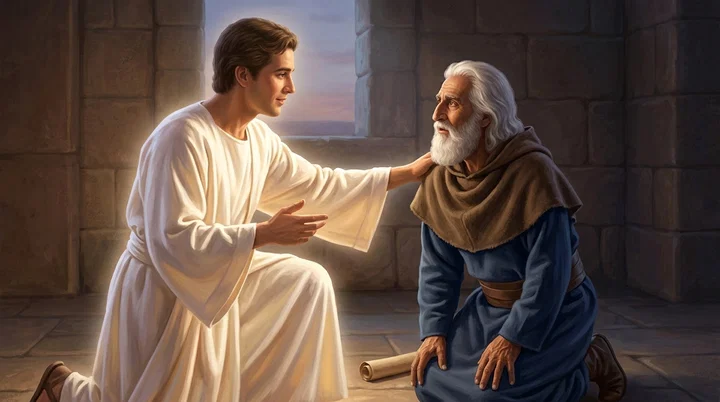
And I heard a man’s voice between the banks of Ulai, which called, and said, Gabriel, make this man to understand the vision.
Translations
American King James Version, King James Version, KJV Cambridge Paragraph Bible, Revised Version
And I heard a man’s voice between the banks of Ulai, which called, and said, Gabriel, make this man to understand the vision.
And I heard a man's voice between the banks of Ulai, which called, and said, Gabriel, make this man to understand the vision.
And I heard a man’s voice between the banks of the Ulai, which called, and said, Gabriel, make this man to understand the vision.
And I hear a voice of man between [the banks of] Ulai, and he calleth and saith: Gabriel, cause this [one] to understand the appearance.
And I heard a man's voice between [ the banks of] the Ulai; and he called and said, Gabriel, make this [ man] to understand the vision.
Then heard I a human voice, between [the banks of] the Ulai,—which cried out, and said, Gabriel! cause this man to understand the revelation.
Berean Standard Bible, Majority Standard Bible
And I heard the voice of a man calling from between the banks of the Ulai: “ Gabriel, explain the vision to this man.”
I heard a man’s voice between the banks of the Ulai, which called and said, “ Gabriel, make this man understand the vision.”
And the voice of a man came to my ears between the sides of the Ulai, crying out and saying, Gabriel, make the vision clear to this man.
And I heard a mans voyce betweene the bankes of Vlai, which called, and sayde, Gabriel, make this man to vnderstand the vision.
Douay-Rheims (Challoner revision)
And I heard the voice of a man between Ulai: and he called, and said: Gabriel, make this man to understand the vision.
Pictures
Cross-references 20 of 34
- Daniel 9:21-23
Yea, whiles I was speaking in prayer, even the man Gabriel, whom I had seen in the vision at the beginning, being caused to fly swiftly, touched me about the time of the evening oblation.
Gabriel returns to give Daniel understanding and explain the vision.
- Daniel 8:27
And I Daniel fainted, and was sick certain days; afterward I rose up, and did the king’s business; and I was astonished at the vision, but none understood it.
Daniel remains astonished and does not understand the vision.
- Daniel 9:24-27
Seventy weeks are determined upon thy people and upon thy holy city, to finish the transgression, and to make an end of sins, and to make reconciliation for iniquity, and to bring in everlasting righteousness, and to seal up the vision and prophecy, and to anoint the most Holy.
Gabriel explains Daniel’s earlier time prophecy through the seventy weeks.
- Daniel 8:20-22
The ram which thou sawest having two horns are the kings of Media and Persia.
Gabriel explains the ram and goat as kingdoms and identifies their horns.
- Daniel 9:21-22
Yea, whiles I was speaking in prayer, even the man Gabriel, whom I had seen in the vision at the beginning, being caused to fly swiftly, touched me about the time of the evening oblation.
Gabriel, seen in the earlier vision, comes to Daniel and gives him understanding.
- Daniel 10:14
Now I am come to make thee understand what shall befall thy people in the latter days: for yet the vision is for many days.
Gabriel explains what will befall Daniel’s people in the latter days.
- Luke 1:19
And the angel answering said unto him, I am Gabriel, that stand in the presence of God; and am sent to speak unto thee, and to shew thee these glad tidings.
Gabriel identifies himself as standing in God’s presence and sent with divine instructions.
- Daniel 9:22
And he informed me, and talked with me, and said, O Daniel, I am now come forth to give thee skill and understanding.
Gabriel returns to give Daniel skill and understanding, fulfilling the command to explain the vision.
- Daniel 8:3-4
Then I lifted up mine eyes, and saw, and, behold, there stood before the river a ram which had two horns: and the two horns were high; but one was higher than the other, and the higher came up last.
The ram’s two horns are identified as Media and Persia.
- Luke 1:26
And in the sixth month the angel Gabriel was sent from God unto a city of Galilee, named Nazareth,
Gabriel is sent to Mary to announce Jesus’ birth.
- Daniel 10:1
In the third year of Cyrus king of Persia a thing was revealed unto Daniel, whose name was called Belteshazzar; and the thing was true, but the time appointed was long: and he understood the thing, and had understanding of the vision.
Daniel later understood the revealed vision after its explanation.
- Daniel 8:26
And the vision of the evening and the morning which was told is true: wherefore shut thou up the vision; for it shall be for many days.
The evening-and-morning vision is true, but its fulfillment is for many days.
- Daniel 8:9-12
And out of one of them came forth a little horn, which waxed exceeding great, toward the south, and toward the east, and toward the pleasant land.
Describes the little horn’s rise, power, and assault on the sanctuary and daily sacrifice.
- Daniel 8:21-22
And the rough goat is the king of Grecia: and the great horn that is between his eyes is the first king.
Gabriel explains the goat as Greece and its division into four kingdoms.
- Daniel 8:5-8
And as I was considering, behold, an he goat came from the west on the face of the whole earth, and touched not the ground: and the goat had a notable horn between his eyes.
The goat’s great horn is replaced by four horns, representing Greece and its divisions.
- Daniel 8:23-25
And in the latter time of their kingdom, when the transgressors are come to the full, a king of fierce countenance, and understanding dark sentences, shall stand up.
Gabriel explains the vision’s little horn and its work.
- Daniel 10:11-13
And he said unto me, O Daniel, a man greatly beloved, understand the words that I speak unto thee, and stand upright: for unto thee am I now sent. And when he had spoken this word unto me, I stood trembling.
Gabriel is sent to Daniel, but faces resistance and receives help.
- Daniel 10:21
But I will shew thee that which is noted in the scripture of truth: and there is none that holdeth with me in these things, but Michael your prince.
Gabriel reveals what is written and names Michael as his ally.
- Daniel 8:2
And I saw in a vision; and it came to pass, when I saw, that I was at Shushan in the palace, which is in the province of Elam; and I saw in a vision, and I was by the river of Ulai.
Places Daniel’s vision by the Ulai, where Gabriel is commanded to explain it.
- Luke 1:11
And there appeared unto him an angel of the Lord standing on the right side of the altar of incense.
Gabriel appears to announce John the Baptist’s birth.
Commentary part 1 of 2
Each commentary is drawn from primary sources: the writings of Ellen G. White and Adventist pioneers and periodicals. Each commentary is separate. Its own words are not a quotation; follow the references to read the source passages.
Ellen G. White
10 sources
By the Ulai a man's voice came from between its banks commanding Gabriel to make Daniel understand the vision, thereby appointing Gabriel as the messenger to convey instruction to the prophet.LS 46.1–47.1LS 45.2–3CET 242.3–243.6GC 324.3–325.1GC88 325.1–2 That explanation at the time was only partial and did not complete the charge.LS 46.1–47.1LS 45.2–3GC 324.3–325.1GC88 325.1–2GC 325.2–326.3 Daniel remained astonished and without full understanding, overwhelmed by what was shown concerning persecution until he became ill, and it was said that no one understood the vision.LS 46.1–47.1LS 45.2–3GC 324.3–325.1 Even Daniel himself did not fully understand these things.PK 547.1
The part left unexplained was the time element, the period of the 2,300 days and especially its starting point.LS 46.1–47.1LS 45.2–3GC 324.3–325.1GC88 325.1–2GC 325.2–326.3 The commission was not abandoned but continued, and Gabriel later returned to give Daniel skill and understanding and to explain that omitted point of time.LS 46.1–47.1LS 45.2–3GC88 325.1–2GC 325.2–326.3 That further explanation was given in chapter 9.LS 46.1–47.1 The prophetic periods of chapters 8 and 9 are reckoned from 457 B.C. as the proper starting point for their calculation.GC 687.4
The little horn of the vision is Rome, not Antiochus Epiphanes, its symbols and specifications meeting their fulfillment in Rome's historical record.LS 67.3–69.3 The vision belongs with the prophecies of chapters 7 to 12 revealing the mysteries of ages to come.PK 547.1 Its light was especially for the last days, ordered to be shut up and sealed even to the time of the end, and its foretold events are now being fulfilled and will soon come to pass.PK 547.1Ms 142, 1901, par. 6 Daniel was directed to go his way till the end, with the assurance that he would rest and stand again in his lot and place at the end of the days in the closing period of this world's history.PK 547.1
Sources
Pioneers and periodicals
274 sources
A man's voice from between the banks of the Ulai commands Gabriel to make Daniel understand the vision of the ram, the goat, the little horn and its appointed duration.ST Oct 4, 1877RH Oct 6, 1863RH Mar 21, 1854ST Dec 22, 1881ST Feb 27, 1912 The one speaking is above Gabriel in rank, Christ Himself as Michael the Archangel, directing Gabriel to reveal what He has received from the Father to Daniel.ST Oct 4, 1877ST Dec 22, 1881RH Aug 9, 1870RH Aug 31, 1869ST Jul 23, 1912 Gabriel is an angel of high order who stands in God's presence, whose name means God is my strength, and who obeyed at once to instruct Daniel under Christ's supervision.ST Oct 4, 1877ST Dec 22, 1881RH Aug 9, 1870ST Apr 2, 1894ST Apr 1, 1897 He explained the symbols in order, the ram as Media and Persia, the goat as Greece with its great horn as the first king, and the little horn as Rome in pagan and papal forms, but he omitted the time element of the 2300 days.ST May 11, 1876ST Oct 22, 1874RH Mar 21, 1854RH Jul 14, 1863RH Dec 23, 1852 That unfinished charge required him to return in Daniel 9 to explain the time, where seventy weeks cut off from the 2300 days begin together in 457 B.C. and reach to the cleansing of the heavenly sanctuary and investigative judgment in 1844.RH Mar 21, 1854RH Aug 23, 1870RH Dec 23, 1852RH Feb 28, 1854RH Dec 15, 1868
Voice, Setting, and Speaker
The explanation starts when Daniel seeks the meaning, and one standing before him with the appearance of a man is met by a man's voice calling from between the banks of the Ulai, Gabriel, make this man to understand the vision of the ram, the goat, the little horn and its duration, including the daily, the transgression of desolation, how long sanctuary and host are trodden under foot, and the 2300 days to cleansing.ST Oct 4, 1877ST Dec 22, 1881ST Feb 27, 1912RH Aug 9, 1870RH Dec 23, 1852 Gabriel began at once upon that appointment, setting before Daniel the destruction of the mighty and holy people and the death of the Son of God, but Daniel fainted and became sick before it was complete.RH Dec 23, 1852ST Aug 8, 1878
The vision was seen at Shushan the palace in Elam by the Ulai, in the third and last year of Belshazzar while Babylon was still great, concerning three historic powers after Babylon, the ram as Medo-Persia, the goat as Greece with its fourfold breakup, and a little horn growing powerful.RH Nov 25, 1902ST Sep 2, 1913ST Feb 20, 1912RH Dec 19, 1912 That third year is dated to 538 B.C., the year Babylon fell to Medo-Persia and the first year of Darius the Mede, with the instruction of Daniel 9 given only weeks or months later in the same year, even less than two years later, to explain the time left unexplained.ST Dec 24, 1894STRH Dec 30, 1915RH May 12, 1910ST Mar 11, 1889 Earlier editions placed fifteen years between the chapters, while later dates follow modern research into Babylonian history, without materially affecting the interpretation.RH May 12, 1910 Those who held the older reckoning dated the third year of Belshazzar to 553 B.C., two years after Daniel 7, with later instruction in Daniel 9 further explaining it and the final vision giving still more detail.RH Dec 20, 1870
Babylon is omitted because it was then history, destined to fall during Daniel's lifetime and passing off the stage, so the prophecy begins with Medo-Persia just at hand and names Medo-Persia and Greece by name, continuing through Rome until earthly empire is broken without hand.ST Aug 14, 1893RH May 12, 1910ST Jun 30, 1914ST Jan 22, 1880 The two high horns with the higher coming up last denote the Medes and Persians, Darius first holding regal power while Cyrus commanded armies, then Cyrus succeeding to absolute monarchy so the Persian horn rose last.ST Jan 22, 1880 The vision thus tells of the three kingdoms to follow the first of the four world monarchies, fortifying the parallel prophecies of the four monarchies to the end.ST Jun 30, 1914ST
The human appearance and man's voice are an angel in human form speaking as a man, not a dead man become an angel nor merely a spirit guide.ST Oct 4, 1877ST Dec 22, 1881RH Aug 9, 1870ST Jul 31, 1879 Angel means messenger, applied to men as well as heavenly beings, but here means one of a different order, the spiritual unfallen servants of God dwelling in His presence, and Gabriel sometimes appears to people in human form.ST Dec 1, 1909 God could speak Himself but sends His message by Gabriel as His way of working, giving every intelligence a part so angels with men serve as co-workers.
The one commanding Gabriel is above him in rank with power to command him, identified as Michael the archangel, Christ the Son of God, since knowledge of the matters communicated exists with Christ and Gabriel alone.ST Oct 4, 1877ST Dec 22, 1881RH Aug 9, 1870 Christ from between the banks sends Gabriel and supervises the giving of the prophecy, receiving truths from the Father and directing Gabriel to reveal them to Daniel, with only Daniel, Michael and Gabriel concerned in its giving.RH Oct 27, 1904ST May 11, 1876ST Feb 5, 1880ST Mar 1, 1877 It is Christ revealing Himself in Old Testament times before His public appearance to put away sin, the same one who stands between the banks of the river in Daniel 12 to swear the oath, with Michael alone holding with Gabriel in these matters.RH Aug 31, 1869ST Jul 23, 1912ST Jul 29, 1880RH Jan 11, 1870
The man's voice from above the Ulai is the divine voice of Christ, God, the Father, commanding Gabriel and thereby identifying the man-like figure before Daniel as Gabriel.ST May 30, 1895RH Jul 6, 1911RH Nov 12, 1908RH Apr 24, 1900RH May 26, 1853 That command makes clear Gabriel came to answer prayer and reveal the meaning for Daniel and succeeding generations, especially the mysterious conversation about sanctuary cleansing, though he stopped when Daniel was overcome and waited until Daniel could calmly consider it.ST May 30, 1895RH Jul 6, 1911ST Jan 27, 1890 The commission was spoken for Daniel but contemplates the remnant people of God in the last days, whose commission is to understand Daniel.RH Apr 24, 1900
Prophetic truth comes in order from the Father as source of light and truth to Christ as revealer to Gabriel to Daniel to the people.ST Feb 5, 1880ST Mar 1, 1877RH Aug 12, 1873 The Father gave the great things to the Son, the Son showed them to Gabriel with the order to reveal them to Daniel, and Gabriel instructed the prophet for the benefit of God's servants.ST Mar 1, 1877RH Aug 12, 1873 It is the same order as the last book of the New Testament, from the Father to the Son to the angel to John.ST Mar 1, 1877RH Aug 12, 1873 Gabriel is Christ's special angel in this chain, standing in the presence of God and acting as the connecting link receiving from Christ and giving to the prophets, the same Gabriel later sent to Zacharias concerning John.ST Feb 5, 1880ST Mar 1, 1877
The book here returns to Hebrew and keeps Hebrew to the end because the subjects are Daniel's personal testimony and the restoration of the Jews and God's future dealings with them, for which Hebrew is best adapted.RH Nov 25, 1873 The keeping of Chaldee through chapter 7 is accounted for by the close likeness of subject between chapters 2 and 7 and by this personal introduction in chapter 8.RH Nov 25, 1873
The command concerns a vision given in pictures — the ram, the he-goat, and the little horn — because pictures impress divine things on the mind through the eye with deeper and more lasting impressions than the other senses.ST Jan 17, 1884 It uses some new and some familiar symbols and combines literal and figurative language, with predictions contained in symbols rather than in literal verbal prophecy.RH Sep 2, 1909RH Jun 12, 1855 It is one of five prophecies in Daniel given in symbols and afterward fully interpreted, and one of seven such prophecies in Daniel and Revelation that furnish the basis for general prophetic interpretation and supply the key in the Bible itself.RH Sep 2, 1909
The vision teaches future events in clear simple symbolic form that can be understood by study and comparison, as when the ram is identified as Medo-Persia and the goat as Greece.ST May 27, 1908 It belongs with Daniel 2, 7, and 9 among symbolic prophecies picturing universal kingdoms by beasts, in contrast to Daniel 11 which uses no symbols but presents history to the close in literal language and is for that reason in some respects easier to understand.RH Dec 12, 1912RH Dec 28, 1911
Gabriel's Identity and Commission
Gabriel is an angel of high order and superior dignity who stands continually in the presence of God and is sent on errands of mercy, and his name signifies the mighty one and means God is my strength.ST Oct 4, 1877ST Dec 22, 1881RH Aug 9, 1870 He continued his instruction to Daniel in chapter 9 after being commanded to make Daniel understand the vision, and he was later commissioned to announce the birth of John the Baptist to Zacharias and the birth of the Messiah to Mary.ST Oct 4, 1877RH Aug 9, 1870ST Feb 5, 1880ST Dec 15, 1898 He is Christ's special angel as the connecting link who receives from Christ and gives to the prophets, standing third in the order of revelation with the Father first as source of light and truth and the Son second as revealer.ST Feb 5, 1880 He is the same Gabriel whom Daniel had seen in the vision and who comes to Daniel while he is speaking in prayer, and the same angel who later appeared to John.ST Feb 5, 1880RH May 14, 1901RH Feb 15, 1870
The verse teaches this commission and nothing more, and it does not show that Gabriel occupies the place from which Satan fell nor does it make Gabriel the Holy Spirit. Gabriel is distinct from the Holy Spirit, for the Holy Spirit is the great all-embracing life of God existing before angels and all creatures, while Gabriel is one of God's servants and a mighty personal servant made powerful by God's Spirit but still limited in personality and power.ST Mar 4, 1903ST Jun 16, 1909 God places His Spirit upon angels as upon human beings so they become bearers of the blessings of God's Spirit, and Gabriel serves as a fellow servant with the prophets. Gabriel obeyed the plain command at once with no parleying or quibbling, illustrating how the will of God is done in heaven by angels who excel in strength and do His commandments.ST Apr 2, 1894 His instant hearkening sets the pattern for doing God's will on earth even as it is done in heaven through perfect surrender and immediate obedience, and he is among the heavenly beings who swiftly carry out God's word and will.ST Apr 2, 1894ST Apr 1, 1897
God could speak Himself but sends His message by Gabriel as His way of working, giving every intelligence a part so that angels with men serve as co-workers with God.ST Nov 8, 1910ST Oct 29, 1902 Gabriel's help to Daniel shows heavenly beings assisting human minds, illustrating God's way of communicating truth through Jesus, then an angel, then human messengers and prophets to God's people and the world.ST Nov 8, 1910RH Feb 27, 1900ST Oct 29, 1902ST Jun 15, 1904ST Dec 1, 1909 Daniel was the pupil and Gabriel was the instructor, teaching under the direct supervision of the Son of God, with Michael, Gabriel and Daniel the only three concerned in the giving of it.ST Apr 15, 1875 Gabriel was commissioned by heaven to help Daniel and through him succeeding generations and later readers understand the mysterious conversation about sanctuary cleansing, faithfully explaining the vision's symbols.ST Apr 15, 1875RH Jul 6, 1911ST
Daniel's fear and falling on his face until Gabriel touched him shows reverence before an angel and the sacred vision, for Daniel could not regain strength until touched.RH Mar 15, 1870 Gabriel like Michael may be called a saint, and angels may be called saints or holy ones.ST Sep 27, 1883RH Dec 31, 1861 The command covers the whole vision, the ram, the he-goat, the little horn and the period of 2300 days, and must be fully fulfilled in a definite work bringing Medo-Persia, Grecia and Rome in review.RH Mar 21, 1854RH Jul 14, 1863 That whole includes how long sanctuary and host are trodden under foot, the daily and the transgression of desolation, standing against the Prince of princes and meeting appointed destruction at the set time.RH Oct 6, 1863RH Mar 21, 1854RH Dec 23, 1852 The vision to be understood includes the 2300 days, which are not solar days of twenty-four hours but prophetic year-days with each day for a year, whose seventy weeks mark the manifestation of the Messiah at His baptism.ST Feb 7, 1884
Under that commission Gabriel explained the symbols in the order they were seen, first the ram, then the goat and its notable horn, then the four horns, next the little horn.RH Apr 14, 1853ST Mar 4, 1886ST Jul 18, 1911 The ram is Medo-Persia and the rough goat is Greece, its great horn the first king with four kingdoms arising after that horn is broken, and the fierce king Rome after Alexander's division.RH Apr 14, 1853ST Feb 16, 1882ST Jul 18, 1911 That authorized explanation by divine authority stands on its own without needing another authorized explainer to make it useful, and Gabriel faithfully explained the symbols by it.ST The explanation given under that command shows that Rome in both its pagan and papal forms profaned the sanctuary at the very center of God's worship, took away the continual leadership of Christ under a tremendous apostasy among God's people, set up the abomination that makes desolate, and put man in the place of God with human worship in the place of divine worship.ST Apr 23, 1912
Gabriel was sent to Daniel to help him understand and was also sent to Daniel with important revelations and later communications.ST Dec 25, 1893 His visit had the same effect on Daniel as the later visitor in Daniel 10, and he promised to explain what would happen at the end of the indignation, later giving further explanation in chapter 9 and coming again to continue the unfinished explanation when Daniel sought understanding through prayer and fasting.RH Dec 20, 1870 The same Gabriel already sent to make Daniel understand the vision is sent again by the glorious man clothed in linen to comfort Daniel and bring him another message from God.ST Apr 9, 1912
Unfinished Vision Continued Later
Gabriel explained the ram, the he-goat and the little horn in plain terms but left the time element unexplained, especially the 2300 days of verses 13-14 with its duration, starting date and closing cleansing, and Daniel closed the chapter astonished with none understanding, which proves time was the troubling point.RH Mar 21, 1854RH Dec 23, 1852RH Dec 31, 1857ST Jul 28, 1909ST The symbols of beasts and horns were made clear, yet the period that gives the vision its name as the vision of the evenings and mornings was not expounded, and literal days of about six and a half years could not cover even one of the powers shown, so the days must be symbols as the beasts and horns are symbols.RH Jul 14, 1863RH Dec 23, 1852ST Daniel could not take in more at that time, for after Gabriel set before him the destruction of the mighty and holy people and the cruel death of the Son of God he fainted and became sick certain days, having received all he could then bear, so Gabriel left the explanation unfinished and reserved the rest for another time.ST Jul 28, 1909ST Jan 11, 1883ST Aug 8, 1878ST Nov 13, 1879ST May 11, 1876
He was overwhelmed and made sick by the long oppression, calamities and suffering to come upon his people, listening with wonder and pain with changed countenance, and he could listen further only after Gabriel strengthened him, so the work had to wait until he could calmly consider the matter and required repeated visits.RH Jan 10, 1856ST Dec 22, 1881RH Jan 10, 1856ST Aug 17, 1882RH Dec 27, 1870 Because Daniel still did not understand, the charge rested on Gabriel until fulfilled and bound him to return in chapter 9 to give skill and understanding, bidding him understand the matter and consider the vision of chapter 8 and explaining the omitted point of time.RH Mar 21, 1854RH Aug 23, 1870RH Dec 23, 1852RH Aug 23, 1870RH Dec 31, 1857 That later visit takes up the work exactly where it was left, with no more about beast symbols but with time explained at once, showing seventy weeks cut off from the 2300 days as its first 490 days or years beginning together, leaving 1810 days or years remaining, and since Gabriel uses no unnecessary words the omission of where they are cut from proves that longer period was already in Daniel's mind.RH Feb 28, 1854RH Dec 15, 1868ST Nov 13, 1879RH Oct 30, 1855
What Gabriel did explain before the interruption was the two-horned ram as Media and Persia, the rough goat as Grecia with its great horn as the first king, the four standing up afterward as four kingdoms without his power, and the fierce king of latter time understanding dark sentences as Rome arising after Alexander's division, but the reckoning of time was broken off when Daniel fainted.ST Jan 11, 1883ST Oct 13, 1909RH Apr 30, 1857 Daniel at first misapplied the cleansing at the end of the 2300 days to the ending of the seventy years captivity and the repairing of Jerusalem's desolations, and while in captivity with Jerusalem desolate he studied Jeremiah and prayed with confession for restoration, for Cyrus, for the temple and for the unexplained part, so Gabriel came to correct that misunderstanding and answer that prayer.RH Aug 23, 1870ST Oct 18, 1877RH Dec 23, 1852ST Jun 26, 1907ST Apr 1, 1880 The standing charge therefore required Gabriel to return after about fifteen years to give further skill and understanding on the same subject, resuming the succession of Medo-Persia, Grecia and Rome and then opening the time prophecy left unexplained.RH Aug 23, 1870ST Feb 16, 1882ST Dec 21, 1882 Those who held for a speedy return taught he must have come very soon, evidently within a year and possibly within months or weeks and not fifteen years later, resuming exactly where he left it a few months earlier to explain prophetic periods.RH Apr 4, 1912ST Aug 31, 1915
Daniel did not understand at the end of chapter 8 but later understood, and by Daniel 10:1 he had understanding and knew the thing was true, though commanded to keep its hidden wisdom sealed.RH Dec 23, 1852RH Feb 17, 1853RH Feb 22, 1870RH Jan 10, 1856 Yet even the explanation in Daniel 9 left him without hope, showing the holy city destroyed and the Prince cut off, making him more solicitous for his people and bringing further comfort in the last vision, while the question how long sanctuary and host would be trodden under foot and what would befall his people at the end of the indignation remained to be sought in later chapters.RH Jan 10, 1856ST Apr 9, 1912RH Jan 10, 1856RH Jan 10, 1856RH Jan 10, 1856 At that time the only revealed period covering the indignation was the seven prophetic times of chastisement in Leviticus 26, so Gabriel's reference to an appointed time points to that period.RH Jan 3, 1856 Chapters 10-12 are a comment and development of chapter 8 covering the same ground, powers and end, carrying the parallel prophecy in largely plain language forward to when Michael stands up, with four periods of 2300, 1260, 1290 and 1335 days where the 2300 is principal and longest and the others intermediate subdivisions, and the promise about standing in the lot looks back to the first vision.ST Apr 9, 1912RH Jul 18, 1871ST Dec 24, 1912ST Jan 10, 1878
Gabriel was commanded to make Daniel understand the vision of Daniel 8, and Daniel 9 is the explanation carrying out that command, so the two chapters belong together and the connection cannot be invalidated, with Gabriel through Daniel making it known to later readers.RH Aug 4, 1868RH Nov 12, 1908STRH Aug 23, 1870ST Apr 1, 1880 Keeping that connection after 1844 required giving up the idea that the earth is the sanctuary.RH Aug 4, 1868 Although Daniel 8 gives no data to determine the commencement, close or place of the 2300 days in history, the necessary information is supplied elsewhere in Daniel and the mystery is dispelled in the next chapter, showing the vision was given to instruct God's people and was meant to be understood as an example of visions meant to be explained rather than treated as mysteries.ST Nov 22, 1883ST Dec 1, 1881RH Jul 12, 1870
Kingdoms and Little Horn
The command to make Daniel understand opens the explanation that the ram is Media and Persia, the goat is Grecia, and the exceedingly great horn is Rome, known by destroying God's people and putting the Prince of princes to death, and the meaning given is clear and easily understood.ST May 11, 1876ST Oct 22, 1874ST Aug 8, 1878RH Mar 10, 1874 The ram's two high horns with the higher coming up last are the two divisions of that empire, the Medes and the Persians, with Darius the Median first holding regal power while Cyrus commanded the armies, then Cyrus succeeding to become absolute monarch so that the Persian horn rose last and attained higher eminence as the leading division.ST Jan 22, 1880ST Sep 29, 1881RH Sep 13, 1915 That Persian power pushed westward and northward and southward in the conquests of Cyrus and Cambyses.ST Jan 22, 1880RH Sep 13, 1915 Horns are symbols of kingdoms and rulers civil or ecclesiastical, the two horns denoting the kings of Media and Persia, the great horn denoting the first king of Grecia, and when broken four standing up denoting Macedon, Thrace, Syria and Egypt under Alexander's four generals Cassander, Lysimachus, Ptolemy and Seleucus.ST Jan 6, 1887RH Mar 21, 1854ST Jul 15, 1913RH Sep 13, 1915RH May 19, 1851
The goat with the notable horn is Grecia with Alexander as first king who destroyed Persia, and in conquering the world he was cooperating with prophecy and conquered easily in a manner little short of miraculous, while in trying to resurrect Babylon he fought against it and could build nothing.ST Jan 8, 1880ST Feb 7, 1884ST Feb 13, 1912RH Sep 13, 1915 The little horn coming out of the Macedonian horn is Rome, the only exceedingly great power that followed Grecia, because Rome conquered Macedonia in 168 B.C. and by that conquest gained great power and prestige, becoming the one great central dominant power from that date, with no prediction of three warlike powers arising before it.ST Mar 11, 1903ST Jul 15, 1913 That little horn small at first waxes exceeding great and becomes stronger than all before it, not great by sudden conquest like Persia and Grecia but gradually by successive conquests until it conquers the world and holds all in its iron grasp, magnifying itself even to the prince of the host and standing against Jesus Christ the Prince of princes at His crucifixion.ST Jan 8, 1880ST Feb 7, 1884RH Feb 17, 1853ST Feb 12, 1880 Its being broken without hands is its destruction at the second coming of Christ.ST Jan 8, 1880
The little horn in Daniel 8 is Rome throughout its career in both pagan and papal forms, unlike Daniel 7 which shows the papacy during only part of Rome's history, describing Rome from entrance upon world action to the end and applicable to modern as well as ancient Rome, the same as the dreadful beast, man of sin, son of perdition, mystery of iniquity and that Wicked.ST Nov 19, 1885RH Apr 10, 1900RH Sep 13, 1915ST Jun 20, 1900RH May 29, 1913 It is Rome first in pagan form and fully in religious form after the falling away, with pagan Rome's kingly-priestly Caesars foreshadowing papal temporal-spiritual power, and applying it to Antiochus Epiphanes shields the papal church and is followed by opposers of the Advent faith.LS 67.3–69.3ST Mar 12, 1912RH Dec 23, 1852RH Dec 10, 1857 The prophecy of the little horn is not fulfilled in Antiochus but is fulfilled in the Roman power, forming part of the great chain proving the Advent doctrine is biblical and that Christ is now at the door.RH Jan 31, 1871 The claim that the vision refers only to Antiochus Epiphanes, his persecution and temple desecration around 160 B.C. rather than Christ's coming and God's kingdom, is an argument against Adventist teaching, not the passage's conclusion.RH May 15, 1856
Those who held a different teaching made the little horn of Daniel 8 to be Mohammedanism, distinct from Daniel 7 which is the Roman Catholic hierarchy as proved by different origin and sphere, with the cleansing referring to earthly affairs at Mohammedanism's destruction.RH Apr 15, 1873 If chapter 9 explains chapter 8, the final desolation in chapter 8 is the same as in chapter 9 and refers to Rome, not Mohammedanism.RH May 1, 1856 The ram, he-goat and horn little at first but waxing great represent Medo-Persia, Grecia and Rome by the prophecy's own declaration, with clear application having no reference to the United States, and modern France, England, Germany and Italy are divisions of ancient Rome.ST Jul 15, 1913ST Sep 4, 1879 The chapter's great subject is Rome, giving it more attention than other powers, and Rome is represented without division into eastern and western parts.RH May 29, 1900RH Mar 16, 1869
The daily is paganism and the desolating transgression is the papacy, the pagan sanctuary especially the Pantheon having its place cast down when Constantine moved the capital to Constantinople, and Rome changed from pagan continual desolation opposing God's cause to papal opposition.RH Jan 28, 1858RH Jan 28, 1858 The daily and transgression of desolation are two desolating powers desolating God's people, Rome first pagan then papal, with the transgression taking the place of the daily only after standing against the Prince and casting down some of the host and stars identified as the church and the apostles.ST Jun 20, 1900RH Feb 15, 1870 The continual means far more than the continual burnt-offering, covering the permanent essence of the whole sanctuary service which makes worship acceptable, centered on a present Christ as living sacrifice received through union of divinity and humanity; to take it away leaves temple, priesthood and church without Christ, substituting paganism for Christianity, which the Papacy has done. The continual to be taken away is organized paganism, taken away in A.D. 508 to make room for the abomination thirty years before the 1260-day period beginning in 538, so that both the 1260 and 1290 days end in 1798.ST Sep 21, 1915
Its historical importance includes apostasy, persecution under a foreign king, and cleansing of the temple with worship restored three years to the day after defilement, which God allowed to chastise His people, details not included in Daniel 9 but later shown as events to befall Daniel's people.ST Apr 23, 1912 Living creatures in symbolic prophecy represent mighty nations, as shown by the ram, he-goat, and great horn.RH Apr 29, 1909
Sanctuary, Cleansing, and Judgment
The command to Gabriel makes the sanctuary and its cleansing the main subject of the vision, covering the solemn scenes of the great day of atonement and judgment.RH Nov 12, 1908 Its climax is the cleansing, which is the investigative judgment immediately before Christ's coming, reaching to the appointed time of the end. The 2300-year period included in the commission marks the opening of that judgment work in heaven, or cleansing of the sanctuary, and its timeline reaching 1844 makes Christ's second coming the next event in the sequence.RH Nov 24, 1910ST Jul 1, 1897 The vision therefore announced when the heavenly judgment would begin and included the symbolic powers Gabriel explained, though Daniel did not understand the whole at that time.RH Nov 12, 1908RH Nov 24, 1910
The order is to understand the vision of sanctuary and host trodden under foot and then cleansed. The sanctuary brought to view is the sanctuary of the new covenant that takes the place of the earthly sanctuary when its services are finished and the old covenant is succeeded by the new.RH Oct 2, 1856 It is the heavenly sanctuary where Christ ministers as High Priest in the presence of His Father, taking the place of the Jewish typical tabernacle.RH Oct 2, 1856RH Mar 11, 1875 Only 400 years of the 2300 years belong to the first covenant, the earthly sanctuary and the Jewish church, ending when the Saviour accomplishes His earthly ministry and confirms the new covenant, with 1810 years reaching forward from that point to the cleansing.RH Oct 2, 1856
The event at the close is not the personal second coming to cleanse the earth by the fires of the last day, because the earth is not the sanctuary.RH Mar 17, 1853RH Mar 11, 1875 Sanctuary means a sacred place, which the earth has not been since the fall and the reign of Satan and death began, and since humanity left Eden it has not been a sacred place or dwelling place of the Most High.RH Dec 5, 1854RH Mar 11, 1875 No part of this earth was cleansed by fire and restored in 1844, so the sanctuary is not this earth or a portion of it to be cleansed by fire at Christ's coming.RH Mar 17, 1853 After the expected coming did not occur in 1844, further study showed the sanctuary was in heaven and that Christ entered its most holy place to begin the investigative judgment.ST Jun 20, 1916
The host means the worshipers, who are never admitted inside the sanctuary but worship outside while the Priest alone goes inside on their behalf. Being trodden under foot does not require being present in heaven, for wicked men on earth tread the heavenly sanctuary and its minister by their actions, just as they crucify the Son of God afresh and tread Him under foot. The sanctuary and its host correspond to Jerusalem and the Lord's people, so the cleansing represents the removal of Jerusalem's iniquity before God's people are delivered and enter the city.RH Oct 14, 1852
The vision foresees a great apostasy in which an earthly priestly system claiming to be the way to heaven would obscure the heavenly sanctuary and set itself against the Prince and the sanctuary.RH Jun 6, 1912 It concerns the removal of the continual ministry through which salvation is ministered, and restoring the true sanctuary teaching restores Christ's place and the connection with heaven.RH Oct 29, 1903RH Jun 6, 1912 Placed at the beginning of Darius the Mede's reign in the third and last year of Belshazzar, it foretells a power that would take away the continual service, interrupt the temple service, cause the shekinah glory to depart, and leave the temple desolate.RH Nov 25, 1902
God's way and the end of the wicked are revealed in the sanctuary, and there are two sanctuaries, earthly and heavenly, the earthly with all its services a type of the heavenly which was its pattern.ST Oct 13, 1909 The continual comprehends the entire sanctuary service as ordained by God — the morning and evening sacrifices for the whole congregation, the continual showbread, the lamps burning continually, the perpetual incense, and the high priest bearing judgment continually — applying in figure to the earthly and with equal force to the heavenly.ST Oct 13, 1909 The whole force of the prophecy applies to the heavenly because the earthly sanctuary and priesthood had ended before the envisioned power began its work.ST Oct 13, 1909 The sanctuary thus introduced is the centerpiece of truth, with the origin of every Bible doctrine revealed in it and its service, and understanding Christ's work in this dispensation comes by studying the sanctuary service as the type.RH Feb 6, 1900
Daniel 8 teaches the Bible meaning of sanctuary, the earthly sanctuary with its service by which sin was transferred to it and its ceremony of cleansing, the sanctuary in heaven with Christ's priestly service and its cleansing, and the development of the Roman power.RH Feb 6, 1900 Its prophetic period reaches to 1844, when Christ entered the most holy place and the cleansing began, and that atoning service includes the cleansing of the sanctuary and the judgment of the dead beginning in the autumn of 1844 at the end of the 2300 years.ST Aug 12, 1875STST Feb 7, 1906ST Jul 8, 1897RH Nov 23, 1905 The vision names Medo-Persia and Greece in order as Babylon passes and Medo-Persia comes into view, points next to Rome as the power standing against the Prince of princes and broken without human help, and gives a definite time ending in 1844 when the investigative judgment begins.STST Feb 7, 1906 Placing that cleansing at Christ's ascension would collapse the connected prophetic timelines into the past and undermine their reach through the Christian dispensation to its end.ST Aug 12, 1875
Those who used the prophecy expected the wrong event at its end, for the 2300 days began in 457 B.C. and ended in 1844 A.D.ST Oct 28, 1908 Its exposition explains the Advent disappointment about time and the true position of those still waiting for Christ, showing what the sanctuary is and the nature of its cleansing.RH Jun 12, 1856RH Jun 19, 1856RH Jun 26, 1856RH Dec 18, 1856 Joined with Daniel 9 it points out distinctly the commencement and termination of the 2300 days and connects the voice by the Ulai directing Gabriel with the exposition of the sanctuary and the twenty-three hundred days.RH Jun 19, 1856RH Mar 5, 1857RH Dec 18, 1856
Sources