Daniel 8:2
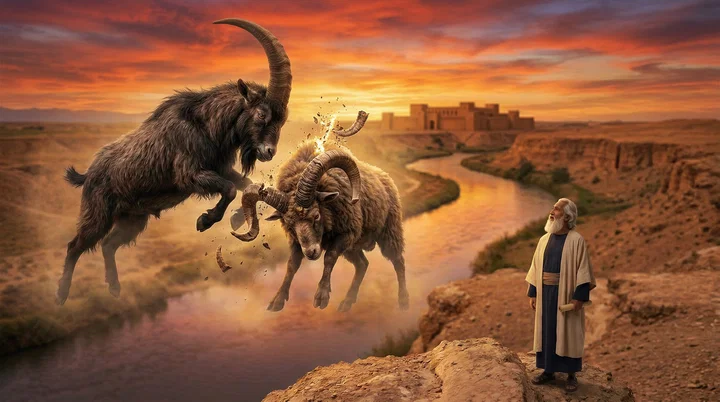
And I saw in a vision; and it came to pass, when I saw, that I was at Shushan in the palace, which is in the province of Elam; and I saw in a vision, and I was by the river of Ulai.
Translations
American King James Version, King James Version, KJV Cambridge Paragraph Bible
And I saw in a vision; and it came to pass, when I saw, that I was at Shushan in the palace, which is in the province of Elam; and I saw in a vision, and I was by the river of Ulai.
And I saw in a vision; and it came to pass, when I saw, that I was at Shushan in the palace, which is in the province of Elam; and I saw in a vision, and I was by the river Ulai.
Revised Version, American Standard Version
And I saw in the vision; now it was so, that when I saw, I was in Shushan the palace, which is in the province of Elam; and I saw in the vision, and I was by the river Ulai.
And I see in a vision, and it cometh to pass, in my seeing, and I [am] in Shushan the palace that [is] in Elam the province, and I see in a vision, and I have been by the stream Ulai.
And I saw in the vision; and it came to pass, when I saw, that I was in the fortress of Shushan, which is in the province of Elam. And I saw in the vision, and I was by the river Ulai.
So then I saw, in the vision, and it came to pass, when I saw, that I was in Shusan the fortress, which is in Persia the province,—yea I saw it in a vision, when, I, was by the river Ulai.
Berean Standard Bible, Majority Standard Bible
And in the vision I saw myself in the citadel of Susa, in the province of Elam. I saw in the vision that I was beside the Ulai Canal.
I saw the vision. Now it was so, that when I saw, I was in the citadel of Susa, which is in the province of Elam. I saw in the vision, and I was by the river Ulai.
And I saw in the vision; and when I saw it, I was in the strong town Shushan, which is in the country of Elam; and in the vision I was by the water-door of the Ulai.
And I saw in a vision, and when I sawe it, I was in the palace of Shushan, which is in the prouince of Elam, and in a vision me thought I was by the riuer of Vlai.
Douay-Rheims (Challoner revision)
Saw in my vision when I was in the castle of Susa, which is in the province of Elam: and I saw in the vision that I was over the gate of Ulai.
Pictures
Cross-references 20 of 22
- Daniel 8:14
And he said unto me, Unto two thousand and three hundred days; then shall the sanctuary be cleansed.
Gives the vision’s duration and the sanctuary’s cleansing at its close.
- Daniel 9:21-23
Yea, whiles I was speaking in prayer, even the man Gabriel, whom I had seen in the vision at the beginning, being caused to fly swiftly, touched me about the time of the evening oblation.
Gabriel comes to give Daniel understanding of the earlier vision.
- Daniel 8:16
And I heard a man’s voice between the banks of Ulai, which called, and said, Gabriel, make this man to understand the vision.
Gabriel is commanded at Ulai to explain Daniel’s vision.
- Daniel 8:20-22
The ram which thou sawest having two horns are the kings of Media and Persia.
Gabriel identifies the ram and goat as Media-Persia and Greece, and explains the goat’s divided kingdom.
- Daniel 8:27
And I Daniel fainted, and was sick certain days; afterward I rose up, and did the king’s business; and I was astonished at the vision, but none understood it.
Daniel remains astonished and does not understand the vision.
- Daniel 10:4
And in the four and twentieth day of the first month, as I was by the side of the great river, which is Hiddekel;
Both visions were received by Daniel beside a river.
- Daniel 8:17
So he came near where I stood: and when he came, I was afraid, and fell upon my face: but he said unto me, Understand, O son of man: for at the time of the end shall be the vision.
Gabriel identifies the vision’s time setting as the time of the end.
- Daniel 9:24-27
Seventy weeks are determined upon thy people and upon thy holy city, to finish the transgression, and to make an end of sins, and to make reconciliation for iniquity, and to bring in everlasting righteousness, and to seal up the vision and prophecy, and to anoint the most Holy.
Daniel 9 further explains the vision and unresolved time period in Daniel 8.
- Daniel 11:1-2
Also I in the first year of Darius the Mede, even I, stood to confirm and to strengthen him.
Daniel 11 explains the vision in Daniel 8.
- Daniel 8:13
Then I heard one saint speaking, and another saint said unto that certain saint which spake, How long shall be the vision concerning the daily sacrifice, and the transgression of desolation, to give both the sanctuary and the host to be trodden under foot?
It asks how long the vision’s persecution and desolation will last.
- Isaiah 21:2
A grievous vision is declared unto me; the treacherous dealer dealeth treacherously, and the spoiler spoileth. Go up, O Elam: besiege, O Media; all the sighing thereof have I made to cease.
Elam joins the Medes in besieging Babylon.
- Daniel 9:21
Yea, whiles I was speaking in prayer, even the man Gabriel, whom I had seen in the vision at the beginning, being caused to fly swiftly, touched me about the time of the evening oblation.
Gabriel seen in Daniel 8 returns to Daniel.
- Jeremiah 49:39
But it shall come to pass in the latter days, that I will bring again the captivity of Elam, saith the LORD.
Elam’s restoration came under the Medes and Persians.
- Daniel 8:6-7
And he came to the ram that had two horns, which I had seen standing before the river, and ran unto him in the fury of his power.
The goat attacks and overthrows the ram in Daniel’s vision.
- Ezekiel 1:1
Now it came to pass in the thirtieth year, in the fourth month, in the fifth day of the month, as I was among the captives by the river of Chebar, that the heavens were opened, and I saw visions of God.
Both describe a vision received beside a river.
- Daniel 10:16
And, behold, one like the similitude of the sons of men touched my lips: then I opened my mouth, and spake, and said unto him that stood before me, O my lord, by the vision my sorrows are turned upon me, and I have retained no strength.
The vision Daniel recalls is identified as the former vision of chapter 8.
- Daniel 12:4-9
But thou, O Daniel, shut up the words, and seal the book, even to the time of the end: many shall run to and fro, and knowledge shall be increased.
prophecies sealed till time of end
- Daniel 8:26
And the vision of the evening and the morning which was told is true: wherefore shut thou up the vision; for it shall be for many days.
Says the vision of the 2,300 days is true and concerns many days.
- Daniel 10:1
In the third year of Cyrus king of Persia a thing was revealed unto Daniel, whose name was called Belteshazzar; and the thing was true, but the time appointed was long: and he understood the thing, and had understanding of the vision.
Chapter 10 continues the vision and its explanation.
- Daniel 9:1
In the first year of Darius the son of Ahasuerus, of the seed of the Medes, which was made king over the realm of the Chaldeans;
The prayer is dated to Darius’s first year, shortly after Daniel’s vision.
Commentary
Each commentary is drawn from primary sources: the writings of Ellen G. White and Adventist pioneers and periodicals. Each commentary is separate. Its own words are not a quotation; follow the references to read the source passages.
Ellen G. White
7 sources
In vision Daniel was at Shushan in the palace, in the province of Elam, and by the river Ulai.16MR 334.2Ms 142, 1901, par. 6Lt 57, 1896, par. 4–7 The vision was given in the third year of Belshazzar, B.C. 553.LS 45.2–3 It belongs to the revelations of the mysteries of ages to come given to Daniel as God's ambassador and recorded in chapters seven to twelve.PK 547.1
The prophecy of Daniel 8 includes the symbol of the little horn, whose specifications apply to Rome and not to Antiochus Epiphanes.LS 67.3–69.3 The vision contained an unresolved time period, the 2300 days, which Daniel mistakenly thought would end with the seventy years of Israel's captivity, and this led him to pray for Jerusalem and its desolate sanctuary.LS 45.2–3 The vision's prophetic periods are reckoned from 457 B.C., a date supported by historical and chronological evidence.GC 687.4
The revelations were not fully understood even by Daniel himself and were not given to be fully understood at that time, but were to be shut up and sealed even to the time of the end.PK 547.1 The visions received by the Ulai and the Hiddekel, and the light given to Daniel from God, were given especially for the last days, and the events they foretold are now in process of fulfillment and will soon be complete.16MR 334.2Ms 142, 1901, par. 6Lt 57, 1896, par. 4–7 Daniel was given the blessed assurance that at the end of the days, in the closing period of this world's history, he would rest and stand in his lot and place.PK 547.1
Sources
Pioneers and periodicals
112 sources
Daniel was carried in vision to the palace city of Shushan in Elam and set beside the river Ulai.RH Nov 12, 1908ST Dec 24, 1894RH Oct 3, 1912 That city was then a Babylonian royal seat but would become the capital of Medo-Persia and its chief province, lying south of Media and east of Chaldea on the stream later known as Choaspes or Euloeus.ST Dec 24, 1894RH Jun 21, 1870ST Nov 17, 1881 He was there in vision only, as prophets were brought to the scene of coming events to behold them as present in symbolic prophecy.RH Jun 12, 1855RH Feb 18, 1873 The vision was given in Belshazzar's third year while Babylon still stood, yet Babylon is passed by because its course was finished and the revelation begins with Medo-Persia about to take its dominion.ST Dec 24, 1894ST Feb 20, 1912RH Dec 30, 1915ST From that eastern station the unfolding symbols of ram, goat and little horn trace Persia, Greece and Rome in pagan and papal phases to the cleansing of the heavenly sanctuary at the end of the 2300 years and the final breaking without human hand.RH Nov 12, 1908RH Apr 28, 1853RH Oct 3, 1912ST Aug 8, 1878ST Oct 22, 1874
Place of the Vision
In vision Daniel was at Shushan the palace in the province of Elam beside the river Ulai.RH Nov 12, 1908ST Dec 24, 1894RH Oct 3, 1912RH Mar 10, 1874 It is the setting from which he sees the prophetic history that follows, extending from the final days of Babylon to the end of earthly kingdoms and the final destruction of earthly kingdoms by God.RH Oct 3, 1912RH Mar 10, 1874 It provides the setting for the vision of the ram and he-goat and the prophecy of the kingdoms that follow, seen in order as ram, goat and little horn.ST The vision is where God announced when the heavenly judgment would begin, tracing the succession of world powers from the rise of the Persian Empire with its symbols of a ram, a goat, and a little horn that becomes exceedingly great.RH Nov 12, 1908RH Mar 10, 1874 The ram is Media and Persia, the goat is Grecia under Alexander the Great, and the goat's kingdom was divided among four generals, namely Macedonia and Greece westward, Thrace and Bithynia northward, Egypt southward, and Syria and the east, less powerful than his undivided empire.RH Nov 12, 1908ST The little horn that grew greater than either beast represents imperial Rome in its pagan and papal phases, which began small and expanded its dominion through craft and conquest and put Jesus to death through Pilate.RH Nov 12, 1908ST
Shushan, also called Susa, was then a Babylonian royal city in Elam with a Babylonian royal palace there, but was destined to become the capital of the Medo-Persian Empire and its chief province.RH Jun 21, 1870ST Nov 17, 1881ST Feb 10, 1898 Elam lay south of Media, east of Chaldea and northwest of Persia proper, and the Ulai is the river later called Karasu or Kerah, Choaspes by the Greeks and Euloeus by Pliny. At that time Elam with its palace at Shushan was in Babylonian hands, and about three years later Shushan under its viceroy revolted to Cyrus and joined the Medes and Persians, so Elam went up with them to besiege Babylon and regained its liberties and became chief province with Shushan as capital.RH Jun 21, 1870ST Nov 17, 1881 The vision's setting is therefore not Babylon, the kingdom about to fall and then on the verge of disappearing and left out, but the seat of the rising Medo-Persian power brought in and named by its historic name; in 538 B.C., when Babylon was overthrown and imperial rule passed to Medo-Persia, the vision begins its sequence with Medo-Persia rather than Babylon, assuring Daniel and the believing Jews in the besieged city that Babylon would soon fall to the besiegers.ST Dec 24, 1894ST Jul 27, 1915 The place belongs to the revelation of the twofold Medo-Persian power, whose two horns were high with one higher coming up last because the Persians, weakest of the two at first, finally had the upper hand when Cyrus the Persian succeeded Darius the Mede.ST Jul 27, 1915
The being at Shushan by the Ulai was seen in vision, not in body, standing in vision at the palace near the waters where he sees a ram standing nearby.ST Aug 17, 1882 Prophets were often taken in vision to the places where the events shown would occur so as to witness them as present among them, even when they lie thousands of years ahead. The passage is symbolic prophecy contained only in symbols rather than verbal prediction, where the prediction is contained in the words expressed whether literal or figurative.RH Jun 12, 1855 As a symbol, it differs from a figure, because the person, place, or thing illustrated by the symbol is not expressed in the vision itself.RH Jun 12, 1855 Visions are always named as such, and the verse means God was revealing things to come in figures and parables, the same things shown in Daniel 2 and Daniel 7 shown again in Daniel 8 by a different vision, and all must be combined into one to be understood and studied together.RH Feb 18, 1873RH Mar 31, 1868
Daniel was there on the king's business as minister of state and prime minister with the burden of the business of that mighty empire upon him, doing the king's business when he received the vision of symbolic world history.RH Jun 21, 1870ST Nov 17, 1881ST Jul 1, 1886ST Jun 11, 1896 The detail of where he was is given to teach that business cares need not separate a person from God, and that it is possible to walk with God and have close communion with him even when burdened with business cares, enjoying as much of the blessing of God about daily business as in the sanctuary, by casting care on the Lord.ST Jul 1, 1886 He was taken to the country at Shushan in the palace by the river to behold one of the most wonderful visions on record.RH May 18, 1905 The setting apart from the city and the country setting by the river gave solitude and meditation to be alone with God and commune with Him, showing the country as the place to receive light from God.RH May 18, 1905
From chapter 8 to the end of the book the language is Hebrew, after Chaldee from Daniel 2:4 to the end of chapter 7, with Daniel formally introducing himself in chapter 8.RH Nov 25, 1873 The Hebrew is used because the subjects are the restoration of the Jews and God's future dealings with them, for which the native Hebrew is best adapted, written for the common people during the Babylonian captivity.RH Nov 25, 1873 The Chaldee is continued through chapter 7 because of the great similarity in subject between chapters 7 and 2.RH Nov 25, 1873
Date and Historical Setting
The vision came in the third year of King Belshazzar, two years after the vision of Daniel 7 given in the first year of Belshazzar, and chronologically before the events of Daniel 6.ST Feb 20, 1912RH Dec 30, 1915 It was given in the last year of Babylon while Babylon was still a great empire, in the last days of Babylon on the verge of disappearing.ST Feb 20, 1912RH May 12, 1910ST Jul 27, 1915 That year is dated to 538 B.C., the last year of Belshazzar's reign and the year Babylon fell to the Medes and Persians and imperial rule passed to Medo-Persia.ST Dec 24, 1894ST Dec 24, 1894ST Mar 11, 1889 The dating rests on Belshazzar ruling jointly with his father Nabonadius, so that his third year began after Nabonadius had reigned alone for fifteen years, rather than in 553 B.C.ST Mar 11, 1889 At that time Daniel was eighty-six years old, shut inside doomed Babylon, and the exact date cannot be finally settled, with the vision placed probably in 538 B.C., the year Babylon fell and the first year of Darius the Mede.RH May 12, 1910
Babylon is left out of the vision because its career had run and it was about to be overthrown in Daniel's day.STST Jul 27, 1915 The vision therefore begins its sequence with Medo-Persia rather than Babylon, beginning its account with Media and Persia at the height of that empire's power.ST Dec 24, 1894RH Nov 21, 1854RH May 12, 1910 Medo-Persia was the rising second kingdom about to take Babylon's dominion in 538 B.C., the second world empire brought in and named by its historic name of Media and Persia.ST Dec 24, 1894ST Jul 27, 1915 The setting is therefore not Babylon, the kingdom about to fall, but Shushan in Elam, the seat of the rising Medo-Persian power that became Persia's capital after Cyrus captured Babylon.ST Dec 24, 1894ST Dec 24, 1912 This assured Daniel and the believing Jews in the besieged city that Babylon would soon fall to the besiegers, and the vision's principal burden then turns to the sanctuary and its cleansing at the appointed time of the end.ST Jul 27, 1915
At that time Elam with its capital city Shushan and its Babylonian royal palace was in Babylonian hands, still a province of the Babylonian Empire in the third year of Belshazzar.RH Jun 21, 1870ST Nov 17, 1881 Daniel was present there on the king's business as minister of state.RH Jun 21, 1870ST Nov 17, 1881 About three years later Shushan under its viceroy Abradates, called its ruler, revolted to Cyrus and was joined to the Medes and Persians.RH Jun 21, 1870ST Nov 17, 1881 So Elam went up with the Medes to besiege Babylon and under the Medes and Persians regained the liberties taken from it by the Babylonians, casting off Babylonian rule, joining Persia, and becoming the chief province of the Persian kingdom with Shushan eventually as capital of the Medo-Persian Empire.RH Jun 21, 1870ST Nov 17, 1881
Its timing places it only a few months from the vision of Daniel 9 and links that vision to the time presented in Daniel 8, from Belshazzar's last year to Darius's first year.ST Dec 24, 1894RH May 12, 1910 The explanation given in Daniel 9 followed shortly afterward, possibly weeks or months later, and fixed the prophetic period's beginning, leading to its fulfillment in 1844 with the cleansing of the sanctuary and the opening of the judgment hour.RH May 12, 1910 Some reckon instead a delay of fifteen years, or sixteen years before Gabriel's visit in Daniel 9, with Gabriel sent at the beginning of Daniel's prayer to give skill and understanding, to show Daniel his error in connecting the cleansing with the end of the seventy years captivity, and to complete the unfinished mission by explaining the matter and the vision.RH Aug 23, 1870RH Dec 6, 1853 Others hold the visions in Daniel 8 and 9 are separated by only a few months, not fifteen years, with Gabriel returning in Daniel 9 to identify the seventy weeks as cut off from the 2,300 days after leaving the time unexplained when Daniel fainted.ST Jul 28, 1909 The interval between this vision and the events of Daniel 9 does not determine the prophecy's interpretation.RH May 12, 1910
Empires Shown After Babylon
The ram with two horns is Media and Persia, and its two horns are the Medes and the Persians, for a horn denotes a ruler and a kingdom.RH Nov 12, 1908ST Aug 8, 1878ST Oct 22, 1874STST May 11, 1876 The higher horn that came up last means the Persian element, weakest at first, came up last and gained the ascendancy, under Cyrus the Persian succeeding Darius the Mede, as also shown by the bear raised up on one side.RH Nov 12, 1908STST Jan 8, 1880RH Feb 17, 1853 The rough goat is Grecia, and its great notable horn between its eyes is its first king, Alexander the Great, coming swiftly from the west.RH Nov 12, 1908STST Jan 8, 1880RH Feb 17, 1853 After his sudden cutting off and the extinction of his lineage, four kingdoms arose toward the four winds, less powerful than his, namely Macedonia and Greece to Cassander westward, Thrace and Bithynia to Lysimachus northward, Egypt to Ptolemy southward, and Syria and the east to Seleucus.RH Nov 12, 1908ST Aug 8, 1878STST Jan 8, 1880 The goat more fully shows the leopard's four heads, and its acts before the break belong to the undivided empire.ST Jan 8, 1880RH Feb 17, 1853RH Sep 2, 1909ST Nov 28, 1895RH Oct 30, 1866
The vision presents three symbols in seen order, ram, goat, and little horn, and its prophetic history runs from the rise of Persia to the final destruction of earthly kingdoms by God and the time of the end.RH Oct 3, 1912ST Aug 8, 1878RH Mar 10, 1874ST Oct 22, 1874ST May 11, 1876 It belongs to the vision given after Babylon had passed and Medo-Persia had come onto the world stage, presenting Medo-Persia, Greece, and Rome and reaching forward to the time of the end.RH Oct 3, 1912ST Aug 8, 1878RH Mar 10, 1874ST Oct 22, 1874ST Dec 24, 1912 The vision is broader than the 2300 days, which end in 1844 without necessarily including the little horn's later breaking.RH Jun 4, 1857RH Feb 15, 1870ST May 27, 1908RH Sep 2, 1909ST Nov 28, 1895 The word vision is used three times in Daniel 8:1-2 for the same vision about which the How long question is asked and Gabriel is commanded to make Daniel understand.RH Jun 4, 1857RH Feb 15, 1870ST May 27, 1908RH Sep 2, 1909ST Nov 28, 1895
God teaches by such distinct object-lessons with simple symbols, as a teacher with objects, to make a lasting impression and make truth easy to grasp.RH Feb 15, 1870ST May 27, 1908RH Sep 2, 1909ST Nov 28, 1895RH Oct 30, 1866 It uses both new and familiar symbols with a combination of literal and figurative language, and its interpretation immediately follows as one of five symbolic prophecies in Daniel that are fully interpreted.RH Feb 15, 1870ST May 27, 1908RH Sep 2, 1909ST Nov 28, 1895RH Oct 30, 1866 Each line of prophecy is distinct and clear in itself, and is to be compared with the other lessons God has given so the intellect can find their relationship and search out the whole chain of truth, furnishing the basis and key for general prophetic interpretation.RH Jun 4, 1857ST May 27, 1908RH Sep 2, 1909ST Nov 28, 1895RH Oct 30, 1866
Identity of Little Horn
The vision seen at Shushan by the Ulai presents the ram as Media and Persia, the goat as Grecia under Alexander the Great with its kingdom divided among four generals, and the little horn that grew greater than either beast as imperial Rome.RH Nov 12, 1908ST Aug 8, 1878ST Its prophetic history runs from the rise of the Persian Empire to the final destruction of earthly kingdoms by God, with the ram as Media and Persia, the goat as Greece, and the horn that becomes exceeding great as Roman power.ST Aug 8, 1878ST Oct 22, 1874ST May 11, 1876 That horn is identified by destroying God's people and putting to death the Prince of princes, and its definite field is fixed by the number of saints put to death, how it stood up against the Prince of princes, what its foretold fate is and when its destruction takes place.ST Oct 22, 1874RH Oct 6, 1863ST May 11, 1876 The symbols are Medo-Persia as the two-horned ram, Grecia as the rough goat, Alexander as its first notable horn, the four divisions of his kingdom as its four horns, and Rome as the little horn that began small and expanded its dominion through craft and conquest.RH Nov 12, 1908ST Persia ruling over 127 provinces is simply called great and Grecia is called very great, so the power called exceeding great is greater still, pushing south and east and toward the glorious land, persecuting the saints, standing up against Jesus Christ as Prince of princes by putting Him to death through Pilate, taking away the continual mediation, and to be broken without human hand at Christ's second coming by the hand of God.RH Nov 12, 1908ST Oct 22, 1874ST Feb 12, 1880
The little horn is not Antiochus Epiphanes and its days are not 1,150 literal days fulfilled by his persecution and desecration of the temple, but reach to Christ's coming and the setting up of God's everlasting kingdom in connection with the abomination of desolation.LS 67.3–69.3RH May 1, 1856RH May 15, 1856 Its specifications apply to Rome, both pagan and papal, rather than to Antiochus Epiphanes king of Syria.LS 67.3–69.3RH Dec 23, 1852RH Dec 10, 1857 Antiochus was only the eighth of twenty-six kings of the Syrian horn, was not the most illustrious, was carried to Rome as a hostage, paid tribute to the Romans, abandoned Egypt at the command of the Romans, enlarged his dominion only by temporary conquests in Egypt, vented his disappointed ambition on the Jews, and died 164 years before Jesus was born.ST Feb 12, 1880 The claim that Dowling's view limiting the vision to Antiochus and treating the 2,300 days as 1,150 literal days is false.RH May 1, 1856
The little horn of Daniel 8 represents Rome throughout its pagan and papal forms, in contrast to the little horn of Daniel 7 which represents the papacy during only part of Rome's history.ST Nov 19, 1885 The two must not be made identical, though both point to Rome and the papacy as the man of sin of 2 Thessalonians 2.ST Jun 20, 1900RH Jan 10, 1871 In this parallel the king of fierce countenance arising in the latter time of the four kingdoms that succeeded Alexander is Rome, the same power as the fourth beast of the seventh chapter including the ten horns and the little horn, with pagan Rome picturing papal Rome as the Caesars as king and priest of the Roman world foreshadowed the temporal and spiritual power centered in the papal chair. The transgression of desolation takes the place of the daily, but not until the daily has stood up against the Prince of princes and cast down some of the host which is the church and of the stars which are the apostles.ST Jun 20, 1900 Those who held the eastern place of origin at Shushan in Elam by the Ulai to prove a different sphere taught that the little horn of Daniel 8 is Mahometanism, distinct from the little horn of Daniel 7 as the Roman Catholic hierarchy, so that the cleansing of the sanctuary refers to affairs on earth at the destruction of Mahometanism.RH Apr 15, 1873
Twenty-Three Hundred Days Sanctuary
The 2300 days are not literal twenty-four-hour days of about seven years, for so short a time could not cover even one of the powers shown, much less extend over them all.RH Dec 23, 1852ST Feb 18, 1886 They are symbolic year-days, each day for a year, even as the beasts and horns are symbols and a horn stands for a kingdom.RH Dec 23, 1852ST Feb 7, 1884RH Dec 29, 1863 The vision is called the vision of the evenings and mornings because these days are its leading feature, and its time periods including the time, times and a half are symbolic time like Ezekiel 4 and Revelation, though the day-year rule is not expressly stated in Daniel.RH Dec 29, 1863RH Feb 21, 1856 The seventy weeks cut off from that period were weeks of years reaching to the manifestation of the Messiah at His baptism, which proves the year-day reckoning, and Daniel's last vision in chapters 10-12 explaining this earlier vision uses 1290 days of the same year-day kind.ST Feb 7, 1884RH Dec 29, 1863 To deny the cleansing at the termination of the 2300 days is as unreasonable as denying the commencement of Christ's ministry at the termination of the sixty-nine weeks, His death at sixty-nine and a half weeks, or the turning to the Gentiles at seventy weeks, and to insert twelve years between the end and the cleansing is as fatal as inserting twelve years into Daniel 9.RH Feb 21, 1856RH Mar 17, 1853
Gabriel was commanded by the voice from the Ulai to make Daniel understand the vision, and he explained the ram, the he-goat and the little horn as Medo-Persia, Grecia and Rome, but gave no instruction where the 2300 days commence or whether they are literal or prophetic.RH Mar 21, 1854RH Mar 17, 1853 Time was therefore the omitted part that troubled Daniel, leaving him astonished at the vision with none understanding it, distressed and sad and perplexed over the unexplained period and sanctuary.RH Dec 23, 1852RH Mar 21, 1854RH Jul 14, 1863RH May 12, 1910RH Dec 31, 1857 The explanation was not finished in chapter 8 and Gabriel had to finish his commission, returning in Daniel 9 to give skill and understanding and bid Daniel consider the vision.RH Mar 21, 1854RH May 12, 1910RH Dec 31, 1857 Seventy weeks cut off upon the Jews, being time cut off from time, are the first 490 days of the 2300, so the two periods begin together and the days are proved to be prophetic years.RH Mar 21, 1854RH Mar 17, 1853
That commandment to restore and build Jerusalem is the decree to Ezra in the seventh year of Artaxerxes in 457 B.C., with only 490 years belonging to the Jews and their sanctuary and the remainder belonging to the gospel church and the new covenant sanctuary in heaven where Christ ministers.RH Mar 21, 1854RH Mar 17, 1853 Reckoned by a day for a year, sixty-nine weeks or 483 years reach to A.D. 27 where Christ as Messiah the Prince began His ministry preaching the time is fulfilled, with the finishing of the wall in 408 B.C. on the way.RH Mar 21, 1854RH Nov 24, 1910RH May 20, 1909ST Oct 28, 1908 The midst of the seventieth week brings the crucifixion in spring A.D. 31 causing sacrifice and oblation to cease, and the end of the week in autumn A.D. 34 brings the rejection by the Jews and the turn to the Gentiles, sealing the vision and giving the key to unlock it.RH Mar 21, 1854RH Nov 24, 1910 With 1810 years remaining, the whole 2300 years ends in the fall of 1844 with the cleansing of the sanctuary and the opening of the judgment hour, an explanation given shortly afterward in Darius's first year, possibly weeks or months later.RH May 12, 1910RH Nov 24, 1910RH May 20, 1909ST Oct 28, 1908
Daniel understood the ram, he-goat and little horn as Medo-Persia, Greece and Rome, but did not understand the cleansing of the sanctuary at the end of the 2300 days.RH Aug 23, 1870ST Oct 18, 1877 He concluded the cleansing would come when the seventy years captivity ended and the desolations of the sanctuary were repaired, and prayed for Jerusalem and its desolate sanctuary on that basis in the third year of Belshazzar, B.C. 553, while Israel was still in captivity.LS 45.2–3RH Aug 23, 1870ST Jul 10, 1901 After a delay of fifteen years Gabriel was sent at the beginning of that prayer to give skill and understanding, to show Daniel his error, and to complete the unfinished mission by explaining the matter and the vision.RH Aug 23, 1870ST Oct 18, 1877
The sanctuary to be cleansed is not the earth or any part of it, which has not been a sacred dwelling place of God since humanity left Eden, nor the earthly tabernacle already destroyed.RH Dec 5, 1854ST Jun 20, 1916RH Feb 21, 1856 It is the heavenly tabernacle where Christ ministers, into whose most holy place Christ entered in 1844 to begin the investigative judgment.ST Aug 14, 1893ST Jun 20, 1916RH May 20, 1909 That cleansing begun in 1844 is the investigative judgment, final atonement and finishing of the mystery, when from the opened books the destiny of souls is decided before Christ comes, after which His coming follows when the closing priestly work is finished.ST Aug 14, 1893ST Jun 20, 1916ST Feb 7, 1884 Its treading under foot means its worshipers and ministry are trodden from earth without wicked men entering heaven itself, and the ministry in the holiest requires several prophetic days proportioned to the ministry in the first apartment, with mighty events connected with that ministration.RH Apr 28, 1853RH Feb 21, 1856
The continual taken away embraces the entire sanctuary service, morning and evening offerings, showbread, lamps, incense and high-priestly bearing of judgment, applying to the heavenly sanctuary after the earthly ended.RH Nov 25, 1902RH Oct 29, 1903 The words sacrifice and burnt offering are supplied words that turn aside the thought, for the real thought is taking away continuance, and salvation is continuance while sin is non-continuance.RH Oct 29, 1903 The gift of God through His Son ministered through the sanctuary service is eternal life, the vital principle of continuance brought to the flesh in Jesus Christ taking flesh and becoming high priest ministering His own presence in the Holy Spirit.RH Oct 29, 1903 To pervert sanctuary truth by putting leader and temple and priest on earth leaves out connection with heaven and takes away salvation, destroying the ministry of salvation.ST Jun 20, 1900RH Oct 29, 1903 The daily is Paganism, whose temples and places of worship are its sanctuary, by which Satan opposed God's cause from the days of the Assyrian kings mimicking Levitical worship in priests, altars and sacrifices, and the little horn succeeding the goat is Rome as a unit changing from Paganism to Papacy when Levitical worship gave place to Christian worship, the same as the transgression of desolation, the little horn of Daniel 7 and the man of sin of 2 Thessalonians 2, continuing in opposition until the sanctuary is cleansed.ST Sep 9, 1880ST Jun 20, 1900RH Jan 28, 1858
Links to Daniel 9-12
Gabriel was commanded to make Daniel understand the vision opened at Shushan by the Ulai, but his work in chapter 8 was left unfinished.RH Dec 31, 1857RH Aug 23, 1870RH Aug 23, 1870 He explained the ram, the he-goat and the little horn as Medo-Persia, Greece and Rome, yet omitted the time, leaving Daniel astonished and perplexed with none understanding because the cleansing of the sanctuary at the end of the 2300 days troubled him.RH Mar 21, 1854RH Aug 23, 1870ST Apr 9, 1912 Daniel concluded that cleansing would come when the seventy years of captivity ended and the desolations of the sanctuary were repaired, and prayed on that basis.RH Aug 23, 1870 After the delay Gabriel was sent again at the beginning of that prayer in Daniel 9 to give skill and understanding, to show the error, to bid Daniel consider the vision, and to complete the unfinished commission by explaining the matter of time left unexplained.RH Mar 21, 1854RH Dec 23, 1852RH Dec 31, 1857RH Aug 23, 1870ST Apr 9, 1912
Seventy weeks are cut off from the 2300 days, so the seventy weeks are its first 490 days and the two periods begin together from the going forth of the commandment to restore and build Jerusalem.RH Mar 21, 1854 That commandment is the decree to Ezra in the seventh year of Artaxerxes in 457 B.C.RH Mar 21, 1854 Reckoned by a day for a year, sixty-nine weeks or 483 years reach to A.D. 27 where Christ as Messiah the Prince began His ministry preaching the time is fulfilled.RH Mar 21, 1854 The midst of the seventieth week brings the crucifixion in spring A.D. 31 causing sacrifice and oblation to cease, and the end of the week in autumn A.D. 34 brings the rejection by the Jews and the turn to the Gentiles, sealing the vision of the 2300 days and giving the key to unlock it.RH Mar 21, 1854
Daniel 10-12 is one further vision developing and commenting on the same vision of the ram and he-goat, covering the same ground, dealing with the same powers, and reaching the same end.ST Apr 9, 1912RH Jan 17, 1856ST Apr 9, 1912 Its explanation, apart from Daniel's prayer and Gabriel's introductory remarks, runs from Daniel 8:15 to the end of chapter 12 as links in one connected prophetic chain, giving more minute information in mostly plain language about Persia, Greece, the cutting off of Messiah and destruction of Jerusalem, the final apostasy broken without hand, and Michael standing up.ST Apr 9, 1912RH Jan 17, 1856ST Dec 24, 1912 It was given for the latter days and the time of the end, concerned with the indignation, closing with the violent end of the final apostasy without human hand, where Michael identified as Jesus Christ under a messenger name meaning like God stands up to reign forever at His second coming.ST Apr 9, 1912ST Dec 24, 1912 The vision had left Daniel sad and perplexed, assuring only that the great apostate power would be broken without hand without the clear eventual triumph of the Prince and the host shown in chapter 7, so Daniel prayed and fasted three weeks to understand its ultimate issue and Gabriel was sent to unfold those mysteries.ST Apr 9, 1912
That vision as carried out and explained in chapters 9, 10, 11 and 12 contains four prophetic periods, the 2300, 1260, 1290 and 1335 days.RH Jul 18, 1871 The 2300 days is the principal and longest period, while the others are only intermediate parts and subdivisions within it.RH Jul 18, 1871ST Jul 27, 1882 When Daniel is told at the close to stand in his lot at the end of the days without specifying which period, his mind would turn to the principal longest period, the 2300 days, which terminated in 1844 and brought the cleansing of the sanctuary.RH Jul 18, 1871ST Jul 27, 1882 Chapters 8 and 9 alone do not yet answer how long the host would be trodden underfoot or explain what would befall Daniel's people at the last end of the indignation.RH Jan 10, 1856
Daniel 8 expounded together with Daniel 9 points out distinctly the commencement and termination of the 2300 days.RH Jun 12, 1856RH Jul 10, 1856RH Jun 19, 1856 Together they show what the sanctuary is and the nature of its cleansing in connection with the twenty-three hundred days.RH Jun 12, 1856RH Jul 10, 1856RH Jun 19, 1856RH Dec 18, 1856RH Sep 4, 1856 They explain the disappointment of the Advent people in regard to time and show the true position of those now waiting for their Lord.RH Jun 12, 1856RH Jul 10, 1856RH Jun 19, 1856RH Dec 27, 1855
Fulfillment and Present Application
Daniel 8 runs parallel with Daniel 2 and Daniel 7 and with Revelation, tracing the successive rise and passing of Babylon, Medo-Persia, Grecia, and Rome, with Rome divided and remaining divided until the end of time, and showing that God is about to set up His everlasting kingdom as the fifth universal empire.ST Aug 2, 1877ST Jun 30, 1914RH Jan 15, 1867ST Apr 30, 1912RH Mar 5, 1867 The ram is the Medo-Persian kingdom, the goat is Grecia, and the little horn that waxed exceeding great is the Roman kingdom, the same powers shown as breast and arms, belly and sides of brass, and legs and feet in Daniel 2 and as bear, leopard, and ten-horned beast in Daniel 7.RH Feb 17, 1853ST Apr 30, 1912 The vision asks how long to give both sanctuary and host to be trodden under foot, and answers unto 2300 days then shall the sanctuary be cleansed, the days commencing in B.C. 457 and terminating in 1844.ST Aug 14, 1893RH Feb 17, 1853 The time is right, and the disappointment in 1844 came from reading the cleansing as Christ coming to raise the dead and change the living saints, from not understanding the sanctuary and its cleansing, while the fulfilled time stands as evidence for the immediate coming of Christ.ST Jun 20, 1916RH Feb 17, 1853
The prophecy reaches to the end of this dispensation and is all fulfilled except the very closing specification, the breaking without hand of the little horn, after which God's kingdom is immediately impending.ST Aug 2, 1877ST Oct 10, 1878ST Sep 14, 1882ST Jun 27, 1878 Its prophecies, given hundreds of years before the Christian era in the main prophetic portion of Daniel 6-12, are definite and dependable, have been fulfilled through the centuries with minute accuracy in every specification except those concerning the closing events, and make known with certainty the outcome of the world.ST Nov 24, 1914ST Jun 30, 1914ST Jun 27, 1878 Alexander's conquest was in harmony with it, but his attempt to rebuild Babylon opposed it and failed, showing God's prophetic word cannot be broken, and God's care in the Persian-Grecian contest and the fulfilled fall of the Ottoman power in 1840 confirm it.ST Jun 20, 1916ST Feb 13, 1912 No period reaches to the day and hour of the second coming, while the coming of the Son of man remains the crowning event of prophecy.ST Oct 10, 1878RH Aug 28, 1913
The vision containing the 2300 days was the main pillar in calculating the time of the second advent, scaled in perfect harmony with Daniel 9 with one starting point in the fall of B.C. 457 from Ezra's decree to restore and build Jerusalem.RH Mar 11, 1875RH Feb 17, 1853RH Feb 25, 1873 Determined means cut off, so the 70 weeks of years are cut off from the 2300 years to seal the vision, the 69 weeks or 483 years running from B.C. 457 to the fall of A.D. 27 to Messiah at His baptism when He preached the time is fulfilled, the 70 weeks extending to the fall of A.D. 34, leaving 1810 years to end in the fall of A.D. 1844 where the loud cry of the first angel ended.RH Feb 17, 1853RH Feb 25, 1873 It was the basis of the preaching of Joseph Wolff in Asia and Europe and the islands of the sea, of Edward Irving in England, of William Miller in America, and of others in different parts of the world who unknown to one another preached the same central truth, once stirring the world and making a separate and distinct people.RH Oct 27, 1904ST Sep 7, 1915 As Moses closing his work bringing Israel out of Egypt recounted God's dealings, and as Paul about six years before Jerusalem was destroyed told the Hebrews to call to remembrance the former days after illumination when they endured affliction, so when the people lose the spirit of the message that made them distinct they are called to review the past and not cast away confidence.RH Oct 27, 1904RH Jun 12, 1856
Since 1844 Christ has entered the most holy place in the heavenly sanctuary, not the earth or any portion of it, to begin the cleansing and investigative judgment of the dead from the opened books, the finishing of the mystery of God, preparatory to the resurrection and His coming to reap the harvest.ST Aug 14, 1893ST Jun 20, 1916ST Sep 14, 1882 The vision traces Medo-Persia, Greece, and Rome, then points to Christ's manifestation as Messiah, the duration of His earthly ministry, and the beginning and closing work of His priesthood, with the year 1844 marking the beginning of the closing priestly work after which Christ comes when it is finished.ST Aug 14, 1893ST Jul 8, 1897 Its climax is the cleansing immediately before Christ's coming, after which the last and next event is the coronation of Jesus Christ as coming King.ST Jul 8, 1897 It is not limited to Antiochus Epiphanes and his persecution and temple desecration, but connects with Christ's coming, the setting up of the everlasting kingdom, and the abomination of desolation Jesus warned His people to watch for.RH May 15, 1856
The vision exposes civil persecuting powers, the system identified with Romanism and its aggression, the papacy as counterfeit mediation, and apostasy casting truth down, requiring the commandments and faith of Jesus in the Sunday-law crisis.RH Jun 6, 1912RH May 15, 1856ST Jul 8, 1897 Much of this divine prophecy of the history of earth's nations is fulfilled and more is still being fulfilled toward a climax involving the ruin of the republic, after which Christ's everlasting kingdom will succeed it, pointing the last generation to the nearness of His coming without revealing day or hour.ST Jul 4, 1911ST Jul 4, 1900RH Aug 28, 1913 It concerns all who wait for the consolation of Israel and requires serious attention and careful re-examination, beginning with the first thing set before the prophet's eye, with symbolic interpretation by days for years unlike literal Daniel 11, and revealing the great controversy between good and evil.RH Dec 23, 1852RH Aug 28, 1913 Gabriel's instant unquestioning obedience when commanded to make Daniel understand, coming swiftly with no parleying or delay, illustrates how angels do God's commandments and is the pattern for doing God's will on earth as in heaven through full surrender.ST Apr 2, 1894 Daniel receiving the vision while doing the king's business as prime minister at Shushan teaches that business cares need not separate from God, that close communion is possible amid burden, and that solitude in the country gives light, with reverence like Daniel's fear before Gabriel.RH Dec 23, 1852ST Jul 1, 1886
Sources