Exodus 26:35
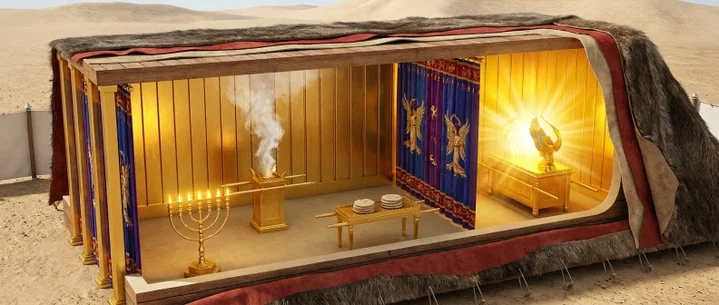
And thou shalt set the table without the vail, and the candlestick over against the table on the side of the tabernacle toward the south: and thou shalt put the table on the north side.
Translations
And you shall set the table without the veil, and the candlestick over against the table on the side of the tabernacle toward the south: and you shall put the table on the north side.
King James Version, KJV Cambridge Paragraph Bible
And thou shalt set the table without the vail, and the candlestick over against the table on the side of the tabernacle toward the south: and thou shalt put the table on the north side.
And thou shalt set the table without the vail, and the candlestick over against the table on the side of the tabernacle towards the south: and thou shalt put the table on the north side.
Revised Version, American Standard Version
And thou shalt set the table without the veil, and the candlestick over against the table on the side of the tabernacle toward the south: and thou shalt put the table on the north side.
'And thou hast set the table at the outside of the vail, and the candlestick over-against the table on the side of the tabernacle southward, and the table thou dost put on the north side.
And thou shalt set the table outside the veil, and the lamp-stand opposite to the table on the side of the tabernacle southward; and thou shalt put the table on the north side.
And thou shalt set the table outside the veil, and the lampstand over against the table, on the side of the habitation, southward,—and the table, shalt thou place on the north side.
Berean Standard Bible, Majority Standard Bible
And place the table outside the veil on the north side of the tabernacle, and put the lampstand opposite the table, on the south side.
You shall set the table outside the veil, and the lamp stand opposite the table on the side of the tabernacle toward the south. You shall put the table on the north side.
And outside the veil you are to put the table, and the support for the lights opposite the table on the south side of the House; and the table is to be on the north side.
And thou shalt set the Table without the vaile, and the Candlesticke ouer against the Table on the Southside of the Tabernacle, and thou shalt set the Table on the Northside.
Douay-Rheims (Challoner revision)
And the table without the veil: and over against the table the candlestick in the south side of the tabernacle; for the table shall stand in the north side.
Pictures
Cross-references 20 of 29
- Hebrews 9:2
For there was a tabernacle made; the first, where in was the candlestick, and the table, and the shewbread; which is called the sanctuary.
Identifies the table and candlestick together in the first apartment.
- Exodus 40:22-25
And he put the table in the tent of the congregation, upon the side of the tabernacle northward, without the vail.
Moses places the table northward and the candlestick opposite it southward, then lights its lamps.
- Hebrews 8:5
Who serve unto the example and shadow of heavenly things, as Moses was admonished of God when he was about to make the tabernacle: for, See, saith he, that thou make all things according to the pattern shewed to thee in the mount.
The earthly tabernacle is a shadow of the heavenly sanctuary.
- Hebrews 9:24
For Christ is not entered into the holy places made with hands, which are the figures of the true; but into heaven itself, now to appear in the presence of God for us:
The earthly sanctuary’s arrangement figures the true heavenly sanctuary where Christ appears for us.
- Exodus 25:31-32
And thou shalt make a candlestick of pure gold: of beaten work shall the candlestick be made: his shaft, and his branches, his bowls, his knops, and his flowers, shall be of the same.
Describes the sanctuary’s candlestick.
- Acts 7:44
Our fathers had the tabernacle of witness in the wilderness, as he had appointed, speaking unto Moses, that he should make it according to the fashion that he had seen.
The wilderness tabernacle was made according to the pattern shown to Moses.
- Exodus 25:8-9
And let them make me a sanctuary; that I may dwell among them.
God commands the sanctuary’s construction according to the pattern shown to Moses.
- Hebrews 9:11
But Christ being come an high priest of good things to come, by a greater and more perfect tabernacle, not made with hands, that is to say, not of this building;
The earthly sanctuary’s arrangement contrasts with Christ’s ministry in the greater tabernacle.
- Exodus 40:22-23
And he put the table in the tent of the congregation, upon the side of the tabernacle northward, without the vail.
The table is placed north of the veil, and the bread is set in order.
- Exodus 40:4
And thou shalt bring in the table, and set in order the things that are to be set in order upon it; and thou shalt bring in the candlestick, and light the lamps thereof.
Both describe the table and lampstand in the sanctuary.
- Exodus 37:17-23
And he made the candlestick of pure gold: of beaten work made he the candlestick; his shaft, and his branch, his bowls, his knops, and his flowers, were of the same:
Describes the candlestick and its lamps.
- Exodus 27:21
In the tabernacle of the congregation without the vail, which is before the testimony, Aaron and his sons shall order it from evening to morning before the LORD: it shall be a statute for ever unto their generations on the behalf of the children of Israel.
Both describe the service in the tabernacle outside the veil.
- Numbers 4:9
And they shall take a cloth of blue, and cover the candlestick of the light, and his lamps, and his tongs, and his snuffdishes, and all the oil vessels thereof, wherewith they minister unto it:
Both describe the tabernacle lampstand and its lamps.
- Exodus 26:15-30
And thou shalt make boards for the tabernacle of shittim wood standing up.
describes framework of same tabernacle
- Leviticus 24:4
He shall order the lamps upon the pure candlestick before the LORD continually.
Both describe the lampstand and its lamps before the Lord.
- Hebrews 8:2
A minister of the sanctuary, and of the true tabernacle, which the Lord pitched, and not man.
Christ ministers in the heavenly sanctuary.
- Hebrews 9:6-7
Now when these things were thus ordained, the priests went always into the first tabernacle, accomplishing the service of God.
Describes service in the first and second apartments.
- Exodus 31:7-11
The tabernacle of the congregation, and the ark of the testimony, and the mercy seat that is thereupon, and all the furniture of the tabernacle,
endows wisdom to carry out directions
- Hebrews 9:3
And after the second veil, the tabernacle which is called the Holiest of all;
The veil divides the holy place from the Holiest of all.
- Exodus 25:9
According to all that I shew thee, after the pattern of the tabernacle, and the pattern of all the instruments thereof, even so shall ye make it.
commands building after divine pattern
Commentary
Each commentary is drawn from primary sources: the writings of Ellen G. White and Adventist pioneers and periodicals. Each commentary is separate. Its own words are not a quotation; follow the references to read the source passages.
Ellen G. White
2 sources
Exodus 26:35 is part of the specifications God gave Moses for building the tabernacle.Ms 97, 1899, par. 3–4 It belongs to the plan for a portable structure to be taken apart and carried with Israel in all their journeyings, yet a building of extraordinary magnificence.ST Mar 4, 1903 Its walls were of upright boards heavily plated with purest gold.ST Mar 4, 1903
The vail named in the verse divides the sacred building into two apartments.ST Mar 4, 1903 A similar veil closes the entrance of the first apartment.ST Mar 4, 1903 These veils, together with the curtain forming the ceiling of the tabernacle, were of a variety of colors most beautifully arranged.ST Mar 4, 1903 Cherubim were inwrought upon them with threads of gold and silver to represent the angelic host connected with the work of the heavenly sanctuary as ministering angels to the saints upon the earth.ST Mar 4, 1903
The instructions, including the arrangement of the table and candlestick, taught that the skill, wisdom, and work used to build the sanctuary came from God and were to be used for His glory.Ms 97, 1899, par. 3–4
Sources
Pioneers and periodicals
33 sources
God directed Moses on Sinai to set the table for the bread on the north side of the first room and the lampstand directly opposite it on the south side, outside the inner veil that divided the dwelling into two rooms.ST May 20, 1880ST Oct 29, 1894RH Jan 6, 1853RH Mar 1, 1870 This order was part of His exact instructions for the portable tabernacle and its worship, given after Israel's deliverance from Egypt together with its organization and laws.ST Mar 3, 1914RH Dec 31, 1861RH Jan 20, 1916 Nothing was left to human design, but the builders were to follow precisely the pattern shown on the mountain under the Spirit's guidance.ST Feb 17, 1890ST Jan 27, 1909ST Jun 26, 1907 That pattern made the earthly house with its two rooms a copy and lesson of the great temple in heaven where Christ ministers, with its sacrifices ending at His once-for-all death.ST Jan 24, 1911ST May 16, 1878RH Jan 4, 1870ST Jun 26, 1907 The bread is a type of God's Word as the bread of life, and the seven burning lamps are a symbol of the sevenfold Spirit of God in His work in both the earthly and the heavenly sanctuaries.RH Jun 24, 1862
Setting in Exodus
Exodus 26:35 is part of God's detailed instructions to Moses for the construction of the tabernacle and its furniture, given during his forty days' stay with God in the mountain in Sinai together with the tables of stone.RH Dec 31, 1861ST Jan 31, 1911 It belongs to the second, chiefly legislative division of Exodus, chapters 19-40, in which the ransomed people are bound to Jehovah by solemn covenant and provided with a system of legal ordinances for their guidance. It describes part of the sanctuary pattern God gave Moses on the mountain, including the sanctuary in which the ark containing the law written on stone would be placed.RH Dec 31, 1861ST Dec 10, 1896 It belongs to the instructions about building the sanctuary and its furnishings, and the sanctuary was built and set up immediately afterward.ST Jan 31, 1911ST Dec 10, 1896
The verse belongs to Exodus 19-26, which gives the account of the giving of the law of Ten Commandments upon Mount Sinai.ST Mar 3, 1914 It belongs to the worship part of Exodus, chapters 25 to 40, which gives Israel's established form of worship after their deliverance from Egypt when they became a nation with organization, leadership, and a complete code of laws.ST Mar 3, 1914RH Jan 20, 1916
The verse belongs to the complete description of the worldly sanctuary in Exodus 25-31 and 35-40, and its direction for setting the table and the candlestick shows part of the arrangement of God's dwelling-place among Israel.ST Jun 4, 1885 It is part of the instructions recorded in Exodus 25-30, given to Moses on the mountain after the people asked him to receive God's words for them, and grouped among the statutes and ceremonies given through Moses, distinct from the Ten Commandments spoken by God and written on stone.ST Apr 15, 1886
Construction of Tabernacle
Exodus 26:35 belongs to God's explicit instructions to Moses in the first year after Israel came out of Egypt for building the sanctuary and making its furniture, given so that He might dwell among Israel and their worship might center there.ST Feb 17, 1890 The word sanctuary means a sacred or holy place, and its use is shown by these instructions, which were not left to man's fancy but gave the divine pattern to be carried out exactly under penalty of death by men specially endowed with wisdom.ST Feb 17, 1890ST Jun 26, 1907 The building and its work were properly done because God placed His Spirit upon the builders Bezalel and Oholiab together with other devoted men and women.ST Jan 27, 1909 The verse is part of the description of the sanctuary God wanted Israel to build in Exodus 25 to 31, giving explicit directions regarding every part including the placement of the table and candlestick.ST Jan 27, 1909ST Jun 26, 1907
The verse concerns a portable but magnificent tabernacle, taken apart and borne with Israel in all their journeyings, yet a structure of extraordinary magnificence.ST Mar 21, 1911ST Mar 4, 1903 It was thirty cubits long, ten cubits wide, and ten cubits high, made of upright acacia boards overlaid with gold and heavily plated with purest gold, set in sockets of silver.ST Mar 4, 1903ST Feb 17, 1890 Its ceiling of fine-twined linen was wrought with cunning needlework and figures of angels, of a variety of colors most beautifully arranged, with cherubim inwrought with threads of gold and silver to represent the angelic host connected with the work of the heavenly sanctuary as ministering angels to the saints upon the earth.ST Mar 4, 1903ST Feb 17, 1890 Over that was a tent roof of goat's hair, red ram-skins, and seal skins, with a richly decorated veil dividing the sacred building into two apartments and a similar veil closing the entrance of the first apartment.ST Mar 21, 1911ST Mar 4, 1903ST Feb 17, 1890 The entrance was toward the east, unlike ancient sun-worship, so the ministering priest stood with his back to the entrance facing west.ST Feb 17, 1890
The center of that sanctuary was the holy of holies where the ark of the covenant was placed, containing God's holy law written on tables of stone.ST Jan 27, 1909 The ark crowned with the mercy-seat holding the tables of the Decalogue stood as the chief object in the most holy place, with the law of God resting there with the mercy-seat over it.ST Jun 19, 1907ST Oct 25, 1905 In both tabernacle and temple the worship of God on earth centered there, and all earthly worship and service revolved around that holy of holies.ST Jun 19, 1907 Exodus 26:31-35 shows the tabernacle divided by veils into the holy and the most holy places, with the table of presence bread, the golden candlestick, and the altar of incense set in the first apartment called the Holy Place.ST Oct 25, 1905
Exodus 26:35 is part of the account of the building, the inner tabernacle, erected by Israel in the wilderness at the command of God, which is what the word sanctuary generally means.ST Jun 19, 1907 Its direction for setting the table and the candlestick shows part of the arrangement of God's dwelling-place among Israel in the wilderness and through the time of the judges, Samuel, Saul, and David, until Solomon built the temple after the same pattern.ST Jun 4, 1885 That temple from the day the glory of the Lord filled it was God's dwelling-place among Israel, and that portable tabernacle was later replaced by the temple built by Solomon.ST Jun 19, 1907ST Jun 4, 1885 The earthly, worldly sanctuary whose pattern was shown to Moses on Mount Sinai was built first as the tabernacle in the wilderness and continued in general outline through the temple of Solomon and the second temple built after the return from Babylon until its destruction by Titus in A.D. 70.RH Dec 24, 1908 That first apartment held the same furniture in each building, the altar of incense, the golden candlestick, and the table of showbread, distinct from the most holy place with the ark, and since the destruction of the second temple there has been no sanctuary on earth.RH Dec 24, 1908
Arrangement of Holy Place
The table of showbread and the golden candlestick stood in the first apartment, the holy place, outside the inner veil that separated it from the most holy place.ST May 20, 1880ST Oct 29, 1894RH Jan 6, 1853RH Aug 4, 1863ST May 16, 1878 The table was set on the north side of the tabernacle and the candlestick was set opposite it on the south side toward the south.ST May 20, 1880ST Oct 29, 1894RH Jan 6, 1853ST Mar 11, 1886 The table and candlestick thus belonged to the first room Moses built, without the veil, distinct from the ark in the second.ST May 16, 1878ST Mar 11, 1886RH Jan 4, 1870ST Nov 1, 1877
The tabernacle was closed on the east by a veil called the door and was divided inside by a second veil of the same material into two rooms and two holy places.ST Mar 11, 1886RH Oct 5, 1916 The first was called the holy place and occupied two-thirds, and the second was called the most holy place and occupied one-third as a perfect ten-cubit cube.ST Mar 11, 1886ST Oct 25, 1905 There was a veil at the entrance and another separating the apartments.RH Oct 5, 1916ST Oct 25, 1905
The holy place held three things, the golden candlestick, the table of showbread, and the altar of incense, while the most holy place held the ark, the mercy-seat, and the cherubim.RH Aug 4, 1863RH Dec 24, 1908RH Jun 21, 1864ST Oct 25, 1905 The candlestick was of solid gold with seven lamps and the table of showbread was of shittim wood overlaid throughout with pure gold.RH Aug 4, 1863RH Jun 21, 1864 The candlestick's lamps provided light because the holy place had no window.ST May 20, 1880 The table of presence bread, the golden candlestick, and the altar of incense were set in the first apartment called the Holy Place, and the ark of the covenant crowned with the mercy-seat holding the tables of the Decalogue stood as the chief object in the most holy place.RH Dec 24, 1908ST Oct 25, 1905
Moses fulfilled this pattern when he erected the sanctuary by placing the table on the north side of the holy place and setting the bread in order upon it.RH Mar 1, 1870 He placed the candlestick on the south side opposite the table and lighted its lamps before the Lord.RH Mar 1, 1870
Pattern of Heavenly Sanctuary
The tabernacle with its two holy places and its sacred vessels was made according to the pattern shown to Moses on the mountain, so that its two-apartment structure is a pattern of the heavenly temple and of heavenly things.ST May 16, 1878RH Jan 4, 1870ST Jun 26, 1907 The table and the candlestick were placed in the first apartment outside the veil, with the ark in the second, the table set on the north side and the candlestick set opposite it toward the south.ST May 16, 1878ST Nov 1, 1877RH Dec 30, 1873 Those exact directions for the earthly sanctuary and its furnishings therefore describe the wilderness tabernacle as a pattern of heavenly things, including the two holy places and the first apartment of the heavenly sanctuary.ST Jun 26, 1907ST Nov 1, 1877RH Dec 30, 1873 The seven lamps are thus identified as furnishings of the first apartment, answering to the first apartment above.RH Dec 30, 1873
Those instructions for building the sanctuary and preparing its services were given as an earthly object lesson of God's plan for governing and dealing with sinners through Christ, with the people cooperating with God in His work through Christ. The ancient tabernacle constructed for ministration involving sacrifices and offerings typified the great temple in heaven where Jesus now ministers.ST Jan 24, 1911 That sacrificial system passed away when Christ died once for all.ST Jan 24, 1911
In the earthly tabernacle the table stood on the north side and the golden candlestick stood opposite it on the south side, both without the veil in the first apartment where the altar of incense also stood.RH Nov 17, 1863 The candlestick and altar seen before the throne in heaven are the heavenly reality answering to that earthly placement.RH Nov 17, 1863 The door opened in heaven is therefore the door of the first apartment, and Christ's ministration there continues in the first apartment of the heavenly sanctuary.RH Nov 17, 1863
The measurements and materials of the earthly sanctuary and its furnishings described in Exodus 26:1-37 are not the limit or the full meaning of the heavenly truth represented by the sanctuary.RH May 25, 1905 Its teaching is a precious, harmonizing truth that reveals Christ's ministry and the gospel, and it must be held as more than a theory or an account of physical construction.RH May 25, 1905 As part of the description of the worldly sanctuary connected with the first covenant and its ordinances of divine service, this arrangement helps explain why that ministration was called a ministration of death.ST Aug 5, 1889
Teaching Doctrine and Application
The table set without the veil on the north side holds bread that is a type of God's Word, the bread of life, while opposite it on the south side stands the seven-branched candlestick whose lamps burn continually as a symbol of the sevenfold Spirit of God. The burning lamps represent the Holy Spirit in all its operations, alike in the earthly sanctuary and in the heavenly sanctuary.RH Jun 24, 1862
The direction for this placement is part of the law of Moses commanded through Moses in Horeb, to be remembered with the statutes and judgments. It stands among all the laws given through Moses, moral, civil, health, ceremonial, sacrificial, and conduct laws, in which offerings, sacrifices, and types were revealed so that the substance of the new dispensation may be traced from the shadows of the old. It is part of the law set forth in Exodus 20 to 40 and Leviticus to which God calls His people to give attention in the last days. As written instruction for the tabernacle it belongs to the law of ordinances written out after the moral law.ST May 6, 1875 It belongs to the instructions given to Moses on the mountain after the people asked him to receive God's words for them, recorded in Exodus 25-30 among the statutes and ceremonies given through Moses, distinct from the Ten Commandments spoken by God and written on stone.ST May 6, 1875ST Apr 15, 1886
The instructions for building the sanctuary and preparing its services served as an earthly object lesson of God's plan for governing and dealing with sinners, and their construction and service involved the people cooperating with God in His work through Christ. That sanctuary God wanted Israel to build is described in Exodus 25 to 31 with explicit directions regarding every part, including the placement of the table and candlestick.ST Jan 27, 1909 Its center was the holy of holies where the ark of the covenant was placed, containing God's holy law written on tables of stone.ST Jan 27, 1909 The building and its work were properly done because God placed His Spirit upon the builders Bezalel and Oholiab together with other devoted men and women, teaching that God is just as willing to bless workers in material things who are consecrated to Him as workers in spiritual things.ST Jan 27, 1909
Sources