Exodus 28:37
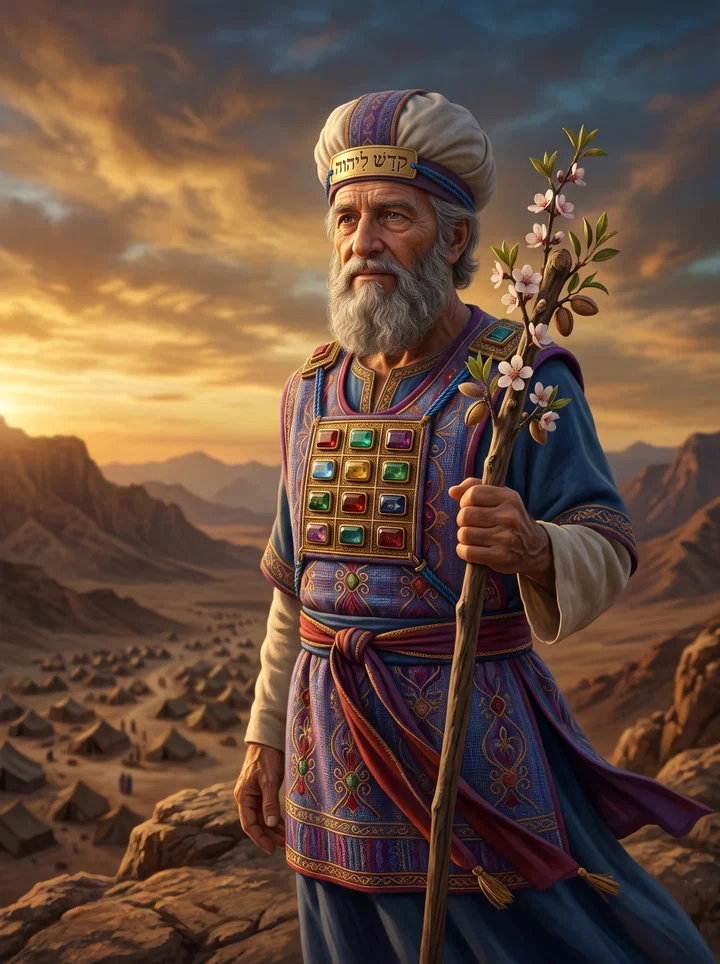
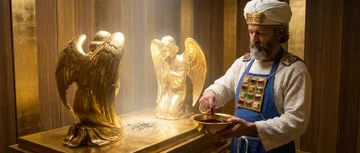
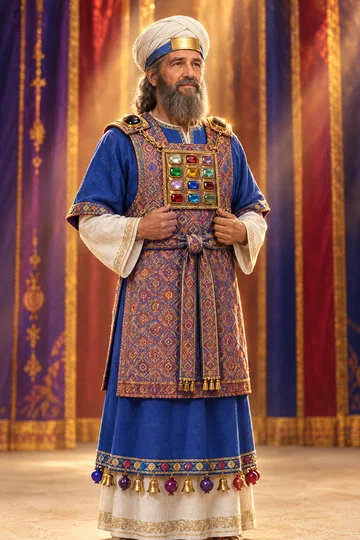
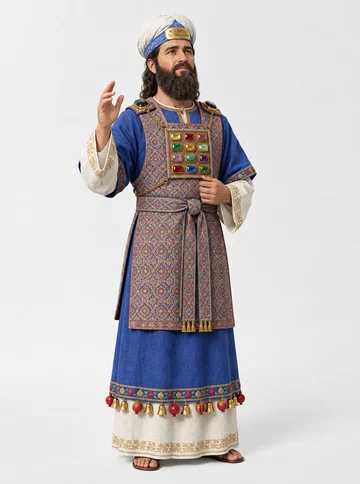
And thou shalt put it on a blue lace, that it may be upon the mitre; upon the forefront of the mitre it shall be.
Translations
And you shall put it on a blue lace, that it may be on the turban; on the forefront of the turban it shall be.
King James Version, KJV Cambridge Paragraph Bible
And thou shalt put it on a blue lace, that it may be upon the mitre; upon the forefront of the mitre it shall be.
And thou shalt put it on a blue lace, that it may be upon the miter; upon the front of the miter it shall be.
Revised Version, American Standard Version
And thou shalt put it on a lace of blue, and it shall be upon the mitre; upon the forefront of the mitre it shall be.
and thou hast put it on a blue ribbon, and it hath been on the mitre — over-against the front of the mitre it is;
And thou shalt put it on a lace of blue, and it shall be upon the turban — upon the front of the turban shall it be.
And thou shalt put it upon a cord of blue, so shall it be upon the turban,—upon the forefront of the turban, shall it be.
Berean Standard Bible, Majority Standard Bible
Fasten to it a blue cord to mount it on the turban; it shall be on the front of the turban.
You shall put it on a lace of blue, and it shall be on the sash. It shall be on the front of the sash.
Put a blue cord on it and put it on the front of the twisted head-dress:
And thou shalt put it on a blew silke lace, and it shalbe vpon the miter: euen vpon the fore front of the miter shall it be.
Douay-Rheims (Challoner revision)
And thou shalt tie it with a violet fillet, and it shall be upon the mitre,
Pictures
Cross-references
- Hebrews 8:5
Who serve unto the example and shadow of heavenly things, as Moses was admonished of God when he was about to make the tabernacle: for, See, saith he, that thou make all things according to the pattern shewed to thee in the mount.
The earthly tabernacle follows the divine pattern shown to Moses.
- Leviticus 8:9
And he put the mitre upon his head; also upon the mitre, even upon his forefront, did he put the golden plate, the holy crown; as the LORD commanded Moses.
The gold plate is placed on the forefront of the mitre as the holy crown.
- Leviticus 16:4
He shall put on the holy linen coat, and he shall have the linen breeches upon his flesh, and shall be girded with a linen girdle, and with the linen mitre shall he be attired: these are holy garments; therefore shall he wash his flesh in water, and so put them on.
The high priest wears humble linen garments, unlike the splendid dress prescribed for Aaron.
- Zechariah 3:5
And I said, Let them set a fair mitre upon his head. So they set a fair mitre upon his head, and clothed him with garments. And the angel of the LORD stood by.
Joshua is reclothed and given a fair mitre.
- Exodus 28:29
And Aaron shall bear the names of the children of Israel in the breastplate of judgment upon his heart, when he goeth in unto the holy place, for a memorial before the LORD continually.
The mitre inscription accompanies the breastplate bearing Israel’s names before the LORD.
- Ezekiel 44:19
And when they go forth into the utter court, even into the utter court to the people, they shall put off their garments wherein they ministered, and lay them in the holy chambers, and they shall put on other garments; and they shall not sanctify the people with their garments.
Priests change out of garments worn only when officiating.
- Exodus 28:33
And beneath upon the hem of it thou shalt make pomegranates of blue, and of purple, and of scarlet, round about the hem thereof; and bells of gold between them round about:
same precious garments Jesus puts on
- Exodus 25:8-9
And let them make me a sanctuary; that I may dwell among them.
The sanctuary and its furnishings were made according to a pattern God showed Moses.
- Exodus 29
And this is the thing that thou shalt do unto them to hallow them, to minister unto me in the priest’s office: Take one young bullock, and two rams without blemish,
The priestly garments serve the priests’ ministry.
- Hebrews 9:11
But Christ being come an high priest of good things to come, by a greater and more perfect tabernacle, not made with hands, that is to say, not of this building;
Christ ministers in the greater sanctuary typified by the ancient one.
Commentary
Each commentary is drawn from primary sources: the writings of Ellen G. White and Adventist pioneers and periodicals. Each commentary is separate. Its own words are not a quotation; follow the references to read the source passages.
Ellen G. White
10 sources
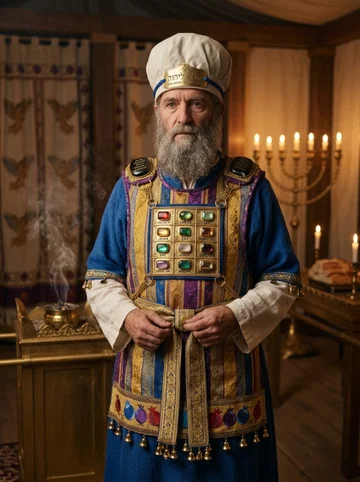
The forefront of the high priest's mitre bore a gold plate declaring holiness to the Lord, fastened to it by a blue lace.Ms 109, 1899, par. 11–12Lt 68, 1900, par. 14–16PP 351.3 The mitre itself was a white linen turban worn on the head, with the engraved plate set upon its front.Ms 109, 1899, par. 11–12Lt 68, 1900, par. 14–16PP 351.3 The plate's place there kept holiness before those serving in ministry as a standard of purity and a reminder to represent the Lord in an ennobling way.Ms 109, 1899, par. 11–12
The direction belongs to God's detailed and specific instructions for Aaron's priestly garments, prescribing the exact style of clothing for those ministering in the holy place and in the priest's office, suited to their work down to the placement of the plate.GW92 162.2GW92 161.12T 610.3–612.1Ms 56, 1900, par. 11–12 Such particularity shows the garments were symbolic and teaches that dress can carry meaning.Ms 56, 1900, par. 11–12 The apparel was meant to impress all who saw it with the holiness of God, the sacredness of His worship, and the purity required of those coming into His presence.PP 351.3 The priests' appearance was to show reverence and to lead the people to regard Him as holy and His service as sacred.2T 610.3–612.1PP 351.3
God may be honored or dishonored by the apparel of those officiating before Him, requiring care and order in everything connected with His service and especially cleanliness.GW92 161.12T 610.3–612.1 In connection with this dress, priests had to wash their hands and feet at the laver set between the altar and the congregation in sight of the people before entering God's presence.GW92 162.2 This taught that every particle of dust must be put away, because God is so high and holy that failure to meet these conditions would bring death.GW92 162.2 Because dress carries meaning, Christ's followers should likewise represent Him by how they dress.Ms 56, 1900, par. 11–12
The inscription on the forefront of the mitre extends to God's people and even their common temporal things.Lt 12, 1897, par. 13 It means the grace of Christ disciplines the whole human fabric so that mind, strength, body and soul partake of the divine nature as His purchased possession.Lt 12, 1897, par. 13 All are to serve Him with the whole mind, heart, soul and strength, with all entrusted talents sanctified to God, so that the entire life is glorified.Lt 12, 1897, par. 13 Then the Lord is glorified in His saints, and the worker reflects more and more the likeness of Christ to the perfection of the whole person.Lt 12, 1897, par. 13 In the vision of Joshua the high priest, the fair mitre is placed on his head after his iniquity is removed and he is given clean garments.Lt 68, 1900, par. 14–16
The mitre points to Jesus Christ as Apostle and High Priest over His own house, worthy of more glory than Moses and higher than Moses and higher than the highest angel.Lt 97, 1898, par. 8–9 He bears the name of Jehovah upon His mitre and the name of Israel upon His breastplate.Lt 97, 1898, par. 8–9 He was the invisible Leader of Israel enshrouded in the pillar of cloud by day and the pillar of fire by night in the wilderness wandering, the Angel of the covenant coming in the name of God.Lt 97, 1898, par. 8–9 As the Son of God and Majesty of heaven exalted above the angels He took humanity that humanity might touch humanity, and in the form of man humbled Himself and became a servant.Lt 97, 1898, par. 8–9 By His life in humanity people may become partakers of the divine nature, and in His work of redemption He carries with Him all who have received Him and believed on His name.Lt 97, 1898, par. 8–9
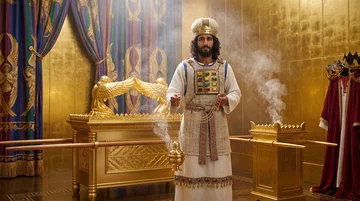
At the close of the prophetic periods in 1844, when He ended His ministration in the holy place and closed the door of that apartment, Jesus clothed Himself with these precious garments.EW 213.1 Among them was the mitre with its front plate fastened by blue lace, appearing as a crown upon His head.EW 213.1 He was fully attired with the bell-and-pomegranate robe and the glittering breastplate bearing engraved names.EW 213.1 Surrounded by angels He then passed in a flaming chariot within the second veil.EW 213.1
Sources
Pioneers and periodicals
28 sources
The verse directs that the gold plate inscribed with holiness to the Lord be fastened by a blue lace upon the forefront of the high priest's white linen mitre or turban, completing his appointed dress and distinguishing him from the under-priests.ST Nov 12, 1894ST Feb 17, 1890ST Apr 26, 1883ST Jan 9, 1893ST Nov 12, 1894 It belongs to the minute and explicit instructions for the sanctuary, its furnishings and priestly garments given by God to Moses in the mount to be made exactly according to the pattern shown him.ST Oct 29, 1894ST Mar 25, 1889 The care down to the lace and clothing shows that even small details of sacred service matter to God and was meant to teach reverence, the holiness of God, and the purity required of those who come into His presence.ST Mar 25, 1889RH Oct 30, 1913ST Nov 12, 1894ST Mar 15, 1883 The earthly sanctuary and its priesthood were a type of the heavenly sanctuary and of Christ's ministry, its rites pointing to Christ the sinless High Priest who now ministers in heaven and whose once-for-all death ended the typical service of sacrifices.ST Jan 24, 1911ST Jun 26, 1907RH Mar 8, 1870 The mitre with its inscription symbolizes character set apart and consecrated to sacred use, and was specially designed to bear the iniquity of the holy things in the work of intercession and atonement.ST Apr 26, 1883RH Jul 26, 1864ST Jan 9, 1893
Garment and Sanctuary Setting
The gold plate inscribed Holiness to the Lord, or Holiness to Jehovah, was to be fastened with a blue lace or cord upon the forefront of the high priest's mitre.ST Feb 17, 1890ST Jan 9, 1893RH Sep 16, 1852ST Jun 6, 1878RH Jul 5, 1864 The mitre itself was a white linen turban or bonnet, worn at the front of the head, and the blue lace was what held the plate in place.ST Feb 17, 1890ST Apr 26, 1883ST Jan 9, 1893ST Nov 12, 1894ST Dec 17, 1912 The mitre with its plate belonged to the splendid dress prescribed for the high priest to wear on other occasions, in contrast to the plainest and humblest dress he put on when entering the most holy place on the Day of Atonement.RH Sep 16, 1852ST Jun 6, 1878RH Jul 5, 1864 The mitre was specially designed to bear the iniquity of the holy things, and the mitre with its inscription symbolized character marked by holiness to the Lord.ST Apr 26, 1883ST Jan 9, 1893
The mitre and its plate belong to the special dress appointed in accordance with priestly office, with a linen turban or mitre completing the outward costume.ST Nov 12, 1894ST Nov 12, 1894 The mitre on the head distinguished the high priest from the under-priests, whose official garments were pure white linen indicating purity of priestly character and work.ST Nov 12, 1894RH Dec 8, 1910 Like the other priestly garments, the white linen bonnet or turban with its gold plate fastened by blue lace was worn only when officiating in the work of the sanctuary.ST Nov 12, 1894ST Dec 17, 1912
The high priest's clothing was significant of his calling and purpose, comprising over his long white coat or robe a linen ephod or cape curiously wrought with gold, blue, purple and scarlet. Upon each shoulder was a beautiful stone in a setting of gold, and before the breast were suspended the names of the twelve tribes in four rows with three names in each row, together with the golden plate inscribed Holiness to the Lord. The mysterious Urim and Thummim also found place there, but in just what form is not known.
The verse belongs to the very minute, explicit and detailed instructions for the sanctuary, its furnishings, sacred vessels, priestly garments and service given by God to Moses in the mount during the forty days before the sanctuary was built.ST Oct 29, 1894ST Mar 25, 1889 Those directions are recorded chiefly in Exodus 25 to 31 and told through Exodus 25 to 40, which Moses was instructed to make exactly according to the pattern shown him.ST Oct 29, 1894ST Jun 19, 1907ST Jan 27, 1909 The word sanctuary generally means the inner tabernacle erected by Israel at God's command in the wilderness, centered on the holy of holies where the ark of the covenant holding God's holy law written on tables of stone was placed.ST Jun 19, 1907ST Jan 27, 1909
The sanctuary was a marvelously beautiful structure, to be made from the free-will offerings of the children of Israel so that God might dwell among them.ST Jan 27, 1909 God placed His Spirit upon the builders Bezalel and Oholiab and other devoted men and women and specially endowed the workmen so the building might be properly erected and the work properly done.ST Jan 27, 1909 The directions were carried out exactly as given, as recorded in Exodus 35 to 40, and wonderful blessing and glory came down upon the congregation and the building when it was completed.ST Jan 27, 1909
The sanctuary was a great multiple object-lesson let down upon earth after the deliverance from Egyptian bondage, because hundreds of years of slavery had unfitted Israel to comprehend God's great salvation and the character He required. It comprehended in its teaching by various forms and rites the great plan of salvation, setting forth God's plan of government and how He deals with those who have sought to dethrone Him by sin. It set forth the provision of the plan devised from eternity for salvation from sin, with God as priest upon the throne, still King while executing the office of priest in dealing with sinners. God made His purpose known to His people because they are so intimately related to the sanctuary question that they co-operate with God in His work through Christ in the sanctuary, so that in every step the divine and the human co-operate.
The priestly rites were committed to Aaron and his sons in the Levitical order set apart by Moses to carry forward the ministration before the ark in the typical sanctuary while that sanctuary continued.ST Mar 3, 1914RH Dec 12, 1854 Those outside the priesthood were not to perform them unless the Lord gave special direction.ST Mar 3, 1914 The verse uses the Hebrew word masak and the Septuagint Greek word katapetasma for the hanging at the entrance to the tabernacle, which the English version calls a hanging.RH Oct 5, 1916
Holiness, Type and Covenant
The minute care with which the fastening of the plate by the blue lace and the clothing and appearance of the priests were specified shows how particular God was about everything pertaining to His worship.ST Mar 25, 1889RH Oct 30, 1913ST Mar 15, 1883 Even so small a detail as how the lace holds the plate on the front of the mitre matters to God in sacred service.ST Mar 15, 1883 That careful specification of appearance in sacred service was meant to teach the people reverence for God.RH Oct 30, 1913 It showed that He is holy and His service sacred.RH Oct 30, 1913ST Nov 12, 1894 It was to impress His holiness, the sacredness of worship, and the purity required of those who come into His presence.ST Nov 12, 1894
All defilement must be put away from those who would approach into God's presence, with shoes left in the court lest dust desecrate the holy place and with washing of hands and feet before ministering in the tabernacle or at the altar of burnt offering.ST Nov 12, 1894 Sanctification is setting apart or consecrating to a sacred or religious use, as illustrated in the priests and in the sanctuary and its utensils being sanctified.RH Jul 26, 1864 The mitre with its inscription of holiness to the Lord symbolizes character marked by holiness to the Lord.ST Jan 9, 1893 What is devoted to God becomes holy, so that money that may have been involved in double dealing is made holy when consecrated to the Lord. For the same reason Sabbath-school and missionary offerings given on the Sabbath are treated as holy rather than as a violation of God's law, with the priestly offering representing Jesus Christ.
The earthly sanctuary with its furnishings, priesthood, and ministration was made according to God's directions as a type of the heavenly sanctuary and a pattern of Christ's ministry in the heavenly sanctuary.ST Jun 26, 1907RH Mar 8, 1870 Its rites and objects pointed to Christ and His power to forgive sin and transform character.ST Jun 26, 1907 The ancient tabernacle and its priestly service involved ministry with sacrifices and offerings, but that sacrificial system passed away when Christ died once for all, and the sanctuary it represented is in heaven where Jesus now ministers.ST Jan 24, 1911ST Jun 26, 1907 Aaron's splendid priestly garments, including the gold plate on the mitre fastened with a blue cord at the front, stand in contrast with Christ the sinless High Priest who lives forever.RH Jul 5, 1864
The splendid dress prescribed was what the high priest wore on other occasions, but on the Day of Atonement when entering the most holy place he laid that splendid dress aside and put on the plainest and humblest dress.RH Jan 11, 1870ST Jun 6, 1878 That laying aside, together with offering a sin offering for himself, shows he was high priest only in a typical sense and not in reality.RH Jan 11, 1870ST Jun 6, 1878 It was designed to impress his infirmity and sinfulness, which has no counterpart in the work of Christ.RH Jan 11, 1870 Yet the holy crown with its plate of holiness to the Lord was part of the high priest's garments as he entered the Holy of Holies in the Day of Atonement service to make atonement and cleanse Israel from its sins.RH Sep 16, 1852 The mitre was specially designed to bear the iniquity of the holy things, and after the high priest finished interceding for Israel in the most holy place he changed all his garments including the mitre.ST Apr 26, 1883 This service represents Christ's final work before the ark in heaven, when the sins of God's people will be blotted out.ST Apr 26, 1883
The direction belongs to the law of Moses commanded through Moses in Horeb with statutes and judgments, set forth in Exodus 20 to 40, including the Ten Commandments together with civil regulations, sacrifices and offerings, conduct, health, ceremonial and moral laws. It is to be remembered in the last days so that the substance of the new dispensation may be traced from the shadows of the old. The appointment of the Levitical priesthood and its garments came after the Ten Commandments in Exodus 20 were received, distinguishing the priestly law from the moral law.ST Mar 22, 1883ST Mar 22, 1883ST Feb 20, 1879 It was not what God spoke directly to the people from Sinai, for God spoke the Ten Commandments and added no more and wrote only those on the two tables of stone.ST Apr 15, 1886 This direction about the mitre belongs instead to the additional precepts, statutes and laws commanded by the hand of Moses during the forty days in the mount and recorded chiefly in Exodus 25 to 30 and Leviticus, standing among the burdensome ceremonies and carnal ordinances imposed until the time of reformation as a yoke which neither the fathers nor their children were able to bear.ST Apr 15, 1886
The holy mitre with its blue lace is one of the things to which the Hebrew word translated continual or daily is applied. That word is applied about a score of times to the burnt offering, and also to the pillar of fire and cloud, the showbread, the holy mitre, the incense, the meal offering, and the ever-burning lamp, covering all the various things relating to God's service. In the common version it is rendered alway, always, continue, continual, daily, ever, evermore and perpetual. Its great thought is continuance and constancy.
Sources