Exodus 30:3
And thou shalt overlay it with pure gold, the top thereof, and the sides thereof round about, and the horns thereof; and thou shalt make unto it a crown of gold round about.
Translations
And you shall overlay it with pure gold, the top thereof, and the sides thereof round about, and the horns thereof; and you shall make to it a crown of gold round about.
King James Version, KJV Cambridge Paragraph Bible, Revised Version, American Standard Version
And thou shalt overlay it with pure gold, the top thereof, and the sides thereof round about, and the horns thereof; and thou shalt make unto it a crown of gold round about.
And thou shalt overlay it with pure gold, its top, and its sides round about, and its horns; and thou shalt make to it a crown of gold round about.
'And thou hast overlaid it with pure gold, its top, and its sides round about, and its horns; and thou hast made to it a crown of gold round about;
And thou shalt overlay it with pure gold, the top thereof, and the sides thereof round about, and the horns thereof; and thou shalt make upon it a border of gold round about.
And thou shalt overlay it with pure gold the top thereof, and the sides thereof round about, and the horns thereof,-and thou shalt make to it a border of gold round about.
Berean Standard Bible, Majority Standard Bible
Overlay with pure gold the top and all the sides and horns, and make a molding of gold around it.
You shall overlay it with pure gold, its top, its sides around it, and its horns; and you shall make a gold molding around it.
It is to be plated with the best gold, the top of it and the sides and the horns, with an edging of gold all round it.
And thou shalt ouerlay it with fine golde, both the toppe therof and the sides thereof round about, and his hornes: also thou shalt make vnto it a crowne of gold round about.
Douay-Rheims (Challoner revision)
And thou shalt overlay it with the purest gold, as well as the grate thereof, as the walls round about and the horns. And thou shalt make to it a crown of gold round about,
Pictures
Cross-references 20 of 22
- Revelation 8:3-4
And another angel came and stood at the altar, having a golden censer; and there was given unto him much incense, that he should offer it with the prayers of all saints upon the golden altar which was before the throne.
Incense rises before God with the prayers of the saints from the golden altar.
- Hebrews 9:1-5
Then verily the first covenant had also ordinances of divine service, and a worldly sanctuary.
Describes the sanctuary and its furnishings, including the golden altar.
- Exodus 25:8-9
And let them make me a sanctuary; that I may dwell among them.
Gives the command and pattern for the sanctuary whose furnishings are described.
- Exodus 30:7-8
And Aaron shall burn thereon sweet incense every morning: when he dresseth the lamps, he shall burn incense upon it.
Specifies the morning and evening incense offering at the golden altar.
- Hebrews 8:1-2
Now of the things which we have spoken this is the sum: We have such an high priest, who is set on the right hand of the throne of the Majesty in the heavens;
Jesus ministers in the heavenly sanctuary typified by the ancient one.
- Hebrews 8:5
Who serve unto the example and shadow of heavenly things, as Moses was admonished of God when he was about to make the tabernacle: for, See, saith he, that thou make all things according to the pattern shewed to thee in the mount.
The earthly tabernacle and its furnishings followed a heavenly pattern.
- Exodus 25:23-30
Thou shalt also make a table of shittim wood: two cubits shall be the length thereof, and a cubit the breadth thereof, and a cubit and a half the height thereof.
Both describe furnishings in the holy place.
- Exodus 40:26-27
And he put the golden altar in the tent of the congregation before the vail:
Places the golden altar before the veil and describes incense burned on it.
- Luke 1:9-11
According to the custom of the priest’s office, his lot was to burn incense when he went into the temple of the Lord.
The priest burned incense at the altar while the people prayed.
- Hebrews 9:24
For Christ is not entered into the holy places made with hands, which are the figures of the true; but into heaven itself, now to appear in the presence of God for us:
The earthly sanctuary represents the true heavenly sanctuary where Christ appears for us.
- Exodus 37:26
And he overlaid it with pure gold, both the top of it, and the sides thereof round about, and the horns of it: also he made unto it a crown of gold round about.
Describes the altar’s making and gold overlay.
- Hebrews 9:11
But Christ being come an high priest of good things to come, by a greater and more perfect tabernacle, not made with hands, that is to say, not of this building;
Christ ministers in the heavenly sanctuary typified by the ancient one.
- Exodus 25:9
According to all that I shew thee, after the pattern of the tabernacle, and the pattern of all the instruments thereof, even so shall ye make it.
The sanctuary furnishings were made according to the heavenly pattern shown on the mount.
- Exodus 30:10
And Aaron shall make an atonement upon the horns of it once in a year with the blood of the sin offering of atonements: once in the year shall he make atonement upon it throughout your generations: it is most holy unto the LORD.
Blood was applied to the altar’s horns for atonement once each year.
- Exodus 25:11
And thou shalt overlay it with pure gold, within and without shalt thou overlay it, and shalt make upon it a crown of gold round about.
Both describe the gold overlay and crown of the ark.
- Leviticus 4:7
And the priest shall put some of the blood upon the horns of the altar of sweet incense before the LORD, which is in the tabernacle of the congregation; and shall pour all the blood of the bullock at the bottom of the altar of the burnt offering, which is at the door of the tabernacle of the congregation.
Blood from individual sin offerings was applied to the altar’s horns.
- Leviticus 16:18-19
And he shall go out unto the altar that is before the LORD, and make an atonement for it; and shall take of the blood of the bullock, and of the blood of the goat, and put it upon the horns of the altar round about.
Blood is applied to the altar’s horns to cleanse and hallow it.
- Exodus 36
Then wrought Bezaleel and Aholiab, and every wise hearted man, in whom the LORD put wisdom and understanding to know how to work all manner of work for the service of the sanctuary, according to all that the LORD had commanded.
These chapters tell of the sanctuary’s construction and inauguration.
- Exodus 25:40
And look that thou make them after their pattern, which was shewed thee in the mount.
The sanctuary furnishings were made according to a heavenly pattern.
- Exodus 40:5
And thou shalt set the altar of gold for the incense before the ark of the testimony, and put the hanging of the door to the tabernacle.
Places the gold incense altar before the ark.
Commentary
Each commentary is drawn from primary sources: the writings of Ellen G. White and Adventist pioneers and periodicals. Each commentary is separate. Its own words are not a quotation; follow the references to read the source passages.
Ellen G. White
11 sources
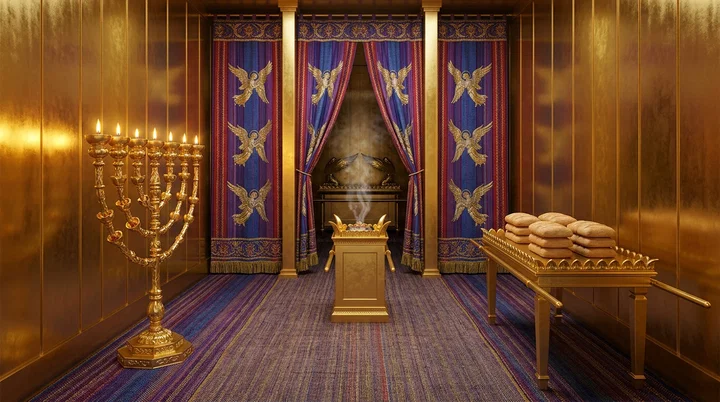
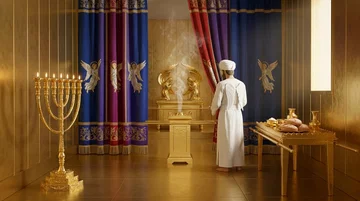
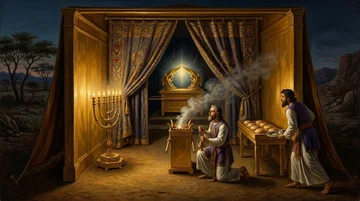
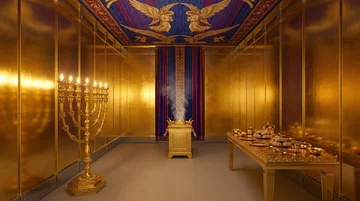
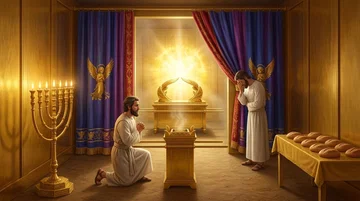
The altar of incense was overlaid with pure gold on its top and on its sides round about and on its horns, and finished with a crown or rim of gold round about it.PP 348.1LSEGW 100.1–3PP 353.2GC88 411.1–412.3 In the earthly sanctuary it stood in the holy place directly before the veil or curtain that separated that apartment from the ark in the most holy place.1SP 273.3ST Mar 4, 1903PP 348.1GC88 411.1–412.3RH Nov 8, 1915 The same altar exists in reality in God's temple in heaven, in the holy place or first apartment entered after the first veil and before the second veil leading to the holy of holies, together with the candlestick with seven lamps and the table of shewbread.CET 91.2–3SG1 158.1EW 25.6 Its heavenly reality looks like purest gold and reflects the image of Christ, and with it belongs a golden censer seen by the ark covered on top and sides with purest gold.CET 91.2–3LSEGW 100.1–3SG1 158.1
Incense was burned upon the altar morning and evening, day and night continually, so that its fragrant cloud filled the sanctuary.1SP 273.3PP 348.1PP 353.2 Its rising fragrance ascended daily before God with the prayers of Israel.PP 353.2GC88 411.1–412.3RH Nov 8, 1915 Its horns were touched with the blood of the sin offering, and it was sprinkled with blood on the Day of Atonement.PP 348.1 The priest offering incense directed his prayer toward the unseen mercy-seat.1SP 273.3ST Mar 4, 1903
This represents God's people directing their prayers by faith to Christ, their Mediator before the mercy-seat in the heavenly sanctuary, and confidently claiming the benefits of His mediation though they cannot see Him.1SP 273.3ST Mar 4, 1903 The incense rising from the altar with Israel's prayers represents Christ's merits and continual intercession, His perfect righteousness imputed to His people through faith.PP 353.2 Only through this Mediator can sinners approach God and receive mercy and salvation.PP 353.2 The altar represents worship ascending to God, but prayers, praise, confession, obedience, and thanksgiving are defiled by human corruption and are acceptable only when Christ gathers them and presents them with His blood and spotless righteousness to make them wholly acceptable, after which gracious answers come from God.Ms 50, 1900, par. 17–18
In heaven Jesus stands by the ark and in the first apartment, and as the saints' prayers come up to Him in faith He offers them to the Father with the smoke of the incense from the censer.CET 91.2–3LSEGW 100.1–3SG1 158.1 The offering rises as a sweet fragrance like smoke of beautiful colors.SG1 158.1 It brings light and glory from the Father through Jesus upon those who prayed.SG1 158.1
Sources
Pioneers and periodicals
45 sources
The verse gives the covering for the altar of incense, that its top and sides and horns were to be overlaid with pure gold with a crown of gold round about.RH Feb 19, 1901ST Apr 22, 1897 It stood in the holy place just before the veil, directly before the ark and mercy seat yet separated by the curtain, with the table on the north and the candlestick on the south.RH Feb 19, 1901ST Apr 22, 1897RH Jun 18, 1901 Upon it sweet incense was burned every morning and evening as a perpetual service, kindled with sacred fire while the people prayed without.RH Jul 2, 1914RH Feb 19, 1901ST Apr 22, 1897 Its horns were the place where blood was applied to make atonement in the daily ministry and on the yearly Day of Atonement when it was cleansed.RH Feb 19, 1901RH Sep 16, 1852 Made after the heavenly pattern, it answers to the altar of incense in the heavenly sanctuary where Jesus now ministers, and its incense represents Christ's intercession and perfect righteousness mingled with the prayers of His people to make them acceptable before God.ST Mar 4, 1903ST Jan 24, 1911ST Jun 26, 1907ST
Setting in Exodus
Exodus 30:3 belongs to the minute, detailed instructions for the tabernacle and its furniture in Exodus 25-40, more particularly in Exodus 25-31 and in Exodus 25-30, built exactly according to the pattern shown to Moses in the mount.ST Oct 29, 1894RH Feb 11, 1858ST Mar 11, 1886ST Jan 31, 1911 Those instructions were given to Moses during his forty days' stay with God in the mountain, belonging to the chiefly legislative second division of Exodus in chapters 19-40 by which the ransomed people were bound to Jehovah by solemn covenant and given legal ordinances for guidance.ST Mar 25, 1889RH Dec 31, 1861ST Jan 31, 1911 They included the pattern of the sanctuary, the ark for the law, and the priesthood to minister before it, coming in order after the events of Exodus 19-32 and before the building and setting up of the sanctuary in Exodus 33-40.RH Dec 31, 1861ST Dec 10, 1896
The sanctuary so described had two apartments separated by a veil, the holy place twenty cubits long, ten cubits wide and ten cubits high, and the most holy place ten cubits in each dimension, half as large as the holy place, the whole about thirty cubits long and about ten broad and ten high.ST Oct 29, 1894RH Feb 11, 1858 Its sides and west end were upright boards of acacia wood overlaid with gold, secured at the bottom by tenons fitting into silver sockets weighing a talent each and held securely at the top by bars placed through rings attached to the boards, with entrance pillars whose chapiters and fillets were also overlaid with gold.ST Oct 29, 1894RH Feb 11, 1858 It was the earthly place around which worship and service centered, with the law of God lying in the most holy place beneath the mercy seat.ST Jun 19, 1907RH Oct 2, 1856
It was made as a dwelling place so that God might dwell among Israel after deliverance from Egyptian bondage, to be built from free-will offerings of the children of Israel of gold, silver, brass, acacia wood, fine linen, goat's hair, skins and costly stones.ST Mar 11, 1886ST Jun 4, 1885ST Jul 8, 1930 It was a marvelously beautiful structure of extraordinary magnificence, built by workmen specially endowed by God according to the divine pattern, given as a great multiple object-lesson by various forms and rites to teach the great plan of salvation to a people unfitted by slavery to comprehend it.ST Oct 29, 1894RH Feb 11, 1858 The minuteness of the instructions for building it and its instruments of service shows how particular God was about what pertained to worship.ST Mar 25, 1889
Altar's Form and Place
The instruction concerns the golden altar, also called the altar of incense, whose top and sides round about and horns were to be overlaid with pure gold, finished with a crown or rim or molding of gold round about.RH Feb 19, 1901ST Apr 22, 1897RH Jan 6, 1853ST Jun 26, 1907 It belonged to the detailed directions for building the sanctuary and preparing its services, and its services of sacrifices and offerings pointed to the heavenly temple.ST Jan 24, 1911ST Jun 26, 1907 The altar was made of acacia wood, three feet high with a top one and one-half feet square, also described as about three and a half feet high and nearly two feet square.RH Mar 1, 1870ST Apr 1, 1913ST Apr 22, 1889 Its horns were projections from the corners, though their shape is not specified.ST Apr 22, 1889
It belonged in the first apartment, the holy place, standing inside the tent of meeting at the western end opposite the entrance, just before the veil or second veil.RH Feb 19, 1901ST Apr 22, 1897RH Jun 18, 1901ST Mar 14, 1911RH Mar 28, 1854 It stood directly before the ark and mercy seat but separated by the curtain, together with the table of showbread on the north and the candlestick on the south.RH Feb 19, 1901ST Apr 22, 1897ST Aug 19, 1913 It was used for burning incense before God, with incense burned morning and evening, and its horns were the place where atonement was made with blood.RH Feb 19, 1901ST Apr 22, 1897RH Mar 28, 1854 It was a large stationary structure fitted with rings and staves for bearing it, not designed to be moved about readily by hand and requiring more than the high priest alone to move.RH Jun 18, 1901 All incense offered in the first apartment was placed on this altar, while the small hand-held golden censer was used almost exclusively in the second apartment after the second veil.RH Jun 18, 1901
It is the first piece met upon entering the holy places, marked by beauty and grandeur and rich appearance belonging to the pattern of the heavenly sanctuary.ST Jun 19, 1907ST Apr 22, 1897 Overlaid so that it glittered like burnished gold, it stood inside the windowless sacred apartments where the solid-gold candlestick with its seven lamps burned day and night.ST Mar 21, 1911ST Nov 14, 1892 Its light reflected from the gold-plated walls upon the altar and the table and the richly embroidered blue and purple and scarlet curtains with shining cherubim, together presenting a scene of magnificence and glory beyond words as part of the sanctuary's extraordinary beauty and sacred character.ST Mar 21, 1911ST Nov 14, 1892 The altar was to be anointed with holy anointing oil prepared by special direction from fragrant herbs, showing its utensils were set apart for sacred use, since sanctification can mean consecration to a holy purpose.RH Jul 2, 1914RH Jul 26, 1864 Beyond this, the construction detail is given without further explaining the gold overlay or crown, identifying the altar of incense in Exodus 30:1-6 as one of the furnishings in the holy place alongside the table and candlestick.ST Nov 14, 1892RH Jun 21, 1864
Daily Service at Altar
Sweet incense was burned upon the golden altar every morning and evening as a perpetual incense before the Lord.RH Jul 2, 1914RH Feb 19, 1901ST Apr 22, 1897 This burning belonged to the daily ministration in the holy place, where the altar stood before the veil before the mercy-seat.RH Feb 19, 1901ST Apr 22, 1897ST Mar 14, 1911 The offering was made in the morning when the priest tended the lamps and in the evening when he lighted them, while the people prayed outside.RH Feb 19, 1901ST Apr 22, 1897ST Mar 14, 1911 Its sacred fire had been kindled by the Lord and was never allowed to go out, and its fragrant cloud filled the sanctuary and ascended daily before God with the prayers of Israel.RH Jul 2, 1914RH Feb 19, 1901
The horns of the altar were the place of atonement where the blood of sin offerings was applied.RH Feb 19, 1901RH Sep 16, 1852 Blood from individual atonements was put there during the daily ministry, and atonement was also made upon the horns once a year.RH Feb 19, 1901RH Sep 16, 1852 On the annual Day of Atonement the altar itself was cleansed from the uncleanness it had received.RH Sep 16, 1852 The offering of incense at the temple was part of the permanent, continual service of divine worship with its lasting practices, not merely the daily morning and evening sacrifice.ST Mar 12, 1912
Type of Heavenly Sanctuary
The altar overlaid on its top and sides round about and its horns with pure gold and finished with a crown or molding of gold round about belonged to the earthly sanctuary made according to God's directions after the heavenly pattern.ST Jun 26, 1907ST Jun 19, 1907ST Nov 11, 1897ST Mar 17, 1898ST May 27, 1880 Its rich appearance was part of that pattern of the heavenly sanctuary, and its earthly form corresponds to an altar of incense in the heavenly sanctuary.ST Jun 19, 1907ST Nov 11, 1897ST Mar 17, 1898ST May 27, 1880 The golden altar with its incense service formed part of the earthly sanctuary pattern which represented the heavenly sanctuary and its service, and the sanctuary's services of sacrifices and offerings ended when Christ died because the sanctuary typified the heavenly temple where Jesus now ministers.ST Jan 24, 1911ST Mar 17, 1898 The furnishings and service were made according to God's directions and served as a type of the heavenly sanctuary and as an object lesson pointing to Christ and his work of forgiving sin.ST Jun 26, 1907
As a furnishing of the earthly sanctuary built after the heavenly pattern, the altar is a type or figure that must have a true antitype in the sanctuary of the better covenant.RH Feb 18, 1858RH Oct 2, 1856 It was one of the furnishings inside Moses' building thirty cubits long and ten broad, made after the pattern shown to Moses, and therefore something in the antitypical sanctuary must answer to it.RH Oct 2, 1856 Neither the land of Canaan, nor the whole earth, nor the church, nor heaven and earth together supplies what answers to the altar of incense, any more than to the two apartments, the golden candlestick, the ark of the covenant, and the earthly priesthood and their continual service.RH Oct 2, 1856 Nothing on earth such as Mount Vesuvius or Hecla answers to it, and this shows the earth is not the sanctuary.RH Feb 18, 1858
The detailed instructions for building the sanctuary and preparing its services, to which the covering of the altar with pure gold and finishing it with a gold rim belongs, provided an earthly object lesson of God's plan for governing and dealing with sinners. They were given as a great multiple object lesson by various forms and rites to teach the great plan of salvation to a people unfitted by slavery to comprehend it, after Israel's deliverance from Egyptian bondage, to be built from free-will offerings of the children of Israel so God might dwell among them. They belong to the marvelously beautiful structure described in Exodus 25-40, built by workmen specially endowed by God according to the divine pattern given to Moses in the mount. The altar belonged to that earthly sanctuary whose furnishings and service pointed to Christ and his work of forgiving sin.ST Jun 26, 1907 The verse belongs to the laws God gave through Moses, which include ceremonial instructions as well as moral and civil laws, and such laws about offerings, sacrifices, and types help trace the realities of the new dispensation from the shadows of the old.
Law Covenant and End
The instruction belongs to the laws given through Moses, which comprise moral and civil laws together with ceremonial instructions.ST Apr 15, 1886ST May 6, 1875 It is part of the full record of the law of ordinances written out in the time of Moses immediately after the moral law, giving the ceremonial direction for overlaying the top, sides, horns and surrounding crown of the altar with pure gold.ST Apr 15, 1886ST May 6, 1875 It stands among the ceremonies and ordinances delivered through Moses on Sinai rather than among the Ten Commandments spoken directly by God to the people, belonging to the further instruction given by the hand of Moses in Exodus 25-30 after those ten words were spoken.ST Apr 15, 1886ST Jul 8, 1886 As such it is associated with the first covenant and its ordinances of divine service, and laws of this kind concerning offerings, sacrifices and types help trace the realities of the new dispensation from the shadows of the old.ST Aug 5, 1889ST Jul 8, 1886
The sanctuary's services of sacrifices and offerings typified by the gold-covered and crowned altar ended when Christ died, while the sanctuary itself typified the heavenly temple where Jesus now ministers.ST Jan 24, 1911 Yet the altar of incense and its service were not to pass away with most of the old forms and ceremonies but to remain under the new dispensation as long as time continues.RH Jul 2, 1914 Its morning and evening burning of sweet incense was to be a perpetual incense before the Lord, and it was God's plan that this service should be remembered and observed by His people in all time.RH Jul 2, 1914 The same direction provided for the altar of incense to be anointed with holy anointing oil prepared by special direction from fragrant herbs.RH Jul 2, 1914
The directions for priestly rites and furnishings to which the verse belongs were given after the priesthood was committed to Aaron and his sons, thereby establishing that others were not to perform priestly services unless the Lord specially directed them.ST Mar 3, 1914
Symbol of Prayer and Grace
The altar of incense stood before the veil separating the holy places, in the holy place at the end opposite the entrance.STST Aug 19, 1913ST Dec 29, 1909 Upon it incense was offered daily, mingling with the prayers of priests and people. That incense represented the grace of God which makes the prayers of His people effectual.STST Aug 19, 1913ST Dec 29, 1909 It was typical of God's grace and love, which makes the prayers of even the humblest acceptable.
The golden altar stood in the holy place directly before the ark, separated from it by a curtain.ST Mar 4, 1903 Incense offered there rose before God while the priest directed his prayer toward the unseen mercy-seat.ST Mar 4, 1903 That service represents God's people directing their prayers by faith to Christ, their Mediator before the mercy-seat in the heavenly sanctuary, and claiming the benefits of His mediation.ST Mar 4, 1903 The incense offered together with prayer represents Christ's intercession and perfect righteousness, which makes worship acceptable to God.
The gold, silver, costly stones, fine linen, and precise directions for the tabernacle and its furnishings offer lessons and spiritual nourishment.ST Jun 10, 1908 Yet their full meaning and the reasons for the exact details cannot be completely grasped.ST Jun 10, 1908
Sources