Exodus 32:6
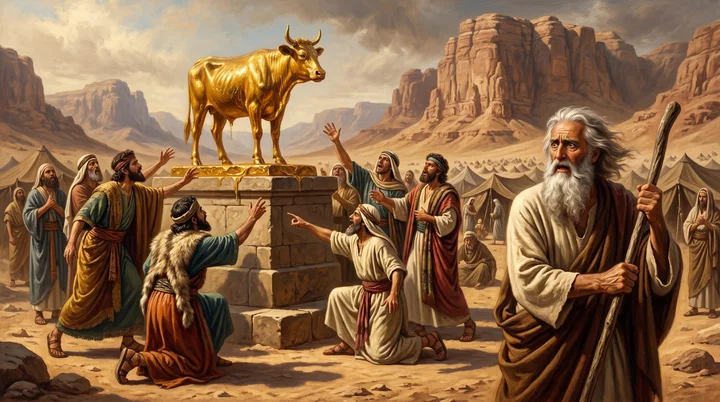
And they rose up early on the morrow, and offered burnt offerings, and brought peace offerings; and the people sat down to eat and to drink, and rose up to play.
Translations
American King James Version, King James Version, KJV Cambridge Paragraph Bible, Revised Version
And they rose up early on the morrow, and offered burnt offerings, and brought peace offerings; and the people sat down to eat and to drink, and rose up to play.
And they rose early on the morrow, and offered burnt-offerings, and brought peace-offerings: and the people sat down to eat and to drink, and rose up to play.
And they rose up early on the morrow, and offered burnt-offerings, and brought peace-offerings; and the people sat down to eat and to drink, and rose up to play.
and they rise early on the morrow, and cause burnt-offerings to ascend, and bring nigh peace-offerings; and the people sit down to eat and to drink, and rise up to play.
And they rose up early on the morrow, and offered up burnt-offerings, and brought peace-offerings; and the people sat down to eat and to drink, and rose up to sport.
So they rose up early, on the morrow, and offered ascending-sacrifices, and brought near peace-offerings, and the people sat down, to eat and to drink, and then rose up—to make sport!
So the next day they arose, offered burnt offerings, and presented peace offerings. And the people sat down to eat and drink, and got up to indulge in revelry.
So the next day they arose, offered burnt offerings, and presented peace offerings. And the people sat down to eat and drink and got up to indulge in revelry.
They rose up early on the next day, and offered burnt offerings, and brought peace offerings; and the people sat down to eat and to drink, and rose up to play.
So early on the day after they got up and made burned offerings and peace-offerings; and took their seats at the feast, and then gave themselves to pleasure.
So they rose vp the next day in the morning, and offred burnt offerings, and brought peace offrings: also the people sate them downe to eate and drinke, and rose vp to play.
Douay-Rheims (Challoner revision)
And rising in the morning, they offered holocausts, and peace victims, and the people sat down to eat, and drink, and they rose up to play.
Pictures
Cross-references 20 of 35
- 1 Corinthians 10:7
Neither be ye idolaters, as were some of them; as it is written, The people sat down to eat and drink, and rose up to play.
Paul uses Israel’s revelry as a warning to the church.
- Exodus 20:3
Thou shalt have no other gods before me.
The golden-calf worship violated the command to have no other gods.
- Psalms 106:19-20
They made a calf in Horeb, and worshipped the molten image.
Israel makes and worships the golden calf at Horeb.
- Exodus 24:18
And Moses went into the midst of the cloud, and gat him up into the mount: and Moses was in the mount forty days and forty nights.
Moses remains on the mountain with God for forty days while the people turn to the calf.
- 1 Corinthians 10:11-12
Now all these things happened unto them for ensamples: and they are written for our admonition, upon whom the ends of the world are come.
Israel’s experience warns later believers to take heed lest they fall.
- Exodus 32:19
And it came to pass, as soon as he came nigh unto the camp, that he saw the calf, and the dancing: and Moses’ anger waxed hot, and he cast the tables out of his hands, and brake them beneath the mount.
Moses sees the calf and dancing, then breaks the tablets.
- Exodus 32:1
And when the people saw that Moses delayed to come down out of the mount, the people gathered themselves together unto Aaron, and said unto him, Up, make us gods, which shall go before us; for as for this Moses, the man that brought us up out of the land of Egypt, we wot not what is become of him.
The people demand gods while Moses is delayed, leading to calf worship.
- Exodus 32:26
Then Moses stood in the gate of the camp, and said, Who is on the LORD’s side? let him come unto me. And all the sons of Levi gathered themselves together unto him.
Moses calls the people to choose the Lord’s side after the golden calf apostasy.
- 1 Corinthians 10:6
Now these things were our examples, to the intent we should not lust after evil things, as they also lusted.
Israel’s conduct is an example warning against desiring evil things.
- Exodus 24:5
And he sent young men of the children of Israel, which offered burnt offerings, and sacrificed peace offerings of oxen unto the LORD.
Both describe burnt offerings and peace offerings; the Sinai covenant preceded the calf worship.
- Psalms 106:21
They forgat God their saviour, which had done great things in Egypt;
Israel forgot God after his deliverance and made an idol.
- Exodus 32:23-24
For they said unto me, Make us gods, which shall go before us: for as for this Moses, the man that brought us up out of the land of Egypt, we wot not what is become of him.
Aaron blames the people and gives a false account of how the calf was made.
- Exodus 20:4-6
Thou shalt not make unto thee any graven image, or any likeness of any thing that is in heaven above, or that is in the earth beneath, or that is in the water under the earth:
The calf worship violates the prohibition against graven images.
- Exodus 32:20
And he took the calf which they had made, and burnt it in the fire, and ground it to powder, and strawed it upon the water, and made the children of Israel drink of it.
Moses destroys the golden calf worshiped by the people.
- Exodus 32:11-14
And Moses besought the LORD his God, and said, LORD, why doth thy wrath wax hot against thy people, which thou hast brought forth out of the land of Egypt with great power, and with a mighty hand?
Moses intercedes for Israel after the golden-calf rebellion, appealing to God’s promises.
- Exodus 32:31-32
And Moses returned unto the LORD, and said, Oh, this people have sinned a great sin, and have made them gods of gold.
Moses pleads for the people who worshiped the golden calf.
- Deuteronomy 9:20
And the LORD was very angry with Aaron to have destroyed him: and I prayed for Aaron also the same time.
Moses recalls God’s anger against Aaron and his prayer for him.
- Exodus 32:28
And the children of Levi did according to the word of Moses: and there fell of the people that day about three thousand men.
Three thousand Israelites die for worshipping the golden calf.
- Hebrews 8:9
Not according to the covenant that I made with their fathers in the day when I took them by the hand to lead them out of the land of Egypt; because they continued not in my covenant, and I regarded them not, saith the Lord.
Both describe Israel’s failure to remain faithful to the covenant.
- Exodus 19:8
And all the people answered together, and said, All that the LORD hath spoken we will do. And Moses returned the words of the people unto the LORD.
Israel’s pledge to obey was soon broken by calf worship.
Commentary part 1 of 2
Each commentary is drawn from primary sources: the writings of Ellen G. White and Adventist pioneers and periodicals. Each commentary is separate. Its own words are not a quotation; follow the references to read the source passages.
Ellen G. White
73 sources
The morning after Israel demanded visible gods, the people rose early to bring burnt offerings and peace offerings to the golden calf, then sat to feast and drink and rose to revel before it with leaping, singing and dancing that descended into gluttony, drunkenness and sensual indulgence.Ms 13, 1906, par. 5–719MR 109.2–3Ms 16, 1896, par. 3–5PP 761.1–3Ms 112, 1897, par. 42 They did this while Moses was still in the mount receiving God's law, after only a few weeks' delay had made them impatient, faithless and determined to wait no longer for their absent leader.5MR 247.3–248.1Ms 51, 1893, par. 3–5PP 315.2–3Ms 58, 1900, par. 23–251SP 242.3–244.1 To call the festival a feast to the Lord did not make it acceptable, for to worship the invisible God under the likeness of an ox was apostasy and rebellion that broke the covenant just made and transgressed the first and second commandments.Ms 13, 1906, par. 5–7Ms 170, 1904, par. 12Lt 69, 1904, par. 29–301SP 242.3–244.1ST May 13, 1880 Aaron, left in charge, failed through fear and desire to please the people, yielding to their clamor, making the calf, building its altar and leading them into offerings and revelry instead of standing firmly to prevent it.CT 351.2SG3 275.1RH Feb 4, 1909Ms 92, 1900, par. 22–25 The revelry stands as a warning that pleasure-seeking feasting casts off the fear of God and prepares the way for idolatry, and its swift punishment with mercy to the repentant testifies to both God's justice and His long-suffering toward transgressors.PP 335.1–2SLP 168.3SPBC 162.2SPBC 155.2
Setting at Sinai
The feasting took place while Moses was in the mount receiving God's law and sacred instructions, with the cloud of the Presence still before the people at the foot of Sinai shortly after their deliverance from Egypt.PP 315.2–3SG3 273.2RH Feb 4, 1909ST May 13, 1880 At that most solemn time the whole congregation should have been in a humble attitude before God, meditating on the law they had heard and keeping close to Him instead of turning to feasting and amusement.5MR 247.3–248.1Ms 51, 1893, par. 3–5PP 315.2–3 Instead of humbling their hearts they became careless, inattentive and lawless, eating and drinking and rising up to play and to revelry around the calf after presenting their offerings.PP 315.2–3SG3 273.2RH Feb 4, 1909ST May 13, 1880
Moses had been absent forty days, delayed only a few weeks in the cloud communing with God, and the people grew impatient, discontented and faithless in his absence.PP 315.2–3Ms 58, 1900, par. 23–251SP 242.3–244.1GW92 81.3–4 Feeling helpless without their leader they complained of his delay, determined to wait no longer, and their unbelief revealed itself in a marked manner.PP 315.2–3Ms 58, 1900, par. 23–25GW92 81.3–4 It is the same pattern seen when instruction is out of sight, as when the Corinthians fell back into heathen sins while Paul was absent and his heavenly instruction no longer urged them, even as Israel turned to eating, drinking and revelry while Moses was out of sight.SLP 150.1
At the suggestion of those who had practiced Egyptian idolatry, especially the impatient mixed multitude eager to reach the promised land, the people demanded visible gods to represent God and to go before them in the place of Moses.PP 315.2–31SP 242.3–244.1 They chose the ox or calf worshiped by the Egyptians as a symbol of deity, imitating Egyptian idolatry in direct violation of the first and second commandments.PP 315.2–31SP 242.3–244.1
This they did although God had given no similitude of Himself and had prohibited any material representation of Him.PP 315.2–3SG3 275.1 The miracles in Egypt and at the Red Sea were designed to establish faith in Him as the invisible, all-powerful Helper and only true God, and the desire for a visible manifestation had already been granted in the pillar of cloud and fire and in the revealing of His glory on Sinai amid sublime demonstrations of divine power.PP 315.2–3SG3 275.1
Feast and Revelry Described
On the morrow they rose up early and offered burnt offerings and brought peace offerings to the golden god, then sat down to eat and to drink and rose up to play before the calf.Ms 13, 1906, par. 5–719MR 109.2–3SG3 273.21SP 242.3–244.1PP 316.1–317.1 The celebration followed impatience over Moses' delayed return in the mount receiving special instructions and sacred oracles, and their demand for a visible god in imitation of Egyptian idolatry.SG3 273.2RH Feb 4, 19091SP 242.3–244.1 The worship was idolatrous even though Aaron had called the feast a feast to the Lord, for they joined religious offerings to worship of the calf and to revelry.Ms 13, 1906, par. 5–719MR 109.2–3Ms 16, 1896, par. 3–5PP 316.1–317.1
Aaron built an altar before the idol and proclaimed a feast to the Lord, and the people presented offerings and celebrated around the calf.RH Feb 4, 1909SPBC 155.4ST May 13, 1880RH Jul 29, 1873Lt 206, 1906, par. 34–37 The announcement was heralded by trumpeters from company to company through the camp, and on the morning after the altar was built they rose early to present offerings and to eat and drink and take part in revelry.RH Feb 4, 1909PP 316.1–317.1 Aaron made the calf to represent God, proclaimed it as God, and stirred up enthusiasm for this false worship.ST May 13, 1880RH Jul 29, 1873Lt 206, 1906, par. 34–37 Their worship came soon after they had heard God's law at Sinai and directly violated His command against idolatry, their faith failing when Moses was absent for a few weeks.ST May 13, 1880RH Jul 29, 1873
The word translated play means playing with leaping, singing, and dancing.PP 761.1–3 The dancing, especially in Egyptian worship, was sensual and indecent, and the festival was marked by the licentious practices of heathen worship of false gods.PP 761.1–3Ms 112, 1897, par. 42 By eating and drinking and holding such a festival they openly turned to idolatry and declared whom they would serve.Ms 112, 1897, par. 42
Their feasting, mirth, music, and dancing gave way to gluttony and to shameful revelry characteristic of heathen worship of false gods.19MR 109.2–3Ms 16, 1896, par. 3–5SPBC 155.4PP 316.1–317.1 The feast became shameful rioting and drunkenness, with merriment and dancing expressing shameful apostasy and with offerings to the idol, eating and drinking, and careless play while God's glory remained visible on Sinai.SPBC 155.43T 296.1–3RH Jul 29, 18733T 340.2 They worshiped the image as the god that had led them out of Egypt, soon after they had covenanted to obey His commands, turning quickly from covenant to idolatry and unrestrained conduct.3T 296.1–3RH Jul 29, 18733T 340.2
Idolatry Breaking Covenant
Mixing burnt offerings and peace offerings with worship of the calf was apostasy and rebellion, not true worship of God.Ms 13, 1906, par. 5–7Ms 170, 1904, par. 12Lt 69, 1904, par. 29–30 Calling the gathering a feast to the Lord was pretense covering an insult to Jehovah, and bringing peace offerings did not make the worship acceptable.Lt 69, 1904, par. 29–30PP 316.1–317.1RH Jul 29, 1873 The people rose early on the morrow to offer to the golden god, then sat down to eat and to drink and rose up to play, joining religious ceremony to revelry.Ms 13, 1906, par. 5–7Ms 170, 1904, par. 12PP 316.1–317.1 Aaron built an altar before the idol and proclaimed the feast, with the announcement heralded by trumpeters from company to company, yet it remained a feast over an image given up to gluttony, licentious reveling, rioting, drunkenness and reckless pleasure.PP 316.1–317.1RH Jul 29, 18733T 299.1–300.2
They worshiped the glory of the invisible God under the similitude of an ox, choosing the ox or calf worshiped by the Egyptians as a symbol of deity to represent God and to go before them.PP 315.2–3SG3 275.1 They treated the calf as the gods that brought them up out of Egypt, as the god that had led them out, and as God Himself, for Aaron made it to represent God, proclaimed it as God, and stirred up enthusiasm for the false worship.RH Jul 29, 18733T 340.2Lt 206, 1906, par. 34–37Lt 10, 1896, par. 4–7 This replaced Jehovah with an image and degraded and belittled their conception of Him, although He had given no similitude of Himself and had prohibited any material representation.PP 315.2–3SG3 275.1 It was done although the miracles in Egypt and at the Red Sea were meant to establish faith in Him as the invisible, all-powerful Helper, and although the desire for visible manifestation had been granted in the pillar of cloud and fire and the revealing of His glory on Sinai with the cloud of the Presence still before them.PP 315.2–33T 340.2
The act came only a few weeks after they had heard the law amid sublime demonstrations of divine power and after they had pledged solemn vows of allegiance to obey, and it broke the covenant they had just entered.SG3 275.1GW92 81.3–4ST Jul 29, 1897PP 371.2–4 Within weeks of entering the covenant they worshiped a graven image, so that Moses' later breaking of the tablets signified that God had broken His covenant with them.ST May 13, 1880ST Jul 29, 1897PP 371.2–4 By engaging in idolatry so recently and expressly forbidden, they transgressed the first and second commandments and violated the command against idolatry when Moses' absence for a few weeks tested their faith.1SP 242.3–244.1ST May 13, 1880SG3 275.1 Their failure exposed their sinfulness and inability to keep the law by their own strength and their need for pardon and a Saviour.1SP 242.3–244.1GW92 81.3–4
Excited by Satan to doubt, apostasy and rebellion, the people denied loyalty to Jehovah in open defiance of the law they had pledged, bowing in adoration before a golden image at the very foot of Sinai during the forty days Moses was in the mount while God was writing His law for His covenant people.PP 335.1–2 It was daring insult and blasphemy by which Satan planned to cause their ruin, to lead the Lord to divorce them and devote them to destruction, and thus to extinguish the seed of Abraham that was to preserve the knowledge of the living God and bring forth the true Seed to conquer Satan.PP 335.1–2 In the play Satan and his angels worked on human minds to make them forget God, turning what was supposed an innocent frolic and intemperate eating and drinking into a species of idolatry like the idols of the nations.Ms 32, 1900, par. 1–8
The worship was a turning back in heart to Egypt in sight of the mount, openly declaring whom they would serve by a festival marked by the licentious practices of the heathen.PP 315.2–3Ms 112, 1897, par. 42 Their revelry showed they had turned from God's law and turned quickly out of the way, dishonoring God despite His deliverance and glory and calling for humility before Jehovah.3T 341.1Ms 2, 1904, par. 20–27 It was a great offense that corrupted them and went to greater lengths in sin than had before entered their minds, because Aaron complied with their desires and proceeded with calm assurance to carry out their plans, which emboldened them.RH Feb 4, 1909Ms 2, 1904, par. 20–27 That apostasy is identified as the account of Israel's sin at Sinai.Ms 13, 1906
Aaron's Failure in Leadership
Left in charge at the foot of the mountain to guard the faithfulness of the people while Moses communed with God, Aaron showed weakness, cowardice, and defective administration, the same failure he had shown with his children in his home.CT 351.2SG3 275.1GW92 81.3–4Ms 73, 1912, par. 13Ms 92, 1900, par. 22–25 From fear of the people's clamors for his life he lost courage and trust in God and cowardly yielded to an impatient people in direct opposition to the commands of God instead of standing nobly for the honor of God.SG3 275.1GW92 81.3–4 Desiring to please them even at the sacrifice of principle, he would not stand firmly against their propositions or exercise his authority to hold the congregation back from wrongdoing.CT 351.2Ms 73, 1912, par. 13Ms 32, 1900, par. 1–8 To avoid offending them he failed to stop their rebellion and to lead them through the temptation.GW92 81.3–4Ms 92, 1900, par. 22–25Ms 26, 1900, par. 5–8
His very first permission to go contrary to God's commands in the least particular was to permit a spirit of hilarity, reveling, and commonness to come into the camp.CT 351.2RP 45.1Ms 73, 1912, par. 13Ms 32, 1900, par. 1–8 That first departure let the spirit of idolatry in and cost him his power of command.CT 351.2Ms 73, 1912, par. 13Ms 32, 1900, par. 1–8 It set in motion a current that could not be stayed until stern and decisive measures were taken.CT 351.2RP 45.1Ms 73, 1912, par. 13 What the people supposed an innocent frolic in eating and drinking as they chose and rising up to play became intemperate and idolatrous like the idols of the nations.Ms 32, 1900, par. 1–8
After first reasoning against the plan he yielded and joined in carrying it out.SG3 275.1Ms 92, 1900, par. 22–25Ms 26, 1900, par. 5–8Lt 83, 1896, par. 4–5 He made the molten calf to represent God, proclaimed it as God and as the gods that brought Israel up out of Egypt, built an altar to it, and stirred up enthusiasm for this false worship.SG3 275.1Lt 206, 1906, par. 34–37PP 425.4Lt 10, 1896, par. 4–7 He thus led the people into offerings, feasting, and revelry that dishonored God, insulted Jehovah, and weakened them spiritually.SG3 275.1Lt 83, 1896, par. 4–5Ms 13, 1906, par. 9 Leaders responsible for others must by this example resist pressure to disregard God's counsel.Ms 26, 1900, par. 5–8
He could have prevented the apostasy if he had had courage to stand for the right irrespective of consequences and had unswervingly maintained his own allegiance to God.SG3 275.1RH Feb 4, 1909Ms 6, 1889, par. 27–28 If he had cited the people to the perils of Sinai, reminded them of their solemn covenant with God to obey His law, spoken plainly against the wrongdoing, and told the truth plainly, that course would have checked the evil.RH Feb 4, 1909Lt 10, 1896, par. 4–7Ms 6, 1889, par. 27–28 Had he done so the calf would not have been made, but by complying with their desires and proceeding with calm assurance to carry out their plans he emboldened them to go to greater lengths in sin than had before entered their minds.RH Feb 4, 1909Lt 10, 1896, par. 4–7 His consent helped bring this sin and disgrace upon the people, showing the harm cowardice causes when people look to a leader for guidance.Lt 83, 1896, par. 4–5Ms 6, 1889, par. 27–28
His failure was so grievous and so serious that the Lord would have slain him had Moses not interceded.Ms 92, 1900, par. 22–25 He then tried to excuse himself by blaming the people and claiming the calf had simply come out of the fire, trying to make them responsible for his weakness and taking a half-and-half compromised position that displeased God.3T 341.2 His course illustrates the danger of trusting human leaders instead of depending on God.Ms 13, 1906, par. 9 Acting the part of Aaron now means opposing the word of the Lord, acting in favor of men opposed to the work of God, helping apostasy and betraying His cause by using influence to destroy confidence in messages of reproof and warning and to make of none effect what God sends.5MR 452.1Lt 121, 1906, par. 6 Leaders must not follow that example but build up the cause in right lines and seek to restore what wrongdoing has damaged.5MR 452.1
Judgment Tempered With Mercy
God let the hidden purpose of the leading men ripen into open wrongdoing, holding Moses back until the evil came to its full expression before the transgressors were punished, so that still greater evils might be prevented.Ms 13, 1906, par. 15 The swift punishment of those who persisted in rebellion upheld His law and government, checked wider corruption, and protected Israel from its enemies, and was mercy both to the nation and to the transgressors themselves. Their feast had become a shameful scene in which they ate and drank without regard for God or His mercy and gave themselves to revelry, dancing, and lustful indulgence, dishonoring God and bringing disgrace on His people before the heathen, yet though judgment was near opportunity was still given to forsake sin.SPBC 156.3
When Moses came down and found the worship of the calf he called for everyone on the Lord's side to show it and take position with the Lord.Ms 125, 1909, par. 40–41 Those who yielded, humbled themselves, and repented were mercifully pardoned and preserved alive, while those who would not be loyal and true but stubbornly ranged themselves on Satan's side were cut off and lost their lives.PP 335.1–2Ms 125, 1909, par. 40–41Ms 185, 1907, par. 13–16 Three thousand men perished, leaving broken ranks and reduced numbers as the mark of God's displeasure, and Moses pleaded with God on the people's behalf.3T 342.1GW92 33.1–34.3Ms 185, 1907, par. 13–16 The same test of loyalty by His Word comes in every age, bracing young and old as Bible students to do righteously, work out truth in character, keep hold on God under temptation, and gain strength of character for every trial through obedience.Ms 185, 1907, par. 13–16
The history stands as a perpetual testimony to the guilt and punishment of idolatry and to the justice and long-suffering mercy of God.PP 335.1–2 The failings of His people are plainly preserved as warnings and lessons for later generations, and this experience of calf worship should have left a lasting warning against apostasy.3T 342.14T 12.1–3 Israel could not bear the test of waiting on God, and no man can be trusted unless his course harmonizes with the Word of God.Ms 117, 1909, par. 15–22 The episode reveals two parties in the world, those serving apostasy and those serving God and keeping distinct from it, and presses upon each person the question which side he is on.Ms 117, 1909, par. 15–22
Warning Against Pleasure Seeking
Israel’s eating and drinking and rising up to play shows that pleasure and indulgence led them to cast off the fear of God they had felt when they heard the law, and their feasting and revelry after offering sacrifices prepared the way for idolatry and its consequences.SLP 168.3SPBC 155.2AA 315.2–316.1 Such pleasure-seeking gatherings centered on eating, drinking, music, singing, and amusement repeat that example, dulling the mind, opening the way to vulgar and degrading associations, drawing minds away from God, and failing to praise and thank Him or acknowledge His blessings.SPBC 162.28T 66.119MR 121.2–3 The conduct stands as disobedience to be warned against and not repeated.SPBC 155.2
Solemn spiritual privilege must be met with humble closeness to God, not with indulgence and sport that loosens hold on Him, as Israel failed on a most solemn occasion while Moses was in the mount to receive instruction and the whole congregation should have been humble before God but turned to feasting and amusement.5MR 247.3–248.1 Games and exhibitions such as football, tennis, cricket, and the bicycle craze, provided merely to amuse instead of exercises productive of good, do not bring participants into closer relation to God, enter a path Christ has not traveled, grieve the Spirit, and leave effects not easily effaced.5MR 247.3–248.1CT 367.3–368.1Ms 32, 1900, par. 1–8 Physical training of bodily powers with mental powers is ordained, but in character it must be in complete harmony with the lessons Christ gave His disciples, lest teachers and students be recorded as lovers of pleasure more than lovers of God.5MR 247.3–248.1 Aaron’s first permission of hilarity and commonness, when the people ate and drank as they chose and became intemperate until they rose up to play in what they supposed an innocent frolic, cost him commanding power and let in a current of idolatry like the idols of the nations, in which Satan and his angels worked on minds to make them forget God, a current that could not be stayed.Ms 32, 1900, par. 1–8
The same spirit appears now in low, common pleasure parties for eating and drinking, singing and playing instruments of music with mirth, carousing, hilarity, and glee.CT 367.3–368.1 It appears also in church festivals and school gatherings centered on feasting and entertainment, and in pleasure-centered gatherings for eating, drinking, singing, and playing, which put God out of mind, lead people away from God, corrupt character, and lead to neglect of sacred duties.STE 215.2–38T 66.12RED 65.2–66.2LC1 169.1–170.219MR 121.2–3 Such indulgence channels thoughts downward, perverting a person’s powers and leaving lasting damage to character.19MR 121.2–3
Those who imitate ancient Israel’s thoughtless feasting and gaiety show little care for Christ’s sufferings, have no sense of them, do not care to meditate upon self-denial and sacrifice, and find little interest in the marked points in the history of Christ’s life upon which the plan of salvation rests.RH Oct 13, 18742RED 65.2–66.2LC1 169.1–170.2ST Mar 4, 1913 To copy a pattern correctly its design must be carefully studied, so to overcome as Christ overcame requires becoming acquainted with the Redeemer’s life, denying self as He did, meeting temptations and overcoming obstacles, and through toil and suffering in the name of Jesus overcoming in order to mingle with the glorified company before the throne.RH Oct 13, 1874
Such gratification is inspired by a spirit from beneath and is an offering to Satan and an offense to God that kindles His wrath.CT 367.3–368.1 Letting amusements and competition absorb abilities turns people from watchfulness and prayer, misuses grace and God-given powers, fails to put God first, and bows the soul to an idol.CT 367.3–368.1Lt 58, 1893, par. 4–5 In these gratifications the mind becomes besotted even as with liquor-drinking, thoughts allowed to run in a low channel soon pervert all the powers of the being, and even when sin is seen and repented and the transgressor pardoned, the keen and sensitive power of discernment to distinguish between the sacred and the common is in great measure destroyed, wounding the soul, carrying scars through lifetime, bringing a stain upon the cause, fostering spiritual blindness, and turning people against the work of the Holy Spirit.CT 367.3–368.119MR 121.2–3
The same influence works today when cherished idols in families and churches separate from God just as the golden calf separated Israel, in small as well as large matters.Ms 52, 1898, par. 23–27 This idolatry appears especially in pride budding and blossoming in apparel, in conformity to the world in fashions of dress, speech, and deportment, in outward adorning with plaited hair, gold, pearls, and costly array, in spending for self-gratification, and in worship of self.Ms 52, 1898, par. 23–27 Outward appearance testifies of the inward working of the heart, revealing its thoughts and interests, and these things steal away love and trust and confidence in God, mar religious experience, and develop a selfishness God cannot look upon.Ms 52, 1898, par. 23–27 God’s people must therefore search themselves and see the idols they cherish, be repentant and not merely ashamed when reproved, become a distinct and separate people, practice self-denial and economy to relieve the poor and suffering near and far, turn from worship of self, and appear in modest apparel in harmony with faith as evidence that truth received in the heart has transformed mind, heart, and character.Ms 52, 1898, par. 23–27
All these things happened as examples of lusting after evil things and of idolatry and were written for admonition upon those on whom the ends of the world are come.SPBC 155.2RH Sep 24, 1908Ms 79, 1908, par. 13–15 The verse warns pleasure-lovers, especially youth, against danger in pleasure seeking and teaches the need to develop Christian character.19MR 121.2–319MR 107 None must assume security lest they fall, but must heed the warnings preserved in Scripture, for God is testing by His Word.RH Sep 24, 1908Ms 185, 1907, par. 13–16Ms 79, 1908, par. 13–15 Young and old must be braced up as Bible students and led to do righteously and work out truth in character, so that if obedient they will have strength of character under every temptation and will not lose hold upon God.Ms 185, 1907, par. 13–16 The same test that came when Israel broke its vow at Sinai, made a calf and gave it the honor of bringing them out of Egypt, and then faced Moses’ call for all on the Lord’s side to take position — when those who would not be loyal perished, three thousand men — will come in our day.RH Jun 25, 1861Ms 185, 1907, par. 13–16
Sources