Exodus 2:23
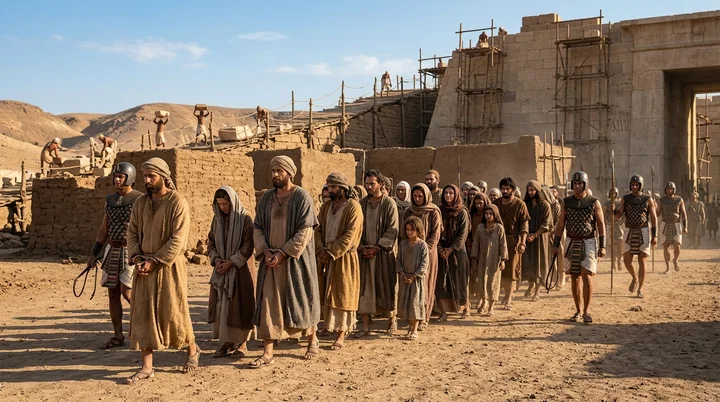
And it came to pass in process of time, that the king of Egypt died: and the children of Israel sighed by reason of the bondage, and they cried, and their cry came up unto God by reason of the bondage.
Translations
And it came to pass in process of time, that the king of Egypt died: and the children of Israel sighed by reason of the bondage, and they cried, and their cry came up to God by reason of the bondage.
King James Version, KJV Cambridge Paragraph Bible
And it came to pass in process of time, that the king of Egypt died: and the children of Israel sighed by reason of the bondage, and they cried, and their cry came up unto God by reason of the bondage.
And it came to pass in process of time, that the king of Egypt died: and the children of Israel sighed by reason of the bondage, and they cried; and their cry ascended to God, by reason of the bondage.
Revised Version, American Standard Version
And it came to pass in the course of those many days, that the king of Egypt died: and the children of Israel sighed by reason of the bondage, and they cried, and their cry came up unto God by reason of the bondage.
And it cometh to pass during these many days, that the king of Egypt dieth, and the sons of Israel sigh because of the service, and cry, and their cry goeth up unto God, because of the service;
And it came to pass during those many days, that the king of Egypt died. And the children of Israel sighed because of the bondage, and cried; and their cry came up to God because of the bondage;
And it came to pass, during those many days, that the king of Egypt died, and the sons of Israel sighed by reason of the servitude and lamented,—and their cry for help went up to God, by reason of the servitude.
Berean Standard Bible, Majority Standard Bible
After a long time, the king of Egypt died. The Israelites groaned and cried out under their burden of slavery, and their cry for deliverance from bondage ascended to God.
In the course of those many days, the king of Egypt died, and the children of Israel sighed because of the bondage, and they cried, and their cry came up to God because of the bondage.
Now after a long time the king of Egypt came to his end: and the children of Israel were crying in their grief under the weight of their work, and their cry for help came to the ears of God.
Then in processe of time, the King of Egypt dyed, and the children of Israel sighed for the bondage and cryed: and their crie for the bondage came vp vnto God.
Douay-Rheims (Challoner revision)
Now after a long time the king of Egypt died: and the children of Israel groaning, cried out because of the works: and their cry went up unto God from the works.
Pictures
Cross-references 20 of 27
- Genesis 15:13-14
And he said unto Abram, Know of a surety that thy seed shall be a stranger in a land that is not theirs, and shall serve them; and they shall afflict them four hundred years;
God foretold Israel’s oppression in a foreign land and their deliverance.
- Exodus 3:7-10
And the LORD said, I have surely seen the affliction of my people which are in Egypt, and have heard their cry by reason of their taskmasters; for I know their sorrows;
God sees Israel’s affliction, hears their cry, and acts to deliver them.
- Exodus 1:13-14
And the Egyptians made the children of Israel to serve with rigour:
Egyptians made Israel serve harshly, leading to their cry for deliverance.
- Acts 7:34
I have seen, I have seen the affliction of my people which is in Egypt, and I have heard their groaning, and am come down to deliver them. And now come, I will send thee into Egypt.
God hears Israel’s groaning in Egypt and sends Moses to deliver them.
- Exodus 3:16-17
Go, and gather the elders of Israel together, and say unto them, The LORD God of your fathers, the God of Abraham, of Isaac, and of Jacob, appeared unto me, saying, I have surely visited you, and seen that which is done to you in Egypt:
God has seen Israel’s affliction and promises to bring them out of Egypt.
- Exodus 4:31
And the people believed: and when they heard that the LORD had visited the children of Israel, and that he had looked upon their affliction, then they bowed their heads and worshipped.
Israel believes God has attended to their affliction and worships.
- Exodus 3:10
Come now therefore, and I will send thee unto Pharaoh, that thou mayest bring forth my people the children of Israel out of Egypt.
God answers Israel’s cry by sending Moses to free them.
- Exodus 6:5-8
And I have also heard the groaning of the children of Israel, whom the Egyptians keep in bondage; and I have remembered my covenant.
God hears Israel’s groaning and promises deliverance, belonging to him, and the promised land.
- Exodus 3:4
And when the LORD saw that he turned aside to see, God called unto him out of the midst of the bush, and said, Moses, Moses. And he said, Here am I.
God reveals Himself to Moses after Israel’s cry for deliverance.
- Deuteronomy 4:20
But the LORD hath taken you, and brought you forth out of the iron furnace, even out of Egypt, to be unto him a people of inheritance, as ye are this day.
Egypt is described as an iron furnace.
- Exodus 1:22
And Pharaoh charged all his people, saying, Every son that is born ye shall cast into the river, and every daughter ye shall save alive.
Pharaoh’s order to kill Hebrew boys exemplifies the oppression that led Israel to cry out.
- Exodus 1:8
Now there arose up a new king over Egypt, which knew not Joseph.
The new king’s rule leads to Israel’s sighing under bondage.
- Ezekiel 20:5
And say unto them, Thus saith the Lord GOD; In the day when I chose Israel, and lifted up mine hand unto the seed of the house of Jacob, and made myself known unto them in the land of Egypt, when I lifted up mine hand unto them, saying, I am the LORD your God;
God made Himself known in Egypt
- Exodus 3:18-20
And they shall hearken to thy voice: and thou shalt come, thou and the elders of Israel, unto the king of Egypt, and ye shall say unto him, The LORD God of the Hebrews hath met with us: and now let us go, we beseech thee, three days’ journey into the wilderness, that we may sacrifice to the LORD our God.
Moses asks Pharaoh to release Israel, and God foretells signs against Egypt.
- Exodus 1:11
Therefore they did set over them taskmasters to afflict them with their burdens. And they built for Pharaoh treasure cities, Pithom and Raamses.
describes taskmasters and affliction behind the sighing
- Exodus 12:31-42
And he called for Moses and Aaron by night, and said, Rise up, and get you forth from among my people, both ye and the children of Israel; and go, serve the LORD, as ye have said.
Israel’s oppression in Egypt ends with their deliverance from the land.
- Genesis 50:24
And Joseph said unto his brethren, I die: and God will surely visit you, and bring you out of this land unto the land which he sware to Abraham, to Isaac, and to Jacob.
Joseph foretold that God would bring Israel out of Egypt.
- Acts 7:19
The same dealt subtilly with our kindred, and evil entreated our fathers, so that they cast out their young children, to the end they might not live.
describes same affliction and cry to God
- 1 Kings 8:51
For they be thy people, and thine inheritance, which thou broughtest forth out of Egypt, from the midst of the furnace of iron:
calls Egypt the iron furnace
- Luke 1:68
Blessed be the Lord God of Israel; for he hath visited and redeemed his people,
God heard Israel’s cry and sent a Deliverer to redeem his people.
Commentary
Each commentary is drawn from primary sources: the writings of Ellen G. White and Adventist pioneers and periodicals. Each commentary is separate. Its own words are not a quotation; follow the references to read the source passages.
Ellen G. White
17 sources
After the king who had sought Moses' life died, Israel remained under long, cruel bondage with hard servitude and anguish, and they sighed and cried out by reason of that bondage until their cry came up unto God.PP 251.2–252.11SP 170.2–171.1SG3 250.1ST Sep 9, 1913SG1 192.1 God heard their groaning, remembered His covenant with Abraham, with Isaac, and with Jacob, and looked upon them with respect, for the time for their deliverance had come.PP 251.2–252.1ST Apr 8, 1875RH Apr 29, 1875SG3 297.1–2 He answered with a strong hand and outstretched arm to bring them out to Himself as His peculiar treasure, working through Moses and Aaron with angels enabling them and with plagues upon the Egyptians.ST Jan 22, 1880ST Apr 8, 1875RH Apr 29, 1875Ms 3, 1885, par. 10–11Ms 38, 1898, par. 15 They had been permitted to fall into slavery to an idolatrous nation because they dishonored Him by transgression and apostasy and imitation of nations without God, and He let distress turn them back to choose His rule and obey Him, so their oppression did not mean He had forsaken them.ST Apr 8, 1875RH Apr 29, 1875SG3 297.1–2Ms 3, 1885, par. 10–11 Their prayers that long seemed unanswered were heard and answered in His own time, and as their cry for deliverance came before Him so the cries of the saints and of all held in cruel bondage rise to heaven, and He punishes the nation and the professed Christians guilty of the sin of slavery until the land drinks the dregs of His fury.SG1 204.1RH Aug 27, 1861ST Sep 9, 1913Lt 16, 1861, par. 26
Israel's Bondage and Cry
In process of time the king of Egypt who had sought Moses' death died, and it was another Pharaoh who was ruling when Moses was sent to seek Israel's release.1SP 170.2–171.1 After years and a long period of bondage Israel endured hard servitude and oppression with cruel abuse and deprivation, lamenting and wailing in anguish over their suffering.1SP 170.2–171.1ST Sep 9, 1913Ms 38, 1898, par. 15 Their children had been put to death, and their grief and crying to God arose from that oppression.1SP 170.2–171.1SG3 250.1 That hard bondage proves false the saying later heard in the wilderness that it had been well with them in Egypt.Ms 38, 1898, par. 15
Israel had been permitted to go into bondage and was punished with slavery to an idolatrous nation because they did not walk in God's ways but dishonored Him by continual transgressions.ST Apr 8, 1875RH Apr 29, 1875Ms 3, 1885, par. 10–11 They had departed from the worship of the true God and transgressed His law by apostasy, imitating the customs of nations without knowledge of God, as had been shown to Abraham in vision that his posterity would become bondmen through apostasy.ST Apr 8, 1875RH Apr 29, 1875 Under oppression and hard servitude they could not keep God's Sabbath, and by long mingling with an idolatrous nation their faith became confused and corrupted.Ms 3, 1885, par. 10–11 Many had lost the knowledge of the true God, while some still worshiped Him.ST Mar 4, 1880 The faithful sought freedom not only from oppression but also from the idolatry and corrupting influence around them, yet they expected release without suffering and lacked the faith and patience to endure affliction while waiting for God to act.ST Mar 4, 1880
Their sighing, grieving, and earnest crying by reason of the bondage was a humbling in which they acknowledged God's dealings and pleaded for deliverance from the oppressive yoke.ST Jan 22, 1880ST Apr 8, 1875RH Apr 29, 18751SP 170.2–171.1 In that cry they promised to serve God and be obedient to His law if He would break the yoke off them.ST Jan 22, 1880ST Apr 8, 1875RH Apr 29, 1875 God allowed the suffering so that distress would turn them back to Him to choose His righteous and merciful rule and obey His requirements, so their oppression did not mean He had forsaken them.SG3 297.1–2 Their long grief over bondage prepared them to hear Moses' message that God had seen their affliction and would bring them to a land flowing with milk and honey.1SP 170.2–171.1 Their prayers may have seemed unanswered for a long time, but God heard them and answered in His own time.ST Sep 9, 1913
God Heard and Delivered
Their sighing and crying and groaning under bondage rose up to God and reached heaven before Him, joining oppression to a cry for help that God hears.PP 251.2–252.1SG1 192.1 God heard their groaning and remembered His covenant with Abraham, with Isaac, and with Jacob, and looked upon the children of Israel and had respect unto them, remaining mindful of His covenant and not forsaking them.PP 251.2–252.1SG3 297.1–2 The appointed time for Israel's deliverance had come, and He mercifully answered their anguished prayers, even after their children had been put to death and their prayers had long seemed unanswered, in a most wonderful manner with a strong hand and with an outstretched arm in His own time.PP 251.2–252.1ST Apr 8, 1875RH Apr 29, 1875Ms 38, 1903, par. 10–12SG3 250.1
He answered by bringing Israel forth from Egypt to take them to Himself as His peculiar treasure and treasured people in covenant, a blessing first conferred because Abraham was faithful in keeping God's commandments, promising to take them as His people and lead them to a good land.ST Jan 22, 1880ST Apr 8, 1875RH Apr 29, 1875SG3 250.1 He wrought through Moses for their deliverance, sending Moses and Aaron to deliver them, with angels of God attending those representative men to enable them to execute His will, to preserve them, and to bring plagues upon the Egyptians.Ms 3, 1885, par. 10–11Ms 38, 1898, par. 15
His purpose was to accomplish the deliverance in a manner to pour contempt on human pride, with the deliverer going forth as a humble shepherd with only a rod in his hand, and God making that rod the symbol of His power.PP 251.2–252.1 That deliverance displayed His power against oppression and His protection of the righteous, and helped preserve the people from abandoning God and His law.ST Sep 9, 1913
Later Cries and Warnings
As Israel's cries for deliverance from bondage came up before God, so the saints' day-and-night cries for deliverance likewise come before Him.SG1 204.1 In the final time of trouble God's people flee from cities and villages while the wicked pursue them and enter houses with swords to kill them.LSEGW 102.1 God breaks the raised swords powerless as straw.LSEGW 102.1 God's people cry day and night for deliverance until their cry comes up before God.SG1 204.1LSEGW 102.1
The cries, groans, agony, and sufferings of people held in cruel bondage rise to heaven to God.RH Aug 27, 1861Lt 16, 1861, par. 26 Angels stand amazed at the hard-hearted, untold, agonizing suffering that man made in the image of his Maker inflicts on his fellow man.RH Aug 27, 1861 The guilt of oppressors is recorded in blood, crossed with stripes, and flooded with burning tears of suffering.RH Aug 27, 1861 God punishes the nation guilty of the sin of slavery, and His anger burns against a nation that practices slavery.RH Aug 27, 1861Lt 16, 1861, par. 26 His anger burns especially against professed Christians who hold slaves and cruelly oppress them day by day, and will not cease until He has caused the land to drink the dregs of the cup of His fury, and in the day of the execution of His judgment it will be more tolerable for heathen and papists than for such cruel professed Christians.RH Aug 27, 1861 Slavery long continued is a curse to the nation that allows it, and His scourge falls even on those who have long submitted to letting slavery exist and letting their fellow men be held in hopeless slavery, tyrannized over and tortured and treated as no more than brutes.Lt 16, 1861, par. 26
The verse shows the same work for the colored people in America, for as the cry of suffering of the children of Israel in bondage in Egypt came up to God and He delivered them with a strong hand and with an outstretched arm, so God delivered them from slavery.Ms 38, 1903, par. 10–12 He then placed upon the people of this nation the responsibility of uplifting them and placing them in a position where they could help themselves.Ms 38, 1903, par. 10–12 The many years during which that work ought to have been done and was left undone leave the field in barrenness as an open rebuke to those who could have helped.Ms 38, 1903, par. 10–12 Association with the ungodly and unbelieving will have the same corrupting influence upon those who believe present truth as mingling with idolaters had upon Israel, unless they keep the Lord ever before them so that His Spirit shall be their shield.Ms 3, 1885, par. 10–11
Sources
Pioneers and periodicals
43 sources
In process of time Egypt's king died while Israel remained in bitter bondage, and they sighed and cried out, placing their suffering and appeal after the king's death and before Moses was called to deliver them.RH Jan 20, 1916RH Dec 17, 1861ST Jan 20, 1909 Their cry by reason of the bondage came up unto God, and in compassion He remembered His covenant with Abraham, Isaac and Jacob.RH Jun 20, 1912 Through heavier tasks and utter helplessness they were humbled to see their folly, acknowledge God's dealings, and promise to serve Him and obey His law if He would break their yoke.ST Jan 22, 1880ST Apr 8, 1875ST Jun 25, 1902RH Nov 25, 1909 They already knew and feared the true God as His church on earth, so His afterward making Himself known was a fuller revelation and not a first introduction, while those who held the other teach that their worship proves they had not forgotten Him and the Sabbath at Sinai was newly given and not recalled.RH May 6, 1852RH Jul 24, 1866RH Feb 3, 1852RH Sep 24, 1872 Earnest pleading avails, for God hears the suffering of those in bondage, delivers the oppressed and punishes oppressors, as with Africans brought by force and sold and whipped whose cry in unutterable pathos also went up to heaven.RH Sep 9, 1862RH Oct 8, 1861RH Feb 2, 1864
Setting in Exodus History
Exodus 2:23 stands in the first, mainly historical division of Exodus, chapters 1-18, in the opening section chapters 1-4 that begins with the oppression of Israel in Egypt and relates the birth and upbringing of Moses until he is called to be the deliverer of his people. It belongs to the series of events in Exodus 1-14 that have no direct mention in the historical records of Egypt, because Egyptian public monuments registered only successes and triumphs and Egyptian court historians and kings inscribed no account of defeats, including terrible plagues suffered during a whole year and the disaster at the Red Sea.RH Apr 23, 1908 It comes about three and one-half millenniums ago when Egypt ruled the world as the greatest of earthly kingdoms in might and power and skill and wisdom in statecraft, deifying her annually overflowing and fertilizing river as a god and worshiping the sun from whom her kings received title as representatives of the sun-god.ST Nov 14, 1906
The children of Israel are the few descendants of the nomadic patriarch Abraham who sought supplies from her granaries, and before their bondage the captive slave Joseph taught Pharaoh how to store grain in plenteous years to become rich in famine, instituted a just land-law with easy combined rental and taxes, and as prime minister brought prosperity in which the people living in Egypt knew no oppression.ST Nov 14, 1906 As long as his memory lived among the rulers of Egypt he was honored, his laws governed, the country flourished, and the people prospered.ST Nov 14, 1906 The verse belongs to the period of Israel's long and bitter oppression in Egypt, which followed only a brief time of prosperity, and that servitude had been foreshadowed in Abraham's vision.RH Dec 17, 1861 That deliverance came after a long period of gradually increasing oppression in Egypt, which had brought the people into ignorance and degradation.RH Oct 21, 1862
The verse marks the passage of time before Israel's deliverance: Egypt's king died, while the Israelites remained in bitter bondage and cried out to God because of their oppression, and their suffering and cry introduce the story of Israel's great deliverance from Egypt.RH Jan 20, 1916 Their cries under Egyptian bondage are placed after the king's death, and their suffering and appeal to God belong to the account of their oppression in Egypt before Moses is called to deliver them.ST Jan 20, 1909 The king of Egypt who oppressed Israel died only after many years, and the long time covers the successive persecutions of the Hebrews and Moses's forty-year stay in Midian, with the same king still on the throne when Moses returned to Egypt.ST Apr 14, 1887
The reign lasted sixty-seven years, Rameses II having been associated on the throne from childhood through his mother and counting his reign from Seti's death when he was eighteen or twenty years old, and such a long reign in peace, undisturbed by invasion after the wars with the Hittite Empire ended in treaty, allowed the policy of repression toward the Hebrews, using their labor and breaking their spirit.ST Apr 14, 1887 Israel's bondage continued until the Egyptian king died, and the Israelites had long grieved under it, yet by the time Moses was to appear before Pharaoh a different king ruled, since Pharaoh was a title borne by nearly all the Egyptian kings.ST Feb 26, 1880 The sighing and crying of Israel under bondage was the groans and murmurs of labor gangs crushed by Egypt's age-old oppression of its toiling thousands.ST Apr 14, 1887
Their suffering was brutal physical toil with almost no machinery and little mechanical help, the whole strain laid on human muscle, dragging huge stone masses like beasts of burden, with arms utterly worn out, vile mixed food, washing only once in a season, and at worst dragging for a month together over soft yielding garden soil a huge block ten cubits by six, with thousands falling worn out under the blows of pitiless taskmasters.ST Apr 14, 1887 Their cry coming up to God was a cry to Someone above to punish oppressors well, taking the shape of starving and beaten laborers complaining, They starve us, They beat us, and looking for punishment from above.ST Apr 14, 1887 The Israelites sighed and cried under their bondage in Egypt, where they labored for Pharaoh under the taskmaster's lash and were denied straw for making bricks, including making brick with bodies splashed with clay under an overseer with baton ready, denied straw yet required to keep the daily number.ST Apr 14, 1887ST Sep 22, 1881
The verse belongs to the true early history of Moses in Exodus 2, including his being hidden three months by his parents, his adoption by Pharaoh's daughter, and his flight into Midian, and this history is no fable because the same account is largely reproduced in Acts 7.ST Apr 13, 1904 Moses at forty years old left the court of Pharaoh to unite himself with the Hebrews in slavery because his mother Jochebed had taught him effectually in his early youth, passing on the treasures of divine truth handed down from Abraham and Isaac and Jacob through Levi.ST Oct 11, 1883 Moses thus possessed all the divine truth held by his ancestors with the highest measure of inspiration ever given to man and was well instructed concerning the events of the last day.ST Oct 11, 1883 He is one of the men the Lord has always raised up both in the church and in the world to fill certain important places in his work in his great plan, a man of the hour specially called and fitted for the particular occasion.RH Oct 19, 1916
Bondage and Israel's Cry
The bondage in Egypt drove Israel to sigh and groan and cry out to God, and that cry rose to Him because of the bondage. It was an exceedingly bitter chorus of multitudes groaning under taskmasters, condemned to impossibilities and gazing in despair upon unconquerable work.ST Sep 2, 1886 It was the groans and murmurs of labor gangs crushed by age-old oppression, complaining that they were starved and beaten and looking above for the punishment of oppressors, a cry still heard unchanged among oppressed field workers in the East.ST Sep 2, 1886ST Apr 14, 1887 That toil was brutal physical labor with almost no machinery, laying the whole strain on human muscle in making brick with bodies splashed with clay under an overseer with baton ready, in dragging huge stone masses like beasts with arms worn out on vile mixed food and washing only once in a season, and at worst in dragging for a month over soft garden soil a block ten cubits by six while thousands fell worn out under pitiless taskmasters.ST Apr 14, 1887
The oppression followed departure from the God of the fathers to worship Egyptian gods and imitate the customs of nations without knowledge of God, so that bondage to an idolatrous nation was punishment for transgressing His law and apostasy, as foretold to Abraham in vision that his posterity would become bondmen.ST Apr 8, 1875RH Apr 29, 1875ST Jun 25, 1902 During more than four hundred years after Joseph's death and more than two hundred years after Joseph was sold into Egypt, Israel in large measure lost living connection with the God of the fathers.ST Mar 4, 1880RH Jun 20, 1912 Intermingling with Egyptians, imbibing their spirit, adopting customs, and losing purity and simplicity of faith, they were sunken in polytheism, idolatry and licentiousness and had well-nigh lost knowledge of God and His laws.ST Feb 28, 1906RH Jun 20, 1912 Many lost knowledge of the true God while some still worshiped Him, and the faithful sought freedom not only from oppression but from idolatry and corrupting influence.ST Mar 4, 1880
The suffering brought Israel to see the folly of their course and to become willing to return to God.ST Jun 25, 1902 They humbled themselves, acknowledged God's dealings, cried earnestly for deliverance from the oppressive yoke, and promised to serve God and obey His law if He would break their bondage.ST Jan 22, 1880ST Apr 8, 1875RH Apr 29, 1875 Their cries and promises reached heaven, to be answered by bringing them forth from Egypt to take them as His peculiar treasure and renew the covenant made with the fathers, a blessing first conferred because Abraham was faithful in keeping God's commandments.ST Apr 8, 1875RH Apr 29, 1875 God prepared both deliverer and people through suffering before that cry, for while Moses was called from Pharaoh's court to spend forty long years training in the wilderness, heavier tasks were laid on Israel.RH Nov 25, 1909 They were required to make brick without straw without abating the daily number, taskmasters became more exacting and cruel, destruction of the male children was enforced more rigidly by increased vigilance, and lives were made wretched with cruelty and slavery until hearts despaired and in utter helplessness they prayed for mercy, so that great travail of soul came before the exodus.RH Nov 25, 1909
The bitterness had purpose, for if bondage had been less bitter Israel would have rested content in Egypt. Out of that bondage came the exodus and the Messiah, proving that darkest days bear choicest fruit. Yet they expected release without suffering and lacked faith and patience to endure afflictions while waiting for God to act.ST Mar 4, 1880 Their prayers may have seemed unanswered for a long time, with suffering even intensified as Pharaoh tightened oppression, and God answered in His own time through events that appeared to work against the deliverance sought.ST Sep 9, 1913RH Oct 27, 1874
God Heard and Delivered
Their sighing and crying by reason of the bondage ascended to heaven as cries of anguish and distress, and God in compassion remembered His covenant with Abraham and His promise unto Isaac and Jacob.RH Jun 20, 1912 Sin had broken connection with Him and they had in large measure largely forgotten Him in Egyptian bondage, yet He still longed for fellowship with them.RH Jun 29, 1916RH Jun 20, 1912 Their groanings under slavery came up to the ears of the God of Sabaoth, and He answered with mighty miracles to recover their liberty and bring them out toward the promised land so He could associate with them again.RH Jun 29, 1916
In their distress they humbled themselves, acknowledged God's dealings with them, and cried earnestly for deliverance from the oppressive yoke with promises to serve God and be obedient to His law if He would break their bondage.ST Jan 22, 1880ST Apr 8, 1875RH Apr 29, 1875 Their cries and promises reached heaven, and God answered their prayers in a most wonderful manner by bringing Israel forth from Egypt to take them to Himself as His peculiar treasure and renew to them the covenant made with their fathers.ST Jan 22, 1880ST Apr 8, 1875RH Apr 29, 1875 That blessing was first conferred because Abraham was faithful in keeping God's commandments.ST Jan 22, 1880RH Apr 29, 1875 Their sighing fulfilled what the Lord had told Abram hundreds of years before, that his seed would be afflicted four hundred years and afterward be brought out with great substance.ST Jul 13, 1915 More than two hundred years after Joseph was sold into Egypt, and after more than four hundred years of long bondage and servitude until the exodus, the once-small Hebrew colony in Goshen kindly received at first for Joseph's sake had grown into a mighty multitude, so a new king who knew not Joseph feared they would join his enemies in war and set taskmasters over them to afflict them.ST Jul 13, 1915RH Jun 20, 1912
When the time arrived for that prophecy to be fulfilled, for their deliverance He raised up Moses and Aaron and sent them to Pharaoh with the request that he let Israel go.ST Jul 13, 1915RH Jun 20, 1912 He worked mighty signs and wonders in Egypt, shielding Israel from evil while plaguing the Egyptians.RH Apr 3, 1879 Their suffering even intensified as Pharaoh tightened their oppression, and their prayers may have seemed unanswered for a long time.ST Sep 9, 1913RH Oct 27, 1874 God heard them and answered in His own time through events that appeared to work against the deliverance they sought, ultimately breaking their bondage.ST Sep 9, 1913RH Oct 27, 1874 That deliverance displayed His power against oppression and His protection of the righteous, and helped preserve people from abandoning God and His law.ST Sep 9, 1913
Their suffering preceded His deliverance of them, for their rescue was not earned by their righteousness.ST Dec 11, 1901 They were to be saved through faith in the way God provided, which became a final trial of their faith.ST Dec 11, 1901 He redeemed them with a mighty hand, yet their hundreds of years of slavery had unfitted them to comprehend His great salvation and the character He required. After delivering them He therefore gave them a great multiple object-lesson by various forms and rites that would comprehend in its teaching the great plan of salvation in the sanctuary He commanded them to build.
Knowledge of God and Sabbath
The sighing and crying that came up unto God by reason of bondage proves that Israel in Egypt already knew and feared the true God.RH May 6, 1852RH Jul 24, 1866RH Feb 3, 1852 They cried to Him constantly under oppression, and were the only church of God on earth at that time.RH May 6, 1852RH Feb 3, 1852 This stands contrary to the claim that they were ignorant idolaters like the Egyptians.RH Jul 24, 1866 God's afterward making Himself known to them was therefore not a first introduction but a fuller revelation of Himself and of their duty to Him.RH May 6, 1852RH Feb 3, 1852 Even so, His making known the holy Sabbath was a further setting forth and impressing of an already existing Sabbath rather than its first creation, so making known at Sinai does not mean they were ignorant of it before.RH May 6, 1852RH Feb 3, 1852
By contrast, others hold that their worshiping God in Egypt, with their cry coming up unto Him, proves they had not forgotten the Lord and His past dealings.RH Sep 24, 1872 On that ground the Sabbath made known at Sinai was newly given and not a forgotten ordinance recalled to their minds.RH Sep 24, 1872 The weight of teaching holds that they were in the most abject bondage in the iron furnace of Egyptian servitude, under a monarch who denied any knowledge of Jehovah and forced them to toil to the utmost.RH Mar 2, 1852RH May 16, 1854RH May 27, 1852 In that oppressed state Sabbath observance was difficult if not impossible, and they could not have kept the Sabbath even if they had desired to, though they might have kept the other nine commandments.RH Mar 2, 1852RH May 16, 1854RH May 27, 1852 God delivered them from being bondmen and brought them out with a mighty hand to a place where everything was adjusted with reference to the Sabbath so they could keep it again, making deliverance the reason why they were then required to keep it and saying nothing about the origin or design of the institution itself.RH Mar 2, 1852RH May 16, 1854RH May 27, 1852
The verse comes in bondage where Israel, sunken in slavery and surrounded by polytheism, idolatry and licentiousness, had well-nigh lost the knowledge of God and His laws, with Sabbath observance difficult if not entirely impossible.ST Feb 28, 1906 It comes when the time of the promise sworn to Abraham drew nigh and Moses, qualified and commissioned by God, began making the people know the statutes of God and His laws.ST Feb 28, 1906 That effort to restore rest brought Pharaoh's reprimand for making the people rest from their work and stringent measures to crush out Sabbath observance.ST Feb 28, 1906
Prophecy and Wider Meaning
The long servitude in Egypt followed only a brief prosperity and had been foreshadowed in Abraham's vision.RH Dec 17, 1861 More than two hundred years after Joseph was sold into Egypt, a new king who knew not Joseph saw the Hebrew colony in Goshen grown into a mighty multitude and feared they would join his enemies in war, so he set taskmasters over them to afflict them with cruel slavery.ST Jul 13, 1915 Their sighing by reason of the bondage fulfilled what the Lord had told Abram hundreds of years before, that his seed would be afflicted four hundred years and afterward would be brought out with great substance.RH Dec 17, 1861ST Jul 13, 1915 When the time arrived for that prophecy to be fulfilled, the Lord sent Moses to Pharaoh to ask to let the people go.ST Jul 13, 1915
Egypt's hard bondage with its bitterness led Israel to groan and cry to God for deliverance.ST Jan 15, 1902 That bondage represents the world's bondage to sin, with its suffering, disease, and death.ST Jan 15, 1902 God heard and delivered His people and overthrew their oppressors.ST Jan 15, 1902 In allegory, their cry is followed by the Great King's call to flee to a land where they can worship and serve Him without oppression.
The children's sighing and crying by reason of physical servitude to Pharaoh king of Egypt, with their cry coming up unto God by reason of the bondage, foreshadows the condition of the Jews when Jesus came.ST Jun 13, 1906 Then tradition had been put in place of truth and the people were again in bondage, not physical servitude but spiritual slavery to man.ST Jun 13, 1906 The rabbis stood over them as masters with the lash of anathema and excommunication.ST Jun 13, 1906 As in Egypt the whole people were crying unto God for deliverance from slavery, God heard their cry and sent them a Deliverer, Jesus Christ, to make them free indeed.ST Jun 13, 1906
Warning and Present Application
Earnest pleading avails, for Israel cried to God for deliverance from bondage and God heard and delivered them.RH Feb 2, 1864 Suffering under bondage reaches God, for their sighs and groans and cries rose to Him because of their oppression.RH Sep 9, 1862RH Oct 8, 1861 That bondage stands as a warning against slavery and oppression, with assurance that He acts to rescue the oppressed and to punish their pursuers and those responsible for cruelties.RH Sep 9, 1862RH Oct 8, 1861
As Israel's cry in sore bondage and oppression went up to the God of heaven, to the ears of the Lord of Sabaoth, so the cry of Africans brought by force from their homes and sold and whipped and torn from family in the land of liberty went up to God in unutterable pathos under cruelty and oppression. The cries and sufferings of those held in cruel bondage reach unto heaven to God.RH Aug 27, 1861 Angels stand amazed at the hard-hearted, untold, agonizing suffering that man made in the image of his Maker inflicts on his fellow man.RH Aug 27, 1861 The guilt of oppressors is recorded in blood, crossed with stripes, and flooded with burning tears of suffering.RH Aug 27, 1861 God's anger burns against a nation that practices slavery, especially against professed Christians who hold slaves and cruelly oppress them day by day, and His anger will not cease until He has caused the land to drink the dregs of the cup of His fury.RH Aug 27, 1861 In the day of the execution of God's judgment it will be more tolerable for heathen and papists than for such cruel professed Christians.RH Aug 27, 1861
The cry of the children of Israel in the days of Pharaoh's oppression is the same cry raised by oppressed believers crying aloud to God for help under persecution for their faith.RH Jun 17, 1915 So Christians in Persia suffer because they are Christians and not Mohammedans, with fifteen thousand gathered in the mission compounds of Urumiah and thousands more facing death and starvation and burning villages and looted property and murdered men and boys and women and children carried away to a fate worse than death by Turks and Kurds.RH Jun 17, 1915 Israel in Egyptian bondage praying to God for release is also the example for Christians who live in cities and are unable to move to the country to pray for release from the cities in obedience to the call to get out of the cities as preparation for the second coming of Christ.RH Aug 11, 1903
Sources