Ezekiel 16:14
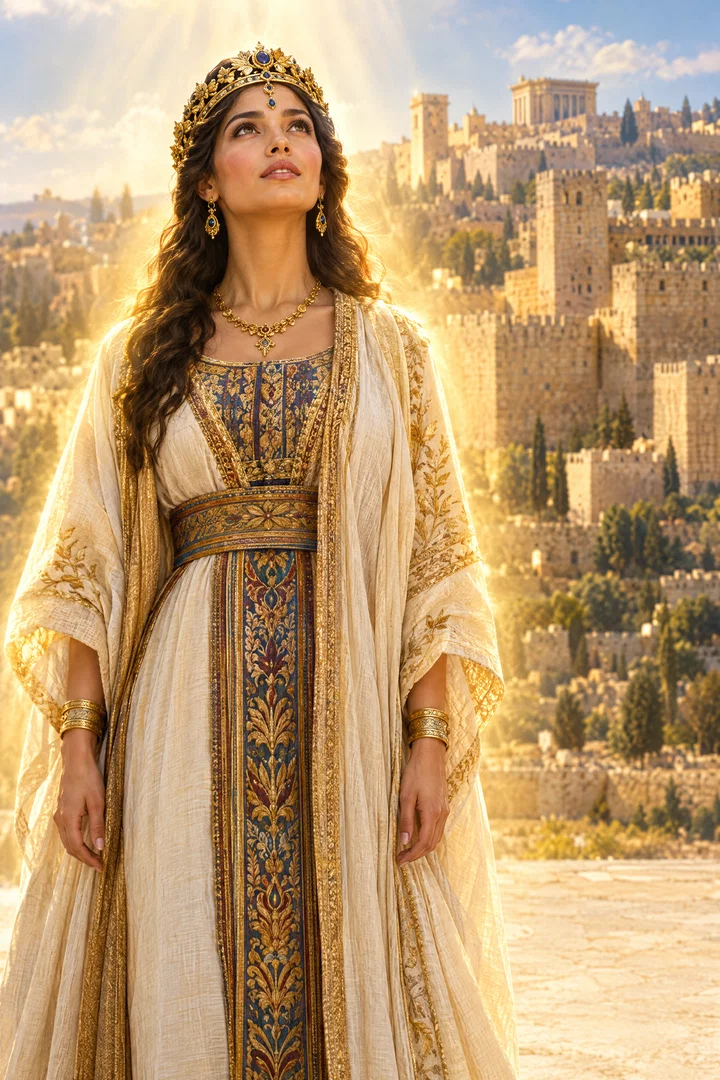
And thy renown went forth among the heathen for thy beauty: for it was perfect through my comeliness, which I had put upon thee, saith the Lord GOD.
Translations
And your renown went forth among the heathen for your beauty: for it was perfect through my comeliness, which I had put on you, says the Lord GOD.
King James Version, Webster Bible
And thy renown went forth among the heathen for thy beauty: for it was perfect through my comeliness, which I had put upon thee, saith the Lord GOD.
And thy renown went forth among the heathen for thy beauty: for it was perfect through my comeliness, which I had put upon thee, saith the Lord God.
And thy renown went forth among the nations for thy beauty; for it was perfect through my majesty which I had put upon thee, saith the Lord GOD.
And thy renown went forth among the nations for thy beauty; for it was perfect, through my majesty which I had put upon thee, saith the Lord Jehovah.
And go forth doth thy name among nations, Because of thy beauty — for it [is] complete, In My honour that I have set upon thee, An affirmation of the Lord Jehovah.
And thy fame went forth among the nations for thy beauty; for it was perfect through my magnificence, which I had put upon thee, saith the Lord Jehovah.
Then went forth thy fame among the nations. for thy beauty,- For perfect, it was—in my splendour which I had put upon thee, Declareth My Lord, Yahweh.
Berean Standard Bible, Majority Standard Bible
Your fame spread among the nations on account of your beauty, for it was perfect in the splendor I bestowed on you, declares the Lord GOD.
Your renown went out among the nations for your beauty; for it was perfect, through my majesty which I had put on you,” says the Lord GOD.
You were so beautiful that the story of you went out into all nations; you were completely beautiful because of my glory which I had put on you, says the Lord.
And thy name was spred among the heathen for thy beautie: for it was perfite through my beautie which I had set vpon thee, saith the Lord God.
Douay-Rheims (Challoner revision)
And thy renown went forth among the nations for thy beauty: for thou wast perfect through my beauty, which I had put upon thee, saith the Lord God.
Pictures
Cross-references 20 of 26
- 2 Corinthians 11:2
For I am jealous over you with godly jealousy: for I have espoused you to one husband, that I may present you as a chaste virgin to Christ.
The church is betrothed to Christ as a chaste virgin.
- Jeremiah 3:14
Turn, O backsliding children, saith the LORD; for I am married unto you: and I will take you one of a city, and two of a family, and I will bring you to Zion:
The Lord calls Israel his backsliding wife and urges her to return.
- Jeremiah 31:32
Not according to the covenant that I made with their fathers in the day that I took them by the hand to bring them out of the land of Egypt; which my covenant they brake, although I was an husband unto them, saith the LORD:
God describes himself as the husband of his people.
- Jeremiah 3:1
They say, If a man put away his wife, and she go from him, and become another man’s, shall he return unto her again? shall not that land be greatly polluted? but thou hast played the harlot with many lovers; yet return again to me, saith the LORD.
Israel’s unfaithfulness to God is pictured as harlotry.
- Isaiah 61:10
I will greatly rejoice in the LORD, my soul shall be joyful in my God; for he hath clothed me with the garments of salvation, he hath covered me with the robe of righteousness, as a bridegroom decketh himself with ornaments, and as a bride adorneth herself with her jewels.
God clothes his people in salvation and righteousness, adorning them like a bride.
- Hosea 2:19
And I will betroth thee unto me for ever; yea, I will betroth thee unto me in righteousness, and in judgment, and in lovingkindness, and in mercies.
God’s gracious covenant with his people is portrayed as a betrothal.
- Jeremiah 6:2
I have likened the daughter of Zion to a comely and delicate woman.
Both compare God’s people to a beautiful woman.
- Ezekiel 16:8
Now when I passed by thee, and looked upon thee, behold, thy time was the time of love; and I spread my skirt over thee, and covered thy nakedness: yea, I sware unto thee, and entered into a covenant with thee, saith the Lord GOD, and thou becamest mine.
God enters a covenant with Israel and claims her as his own.
- Isaiah 54:5
For thy Maker is thine husband; the LORD of hosts is his name; and thy Redeemer the Holy One of Israel; The God of the whole earth shall he be called.
God is Israel’s husband and redeemer.
- Jeremiah 3:20
Surely as a wife treacherously departeth from her husband, so have ye dealt treacherously with me, O house of Israel, saith the LORD.
Israel’s treacherous departure from God is likened to a wife’s infidelity.
- James 4:4
Ye adulterers and adulteresses, know ye not that the friendship of the world is enmity with God? whosoever therefore will be a friend of the world is the enemy of God.
Friendship with the world makes God’s people spiritual adulterers.
- Isaiah 62:4-5
Thou shalt no more be termed Forsaken; neither shall thy land any more be termed Desolate: but thou shalt be called Hephzi-bah, and thy land Beulah: for the LORD delighteth in thee, and thy land shall be married.
Both picture Jerusalem as a bride joined to the Lord, who delights in her.
- Jeremiah 3:6-9
The LORD said also unto me in the days of Josiah the king, Hast thou seen that which backsliding Israel hath done? she is gone up upon every high mountain and under every green tree, and there hath played the harlot.
Israel’s idolatry and defilement are described as adultery.
- Jeremiah 2:2
Go and cry in the ears of Jerusalem, saying, Thus saith the LORD; I remember thee, the kindness of thy youth, the love of thine espousals, when thou wentest after me in the wilderness, in a land that was not sown.
The Jewish church is described as espoused to the Lord.
- Jeremiah 2:20
For of old time I have broken thy yoke, and burst thy bands; and thou saidst, I will not transgress; when upon every high hill and under every green tree thou wanderest, playing the harlot.
Both use harlotry to portray Israel’s apostasy.
- Ezekiel 16:60-62
Nevertheless I will remember my covenant with thee in the days of thy youth, and I will establish unto thee an everlasting covenant.
Describes Jerusalem restored to the Lord through an everlasting covenant.
- Hosea 2:2
Plead with your mother, plead: for she is not my wife, neither am I her husband: let her therefore put away her whoredoms out of her sight, and her adulteries from between her breasts;
Israel’s unfaithfulness is pictured as marital adultery.
- Ephesians 5:26-27
That he might sanctify and cleanse it with the washing of water by the word,
Christ cleanses and makes the church holy and glorious.
- Isaiah 1:21
How is the faithful city become an harlot! it was full of judgment; righteousness lodged in it; but now murderers.
The once-faithful city becomes a harlot.
- Isaiah 62:2
And the Gentiles shall see thy righteousness, and all kings thy glory: and thou shalt be called by a new name, which the mouth of the LORD shall name.
Jerusalem’s glory among the nations accompanies a name given by the Lord.
Commentary
Each commentary is drawn from primary sources: the writings of Ellen G. White and Adventist pioneers and periodicals. Each commentary is separate. Its own words are not a quotation; follow the references to read the source passages.
Ellen G. White
7 sources
The verse pictures divine love under the figure of marriage, in which the Lord joined His people to Himself by solemn covenant and made them His own.GC 381.1–382.1 That marriage portrays the sacred and enduring union between Christ and His church.GC 381.1–382.1
Israel's beauty was perfect and complete entirely through the comeliness God Himself had put upon her, not from herself.GC 382.2–383.1GC 381.1–382.1GC88 381.1–382.1RH Nov 19, 1901Ms 5, 1901, par. 20–22 Her renown went forth among the heathen nations for that beauty, and came from that gift, so her excellence was wholly due to His favor.Lt 19, 1905, par. 9GC 382.2–383.1GC 381.1–382.1GC88 381.1–382.1RH Nov 19, 1901 God Himself had made her exceedingly beautiful and prosperous into a kingdom and had given her honor, so that her fame for beauty spread among the nations.GC 381.1–382.1GC88 381.1–382.1
Israel despised that honor when she trusted in her own beauty and departed from the Lord.GC 381.1–382.1GC88 381.1–382.1 She violated the marriage vow like a treacherous wife leaving her husband for strangers, turning confidence and affection from God to worldly things.GC 381.1–382.1 She thereby rejected the very gift that had made her renowned.GC88 381.1–382.1
The verse applies to the Protestant churches at their rise, when they took a noble stand for God and the truth.GC 382.2–383.1GC88 382.3–383.1 God's blessing accompanied them, bringing good and beneficial results from accepting gospel principles.GC 382.2–383.1GC88 382.3–383.1 Even unbelievers and the unbelieving world recognized those results.GC 382.2–383.1GC88 382.3–383.1
God desires His people and His true, faithful workers to reflect that gift, so that His own beauty and light may shine through their lives to the world.Lt 19, 1905, par. 9RH Nov 19, 1901 Christ desires to speak of His people in the same way, showing that their spiritual beauty and honor come from Him.Ms 5, 1901, par. 20–22
Sources
Pioneers and periodicals
27 sources
Ezekiel pictures the Lord taking Jerusalem to himself as his wife in solemn covenant, clothing and adorning her and giving her public honor among the nations before her unfaithfulness and final restoration.ST Aug 19, 1913RH Oct 7, 1851ST May 4, 1904RH Feb 14, 1856 Her fame for beauty came entirely from what he put upon her, not from herself or any merit or glory of her own, and it was perfect and complete only through his comeliness.RH Nov 19, 1901STST Apr 21, 1914ST Sep 16, 1889 That beauty is spiritual and moral, his righteousness and holiness and salvation with which he washes and clothes the sinful and makes them lovely in Christ.STST Sep 16, 1889 Trusting in her own beauty and adornment instead of God, she grew proud, forsook the source of her greatness, and turned from him.ST Aug 14, 1893RH Aug 21, 1913RH Feb 13, 1900 A woman is the symbol of a church and a harlot of a corrupt and apostate church, so her playing the harlot portrays God's professed people seeking friendship and unlawful union with the world, the kings of the earth, and their gods.ST Jun 29, 1876RH Feb 20, 1855RH Feb 20, 1855RH Oct 19, 1869RH Feb 21, 1854
Words and Setting
Ezekiel gave these prophecies among the captives of Israel between the years 595 and 574, beginning and closing his work just a little later than Jeremiah.ST Jul 26, 1910 He was a man of the priestly family who was first shown visions of God's glory and great majesty.ST Jul 26, 1910 That showing prepared him to carry awful messages of warning and reproof to sinners among his own people without fearing the face of man.ST Jul 26, 1910
The language is that of marriage customs, which included a solemn covenant with accompanying ceremony.ST May 4, 1904 By it the bride passes into marriage with public recognition and honor belonging to the union.ST May 4, 1904 The chapter pictures the Lord's covenant relationship with His people, in which He made a covenant with them and they became His.RH Feb 14, 1856 They broke that bond and relied on another.RH Feb 14, 1856 This marriage-like bond is an Old Testament picture of the Lord's relation to His people, not the marriage of the Lamb at the end.RH Feb 14, 1856
In the allegory Jerusalem is the Lord's wife, with the land represented as the wife and the people as her children.RH Oct 7, 1851 The renown for beauty describes His affection and gifts bestowed upon her before her later unfaithfulness.RH Oct 7, 1851 The sins of Judah and Israel are thus presented under the figure of a lewd woman.ST Aug 19, 1913 The story ends with Jerusalem restored to the Lord under an everlasting covenant, in connection with the restoration of Samaria and Sodom and the Lord's reception of His kingdom.RH Oct 7, 1851
Beauty Bestowed by God
Her renown went forth among the heathen for beauty because of what was given to her, not because of anything she possessed by herself.STST Sep 16, 1889ST Aug 14, 1893RH Dec 9, 1862 That renown came from the splendor and comeliness the Lord placed upon her, and not from her own merit or from any glory belonging to her independently.STST Aug 14, 1893RH Dec 9, 1862RH Feb 13, 1900 Though sinful and unlovely in herself, she was made fair through His comeliness and betrothed to Him.ST Sep 16, 1889 Her beauty was perfect and complete through His comeliness put upon her.RH Nov 19, 1901ST Apr 21, 1914RH Dec 9, 1862 Perfection in this sense comes from God, not from themselves.ST Apr 21, 1914
That beauty is spiritual and moral, consisting in righteousness and holiness and life. It is the beauty of salvation and righteousness and godliness, given by the Lord and spread in renown among the nations.ST Aug 14, 1893 He washed her and clothed her and adorned her with grace, and made her beautiful by His care and righteousness.ST He cleanses the sinful and unlovely and revives them through Christ's life-blood, clothes them in glory, and gives them His own royal beauty.ST Sep 16, 1889 The gift is meant to be reflected outward, so that His light may shine through His people to the world.RH Nov 19, 1901 Its beauty was meant to reflect her Prince's grace, so that those who beheld it would love Him.ST Sep 16, 1889 Its honor could remain only through humility and purity of faith, as seen when exemplary faith clothed believers with salvation and the Lord's righteousness and displayed God's power and godliness to the nations.RH Feb 13, 1900
The same bestowal comforts the repentant mourner, for after godly sorrow and repentance God covers the person with His perfect righteousness. He clothes that person in Christ's character, bringing the comfort of grace and pardon.
Apostasy of the Church
A woman stands for a church, and a lewd or harlot woman stands for a corrupt or apostate church.RH Feb 20, 1855RH Feb 21, 1854 This establishes the meaning of the woman in Revelation 17, where the harlot with daughters is the whole corrupt professed church united to the world, not one single ecclesiastical body.RH Feb 20, 1855RH Feb 10, 1874 Those who held this understanding also insisted she is not mere abstract civil or governmental power, but a corrupt church called a harlot in prophecy.RH Feb 20, 1855RH Feb 21, 1854
The chapter shows the Jewish church espoused to the Lord, with Jerusalem as a city-woman representing His professed people and chosen people.ST Jun 29, 1876RH Feb 20, 1855RH Oct 19, 1869 She played the harlot with many lovers by seeking friendship with the world and unlawful union with the kings of the earth.ST Jun 29, 1876RH Feb 20, 1855 That apostasy meant joining the surrounding nations and worshiping their gods, turning toward Babylon and the world and abandoning God's precepts to become like the nations.RH Oct 19, 1869ST Jun 11, 1896
Any union of God's church with the world is fornication and adultery, because the church belongs to God alone as His wife. Israel's backsliding, conformity to the world, idolatry and departure from God were spiritual adultery, an attempt to mix heaven with earth and righteousness with sin.ST Jan 8, 1902 Her fall illustrates the fall of Babylon, for it was a moral fall consisting in rejection by God rather than immediate destruction.ST Jun 29, 1876RH Mar 6, 1855 Destruction was deferred for a considerable period after rejection.ST Jun 29, 1876RH Mar 6, 1855
Her renown for beauty came entirely from the comeliness the Lord had put upon her, perfect because it was His gift of salvation, righteousness and godliness and not her own merit.ST Aug 14, 1893RH Feb 13, 1900RH Aug 21, 1913 That borrowed beauty became pride when she trusted in her own beauty, adornment and sufficiency and in herself instead of God.ST Aug 14, 1893RH Feb 13, 1900RH Feb 13, 1900 So she forsook the source of her greatness and glory and turned from Him.ST Aug 14, 1893RH Feb 13, 1900RH Aug 21, 1913
The same pattern belongs to later churches, with Ezekiel 16 as the prototype of an apostate church turning to earthly powers for help instead of seeking the Lord.ST Oct 1, 1894ST Nov 11, 1889 The early church at Rome was once clothed with salvation and the Lord's righteousness, displaying God's power and godliness to the nations through exemplary faith.RH Feb 13, 1900ST Nov 11, 1889 Its honor could remain only through humility and purity of faith, but when proud it trusted in its own beauty and turned from the source of its beauty into apostasy.RH Feb 13, 1900RH Feb 13, 1900 The fallen church no longer boasts in God's beauty and righteousness nor sees the gospel as heaven's power to save, but looks to earth for help, courting the state, pleading with earthly powers and politicians to supply lost power, and seeking union with the state and the civil power to force men to her arms, like Mother Rome of old.ST Nov 11, 1889RH Feb 13, 1900
Sources