Exodus 12:41
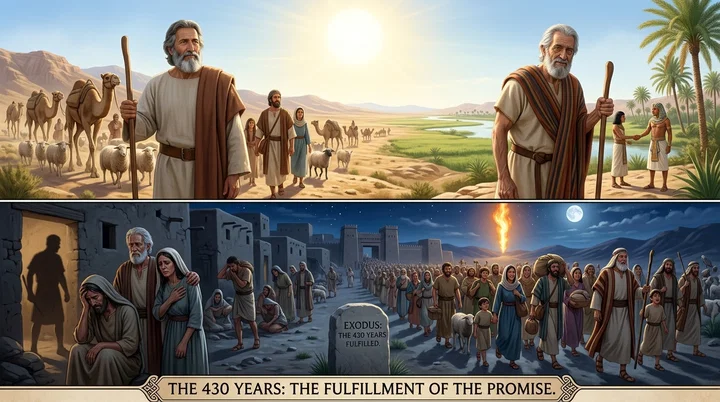
And it came to pass at the end of the four hundred and thirty years, even the selfsame day it came to pass, that all the hosts of the LORD went out from the land of Egypt.
Translations
American King James Version, King James Version
And it came to pass at the end of the four hundred and thirty years, even the selfsame day it came to pass, that all the hosts of the LORD went out from the land of Egypt.
And it came to pass at the end of the four hundred and thirty years, even the selfsame day it came to pass, that all the hosts of the Lord went out from the land of Egypt.
And it came to pass, at the end of the four hundred and thirty years, even the same day it came to pass, that all the hosts of the LORD departed from the land of Egypt.
And it came to pass at the end of four hundred and thirty years, even the selfsame day it came to pass, that all the hosts of the LORD went out from the land of Egypt.
And it came to pass at the end of four hundred and thirty years, even the selfsame day it came to pass, that all the hosts of Jehovah went out from the land of Egypt.
and it cometh to pass, at the end of four hundred and thirty years — yea, it cometh to pass in this self-same day — all the hosts of Jehovah have gone out from the land of Egypt.
And it came to pass at the end of the four hundred and thirty years, on that same day it came to pass that all the hosts of Jehovah went out from the land of Egypt.
And it came to pass at the end of four hundred and thirty years, yea it came to pass, on this self-same day, that all the hosts of Yahweh had come forth out of the land of Egypt.
Berean Standard Bible, Majority Standard Bible
At the end of the 430 years, to the very day, all the LORD’s divisions went out of the land of Egypt.
At the end of four hundred thirty years, to the day, all of the LORD’s armies went out from the land of Egypt.
And at the end of four hundred and thirty years, to the very day, all the armies of the Lord went out of the land of Egypt.
And when the foure hundreth and thirtie yeeres were expired, euen the selfe same day departed all the hostes of the Lord out of the land of Egypt.
Douay-Rheims (Challoner revision)
Which being expired, the same day all the army of the Lord went forth out of the land of Egypt.
Pictures
Cross-references 20 of 66
- Genesis 15:13-14
And he said unto Abram, Know of a surety that thy seed shall be a stranger in a land that is not theirs, and shall serve them; and they shall afflict them four hundred years;
God foretold Israel’s affliction in a foreign land and their eventual departure.
- 1 Corinthians 5:7
Purge out therefore the old leaven, that ye may be a new lump, as ye are unleavened. For even Christ our passover is sacrificed for us:
Christ is identified as the sacrificed Passover lamb.
- Deuteronomy 5:15
And remember that thou wast a servant in the land of Egypt, and that the LORD thy God brought thee out thence through a mighty hand and by a stretched out arm: therefore the LORD thy God commanded thee to keep the sabbath day.
Israel’s deliverance from Egypt is given as a motive for keeping the Sabbath.
- Galatians 3:17
And this I say, that the covenant, that was confirmed before of God in Christ, the law, which was four hundred and thirty years after, cannot disannul, that it should make the promise of none effect.
Both mark the 430 years from the covenant promise to the giving of the law.
- Exodus 12:13
And the blood shall be to you for a token upon the houses where ye are: and when I see the blood, I will pass over you, and the plague shall not be upon you to destroy you, when I smite the land of Egypt.
blood enabling escape from Egypt
- Acts 7:6-7
And God spake on this wise, That his seed should sojourn in a strange land; and that they should bring them into bondage, and entreat them evil four hundred years.
Stephen recounts the foretold oppression and God’s promise to bring Israel out.
- Exodus 14:27-28
And Moses stretched forth his hand over the sea, and the sea returned to his strength when the morning appeared; and the Egyptians fled against it; and the LORD overthrew the Egyptians in the midst of the sea.
overthrow in the sea completes the going out
- Deuteronomy 16:1-6
Observe the month of Abib, and keep the passover unto the LORD thy God: for in the month of Abib the LORD thy God brought thee forth out of Egypt by night.
gives later changed temple form
- Exodus 12:14
And this day shall be unto you for a memorial; and ye shall keep it a feast to the LORD throughout your generations; ye shall keep it a feast by an ordinance for ever.
The Passover is a memorial of Israel’s deliverance from Egyptian bondage.
- Exodus 20:2
I am the LORD thy God, which have brought thee out of the land of Egypt, out of the house of bondage.
The LORD identifies deliverance from Egypt as the basis for the covenant commandments.
- Exodus 16:1
And they took their journey from Elim, and all the congregation of the children of Israel came unto the wilderness of Sin, which is between Elim and Sinai, on the fifteenth day of the second month after their departing out of the land of Egypt.
Dates Israel’s arrival in the wilderness one month after the exodus.
- Genesis 12:1-4
Now the LORD had said unto Abram, Get thee out of thy country, and from thy kindred, and from thy father’s house, unto a land that I will shew thee:
Used to date the beginning of the 430-year period.
- Exodus 12:17
And ye shall observe the feast of unleavened bread; for in this selfsame day have I brought your armies out of the land of Egypt: therefore shall ye observe this day in your generations by an ordinance for ever.
Both identify the selfsame day as the day of deliverance from Egypt.
- Exodus 12:29-31
And it came to pass, that at midnight the LORD smote all the firstborn in the land of Egypt, from the firstborn of Pharaoh that sat on his throne unto the firstborn of the captive that was in the dungeon; and all the firstborn of cattle.
Midnight judgment led to Pharaoh releasing Israel from Egypt.
- Psalms 105:43
And he brought forth his people with joy, and his chosen with gladness:
Retells God bringing Israel out of Egypt.
- Exodus 13:3-8
And Moses said unto the people, Remember this day, in which ye came out from Egypt, out of the house of bondage; for by strength of hand the LORD brought you out from this place: there shall no leavened bread be eaten.
The unleavened-bread feast commemorates Israel’s departure from Egypt.
- Exodus 12:37
And the children of Israel journeyed from Rameses to Succoth, about six hundred thousand on foot that were men, beside children.
Describes the Israelites’ departure from Egypt.
- Exodus 12:33
And the Egyptians were urgent upon the people, that they might send them out of the land in haste; for they said, We be all dead men.
The Egyptians hurried Israel to leave.
- Genesis 47:9
And Jacob said unto Pharaoh, The days of the years of my pilgrimage are an hundred and thirty years: few and evil have the days of the years of my life been, and have not attained unto the days of the years of the life of my fathers in the days of their pilgrimage.
Jacob gives his age upon arriving in Egypt and describes his years as a sojourner.
- Isaiah 11:11-16
And it shall come to pass in that day, that the Lord shall set his hand again the second time to recover the remnant of his people, which shall be left, from Assyria, and from Egypt, and from Pathros, and from Cush, and from Elam, and from Shinar, and from Hamath, and from the islands of the sea.
The exodus serves as a pattern for the remnant’s second recovery and gathering.
Commentary
Each commentary is drawn from primary sources: the writings of Ellen G. White and Adventist pioneers and periodicals. Each commentary is separate. Its own words are not a quotation; follow the references to read the source passages.
Ellen G. White
17 sources
On the appointed selfsame day at the end of four hundred and thirty years, with neither haste nor delay, all the hosts of the Lord marched out of Egypt from around Goshen in organized companies under the covering of the Passover blood.DA 31.2–3PP 281.4ST Dec 9, 1913ST Nov 2, 1915SG3 169.1 That going out fulfilled what had been shown beforehand to Abraham that his descendants would sojourn in bondage and then come out with great substance, and they carried Joseph's bones as a pledge that the promise of deliverance had been kept.DA 31.2–3PP 281.4Ms 10, 1903, par. 15 God visited idolatrous Egypt with mighty signs and judgments that laid the land desolate and destroyed Pharaoh's pursuing army, revealing Himself as the living personal Redeemer above all heathen deities and all power in nature.Ms 10, 1903, par. 15Lt 237, 1904, par. 15–18Ms 38, 1898, par. 18 He called them out because He pitied their grievous slavery and broke the yoke of bondage, to separate them from the customs of the world and make them His church, to lift them from ignorance and little faith to know Him and reveal His goodness, mercy, justice and love as light-bearers to the nations.FE 505.1STB 834.1ED 34.1Ms 55, 1901, par. 22–23Ms 38, 1898, par. 18 That exact fulfillment on time points to the keeping of the hour determined in heaven's council for Christ to be born in Bethlehem, and the mighty deliverance is to be remembered with gratitude as proof of His power to bring victory through trials on the way to the heavenly Canaan, calling those who bear His name today to lift the oppressed and live separate from the world to reveal His character.DA 31.2–3ST Dec 9, 1913STBk 53.2–54.1STA 53.2–54.1Ms 55, 1901, par. 22–23
Exact Time and Deliverance
The four hundred and thirty years ended to the very day, on the selfsame appointed day fixed beforehand, for divine purposes know neither haste nor delay.DA 31.2–3PP 281.4ST Dec 9, 1913Ms 83, 1903, par. 10 All the power of Pharaoh's proud empire contended against that word in vain, and could not hold Israel an hour beyond the time.DA 31.2–3ST Dec 9, 1913 That day had been made certain in the revelation to Abraham that his descendants would endure sojourning and bondage for four hundred years and afterward come out.DA 31.2–3PP 281.4Ms 10, 1903, par. 15 God Himself had sent His people into Egypt and kept them there until His own time for bringing them out had fully come.Lt 237, 1904, par. 15–18
They went out as the hosts of the Lord, in organized companies, in a grand march from the country round about Goshen.PP 281.4ST Nov 2, 1915SG3 169.1 That was the best part of Egypt, where Joseph had settled his father and brothers with good pastures and water, where they could worship apart from Egyptian idolatry.SG3 169.1 Their going followed the sprinkled blood and the death-dealing angel on Passover night.ST Nov 2, 1915 In their departure was fulfilled the promise that Abraham's descendants would leave their land of oppression with great substance and great possessions.DA 31.2–3PP 281.4 They carried Joseph's bones with them as a reminder that the promise of deliverance had been fulfilled.PP 281.4
God visited Egypt with fearful judgments and brought His people forth with power and mighty signs and wonders.SG3 169.1Ms 10, 1903, par. 15Lt 237, 1904, par. 15–18 Egypt was an idolatrous nation that refused to heed Him, and He laid the land desolate to accomplish His purpose and gave Egypt for them.Ms 38, 1898, par. 18Ms 83, 1903, par. 10 In guiding and protecting His people He showed that He ruled the universe and was greater than the heathen deities.Ms 83, 1903, par. 10 He acted as a living, personal Redeemer to show His own power over nature and science as the mighty God who made nature, with nature as His servant under His supreme command and control over all oppressing powers, standing forth as the only God with no god before Him.Ms 38, 1898, par. 18 When the Egyptian host pursued Israel, He destroyed Pharaoh and his army in the Red Sea, despite all Pharaoh's power.Ms 10, 1903, par. 15Ms 83, 1903, par. 10
Purpose for a Delivered People
The exodus was an act of pity, for the Lord saw Abraham's descendants in grievous slavery and broke the yoke of their bondage to call them out.FE 505.1Ms 55, 1901, par. 22–23 That deliverance proves He is not indifferent to the suffering of the oppressed.Ms 55, 1901, par. 22–23 He placed Moses at their head to lead them through the wilderness to the promised land.Ms 55, 1901, par. 22–23
His purpose in bringing them out was to separate them from the customs, habits, and practices of the world and to bring them nearer to Himself to make known His will.STB 834.1 He took them into the wilderness to be under the guidance of the unseen Leader and Teacher, wonderful in counsel, who would lead them in the ways of God.Ms 38, 1898, par. 18 He made them His church, purchased by Christ, with what they held entrusted to the Lord as a representation of His church in every age.16MR 328.3
They came out of lifelong slavery largely untrained, with little knowledge of God and little faith in Him, and He sought to lift them morally by teaching them to know Him.ED 34.1 In life and character they were to manifest the principles of His kingdom and reveal His goodness, mercy, justice, and love, giving the world a representation of His character.STB 834.1 As obedient light-bearers to the nations through whose land they passed they were sustained and strengthened by God.Lt 237, 1904, par. 15–18 When the law of God is thus exemplified in life, even the world recognizes the superiority of those who love and fear and serve God above every other people.STB 834.1
That leading included calling them out to bring them to Sinai to hear the proclamation of the law that had been given in Eden.Lt 74, 1900, par. 29–30 With His own voice in awful grandeur He proclaimed the Ten Commandments to them, demonstrating the fundamental importance of the law and making known His majesty and authority as Ruler of the world to impress its sacredness and the importance of obedience.Lt 74, 1900, par. 29–30 The force and power of its delivery reveals its importance as the faith once delivered to the saints by Christ the Redeemer speaking from Sinai.Lt 74, 1900, par. 29–30 He taught them that if contrite in heart, the powerful Ruler would work for them with nature as His servant, showing His supreme command and control over all powers that oppressed them.Ms 38, 1898, par. 18
Had they obeyed, they would soon have entered Canaan.FE 505.1 But those who murmured and complained and refused to be converted from their evil ways perished in the wilderness.Lt 237, 1904, par. 15–18 Their rebellion brought forty years of wandering, and only two of the adults who left Egypt entered the promised land.FE 505.1 Even after judgments upon Egypt and destruction of Pharaoh and his army in the Red Sea, Israel on the border of the promised land dishonored Him by giving way to unbelief.Ms 10, 1903, par. 15
Remembrance and Gospel Application
The night march out of bondage was to be kept forever in memory by retelling, with the men with girded loins, shoes on feet and staff in hand, the hasty meal, the lamb, the unleavened bread and the bitter herbs, the night assembly following the sprinkled blood and the death-dealing angel.ST Nov 2, 1915 Its story was recounted to Hebrew children as they journeyed to the feasts, and it was rehearsed in solemn silence at Jerusalem as part of the paschal service.ST Nov 2, 1915 That rehearsal was meant to stir the imagination, impress the heart, and fix the memory of deliverance forever in child and youth.ST Nov 2, 1915
The mighty deliverance from Egyptian bondage was given to be remembered with gratitude and firm trust as proof of power to bring victory through trials on the way to the heavenly Canaan.STBk 53.2–54.1STA 53.2–54.1 Forgetting it breeds distrust of God, discouragement and self-pity, mourning and lamentation, and desperation when difficulties come.STBk 53.2–54.1STA 53.2–54.1 Such forgetfulness opens the heart to false and cruel discouraging words and repeats the sin of murmuring, rebellious Israel under the false report of the unfaithful spies.STBk 53.2–54.1STA 53.2–54.1
The exact fulfillment on the appointed day shows that divine purposes know no haste and no delay, fulfilled despite all the power of a proud empire arrayed against the word.DA 31.2–3ST Dec 9, 1913 That keeping of time illustrates that the hour for Christ's coming had been determined in heaven's council and kept, so that Jesus was born in Bethlehem when the great clock of time pointed to that hour.DA 31.2–3ST Dec 9, 1913
The same pity that broke the yoke of bondage and brought Israel out proves that God is not indifferent to the suffering of the oppressed, and it calls those who bear His name today to lift the colored people in America, who though in one sense freed from slavery still live in sin and degradation in the slavery of ignorance.Ms 55, 1901, par. 22–23 They are to be lifted from degradation as Israel was lifted.Ms 55, 1901, par. 22–23 The purpose in bringing Israel forth was to separate them from the customs, habits, and practices of the world and bring them nearer to God to make known His will, so that in life and character they would manifest the principles of His kingdom and reveal His goodness, mercy, justice, and love as a representation of His character, and when the law is thus exemplified even the world recognizes the superiority of those who love and fear and serve Him above every other people, and this same purpose holds for His people today.STB 834.1
Sources
Pioneers and periodicals
130 sources
At the end of the four hundred and thirty years all the hosts of the Lord went out from Egypt in the Exodus itself, hurried out after the tenth plague and the death of the firstborn that broke Pharaoh's resistance.RH Jan 20, 1916ST Feb 4, 1913 The four hundred and thirty years ended to the very day, reckoned from the covenant with Abram when he entered Canaan to the deliverance, embracing both the sojourning of the fathers in Canaan and the sojourning in Egypt in two equal parts of two hundred and fifteen years.RH Sep 17, 1914GSAM 44.1ST Jun 4, 1885ST Jun 4, 1885 That exact-day departure fulfilled God's promise to Abraham on schedule, with neither haste nor delay despite Pharaoh's power and generations of bondage, showing human opposition cannot stop what prophecy appoints.RH Sep 17, 1914ST Jul 22, 1913RH Sep 14, 1916RH Sep 17, 1914ST Dec 12, 1916 The night they went out was the first Passover kept at Rameses, when the blood on the doorposts spared Israel and represents Christ's blood by which God passes over transgression, and the lamb slain on the fourteenth met its antitype in the death of Christ our Passover on that same day.ST Apr 13, 1904ST May 22, 1907RH Aug 3, 1916ST Aug 13, 1874ST May 12, 1898 The flight is memorialized in the Passover eaten at night and in the Feast of Unleavened Bread, and not in the Sabbath, which commemorates creation and the Creator's rest.RH Jan 3, 1865ST Aug 13, 1885RH Nov 13, 1860RH Nov 15, 1853 The going out toward Canaan is a type of the final deliverance of God's people from the Egypt of sin and earth to the heavenly Canaan, with the plagues on Egypt foreshadowing the seven last plagues through which the saints will live under divine protection.STRH Dec 23, 1851ST Jul 18, 1878RH Aug 24, 1916ST Oct 28, 1930
Exodus Narrative Setting
The verse records the Exodus itself, the hurried departure of all the hosts of the Lord from Egypt after the tenth plague, the death of the firstborn, which culminated the contest with Pharaoh.ST Jan 30, 1912ST Nov 4, 1880 It belongs to the block of Exodus 11 to 13:16, in close connection with which the ordinance of the Passover is given and the firstborn are claimed as the Lord's. It is the climax of the plagues of Exodus 9 to 12 and the doorway to the first Passover, the leading by fire and by cloud, the passage through the Red Sea, and the song of triumph of Exodus 13 to 15.RH Jan 20, 1916ST Jan 30, 1912 It marks the end of the account of Israel's deliverance from Egypt after God's dealings with Pharaoh and the wonders that showed Egypt's gods to be powerless.ST Feb 4, 1913 Jacob's descendants left bondage and went out free.ST Nov 4, 1880
The verse belongs to the confrontation of God's religious system with Egypt's, with both systems supported by miracles.RH Mar 11, 1915 The miracles in the surrounding chapters exposed the impotence of Egypt's worship and showed the supremacy of the God of the Hebrews.RH Mar 11, 1915ST Nov 1, 1899 The plagues through Exodus 6 to 12 completed God's merciful deliverance of His children on their journey to the promised land.ST Jan 20, 1909 At first the plagues were brought not against human beings but against the gods the Egyptians worshiped, almost every plague being connected with their worship to show their gods utterly unworthy of trust, showing that Jehovah was above Egypt's gods and possessed power over all nature.ST Jan 20, 1909ST Nov 1, 1899 This deliverance, with the sparing of Israel's firstborn and the escape through the Red Sea, gave the people direct experience of God's power and mercy.ST Nov 27, 1901
The oppression was not mere physical bondage but involved the right to worship the true God as Creator and to keep His commandments, and that question became a direct issue and came to a crisis during the latter part of the stay.RH Mar 25, 1909 The deliverance shows God's mercy to Pharaoh and the Egyptians in the reasonable request, Let My people go that they may serve Me, which Pharaoh refused, though God would have left Israel in Egypt if they had been allowed to serve Him there.ST Jan 20, 1909 LORD in capital letters means Jehovah, so Pharaoh's question was Who is Jehovah, with the answer I know not Jehovah, neither will I let the people go.ST Jan 20, 1909 Pharaoh stubbornly refused to let Israel go until his land was laid waste by terrible plagues and by direct intervention and miraculous power of God, culminating in death in every Egyptian family.RH Mar 25, 1909 God's prediction in Moses' commission that He would harden Pharaoh's heart was fulfilled only after Pharaoh himself made his heart hard and stubborn by rejecting every appeal God made to him, when God withdrew His Spirit and Pharaoh's heart remained hardened with no hope of saving him.ST Jan 20, 1909
The going out of all the hosts of the Lord from the land of Egypt was a wonderful deliverance that demonstrated God's wisdom, love, and power, proving His ability and right to rule and Israel's obligation to obey, while still leaving them to be tested and tried to prove whether they would walk in His law.ST Mar 7, 1906 Israel's history, including its miraculous deliverance from long servitude, shows that God lives and reigns, saves His people, and punishes the wicked.RH Apr 20, 1916 The jewels of gold and silver were not borrowed from the Egyptians but asked as Israel's perfect right for long service and labor, which the Egyptians were anxious to give.ST Jan 20, 1909
The destroying angel who passed through Egypt is not named in Scripture but was one of Jehovah's angels, commissioned to carry out God's punishment of the Egyptians, who had chosen sin and stood with Egypt's oppression of Israel. The turning of the rivers of Egypt into blood and the smiting of the land with plagues through Exodus 7 to 12, ending in the hosts going out of Egypt, was not power in Moses himself but power in the Word, in the message God spoke through him.ST Apr 4, 1911
The departure dates later history, with the Tabernacle set up on the first day of the first month of the second year from it. Its going out begins a connected history including the incidents of the forty years' wanderings, the building of the sanctuary, the entrance into Canaan, the subjection of the land, and the continued history of the Israelite nation down to the close of David's reign.ST It is a thrilling object-lesson for all time, a wonderful history and great spectacle in the astonishing movement of the mighty host going out from Egypt, which leads into the long busy remarkable stay at Mount Sinai and then the methodical start toward the promised land. The sojourn in the wilderness did not begin until after the deliverance.
Those events were not expected to appear directly in Egypt's official historical records, which recorded successes and triumphs rather than disasters.RH Apr 23, 1908 The account of Israel's departure is stated in firm historical terms under Moses' direct supervision, with no less certainty than the history of creation, though Moses had no personal knowledge of creation.ST Jul 28, 1881 The departure and the journeyings through the wilderness are plain historical fact, told with positiveness and certainty, not as allegory or parable.ST Aug 25, 1881 It is tied to Moses as a real man, not a myth or idealized epitome, recording a real revelation of God to man that has foundation in fact, and it confirms that Israel was in Egypt and left it.RH Feb 3, 1910ST May 10, 1910
About three million people departed, including families and livestock, beginning the journey toward Succoth and the wilderness under Moses' leadership.ST Aug 9, 1910ST Aug 31, 1888 They left with food for only two or three days, which God afterward sustained.ST Aug 31, 1888 They started on their journey to the land of promise and came to the wilderness of Sin, shut in on every side by fruitless wastes, with the food they had hastily prepared and carried from Egypt exhausted, and He who had undertaken their deliverance supplied the lack by raining bread from heaven.RH Jun 27, 1912 Their triumphal going out marked the overthrow of their oppressors, and they were at last free, with every reason for gratitude for divine power in their behalf.RH Jun 27, 1912
Moses is the true leader of labor who organized and led the workers from the brickyards of Pharaoh, king of Egypt, out toward the Promised Land. The bondage was under Pharaoh, not Herod. Pharaoh lived nearly fifteen centuries before Herod, and the Herods were kings in Syria, not kings of Egypt.
Wording of Time and Departure
The four hundred and thirty years ended on the selfsame day the hosts went out, an exact to-the-day completion of the foretold sojourn and not a day later.RH Sep 17, 1914GSAM 44.1ST Jul 22, 1913ST Sep 26, 1911 The departure took place at the predicted time on the very day the period was completed, fulfilling the appointed time for deliverance despite generations of waiting, enslavement, and Pharaoh's power and resistance.RH Sep 17, 1914GSAM 44.1ST Jul 22, 1913RH Jan 14, 1862 The going out happened at night, at midnight on the fifteenth day of the first month, in the lunar month Xanthicus.RH Jan 2, 1913RH Apr 14, 1874 That night was set apart to be specially kept to the Lord for bringing them out, by all Israel in all generations.RH Dec 12, 1871
The night of departure belonged to the same twenty-four-hour day described as the end of the 430 years, so the word day here covers the whole period including night.RH Dec 12, 1871RH Dec 4, 1855RH Jan 21, 1862 A day therefore includes its evening and night and begins at evening, with the night called the night on which the Lord brought Israel out.RH Dec 12, 1871RH Dec 4, 1855 The departing people are called all the hosts of the Lord, identifying them as the Lord's hosts led forth as an army.RH Oct 1, 1861ST Feb 27, 1901 They went out as fugitive slaves delivered from serfdom to Pharaoh after God demanded their instant release, judged their oppressors, and afterward drowned their pursuers in the Red Sea, and their leading out of the confusion of distracted slavery was with order and not confusion.RH Oct 1, 1861ST Mar 24, 1887
The going out was in thrilling silence, with quiet joy mingled with regret at leaving their birthplace though it was a house of bondage, for the promised land.ST Feb 4, 1889 Israel waited ready for hasty flight with girded loins, sandals on feet and staff in hand, with unbaked bread in the kneading-trough and scattered flocks gathered in the fold.ST Feb 4, 1889 The solemn midnight hour came on the dark night chosen to smite the loved firstborn on every side, sparing not even the firstlings of the flock, when God's almighty arm broke the chain that bound His people to proud Pharaoh's throne.ST Feb 4, 1889 The nation went out amid darkness, plague, and storm.ST Sep 28, 1904
Span and Dating of Years
The 430 years measure the whole sojourning from the covenant made with Abram when he left his native land to wander in Canaan and Egypt until the Exodus, and in their full sense they include the sojourning of the fathers in the land of Canaan with the sojourning in the land of Egypt, not the stay in Egypt alone.ST Jun 4, 1885ST Jun 4, 1885ST Mar 11, 1903ST Dec 1, 1898 They are reckoned from the promise to Abraham rather than counting only the years of bondage, as shown by the Samaritan and Septuagint versions and agreement with Galatians 3:17.ST Jun 4, 1885ST Mar 11, 1903RH May 8, 1856 The period divides into two equal parts of 215 years each, from Abraham's entrance into Canaan to Jacob's removal from Canaan into Egypt and from Jacob's entrance into Egypt to the deliverance by Moses.RH Jan 2, 1913ST Jun 4, 1885ST Dec 1, 1898 From Abram's departure to Jacob's entrance into Egypt was 215 years, and Jacob and his posterity continued in Egypt 215 years more, making 430 years together.ST Jun 4, 1885
The reckoning is dated from B.C. 1921 for Abraham's entrance into Canaan to B.C. 1491 for the deliverance, with Jacob's entrance into Egypt in B.C. 1706 and the night of deliverance exactly 430 years to the selfsame day.RH Jan 2, 1913 The departure itself is dated to 1491 years before Christ, in 1491 B.C.RH May 14, 1901RH Jan 2, 1913ST Jan 28, 1886 Counted from Abram's departure from his father's house and not from the beginning of slavery, the slavery itself began later in 1573 B.C., leaving the Israelites enslaved for eighty-two years.RH May 14, 1901 Israel sojourned in Africa for more than two hundred years.RH Jan 5, 1911
The same 430 years reach from the covenant with Abraham to the giving of the law at Mount Sinai, so the law given 430 years after the covenant confirmed to Abraham could not change the promised inheritance, which was given to Abraham and his seed through the righteousness of faith and not through the law.ST Mar 11, 1903ST Feb 22, 1899 The four hundred years of affliction are a shorter period within the 430, reckoned from the mocking and persecution of Isaac by Ishmael at his weaning, which was persecution breaking out in violence against the true seed and continuing through his posterity.RH Jan 2, 1913 That affliction began thirty years after the promise to Abraham, with Ishmael's persecution of Isaac, yet ended at the same deliverance from Egyptian bondage.ST Jun 4, 1885ST Jun 4, 1885 The fourth generation is distinct still, beginning later at the entrance into Egypt and ending forty years after the deliverance at the entrance into Canaan.RH Jan 2, 1913
By the time Moses was forty, 390 years had passed and his first attempt to deliver Israel failed because his people did not understand God's promise and power.ST Aug 9, 1910 After Moses spent forty more years in Midian the full 430 years had elapsed, and Israel's deliverance came through God's mercy, not by sword, spear, or battle.ST Aug 9, 1910 One position holds that the departure occurred exactly 430 years after Israel entered Egypt, marking the appointed time when God fulfilled His promise to deliver Abraham's descendants from bondage and bring them back to Canaan.RH Feb 17, 1874 The time span is stated in round numbers yet on a definite day at the end of 430 years, contrasting with the sixth trumpet's precisely specified duration given to impress the Bible student with the importance of prophetic dates.RH Dec 25, 1900
The exact number of years and days from creation to the Exodus, counted from the Creator's rest-day in Eden in Genesis 1 to the first day of unleavened bread in Egypt, cannot be established with certainty, much less the exact number of days to a day.ST Jun 12, 1879 Hebrew chronology is discarded as utterly unreliable in favor of the chronology of the Septuagint, a Greek translation made at Alexandria in Egypt two or three centuries before Christ, even though its numbers have been more or less subject to alterations and may sometimes need correction.ST Jun 12, 1879 The verse supplies chronology for the duration of 430 years and the precise day Israel left Egypt, placing arrival in the wilderness of Sin on the fifteenth day of the second month, thirty days before Sinai and one month after leaving Egypt.RH Oct 21, 1851ST Apr 24, 1879 The treasure cities are named as built by Rameses II, including Rameses, with the exodus placed six years after his reign, and the reigning Pharaoh at the departure is identified as Menepta after Rameses had died.ST Aug 9, 1910ST Aug 11, 1909 The Exodus had just occurred when Merneptah's stela was engraved, whose reference to Israel as no longer located in Egypt suggests they had disappeared into the wilderness and Goshen was empty.
Promise Exactly Fulfilled
The exodus took place at the exact end of the foretold 430-year sojourn, on the very selfsame day the period closed, in direct fulfillment of the promise given to Abraham centuries before that in the fourth generation his descendants would come into possession of the land.RH Sep 17, 1914GSAM 44.1RH Apr 8, 1909RH Apr 14, 1903ST Oct 6, 1909 The departure on that appointed day fulfilled God's time prophecy to Abraham, who had been shown beforehand by the divine "I Am" what would come, and it displayed His love, mercy and faithfulness to His word in leading Israel out of bondage with power.RH Apr 14, 1903ST Oct 6, 1909ST Mar 30, 1915 It proves that when the fullness of the time comes men find their place in prophecy and go forward.RH Apr 8, 1909
Despite Pharaoh's power and resistance, God fulfilled His promise of return on schedule and brought Israel out with power and with great substance as foretold after four hundred years of affliction.RH Sep 17, 1914ST Dec 12, 1916RH Mar 20, 1913 The deliverance came on the exact day God had appointed even when there seemed no possibility of escape and no prospect of success, Pharaoh's refusal being unable to stop it.RH Sep 14, 1916ST Dec 12, 1916RH Mar 20, 1913 What God has appointed in prophecy cannot be stopped by human opposition, and He can bring His people out and complete His work.RH Sep 14, 1916RH Mar 20, 1913
God's purposes are fulfilled at their appointed time with neither haste nor delay, not a day later, even after generations of waiting, enslavement and suffering.ST Dec 9, 1913ST Jul 22, 1913RH Feb 4, 1873 The exodus waited for Moses to be prepared through long years of suffering and training, yet came on the very day appointed in God's counsels at the completion of the stated 430 years.ST Jul 22, 1913RH Sep 17, 1914RH Feb 4, 1873 Severe bondage and prolonged suffering did not mean God had forgotten or failed them, and apparent delays do not make His promises abortive, so His people should wait patiently for the time He has appointed.RH Apr 21, 1874
The exact-day departure illustrates the appointed time for Christ's birth centuries after promise, showing that events in God's plan occur when set long beforehand.ST Dec 9, 1913ST Mar 14, 1911 Definite time prophecies are fulfilled literally according to the finite human way of measuring time, even though one day is with the Lord as a thousand years.RH Apr 8, 1909 The deliverance came at a definite prophetic time through which the same gospel was preached, calling for faith in God's gracious word and in the time and circumstances He appointed, fulfilling His purpose through events that human wisdom and power could neither foresee nor accomplish before the outcome was visible.RH Jul 30, 1867ST Jan 16, 1896 That recovery fixed to an appointed period of 430 years, occurring even the selfsame day at its end, furnishes the pattern for the appointed time when the indignation shall cease, the yoke be broken and the remnant be recovered from under chastisement in the last days.RH Jul 30, 1867
Passover Memorial Instituted
The very first Passover was kept at Rameses in Egypt on the night Israel was led out of bondage and marched out toward Canaan, and the feast bears that name because when the angel saw the blood on the doorposts he passed over that house and did not slay the firstborn, a deliverance afterward commemorated every year by going up to Jerusalem for the feast.ST May 22, 1907ST May 12, 1898 The blood on the doorposts represents the blood of Christ, through which God passes over transgressions and grants forgiveness so that His people are not cut off.ST Apr 13, 1904 The paschal lamb was slain on the fourteenth day of the first month, and that slaying met its antitype in the death of the Lamb of God on that same day, when Christ our Passover was sacrificed on the very day of the Passover.RH Aug 3, 1916ST Aug 13, 1874RH Mar 31, 1874
On that night the Passover service was instituted as the first of the three yearly sanctuary gatherings, to be observed yearly until the crucifixion, with its annual observance falling at the anniversary of the exodus afterward at Jerusalem.RH Aug 3, 1916ST May 12, 1898 The exodus has its own fitting two-fold memorial in the Passover and the Feast of Unleavened Bread, the latter kept on the fifteenth day of the first month recalling haste and declaring how the fearful Egyptians hurried Israel away.RH Jan 3, 1865RH Nov 15, 1853ST Sep 13, 1877RH Apr 14, 1874 The Passover preserves remembrance of how God brought judgment near, Egypt's firstborn were doomed to die, and the destroying angel passed over Israel's dwellings, while the Feast of Unleavened Bread answers sons asking what the service means that with mighty hand Jehovah brought them up from Egypt's land.ST Sep 13, 1877RH Apr 14, 1874 A weekly rest cannot fitly keep in memory a midnight flight on a monthly date that comes but once a year, and a rest cannot memorialize a rush, so the Sabbath is not a third memorial of that flight but the memorial of creation and the Creator's rest.RH Jan 3, 1865RH Nov 15, 1853ST Sep 13, 1877RH Apr 14, 1874
Its story was recounted to Hebrew children as they journeyed to the feasts and was rehearsed in solemn silence at Jerusalem as part of the paschal service, with the night assembly, the men with girded loins, shoes on feet and staff in hand, the hasty meal, the lamb, the unleavened bread and the bitter herbs, to stir the imagination, impress the heart, and fix the memory of deliverance forever in child and youth.ST Nov 2, 1915 That first form as instituted in Egypt with its original instructions was observed in the wilderness on the journey to Palestine and for some time later, before the celebration was materially changed after the building of the temple with added injunctions hardly possible to carry out in the wilderness.ST Feb 22, 1899 Though the Passover and its feast were called perpetual, that designation does not mean they must continue forever, since their appointed period could expire just as the period of other institutions described as perpetual or everlasting could expire.RH Apr 15, 1873
The blood of the paschal lamb on the houses of the Israelites caused them to be spared when the destroyer passed over to slay the firstborn of the Egyptians, and this shows what the seal of God placed on His servants does in sparing them from divine judgments falling on the wicked around them.ST May 8, 1879 The Passover commemorated deliverance from Egyptian bondage and served as a type of Christ our Passover, while the Lord's Supper is an occasional symbol of the continuing feast on Christ's word and life pointing forward to His second coming, its frequency left to the faith, discretion and devotion of God's people.ST Apr 23, 1896
Sabbath and Law Distinctions
The flight from Egypt has its own fitting memorial in the Passover, which was eaten in the night because the departure was in the night, and not in the Sabbath.ST Aug 13, 1885RH Nov 13, 1860ST May 31, 1905RH Apr 30, 1872 That night when the 430 years ended to the very day was set apart to be specially kept to the Lord for bringing them out, by all Israel in all generations, as a night to be observed belonging to the coming out of Egypt.RH Apr 30, 1872 The Passover and the Feast of Unleavened Bread were the memorials of the rescue from Egypt, while the Sabbath is a memorial of creation and the Creator's rest as stated in the fourth commandment itself, with no reference to the flight from Egypt.ST Aug 13, 1885RH Nov 13, 1860ST May 31, 1905RH Nov 15, 1853 The Passover was given to commemorate the deliverance and stands as a shadow of good to be done for the human race, distinct from the Sabbath given at creation.RH Dec 17, 1857ST Aug 13, 1885
The mention of that deliverance in Deuteronomy 5:15 is only an appeal to gratitude for being brought out of bondage to where the Sabbath could be kept, an added motive for obedience and not the Sabbath's original basis or a change in its purpose as a memorial of creation.RH Dec 17, 1857RH Jan 3, 1865RH Nov 15, 1853 The deliverance is celebrated by the feast of unleavened bread on the fifteenth day of the first month, not by the Sabbath, so Deuteronomy does not make the Sabbath such a memorial.RH Jan 3, 1865RH Nov 15, 1853 A weekly rest cannot fitly keep in memory a day that comes round but once a year, and a rest cannot memorialize a rush.ST Sep 13, 1877 Resting on the seventh day of every week has nothing in it to commemorate a midnight flight on the fifteenth day of the first month, so the weekly Sabbath is not a memorial of the exodus from Egypt.ST Sep 13, 1877RH Apr 14, 1874
The exodus has its own appointed two-fold memorial in the Passover and the feast of unleavened bread, just as the Sabbath is the memorial of creation and the Creator's rest.ST Sep 13, 1877RH Apr 14, 1874 The Passover preserves remembrance of how judgment came nigh, Egypt's first-born were doomed to die, and the destroying angel passed over Israel's dwellings, and the Feast of Unleavened Bread declares how the fearful Egyptians hurried Israel away, with the answer to sons asking what the service means being that with mighty hand Jehovah brought them up from Egypt's land.ST Sep 13, 1877 After God bared His arm to lift suffering and bring Israel from beneath the oppressor's rod where they could freely serve and worship Him, He reminded them of the Sabbath day to charge them to whom their homage should be paid.ST Sep 13, 1877
The deliverance did not create the Sabbath, nor did it mean that the Sabbath, God's law, or knowledge of the true God began then, since the Sabbath was holy from creation and Abraham had kept God's commandments, statutes, and laws.RH Dec 17, 1861RH Jan 7, 1862 Israel was brought out as God's special people so He could give them His Sabbath and law and be their God, and their deliverance began a formal public covenant between God and the people.RH Dec 17, 1861 That deliverance from Egypt gave Israel a reason to keep the Sabbath in gratitude, while the Sabbath originated at creation, and the Passover and Feast of Unleavened Bread rather than the Sabbath were appointed as memorials of the deliverance on the fifteenth day of the first month as an annual event distinct from the weekly rest.RH Dec 17, 1861RH Jan 7, 1862
The deliverance became the immediate historical basis for establishing the Ten-Commandment covenant with Israel, a fact then in history for the first time and different in that respect from the basis with the fathers.ST Feb 15, 1905 It signified salvation, redemption, recreation, and the only possibility for Israel to enter into and receive the benefits of the everlasting covenant made with Abraham, Isaac, and Jacob.ST Feb 15, 1905 Their Deliverer was Christ the Creator, so the deliverance leads at once back to the everlasting or new covenant and its promises, whose principles underlying both the deliverance and the covenant were old.ST Feb 15, 1905 With that deliverance a special work of education and revelation in the unfolding of the plan of redemption was introduced through Israel as the people bringing in the promised Seed, the everlasting covenant was re-established with them, and special statutes, judgments, and the enlarged centralized sanctuary system of typical sacrifices were added to the compact.ST Feb 15, 1905
Israel going out from Egypt was a people who still worshiped God and kept His ordinances, keeping circumcision which was necessary to eat the Passover and being ready to keep the Passover.RH Sep 24, 1872 This proves they had not forgotten God's past dealings and institutions, so the Sabbath made known at Sinai was first given there and not merely recalled as a forgotten ordinance.RH Sep 24, 1872 The claim that God changed the Sabbath at the exodus, whether from the seventh day to the sixth or from the first day to the seventh, or replaced His Sabbath with a ceremonial Sabbath, is rejected.ST Jul 24, 1879 The verse shows at most the calendar arrangement for that one year; it does not prove that weeks began with the year or restarted with each month, but the weeks remained full rather than ending with a shortened week, so weekdays fell on different dates of the month.
Its convocation days fell on particular days of the month with no reference to the weekly Sabbath, and the seventh day commences at the end of the sixth day.RH Apr 9, 1861 Abib is identified as the first month of Israel's sacred year, reckoned from creation the seventh month of the civil year.RH Nov 7, 1871 Abib was established as the beginning of the Jewish civil year, distinct from the sacred or sanctuary year, on which reckoning the Day of Atonement was on the tenth day of the seventh month of the civil year but on the last day of the sacred year.ST Jun 18, 1912RH Nov 7, 1871 The same law God gave to Israel was for every other person of whatever race or nationality, with Israel as the chosen people through whom knowledge of God was to extend throughout the earth as a light to the surrounding nations, revealing what it means to be a member of God's government and people, the Ten Commandments being the constitution of Israel's government with added ceremonies and instructions as by-laws to make plain the greatness and depth of that organic law applying universally.ST Jun 13, 1906
Covenant Sanctuary and Nation
On the very selfsame day the four hundred and thirty years ended, the foretold time of servitude was fulfilled and Abraham's seed were led forth out of bondage, having multiplied into a nation established as independent and free to worship God as an example to the surrounding heathen nations to show forth the true God and His character.RH Jan 20, 1916ST Apr 23, 1912 That departure begins the account of how Israel became a nation.RH Jan 20, 1916 Then in the wilderness the whole sacrificial scheme was elaborated in the service instituted there, with the earthly sanctuary they were instructed to build and the ceremonial ordinances revealing the plan of salvation as a perfect shadow or type of salvation through Jesus Christ.ST Apr 23, 1912
At the end of the long bondage God gathered out the descendants of Jacob, delivered them from their oppressors, made them a nation, established them in the land promised to Abraham, and gave them through Moses detailed instruction for the sanctuary service requiring a tithe of all the increase of flocks and fields.RH Jan 2, 1913 The tithing system so incorporated into the sanctuary service of the delivered nation was not new and peculiarly Israelitish, but the plan devised from the beginning for the good of all men and for the support of His work, with differing conditions between the patriarchs and their children making no difference and the requirements identical in both periods.RH Jan 2, 1913 The deliverance through the plagues, the sparing of Israel's firstborn, and the escape through the Red Sea gave direct experience of divine power and mercy and made God's identity known, so that the title the Lord thy God which brought thee out of the land of Egypt is more comprehensive than the God of Abraham, Isaac, and Jacob.ST Nov 27, 1901
After dwelling four hundred years in idolatrous Egypt their worship of the true God had nearly been forgotten and had become associated with heathen worship with much knowledge of God lost, so Moses was sent to proclaim His name and lead them from bondage.ST Apr 15, 1913ST Mar 3, 1898 Their deliverance therefore preceded a renewed teaching of the principles of atonement through which they could know God and be reconciled to Him.ST Mar 3, 1898 Four hundred and thirty years of slavery in a heathen land had more or less corrupted Hebrew habits, weakening moral power as appetite and passion grew stronger in the same degree, making them irritable and disqualified to endure thirst or the gnawings of perverted appetite, so with outstretched arm they were brought from servitude into the wilderness where it was purposed to reform them.ST Apr 22, 1875ST Jun 10, 1875
The bondage was not God's will but the result of Israel's own apostasy, showing that sin in all its phases tends to deepest distress and bondage, yet God remembered His covenant with Abraham, Isaac, and Jacob and stretched forth His arm to save His heritage from the furnace of affliction revealed to Abraham four hundred years before under the symbol of a burning lamp and a smoking furnace.ST Nov 23, 1904 Even the modified form of slavery in which Israel served as serfs was not sanctioned, for after allowing them to remain in that servile condition for a time instant release was demanded, and on refusal terrible judgments fell on the oppressors, Israel was led forth as an army of fugitive slaves, and the pursuers were drowned in the Red Sea.RH Oct 1, 1861 The promised inheritance was God's gift, but later possession of the land depended on obedience, and accepting the call to come out of bondage gave opportunity to show loyalty without outward participation itself making every person a true member of God's church.ST Mar 1, 1910RH Oct 22, 1861
The night of going out is a way-mark proving they had been led and made a peculiar treasure above all the earth, including a midnight cry, and when entirely freed God gave the law which kept would bring the promised inheritance.RH May 29, 1856
Type of Final Deliverance
The going out toward Canaan is a type of the deliverance of God's people from the dark Egypt of earth, picturing the Christian's call out of sin and connected also with Christ's coming out of Egypt.STRH Aug 24, 1916 The plagues that preceded that deliverance foreshadow the seven last plagues that will come just before the saints' final deliverance, with the ten plagues upon Egypt serving as the comparison for the seven to fall on the world before its deliverance.RH Dec 23, 1851ST Oct 28, 1930 Just as Israel lived through the plagues upon Egypt, so God's people will remain on earth during the end-time plagues, under God's protection.ST Jul 18, 1878
The time finally came to depart, just as the time will come for Christ's second coming, after descendants of Jacob had dwelt four hundred years in idolatrous Egypt where worship of the true God had nearly been forgotten until God sent Moses to proclaim His name and lead them from bondage.ST Apr 15, 1913RH Jun 11, 1901 That exodus became the pattern for the last-day deliverance of God's people from the world of sin to the heavenly Canaan.ST Apr 15, 1913 The homeward journey of about 50,000 captives of Judah together with the longer captives of Israel from Babylon was a second going up out of Egypt to the promised land with joy of heart, and that second exodus typifies once again the final deliverance of all who believe God from the bondage of sin and death.ST Dec 19, 1892
The night Israel went out is a way-mark proving God had led them and made them His peculiar treasure, including a midnight cry, and when entirely freed God gave the law which kept would bring the promised inheritance.RH May 29, 1856 It is an example for the last days, when God brings a people out of the churches, the antitypical Egypt, under the midnight cry, and when free from the churches gives them the Third Angel's Message containing the ten commandments which kept will bring the everlasting inheritance.RH May 29, 1856 Not all who came out with Moses entered the promised land, so not all who profess the Third Message will enter the antitypical land.RH May 29, 1856 In the same way being brought out of Egypt stands as the comparison for being brought out of a church and led to keep God's Sabbath.RH Dec 17, 1861
Personal escape from dwelling in bondage to a cruel king remains open wide for others, through the blood of Jesus, fleeing at darkest midnight with Jesus leading the way and the cloud ever present to guide night and day toward the prize.ST Jul 4, 1906 The way runs by a crooked pathway through the desert with murmuring yet with God present and His Spirit satisfying, kept by sufficient grace day by day through a thorny way and brought at last through the river into safety, with the cloud before and Jesus as guide.ST Jul 4, 1906 Every person goes through such bondage in Egypt, and God can and does lead out in a single night, yet that sudden deliverance does not bring at once to Palestine, because Egypt is in the blood and getting Egypt out of the person is as important as getting the person into Palestine.ST Sep 9, 1913 Therefore after the night of exodus God leads by the longer wilderness way with the discipline of defeat, hope deferred, faith and perseverance, meeting foes gradually and learning dependence on God when water and food fail and when faced with inscrutable mystery, gaining stability, sufficiency and fitness for life's task only by gradual painstaking growth.ST Sep 9, 1913 Getting Israel out of Egypt took only forty-eight hours, while removing Egypt's influence from Israel took forty years.ST Sep 29, 1898
The freeing from bodily servitude and Egyptian oppression was like the emancipation of former slaves, but not a freeing from the slavery of sin and Satan, for those who left were still in bondage to sin as their wilderness experience proved.ST Apr 21, 1909 Only those who attained the other liberty, with a different spirit in their hearts as Caleb had, could enter Canaan, showing that only those set free by the grace of the Redeemer into the glorious liberty of the sons of God will enter the heavenly Canaan, the eternal kingdom of God.ST Apr 21, 1909 Israel stood ready through the night in expectation of departure at God's appointed time, trusting His word, and that waiting in readiness illustrates tested faith, complete consecration and obedience while awaiting deliverance despite uncertainty and opposition.RH Oct 6, 1904ST Mar 7, 1878RH Aug 27, 1914 It is the kind of faith needed to act on solemn warning, to obey truth, to prepare to meet the Lord and the coming Saviour.RH Feb 15, 1912ST Mar 7, 1878LDT 173.1–174.1
The deliverance was led by the Son of God, who brought ancient Israel toward the earthly Canaan at the exact completion of the four hundred and thirty years, as He will lead the saved of every age into the heavenly land.ST Mar 24, 1887 The plagues were joyful signs to Israel that freedom was coming, and that same delivering power will be recognized by Christ's followers in the last-day judgments as God working for them and bringing their hopes to fulfillment.RH Sep 10, 1901 The exodus from oppression likewise provides the comparison for the Huguenots' flight from religious persecution in France.ST May 17, 1905 The sojourn in Egypt was a divinely appointed period of time and a local historical event, unlike the thousand years described in Revelation, which concerns universal events.ST Sep 12, 1916
Sources