Genesis 27:31
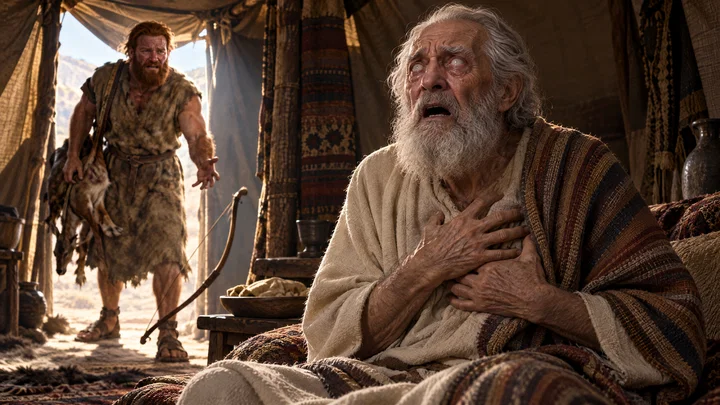
And he also had made savoury meat, and brought it unto his father, and said unto his father, Let my father arise, and eat of his son’s venison, that thy soul may bless me.
Translations
And he also had made savoury meat, and brought it to his father, and said to his father, Let my father arise, and eat of his son’s venison, that your soul may bless me.
King James Version, KJV Cambridge Paragraph Bible
And he also had made savoury meat, and brought it unto his father, and said unto his father, Let my father arise, and eat of his son’s venison, that thy soul may bless me.
And he also had made savory meat, and brought it to his father; and said to his father, Let my father arise, and eat of his son's venison, that thy soul may bless me.
And he also made savoury meat, and brought it unto his father; and he said unto his father, Let my father arise, and eat of his son’s venison, that thy soul may bless me.
And he also made savory food, and brought it unto his father; and he said unto his father, Let my father arise, and eat of his son’s venison, that thy soul may bless me.
and he also maketh tasteful things, and bringeth to his father, and saith to his father, 'Let my father arise, and eat of his son's provision, so that thy soul doth bless me.'
And he also had prepared savoury dishes, and he brought [ them] in to his father, and said to his father, Let my father arise and eat of his son's venison, in order that thy soul may bless me.
Then, he too, made dainty meats, and brought in to his father,—and said to his father, Let my father rise that he may eat of the game of his son, To the end thy soul may bless me!
Berean Standard Bible, Majority Standard Bible
He too made some tasty food, brought it to his father, and said to him, “ My father, sit up and eat of your son’s game, so that you may bless me.”
He also made savory food, and brought it to his father. He said to his father, “ Let my father arise, and eat of his son’s venison, that your soul may bless me.”
And he made ready a meal, good to the taste, and took it to his father, and said to him, Let my father get up and take of his son's meat, so that you may give me a blessing.
And hee also prepared sauourie meate and brought it to his father, and sayd vnto his father, Let my father arise, and eat of his sonnes venison, that thy soule may blesse me.
Douay-Rheims (Challoner revision)
And brought in to his father meats made of what he had taken in hunting, saying: Arise, my father, and eat of thy son’s venison; that thy soul may bless me.
Pictures
Cross-references
- Genesis 25:29-34
And Jacob sod pottage: and Esau came from the field, and he was faint:
Esau sold his birthright to Jacob for food, foreshadowing the later loss of his blessing.
- Genesis 25:23
And the LORD said unto her, Two nations are in thy womb, and two manner of people shall be separated from thy bowels; and the one people shall be stronger than the other people; and the elder shall serve the younger.
God foretold that the elder would serve the younger, shaping the conflict over Isaac’s blessing.
- Hebrews 12:16-17
Lest there be any fornicator, or profane person, as Esau, who for one morsel of meat sold his birthright.
Esau lost his birthright and later sought the blessing with tears, but could not regain it.
- Genesis 28:12-15
And he dreamed, and behold a ladder set up on the earth, and the top of it reached to heaven: and behold the angels of God ascending and descending on it.
God renews his promises of blessing and protection to Jacob.
- Genesis 27:6-17
And Rebekah spake unto Jacob her son, saying, Behold, I heard thy father speak unto Esau thy brother, saying,
Rebekah directs Jacob in deceiving Isaac to obtain his blessing.
- Genesis 27:1-5
And it came to pass, that when Isaac was old, and his eyes were dim, so that he could not see, he called Esau his eldest son, and said unto him, My son: and he said unto him, Behold, here am I.
Isaac asks Esau to prepare venison before blessing him.
- Genesis 25:28
And Isaac loved Esau, because he did eat of his venison: but Rebekah loved Jacob.
Isaac’s preference for Esau is tied to his enjoyment of Esau’s venison.
- Genesis 28:1-5
And Isaac called Jacob, and blessed him, and charged him, and said unto him, Thou shalt not take a wife of the daughters of Canaan.
Jacob is sent away after the deception.
- Hebrews 11:20
By faith Isaac blessed Jacob and Esau concerning things to come.
Isaac’s blessing of his sons concerns things to come.
- Genesis 29:25
And it came to pass, that in the morning, behold, it was Leah: and he said to Laban, What is this thou hast done unto me? did not I serve with thee for Rachel? wherefore then hast thou beguiled me?
Jacob, who deceived Isaac, is later deceived by Laban.
Commentary
Each commentary is drawn from primary sources: the writings of Ellen G. White and Adventist pioneers and periodicals. Each commentary is separate. Its own words are not a quotation; follow the references to read the source passages.
Ellen G. White
8 sources
Esau himself is the one who has prepared the savory meat and brought it to his father, asking him to arise and eat of his son's venison so that his soul may bless him, coming in after Jacob has already obtained by deception and fraud the blessing intended for Esau.SG3 115.11SP 108.1–2GC88 616.1–24SP 437.2PP 180.3–4 Those who held the other understanding took the verse to show Jacob bringing the savory meat to Isaac and asking him to eat so that Isaac would bless him, as part of Jacob's deception in obtaining his father's blessing.GC 619.2–620.1 The blessing so sought involved more than spiritual privilege, being connected with the temporal birthright including leadership of the family and a double portion of Isaac's wealth.PP 180.3–4
Esau had lost the blessing because he had rashly sold his birthright, and when he learned this he was deeply distressed and repented too late to undo his choice.1SP 108.1–2 Jacob resorted to fraud to gain what was already his by God's promise and foretold purpose, when he should have trusted God to fulfill it without deceit, and even without the privileges of the firstborn he could have received God's blessing through a righteous course.SG3 115.1ED 147.1–2 The blessing itself did not guarantee prosperity, for the prosperity of Esau or of Jacob depended on God and on whether each loved and obeyed Him.SG3 115.1
The wrong led to Esau's hatred and threat so that Jacob had to flee for his life, and years later when Jacob returned to his homeland at God's command he feared Esau was coming to take revenge.GC88 616.1–2 The deception reaped twenty years of exile in which Jacob himself was wronged and defrauded and at last forced to flee, followed by a second harvest as the evils of his own character cropped out in his sons.ED 147.1–2 What a person does is the result of what he is, life's experiences are the fruition of thoughts and deeds, and every deed reacts upon the doer so that the evils that curse life are the fruitage of one's own sowing.ED 147.1–2
Jacob's sin in obtaining the blessing had to be and was repented of before he could confidently plead with God for deliverance, illustrating that unconfessed sin would leave God's people without confidence to plead for deliverance in the time of trouble.4SP 437.2GC 619.2–620.1 The account warns that people may trade their inheritance of heaven for appetite and other selfish pleasures, and may find no place for repentance when it is too late.1SP 108.1–2 The chapter exemplifies deceptive dealing to gain advantage over another by secret methods, partiality and hypocrisy, and deceptive reasoning to bind freedom, turn a man from his rights, and grasp all that can be gotten regardless of agreements and of the disappointment and wrong done to others.Lt 7, 1896, par. 1–4 Such handling of men as machinery to be harnessed and driven, and such ruling as a lord over God's heritage by men in positions of trust who claim their councils stand as the voice of God, is an offense God will not tolerate, justify, or excuse, imperils souls, corrupts through selfishness and covetousness which is idolatry, and stands open to the eye of Him with whom we have to do.Lt 7, 1896, par. 1–4 Yet even thus there is hope, for God will not contend forever nor be always wroth, but sees the sinner's ways and heals him and leads him and restores comforts to him and to his mourners, giving peace to him that is far off and to him that is near.ED 147.1–2
Sources
Pioneers and periodicals
32 sources
Esau himself prepared food from the game he had hunted and brought it to his aged, blind father, asking him to rise and eat his son's venison and give him the blessing.ST Sep 22, 1898ST Jan 3, 1911ST Mar 30, 1888ST Jan 14, 1913 He came only after his younger brother had already obtained that blessing by fraud and impersonation, leaving the firstborn with second place.ST Sep 22, 1898ST Jul 31, 1901ST Jan 3, 1911ST Feb 28, 1906ST Apr 1, 1897 He still claimed what he had already deliberately traded away for a single perishable meal without his father's knowledge, a bargain that could not be undone.ST Mar 30, 1888ST Apr 1, 1897ST Nov 18, 1897 The scheme to secure by human trickery what God had promised showed lack of trust in God to fulfill His word in His own time and way, and though it succeeded for the moment it brought rage, flight, lifelong separation, and more than twenty years of exile and sorrow upon the whole household.ST Feb 24, 1887ST Jul 31, 1884ST Jul 31, 1901STST Oct 1, 1902 The deceiver was in turn deceived and left to suffer bitter consequences until chastisement worked deep repentance and ripened him for the kingdom, while Esau stands as warning that those ruled by appetite who barter heavenly heirship for present gratification may seek the blessing with tears when no remedy remains.ST Apr 24, 1879ST Jan 9, 1912ST May 17, 1910ST Jan 9, 1912RH Apr 26, 1870
Narrative Setting and Meaning
Esau himself had hunted game, prepared it as savoury meat, brought it to his father, and asked his father to arise and eat his son's venison so that his soul might bless him.ST Sep 22, 1898ST Jan 3, 1911ST Mar 30, 1888ST Feb 23, 1915ST Sep 22, 1898 He came expecting as firstborn to receive the ancestral blessing, for Isaac had sent him to hunt and prepare such meat before he died. Isaac had arranged to pronounce upon Esau the blessing Heaven had decreed for Abraham and Isaac and had promised to Jacob as a prince in Israel.ST Jul 31, 1901
He made this request after Jacob had already obtained the blessing by fraud and deception at Rebekah's urging, Isaac having already eaten and blessed Jacob before Esau arrived.ST Sep 22, 1898ST Jul 31, 1901ST Jan 3, 1911ST Feb 23, 1915ST Sep 22, 1898 The account is therefore that of Jacob obtaining his father's blessing by fraud, with Esau the firstborn given a second place.ST Jan 3, 1911ST Jan 3, 1911 Esau's coming was his later attempt to receive the birthright blessing, and he then learned what had been done.ST Jul 31, 1901ST Mar 30, 1888 His rage was moved to resolve to kill Jacob, forcing flight to distant relatives in another country where Jacob remained many long years in bitter hardship and distress.ST Jul 31, 1901
Isaac was old and blind and near death when he told Esau to prepare such venison dinner as he liked in order to receive his blessing.ST Oct 1, 1902 He favored Esau because he ate his venison, and his overfondness for Esau shaped an unsatisfactory family experience centered on material advantage and division surrounding the promise that the Seed would come through Jacob.ST Jan 14, 1913 His affection for Esau was linked to his fondness for meat, and the question is how that fondness affected his spiritual discernment.ST Sep 22, 1898
Esau sought the blessing he expected as firstborn even though he had deliberately sold his birthright to Jacob, taking selfish advantage of need being taken of his hunger and appetite, for a meal of pottage that perishes with the using, without telling Isaac that he had done so.ST Feb 24, 1887ST Mar 30, 1888ST Apr 1, 1897ST Nov 18, 1897 That deliberate trade under solemn oath could not be undone, and his later distress came when it was too late to remedy the matter.ST Apr 24, 1879ST Mar 30, 1888RH Mar 20, 1879 The birthright at stake included a double share of property, family rulership, and the priesthood, and in this family it also involved the line through whom Christ would come and in a measure the salvation of the race.ST Jul 31, 1901ST May 17, 1910
Isaac through dimness of sight blessed Jacob and passed Esau by.RH Nov 4, 1858 This shows that human sight and knowledge fail, so that time, place, speech, or apparel can obscure and darken the human eye and ear and estrange love and knowledge in the creature.RH Nov 4, 1858 By contrast the Lord knows who are His, for His eye as His essence is everywhere and He knows all things, so that time, place, speech, or apparel cannot obscure or darken His eye or ear toward His people.RH Nov 4, 1858
Faith, Retribution, and Warning
The scheming around the blessing was human interference with God's plan for the Promised Seed and the channel through which that Seed should come, springing from lack of faith that God could fulfil His promises without human help, the same lack first shown by Abraham and found at the basis of all union of church and state.ST Feb 24, 1887ST Jul 31, 1884ST Rebekah and Jacob should have trusted God to bring about His purposes in His own time and way, quietly waiting on the Lord instead of growing impatient and uneasy and devising human ingenuity to help Him, for when God promises a thing He will perform it at the proper time and promptly bestow His blessings when His people are ready to receive them.ST Feb 24, 1887ST Jul 31, 1884ST Jul 31, 1901 Jacob truly valued God's promise and blessing, yet his covetous and unrighteous method of seizing the birthright and blessing was wrong and God did not approve it, though He regarded Jacob's desire and repentance.ST Jul 31, 1884ST Oct 4, 1905
In this setting Jacob proved the meaning of his name supplanter by an overreaching, mercenary, covetous character, taking selfish advantage of Esau's hunger and appetite to purchase the birthright and then obtaining by fraud the blessing designed for his brother through trickery, fraud, duplicity and deception.ST Feb 28, 1906ST Apr 1, 1897ST Nov 18, 1897 His mother overheard Isaac's charge to Esau to prepare the venison dinner he liked in order to receive the blessing, remembered the Lord's promise that the elder should serve the younger, became alarmed lest the promise be frustrated, supposed she must do something, and led Jacob into error.ST Oct 1, 1902ST Oct 4, 1905ST Apr 12, 1883 She had Jacob kill two kids while Esau was hunting, prepared the dinner herself, put the kids' skins on Jacob's neck and hands to imitate his brother's hairy skin, and sent him to deceive Isaac by personating Esau.ST Oct 1, 1902
That attempt to supplement the Lord's promise with human works succeeded for the moment but was disastrous to the happiness of the entire family.ST Jul 31, 1901ST Oct 1, 1902 Esau's request is the moment he learns what was done after Jacob had already obtained by deception at Rebekah's urging the blessing Heaven had decreed for Abraham and Isaac and had promised to Jacob as a prince in Israel, and his rage and hatred were aroused to resolve to kill Jacob.ST Jul 31, 1901ST Oct 1, 1902 Jacob therefore had to flee from home and from Canaan to take refuge in Mesopotamia, the country from which God had called Abraham out, with Rebekah's father's people and distant relatives in a distant country to escape his brother's vengeance, an apostasy and treachery that brought disgrace and exile.ST Jul 31, 1901ST Apr 12, 1883 Mother and son were separated for life and Rebekah never saw her favorite son again, while Jacob remained many long years and over twenty years passing through bitter hardship, distress, sorrow and exile before even a formal reconciliation between the brothers.ST Jul 31, 1901STST Oct 1, 1902ST Oct 4, 1905
God's providence brought retribution in time and in kind, for he who overreached others in selfish plotting in turn met overreaching and suffered calamities that came back upon him.ST Jan 9, 1912ST Jan 9, 1912RH Apr 26, 1870 As Jacob had deceived Isaac he was later deceived by Laban, and his sin against Esau in taking the blessing by deception brought long-continued afflictions upon him as God's chastisement, a captivity that lasted until he went down into Egypt.ST Mar 31, 1881ST Jul 21, 1881ST Jul 27, 1915 That chastisement worked deep and thorough repentance in him so that the rod was then withdrawn, his sojourn in Egypt became the time appointed by Providence for his ripening for the kingdom, and his life ended in heavenly brightness.ST Jul 21, 1881 Though his heinous sin was repented of and accepted with assurance of eternal life, God left him to suffer bitter consequences in this life, showing that no deception avails before God who sees the heart and that the way of the transgressor is hard.RH Oct 4, 1864RH Apr 26, 1870ST Mar 31, 1881
The effects reached to posterity, for Jacob was favored with a view of the direful effect of his deception upon his descendants to the latest generation, shown how as centuries passed they would become more and more deceitful and covetous and wicked until the end.RH Oct 4, 1864 Esau's animosity likewise affected his descendants for hundreds of years, so they refused to let Israel pass through their land on the journey from Egypt to Canaan, Israel could never wield any moral influence over them, and Israel had to subdue the Edomites by warfare.ST Oct 1, 1902
Esau represents the worldly person and the children of unbelief and disobedience, reckless and ruled by appetite and corrupt passion, living to satisfy immediate desires and valuing present gratification, perishable treasure, hurtful indulgences and a mess of pottage which perishes with the using above high and heavenly blessings and heirship to Heaven, even sacrificing health and enfeebling the mental faculties.ST Apr 24, 1879ST May 17, 1910ST Nov 18, 1897 Jacob represents an unconverted person who nevertheless longed to know and do God's will and desired the Lord's blessing even by fraud, valuing the birthright which included a double share of property, family rulership and the priesthood and in this family also involved the line through whom Christ would come and in a measure the salvation of the race, yet his desire was driven in a temporal rather than spiritual spirit.ST May 17, 1910ST Nov 18, 1897ST Oct 4, 1905 As Jacob the supplanter he is a type of religionists who seek the Lord's blessing as place or position, as loaves and fishes, as the temporal instead of the spiritual, trying to obtain it by might or right, by hook or crook, by principle or policy, by right or expediency, sacrificing principle, taking the unholy suggestions of the faithless and uniting with the world and the State, only to be utterly disappointed at last.ST Nov 18, 1897 Esau repented of his rash act of selling the birthright under solemn oath when it was too late to remedy the matter, and his case stands on record as a warning for the course of the unrighteous who count the redemption purchased by Christ of little value and despise God and Heaven for self-gratification, who barter away their heirship to eternal glory and in the day of God will find no place for repentance though they seek it carefully and with tears and reach a point from which return is impossible.ST Apr 24, 1879RH Mar 20, 1879
Sources