Genesis 27:32
And Isaac his father said unto him, Who art thou? And he said, I am thy son, thy firstborn Esau.
Translations
And Isaac his father said to him, Who are you? And he said, I am your son, your firstborn Esau.
King James Version, KJV Cambridge Paragraph Bible
And Isaac his father said unto him, Who art thou? And he said, I am thy son, thy firstborn Esau.
And Isaac his father said to him, Who art thou? And he said, I am thy son, thy first-born Esau.
And Isaac his father said unto him, Who art thou? And he said, I am thy son, thy firstborn, Esau.
And Isaac his father said unto him, Who art thou? And he said, I am thy son, thy first-born, Esau.
And Isaac his father saith to him, 'Who [art] thou?' and he saith, 'I [am] thy son, thy first-born, Esau;'
And Isaac his father said to him, Who art thou? And he said, I am thy son, thy firstborn, Esau.
And Isaac his father said to him Who art, thou? And he said, I, am thy son thy firstborn, Esau.
Berean Standard Bible, Majority Standard Bible
But his father Isaac replied, “ Who are you?”“ I am Esau, your firstborn son,” he answered.
Isaac his father said to him, “ Who are you?”He said, “ I am your son, your firstborn, Esau.”
And Isaac his father said to him, Who are you? And he said, I am your oldest son, Esau.
But his father Izhak sayde vnto him, Who art thou? And he answered, I am thy sonne, euen thy first borne Esau.
Douay-Rheims (Challoner revision)
And Isaac said to him: Why! who art thou? He answered: I am thy firstborn son Esau.
Pictures
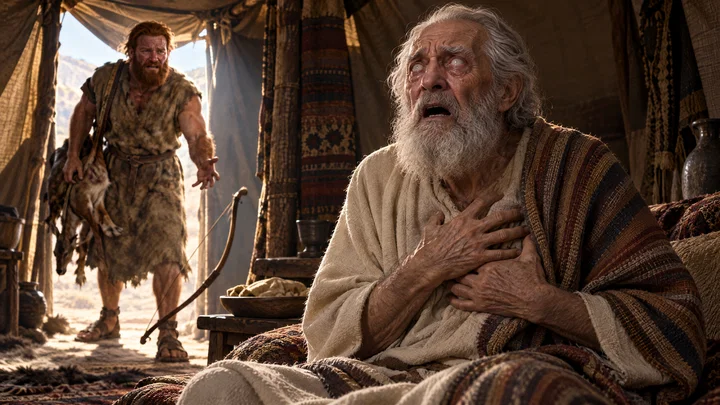
Cross-references
- Genesis 25:29-34
And Jacob sod pottage: and Esau came from the field, and he was faint:
Esau sells his birthright to Jacob for food before Jacob obtains the blessing.
- Hebrews 12:17
For ye know how that afterward, when he would have inherited the blessing, he was rejected: for he found no place of repentance, though he sought it carefully with tears.
Esau learned the blessing had gone to Jacob and was rejected despite his tears.
- Genesis 25:23
And the LORD said unto her, Two nations are in thy womb, and two manner of people shall be separated from thy bowels; and the one people shall be stronger than the other people; and the elder shall serve the younger.
God foretold that the elder would serve the younger, shaping the blessing conflict.
- Genesis 27:18-24
And he came unto his father, and said, My father: and he said, Here am I; who art thou, my son?
Jacob claims to be Esau when Isaac questions him.
- Genesis 27:41-45
And Esau hated Jacob because of the blessing wherewith his father blessed him: and Esau said in his heart, The days of mourning for my father are at hand; then will I slay my brother Jacob.
Esau’s anger drives Jacob to leave home.
- Genesis 27:6-17
And Rebekah spake unto Jacob her son, saying, Behold, I heard thy father speak unto Esau thy brother, saying,
Rebekah directs Jacob in deceiving Isaac to obtain Esau’s blessing.
- Malachi 1:2-3
I have loved you, saith the LORD. Yet ye say, Wherein hast thou loved us? Was not Esau Jacob’s brother? saith the LORD: yet I loved Jacob,
Contrasts God’s treatment of Jacob and Esau.
- Romans 9:13
As it is written, Jacob have I loved, but Esau have I hated.
God distinguishes Jacob from Esau in his love and choice.
- Hebrews 11:20
By faith Isaac blessed Jacob and Esau concerning things to come.
Isaac blesses Jacob and Esau concerning things to come by faith.
- 2 Samuel 8:14
And he put garrisons in Edom; throughout all Edom put he garrisons, and all they of Edom became David’s servants. And the LORD preserved David whithersoever he went.
David subdues Edom, Esau’s descendants.
- 2 Chronicles 21:3
And their father gave them great gifts of silver, and of gold, and of precious things, with fenced cities in Judah: but the kingdom gave he to Jehoram; because he was the firstborn.
The firstborn receives the heir’s place and rule.
- Genesis 28:10
And Jacob went out from Beer-sheba, and went toward Haran.
Jacob’s journey follows his flight from home.
- Genesis 32:24-30
And Jacob was left alone; and there wrestled a man with him until the breaking of the day.
Jacob wrestles in prayer for deliverance from Esau.
- Genesis 25:34
Then Jacob gave Esau bread and pottage of lentiles; and he did eat and drink, and rose up, and went his way: thus Esau despised his birthright.
shows despising birthright for pottage
Commentary
Each commentary is drawn from primary sources: the writings of Ellen G. White and Adventist pioneers and periodicals. Each commentary is separate. Its own words are not a quotation; follow the references to read the source passages.
Ellen G. White
7 sources
The moment belongs to Isaac's intent to give the firstborn's blessing to Esau, when he questioned the son who came for that blessing and received the false answer claiming to be Esau the firstborn.SG3 115.1GC88 616.1–24SP 437.2Lt 7, 1896, par. 1–4 By fraud and false pretenses Jacob sought to gain what was already his by God's promise.ED 147.1–2 The blessing by itself would not ensure Esau's prosperity, for that depended on his course of action before God, and Jacob likewise would be blessed if he loved and feared God even without the privileges usually given to the firstborn.SG3 115.1
Esau learned that Jacob had received the blessing that would have been his and was distressed, but his regret came too late because he had rashly sold his birthright.1SP 108.1–2 His loss warns that people who trade their hope of heaven for selfish pleasures may seek repentance only after it is too late.1SP 108.1–2 Jacob's deception against Isaac and Esau to obtain the family blessing and birthright brought retribution on himself in his brother's hatred and threats, his flight for his life, twenty years of exile in which he himself was wronged and defrauded until forced to find safety in flight, and a later harvest when the evils of his own character appeared in his sons.ED 147.1–2GC88 616.1–2
What a person does results from what he is, every deed reacts upon the doer, and the evils that curse life are the fruit of his own sowing.ED 147.1–2 Yet God will not contend forever nor always be wroth, lest the spirit fail before Him, for though He was wroth with covetous iniquity and hid Himself while the sinner went on frowardly in the way of his heart, He sees his ways and will heal him, lead him, restore comforts to him and to his mourners, and give peace to him that is far off and to him that is near.ED 147.1–2 Jacob later repented of the deception by which he had obtained the birthright, and the account shows that God does not overlook concealed or unrepented sin.GC 619.2–620.14SP 437.2 Genuine repentance and confession leave no hidden wrong to undermine confidence in God's deliverance, and when Jacob pleaded with God in distress God mercifully preserved his life.GC 619.2–620.14SP 437.2 Deceptions like Jacob's are practiced by those standing in high places of trust who use deceptive reasoning, partiality and hypocrisy to handle men as machinery, to grasp all they can, and to wrong and disappoint others irrespective of rights and agreements.Lt 7, 1896, par. 1–4
Sources
Pioneers and periodicals
37 sources
The verse records the moment when Isaac asks who stands before him and Esau answers that he is his son, his firstborn Esau, after Jacob has already received the blessing in disguise.ST Sep 22, 1898ST Jan 6, 1909ST Sep 22, 1898 Isaac was old and blind so he could not know his own sons, and Esau was returning from hunting to bring game for the blessing Isaac meant to give him, without having told Isaac that he had sold his birthright and while Isaac was preparing to give him the blessing Heaven had promised to Jacob.ST Feb 24, 1887ST Jul 31, 1901ST Oct 1, 1902 The birthright carried the double share, family authority and priesthood, and the line through whom Christ would come, yet Esau had sold it to Jacob for a single meal and sealed the bargain with an oath, while still coming with full confidence that he would inherit the blessing.ST Mar 30, 1888ST May 17, 1910RH Apr 14, 1859 Jacob's obtaining of that blessing by his mother's plan and his own fraud was disobedience and lack of faith, for God had promised him the birthright and would have given him the blessing at the proper time without human help if he had quietly waited and trusted.ST Jul 31, 1901STST Feb 28, 1906ST Apr 1, 1897ST Nov 18, 1897 Esau's loss warns that those who despise their heavenly inheritance secured through Christ's redemption for temporary pleasure and appetite will find no place to regain it afterward, even though they seek it with tears.ST Apr 24, 1879RH Apr 14, 1859RH Mar 20, 1879
Narrative Setting and Discovery
Genesis 27:32 records the moment Isaac asks who stands before him and receives the answer that it is his son, his firstborn Esau, coming after Jacob has already received Isaac's blessing in disguise.ST Feb 24, 1887ST Sep 22, 1898ST Jan 6, 1909ST Sep 22, 1898 The arrival reveals that Isaac had been deceived into blessing Jacob while believing him to be Esau, and Isaac then trembles greatly at the discovery.ST Sep 22, 1898ST Sep 22, 1898 The exchange belongs to the larger account of Isaac, his two sons and their defects, and Jacob's eventual victory by which he became Israel, a prevailer with God.ST Jan 6, 1909
Isaac was old and near death, and blind with dimness of sight so that he could not know his own sons, which is why he asks who stands before him and why he had blessed Jacob and passed over Esau.ST Jul 31, 1901ST Oct 1, 1902RH Nov 4, 1858 Esau was returning from hunting in the fields to bring game and a savory dish for the intended blessing, only to find Jacob had already obtained it by gross deception while he was away.ST Jul 31, 1901 Isaac had been arranging to pronounce upon Esau the blessing Heaven had promised to Jacob as heir of Abraham and Isaac, but Rebekah urged Jacob to deceive his father and take it during Esau's absence.ST Jul 31, 1901
Esau had not told Isaac that he had sold his birthright, and Isaac had intended to bless Esau as firstborn.ST Feb 24, 1887ST Jul 31, 1901 His coming in this verse exposes what was done, revealing the deception into blessing Jacob instead.ST Sep 22, 1898ST Jul 31, 1901ST Sep 22, 1898 The chapter's blessing story distinguishes Isaac's spiritual blessing of Jacob in God's name from the blessing he gives Esau in his own name, in keeping with their desires.ST Sep 22, 1898
In this account of Jacob's guile in gaining the blessing from Isaac, Esau appears as the outdoor son with face reddened by desert sun-heat.RH Feb 22, 1912
Birthright and Blessing Meaning
Isaac's blessing was bound up with the birthright, so Esau's answer that he is the firstborn is a claim to the firstborn's inheritance and privilege, with the discovery that Jacob has already received the blessing intended for Esau turning on that identification.RH May 30, 1912 The birthright itself carried a double share of the family property, authority and pre-eminence or rulership in the family, and the family priesthood.ST May 17, 1910 In this case it carried still more, for it involved being the ancestor through whom Christ would come and thus, in that way, the salvation of the human race.ST May 17, 1910
Esau had already sold that birthright to Jacob for food, for a single meal of pottage, because he despised it for immediate appetite and sealed the bargain with a solemn oath.ST Mar 30, 1888RH Apr 14, 1859 Yet he came to Isaac seeking the blessing and identifying himself as firstborn son with full confidence that he would still inherit it, expecting to keep both the meal and the birthright.ST Mar 30, 1888RH Apr 14, 1859 His confident assertion of his identity as proof of his right therefore exposes self-deception and deluded hope.RH Apr 14, 1859
Its immediate result was rejection when he would have inherited the blessing, which greatly embittered his distress at the hopeless loss.RH Apr 14, 1859 He could not undo that deliberate trade or regain the blessing afterward, even though he sought it with tears.ST Mar 30, 1888RH Mar 20, 1879 He became deeply distressed when the blessing that would have been his went to Jacob, but his regret came too late to undo his choice, and his claim to the birthright did not restore what he had lost.ST Apr 24, 1879ST Mar 30, 1888RH Mar 20, 1879
Deception and Lack of Faith
This moment belongs to trickery, fraud, duplicity and deception, to disobedience and transgression in which Jacob took selfish advantage of Esau and obtained by fraud the blessing intended for his brother.ST Feb 28, 1906ST Apr 1, 1897ST Nov 18, 1897ST Oct 4, 1905 The name Jacob, meaning supplanter, describes his overreaching, covetous character at that time, for he coveted the birthright and the blessing.ST Apr 1, 1897ST Nov 18, 1897 He took advantage of his brother's supposed need to acquire the birthright and then took the blessing by fraud and deceit.ST Apr 1, 1897ST Nov 18, 1897
The lie was part of Rebekah's plan, formed from fear that God's word that the elder should serve the younger would be frustrated.ST Oct 1, 1902 While Esau was hunting, she sent Jacob with goat meat prepared as venison and with kids' skins on his hands and neck to imitate Esau's hairiness.ST Oct 1, 1902 Jacob continued the deception by falsely claiming to be Esau the firstborn when Isaac asked who he was, in order to obtain the blessing Isaac had promised Esau after a meal of hunted venison.ST Nov 18, 1897ST Oct 1, 1902RH Jul 4, 1865 He was led into error by his mother's influence, and the family's division was connected with Isaac's excessive affection for Esau and Rebekah's favoring of Jacob.ST Jan 14, 1913ST Apr 12, 1883
The deception was wrong and showed lack of faith that God could fulfill His promises.ST Feb 24, 1887ST Jul 31, 1884ST Jul 31, 1901ST God had promised Jacob the birthright, and would have given him the promised blessing at the proper time without human help if Jacob had quietly waited and trusted God to fulfill the promise in God's way and time.ST Feb 24, 1887ST Jul 31, 1884ST Jul 31, 1901 God could have blessed Jacob even without the privileges usually given to the firstborn.ST Feb 24, 1887 This stands in the record of human interference in God's plans for the Promised Seed and the channels through which that Seed should come, the same lack of faith first shown in Abraham and found at the basis of all union of church and state, with the family pursuing the promise in material terms described as supplanting.STST Jan 14, 1913
Jacob's desire for the birthright and blessing was driven by temporal rather than spiritual aims.ST Oct 4, 1905 Even so, his action was wrong although he valued God's promise more than Esau did, for Esau was willing to trade his birthright for a meal while Jacob believed the promises made to Abraham and Isaac.ST Oct 4, 1905
Consequences and Divine Retribution
Esau the firstborn was by this disclosure placed in second position and driven to hatred of his brother, with enraged resolve to kill Jacob and threats of vengeance.ST Jul 31, 1901ST Jan 3, 1911 That murderous hatred forced Jacob's flight from home, delayed reconciliation for over twenty years, separated Rebekah from Jacob forever, and produced centuries of enmity in which Edom refused Israel passage from Egypt to Canaan and Israel subdued Edom only by warfare without moral influence.ST Jul 31, 1901ST Oct 1, 1902 Jacob's selfish plotting and attempt to secure God's promised blessing by his own means brought suffering, anxiety, guilt, and exile, and he was himself overreached as God's providence brought retribution.ST Jan 9, 1912ST Oct 4, 1905ST Oct 4, 1905
He had to flee from home to distant relatives for many long years of bitter experience, hardship and distress, wholly separating Rebekah from the son who was her comfort and bringing grief to her as a consequence of her error.ST Jul 31, 1884ST Jul 31, 1901RH Jul 4, 1865 The human scheming brought lifelong separation of mother and son and great hardship to Jacob, followed by trials and victories ending in complete change of heart that places Jacob the supplanter among the Israel of God.ST His treachery caused him to flee from Canaan to take refuge in the land from which God had called Abraham, in order to escape his brother's vengeance. That return was apostasy with no legitimate excuse, unlike Abraham who would not return and would not allow Isaac to return, and it foreshadowed his posterity, who after deliverance from Egypt and planting in Canaan lapsed into apostasy and were carried captive to that same country.
Jacob's deceit brought sorrow upon himself, for he had to flee for his life and his uncle Laban later dealt with him deceitfully and cruelly, illustrating that evil actions can return upon the one who commits them.RH Apr 26, 1870ST Mar 31, 1881ST Jul 27, 1915 Laban's deception led to lasting misery in Jacob's family, including Joseph's sale into slavery and Jacob's long belief that Joseph had been killed by a wild beast.ST Mar 31, 1881 The deception was a sin peculiarly abhorrent to God and a sinful departure from strict integrity that brought long exile and troubled conscience.ST Nov 20, 1879RH Mar 30, 1869 Though Jacob repented and God accepted his repentance with assurance of eternal life, he was left to suffer the bitter consequences of that sin in this life.RH Mar 30, 1869
Jacob was brought to see more clearly how heinous his sin was and how its effects could extend through his descendants to later generations, and the sin could be put away only because he had repented beforehand.RH Oct 4, 1864 He later reviewed his wrongdoing, acknowledged his unworthiness, remembered God's mercy and help, and was brought to deep humility.ST Nov 20, 1879RH Jul 4, 1865 Jacob had to repent of that fraud in obtaining the blessing, for unconfessed wrongdoing would have prevented him from receiving deliverance.RH Nov 14, 1912 The chastisement for that sin worked deep and thorough repentance in Jacob, so that when he went down into Egypt his afflictions were closed forever and the rod was withdrawn.ST Jul 21, 1881 His sojourn in Egypt was the time appointed for his ripening for the kingdom of God, and his life ended in heavenly brightness.ST Jul 21, 1881
Types and Doctrinal Connections
Jacob and Esau are types of men who have existed and still exist everywhere, Jacob representing a religious class that desires the Lord's blessing even though he gets it by fraud, and Esau representing those who have no faith, children of unbelief and disobedience who sell the birthright for a mess of pottage which perishes with the using.ST Nov 18, 1897 As Jacob the supplanter he took selfish advantage of his brother's supposed need to acquire the birthright and then took the blessing by fraud and deceit when the question of identity was asked.ST Nov 18, 1897 In this he types religionists who treat the Lord's blessing as largely place or position, loaves and fishes, the temporal instead of the spiritual, and who hope to obtain it by might or right, by hook or crook, by principle or policy, by right or expediency.ST Nov 18, 1897 They sacrifice principle, take the unholy suggestions of the faithless, and unite with the world and the State, only to be utterly disappointed at last.ST Nov 18, 1897
Esau represents a worldly person who lives for immediate physical pleasure and was willing to trade away his birthright for temporary gratification.ST May 17, 1910 That birthright included a double share of the family property, authority in the family, and the priesthood, and in this case it also involved being the ancestor through whom Christ would come and in that way the salvation of the human race.ST May 17, 1910 The verse belongs to the account of Isaac, his two sons, and their defects, and Jacob's eventual victory by which he became Israel, a prevailer with God.ST Jan 6, 1909
Isaac's mistake through dimness of sight, so that he could not know his own sons and blessed Jacob and passed over Esau, shows that ignorance and forgetfulness can estrange love and knowledge in the creature.RH Nov 4, 1858 This stands in contrast to the Lord who knows who are His and whose eye is always over them, since time, place, speech, or apparel cannot obscure or darken His eye or ear.RH Nov 4, 1858 Jacob's experience of fraud in obtaining the birthright, of which he had to repent because unconfessed wrongdoing would have prevented deliverance, is used as a pattern for God's people in the coming time of trouble.RH Nov 14, 1912 They will feel their unworthiness, but because their sins have been confessed and blotted out, they will have no concealed wrongs to face and can plead with confidence for deliverance.RH Nov 14, 1912
Warning and Practical Application
Esau's rash sale of his birthright and his deep distress when the blessing that would have been his went to Jacob warn that people may treat their heavenly inheritance, secured through Christ's redemption, as worthless and trade it for temporary pleasures.ST Apr 24, 1879 That barter is especially the gratification of unhealthy appetite and other selfish desires, and when judgment comes there will be found no place for repentance, even if it is sought with tears.ST Apr 24, 1879 His regret came too late to undo his deliberate choice.ST Apr 24, 1879
His arrival after Jacob had already received the blessing, identifying himself as Isaac's firstborn son, did not restore what he had lost, for he sought it with tears but could not regain it.RH Mar 20, 1879 His case therefore warns that a person may give up the right to eternal glory and later be unable to return.RH Mar 20, 1879
Esau was willing to trade his birthright for a meal, and people likewise barter God's promises for pleasure, power, wealth, or fame.ST Oct 4, 1905 Jacob's obtaining of Isaac's blessing through deception was wrong even though Jacob valued God's promise more than Esau did and believed the promises made to Abraham and Isaac.ST Oct 4, 1905 God did not approve Jacob's method, but regarded his desire for the blessing and his repentance.ST Oct 4, 1905
Esau's return from hunting in the fields to his father Isaac, who was near death, answering that he is his firstborn son only to find Jacob had already obtained the blessing by gross deception, exposes what was done.ST Jul 31, 1901 Isaac had been arranging to pronounce upon Esau the blessing Heaven had promised to Jacob as heir of Abraham and Isaac, but while Esau was away Rebekah urged Jacob to deceive his father and take it.ST Jul 31, 1901 That exposure stirred Esau's enraged resolve to kill Jacob, forcing Jacob to flee to distant relatives for many long years of bitter experience, hardship and distress, and wholly separating Rebekah from the son who was her comfort.ST Jul 31, 1901 The verse therefore teaches that God would have given Jacob the promised blessing at the proper time without human help, so impatience and human ingenuity only bring separation and suffering.ST Jul 31, 1901 When the Lord promises a thing men must not become nervous or uneasy but quietly wait, get ready to receive, and He will promptly bestow His blessings.ST Jul 31, 1901
Sources