Genesis 40:15
For indeed I was stolen away out of the land of the Hebrews: and here also have I done nothing that they should put me into the dungeon.
Translations
American King James Version, King James Version
For indeed I was stolen away out of the land of the Hebrews: and here also have I done nothing that they should put me into the dungeon.
KJV Cambridge Paragraph Bible, Revised Version, American Standard Version
for indeed I was stolen away out of the land of the Hebrews: and here also have I done nothing that they should put me into the dungeon.
For indeed I was stolen away from the land of the Hebrews: and here also have I done nothing that they should put me into the dungeon.
for I was really stolen from the land of the Hebrews; and here also have I done nothing that they have put me in the pit.'
for indeed I was stolen out of the land of the Hebrews, and here also have I done nothing that they should put me into the dungeon.
For I was, stolen, out of the land of the Hebrews,—and, even here, had I done nothing, that they should have put me in the dungeon,
Berean Standard Bible, Majority Standard Bible
For I was kidnapped from the land of the Hebrews, and even here I have done nothing for which they should have put me in this dungeon.”
For indeed, I was stolen away out of the land of the Hebrews, and here also I have done nothing that they should put me into the dungeon.”
For truly I was taken by force from the land of the Hebrews; and I have done nothing for which I might be put in prison.
For I was stollen away by theft out of the land of the Ebrewes, and here also haue I done nothing, wherefore they should put mee in the dungeon.
Douay-Rheims (Challoner revision)
For I was stolen away out of the land of the Hebrews, and here without any fault was cast into the dungeon.
Pictures
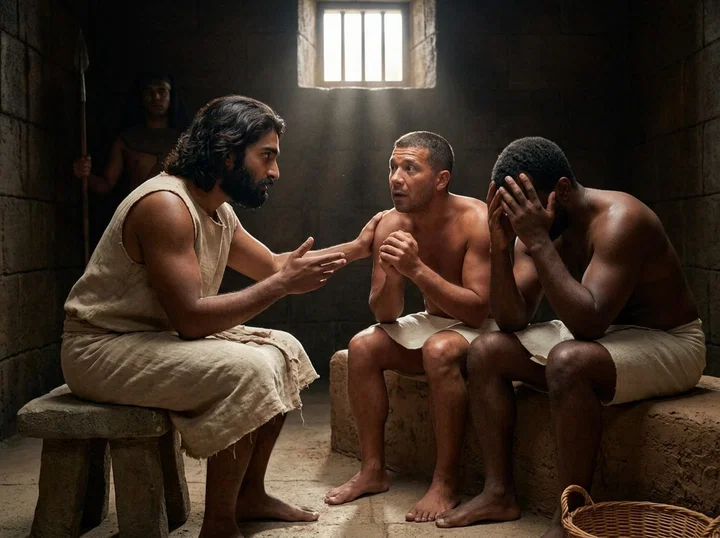
Cross-references
- Genesis 39:20
And Joseph’s master took him, and put him into the prison, a place where the king’s prisoners were bound: and he was there in the prison.
Joseph is imprisoned despite his innocence after Potiphar’s wife accuses him.
- Genesis 41:14
Then Pharaoh sent and called Joseph, and they brought him hastily out of the dungeon: and he shaved himself, and changed his raiment, and came in unto Pharaoh.
Joseph is brought from prison before Pharaoh.
- Genesis 41:9-13
Then spake the chief butler unto Pharaoh, saying, I do remember my faults this day:
The butler recalls Joseph’s accurate interpretation when Pharaoh’s dreams trouble him.
- Psalms 105:18
Whose feet they hurt with fetters: he was laid in iron:
Both describe Joseph’s unjust imprisonment and suffering.
- Genesis 40:8
And they said unto him, We have dreamed a dream, and there is no interpreter of it. And Joseph said unto them, Do not interpretations belong to God? tell me them, I pray you.
Joseph says dream interpretation belongs to God.
- Genesis 37:28
Then there passed by Midianites merchantmen; and they drew and lifted up Joseph out of the pit, and sold Joseph to the Ishmeelites for twenty pieces of silver: and they brought Joseph into Egypt.
Joseph’s brothers sell him into Egypt.
- Genesis 37:5-11
And Joseph dreamed a dream, and he told it his brethren: and they hated him yet the more.
Joseph’s earlier dreams of exaltation contrast with his imprisonment.
- Genesis 40:23
Yet did not the chief butler remember Joseph, but forgat him.
The chief butler forgot Joseph’s plea.
- Genesis 41:40
Thou shalt be over my house, and according unto thy word shall all my people be ruled: only in the throne will I be greater than thou.
Joseph is raised to authority in Egypt.
- Genesis 42:1-3
Now when Jacob saw that there was corn in Egypt, Jacob said unto his sons, Why do ye look one upon another?
Jacob’s sons go to Egypt to buy grain from Joseph.
- Genesis 41:42
And Pharaoh took off his ring from his hand, and put it upon Joseph’s hand, and arrayed him in vestures of fine linen, and put a gold chain about his neck;
The gold collar marks Joseph’s distinction in Egypt.
Commentary
Each commentary is drawn from primary sources: the writings of Ellen G. White and Adventist pioneers and periodicals. Each commentary is separate. Its own words are not a quotation; follow the references to read the source passages.
Ellen G. White
4 sources
The verse is Joseph's touching plea to Pharaoh's chief butler while both are in prison together.SG3 146.2–147.11SP 134.1–2 At that time he is held in prison as a Hebrew servant.ST Jan 15, 1880 He had shown the butler kind interest and kind treatment and help in his great distress of mind by interpreting his dream to mean restoration to the king's favor in three days to deliver Pharaoh's cup as before.SG3 146.2–147.11SP 134.1–2 On that basis he asks the butler to think on him and remember him when it is well with him, to show him kindness by mentioning him to Pharaoh and bringing him out of the prison house.SG3 146.2–147.11SP 134.1–2 To support the request he declares his innocence, that he was stolen away and taken by force out of the land of the Hebrews and his people's land and here also has done nothing to deserve being put into the dungeon.SG3 146.2–147.11SP 134.1–2
The verse belongs to the account of the butler's and baker's dreams and the three days in Genesis 40:12-20, in which Joseph's interpretations were accurately fulfilled by the butler's restoration and the baker's execution in accordance with the prediction.GC 323.2–324.2ST Jan 15, 1880 That predicted event limited to a given time was once only a matter of prophecy and was then fulfilled in accordance with the prediction.GC 323.2–324.2 The three days stand with other measured periods as proof that God fulfills what He foretells within the time foretold.GC 323.2–324.2 So the chronological portions of the Bible are as much God's word and as worthy of serious consideration as any other portion, including chronological periods extending to the second coming of Christ as revealed appointed times.GC 323.2–324.2
Sources
Pioneers and periodicals
18 sources
He was stolen by force from his homeland and sold by his brothers into Egypt, where as a Hebrew exile among strangers he lay in the dungeon though he had done nothing wrong there to deserve it.ST Jan 3, 1911ST Nov 3, 1898ST Apr 9, 1894 He spoke these words to the chief butler after interpreting his dream of restoration to office within three days, asking to be remembered and shown kindness by being mentioned to Pharaoh so he might be brought out of prison.ST Nov 3, 1898ST Nov 3, 1898RH Jul 28, 1904 His imprisonment had followed a false accusation after he resisted temptation with integrity and refused to break God's law, so that he was degraded and humbled as a culprit instead of being exalted as his earlier dreams had shown.ST Apr 9, 1894ST Feb 22, 1899ST Oct 16, 1901 Even with appearances so forbidding he kept his purity and confidence in God the interpreter of dreams, and his prison discipline was God's way of preparing him to be raised to authority in Egypt to preserve the holy Seed.ST Jan 3, 1911ST Jan 21, 1913ST Feb 22, 1899 His asking the butler for help was natural, but it failed because God's time for his deliverance had not yet come, teaching patience to leave plans in the hands of Him who knows the end from the beginning, while the fulfillment of the three days foretold to the butler and baker gives reason to trust the timed periods of Scripture reaching to the coming of the Saviour.RH Apr 18, 1854RH Mar 31, 1868ST Nov 29, 1905
Plea and Prison Setting
Joseph was stolen away by force and carried from his homeland, the land of the Hebrews, sold by his brothers into slavery into Egypt, where as a Hebrew servant and an exile among strangers and enemies he was confined in the dungeon though he had done nothing and committed no crime or wrong in Egypt to deserve it.ST Jan 3, 1911ST Nov 3, 1898ST Oct 9, 1901 His plea gives that double injustice as the just reason to be remembered and helped out of prison.ST Nov 3, 1898ST Nov 3, 1898 His integrity and purity had remained firm under that unjust confinement.ST Jan 3, 1911
He spoke these words to the chief butler after interpreting the butler's dream of restoration to his office within three days, while he himself would remain behind in prison.ST Nov 3, 1898RH Jul 28, 1904 He asked to be remembered when the butler was restored, to be shown kindness by having his case spoken of to Pharaoh, and so to be gotten out of prison.ST Nov 3, 1898ST Nov 3, 1898 He pointed to the injustice of his own suffering as reason to be remembered, declaring his innocence in order to gain help before Pharaoh for release.ST Nov 3, 1898RH Jul 28, 1904
His long imprisonment had followed a false accusation after he resisted temptation with integrity and refused to violate God's law, for which he was cast into prison unjustly.ST Apr 9, 1894ST Oct 16, 1901 He was thereby reduced to the condition of a culprit, degraded, humbled, and imprisoned.ST Feb 22, 1899 That low condition was the very opposite of his earlier dreams of being elevated to a superior position and exalted among his brethren.ST Feb 22, 1899
The verse belongs to the account in which in prison he served Pharaoh's imprisoned officers and interpreted the dreams of the butler and the baker accurately.ST Jan 15, 1880ST Mar 24, 1887 Those interpretations came true in that the chief butler returned to his office and was restored while the chief baker was hanged and executed.ST Jan 15, 1880ST Mar 24, 1887 The surrounding account's details fit Egyptian customs and setting, and those Egyptian features support its historical character rather than its being fiction.ST Dec 14, 1915
God's Purpose and Deliverance
Joseph was carried by force out of the land of the Hebrews and shut up in Egypt though he had committed no crime, and in that prison discipline his integrity and purity stood firm until God lifted him to authority.ST Jan 3, 1911ST Feb 22, 1899 Reduced to the state of a culprit, degraded, humbled, imprisoned, an exile among strangers and enemies, he was living the very opposite of his earlier dreams of being lifted to a superior place and exalted among his brethren.ST Feb 22, 1899 Yet even with outward and present appearances so forbidding he kept confidence in dreams, because his trust was in God the interpreter of dreams, looking at the invisible and knowing his own dreams would sometime be fulfilled.ST Feb 22, 1899
That prison schooling belonged to his sojourn in Egypt after being sold into slavery by his brothers, in which God dealt well with him.ST Jan 3, 1911 The Lord was in it preparing him to preserve the holy Seed.ST Jan 21, 1913 He stands in that Egyptian history as a prophet, because he foretold the seven years of plenty and the seven years of famine.RH Jun 23, 1903
His history shows that whatever God has intended a person for He will safely bring them to it, for He may lead round about yet He guides right and can be trusted to do so.RH Jan 19, 1860 His asking the chief butler to speak for him and get him out of prison was a perfectly natural effort to be free.ST Nov 29, 1905 It failed because the time had not yet arrived in God's plan for his deliverance, teaching that when plans fail the program is to be left in the hands of the Lord who knows the end from the beginning and does all things well, and only so to have patience and wait for God's time.ST Nov 29, 1905
Prophecy, Confidence, and Pattern
The three days foretold for the butler and the baker were once only a matter of prophecy.RH Apr 18, 1854RH Mar 31, 1868 That period, given in Genesis 40:12-20 for the fulfillment of their dreams, was then fulfilled in accordance with the predictions.RH Apr 18, 1854RH Mar 31, 1868 This proves that predicted events limited by a given time occur within that time.RH Apr 18, 1854RH Mar 31, 1868 It gives reason to trust the chronological periods of the Bible extending to the coming of the Saviour and supports confidence in them.RH Apr 18, 1854RH Mar 31, 1868
His experience in Egypt shows God's individual leading under the new covenant promise.RH Dec 20, 1906 It sets the pattern for what God's workers are to be in the closing act of the world.RH Dec 20, 1906 That includes medical missionary workers carrying truth to those perishing spiritually and physically.RH Dec 20, 1906
Sources