Leviticus 16:30
For on that day shall the priest make an atonement for you, to cleanse you, that ye may be clean from all your sins before the LORD.
Translations
For on that day shall the priest make an atonement for you, to cleanse you, that you may be clean from all your sins before the LORD.
King James Version, Webster Bible
For on that day shall the priest make an atonement for you, to cleanse you, that ye may be clean from all your sins before the LORD.
for on that day shall the priest make an atonement for you, to cleanse you, that ye may be clean from all your sins before the Lord.
for on this day shall atonement be made for you, to cleanse you; from all your sins shall ye be clean before the LORD.
for on this day shall atonement be made for you, to cleanse you; from all your sins shall ye be clean before Jehovah.
for on this day he maketh atonement for you, to cleanse you; from all your sins before Jehovah ye are clean;
for on that day shall atonement be made for you, to cleanse you: from all your sins shall ye be clean before Jehovah.
For on this day, shall a propitiatory-covering, be put over you, to cleanse you,—From all your sins before Yahweh, shall ye be clean.
Berean Standard Bible, Majority Standard Bible
because on this day atonement will be made for you to cleanse you, and you will be clean from all your sins before the LORD.
for on this day shall atonement be made for you, to cleanse you. You shall be clean from all your sins before the LORD.
For on this day your sin will be taken away and you will be clean: you will be made free from all your sins before the Lord.
For that day shall ye Priest make an atonement for you to clense you: ye shalbe cleane from all your sinnes before the Lord.
Douay-Rheims (Challoner revision)
Upon this day shall be the expiation for you, and the cleansing from all your sins: you shall be cleansed before the Lord.
Pictures
Cross-references 20 of 132
- Hebrews 9:23-24
It was therefore necessary that the patterns of things in the heavens should be purified with these; but the heavenly things themselves with better sacrifices than these.
Christ’s heavenly ministry is linked to the cleansing foreshadowed by the earthly sanctuary.
- Hebrews 8:1-2
Now of the things which we have spoken this is the sum: We have such an high priest, who is set on the right hand of the throne of the Majesty in the heavens;
Christ ministers as High Priest in the heavenly sanctuary, fulfilling the earthly type.
- Hebrews 9:7
But into the second went the high priest alone once every year, not without blood, which he offered for himself, and for the errors of the people:
Describes the high priest’s yearly entry with blood for the people’s sins.
- Leviticus 23:29
For whatsoever soul it be that shall not be afflicted in that same day, he shall be cut off from among his people.
gives the cutting-off for not humbling the soul
- Leviticus 16:21-22
And Aaron shall lay both his hands upon the head of the live goat, and confess over him all the iniquities of the children of Israel, and all their transgressions in all their sins, putting them upon the head of the goat, and shall send him away by the hand of a fit man into the wilderness:
Israel’s confessed sins are placed on the scapegoat and borne away.
- Daniel 8:14
And he said unto me, Unto two thousand and three hundred days; then shall the sanctuary be cleansed.
The sanctuary’s cleansing is identified with the Day of Atonement cleansing.
- Leviticus 16:16
And he shall make an atonement for the holy place, because of the uncleanness of the children of Israel, and because of their transgressions in all their sins: and so shall he do for the tabernacle of the congregation, that remaineth among them in the midst of their uncleanness.
Describes the annual sanctuary cleansing that prefigures Christ’s work.
- Acts 3:19
Repent ye therefore, and be converted, that your sins may be blotted out, when the times of refreshing shall come from the presence of the Lord;
Connects the cleansing with sins being blotted out.
- Hebrews 8:5
Who serve unto the example and shadow of heavenly things, as Moses was admonished of God when he was about to make the tabernacle: for, See, saith he, that thou make all things according to the pattern shewed to thee in the mount.
The earthly priestly service is a pattern of Christ’s heavenly ministry.
- Hebrews 9:24-26
For Christ is not entered into the holy places made with hands, which are the figures of the true; but into heaven itself, now to appear in the presence of God for us:
Christ appears before God for his people and puts away sin by his once-for-all sacrifice.
- Hebrews 9:12
Neither by the blood of goats and calves, but by his own blood he entered in once into the holy place, having obtained eternal redemption for us.
Christ enters the holy place by his own blood, obtaining redemption and cleansing.
- Hebrews 10:1-4
For the law having a shadow of good things to come, and not the very image of the things, can never with those sacrifices which they offered year by year continually make the comers thereunto perfect.
Yearly animal sacrifices reminded people of sin but could not take it away.
- Leviticus 16:7-10
And he shall take the two goats, and present them before the LORD at the door of the tabernacle of the congregation.
The two goats and the lots cast for them begin the cleansing ritual.
- Leviticus 17:11
For the life of the flesh is in the blood: and I have given it to you upon the altar to make an atonement for your souls: for it is the blood that maketh an atonement for the soul.
Blood makes atonement because life is in it.
- Hebrews 10:1
For the law having a shadow of good things to come, and not the very image of the things, can never with those sacrifices which they offered year by year continually make the comers thereunto perfect.
The law’s yearly sacrifices were a shadow, not the full reality of Christ’s work.
- Leviticus 4:4-6
And he shall bring the bullock unto the door of the tabernacle of the congregation before the LORD; and shall lay his hand upon the bullock’s head, and kill the bullock before the LORD.
The sin offering’s blood was applied in the sanctuary, transferring sin before the Day of Atonement.
- Leviticus 16:18-19
And he shall go out unto the altar that is before the LORD, and make an atonement for it; and shall take of the blood of the bullock, and of the blood of the goat, and put it upon the horns of the altar round about.
The altar is cleansed and hallowed with blood during the Day of Atonement.
- Hebrews 9:1-5
Then verily the first covenant had also ordinances of divine service, and a worldly sanctuary.
Describes the first covenant sanctuary where the yearly cleansing services took place.
- Hebrews 9:22
And almost all things are by the law purged with blood; and without shedding of blood is no remission.
Both connect cleansing and remission of sin with blood.
- Hebrews 7:25
Wherefore he is able also to save them to the uttermost that come unto God by him, seeing he ever liveth to make intercession for them.
Christ lives continually to intercede and save those who come to God through him.
Commentary part 1 of 2
Each commentary is drawn from primary sources: the writings of Ellen G. White and Adventist pioneers and periodicals. Each commentary is separate. Its own words are not a quotation; follow the references to read the source passages.
Ellen G. White
82 sources
On its face the verse belongs to the great Day of Atonement on the tenth day of the seventh month, when the high priest alone entered the most holy place to make atonement that cleansed Israel from all sins before the Lord, while all the people afflicted the soul in solemn humiliation, prayer and fasting.GC88 398.4–400.1GC 399.1–4GC88 419.3RH Nov 8, 1915LS 116.1 That earthly cleansing removed in figure the sins daily transferred to the sanctuary by blood, with blood sprinkled before the mercy seat and iniquities confessed over the scapegoat to be borne away never to return.4SP 262.1–263.1GC88 420.1GC 419.1–3 Its antitype is the cleansing of the heavenly sanctuary, opened in 1844 at the end of the 2300 days when Christ as great High Priest entered the most holy place to perform the closing work of atonement by His own blood.GC88 398.4–400.1GC 399.1–4GC 433.1–434.1GC88 433.1Ms 6, 1876, par. 5–6 That work is now going on above as the investigative judgment of the professed people of God, where only those who come with confession and repentance have their sins blotted out and their names retained in the book of life.ST May 17, 1883ST Nov 8, 19055T 420.3GC 480.15T 359.1 Therefore the command to afflict the soul still binds, calling every person to deep searching of heart, confession and forsaking of sin, and faith in Christ's mediation, that cleansed and clothed in His righteousness they may stand blameless when probation closes.ST May 17, 1883GC88 490.1RH Sep 21, 19164SP 499.3–500.1ASCOP 25.2
Day, Sanctuary, and Ritual
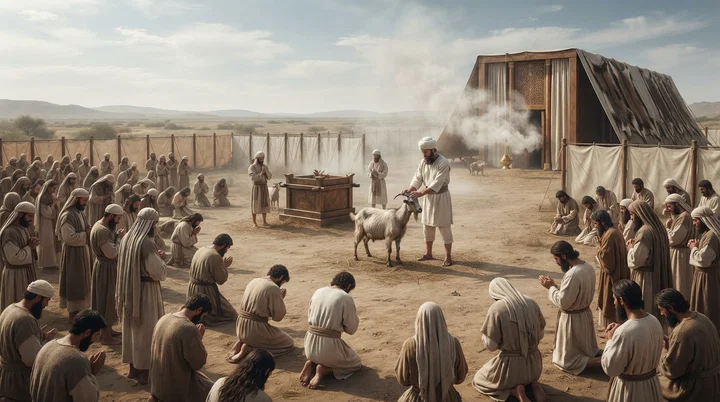
The verse belongs to the great Day of Atonement on the tenth day of the seventh Jewish month.GC88 398.4–400.1GC 399.1–4LS 116.1 On that day the high priest made atonement for Israel to cleanse them from all their sins before the Lord, removing their sins from the sanctuary, and then came out to bless the people.GC88 398.4–400.1GC 399.1–4 The sanctuary so cleansed was God's earthly dwelling-place of glory, first the movable tabernacle erected in the desert of Sinai and afterward Solomon's temple in Canaan with its holy and most holy place and its vessels.GC88 683.4–684.54SP 498.6
On that day the high priest alone entered the most holy place, after solemn preparation and in his special attire, to perform the special work of atonement that completed the yearly round of service.WLF 9.14SP 262.1–263.1SG4 9.2 While he stood before God's presence the people waited about the sanctuary in silence and fear and prayer, fearing when he stayed unusually long.SG4 9.2ST Mar 4, 1903 They were relieved when they heard his bells and saw him come out to bless them.SG4 9.2ST Mar 4, 1903
Day by day through the year sins had in figure been transferred to the sanctuary through the blood or flesh of offerings in the holy place, which acknowledged the law's authority and the sinner's guilt while pointing to pardon through a Redeemer without by itself canceling sin or fully releasing the sinner from the law's condemnation.4SP 262.1–263.1GC88 420.1 The yearly cleansing removed them with blood, for it was a cleansing from sin and not from physical impurity.4SP 262.1–263.1 The high priest brought the blood of the offering into the most holy place and sprinkled it on and before the mercy seat over the law in satisfaction of its claims, and upon the altar of incense.GC88 420.1GC 419.1–3 As mediator he then bore the sins from the sanctuary and all the iniquities and transgressions and sins of Israel were confessed over the head of the live scapegoat to be borne by him to a land not inhabited, forever separated from the people never to return to the camp, and the people were not regarded as freed from the burden of their sins until the goat had been sent away.GC88 420.1GC 419.1–3PP 355.2–4
While the atonement was going forward all Israel was required to gather about the sanctuary and every man to afflict his soul, lay aside all business, and spend the day in solemn humiliation before the Lord with prayer, fasting, and deep searching of heart.GC88 419.3RH Nov 8, 1915GC 419.1–3 The ceremony taught God's holiness and His abhorrence of sin and that no one can come in contact with sin without becoming polluted.GC88 419.3RH Nov 8, 1915GC 419.1–3 Its cleansing brought pardon and cleansing from sin and peace with Heaven, with assurance that iniquity would be remembered no more, preparing the people to rejoice and praise Him for His goodness and mercy at the Feast of Tabernacles.GC88 419.3DA 448.2PP 540.2–3
Prophetic Time and Fulfillment
Just as the types relating to the first advent were fulfilled not only as to the event but as to the time, so the types relating to the second advent must be fulfilled at the time pointed out in the symbolic service.GC 399.1–4 This day therefore points to the autumn, when Christ as great High Priest would purify the earth by the destruction of sin and sinners and bless His waiting people with immortality.GC 399.1–4 That appointed time was October 22 in the year 1844, in harmony with the termination of the 2300 days in the autumn.GC88 398.4–400.1GC 399.1–4 The cleansing of the sanctuary is the type of Christ's work as the great High Priest, and its antitypical fulfillment was expected at the time appointed by the symbolic service.GC88 398.4–400.1
The sanctuary to be cleansed is not the earth to be purified by fire at Christ's second coming, but the sanctuary in heaven.Ms 6, 1876, par. 5–6 In the ministration of the earthly tabernacle the second apartment, the holy of holies containing the ark of God's testament, was opened only upon the great day of atonement for the cleansing of the sanctuary.GC 433.1–434.1GC88 433.1 That earthly ministration served unto the example and shadow of heavenly things.GC88 433.1 Its fulfillment is the opening of the most holy place of the heavenly sanctuary in 1844, as Christ entered there to perform the closing work of the atonement.GC 433.1–434.1GC88 433.1 He is now officiating before the ark of God, pleading His blood in behalf of sinners, followed by faith by those who understand His change of ministration and behold the ark of His testament.GC 433.1–434.1GC88 433.1
What Christ accomplished on that very day was all that the Day of Atonement type would justify expecting, a cleansing priestly work rather than His coming to earth.LS 116.1 Day by day sins had in figure been transferred to the sanctuary, and the once-a-year cleansing removed them, not as removal of physical impurity, for it was accomplished with blood, and therefore was a cleansing from sin.4SP 262.1–263.1 This earthly cleansing is the pattern for the cleansing of the heavenly sanctuary at the termination of the 2300 days in 1844.4SP 262.1–263.1GC88 421.2 After the 2300 days ended, Christ entered the most holy place to cleanse the heavenly sanctuary and remove the sins recorded there.GC88 421.2
That antitypical Day of Atonement is carried out in the most holy place, where Christ, the great High Priest, blots out the sins of His faithful people by virtue of His own blood.4SP 499.3–500.1Ms 6, 1876, par. 5–6 Its cleansing work continues until the ministry of the gospel ends and probation closes.4SP 499.3–500.1 His holding back from coming then to destroy the wicked gives sinners further time in mercy to repent of their sins and prepare for His coming.Ms 6, 1876, par. 5–6
Christ's Heavenly Mediation
Christ as the great High Priest now ministers in the heavenly sanctuary, making a special atonement and cleansing for Israel to make them clean from all their sins before the Lord.ST May 17, 1883SG1 157.1EW 212.2Ms 26, 1886, par. 18–19 As on that day the people were to humble themselves and confess their sins so they could be atoned for and blotted out, so in the present antitypical Day of Atonement while cases are reviewed in the investigative judgment people must repent and confess their sins.ST May 17, 1883 He stands in the heavenly sanctuary making atonement for the sins of His people.Ms 26, 1886, par. 18–19 While completing this atoning work in the Holy of Holies He wears the high priest's attire described for that service, before laying it aside to reign as king.WLF 9.1 After completing it He will come to earth in kingly power and take the waiting faithful to Himself.EW 212.2
He presents the prayers of repentant people to the Father with His own righteousness, and their sins are pardoned.Ms 25, 1886, par. 6–7 As the people humbled themselves and confessed and the high priest interceded for them before God who granted pardon, so Christ now intercedes in the heavenly sanctuary.Ms 25, 1886, par. 6–7 As Joshua the high priest stood as representative of an imperfect, sinful, contaminated people accused by Satan as a criminal and transgressor of the law, so Christ ministers for His people and bears the sinner's place.17MR 242.1–2Ms 124, 1901, par. 18–19 All types point to Jesus Christ as Sin-bearer and Substitute, who takes away the sin of the repentant, believing transgressor and cannot Himself be accused, so that in heaven the sinner is accounted justified.17MR 242.1–2Ms 124, 1901, par. 18–19 He answers Satan's accusation and rebukes him when he points to the defilement of God's people and triumphs in their discomfiture.17MR 242.1–2Ms 124, 1901, par. 18–19 The only hope for God's people in defection of Christian character is reconversion, repentance toward God, and faith in the Lord Jesus Christ who is made unto them righteousness and sanctification.Ms 124, 1901, par. 18–19
In this fulfillment each person should humble himself before God, seek pardon for sin, and accept Christ's justifying grace and the Holy Spirit's sanctifying work, which renews the carnal nature in holiness after Christ's righteousness.ASCOP 25.2 This is the great day of atonement when holiness is of supreme importance and cleansing from all sins before the Lord is offered, calling for confession of sins and acknowledgment of God's mercy and love in pardoning transgressions, thankfulness for warnings that save from perverse ways, and witness to His goodness by a changed life.RH Sep 24, 1903 Reverses upon individuals, families, and churches are permitted to show danger and to humble hearts in repentance, for God chastens His children in hope of saving their souls.RH Sep 24, 1903 Those who heed reproof and repent with humility and contrition and confession are received again into favor with tenderness and love, spoken pardon to, and clothed with the garments of Christ's righteousness, and those who honor God by obeying His commandments are exalted by Him with strength and victory.RH Sep 24, 1903
Investigative Judgment Review
The great Day of Atonement is now going on in the sanctuary above as the solemn scenes of the Judgment that concern every individual, and this is the great day of preparation when each person's case will soon come under review before God.5T 420.35T 359.1 The work in heaven must not be lightly regarded or crowded out by business cares but kept constantly before the mind, kept before the people, and urged upon consciences with earnestness and power, for a correct view of the sanctuary gives a correct view of the importance of the work for this time.5T 420.3 That readiness to stand before God includes accountability for actions that encourage others to use stimulants and lead them toward sin.5T 359.1
While Christ the great High Priest ministers in the heavenly sanctuary, cases are reviewed in the investigative judgment, and the people must humble themselves, repent, and confess their sins so they may be atoned for and blotted out.ST May 17, 1883 The call to be cleansed from sin before the Lord joins a final day of confession before the books are opened and every person is judged, when every deed is reviewed before the heavenly universe, to be faced honestly rather than covered up, with Christ's death at Calvary as the basis for forgiveness and pardon.Ms 52, 1905, par. 10
In the type only those who had come before God with confession and repentance, and whose sins through the blood of the sin offering were transferred to the sanctuary, had part in the cleansing.GC 480.1 In like manner only the cases of the professed people of God are now considered in the great day of final atonement and investigative judgment, while the judgment of the wicked is a distinct and separate work that takes place at a later period.GC 480.1
All who would have their names retained in the book of life and pardon recorded against their names must now sorrow for sin, truly repent, afflict the soul, search the heart, and closely examine the life history in individual probation, lest they be cut off from among the people, blotted from the book, or weighed in the balances of the sanctuary and pronounced wanting.ST Nov 8, 1905GC88 490.1RH Nov 9, 1905Lt 71, 1895, par. 3621MR 385.5–386.3 This requires laying aside the garments of self-righteousness and daily humbling the soul before God, confessing individual sins, seeking pardon for transgressions, repenting and being converted that sins may be blotted out, entering the sanctuary above by faith and cooperating with Christ as Advocate and Intercessor to work out salvation with fear and trembling and to prepare the soul to reflect the divine image.Lt 71, 1895, par. 36Lt 227, 1905, par. 15–16 It requires deep, faithful searching of heart, putting away a light frivolous spirit, earnest warfare to subdue evil tendencies that strive for the mastery, cleansing of the soul temple now in this life by sincere repentance and forsaking of every sin, purifying the corrupt heart and fountain so thoughts and stream are pure, overcoming, watchfulness, strengthening what remains and holding fast what was received and heard, and entire renovation of character to become a child of God, for the Judge of all the earth is taking a record of the lives of all who claim to be Christians and each one has a soul to save or to lose.GC88 490.121MR 385.5–386.3Lt 227, 1905, par. 15–16
The work of preparation is an individual work, not in groups, where the purity and devotion of one will not offset the want of these qualities in another and no one's purity or devotion can make up for another's lack.GC88 490.1RH Nov 9, 1905 Though all nations are to pass in judgment before God, He will examine the case of each individual with as close and searching scrutiny as if there were not another being upon the earth, and everyone must be tested and found without spot or wrinkle or any such thing.GC88 490.1 Only those who by faith follow Jesus in the great work of the atonement, understand the work of the merciful High Priest in the heavenly sanctuary, know what duties are required, and behold by faith the ark of His testament receive the benefits of His mediation and receive pardon of sins and not be cut off from the congregation.4SP 270.1GC 430.2–3GC88 430.2–3 Those who reject the light and remain willingly ignorant of that ministration are not benefited, and the condition of careless and unbelieving professed Christians who are willingly ignorant of that work is the same as the condition of the unbelieving Jews.4SP 270.1GC 430.2–3
Repentance and Heart Preparation
The command to afflict the soul still binds in the few remaining days of probation, requiring sorrow for sin, true repentance, deep humiliation before the Lord, and earnest warfare to subdue evil tendencies and put away a light, frivolous spirit.GC88 490.1Ms 143, 1899, par. 5Ms 93, 1901, par. 35–37 To afflict the soul means to be sanctified through the truth by receiving Christ who is the Truth, putting on Christ and partaking of His love, tenderness and compassion through the Word applied to the soul as eternal life that makes partakers of the divine nature.Ms 143, 1899, par. 5 It means to humble self in the sight of the Lord so that He will lift up, to cleanse the hands and purify the heart, to cease striving for the highest place and thinking or speaking evil that causes heart-burning and discord, and to wage valiant warfare against every species of sin in order to be cleansed to pass through the portals of the holy city, for there will be no second trial.GC88 490.1Ms 93, 1901, par. 35–37
Sins must be confessed, repented of, and forsaken beforehand so that they may go beforehand to judgment and be atoned for and blotted out.ST May 17, 1883RH Sep 21, 1916Ms 81, 1886, par. 99MR 252.2ST Mar 25, 1913 The time demands special preparation in humility, drawing near to God, searching the heart, putting sin away and cherishing no sin, while recognizing the condition as sinners and seeking the Lord with true penitence and deep contrition.RH Sep 21, 1916Lt 35, 1885, par. 26–32Ms 81, 1886, par. 99MR 252.2ST Mar 25, 1913 Christ is able to cleanse from all unrighteousness and wash away every stain of sin, and those who confess and cling to Him may have pardon recorded against their names.Ms 81, 1886, par. 99MR 252.2
This requires deep, faithful searching of heart with close self-examination and surrender of self.GC88 490.1Ms 90, 1903, par. 15–16Ms 143, 1905, par. 22 Wrong thoughts and wrongs done must be put right through confession, reformation and repentance, with separation from the world to stand on God's side.Ms 90, 1903, par. 15–16 Each person must do the work of cleansing the mind and purifying the soul in order to stand blameless before God, confessing sins to God and to anyone wronged, for leaving this work undone brings the day of the Lord unawares.Ms 143, 1905, par. 22
Each person is to confess only his own sins and mistakes rather than occupy the mind investigating other souls.Ms 52, 1905, par. 1STB 58.39T 218.3Ms 94, 1904, par. 9–10Ms 74, 1904, par. 1–2 Whoever senses something standing between himself and God should go to God for help to make the confession necessary to take the wrong, whatever its character, out of the way, and for help not to repeat the wrong.Ms 52, 1905, par. 1 This means ceasing to accuse and find fault and speak evil against one another, laying aside all anxiety about the acknowledgements and confessions to be made by others, and loving as brethren with gentleness, courtesy and kindness.Ms 94, 1904, par. 9–10Ms 74, 1904, par. 1–2 Such personal humbling and confessing makes way for the Lord's presence and brings spiritual victory.STB 58.3Ms 74, 1904, par. 1–2
The soul must daily lay aside the garments of self-righteousness, humble itself before God, confess individual sins, seek pardon for transgressions, and cooperate with Christ as Advocate and Intercessor to prepare the soul to reflect the divine image.Lt 71, 1895, par. 36 It is to enter the sanctuary above by faith and unite with Christ in working out salvation with fear and trembling, for those who do not will be weighed in the balances of the sanctuary and pronounced wanting.Lt 71, 1895, par. 36 Every soul must by living faith rest upon the merits of the crucified and risen Saviour, pleading the atoning sacrifice of Him who gave His life on Calvary, ceasing rebellion, opening the door of the heart to the heavenly Guest, and trusting in the efficacy of His sacrifice, without which faith prayers are worthless.Lt 209, 1904, par. 15Lt 58, 1895, par. 50–54Lt 63, 1895, par. 46–50
Cleansing from defilement comes through the blood of Jesus to those who confess and cling to Him.Ms 81, 1886, par. 9Lt 53, 1886, par. 4 It purifies the corrupt heart and fountain so that thoughts are pure, requiring a living, active faith that works by love and purifies the soul, with self-control, pure holy motives, and reform.Ms 194, 1901, par. 11Lt 6, 1880, par. 55–56 This means refusing to corrupt the soul by self-indulgence through appetite, liquor, tobacco and base passions, so the mind stays clear and the brain vigorous to distinguish right from wrong.Ms 194, 1901, par. 11 To be cleansed from all sins is to meet the comprehensive requirement of God's Word to be like Him and represent in life the life and character of the holy Pattern, through the transforming power of God in the renewing of the mind by the Holy Spirit producing a new creature in harmony with the Word and with Jesus, shown by searching its pages and willingly approaching Him in prayer rather than avoiding self-examination.Lt 6, 1880, par. 55–56 If after profession one still manifests fretfulness, peevishness, faultfinding, envy, evil surmisings, jealousy, impure thoughts and every rough and uncomely trait, the character is unchanged and reveals the satanic rather than the divine, showing Satan has power over mind, affections and character.Lt 6, 1880, par. 55–56
The antitypical day is of the same great humiliation and confession character as the type and is now present.5T 520.1 As the priest had to prepare carefully and guard against contamination while sins were brought to mind, repented of and cleansed, so the atonement now taking place in heaven calls for holiness, reverence and careful preparation from those who minister in sacred things.Ms 3, 1885, par. 235MR 5.2 That present sacred work should be the constant study of God's people.5T 520.1
Those who repent and confess their sins are recognized as worthy of God's protection and receive His seal, while those who persist in sin are passed by.SLP 24.1 Cleansing requires humbling the heart before God, heeding His counsel, examining the heart, ceasing murmuring and strife, learning from Israel's unbelief and impenitence, and repenting at once as the only hope of salvation.Lt 101, 1904, par. 23–26 Delay is perilous, and persisting in self-complacency, standing in one's own light, and resisting the Spirit leaves the soul to destruction without remedy.Lt 101, 1904, par. 23–26
Present Life and Mission
The church is now living in the great antitypical Day of Atonement, the solemn time and day of grace appointed for confessing sins, repenting, and being cleansed from all sins before the Lord.Lt 259, 1903, par. 18–20Lt 101, 1904, par. 23–26Ms 55, 1911, par. 22 Everything in salvation centers in the sanctuary where that cleansing work goes forward, and everyone must get ready.Ms 55, 1911, par. 22Ms 160, 1907, par. 7 That readiness can coexist with joy and pleasure in Christ, as each person is urged to find Him now.Ms 160, 1907, par. 7
Its call to cleansing is a personal work to humble the heart before God, seek Him, and confess one's own sins rather than another's, shown in a Spirit-filled, born-again life.9T 218.3Lt 9, 1905, par. 13 The present condition fitting the occasion requires confessing mistakes and errors, using all talents in harmony with the plan of Jesus Christ as co-workers with God, and following the life of Christ as the only safe pattern, and only those who do this are entitled to the name Christian.Lt 9, 1905, par. 13 The church is to begin purification through repentance, humility, and deep heart-searching, with its members resisting evil, forsaking iniquity, and keeping God's law.Lt 55, 1886, par. 9–10
Its lesson is to remove wrongs between believers rather than allow them to remain, and to examine oneself in readiness to meet God's standard.Ms 187, 1905, par. 31 This means ceasing to accuse and find fault and speak evil against one another, confessing only one's own sins in meekness and humility, and loving as brethren with gentleness, courtesy, and kindness.Ms 94, 1904, par. 9–10 Repentance and conversion blot out sins and cleanse hearts from all jealousy and evil surmising, making pure, unselfish workers sanctified through the truth, given the quietude and simplicity of a little child, unified in trust and confidence so the work of God can advance and others can be helped, blessed, and converted.Ms 94, 1904, par. 9–10
The present sacred work in the heavenly sanctuary for the people of God is of the same humiliation and confession character as the typical day, and it should be the constant study of God's people.5T 520.1 It is to be taught to children and to others by precept and example, teaching them to humble their hearts before God, confess sins, and know God and Jesus Christ.5T 520.1CE 156.1–157.1 Those who teach this truth must give the trumpet a certain sound, leading people away from worldly customs and practices up higher to spirituality, piety, and earnest work for God in proclaiming the message of the third angel.5T 520.1
A correct view of the sanctuary gives correct views of the importance of the work for this time, for the great day of preparation and solemn scenes of the Judgment concerning every individual is now going on in the sanctuary above.5T 420.3 That heavenly work must not be lightly regarded or crowded out by business cares but kept constantly before the minds of those employed in institutions, kept before the people, and urged upon their consciences with earnestness and power.5T 420.3 Proper appreciation of it leads workers in publishing houses to manifest greater energy and zeal to make the work a success, keeping none careless and blinded to the wants of the cause and the perils that attend every soul, but making each a channel of light.5T 420.3
Readiness to stand when each person's case will soon come under review includes accountability for actions that encourage others to use stimulants and lead them toward sin.5T 359.1 It is duty now to confess sins and acknowledge God's mercy and love in pardoning transgressions, to thank the Lord for warnings given to save from perverse ways, and to witness to His goodness by a change in life.RH Sep 24, 1903Ms 34, 1900, par. 35 Reverses upon individuals, families, and churches are permitted to show danger and to humble hearts in repentance, for God chastens His children in hope of saving their souls, and those who heed reproof and repent with humility and contrition and confession are received again into favor with tenderness and love, spoken pardon to, and clothed with the garments of Christ's righteousness, while those who honor God by obeying His commandments are exalted by Him with strength and victory.RH Sep 24, 1903
The pattern calls seekers to recognize weakness, turn from sin, confess sins, and be purified from every moral defilement.STMW10 7.4–8.1 As Israel sought the Lord as little children, so men handling sacred responsibilities must follow that same pattern in a conversion represented by a new birth, coming with a sense of weakness to be heard and answered.Lt 5, 1897, par. 20–21 That coming strips away self, self-righteousness, Pharisaism and hardness of heart, with self dead and the life of Christ revealed by faith in the Son of God.Lt 5, 1897, par. 20–21
It is too late in the day for disputation and contention, for murmuring and strife and standing in one's own light.15MR 21.4Lt 101, 1904, par. 23–26 All must arouse from spiritual sleep, learn from Israel's unbelief and impenitence, afflict the soul, confess sins, humble the heart before God, repent at once as the only hope of salvation, and get ready for the great conflict and Christ's coming.12MR 320.315MR 21.4Lt 101, 1904, par. 23–26 Delay is perilous, and persisting in self-complacency and resisting the Spirit leaves the soul to destruction without remedy, with purification before God carrying eternal consequences.12MR 320.3Lt 101, 1904, par. 23–26
Abundant grace is provided for all who feel their need, as each person humbles the heart before God and freely confesses his own sins, laying aside all anxiety about the acknowledgements and confessions to be made by others.Ms 74, 1904, par. 1–2 When this humbling and confessing is done the Lord comes in and great victories are gained, cleansing hearts from jealousy and evil surmising in preparation for Christ's coming.Lt 271, 1904, par. 20–22Ms 74, 1904, par. 1–2 The churches are thus to humble themselves, with each person confessing and putting away sin, which defiles character and separates from God, so sins are atoned for and cleansed.Lt 271, 1904, par. 20–22Lt 125, 1886, par. 7
Sources
Pioneers and periodicals
256 sources
On that day, the tenth day of the seventh month, the priest makes atonement to cleanse the people so they may be clean from all their sins before the LORD.ST Nov 20, 1879ST Jun 4, 1885RH Oct 3, 1912RH Dec 15, 1868 The cleansing is twofold, both of the sanctuary from the record of sin and of the people from sin itself, accomplished by the blood of the slain goat carried within the veil and sprinkled upon and before the mercy-seat, and completed when the confessed sins are laid upon the live goat and borne into the wilderness forever.ST Nov 20, 1879ST Jul 4, 1911ST Aug 15, 1878RH Nov 17, 1863ST Sep 26, 1911 As the earthly high priest cleansed the earthly sanctuary in figure, so Christ as great High Priest cleanses the true heavenly sanctuary in fact with His own blood, a work begun at the close of the 2300 days in 1844 when He entered the most holy place.RH Oct 3, 1912RH Apr 6, 1869RH Dec 15, 1868CO 91.1 That cleansing is the investigative judgment, in which records are examined and confessed sins are blotted out forever while the unrepentant are left with their sins, to be finished before the second coming.ST Apr 20, 1904ST Apr 3, 1879RH Oct 3, 1912RH Jun 11, 1857 While the atonement is in progress the people must afflict their souls with fasting, confession, humility and prayer and do no work, for only confessed sins are put away and whoever will not humble himself is cut off.RH Dec 29, 1904ST Mar 23, 1904RH Oct 24, 1885
Day and Sanctuary Setting
The cleansing belongs to the Day of Atonement on the tenth day of the seventh month, Tisri, ten days after the Feast of Trumpets and five days before Tabernacles.ST Nov 20, 1879RH Nov 17, 1863RH Mar 8, 1870RH Feb 3, 1853 It was kept once a year as the annual last and culminating day of the religious year, the one commanded fast day and a ceremonial sabbath of rest on which no work was done regardless of the weekday, with fasting and prayer, examination of heart, and holy convocation.ST Jun 4, 1885ST Apr 20, 1904RH Dec 29, 1904 On that day the high priest took two goats and cast lots with one for the Lord and one for Azazel, slew the Lord's goat, carried its blood into the most holy place to sprinkle upon the mercy-seat to make atonement for the people and to cleanse the sanctuary by removing the sins of the people of God, then laid both hands on the Azazel goat, confessed over him all the transgressions of Israel in all their sins, put them upon his head, and sent him by a fit man into the wilderness to bear all iniquities unto a land not inhabited.ST Nov 20, 1879ST Jun 4, 1885RH Dec 29, 1904RH Nov 17, 1863 The work completed what was partly done in the first apartment through the year, where repentant sins were transferred to the sanctuary through the blood of sin-offerings, and by this second-apartment work the sanctuary was cleansed and the sins of the people of God were blotted out as the example and shadow of heavenly things, representing the day of judgment and pointing to the final destruction of Satan.ST Nov 20, 1879ST Apr 20, 1904RH Dec 29, 1904RH Nov 17, 1863
Through the year ministration continued in the first apartment, the holy place, but on that day it was transferred to the second apartment, the most holy place containing the ark.RH Feb 2, 1911ST Nov 20, 1879RH Mar 8, 1870RH Feb 3, 1853ST Apr 26, 1883 That inner apartment was entered by the high priest alone only once a year on pain of death, solemnly opened for that day and then closed again, with ordinary offerings at the door suspended and attention fixed on the atonement.RH Feb 2, 1911ST Nov 20, 1879RH Feb 3, 1853ST Apr 26, 1883 The yearly closing work was performed by the high priest alone with blood, first with the blood of a bullock for himself and then with the blood of the Lord's goat for the people, to make atonement for the children of Israel for all their sins and to cleanse the holy sanctuary.RH Feb 2, 1911ST Nov 20, 1879RH Mar 8, 1870RH Feb 3, 1853 Through the year the sins of the people had been transferred from themselves to the victims by laying on of hands and through the blood of the sacrifices transferred to and sprinkled upon the sanctuary itself, and on this day that accumulated uncleanness was removed by blood so the people were made clean from all their sins before the Lord and the two holy places were cleansed.ST Nov 20, 1879RH Feb 3, 1853ST Apr 26, 1883 This earthly daily and yearly ministration was the example and shadow of the more excellent ministry in the true tabernacle, representing the final work before the ark in heaven when sins will be blotted out, in which each individual case is tried by the law in the ark and every wrong must be made right and every sin put away.RH Feb 3, 1853ST Apr 26, 1883
The same day's work applied not only to the people but to the sanctuary, tabernacle, altar of incense, priests, all the congregation, sacred vessels and both apartments.ST Feb 11, 1886ST Sep 11, 1884ST Dec 15, 1881ST Nov 19, 1894RH Aug 18, 1863 Its one-day service in the most holy place followed 364 days of ministry in the first apartment and completed that year's round before the cycle began again, when the high priest had reconciled the holy place, tabernacle, and altar and the live goat carried Israel's iniquities away into the wilderness so the sins would no longer be remembered against the people.ST Jun 4, 1885ST Dec 15, 1881ST Nov 19, 1894RH Aug 18, 1863RH Feb 18, 1858 Israel's sins, transferred in figure to the sanctuary through the daily sacrifices, had defiled its holy places, and the atonement cleansed and hallowed the sacred apartments and altar from that uncleanness by blood from calves and goats.ST Sep 11, 1884ST Dec 15, 1881ST Nov 19, 1894RH Aug 18, 1863RH Feb 18, 1858 These cleansed earthly objects were patterns of heavenly things, and the earthly sanctuary was a figure of the true sanctuary in heaven, with its two departments and altar cleansed with blood.RH Aug 18, 1863RH Feb 18, 1858ST Jun 10, 1880 The rest commanded is a ceremonial sabbath distinct from the weekly creation Sabbath of the Ten Commandments, a shadow pointing forward to things to come and not a memorial sign of creative power pointing back to the past, among the sabbaths that were to cease.RH Oct 14, 1915 Forever in such laws is limited by the continuance of the thing to which it applies and does not necessarily mean endless duration.
The instruction belongs to the laws of approach to a holy God by a sinful yet chosen people, the duties of priests, Levites and people in offerings and sacrifices, and the first covenant's worldly sanctuary and ministration of death with its two apartments, altar and veils as patterns of heavenly things.RH Aug 18, 1863RH Feb 3, 1916RH Feb 18, 1858ST Aug 18, 1881ST Jun 10, 1880 It is a new institution from Abraham's time onward with plainly revealed time, rites and purpose, given upon entrance into the land promised 430 years before, requiring exact obedience, and is important to be read carefully rather than lightly passed over as an ancient rite, with absence of a recorded observance not proving it was never observed.RH Aug 18, 1863RH Feb 3, 1916RH Feb 18, 1858ST Jun 19, 1907 Each of the sanctuary holy places was entered through a veil, giving the earthly pattern for the heavenly holy places, and the chapter describes the main features of the sanctuary service.ST Aug 18, 1881ST Jun 19, 1907ST Jun 10, 1880 The high priest entered the inner dwelling of visible glory before the bright Shekinah above the mercy-seat only after careful solemn preparation with trembling, where God conversed with him, while the people waited outside in solemn silence in prayer with hearts uplifted in earnest prayer for the divine blessing.ST Mar 21, 1911ST Jun 24, 1880ST Mar 4, 1903 If he remained an unusual time the people were terrified, fearing that because of their sins or some sin of the priest the glory of the Lord had slain him, and when the sound of the bells upon his garments was heard they were greatly relieved, and he came forth and blessed the people.ST Mar 21, 1911ST Jun 24, 1880ST Mar 4, 1903
Ritual of Atonement
The ritual began with a bullock offered for the priest and his house, that the high priest himself might stand free and sinless before God before he stood for the people.ST Nov 29, 1905ST Apr 8, 1913RH Oct 31, 1854ST Oct 25, 1905ST Jan 17, 1884 Two goats were then taken from the whole congregation and set alive before the Lord at the door of the tent of meeting, and lots were cast upon them, one lot for the LORD and one lot for Azazel.ST Nov 29, 1905ST Oct 25, 1905ST Jan 17, 1884 For this service the high priest laid aside his splendid dress and put on the plainest and humblest dress, publicly acknowledging his own sinfulness and infirmity, showing himself high priest only in a typical sense and not in reality.ST Jan 17, 1884RH Jan 11, 1870 That first atonement for himself has no counterpart in Christ, who was separate from sinners and needed no offering for himself.ST Jan 17, 1884RH Jan 11, 1870
The goat on which the Lord's lot fell was slain as a sin-offering for the people, and its blood with the bullock's blood was carried with incense within the veil into the most holy place.ST Nov 20, 1879ST Jul 4, 1911ST May 27, 1897RH Oct 31, 1854 The high priest sprinkled it with his finger upon the mercy-seat and before the mercy-seat seven times, and also upon the altar of incense, making atonement both for the people and for the sanctuary and altar.ST Jul 4, 1911ST May 27, 1897ST Sep 6, 1910 This sprinkling was done directly over the broken Ten Commandments in the ark beneath the mercy-seat, indicating complete satisfaction and thorough and complete forgiveness for every repentant sinner.ST May 27, 1897ST Sep 6, 1910 The sacrifices stood in place of the forfeited lives of priest and people whose sins incurred death, the victim's death accepted as substitute and its blood making atonement.RH Oct 31, 1854
When the reconciling of the holy place, tabernacle and altar was finished, the high priest came out to the live goat.ST Nov 20, 1879ST Jun 4, 1885RH Nov 17, 1863 He laid both hands upon its head and confessed over him all the iniquities, transgressions, sins and uncleannesses of Israel, putting them upon his head.ST Nov 20, 1879ST Sep 26, 1911RH Mar 24, 1863ST Mar 23, 1904 He then sent him by a fit appointed man into the wilderness, into an uninhabited, barren, separated land of forgetfulness and oblivion, to bear all their iniquities away from the camp and disappear forever and not return.ST Nov 20, 1879ST Sep 26, 1911ST Mar 23, 1904ST Apr 3, 1879ST May 27, 1897 Once so separated, the penitent were left free from sin and rejoiced before the Lord.ST Mar 23, 1904
Through the year repentant sins had been transferred from the sinner to the victim by laying on of hands with confession, and by sacrificial blood sprinkled before the veil or by the priest eating the flesh in the holy place, thus bearing them in figure into the sanctuary and defiling it.ST Nov 20, 1879ST Jul 4, 1911ST Aug 15, 1878ST Apr 3, 1879 The Day of Atonement reversed that process and bore them out, completing what was partly done in the first apartment and ending the yearly service for sin.ST Nov 20, 1879ST Jul 4, 1911RH Dec 24, 1908 The accumulated record brought in figure to the sanctuary during the year was removed from it by blood, borne out by the high priest, confessed over the live goat and carried into the wilderness, so that sanctuary and people were cleansed and sins blotted out before God.ST Aug 15, 1878ST Apr 3, 1879RH Dec 24, 1908 This decisive work closed the yearly round, providing final removal of sins confessed during the year just ended.ST Apr 3, 1879RH Dec 24, 1908
Contact with the scapegoat defiled, so the man who led it into the wilderness and Aaron himself had to wash and be purified before returning.RH Mar 24, 1863 The fate of the scapegoat shows the final condition of those who die in sin after propitiation has been made for them, while the congregation that puts away the evil of its doings lives a righteous and godly holy life, having been redeemed by the blood of atonement.RH Mar 24, 1863
The two goats have two different meanings and the cleansing is made by the two together.ST Sep 26, 1911RH Mar 24, 1863 The goat for Jehovah represents Christ, who saves from sin, and its slaying and blood cleanse the sanctuary from the sins and uncleannesses of Israel.ST Sep 26, 1911RH Mar 24, 1863 The goat for Azazel, meaning the strong one who revolted, represents Satan, the type of evil and of the Evil One who led God's people into sin, upon whose head the sins due to him are laid to bear them away.ST Sep 26, 1911RH Mar 24, 1863ST Nov 29, 1905ST Jul 9, 1894RH May 9, 1871 The scapegoat does not represent Christ.ST Sep 26, 1911ST Nov 29, 1905
Meaning of Cleansing
On that day the priest makes atonement to cleanse the people so they may be clean from all sins before the Lord, bringing both forgiveness of iniquity and cleansing from sin, covering especially sins of ignorance through the year, with the high priest's work in the most holy place concerning the people's sins as well as the sanctuary and the blood offered there representing mercy for the whole people.RH Oct 3, 1912RH Dec 15, 1868RH Feb 26, 1867RH May 11, 1869 The yearly work took place after daily ministry in the holy place when the high priest entered the most holy place where glory was above the ark, and this service foreshadows the work of the great High Priest in the sanctuary above in an investigative judgment in which records are examined, sin removed, and sins of the righteous ultimately laid upon Satan their originator.RH Oct 3, 1912RH Dec 8, 1915RH May 11, 1869 That heavenly cleansing is the closing of mediatorial work and finishing of the mystery of God, while individual cases may still be dealt with while blood continues to avail.RH Dec 15, 1868RH Feb 26, 1867
Atonement means covering, expiating, purging, pardoning sin and making satisfaction for it, and making atonement and cleansing the sanctuary mean precisely the same thing, done when the high priest sprinkles blood upon the mercy-seat and the altar to cleanse them from the people's sins.RH Aug 22, 1854RH Dec 1, 1863RH Jun 2, 1874ST Feb 7, 1884 Atonement does not change God's disposition but the sinner is changed through reconciliation, with confession and forsaking bringing forgiveness, covering and blotting out for those reconciled and none for those remaining opposed, as the final work of priesthood set apart to the tenth day of the seventh month establishing a definite appointed time when judgment sits.RH Dec 1, 1863ST Feb 7, 1884ST Mar 29, 1883 The slaying of the offering did not make atonement but was preparatory to it, for after the offering was slain the priest took blood into the sanctuary and made atonement there, the blood atoning and cleansing but the priest presenting it before God making the atonement that fixes salvation certain so all for whom it is thus made will be saved.ST Mar 29, 1883ST Mar 10, 1898
The verse teaches a twofold cleansing accomplished by the one offering of the slain goat's blood before the live goat was brought: both the sanctuary from the record of sin and the people from sin itself, so they are clean from all sins before the Lord and reconciled, at one with Him.ST Jul 4, 1911ST Aug 15, 1878ST Sep 6, 1910ST Dec 12, 1916 Daily ministration bore sins into the sanctuary and the Day of Atonement reverses that process by bearing them out, with principal work in the second apartment where the high priest slays the goat on which the Lord's lot fell as sin-offering and bears its blood within the veil to sprinkle with his finger upon the mercy-seat and before it seven times.ST Jul 4, 1911 That sevenfold sprinkling on the mercy-seat over the broken Ten Commandments indicates complete satisfaction and thorough forgiveness for every repentant sinner, a final balancing of accounts and final disposition of the yearly record made through sacrificial blood, first for priests with a bullock then for the people with a goat.ST Sep 6, 1910 One goat for Jehovah represents Christ who saves from sin and is slain with its blood cleansing the sanctuary, while the other for Azazel meaning the strong one who revolted represents Satan who led God's people into sin and does not represent Christ, bearing sins due to him away into a land of forgetfulness to be fulfilled at the beginning of the thousand years.ST Sep 26, 1911
The cleansing is not of physical dirt, ordinary impurity, wear or material uncleanness of its own, for priests washed to keep even dust out and only priests entered, yet sins were represented even in the most holy place where the high priest entered once a year.RH Jan 1851RH Dec 1, 1863RH Jun 2, 1874RH Aug 10, 1876RH Feb 15, 1870 It is removal of the people's imputed moral sins brought there by their representative priest from God's presence and throne of judgment to restore harmony with His purity, the sanctuary defiled by sins though the people never contact it because the high priest bears their judgment and sins there as pattern for Christ bearing sins as representative in heaven.RH Dec 1, 1863RH Jun 2, 1874RH Sep 21, 1905 Those who had confessed were freed from effect and brought into harmony with God while those who had not confessed retained sins and remained separate, and the heavenly sanctuary must be cleansed in the same way by removal of sins transferred there by those seeking pardon through Jesus to be borne away forever.RH Sep 21, 1905RH Aug 10, 1876
Atonement and cleansing are accomplished by blood as substitute for forfeited lives of the guilty who deserved death, because life is in the blood and shedding blood and laying down life are the same atoning act, without shedding of blood no remission.ST May 27, 1897RH Oct 31, 1854ST Mar 25, 1889 The blood offered represents life given to meet the law's demand beneath the mercy-seat, showing disobedience forfeited eternal life and salvation depended on the promised Redeemer, with sprinkling upon and before the mercy-seat seven times directly over the broken law making full satisfaction so with demands met the law released hold on sins in the sanctuary and on sinners.ST Jul 4, 1911ST May 1, 1879ST Apr 1, 1886 For 359 days sins were transferred in when the penitent confessed over the offering and took its life acknowledging just desert of death with blood sprinkled before the veil concealing the ark of the violated law demanding death, then on the Day service changed to remove sins from the sanctuary out of the camp, and since the crucifixion and rending of the veil earthly sacrifices are of no service.ST May 27, 1897ST Mar 25, 1889
The blood of bulls, goats and calves pictured justice and deserved death but could not actually take away a single sin in reality; it only reminded of sin and hallowed in figure as shadow, gospel ordinance and compact prophecy expressing faith in the Redeemer to come, differing from Christ's offering in efficacy not purpose, while Christ's perfect sacrifice and promised blood cleanses from all sin in fact.ST Mar 25, 1889ST Jan 21, 1886ST Feb 7, 1884ST Feb 17, 1890ST Apr 15, 1886 The law beneath the mercy-seat made atonement necessary because broken, the earthly rites only shadow, and Christ's death the real atonement for transgression, with pardon under the old covenant real only in virtue of the promised offering under the new covenant helping faith realize sinfulness and certainty of penalty that wages of sin is death.ST Mar 25, 1889RH Mar 4, 1862ST Apr 1, 1886 The sins were symbolically placed on the substitute whose body was burned, but only Christ the Lamb removes sin through His own sacrifice.ST Apr 15, 1886
Making atonement is the priest's distinct work with the blood, separate in order from laying hand on the offering and killing it done by sinner or elders; the slaying came before and was preparatory and was not itself the final priestly work, which is made by the priest presenting blood before God after the offering was slain.RH Nov 24, 1874ST Jun 4, 1874RH Jul 6, 1869ST Feb 21, 1878ST Mar 29, 1883 The Levitical priesthood foreshadowed Christ's ministry in heaven, where the cross was not that atonement but only offering of sacrifice, and Christ slain near the end of the week did not complete atonement on resurrection day nor properly begin priestly work until after ascending.RH Nov 24, 1874ST Jun 4, 1874RH Jul 6, 1869ST Jan 28, 1875 That atonement to cleanse from sins is the very last portion of His work as priest and only mediator with His own blood in the sanctuary.RH Nov 24, 1874ST Feb 21, 1878
The cleansing removes sin by transfer to another bearer and does not destroy it or make sin cease to exist, since after atonement fully made and sanctuary cleansed the people's sins transferred through the priest into the sanctuary are removed and put upon the head of the live scapegoat typifying something future after the heavenly sanctuary is cleansed.RH Aug 30, 1864 The sending away to a land not inhabited to remain there proves pardon relative not absolute extinction, God not setting aside law or justice, with further appointed action concerning sin remaining, applying only to penitent who afflicted souls and accepted while impenitent continuing to transgress bear own sins on own heads.RH Aug 30, 1864
The people's penitence, humility, fasting and affliction of soul did not itself make atonement or remove guilt; it related them to God so the priest's blood-mediated work could avail for them, whose efficacy rested on blood offered in the sanctuary, so contrition, abstaining from food or penance does not remit sin.ST Nov 27, 1884ST Oct 18, 1883
The yearly service when sins were reviewed and figuratively removed was complete only for that year, with annual remembrance of sins, closing the cycle and bringing it to conclusion on the tenth day of the seventh month.ST Nov 26, 1894RH Jul 7, 1853RH Sep 16, 1852 Atonement, cleansing and removal are related aspects of bringing people into favor with God by means of blood, distinct from earlier daily forgiveness, for after sins forgiven through daily ministry in the Holy the high priest entered the Holy of Holies to cleanse nationally not merely individually and blot out, and application of blood was for cleansing not only for dedication.ST Nov 20, 1884RH Sep 16, 1852RH Sep 16, 1852
The earthly sanctuary service with sacrifices was object lesson and type of Christ's work as High Priest in the heavenly sanctuary God pitched, ministering reconciliation by His own sacrifice; each detail has fuller meaning in Jesus, all sacrifices from Abel pointed to Him for remission, and understanding types is necessary to understand how He fulfills Moses and the prophets.ST Oct 25, 1905RH Oct 30, 1855ST Feb 7, 1911ST Feb 17, 1898 That service was first performed in Moses' tabernacle and afterward in Solomon's temple of the first covenant, closing the yearly round after daily ministration in the first apartment with the high priest alone entering the second with the ark to put away sin, typically cleansing by blood of the sacrificial goat as sinner's substitute with confessed sins carried out on the scapegoat to the wilderness, carrying out the gospel plan to take away sins of penitent and condemn the wicked as final judgment work to which the 2300 days reach.ST Oct 21, 1880ST Feb 17, 1898 Christ's blood remains effective for believers while this work is accomplished, and its lessons mean everything to the generation living today.ST Oct 25, 1905RH Oct 30, 1855
Christ's heavenly ministry fulfills earthly priests and offerings but corresponds to sanctuary services throughout the year as well as to the Day of Atonement and is not limited to that day's service; unlike repeated yearly service Christ completes each part once for all because He ever lives and is not repeated, the recurring shadow teaching about His work.RH Mar 10, 1874ST Oct 22, 1874RH Nov 25, 1909
The cleansing was performed within the tabernacle, not in the court, even though holy places were sacred where the Lord dwelt, with atonement, reconciliation and cleansing describing the same blood work as type of new-covenant cleansing.RHRH Sep 30, 1852 The high priest entered the holiest within the veil alone once a year on the tenth day to cleanse, never sitting upon the mercy-seat covering the ark overshadowed by cherubims of glory, typifying Jesus entering the holiest of the true tabernacle at the end of the 2300 days prepared for by shutting the holy-place door.RH
The cleansing of the sanctuary and freeing of the people before God gives the temple service a new meaning by showing the relation between the law and the gospel.ST Oct 24, 1900
Sources